Simple PPDB: A Paraphrase Database for Simplification
Ellie Pavlick
University of Pennsylvania
Chris Callison-Burch
University of Pennsylvania
Abstract
We release the Simple Paraphrase Database, a subset of of the Paraphrase Database (PPDB) adapted for the task of text simplification. We train a super-vised model to associate simplification scores with each phrase pair, producing rankings competitive with state-of-the-art lexical simplification models. Our new simplification database contains 4.5 million paraphrase rules, making it the largest available resource for lexical simplification.
1 Motivation
Language is complex, and the process of reading and understanding language is difficult for many groups of people. The goal of text simplification is to rewrite text in order to make it easier to un-derstand, for example, by children (De Belder and Moens, 2010), language learners (Petersen and Ostendorf, 2007), people with disabilities (Rello et al., 2013; Evans et al., 2014), and even by machines (Siddharthan et al., 2004). Automatic text simplification (Napoles and Dredze, 2010; Wubben et al., 2012; Xu et al., 2016) has the po-tential to dramatically increase access to informa-tion by making written documents available at all reading levels.
Full text simplification involves many steps, including grammatical restructuring and summa-rization (Feng, 2008). One of the most basic subtasks is lexical simplification (Specia et al., 2012)– replacing complicated words and phrases with simpler paraphrases. While there is active re-search in the area of lexical simplification (Coster and Kauchak, 2011a; Glavaˇs and ˇStajner, 2015; Paetzold, 2015), existing models have been by-and-large limited to single words. Often,
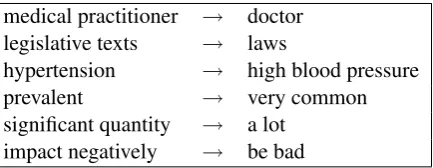
how-medical practitioner → doctor legislative texts → laws
hypertension → high blood pressure
prevalent → very common
[image:1.595.312.529.221.305.2]significant quantity → a lot impact negatively → be bad
Table 1: In lexical simplification, it is often necessary to re-place single words with phrases or phrases with single words. The above are examples of such lexical simplifications cap-tured by the Simple PPDB resource.
ever, it is preferable, or even necessary to para-phrase a single complex word with multiple sim-pler words, or to paraphrase multiple words with a single word. For example, it is difficult to imagine a simple, single-word paraphrase ofhypertension, but the three-word phrasehigh blood pressureis a very good simplification (Table 1). Such phrasal simplifications are overlooked by current lexical simplification models, and thus are often unavail-able to the end-to-end text simplification systems that require them.
Recent research in data-driven paraphrasing has produced enormous resources containing millions of meaning-equivalent phrases (Ganitkevitch et al., 2013). Such resources capture a wide range of language variation, including the types of lexical and phrasal simplifications just described. In this work, we apply state-of-the-art machine learned models for lexical simplification in order to iden-tify phrase pairs from the Paraphrase Database (PPDB) applicable to the task of text simplifica-tion. We introduce Simple PPDB,1a subset of the
Paraphrase Database containing 4.5 million sim-plifying paraphrase rules. The large scale of Sim-ple PPDB will support research into increasingly advanced methods for text simplification.
1http://www.seas.upenn.edu/˜nlp/ resources/simple-ppdb.tgz
2 Identifying Simplification Rules 2.1 Paraphrase Rules
The Paraphrase Database (PPDB) is currently the largest available collection of paraphrases. Each paraphrase rule in the database has an automatically-assigned quality score between 1 and 5 (Pavlick et al., 2015). In this work, we use the PPDB-TLDR2dataset, which contains 14
mil-lion high-scoring lexical and phrasal paraphrases, and is intended to give a generally good tradeoff between precision and recall. To preprocess the data, we lemmatize all of the phrases, and remove rules which differ only by morphology, punctu-ation, or stop words, or which involve phrases longer than 3 words. The resulting list contains 7.5 million paraphrase rules covering 625K unique lemmatized words and phrases.
2.2 Lexical Simplification Model
Our goal is to build a model which can accurately identify paraphrase rules that both 1) simplify the input phrase and 2) preserve its meaning. That is, we want to avoid a model which favors “sim-ple” words (e.g.the,and) even when they capture none of the meaning of the input phrase. We there-fore train our model to make a three-way distinc-tion between rules which simplify the input, rules which make the input less simple, and rules which generate bad paraphrases.
Data. We collect our training data in two phases. First, we sample 1,000 phrases from the vocab-ulary of the PPDB. We limit ourselves to words which also appear at least once in the Newsela corpus for text simplifcation (Xu et al., 2015), in order to ensure that we focus our model on the types of words for which the final resource is most likely to be applied. For each of these 1,000 words/phrases, we sample up to 10 candidate phrases from PPDB, stratified evenly across para-phrase quality scores. We ask workers on Ama-zon Mechanical Turk to rate each of the chosen paraphrase rules on a scale from 1 to 5 to indi-cate how well the paraphrase preserves the meing of the original phrase. We use the same an-notation design used in Pavlick et al. (2015). We have 5 workers judge each pair, omitting workers who do not provide correct answers on the em-bedded gold-standard pairs which we draw from WordNet. For 62% of the paraphrase rules we had
2http://paraphrase.org/#/download
scored, the average human rating falls below 3, in-dicating that the meaning of the paraphrase differs substantially from that of the input. We assign all of these rules to the “bad paraphrase” class.
We take the remaining 3,758 meaning-preserving paraphrase rules (scored ≥3 in the above annotation task) and feed them into a second annotation task, in which we identify rules that simplify the input. We use the same annotation interface as in Pavlick and Nenkova (2015), which asks workers to choose which of the two phrases is simpler, or to indicate that there is no difference in complexity. We collect 7 judgements per pair and take the majority label, discarding pairs for which the majority opinion was that there was no difference. We include each rule in our training data twice, once as an instance of a “simplifying” rule, and once in the reverse direction as an instance of a “complicating” rule.
In the end, our training dataset contains 11,829 pairs, with the majority class being “bad para-phrase” (47%), and the remaining split evenly between “simplifying” and “complicating” para-phrase rules (26% each).
Features. We use a variety of features that have been shown in prior work to give good signal about phrases’ relative complexity. The fea-tures we include are as follows: phrase length in words and in characters, frequency according to the Google NGram corpus (Brants and Franz, 2006), number of syllables, the relative frequency of usage in Simple Wikipedia compared to normal Wikipedia (Pavlick and Nenkova, 2015), charac-ter unigrams and bigrams, POS tags, and the aver-aged Word2Vec word embeddings for the words in the phrase (Mikolov et al., 2013). For each phrase pairhe1, e2i, for each featuref, we includef(e1), f(e2)andf(e1)−f(e2).3 We also include the
co-sine similarity of the averaged word embeddings and the PPDB paraphrase quality score as features. We train a multi-class logistic regression model4to predict if the application of a paraphrase
rule will result in 1) simpler output, 2) more com-plex output, or 3) non-sense output.
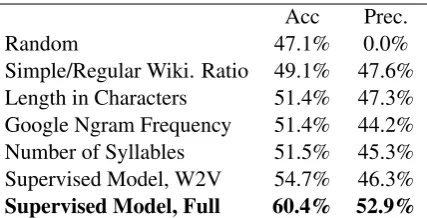
Performance. Table 2 shows the performance of the model on cross-validation, compared to several baselines. The full model achieves 60% accuracy,
3We do not compute the difference f(e
1)−f(e2) for sparse features, i.e. character ngrams and POS tags.
Acc Prec.
Random 47.1% 0.0%
Simple/Regular Wiki. Ratio 49.1% 47.6%
Length in Characters 51.4% 47.3%
Google Ngram Frequency 51.4% 44.2%
Number of Syllables 51.5% 45.3%
Supervised Model, W2V 54.7% 46.3%
[image:3.595.76.290.61.170.2]Supervised Model, Full 60.4% 52.9%
Table 2: Accuracy on 10-fold cross-validation, and precision for identifying simplifying rules. Folds are constructed so that train and test vocabularies are disjoint.
5 points higher than the strongest baseline, a su-pervised model which uses only word embeddings as features.
2.3 Simple PPDB
We run the trained model described above over all 7.5 million paraphrase rules. From the pre-dictions, we construct Simple PPDB: a list of 4.5 million simplifying paraphrase rules. A rule in Simple PPDB is represented as a triple, consist-ing of a syntactic category, and input phrase, and a simplified output phrase. Each rule is associated with both a paraphrase quality score from 1 to 5 (taken from PPDB 2.0), and simplification fidence score from 0 to 1.0 (our classifier’s con-fidence in the prediction that the rule belongs to the “simplifying” class). Note that ranking via the confidence scores of a classification model has not, to our knowledge, been explored in previous work on lexical simplification. The remainder of this paper evaluates the quality of the simplifica-tion ranking. For an evaluasimplifica-tion of the paraphrase quality ranking, see Pavlick et al. (2015). Table 3 shows examples of some of the top ranked para-phrases according to Simple PPDB’s simplifica-tion score for several input phrases.
3 Evaluation
To evaluate Simple PPDB, we apply it in a set-ting intended to emulate the way it is likely to be used in practice. We use the Newsela Simplifica-tion Dataset (Xu et al., 2015), a corpus of manu-ally simplified news articles. This corpus is cur-rently the cleanest available simplification dataset and is likely to be used to train and/or evaluate the simplification systems that we envision benefitting most from Simple PPDB.
We draw a sample of 100 unique word types (“targets”) from the corpus for which Simple
PPDB has at least one candidate simplification. For each target, we take Simple PPDB’s full list of simplification rules which are of high quality according to the PPDB 2.0 paraphrase score5 and
which match the syntactic category of the target. On average, Simple PPDB proposes 8.8 such can-didate simplifications per target.
Comparison to existing methods. Our base-lines include three existing methods for gener-ating lists of candidates that were proposed in prior work. The methods we test for generating lists of candidate paraphrases for a given target are: the WordNetGenerator, which pulls syn-onyms from WordNet (Devlin and Tait, 1998; Carroll et al., 1999), the KauchakGenerator, which generates candidates based on automatic alignments between Simple Wikipedia and normal Wikipedia (Coster and Kauchak, 2011a), and the
GlavasGenerator, which generates candidates from nearby phrases in vector space (Glavaˇs and ˇStajner, 2015) (we use the pre-trained Word2Vec VSM (Mikolov et al., 2013)).
For each generated list, we follow Horn et al. (2014)’s supervised SVM Rank approach to rank the candidates for simplicity. We reimplement the main features of their model: namely, word fre-quencies according to the Google NGrams cor-pus (Brants and Franz, 2006) and the Simple Wikipedia corpus, and the alignment probabili-ties according to automatic word alignments be-tween Wikipedia and Simple Wikipedia sentences (Coster and Kauchak, 2011b). We omit the lan-guage modeling features since our evaluation does not consider the context in which the substitution is to be applied.
All of these methods (the three generation meth-ods and the ranker) are implemented as part of the LEXenstein toolkit (Paetzold and Specia, 2015). We use the LEXenstein implementations for the results reported here, using off-the-shelf configu-rations and treating each method as a black box.
Setup. We use each of the generate-and-rank methods to produce a ranked list of simplification candidates for each of the 100 targets drawn from the Newsela corpus. When a generation method fails to produce any candidates for a given tar-get, we simply ignore that target for that partic-ular method. This is to avoid giving Simple PPDB
5Heuristically, we define “high quality” as≥3.5 for words
keenly omit employment opportunity remedied
most strongly leave out a new job set right
deeply delete it opportunity be fixed
strongly be removed business opportunity be corrected
eagerly forget about it the job to be resolved
[image:4.595.114.490.62.145.2]very be ignored labour be solved
Table 3: Examples of top-ranked simplifications proposed by Simple PPDB for several input words. Often, the best simplifi-cation for a single word is a multiword phrase, or vice-versa. These many-to-one mappings are overlooked when systems use only length or frequency as a proxy for simplicity.
an unfair advantage, since, by construction, PPDB will have full coverage of our list of 100 targets. In the end, the GlavasGenerator is evaluated over 95, the WordNetGenerator over 82, and the Kauchak-Generator over 48. The results in Table 4 do not change significantly if we restrict all systems to the 48 targets which the KauchakGenerator is ca-pable of handling. Since the GlavasGenerator is capable of producing an arbitrary number of can-didates for each target, we limit the length of each of its candidate lists to be equal to the number of candidates produced by Simple PPDB for that same target.
Human judgments. For each of the proposed rules from all four systems, we collect human judgements on Amazon Mechanical Turk, using the same annotation interface as before. That is, we ask 7 workers to view each pair and indicate which of the two phrases is simpler, or to indicate that there is no difference. We take the majority la-bel to be the true lala-bel for each rule. Workers show moderate agreement on the 3-way task (κ = 0.4
±0.03), with 14% of pairs receiving unanimous agreement and 37% receiving the same label from 6 out of 7 annotators. We note that the κ metric is likely a lower bound, as it punishes low agree-ment on pairs for which there is little difference in complexity, and thus the “correct” answer is not clear (e.g. for the pairhmatter, subjecti, 3 annota-tors say thatmatteris simpler, 2 say thatsubjectis simpler, and 2 say there is no difference).
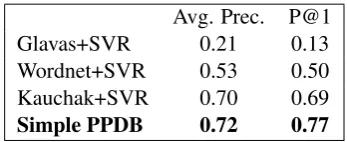
Results. Table 4 compares the different meth-ods in terms of how well they rank simplifying rules above non-simplifying rules. Simple PPDB’s ranking of the relative simplicity achieves an av-eraged precision of 0.72 (0.77 P@1), compared to 0.70 (0.69 P@1) achieved by the Horn et al. (2014) system– i.e. the KauchakGenerator+SVM Ranker. We hypothesize that the performance difference between these two ranking systems is
Avg. Prec. P@1
Glavas+SVR 0.21 0.13
Wordnet+SVR 0.53 0.50
Kauchak+SVR 0.70 0.69
[image:4.595.329.503.202.273.2]Simple PPDB 0.72 0.77
Table 4: Precision of relative simplification rankings of three existing lexical simplification methods compared to the Sim-ple PPDB resource in terms of Average Precision and P@1 (both range from 0 to 1 and higher is better). All of the ex-isting methods were evaluated using the implementations as provided in the LEXenstein toolkit.
likely due to a combination of the additional fea-tures applied in Simple PPDB’s model (e.g. word embeddings) and the difference in training data (Simple PPDB’s model was trained on 11K para-phrase pairs with trinary labels, while the Horn et al. (2014) model was trained on 500 words, each with a ranked list of paraphrases). Table 5 pro-vides examples of the top-ranked simplification candidates proposed by each of the methods de-scribed.
alarm Glavas enrage, perturb, stun
WordNet horrify, dismay,alert, appall, appal Kauchak pure,worry
PPDB worry,concern,alert genuine
Glavas credible, sort, feign, phoney, good na-turedness, sincere, sincerely, insincere, bonafide
WordNet real,actual, unfeigned, literal, echt,true Kauchak thermal
PPDB true,real,actual,honest,sincere
Table 5: Examples of candidate simplifications proposed by Simple PPDB and by three other generate-and-rank methods. Bold words were rated by humans to be simpler than the tar-get word. Note that these candidates are judged on simplicity, not on their goodness as paraphrases.
[image:4.595.311.523.510.637.2]Avg. PPs Total per Input Vocab.
Glavas+SVR ∞ ∞
Kauchak+SVR 4.4 127K
Wordnet+SVR 6.7 155K
[image:5.595.94.270.61.146.2]Simple PPDB 8.8 624K
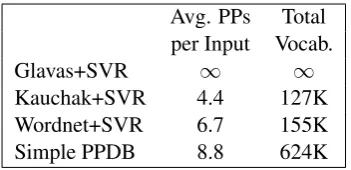
Table 6: Overall coverage of three existing lexical simplifica-tion methods compared to the Simple PPDB resource. Glavas is marked as∞since it generates candidates based on near-ness in vector space, and in theory could generate as many words/phrases as are in the vocabulary of the vector space.
each target– for the 100 targets drawn from the Newsela corpus, PPDB provided an average of 8.8 candidates per target. The next best generator, the WordNet-based system, produces only 6.7 candi-dates per target on average, and has a total vocab-ulary of only 155K words.
4 Conclusion
We have described Simple PPDB, a subset of the Paraphrase Database adapted for the task of text simplification. Simple PPDB is built by apply-ing state-of-the-art machine learned models for lexical simplification to the largest available re-source of lexical and phrasal paraphrases, result-ing in a web-scale resource capable of supportresult-ing research in data-driven methods for text simplifi-cation. We have shown that Simple PPDB offers substantially increased coverage of both words and multiword phrases, while maintaining high quality compared to existing methods for lexical simplification. Simple PPDB, along with the hu-man judgements collected as part of its creation, is freely available with the publication of this paper.6
Acknowledgments
This research was supported by a Facebook Fel-lowship, and by gifts from the Alfred P. Sloan Foundation, Google, and Facebook. This mate-rial is based in part on research sponsored by the NSF grant under IIS-1249516 and DARPA under number FA8750-13-2-0017 (the DEFT program). The U.S. Government is authorized to reproduce and distribute reprints for Governmental purposes. The views and conclusions contained in this pub-lication are those of the authors and should not be interpreted as representing official policies or en-dorsements of DARPA and the U.S. Government.
6http://www.seas.upenn.edu/˜nlp/ resources/simple-ppdb.tgz
We would especially like to thank Ani Nenkova for suggesting this line of research and for pro-viding the initial ideas on which this work builds. We would also like to thank Courtney Napoles and Wei Xu for valuable discussions, the anonymous reviewers for thoughtful comments, and the Ama-zon Mechanical Turk annotators for their contri-butions.
References
Thorsten Brants and Alex Franz. 2006. Web 1T 5-gram Version 1. Linguistic Data Consortium, Philadelphia.
John Carroll, Guido Minnen, Darren Pearce, Yvonne Canning, Siobhan Devlin, and John Tait. 1999. Simplifying text for language-impaired readers. In
Proceedings of EACL, volume 99, pages 269–270.
Will Coster and David Kauchak. 2011a. Learning to simplify sentences using Wikipedia. InProceedings of the Workshop on Monolingual Text-To-Text Gen-eration, pages 1–9, Portland, Oregon, June. Associ-ation for ComputAssoci-ational Linguistics.
William Coster and David Kauchak. 2011b. Simple English Wikipedia: A new text simplification task. In Proceedings of the 49th Annual Meeting of the Association for Computational Linguistics: Human Language Technologies, pages 665–669, Portland, Oregon, USA, June. Association for Computational Linguistics.
Jan De Belder and Marie-Francine Moens. 2010. Text simplification for children. InProceedings of the SI-GIR workshop on accessible search systems, pages 19–26. ACM.
Siobhan Devlin and John Tait. 1998. The use of a psycholinguistic database in the simplification of text for aphasic readers. Linguistic databases, pages 161–173.
Richard Evans, Constantin Orasan, and Iustin Dor-nescu. 2014. An evaluation of syntactic simplifica-tion rules for people with autism. InProceedings of the 3rd Workshop on Predicting and Improving Text Readability for Target Reader Populations (PITR), pages 131–140.
Lijun Feng. 2008. Text simplification: A survey. The City University of New York, Tech. Rep.
Goran Glavaˇs and Sanja ˇStajner. 2015. Simplifying lexical simplification: Do we need simplified cor-pora? In Proceedings of the 53rd Annual Meet-ing of the Association for Computational LMeet-inguistics and the 7th International Joint Conference on Natu-ral Language Processing (Volume 2: Short Papers), pages 63–68, Beijing, China, July. Association for Computational Linguistics.
Colby Horn, Cathryn Manduca, and David Kauchak. 2014. Learning a lexical simplifier using Wikipedia. In Proceedings of the 52nd Annual Meeting of the Association for Computational Linguistics (Volume 2: Short Papers), pages 458–463, Baltimore, Mary-land, June. Association for Computational Linguis-tics.
Tomas Mikolov, Kai Chen, Greg Corrado, and Jef-frey Dean. 2013. Efficient estimation of word representations in vector space. arXiv preprint arXiv:1301.3781.
Courtney Napoles and Mark Dredze. 2010. Learn-ing Simple Wikipedia: A cogitation in ascertainLearn-ing abecedarian language. InProceedings of the NAACL HLT 2010 Workshop on Computational Linguistics and Writing: Writing Processes and Authoring Aids, pages 42–50, Los Angeles, CA, USA, June. Associ-ation for ComputAssoci-ational Linguistics.
Gustavo Paetzold and Lucia Specia. 2015. LEXen-stein: A framework for lexical simplification. In
Proceedings of ACL-IJCNLP 2015 System Demon-strations, pages 85–90, Beijing, China, July. Associ-ation for ComputAssoci-ational Linguistics and The Asian Federation of Natural Language Processing.
Gustavo Paetzold. 2015. Reliable lexical simplifica-tion for non-native speakers. InProceedings of the 2015 Conference of the North American Chapter of the Association for Computational Linguistics: Stu-dent Research Workshop, pages 9–16, Denver, Col-orado, June. Association for Computational Linguis-tics.
Ellie Pavlick and Ani Nenkova. 2015. Inducing lexical style properties for paraphrase and genre differen-tiation. In Proceedings of the 2015 Conference of the North American Chapter of the Association for Computational Linguistics: Human Language Tech-nologies, pages 218–224, Denver, Colorado, May– June. Association for Computational Linguistics.
Ellie Pavlick, Pushpendre Rastogi, Juri Ganitkevitch, Benjamin Van Durme, and Chris Callison-Burch. 2015. PPDB 2.0: Better paraphrase ranking, fine-grained entailment relations, word embeddings, and style classification. InProceedings of the 53rd An-nual Meeting of the Association for Computational Linguistics and the 7th International Joint Confer-ence on Natural Language Processing (Volume 2: Short Papers), pages 425–430, Beijing, China, July. Association for Computational Linguistics.
Sarah E. Petersen and Mari Ostendorf. 2007. Text sim-plification for language learners: a corpus analysis. InSLaTE, pages 69–72. Citeseer.
Luz Rello, Ricardo A. Baeza-Yates, and Horacio Sag-gion. 2013. The impact of lexical simplification by verbal paraphrases for people with and without dyslexia. InCICLing (2), pages 501–512.
Advaith Siddharthan, Ani Nenkova, and Kathleen McKeown. 2004. Syntactic simplification for im-proving content selection in multi-document sum-marization. InProceedings of the 20th international conference on Computational Linguistics, page 896. Association for Computational Linguistics.
Lucia Specia, Sujay Kumar Jauhar, and Rada Mihal-cea. 2012. SemEval-2012 task 1: English lexi-cal simplification. In *SEM 2012: The First Joint Conference on Lexical and Computational Seman-tics – Volume 1: Proceedings of the main conference and the shared task, and Volume 2: Proceedings of the Sixth International Workshop on Semantic Eval-uation (SemEval 2012), pages 347–355, Montr´eal, Canada, 7-8 June. Association for Computational Linguistics.
Sander Wubben, Antal Van Den Bosch, and Emiel Krahmer. 2012. Sentence simplification by mono-lingual machine translation. InProceedings of the 50th Annual Meeting of the Association for Compu-tational Linguistics: Long Papers-Volume 1, pages 1015–1024. Association for Computational Linguis-tics.
Wei Xu, Chris Callison-Burch, and Courtney Napoles. 2015. Problems in current text simplification re-search: New data can help. Transactions of the As-sociation for Computational Linguistics, 3:283–297. Wei Xu, Courtney Napoles, Ellie Pavlick, Quanze Chen, and Chris Callison-Burch. 2016. Optimizing statistical machine translation for text simplification.