5338
How to best use Syntax in Semantic Role Labelling
Yufei Wang1 and Mark Johnson1 and Stephen Wan2 and Yifang Sun3 and Wei Wang3
Macquarie University, Sydney, Australia1 CSIRO Data61, Sydney, Australia2
The University of New South Wales, Sydney, Australia3
[email protected], [email protected] [email protected]
{yifangs,weiw}@cse.unsw.edu.au
Abstract
There are many different ways in which exter-nal information might be used in an NLP task. This paper investigates how external syntac-tic information can be used most effectively in the Semantic Role Labeling (SRL) task. We evaluate three different ways of encod-ing syntactic parses and three different ways of injecting them into a state-of-the-art neural ELMo-based SRL sequence labelling model. We show that using a constituency represen-tation as input features improves performance the most, achieving a new state-of-the-art for non-ensemble SRL models on the in-domain
CoNLL’05andCoNLL’12benchmarks.1
1 Introduction
Properly integrating external information into neu-ral networks has received increasing attention re-cently (Wu et al., 2018; Li et al., 2017; Strubell et al., 2018). Previous research on this topic can be roughly categorized into three classes: i) In-put: The external information are presented as ad-ditional input features (i.e., dense real-valued vec-tors) to the neural network (Collobert et al.,2011).
ii) Output: The neural network is trained to pre-dict the main task and the external information in a multi-task approach (Changpinyo et al.,2018).iii) Auto-encoder: This approach, recently proposed byWu et al.(2018), simultaneously combines the
InputandOutputduring neural models training. The simplicity of these methods allow them to ap-ply to many NLP sequence tasks and various neu-ral model architectures.
However, previous studies often focus on inte-grating word-level shallow features such as POS or chunk tags into the sequence labelling tasks. Syntactic information, which encodes the long-range dependencies and global sentence structure, has not been studied as carefully. This paper fills
1Our model source code is available in https:// github.com/GaryYufei/bestParseSRL
this gap by integrating syntactic information to the sequence labelling task. We address three ques-tions: 1)How should syntactic information be en-coded as word-level features? 2)What is the best way of integrating syntactic information? and3)
What effect does the choice of syntactic represen-tation have on the performance?
We study these questions in the context of Se-mantic Role Labelling (SRL). A SRL system ex-tracts the predicate-argument structure of a sen-tence.2 Syntax was an essential component of early SRL systems (Xue and Palmer, 2004; Pun-yakanok et al., 2008). The state-of-the-art neu-ral SRL systems use a neuneu-ral sequence labelling model without any syntax knowledge (He et al., 2018,2017;Tan et al.,2018). We show below that injecting external syntactic knowledge into a neu-ral SRL sequence labelling model can improve the performance, and our best model sets a new state-of-the-art for a non-ensemble SRL system.
In this paper we express the external syntac-tic information as vectors of discrete features, be-cause this enables us to explore different ways of injecting the syntactic information into the neural SRL model. Specifically, we propose three dif-ferent syntax encoding methods: a) a full con-stituency tree representation (Full-C);b)an SRL-specific span representation (SRL-C); and c) a dependency tree representation (Dep). For (a)
we adapt the constituency parsing representation from (G´omez-Rodr´ıguez and Vilares, 2018) and encode the tree structure as a set of features for word pairs. For (b), we use a categorical repre-sentation of the constituency spans that are most relevant to SRL tasks based on (Xue and Palmer, 2004). Finally, (c) we propose a discrete vector representation that encodes the head-modifier re-lationships in the dependency trees.
We evaluate the effectiveness of these encod-ings using three different integration methods on
the SRLCoNLL’05andCoNLL’12benchmarks. We show that using either of the constituency representations in either the Input or the Auto-Encoderconfigurations produces the best perfor-mance. These results are noticeably better than a strong baseline and set a new state-of-the-art for non-ensemble SRL systems.
2 Related Work
Semantic Role Labeling (SRL) generally refers to the PropBank style of annotation (Palmer et al., 2005). Broadly speaking, prior work on SRL makes use of syntactic information in two differ-ent ways. Carreras and M`arquez (2005); Prad-han et al.(2013) incorporate constituent-structure span-based information, while Hajiˇc et al.(2009) incorporate dependency-structure information.
This information can be incorporated into an SRL system in several different ways. Swayamdipta et al. (2018) use span information from constituency parse trees as an additional training target in a multi-task learning approach, similar to one of the approaches we evaluate here. Roth and Lapata (2016) use an LSTM model to represent the dependency paths between predi-cates and arguments and feed the output as the in-put features to their SRL system. Marcheggiani and Titov (2017) use Graph Convolutional Net-work (Niepert et al., 2016) to encode the depen-dency parsing trees into their LSTM-based SRL system. Xia et al.(2019) represent dependency parses using position-based categorical features of tree structures in a neural model. Strubell et al. (2018) use dependency trees as a supervision sig-nal to train one of attention heads in a self-attentive neural model.
3 Syntactic Representation
This section introduces our representations of con-stituency and dependency syntax trees.
3.1 Full-C: Full Constituency Representation
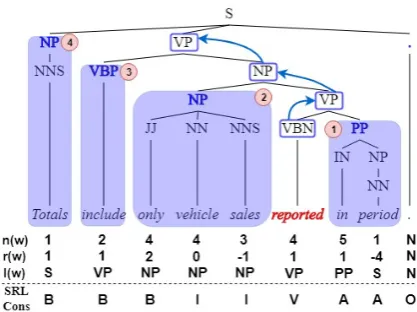
G´omez-Rodr´ıguez and Vilares(2018) propose a full representation of constituency parsing trees where the string position betweenwi andwi+1is associated with the pair(n(wi)−n(wi−1), l(wi)) wheren(wi)is the number of common ancestors between(wi, wi+1)andl(wi)is the non-terminal label at the lowest common ancestor3. For
sim-3The full constituency trees can be reconstructed from
[image:2.595.313.522.61.217.2]this representation, details refer to (G´omez-Rodr´ıguez and
Figure 1: Examples ofFull-C(n(w),r(w)andl(w)) and SRL-C (SRL-Cons). reported is the predicate word. The blue non-terminals are candidate con-stituents in theSRL-C. The circled number is the ex-traction order.
plicity, we define r(wi) = n(wi) − n(wi−1) throughout this paper.4
This encoding method transforms the whole constituency parsing tree inton−1 (r(wi), l(wi)) feature pairs for a length-n sentence. We assign (r(wi), l(wi))to thewi (0< i ≤n−1) and leave a padding symbolNto thewn. We treatr(wi)and
l(wi)as two separate categorical features for each word. We refer this representation as the Full-C
(Figure1).
3.2 SRL-C: SRL Span Representation
Xue and Palmer (2004) show only a small frac-tion of the constituents in the parse trees are use-ful for the SRL task given the predicate word. That means encoding the full constituency parsing tree may introduce redundant information.
Therefore, we preserve the constituent spans that are most likely to be useful for the predicate word in the trees. We re-use thepruning algorithm in (Xue and Palmer, 2004). Their algorithm col-lects the potential argument constituents by walk-ing up the tree to the root node recursively, which filters out many irrelevant constituents from the syntax trees with 99.3% of the ground truth argu-ments preserved.
We encode the output of this rule-based pruning algorithm using a standard BIO (Begin-I
nside-Outside) annotation scheme. The words that are
Vilares,2018)
4In (G´omez-Rodr´ıguez and Vilares, 2018), both r(wi)
outside any candidate constituent receive the tag
O. The words that are beginning of a candidate constituent receive the tagB, and the words that are inside a candidate constituent receive the tagI. We use the tagA to label words in prepositional phrases. We refer this representation as the SRL-C(Figure1).
3.3 Dep: Dependency Tree Representation
The seeds already are in the script
Left 0 1 0 2 0 0 1
Right 0 0 0 1 1 0 0
RG 1 2 1 4 -1 1 -2
Edge L L N R R L R
DL det nsubj dep root prep det pobj
root
det
nsubj
dep prep det
[image:3.595.322.508.62.117.2]pobj
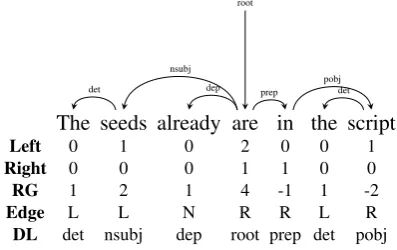
Figure 2: Features from Dependency Tree.
The dependency tree representation encodes key aspects of the head-modifier relationships within the sentence. We also consider encod-ing constituent edge information. The followencod-ing word-level features have been proposed:
a) #left/right Dependents (Left / Right). The number of dependents a word has on the left and right side.
b) Right/Left-most Dependent(Edge). Whether the word is the Right/Left/None-most depen-dent of its governor.
c) Relative Distance to Governor (RG). The relative distance between the word and its governor.
d) Dependency Label(DL). The label describ-ing the relationship between each pair of de-pendent and governor.
We refer this representation as the Dep (Figure 25).
4 Injecting External Information
In this section, we introduce three different meth-ods for integrating external syntactic information into the neural SRL system (Figure3):
5In this example, we assume the “root” is the first word of
[image:3.595.81.280.202.327.2]the sentence from the left.
Figure 3: Model Architecture. Blue indicates the base-line model; Red indicates the multi-task output compo-nent; Green indicates the external feature component.
Baseline Our baseline system is a stacked bi-LSTM architecture (He et al., 2017). We use ELMo (Peters et al., 2018) as word embeddings and a CRF output decoder on the top of LSTM, as shown in Figure3.
Input This approach represents the external cat-egorical features as trainable, high dimensional dense vector token embeddings, which are con-catenated with the representation vectors of ELMo in the baseline model. The syntactic parse trees that are used as the input features are produced byKitaev and Klein(2018) (for constituency pars-ing). The dependency trees are produced by transforming the constituency trees using Stan-ford CoreNLP toolkit. This ensures that the con-stituency and dependency parses have a similar error distribution, helping to control for parsing quality. Our constituency and dependency parses score a state-of-the-art 95.4 F1 and 96.4% UAS on the WSJ test set respectively. We used a 20-fold cross-validation procedure to produce the data for the external syntactic input.
Output In this approach, our model predicts both SRL sequence tags and syntactic features (en-coded as the word-level features above) simultane-ously. We use a log loss for each categorical fea-ture. The final training loss is the multi-task objec-tiveLSRL−Pmf=1logpf(yf?), wherepf(yf)is the probability of generatingyf as thefthfeature (m features in total, m = 1,2,5 forSRL-C, Full-C
andDep respectively) andyf? is the ground truth for thefth feature. Gold training data was used as the external syntactic information for the multi-task output setting, as this external information is not required at test time.
its input, encouraging it to incorporate this infor-mation in its internal representations. The input and output representations are the same as above.
5 Experiments
We evaluate 10 different models (the 3 ways of using external information by 3 different en-codings of syntax and a baseline model) on
CoNLL’05 (Carreras and M`arquez, 2005) and
CoNLL’12(Pradhan et al.,2013) benchmarks, un-der the evaluation setting where the gold predicate is given. The CoNLL’05 benchmark uses WSJ and Brown test as in-domain and out-domain eval-uation respectively.
5.1 Main Results
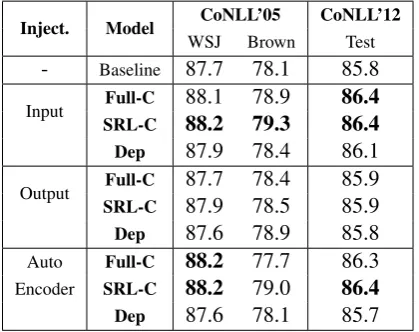
Table1shows the effect of using the three different kinds of external syntactic information in the three different ways just described. When used as input features, all three representations improve over our baseline system. This shows that syntactic repre-sentations provide additional useful information, which is beyond the dynamic context embeddings from ELMo, to SRL task.
Syntax Representations Models using con-stituency representations are 0.3% - 0.6% bet-ter than the models using the dependency repre-sentations. This might be because constituents align more directly with SRL arguments and con-stituency information is easier to use.
Inject. Model CoNLL’05 CoNLL’12
WSJ Brown Test
- Baseline 87.7 78.1 85.8
Input Full-C 88.1 78.9 86.4
SRL-C 88.2 79.3 86.4 Dep 87.9 78.4 86.1
Output Full-C 87.7 78.4 85.9
SRL-C 87.9 78.5 85.9
Dep 87.6 78.9 85.8
Auto Encoder
Full-C 88.2 77.7 86.3
SRL-C 88.2 79.0 86.4 Dep 87.6 78.1 85.7
Table 1: Injecting External Syntax Information. Bold numberis the best performance in each column, same below.
The SRL-C is slightly better than the Full-C
for in-domain evaluation. The advantages of the
SRL-Capproach are greater on the out-of-domain
(Brown) evaluation, with a margin of 0.4%. This could be becauseFull-Cis more sensitive to pars-ing errors than SRL-C. When we compare gold and automatic parser representations in Brown de-vice data, 10.5% of the words get differentFull-C
features while this only 7.9% get differentSRL-C
features.
External Information Injection Table1shows at least on this task, multi-task learning does not perform as well as adding external information as additional input features. Both the Input and Auto-Encoder methods work equally well. We conclude that the extra complexity of the auto-encodermodel is not justified. In particular,Dep
withauto-encoder hurts SRL accuracy (0.6% be-hind the model with the constituency features).
5.2 Comparison with existing systems
We compare our best system (SRL-C used as Input) with previous work in Table 2. We im-prove upon the state-of-the-art results for non-ensemble SRL models on in-domain test by 0.6% and 0.2% on CoNLL’05and CoNLL’12 respec-tively. Our model also achieves a competitive re-sult on CoNLL’05Brown Test. Comparing with the strong ensemble model in (Ouchi et al.,2018), our model is only 0.3% and 0.6% lower in two benchmarks respectively.
Model CoNLL’05 CoNLL’12
WSJ Brown Test ELMo Baseline 87.7 78.1 85.8
Strubell et al.(2018) 86.0 76.5
-Xia et al.(2019) 86.9 76.8
-He et al.(2018) 87.4 80.4 85.5
Ouchi et al.(2018) 87.6 78.7 86.2
Our best model 88.2 79.3 86.4 Xia et al.(2019)§ 87.8 78.8
[image:4.595.310.521.464.606.2]-Ouchi et al.(2018)§ 88.5 79.6 87.0
Table 2: Comparison with existing systems.§indicates ensemble models.
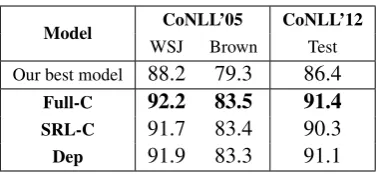
5.3 Using Gold Parse Trees
[image:4.595.77.287.496.662.2]Model CoNLL’05 CoNLL’12
WSJ Brown Test Our best model 88.2 79.3 86.4
Full-C 92.2 83.5 91.4 SRL-C 91.7 83.4 90.3
[image:5.595.87.276.60.147.2]Dep 91.9 83.3 91.1
Table 3: SRL Performance with Gold Trees
6 Conclusion and Future Work
This paper evaluated three different ways of repre-senting external syntactic parses, and three differ-ent ways of injecting that information into a state-of-the-art SRL system. We showed that repre-senting the external syntactic information as con-stituents was most effective. Using the exter-nal syntactic information as input features was far more effective than a multi-task learning ap-proach, and just as effective as an auto-encoder approach. Our best system sets a new state-of-the-art for non-ensemble SRL systems on in-domain data.
In future work we will explore how external in-formation is best used in ensembles of models for SRL and other tasks. For example, is it better for all the models in an ensemble to use the same ex-ternal information, or is it more effective if they make use of different kinds of information? We will also investigate whether the choice of method for injecting external information has the same im-pact on other NLP tasks as it does on SRL.
Acknowledgments
This research was supported by the Australian Research Councils Discovery Projects fund-ing scheme (project number DPs 160102156, 170103710, 180103411), D2DCRC (DC25002, DC25003), and in part by CSIRO Data61.
References
Xavier Carreras and Llu´ıs M`arquez. 2005. Intro-duction to the conll-2005 shared task: Semantic role labeling. InProceedings of the Ninth Confer-ence on Computational Natural Language
Learn-ing (CoNLL-2005), pages 152–164. Association for
Computational Linguistics.
Soravit Changpinyo, Hexiang Hu, and Fei Sha. 2018. Multi-task learning for sequence tagging: An em-pirical study. In Proceedings of the 27th
Inter-national Conference on Computational Linguistics,
pages 2965–2977. Association for Computational Linguistics.
Ronan Collobert, Jason Weston, L´eon Bottou, Michael Karlen, Koray Kavukcuoglu, and Pavel P. Kuksa. 2011. Natural language processing (almost) from scratch. Journal of Machine Learning Research, 12:2493–2537.
Carlos G´omez-Rodr´ıguez and David Vilares. 2018. Constituent parsing as sequence labeling. In Pro-ceedings of the 2018 Conference on Empirical
Meth-ods in Natural Language Processing, pages 1314–
1324. Association for Computational Linguistics.
Jan Hajiˇc, Massimiliano Ciaramita, Richard Johans-son, Daisuke Kawahara, Maria Ant`onia Mart´ı, Llu´ıs M`arquez, Adam Meyers, Joakim Nivre, Sebastian Pad´o, Jan ˇStˇep´anek, Pavel Straˇn´ak, Mihai Surdeanu, Nianwen Xue, and Yi Zhang. 2009. The CoNLL-2009 shared task: Syntactic and semantic depen-dencies in multiple languages. In Proceedings of the Thirteenth Conference on Computational Nat-ural Language Learning (CoNLL 2009): Shared Task, pages 1–18, Boulder, Colorado. Association for Computational Linguistics.
Luheng He, Kenton Lee, Omer Levy, and Luke Zettle-moyer. 2018. Jointly predicting predicates and ar-guments in neural semantic role labeling. In Pro-ceedings of the 56th Annual Meeting of the Associa-tion for ComputaAssocia-tional Linguistics (Volume 2: Short
Papers), pages 364–369. Association for
Computa-tional Linguistics.
Luheng He, Kenton Lee, Mike Lewis, and Luke Zettle-moyer. 2017. Deep semantic role labeling: What works and what’s next. InProceedings of the 55th Annual Meeting of the Association for
Computa-tional Linguistics (Volume 1: Long Papers), pages
473–483. Association for Computational Linguis-tics.
Nikita Kitaev and Dan Klein. 2018. Constituency parsing with a self-attentive encoder. In Proceed-ings of the 56th Annual Meeting of the Association for Computational Linguistics (Volume 1: Long
Pa-pers), pages 2676–2686. Association for
Computa-tional Linguistics.
Junhui Li, Deyi Xiong, Zhaopeng Tu, Muhua Zhu, Min Zhang, and Guodong Zhou. 2017. Modeling source syntax for neural machine translation. In Proceed-ings of the 55th Annual Meeting of the Associa-tion for ComputaAssocia-tional Linguistics (Volume 1: Long
Papers), pages 688–697. Association for
Computa-tional Linguistics.
Diego Marcheggiani and Ivan Titov. 2017. Encoding sentences with graph convolutional networks for se-mantic role labeling. In Proceedings of the 2017 Conference on Empirical Methods in Natural
Lan-guage Processing, pages 1506–1515, Copenhagen,
Mathias Niepert, Mohamed Ahmed, and Konstantin Kutzkov. 2016. Learning convolutional neural net-works for graphs. In Proceedings of the 33nd In-ternational Conference on Machine Learning, ICML
2016, New York City, NY, USA, June 19-24, 2016,
volume 48 ofJMLR Workshop and Conference
Pro-ceedings, pages 2014–2023. JMLR.org.
Hiroki Ouchi, Hiroyuki Shindo, and Yuji Matsumoto. 2018. A span selection model for semantic role la-beling. InProceedings of the 2018 Conference on Empirical Methods in Natural Language Process-ing, pages 1630–1642. Association for Computa-tional Linguistics.
Martha Palmer, Daniel Gildea, and Paul Kingsbury. 2005. The proposition bank: An annotated cor-pus of semantic roles. Computational Linguistics, 31(1):71–106.
Matthew Peters, Mark Neumann, Mohit Iyyer, Matt Gardner, Christopher Clark, Kenton Lee, and Luke Zettlemoyer. 2018. Deep contextualized word repre-sentations. InProceedings of the 2018 Conference of the North American Chapter of the Association for Computational Linguistics: Human Language
Technologies, Volume 1 (Long Papers), pages 2227–
2237. Association for Computational Linguistics.
Sameer Pradhan, Alessandro Moschitti, Nianwen Xue, Hwee Tou Ng, Anders Bj¨orkelund, Olga Uryupina, Yuchen Zhang, and Zhi Zhong. 2013. Towards ro-bust linguistic analysis using ontonotes. In Proceed-ings of the Seventeenth Conference on
Computa-tional Natural Language Learning, pages 143–152.
Association for Computational Linguistics.
Vasin Punyakanok, Dan Roth, and Wen-tau Yih. 2008. The importance of syntactic parsing and inference in semantic role labeling. Computational Linguistics, 34(2):257–287.
Michael Roth and Mirella Lapata. 2016. Neural se-mantic role labeling with dependency path embed-dings. In Proceedings of the 54th Annual Meet-ing of the Association for Computational LMeet-inguistics
(Volume 1: Long Papers), pages 1192–1202, Berlin,
Germany. Association for Computational Linguis-tics.
Emma Strubell, Patrick Verga, Daniel Andor, David Weiss, and Andrew McCallum. 2018. Linguistically-informed self-attention for semantic role labeling. In Proceedings of the 2018 Confer-ence on Empirical Methods in Natural Language
Processing, pages 5027–5038. Association for
Computational Linguistics.
Swabha Swayamdipta, Sam Thomson, Kenton Lee, Luke Zettlemoyer, Chris Dyer, and Noah A. Smith. 2018. Syntactic scaffolds for semantic structures.
In Proceedings of the 2018 Conference on
Empiri-cal Methods in Natural Language Processing, pages
3772–3782. Association for Computational Linguis-tics.
Zhixing Tan, Mingxuan Wang, Jun Xie, Yidong Chen, and Xiaodong Shi. 2018. Deep semantic role label-ing with self-attention. InProceedings of the Thirty-Second AAAI Conference on Artificial Intelligence, (AAAI-18), New Orleans, Louisiana, USA, February 2-7, 2018, pages 4929–4936.
Minghao Wu, Fei Liu, and Trevor Cohn. 2018. Evalu-ating the utility of hand-crafted features in sequence labelling. InProceedings of the 2018 Conference on Empirical Methods in Natural Language
Pro-cessing, pages 2850–2856. Association for
Compu-tational Linguistics.
Qingrong Xia, Zhenghua Li, Min Zhang, Meishan Zhang, Guohong Fu, Rui Wang, and Luo Si. 2019. Syntax-aware neural semantic role labeling.
In Proceedings of the Thirty-Third AAAI
Confer-ence on Artificial IntelligConfer-ence, (AAAI-19), Honolulu,
Hawaii, USA, Jan 27-Feb 1, 2019.
Nianwen Xue and Martha Palmer. 2004. Calibrating features for semantic role labeling. InProceedings of the 2004 Conference on Empirical Methods in