4377
Chinese Relation Extraction with Multi-Grained Information and
External Linguistic Knowledge
Ziran Li1,2∗, Ning Ding1,2∗, Zhiyuan Liu2,3,4, Hai-Tao Zheng1,2†, Ying Shen5
1Tsinghua Shenzhen International Graduate School, Tsinghua University
2Department of Computer Science and Technology, Tsinghua University, Beijing, China 3Institute for Artificial Intelligence, Tsinghua University, Beijing, China
4State Key Lab on Intelligent Technology and Systems, Tsinghua University, Beijing, China 5School of Electronics and Computer Engineering, Peking University Shenzhen Graduate School
{lizr18,dingn18}@mails.tsinghua.edu.cn
Abstract
Chinese relation extraction is conducted using neural networks with either character-based or word-based inputs, and most existing meth-ods typically suffer from segmentation errors and ambiguity of polysemy. To address the is-sues, we propose a multi-grained lattice frame-work (MG lattice) for Chinese relation ex-traction to take advantage of multi-grained language information and external linguistic knowledge. In this framework, (1) we incorpo-rate word-level information into character se-quence inputs so that segmentation errors can be avoided. (2) We also model multiple senses of polysemous words with the help of external linguistic knowledge, so as to alleviate poly-semy ambiguity. Experiments on three real-world datasets in distinct domains show con-sistent and significant superiority and robust-ness of our model, as compared with other baselines. The source code of this paper can be obtained fromhttps://github.com/ thunlp/Chinese_NRE.
1 Introduction
Relation extraction (RE) has a pivotal role in infor-mation extraction (IE), aiming to extract seman-tic relations between entity pairs in natural lan-guage sentences. In downstream applications, this technology is a key module for constructing large-scale knowledge graphs. Recent developments in deep learning have heightened the interest for neu-ral relation extractions (NRE), which attempt to use neural networks to automatically learn seman-tic features (Liu et al., 2013; Zeng et al., 2014,
2015; Lin et al., 2016; Zhou et al., 2016; Jiang et al.,2016).
∗
indicates equal contribution †
[image:1.595.310.524.237.379.2]Corresponding author: Hai-Tao Zheng. ( E-mail: [email protected] )
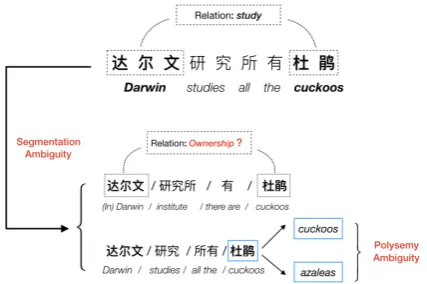
Figure 1: An example of segmentation ambiguity and polysemy ambiguity in Chinese RE.
Although it is not necessary for NRE to per-form feature engineering, they ignore the fact that different language granularity of input will have a significant impact on the model, especially for Chinese RE. Conventionally, according to the difference in granularity, most existing methods for Chinese RE can be divided into two types: character-based RE and word-based RE.
For the character-based RE, it regards each in-put sentence as a character sequence. The short-coming of this kind of method is that it can-not fully exploit word-level information, capturing fewer features than the word-based methods. For the word-based RE, word segmentation should be first performed. Then, a word sequence is derived and fed into the neural network model. However, the performance of the word-based models could be significantly impacted by the quality of seg-mentation.
For example, as shown in Fig 1, the Chinese sentence “达尔文研究所有杜鹃(Darwin studies all the cuckoos)” has two entities, which are “达
尔文 (Darwin)” and “杜鹃 (cuckoos)”, and the
correct segmentation is “达尔文(Darwin) /研究 (studies) /所有(all the) /杜鹃(cuckoos)” . Nev-ertheless, semantics of the sentence could become entirely different as the segmentation changes. If the segmentation is “达尔文(In Darwin) /研究所 (institute) /有 (there are) / 杜鹃 (cuckoos)”, the meaning of the sentence becomes ’there are cuck-oos in Darwin institute’ and the relation between “达尔文 (Darwin)” and “杜鹃 (cuckoos)” turns into Ownership, which is wrong. Hence, neither character-based methods nor word-based methods can sufficiently exploit the semantic information in data. Worse still, this problem becomes sev-erer when datasets is finely annotated, which are scarce in number. Obviously, to discover high-level entity relationships from plain texts, we need the assistance of comprehensive information with various granularity.
Furthermore, the fact that there are many pol-ysemous words in datasets is another point ne-glected by existing RE models, which limits the ability of the model to explore deep semantic fea-tures. For instance, the word “杜鹃” has two different senses, which are ’cuckoos’ and ’aza-leas’. But it’s difficult to learn both senses infor-mation from plain texts without the help of exter-nal knowledge. Therefore, the introduction of ex-ternal linguistic knowledge will be of great help to NRE models.
In this paper, we proposed the multi-granularity lattice framework (MG lattice), a unified model comprehensively utilizes both internal informa-tion and external knowledge, to conduct the Chi-nese RE task. (1) The model uses a lattice-based structure to dynamically integrate word-level fea-tures into the character-based method. Thus, it can leverage multi-granularity information of in-puts without suffering from segmentation errors. (2) Moreover, to alleviate the issue of polysemy ambiguity, the model utilizes HowNet (Dong and Dong,2003), which is an external knowledge base manually annotates polysemous Chinese words. Then, the senses of words are automatically se-lected during the training stage and consequently, the model can fully exploit the semantic informa-tion in data for better RE performance.
Sets of experiments has been conducted on three manually labeled RE datasets. The results indicate that our model significantly outperforms multiple existing methods, achieving state-of-the-art results on various datasets across different
do-mains.
2 Related Work
Recent years RE, especially NRE, has been widely studied in the NLP field. As a pioneer, (Liu et al.,
2013) proposed a simple CNN RE model and it is regarded as one seminal work that uses a neural network to automatically learn features. On this basis, (Zeng et al.,2014) developed a CNN model with max-pooling, where positional embeddings were first used to represent the position informa-tion. Then the PCNNs model (Zeng et al.,2015) designed the multi-instance learning paradigm for RE. However, the PCNNs model suffers the issue of the selection of sentences. To address the prob-lem,Lin et al.(2016) applied the attention mech-anism over all the instances in the bag. Further,
Jiang et al. (2016) proposed a model with multi-instance and multi-label paradigms. Although PC-NNs models are more efficient, they cannot exploit contextual information like RNNs. Hence, LSTM with attention mechanism was also applied to the RE task (Zhang and Wang, 2015; Zhou et al.,
2016;Lee et al.,2019).
Existing methods for Chinese RE are mostly character-based or word-based implementations of mainstream NRE models (Chen and Hsu, 2016;
R¨onnqvist et al., 2017; ZHANG et al.,2017;Xu et al., 2017). In most cases, these methods only focus on the improvement of the model itself, ig-noring the fact that different granularity of input will have a significant impact on the RE mod-els. The character-based model can not utilize the information of words, capturing fewer fea-tures than the word-based model. On the other side, the performance of the word-based model is significantly impacted by the quality of segmen-tation (Zhang and Yang, 2018). Although some methods are used to combine character-level and word-level information in other NLP tasks like character-bigrams (Chen et al.,2015;Yang et al.,
2017) and soft words (Zhao and Kit,2008;Chen et al.,2014;Peng and Dredze,2016), the informa-tion utilizainforma-tion is still very limited.
(Sperber et al.,2017) and NRE (Zhang and Yang,
2018). Although the lattice LSTM model can ex-ploit word and word sequence information, it still could be severely affected by the ambiguity of pol-ysemy. In other words, these models cannot han-dle the polysemy of words with the change of lan-guage situation. Therefore, the introduction of external linguistic knowledge is very necessary. We utilize sense-level information with the help of HowNet proposed by Dong and Dong (2003), which is a concept knowledge base that annotates Chinese with correlative word senses. In addition, the open-sourced HowNet API (Qi et al.,2019) is also used in our work.
3 Methodology
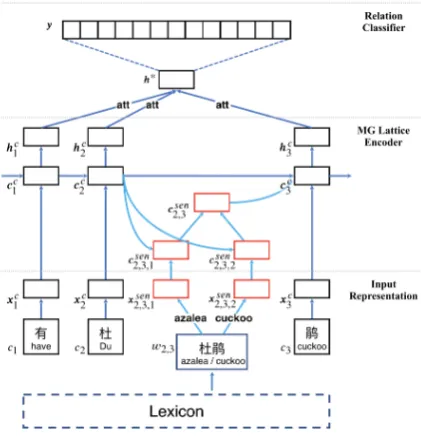
[image:3.595.77.288.390.612.2]Given a Chinese sentence and two marked enti-ties in it, the task of Chinese relation extraction is to extract semantic relations between the two entities. In this section, we present our MG lat-tice model for Chinese relation extraction in detail. As shown in Fig2, the model could be introduced from three aspects:
Figure 2: MG lattice framework.1
Input Representation. Given a Chinese sen-tence with two target entities as input, this part rep-resents each word and character in the sentence. Then the model can utilize both word-level and character-level information.
MG Lattice Encoder. Incorporating external knowledge into word sense disambiguation, this
1In order to keep the figure clear and concise, we do not
show gate cells and the backward direction.
part uses a lattice-structure LSTM network to con-struct a distributed representation for each input instance.
Relation Classifier. After the hidden states are learned, a character-level mechanism is adapted to merge features. Then the final sentence represen-tations are fed into a softmax classifier to predict relations.
We will introduce all the three parts in the fol-lowing subsections in detail.
3.1 Input Representation
The input of our model is a Chinese sentence s
with two marked entities. In order to utilize multi-granularity information, we represent both charac-ters and words in the sentence.
3.1.1 Character-level Representation
Our model takes character-based sentences as di-rect inputs, that is, regarding each input sentence as a character sequence. Given a sentence s con-sisting of M characterss= {c1, ..., cM}, we first
map each charactercito a vector ofdcdimensions,
denoted as xcei ∈ Rdc
, via the Skip-gram model (Mikolov et al.,2013).
In addition, we leverage position embeddings to specify entity pairs, which are defined as the rel-ative distances from the current character to head and tail entities (Zeng et al., 2014). Specifically, the relative distances from thei-th characterci to
the two marked entities are denoted as p1i andp2i
respectively. We calculatep1i as below:
p1i =
i−b1 i < b1, 0 b1 ≤i≤e1, i−e1 i > e1,
(1)
where b1 and e1 are the start and end indices of the head entity. The computation ofp2i is similar to Eq.1. Then,p1i andp2i are transformed into two corresponding vectors, denoted asxp1
i ∈ Rd p
and
xp2 i ∈ Rd
p
, by looking up a position embedding table.
Finally, the input representation for characterci,
denoted asxci ∈Rd(d=dc+ 2×dp), is
concate-nated by character embedding xce
i , position
em-beddingsxp1 i andx
p2 i :
xci = [xcei ;xp1 i ;x
p2
i ]. (2)
Then, the representation of characters xc = {xc
3.1.2 Word-level Representation
Although our model takes character sequences as direct inputs, in order to fully capture word-level features, it also needs the information of all poten-tial words in the input sentences. Here, a potenpoten-tial word is any character subsequence that matches a word in a lexiconDbuilt over segmented large
raw text. Let wb,e be such a subsequence
start-ing from the b-th character to thee-th character. To representwb,e, we use the word2vec (Mikolov
et al.,2013) to convert it into a real-valued vector
xwb,e∈Rdw.
However, the word2vec method maps each word to only one single embedding, ignoring the fact that many words have multiple senses. To tackle this problem, we incorporate HowNet as an external knowledge base into our model to repre-sent word senses rather than words.
Hence, given a word wb,e, we first obtain all K senses of it by retrieving the HowNet. Using
Sense(wb,e) to denote the senses set ofwb,e, we
then convert each sensesen(kwb,e) ∈ Sense(wb,e)
into a real-valued vector xsenb,e,k ∈ Rdsen
through the SAT model (Niu et al.,2017). The SAT model is on the basis of the Skip-gram, which can jointly learn word and sense representations. Finally, the representation of wb,e is a vector set denoted as xsenb,e ={xsen
b,e,1, ...,xsenb,e,K}.
In the next section, we will introduce how our model utilizes sense embeddings.
3.2 Encoder
The direct input of the encoder is a character se-quence, together with all potential words in lexi-conD. After training, the output of the encoder is
the hidden state vectorshof an input sentence. We introduce the encoder with two strategies, includ-ingthe basic latticeLSTM and themulti-graind lattice(MG lattice) LSTM.
3.2.1 Basic Lattice LSTM Encoder
Generally, a classical LSTM (Hochreiter and Schmidhuber,1997) unit is composed of four ba-sic gates structure: one input gate ij controls
which information enters into the unit; one output gateoj controls which information would be
out-putted from the unit; one forget gate fj controls
which information would be removed in the unit. All three gates are accompanied by weight matrix
W. Current cell statecj records all historical
in-formation flow up to the current time. Therefore,
the character-based LSTM functions are:
icj =σ(Wixcj+Uihcj−1+bi), ocj =σ(Woxcj +Uohcj−1+bo), fjc=σ(Wfxcj+Ufhcj−1+bf),
˜
ccj = tanh(Wcxcj +Uchcj−1+bc),
(3)
ccj =fjcccj−1+icjc˜cj, (4)
hcj =ocjtanh(ccj), (5)
whereσ()means the sigmoid function. Hence, the current cell state cj will be generated by
calcu-lating the weighted sum using both previous cell state and current information generated by the cell (Graves,2013).
Given a word wb,e in the input sentence which
matches the external lexiconD, the representation
can be obtained as follows:
xwb,e =ew(wb,e), (6)
where b and e denotes the start and the end of the word, andew is the lookup table . Under this circumstance, the computation ofccj incorporates word-level representationxwb,eto construct the ba-sic lattice LSTM encoder. Further, a word cellcwb,e
is used to represent the memory cell state ofxwb,e. The computation ofcwb,eis:
iwb,e=σ(Wixwb,e+Uihcb+bi),
fb,ew =σ(Wfxwb,e+Ufhcb+bf),
˜
cwb,e= tanh(Wcxwb,e+Uchcb+bc),
(7)
cwb,e=fb,ew ccb+iwb,ec˜wb,e, (8)
whereiwb,eandfb,ew serve as a set of word-level in-put and forget gates.
The cell state of thee-th character will be cal-culated by incorporating the information of all the words that end in index e, which is wb,e with
b ∈ {b0|wb0,e ∈ D}. To control the contribution
of each word, an extra gateicb,eis used:
icb,e=σ(Wxce+Ucwb,e+bl). (9)
Then the cell value of thee-th character is com-puted by:
cce= X b∈{b0|w
b0,e∈D}
whereαcb,e andαce are normalization factors, set-ting the sum to 1:
αcb,e= exp(i c b,e) exp(ic
e)+
P
b0∈{b00|w
b00,e∈D}exp(i c b0,e)
, (11)
αce= exp(i c e) exp(ic
e)+
P
b0∈{b00|w
b00,e∈D}exp(i c b0,e)
. (12)
Finally, we use Eq. 5 to compute the final hid-den state vectorshcj for each character of the se-quence. This structure is also used in Zhang and Yang(2018).
3.2.2 MG Lattice LSTM Encoder
Although the basic lattice encoder can explicitly leverages character and word information, it could not fully consider the ambiguity of Chinese. For instance, as shown in Figure2, the wordw2,3 (杜
鹃) has two senses: sen(w2,3)
1 represents ’azalea’
andsen(2w2,3)represents ’cuckoo’, but there is only one representation forw2,3in the basic lattice
en-coder, which isxw2,3.
To address this shortcoming, we improve the model by adding sense-level paths as external knowledge to the model. Hence, a more compre-hensive lexicon would be constructed. As men-tioned in3.1, the representation of thek-th sense of the wordwb,eisxsenb,e,k.
For each word wb,ewhich matches the lexicon D, we will take all its sense representations into
the calculation. The computation of thek-th sense of wordwb,eis:
isenb,e,k =σ(Wixsenb,e,k+Uihcb+bi),
fb,e,ksen =σ(Wfxsenb,e,k+Ufhcb+bf),
˜
csenb,e,k= tanh(Wcxsenb,e,k+Uchcb+bc),
(13)
csenb,e,k =fb,e,ksen ccb+isenb,e,kc˜senb,e,k, (14)
wherecsenb,e,k represents the memory cell of thek -th sense of -the word wb,e. Then all the senses
are merged into a comprehensive representation to compute the memory cell ofwb,e, which is denoted
ascsenb,e:
csenb,e =X k
αsenb,e,kcsenb,e,k, (15)
αsenb,e,k= exp(i sen b,e,k) K
P
k0
exp(isen b,e,k0)
, (16)
whereisenb,e,k is an extra gate to control the contri-bution of thek-th sense, and is computed similar as Eq.9.
In this situation, all the sense-level cell states will be incorporated into the word representation
csenb,e , which could better represent the polysemous word. Then, similar to Eq.9-12, all the recurrent paths of words ending in indexewill flow into the current cellcce:
cce= X
b∈{b0|wd b0,e∈D}
αsenb,e csenb,e +αcec˜ce. (17)
Finally, the hidden statehare still computed by Eq.5and then sent to the relation classifier.
3.3 Relation Classifier
After the hidden state of an instanceh ∈ Rdh×M
is learnt, we first adopt a character-level attention mechanism to mergehinto a sentence-level fea-ture vector, denoted ash∗ ∈ Rdh
. Here,dh indi-cates the dimension of the hidden state andM is the sequence length. Then, the final sentence rep-resentation h∗ is fed into a softmax classifier to compute the confidence of each relation.
The representation h∗ of the sentence is com-puted as a weighted sum of all character feature vectors inh:
H= tanh(h), (18)
α= softmax(wTH), (19)
h∗=hαT, (20)
wherew ∈ Rdh
is a trained parameter andα ∈ RM is the weight vector ofh.
To compute the conditional probability of each relation, the feature vectorh∗of sentenceSis fed into a softmax classifier:
o=W h∗+b, (21)
p(y|S) = softmax(o), (22)
whereW ∈ RY×dh
is the transformation matrix andb∈RY is a bias vector. Y indicates the total
number of relation types, and y is the estimated probability for each type. This mechanism is also applied to (Zhou et al.,2016).
Finally, given all (T) training examples
(S(i), y(i)), we define the objective function using cross-entropy as follows:
J(θ) = T
X
i=1
whereθindicates all parameters of our model. To avoid co-adaptation of hidden units, we ap-ply dropout (Hinton et al., 2012) on the LSTM layer by randomly removing feature detectors from the network during forward propagation.
4 Experiments
In this section, we conduct a series of experiments on three manually labeled datasets. Our models show superiority and effectiveness compared with other models. Furthermore, generalization is an-other advantage of our models, because there are five corpora used to construct the three datasets, which are entirely different in topics and manners of writing. The experiments will be organized as follows:
(1) First, we study the ability of our model to combine character-level and word-level informa-tion by comparing it with char-based and word-based models;
(2) Then we focus on the impact of sense rep-resentation, carrying out experiments among three different kinds of lattice-based models;
(3) Finally, we make comparisons with other proposed models in relation extraction task.
4.1 Datasets and Experimental Settings
Datasets. We carry out our experiments on three different datasets, including Chinese San-Wen (Xu et al.,2017), ACE 2005 Chinese corpus (LDC2006T06) and FinRE.
The Chinese SanWen dataset contains 9 types of relations among 837 Chinese literature articles, in which 695 articles for training, 84 for testing and the rest 58 for validating. The ACE 2005 dataset is collected from newswires, broadcasts, and we-blogs, containing 8023 relation facts with 18 re-lation subtypes. We randomly select 75% of it to train the models and the remaining is used for eval-uation.
For more diversity in test domains, we manu-ally annotate the FinRE dataset from 2647 finan-cial news in Sina Finance2, with 13486, 3727 and 1489 relation instances for training, testing and validation respectively. The FinRE contains 44 distinguished relationships including a special re-lation NA, which indicates that there is no rere-lation between the marked entity pair.
Evaluation Metrics. Multiple standard evalu-ation metrics are applied in the experiments,
in-2https://finance.sina.com.cn/
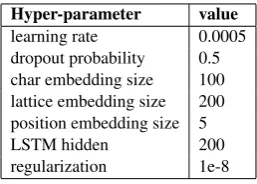
Hyper-parameter value learning rate 0.0005 dropout probability 0.5 char embedding size 100 lattice embedding size 200 position embedding size 5
LSTM hidden 200
[image:6.595.353.482.61.153.2]regularization 1e-8
Table 1: Hyper-parameters
cluding the precision-recall curve, F1-score, Pre-cision at top N predictions (P@N) and area un-der the curve (AUC). With comprehensive evalua-tions, models can be estimated from multiple an-gles.
Parameter Settings. We tune the parameters of our models by grid searching on the validation dataset. Grid search is utilized to select optimal learning rateλfor Adam optimizer (Kingma and Ba,2014) among{0.0001,0.0005,0.001,0.005,}
and position embedding dp in {5,10,15,20}.
Table 1 shows the values of the best hyper-parameters in our experiments. The best models were selected by early stopping using the evalu-ation results on the validevalu-ation dataset. For other parameters, we follow empirical settings because they make little influence on the whole perfor-mance of our models.
Models FinRE SanWen ACE
Word-based
Word-baseline 41.23 54.26 64.43
+char CNN 41.60 56.62 68.86
+char LSTM 42.20 57.92 69.81
Char-based
Character-baseline 40.50 60.34 71.52
+softword 41.42 60.69 69.81
+bichar 40.52 61.34 71.86
+softword + bichar 42.03 61.75 72.63
Ours Basic Lattice 47.41 63.88 77.12
MG Lattice 49.26 65.61 78.17
Table 2: F1-scores of word-baselines, character base-lines and lattice-based models on all datasets.
4.2 Effect of Lattice Encoder.
[image:6.595.307.526.445.556.2]Datasets ACE-2005 SanWen FinRE
P@N 100 200 300 Mean 100 200 300 Mean 100 200 300 Mean
[image:7.595.81.516.61.120.2]Basic Lattice 99.01 94.03 94.68 95.91 96.04 90.05 89.04 91.71 97.03 92.04 90.70 93.26 Basic Lattice (SAT) 97.03 97.01 96.01 96.69 93.07 93.03 91.36 92.49 98.02 93.03 90.70 93.92 MG Lattice 98.02 97.51 96.01 97.18 94.06 93.03 90.70 92.60 100.0 92.54 89.70 94.08
Table 3: Precision@N of lattice-based models on all datasets.
an extra CNN/LSTM to learn hidden states for characters of each word (char CNN/LSTM). For char baseline, bichar and softword (word in which the current character is located) are used as word-level features to improve character representation. The lattice-based approaches include two lattice-based models, and both of them can explic-itly leverage both character and word information. The basic lattice uses the encoder mentioned in
3.2.1, which can dynamically incorporate word-level information into character sequences. For MG lattice, each sense embedding will be used to construct an independent sense path. Hence, there is not only word information, but also sense infor-mation flowing into cell states.
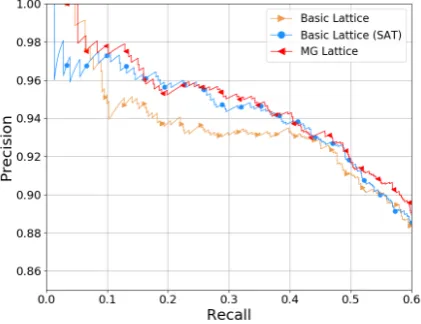
Figure 3: Precision-recall curves for three lattice-based models on ACE-2005.
Results of word-based model. With automatic word segmentation, the baseline of the word-based model yields 41.23%, 54.26% and 64.43% F1-score on three datasets. The F1-scores are in-creased to 41.6%, 56.62 and 68.86% by adding character CNN to the baseline model. Compared with the character CNN, character LSTM repre-sentation gives slightly higher F1-scores, which are 42.2%, 57.92%, and 69.81% respectively. The results indicate that character information will promote the performance of the word-based model, but the increase in F1-score is not signifi-cant.
Results of character-based model. For the character baseline, it gives higher F1-scores com-pared with the word-based methods. By adding soft word feature, the F1-scores slightly increase on FinRE and SanWen dataset. Similar results are achieved by adding character-bigram. Ad-ditionally, a combination of both word features yields best F1-scores among character-based mod-els, which are 42.03%, 61.75%, and 72.63%.
Results of lattice-based model. Although we take multiple strategies to combine character and word information in baselines, the lattice-based models still significantly outperform them. The basic lattice model improves the F1-scores of three datasets from 42.2% to 47.35%, 61.75% to 63.88% and 72.63% to 77.12% respectively. The results demonstrate the ability to exploit charac-ter and word sequence information of the lattice-based model. Comparisons and analysis of the lattice-based models will be introduced in the next subsection.
4.3 Effect of Word Sense Representations
In this section, we will study the effect of word sense representations by utilizing sense-level in-formation with different strategies. Hence, three types of lattice-based models are used in our ex-periments. First, the basic lattice model uses word2vec (Mikolov et al.,2013) to train the word embeddings, which considers no word sense infor-mation. Then, we introduce the basic lattice (SAT) model as a comparison, for which the pre-trained word embeddings are improved by sense informa-tion (Niu et al., 2017). Moreover, the MG lattice model uses sense embeddings to build indepen-dent paths and dynamically selects the appropriate sense.
[image:7.595.76.287.379.541.2](a) Results on FinRE (b) Results on SanWen (c) Results on ACE-2005
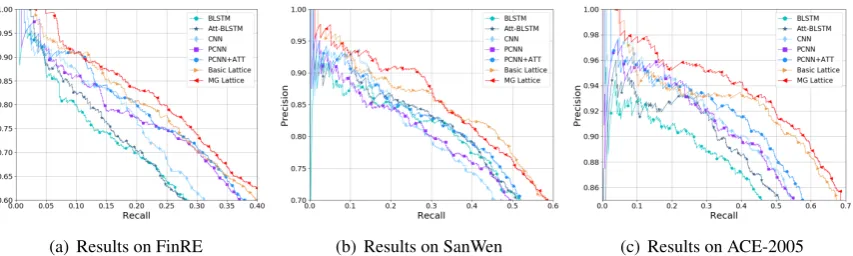
Figure 4: Precision-recall curves of BLSTM, Att-BLSTM, CNN, PCNN, PCNN+ATT, Basic lattice and MG lattice on all datasets. All models (except the Basic and MG lattice) are character-based.
top 100 instances is still lower than the lattice-basic model. Compared with the other two mod-els, MG lattice shows superiority in all indexes of P@N, achieving the best results in the mean scores.
To compare and analyze the effectiveness of all lattice-based models more intuitively, we re-port the precision-recall curve of the ACE-2005 dataset in Figure 3as an example. Although the basic lattice (SAT) model obtains better overall performance than the original basic lattice model, the precision is still lower when the recall is low, which corresponds to the results in Table3. This situation indicates that considering multiple senses only in the pre-trained stage would add noise to the word representations. In other words, the word representation tends to favor the commonly used senses in the corpora, which will disturb the model when the correct sense of the current word is not the common one. Nevertheless, the MG lattice model successfully avoids this problem, giving the best performance in all parts of the curve. This re-sult indicates that the MG lattice model is not sig-nificantly impacted by the noisy information be-cause it can dynamically select the sense paths in different contexts. Although MG lattice model shows effectiveness and robustness on the over-all results, it is worth noting that the improvement is limited. The situation indicates that the utiliza-tion of multi-grained informautiliza-tion could still be im-proved. A more detailed discussion is in Section
5.
4.4 Final Results
In this section, we compare the performance of the lattice-based model with various proposed meth-ods. The proposed models we selected are as
fol-Models FinRE SanWen ACE-2005 AUC F1 AUC F1 AUC F1
BLSTM 28.80 42.87 50.21 61.04 60.40 70.03
Att-BLSTM 27.81 41.48 50.42 59.48 61.85 70.69
CNN 27.12 41.47 47.81 59.42 64.49 72.41
PCNN 30.49 45.51 48.26 61.00 66.10 74.33
PCNN+Att 31.89 46.13 50.41 60.55 65.79 73.17
Basic Lattice 36.58 47.41 56.88 63.88 70.51 77.12
[image:8.595.89.516.67.195.2]MG Lattice 38.74 49.26 57.33 65.61 72.28 78.17
Table 4: AUC and F1-scores of BLSTM, Att-BLSTM, CNN, PCNN, PCNN +Att, Basic lattice and MG lattice on all datasets. All models (except the Basic and MG lattice) are character-based.
lows:
CNN(Zeng et al.,2014) proposes a CNN model for relation extraction.
PCNN(Zeng et al.,2015) puts forward a piece-wise CNN model with multi-instance learning.
BLSTM (Zhang and Wang, 2015) proposes a bidrectional LSTM model for relation extraction.
Att-BLSTM (Zhou et al., 2016) is a bidrec-tional LSTM model with word-level attention mechanism.3
PCNN+ATT(Lin et al.,2016) improves PCNN model with selective attention mechanism.
We conduct experiments on both character-based and word-character-based versions of the five mod-els mentioned above. The results show that the character-based versions perform better than the word-based versions for all models on all datasets. Consequently, we only use the character-based version of the five selected models in the following experiments.
3For the sake of fairness, we add position embeddings
For comprehensive comparison and analysis, we report precision-recall curves in Figure4 and F1-scores and AUC in Table 4. From the re-sults, we can observe that: (1) Lattice-based els significantly outperform other proposed mod-els on datasets from different domains. Thanks to the polysemy information, the MG lattice model performs best among all models, showing supe-riority and effectiveness on the Chinese RE task. The results indicate that sense-level information could enhance the ability to capturing deep se-mantic information from text. (2) The gap be-tween the basic lattice model and the MG lat-tice model becomes narrow on the dataset FinRE. The reason for this phenomenon is that FinRE is constructed from financial report corpus, and the words of financial reports are often rigorous and unambiguous. (3) In comparison, the PCNN and PCNN+ATT models perform worse in the SanWen and ACE datasets. The reason is that there are po-sitional overlaps between entity pairs in these two datasets, making PCNN unable to take full advan-tage of the piece-wise mechanism. The results in-dicate that the PCNN-based methods have a high dependence on the form of the dataset. In com-parison, our models show robustness on all three datasets.
5 Conclusion and Future Work
In this paper, we propose the MG lattice model for Chinese relation extraction. The model in-corporates word-level information into character sequences to explore deep semantic features and avoids the issue of polysemy ambiguity by intro-ducing external linguistic knowledge, which is re-garded as sense-level information. We compre-hensively evaluate our model on various datasets. The results show that our model significantly out-performs other proposed methods, reaching the state-of-the-art results on all datasets.
In the future, we will attempt to improve the ability of the MG Lattice to utilize multi-grained information. Although we have used word, sense and character information in our work, more level of information can be incorporated into the MG Lattice. From coarse to fine, sememe-level in-formation can be intuitively valuable. Here, se-meme is the minimum semantic unit of word sense, whose information may potentially assist the model to explore deeper semantic features. From fine to coarse, sentences and paragraphs
should be taken into account so that a border range of contextual information can be captured.
6 Acknowledgement
This research is supported by the National Natural Science Foundation of China (Grant No. 61773229), the Basic Scientific Re-search Program of Shenzhen City (Grant No. JCYJ20160331184440545), and the Overseas Co-operation Research Fund of Graduate School at Shenzhen, Tsinghua University (Grant No. HW2018002). Moreover, Zhiyuan Liu is sup-ported by the National Key Research and Develop-ment Program of China (No. 2018YFB1004503). Finally, we would like to thank the anonymous reviewers for their helpful feedback and sugges-tions.
References
Xinchi Chen, Xipeng Qiu, Chenxi Zhu, Pengfei Liu, and Xuanjing Huang. 2015. Long short-term mem-ory neural networks for chinese word segmentation. In Proceedings of the 2015 Conference on Empiri-cal Methods in Natural Language Processing, pages 1197–1206.
Yanping Chen, Qinghua Zheng, and Wei Zhang. 2014. Omni-word feature and soft constraint for chinese relation extraction. InProceedings of the 52nd An-nual Meeting of the Association for Computational Linguistics (Volume 1: Long Papers), volume 1, pages 572–581.
Yu-Ju Chen and Jane Yung-jen Hsu. 2016. Chinese re-lation extraction by multiple instance learning. In Workshops at the Thirtieth AAAI Conference on Ar-tificial Intelligence.
Zhendong Dong and Qiang Dong. 2003. Hownet-a hy-brid language and knowledge resource. In Proceed-ings of NLP-KE.
Alex Graves. 2013. Generating sequences with recurrent neural networks. arXiv preprint arXiv:1308.0850.
Geoffrey E Hinton, Nitish Srivastava, Alex Krizhevsky, Ilya Sutskever, and Ruslan R Salakhutdinov. 2012. Improving neural networks by preventing co-adaptation of feature detectors. arXiv preprint arXiv:1207.0580.
Sepp Hochreiter and J¨urgen Schmidhuber. 1997. Long short-term memory. Neural computation, 9(8):1735–1780.
of COLING 2016, the 26th International Confer-ence on Computational Linguistics: Technical Pa-pers, pages 1471–1480.
Diederik P Kingma and Jimmy Ba. 2014. Adam: A method for stochastic optimization. arXiv preprint arXiv:1412.6980.
Joohong Lee, Sangwoo Seo, and Yong Suk Choi. 2019. Semantic relation classification via bidirec-tional lstm networks with entity-aware attention us-ing latent entity typus-ing.
Yankai Lin, Shiqi Shen, Zhiyuan Liu, Huanbo Luan, and Maosong Sun. 2016. Neural relation extraction with selective attention over instances. In Proceed-ings of the 54th Annual Meeting of the Association for Computational Linguistics (Volume 1: Long Pa-pers), volume 1, pages 2124–2133.
ChunYang Liu, WenBo Sun, WenHan Chao, and Wanxiang Che. 2013. Convolution neural network for relation extraction. InInternational Conference on Advanced Data Mining and Applications, pages 231–242. Springer.
Tomas Mikolov, Ilya Sutskever, Kai Chen, Greg S Cor-rado, and Jeff Dean. 2013. Distributed representa-tions of words and phrases and their compositional-ity. InAdvances in neural information processing systems, pages 3111–3119.
Yilin Niu, Ruobing Xie, Zhiyuan Liu, and Maosong Sun. 2017. Improved word representation learning with sememes. In Proceedings of the 55th Annual Meeting of the Association for Computational Lin-guistics (Volume 1: Long Papers), volume 1, pages 2049–2058.
Nanyun Peng and Mark Dredze. 2016. Improving named entity recognition for chinese social me-dia with word segmentation representation learning. arXiv preprint arXiv:1603.00786.
Fanchao Qi, Chenghao Yang, Zhiyuan Liu, Qiang Dong, Maosong Sun, and Zhendong Dong. 2019. Openhownet: An open sememe-based lexical knowledge base. arXiv preprint arXiv:1901.09957.
Samuel R¨onnqvist, Niko Schenk, and Christian Chiar-cos. 2017. A recurrent neural model with attention for the recognition of chinese implicit discourse re-lations.arXiv preprint arXiv:1704.08092.
Matthias Sperber, Graham Neubig, Jan Niehues, and Alex Waibel. 2017. Neural lattice-to-sequence models for uncertain inputs. arXiv preprint arXiv:1704.00559.
Jinsong Su, Zhixing Tan, Deyi Xiong, Rongrong Ji, Xi-aodong Shi, and Yang Liu. 2017. Lattice-based re-current neural network encoders for neural machine translation. InThirty-First AAAI Conference on Ar-tificial Intelligence.
Lin Sun, Kui Jia, Kevin Chen, Dit-Yan Yeung, Bertram E Shi, and Silvio Savarese. 2017. Lattice long short-term memory for human action recogni-tion. InProceedings of the IEEE International Con-ference on Computer Vision, pages 2147–2156.
Kai Sheng Tai, Richard Socher, and Christopher D Manning. 2015. Improved semantic representations from tree-structured long short-term memory net-works. arXiv preprint arXiv:1503.00075.
Jingjing Xu, Ji Wen, Xu Sun, and Qi Su. 2017. A discourse-level named entity recognition and rela-tion extracrela-tion dataset for chinese literature text. arXiv preprint arXiv:1711.07010.
Jie Yang, Yue Zhang, and Fei Dong. 2017. Neu-ral word segmentation with rich pretraining. arXiv preprint arXiv:1704.08960.
Daojian Zeng, Kang Liu, Yubo Chen, and Jun Zhao. 2015. Distant supervision for relation extraction via piecewise convolutional neural networks. In Pro-ceedings of the 2015 Conference on Empirical Meth-ods in Natural Language Processing, pages 1753– 1762.
Daojian Zeng, Kang Liu, Siwei Lai, Guangyou Zhou, Jun Zhao, et al. 2014. Relation classification via convolutional deep neural network.
Dongxu Zhang and Dong Wang. 2015. Relation classi-fication via recurrent neural network.arXiv preprint arXiv:1508.01006.
Qian-qian ZHANG, Meng-dong CHEN, and Lian-zhong LIU. 2017. An effective gated recurrent unit network model for chinese relation extraction. DEStech Transactions on Computer Science and En-gineering, (wcne).
Yue Zhang and Jie Yang. 2018. Chinese ner using lat-tice lstm.arXiv preprint arXiv:1805.02023.
Hai Zhao and Chunyu Kit. 2008. Unsupervised seg-mentation helps supervised learning of character tagging for word segmentation and named entity recognition. In Proceedings of the Sixth SIGHAN Workshop on Chinese Language Processing.