Proceedings of the 57th Annual Meeting of the Association for Computational Linguistics, pages 5032–5046 5032
Asking the Crowd: Question Analysis, Evaluation and Generation for
Open Discussion on Online Forums
Zi Chai1,2, Xinyu Xing1,2, Xiaojun Wan1,2, Bo Huang3
1Institute of Computer Science and Technology, Peking University 2The MOE Key Laboratory of Computational Linguistics, Peking University
3Zhihu Institude
{chaizi, xingxinyu, wanxiaojun}@pku.edu.cn, [email protected]
Abstract
Teaching machines to ask questions is an im-portant yet challenging task. Most prior work focused on generating questions with fixed an-swers. As contents are highly limited by given answers, these questions are often not worth discussing. In this paper, we take the first step on teaching machines to ask open-answered questions from real-world news for open dis-cussion (openQG). To generate high-qualified questions, effective ways for question evalua-tion are required. We take the perspective that the more answers a question receives, the bet-ter it is for open discussion, and analyze how language use affects the number of answers. Compared with other factors, e.g. topic and post time, linguistic factors keep our evalua-tion from being domain-specific. We carefully perform variable control on 11.5M questions from online forums to get a dataset, OQRanD, and further perform question analysis. Based on these conclusions, several models are built for question evaluation. For openQG task, we construct OQGenD, the first dataset as far as we know, and propose a model based on con-ditional generative adversarial networks and our question evaluation model. Experiments show that our model can generate questions with higher quality compared with commonly-used text generation methods.
1 Introduction
Teaching machines to ask questions from given corpus, i.e. question generation (QG), is an im-portant yet challenging task in natural language processing. In recent years, QG has received in-creasing attention from both the industrial and academic communities due to its wide applica-tions. Dialog systems can be proactive by ask-ing users questions (Wang et al., 2018), question answering (QA) systems can benefit from the cor-pus produced by a QG model (Duan et al.,2017),
education (Heilman and Smith, 2010) and clini-cal (Weizenbaum et al.,1966;Colby et al.,1971) systems require QG as well.
We can divide all questions into two categories.
Fixed-answeredquestions have standard answers, e.g. “who invented the car? (Karl Benz)”. In con-trast, different people may have distinct answers overopen-answered questions like “what do you think of the self-driving car?”. Most prior work about QG (QA) aimed to generate (answer) fixed-answered questions. As questions are targeting on answers which are certain spans of given corpus, they are always not worth discussing. Nowadays, with the help of online QA forums (e.g. Quora and Zhihu1), open-answered questions can greatly arouse open discussion that helps people under different backgrounds to share knowledge and ideas (high-qualified questions can help to attract more visitors for QA forums as well). This kind of questions are also useful for many tasks, e.g. mak-ing dialog systems more proactive.
In this paper, we focus on generating open-answered questions for open discussion, i.e. the openQG task. To make our model useful in prac-tice, we generate questions from real-world news which are suitable for arousing open discussion. As far as we know, no researchhas focused on this task before due to the two difficulties:
• To generate high-qualified questions (for open discussion), we need to perform ques-tion evaluaques-tion, which is rather challenging.
• Questions in most existed QG (QA) datasets, e.g. SQuAD (Rajpurkar et al., 2016), are fixed-answered thus not suitable for openQG.
It is worth mentioning that a good question eval-uation metric is not only a necessity to compare
different models, but can also throw light on the text generation process, e.g. acting as the reward function through reinforcement learning. Based on the perspective that the more answers a ques-tion receives, the higher quality it has for open discussion, we analyze howlanguage useaffects the number of answers. Compared with other factors, e.g. the topic and post time, focusing on language use can keep our evaluation from being domain-specific. To this end, we carefully per-form variable control on 11.5M online questions from Zhihu and build the “open-answered ques-tion ranking dataset (OQRanD)”, containing 22K question pairs (questions in each pair onlydiffer in language use). Based on OQRanD, we reach to some interesting conclusions on how linguistic factors affects the number that a question receives, and further build question evaluation models.
After building our linguistic-based question evaluation model, we propose a QG model based on conditional generative adversarial network (CGAN). During the adversarial training process, we perform reinforcement learning to introduce information from the evaluation model. This ar-chitecture wasnot usedin QG before as far as we know, and experiments show that our model gets better performance compared with commonly-used text generation methods in the quality of gen-erated questions. All the experiments are per-formed on the “open-answered question genera-tion dataset (OQGenD)” we build, which contains 20K news-question pairs. It isthe firstdataset for openQG to the best of our knowledge.
Above all, the main contributions of this paper are threefold:
• We propose the openQG task, and build OQ-GenD, OQRanD from 11.5M questions for generating and evaluating questions.
• We study how language use affects the num-ber of answers a question receives, and draw some interesting conclusions for linguistic-based question evaluation.
• We propose a model based on CGAN and our question evaluation model, which outper-forms commonly-used text generation mod-els in the quality of generated questions.
In this paper, the two datasets OQRanD and OQGend are available at https://github. com/ChaiZ-pku/OQRanD-and-OQGenD.
2 Related Work
2.1 Question Evaluation
Question evaluation is a rather challenging task. Automatic evaluation metrics such as BLEU ( Pa-pineni et al.,2002), ROUGE (Lin,2004) and ME-TEOR (Lavie and Agarwal, 2007) were widely used to measure n-gram overlaps between gener-ated questions and ground truth questions, how-ever, they are far from enough since we cannot list all possible ground truth questions in openQG. To this end, we need to develop specific evaluation metrics for questions. Some researches (Heilman and Smith, 2010; Figueroa and Neumann, 2013) directly trained question ranking (QR) models via supervised learning, and used it to perform evalu-ation. However, these models are always domain-specific and not interpretable since we cannot tell what makes a question get a high (low) score.
Rao and Daumé III(2018) took a step further, and pointed out that a good question is one whose ex-pected answer will be useful. By using the “ex-pected value of perfect information”, they pro-posed a useful evaluation model. However, our task significantly differs from it in two aspects: first, there is no correct answer for open-answered questions thus it is hard to tell which answer is “useful”. Second, the goal of openQG is to arouse open discussions instead of “solving a problem”.
Intuitively, a good question evaluation metric should be interpretable and keeps away from be-ing domain-specific. To this end, we first analyze how language use affects the number of answers, and then build evaluation models based on these conclusions. There are some researches (Guerini et al.,2011;Danescu-Niculescu-Mizil et al.,2012;
Guerini et al.,2012;Tan et al., 2014) about how language use affects the reaction that a piece of text generates, but we are the first to focus on questions as far as we know.
2.2 Question Generation
QG was traditionally tackled by rule-based ap-proaches (Heilman and Smith, 2010; Lindberg et al., 2013; Mazidi and Nielsen, 2014; Hussein et al.,2014;Labutov et al.,2015). In recent years, neural network (NN) approaches have taken the mainstream.Du et al.(2017) pioneered NN-based QG by using Seq2seq models (Sutskever et al.,
2017), pointer mechanism (Kumar et al., 2018a;
Zhao et al.,2018), etc. Adding more constraints, e.g. controlling the topic (Hu et al.,2018) and dif-ficulty (Gao et al.,2018) of QG, or combining it with QA (Duan et al., 2017; Wang et al., 2017;
Tang et al., 2017) have also been studied. Re-cently, using adversarial training and reinforce-ment learning (Yuan et al., 2017; Kumar et al.,
2018b;Yao et al.,2018) have become a new trend. As far as we know, the CGAN model we pro-posed has not used before. Besides, most prior researches aimed to generate fixed-answered ques-tions, and we arethe firstto propose openQG task to the best of our knowledge.
It is worth mentioning that though we only fo-cus on text-based QG, we can also generate ques-tions from images, i.e. visual question genera-tion (Ren et al.,2015;Fan et al.,2018) and knowl-edge graphs (Serban et al., 2016; Elsahar et al.,
2018) as well.
3 Question Analysis and Evaluation
In this section, we deal with question analysis and evaluation. We first perform variable control and build OQGenD. After that, we analyze how lan-guage use affects the number of answers a ques-tion receives. Based on these conclusions, we fur-ther build question evaluation models.
3.1 Construction of OQRanD
The number of answers a question receives is af-fected by many factors. As pointed out by a num-ber of prior researches, there are four dominated variables: topic,author,timeandlanguage use. In other words, we should control the first three variables to study the effect of language use. We perform our analysis based on an in-house dataset from Zhihu. There are 11.5M open-domain ques-tions, and the following information is also pro-vided for each question: the post time, the author (user ID), the author’s followers and followees, the manually-tagged topics, the number of answers, viewers and followers.
Although we mainly focus on the number of answers, the counts of viewers and followers of the question are also interesting. Especially, if a question receives more answers, can we expect it to be viewed and followed by more people as well? To figure it out, we perform correlation analysis using the Pearson correlation coefficient (PCC) (Lee Rodgers and Nicewander,1988). PCC
is a measure of the linear correlation between two random variables. It is a real number between [-1, 1], where 1 means there is a total positive linear correlation, 0 means no linear correlation exixts, and -1 means there is a total negative linear corre-lation. PCC between the number of answers and viewers is 0.93, and that number between the num-ber of answers and followers is 0.86. So a question with more answers can always attract more visi-tors and followers.
As for variable control, we first focus ontopic. Since each of the 11.5M questions has one of the 37 manually-tagged topics (all topics are listed in the appendix), we divide them into 37 subsets, and further extract question-pairs in each subset inde-pendently. In each pair, we want the topics of two questions as close as possible. Since ques-tions are short texts (often about 10 words), topics are greatly reflected by nouns. We measure topic-similarity for questionsq1, q2by:
T S(q1, q2) =
# nouns in bothq1andq2
# nouns inq1+# nouns inq2
(1)
where “#” means “the number of”. The larger
T S(q1, q2)forq1, q2, the closer they are in topics.
We set a boundaryµ, and filter out question pairs whoseT S(q1, q2) < µ. A number of values forµ
is tried, and we finally chooseµ = 0.3since the topics of(q1, q2)are already close enough without
discarding too much data. Finally, we get 24.2M topic-controlled (TC) question pairs.
Based on TC pairs, we further control the ef-fect ofauthors. Since users with more followers are expected to get more responses, we need to eliminate the effect of their social network. To do so, we collect all active users provided by Zhihu and build a “follower network”. In this network, each user is a node, and there is an edge from A to B if user A follows user B. We run PageRank algorithms (Page et al.,1999) on the network, and get a PageRank value for each user (real values are rounded to integers). By excluding TC pairs whose authors do not have the same PageRank value, we get 10.8M topic- and author-controlled (TAC) question pairs.
Figure 1: The effect of time lag (∆t) onD.
number of their answers, and(t1, t2)to show their
posted times. The idea is: we first study how time factors affect the number of answers, i.e. how ∆t = |t1 −t2| affects ∆n = |n1 −n2|. After
that, we can find if certain ∆t has small effects. By picking TAC pairs with such∆t, the effect of time can be greatly reduced.
To study how ∆t affects∆n, we should leave ∆tas the only variable, i.e. control the effect of language use in TAC pairs. To do so, we measure the distance betweenq1andq2by normalized edit
distance:
d(q1, q2) =
edit(q1, q2) max(len(q1), len(q2)
(2)
whereedit(q1, q2)is the edit distance, andlen(·)
is the length of a question. The smallerd(q1, q2)
between q1 and q2, the more similar they are in
language use. We further rank all TAC pairs by
dvalues from small to large, and pick up the first 2% pairs to get 217K topic-, author- and language-controlled (TALC) question pairs. Now that∆tis the only difference, the smaller effect it has, the smaller ∆n is expected. The number of TALC pairs decreases exponentially with the growth of ∆t. As pointed out byTan et al.(2014), directly computing E(∆n|∆t) is not reliable since the estimate will be dominated by TALC pairs with small ∆n. Instead, we should use the deviation estimate:
D= X
0≤n1≤9
[image:4.595.308.524.64.174.2]|Eˆ(n2|n1)−n1| (3)
Figure 2:Dunder differentn1(the smaller, the better).
where Eˆ(n2|n1) is the average n2 over question
pairs whose q1 has n1 answers, and TALC pairs
whosen1 >9are not considered since the number
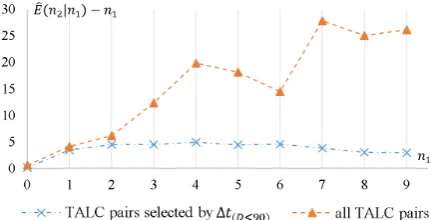
is too few, making the results less reliable. In Figure 1(a), we show how D varies with ∆t (a smaller effect of ∆t makes D closer to 0). As we can see, D is rather small when ∆t
is close to0, which is in accordance with common sense. As∆tgrows,Dincreases sharply, which is largely caused by the “first move advantage” de-scribed in (Borghol et al.,2012). AlthoughD de-creases when∆tis about 100 hours (we think the main reason is: earlier questions starts to become “stale”), it is not so small as before. When∆tis about 200 hours (the later questions also starts to become “stale”),Dincreases again and maintains at a high level. Figure1(b) shows the case when ∆tis close to0.
As mentioned above, if we control∆tto make
Drather small, the effect of time will be greatly re-duced. However, we may filter out too many data if making∆ttoo close to0. Intuitively, 90 seems like a good upper-bound, and we use∆tD<90 to
denote the time interval composed by all∆tthat make D < 90. To further test this upper-bound, we pick out TALC pairs whose ∆t ∈ ∆tD<90,
and compute the deviation |E(n2|n1) −n1|
un-der different n1 to get Figure 2 (in contrast, we
also show the case when ∆t is not controlled). As we can see, by choosing pairs whose ∆t ∈
∆tD<90, we can greatly reduce deviations. Since |E(n2|n1)−n1|<5under eachn1, we can further
eliminate the remaining time-effect by enlarging ∆n. Based on thse conclusions, we perform time-control on all TAC pairs by choosing pairs whose ∆t ∈ ∆tD<90 and∆n > 20 (20 is much larger
than 5). To study the effect of language use, we wantq1, q2not so close. So we further discard the
remaining pairs whose d(q1, q2) < 0.6, and get
notation t-test efficacy
↑↑↑↑,↓↓↓↓ p≤0.0001
↑↑↑,↓↓↓ p≤0.001
↑↑,↓↓ p≤0.01
[image:5.595.311.520.61.214.2]↑,↓ p≤0.05
Table 1: The number of arrows and t-test efficacy.
length ↓↓↓↓ puctuation ↓↓↓↓
noun ↓↓↓↓ 1stppron ↓↓↓↓
verb ↑↑↑↑ 2ndppron ↑↑↑↑
adjective ↓↓↓ 3rdppron ↓↓↓↓
adverb ↑↑↑↑ please-word ↓↓↓↓
preposition ↓↓↓ positive-word ↑↑↑↑
pronoun - negative-word -quantifier ↑↑↑ sentiment-word ↑
[image:5.595.114.249.62.132.2]numeral - common-word ↑
Table 2: Significance tests on text features. The “ppon” denotes for “personal pronoun”.
3.2 The Effects of Language Use
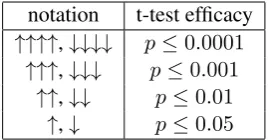
To show how language use affects the number of answers that a question receives, we perform sig-nificant tests on different linguistic features. The one-sided paired t-test with Bonferroni correction (for multiple comparisons) is adopted. For sig-nificant levels, we set α = .05, .01, .001, .0001, which correspond with the number of arrows (Ta-ble1). The direction of arrows show how the fea-ture affects the number of answers: up arrows (↑) indicate that a large feature-value (e.g. a longer length, a higher perplexity) can lead to more an-swers, and down arrows (↓) means small feature values are preferred. Here are some interesting conclusions2:
Ask concise questions. The basic sanity check we perform is the length of questions. Table2 in-dicates that questions with less words tend to get more answers. This is in accordance with Sim-mons et al.(2011) which shows that short version of memes are more likely to become popular. In contrast, Tan et al. (2014) found that longer ver-sions of tweets are more likely to be popular. This indicates that attracting more answers is different from making a blog retweeting by more people.
Ask one thing a time and make it vivid.
What kinds of words can help to get more an-swers? We test the proportion of different parts
2More details, (e.g. how we trained the language models) are listed in the appendix).
data for training language models
ppl (word n-grams)
ppl (POS n-grams) random
sampled questions
3-gram ↓↓↓↓ ↓↓↓↓
2-gram ↓↓↓↓ ↓↓↓↓
1-gram ↓↓↓↓ ↓↓↓↓
most answered questions
3-gram ↓↓↓↓ ↓↓↓↓
2-gram ↓↓↓↓ ↓↓↓↓
1-gram ↓↓↓↓ ↓↓↓↓
news headlines
3-gram ↓↓↓↓ ↓↓↓↓
2-gram ↓↓↓↓ ↑↑↑↑
[image:5.595.76.287.169.295.2]1-gram ↓↓↓↓ ↑↑↑↑
Table 3: Significance tests on LM-based features. ppl stands for perplexity.
of speech (POS) that occurs (proportions are bet-ter than word counts since they can eliminate the effect of length). As Table2suggests, using less nouns, adjectives and prepositions is helpful. As nouns are often topic words (occurred with adjec-tives and prepositions), it is better to contain less topics and ask one thing a time. On the other hand, it is better to use more verbs and adverbs to make the question vivid. Besides, using less punctuation helps (this often leads to more concise questions).
Interact with readers naturally.We check the proportions of personal pronouns (ppron), and find it helps to be interactive by using more second ppron, e.g. 你认为 (what do you think of). We also check the proportion of please-words, e.g.请 教(could you please answering...). As Table2 in-dicates, we should not use too many honorifics. Just interact with others naturally as if we are talk-ing to our close friends.
Positive words help. Can we get more answers by picking words with sentiments? We check the occurrence of positive and negative words based on a word emotional polarity dictionary, NTUSD3. As shown in Table2, more sentiment words can help, especially positive words.
Use familiar expressions. Distinctive expres-sions may attract attention, but using “common language” can make a question better understood. Intuitively, if more commonly-used words occurs, a question is easier to read. To this end, we col-lect 4K words with the highest frequency from OQRanD and measure their occurrence. Table2
shows that it is better to use common words and make the question familiar.
Model Accuracy
traditional traditional+ours
LR 78.61% 82.33%
RF 81.70% 87.74%
SVM 79.02% 87.96%
RNN 74.68%
-CNN 83.18%
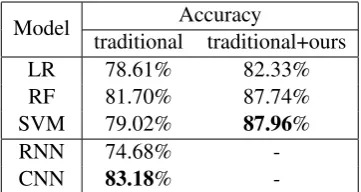
-Table 4: Results for QR task. For LR (logistic re-gression), RF (random forest) and SVM (support vec-tor machine), “traditional” means n-gram word and POS features. “+ours” means adding the 33 fea-tures that pass the significant test in Table 2 and Ta-ble3. For LSTM (long-short term memory network) and CNN (convolution neural network), “traditional” means word and POS embeddings.
In addition, we randomly sample 134K ques-tions that are not appeared in OQRanD to build six language models (LMs) based on 1, 2, 3 gram word and POS features, respectively. Table 3
indicates that questions with smaller perplexity (i.e. more familiar) are always better.
Imitate good questions. Since a number of questions have already aroused a large range of open discussion, can we get more answers by im-itating them? We pick 80K questions that are not appeared in OQRanD with the highest answer number as “good questions” and train six LMs (similar to above). Table 3 shows that the less perplexity a question gets, the more answers it arouses. In conclusion, imitating good questions helps. We also explore if news headlines are worth imitating. On one hand, they are carefully-written concise texts. On the other hand, as pointed out by Wei and Wan (2017), a lot of Chinese news headlines are intentionally written to be attention-getting. From Table3, it turns out that imitating their word use is useful.
3.3 Question Evaluation Model
Based on OQRanD and our conclusions about how language use affects the answer that a question re-ceives, we can train models to predict which ques-tion can receive more answers in each pair. Since questions in the same pair only differ in language use, models based on OQRanD can concentrate on linguistic facts to avoid being domain-specific.
Given pair (q1, q2), we label it as “1” if n1 > n2, otherwise we use label “0”. In this way, our
task turns into a binary classification task. We fur-ther train a modelFswhich inputs a question and
outputs a score. The largerFs(·), the more answer is expected. By comparingFs(q1), Fs(q2), we can
make the final prediction. Although we can also use bothq1, q2 as inputs and train a model that
di-rectly outputs label 0 or 1, usingFs on q1, q2
re-spectively is more flexible when we need to rank more than two question. Besides, Fs can be di-rectly used for getting rewards during the rein-forcement QG process.
We use several models asFs, and perform train-ing based on the htrain-inge loss. Table 4 shows the accuracy of different models (hyper-parameters and training details are provided in the appendix). When features in Section 3.2 are not used, the CNN model gets the best performance, which is not surprised. However, adding these features greatly improves the performance of all statistical models, making SVM and RF significantly sur-pass CNN. This illustrates the importance of lin-guistic factors.
4 Question Generation
In this section, we perform openQG. We construct OQGenD, the first dataset for openQG as far as we know, and propose a model based on CGAN. Especially, we use the question evaluation model based on OQRanD to introduce prior knowledge. Finally, we perform experiments and use multiple evaluation metrics (including our linguistic-based model) and reach to the conclusions.
4.1 Construction of OQGenD
Since real-world news are suitable for arousing open discussion, we built OQGenD from news and open-answered questions. We crawled news (published in the last three years) from Tencent News4, and performed data cleaning (removing non-textual components and filtering out redun-dant data) to get 59K news at last. To make ques-tions in OQGenD suitable for open discussion, we ranked the 11.5M questions mentioned in Sec-tion3.1by their number of answers from large to small and picked the first half (576K).
To match news and questions, we first used au-tomatic ways to find a “candidate dataset” and then performed human labeling to build our final OQGenD dataset. To get the candidate dataset, three heuristic unsupervised methods were used to compute the distance between a piece of news
[image:6.595.91.272.62.158.2]Figure 3: Architecture of our model.
and a question: (1)term frequency-inverse doc-ument frequency (tf-idf), which first extracted 5 (10) key words from each question (news) by tf-idf values, and then measured distances by the number of intersected key words; (2)cosine dis-tance, which is based on the bag-of-words model; (3)weighted averaged word embeddings, which was proposed byArora et al.(2016). It first com-puted a weighted average of the word vectors in the sentence and then performed a “common com-ponent removal”. For each piece of news, we picked out questions with the smallest two dis-tances under each method.
We further hired five native speakers to label the candidate dataset. An NQ-pair was preserved only if it was appropriate for a human to raise the ques-tion given the piece of news. In other words, the question should be related to the given news while not mentioning extra information. In case that too many NQ-pairs were discarded, we allowed hu-man labelers to perform two kinds of modifica-tions on each question to preserve more data. First, we allowed them to modify the question in an NQ-pair by at most two entities, e.g. change it from “马 克龙是怎样一个人?(What is Macron like?)” to “特朗普是怎样的一个人(What is Trump like?)”. Second, we allowed them to use a meaningful sub-string to replace the original question. We ensured that each NQ-pair was labeled by three people, and it was preserved in OQGenD only if all of them agreed. In this way, we got 20K NQ-pairs. Among these pairs, there were 9K news, each cor-responding with more than one questions. The av-erage word numbers in each piece of news, ques-tion were 508, 12, respectively.
4.2 Model
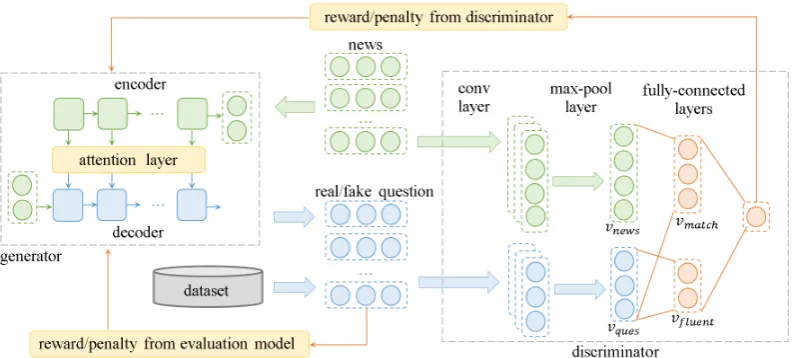
As shown in Figure3, our model is composed by a generatorGθand a discriminatorDφ.Gθoutputs a questionYˆ = {yˆ1,yˆ2, ...,yˆn}from given news
X = {x1, x2, ..., xm}. It is a Seq2seq network with the attention mechanism (Luong et al.,2015). Both encoder and decoder are GRU (Chung et al.,
2014) networks. Dφ takes an NQ-pair (X, YD) as input, and predicts how likely it comes from real-world dataset. First, it embeds theX, YD into
vnews,vques respectively by two CNNs similar to
Zhang and Wallace(2015). Based on the two rep-resentations, it computes
vmatch=Wm[vnews;vques] +bm
vf luent=Wf vques+bf
(4)
where [vnews;vques] is the concatenation of the two vectors vnews,vques, and Wm,Wf,bm,bf are parameters of our model. We expect vmatch to measure if the question matches the news, and
vf luentto measure if the question is fluent enough (like human-written questions). The final predic-tionDφ(X, YD)is computed by
Dφ(X, YD) =σ(Wproj[vmatch;vf luent] +bproj) (5) whereσis thesigmoidfunction andWproj,bproj are parameters. As we can see, bothGθ(X) and
Algorithm 1Training process.
Input: NQ-pairs(X, Y)from OQGenD; Genera-torGθ; DiscriminatorDφ; EvaluatorQ;
Output: Well-trained generator. 1: InitializeGθ, Dφ(Qis frozen); 2: Pre-trainGθon(X, Y)by MLE; 3: repeat
4: ford-stepsdo
5: SampleYˆ ∼Gθ( ˆY|X);
6: UseX, Y,Yˆ to generate fake NQ-pairs (Xf, Yf);
7: TrainDφon real NQ-pairs(X, Y)and fake NQ-pairs(Xf, Yf)by Eq.6; 8: end for
9: forg-stepsdo
10: SampleYˆ ∼Gθ( ˆY|X);
11: Compute rewards forYˆ by Eq.10; 12: UpdateGθon(X,Yˆ)by Eq.9; 13: end for
14: untilG,Dconverge
4.3 Adversarial Training
The training process of GAN is formalized as a game in which the generative model is trained to generate outputs to fool the discriminator ( Good-fellow et al., 2014). For our model, the training process is described in algorithm1.
Before adversarial training, we pre-trainGθ by maximizing the log probability of a question Y
given X (X, Y come from OQGenD), i.e. Max-imum Likelihood Estimate (MLE), as described inSutskever et al.,2014. This is helpful for mak-ing the adversarial trainmak-ing process more stable. Besides, the parameters of our question evaluation modelQis frozen during the whole process.
We iteratively perform d-steps and g-steps to train Dφ, Gθ respectively during the adversarial traing process. In d-steps, we fix the parameters of
Gθ, and the inputs forDφare three-folds: (1) NQ-pairs(X, Y)from OQGenD. (2) News and ques-tions generated byGθ, i.e.(X,Yˆ). (3) Unmatched NQ-pairs created from OQGenD. We label “real data” (1) as “1”; and regard both (2), (3) as “fake data” with label “0”. It is worth mentioning that the unmatched NQ-pairs are used to keepDφfrom only focusing on the questions. To trainDφ, we minimize the objective function:
JD(φφφ) =−E(X,Y)∼Preal datalogDφφφ(X, Y)
−E(X,Y)∼P
fake datalog(1−Dφφφ(X, Y)) (6)
Since text-generation is a discrete process, we cannot directly useDφ(X,Yˆ) to updateθ inGθ. A commonly-used idea (Yu et al.,2017;Li et al.,
2017) is to trainGθbased on policy gradient (
Sut-ton et al.,2000). In this case, Gθ is regarded as a policy network. At time-step t, state st is the generated text Yˆ[1:t], and action at is generating the next wordyˆt+1with a probabilityπG(at|st) =
pG(ˆyt+1|Yˆ[1:t], X). To get rewardrt, we perform
Monte-Carlo search, i.e. sampleYˆ[1:t]into a com-plete sentenceYˆM Cforktimes, and perform:
rt= 1
k
k
X
i=1
Dφ( ˆYM C(i) , X) (7)
After gettingrt,θis updated by minimizing
JG(θθθ) =−E[
X
t
rt·logπ(at|st)] (8)
We can also change Eq 8 into a penalty-based version:
JG0 (θθθ) =E[
X
t
(1−rt)·π(at|st)]
=JG(θθθ) +E[
X
t
π(at|st)]
(9)
whereE[Ptπ(at|st)]can be viewed as a regular-ization term. It forces the generator to prefer a smallerπ(at|st). In this way, it can generate more diversified results.
Since we have already trained a question evalu-ation modelFs(·)in Section3.3, we can use:
rt= 1
k
k
X
i=1
(γDφ( ˆYM C(i) , X) + (1−γ)Fs( ˆYM C(i) ))
(10) to replace Eq.7. In Eq.10, we add prior knowl-edge about “how language use affects the num-ber of answers” into the adversarial training pro-cess through reinforcement learning, and expect the linguistic affects that we have discovered can throw light on the text generation process.
4.4 Experiments
We choose several typical text-generation models as baselines. We apply a Seq2seq model similar toDu et al.(2017), and use a CopyNet similar to
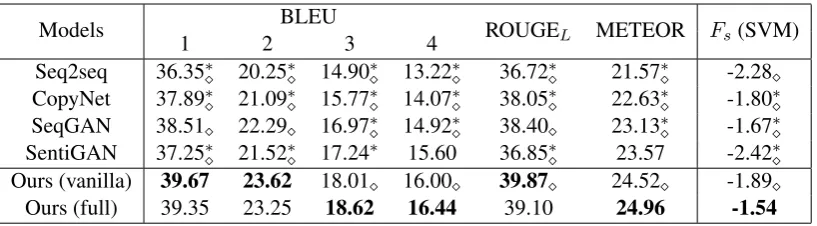
Models BLEU ROUGEL METEOR Fs(SVM)
1 2 3 4
Seq2seq 36.35∗ 20.25∗ 14.90∗ 13.22∗ 36.72∗ 21.57∗ -2.28
CopyNet 37.89∗ 21.09∗ 15.77∗ 14.07∗ 38.05∗ 22.63∗ -1.80∗
SeqGAN 38.51 22.29 16.97∗ 14.92∗ 38.40 23.13∗ -1.67∗
SentiGAN 37.25∗ 21.52∗ 17.24∗ 15.60 36.85∗ 23.57 -2.42∗
Ours (vanilla) 39.67 23.62 18.01 16.00 39.87 24.52 -1.89
[image:9.595.96.505.61.174.2]Ours (full) 39.35 23.25 18.62 16.44 39.10 24.96 -1.54
Table 5: Results for openQG.∗ () denotes that our vanilla (full) model differs from the baseline significantly based on one-side paired t-test withp <0.05.
version uses Eq. 7 to compute rewards, and the “full” version uses Eq.10(the SVM model which gets the best performance in Table 4are adopted asFs). More details about hyper-parameters and training process are provided in the appendix.
We adopt the commonly-used BLEU, ROUGE-L and METEOR for question evaluation. Besides, our score functionFs based on OQRanD is also used. Similarly, we choose the the SVM model which gets the best performance in Table 4. We compute Fs( ˆY) for each generated question Yˆ, and report the average value in “Fs-SVM” col-umn of Table5. As mentioned above,Fs shows if the generated questions are expected to receive more answers thus are more suitable for open dis-cussion. The higher Fs a model gets, the better performance it has.
The results of our experiments are listed in Ta-ble 5. When it comes to BLEU, ROUGE-L and METEOR, our models get the best performance. This shows the advantage of making both of the generator and discriminator conditioned on input news. Besides, the full version of our model gets the best BLEU-3, BLEU-4 and METEOR values by introducing the linguistic-based question evalu-ation model during adversarial training. Of all the baselines, SentiGAN gets the best performances on BLEU-3 and BLEU-4, which is largely con-tributed by its penalty based objective function. Since the same piece of news always corresponds with multiple questions (and these questions may differ a lot) in OQGenD, models based on adver-sarial training (SeqGAN, SentiGAN and ours) al-ways get better results than others (Seq2seq and CopyNet).
When it comes to Fs, the full version of our model gets the best performance, which illustrates that information from the SVM model is useful to generate questions with better quality. Besides, we
can also use the conclusions in Section3.2to com-pare different models, e.g. questions generated by our full version model are the most concise (9.68 words per question). On the other hand, Senti-GAN generates the longest questions (11.54 words per question).
5 Conclusion and Future Work
In this paper, we take the first step on teaching ma-chines to ask open-answered questions from news for open discussion. To generate high-qualified questions, we analysis how language use affects the number of answers that a question receives based on OQRanD, a dataset created by variable control. These conclusions help us to build ques-tion evaluaques-tion models, and can also used to com-pare results of different question generation mod-els. For question generation, we propose a model based on CGAN using reinforcement learning to introduce information from our evaluation model. Experiments show that our model outperforms commonly-used text generation methods.
There are many future works to be done. First, we will explore more powerful QG structure to deal with the huge difference between the length of input and output texts. Besides, how to bet-ter leverage prior knowledge during openQG (like human often do) is also interesting. Finally, com-bining openQG with its reverse task, openQA, is also worth exploration.
Acknowledgments
References
Sanjeev Arora, Yingyu Liang, and Tengyu Ma. 2016. A simple but tough-to-beat baseline for sentence em-beddings.
Youmna Borghol, Sebastien Ardon, Niklas Carlsson, Derek Eager, and Anirban Mahanti. 2012. The un-told story of the clones: content-agnostic factors that impact youtube video popularity. InProceedings of the 18th ACM SIGKDD international conference on Knowledge discovery and data mining, pages 1186– 1194. ACM.
Junyoung Chung, Caglar Gulcehre, KyungHyun Cho, and Yoshua Bengio. 2014. Empirical evaluation of gated recurrent neural networks on sequence model-ing. arXiv preprint arXiv:1412.3555.
Kenneth Mark Colby, Sylvia Weber, and Franklin Den-nis Hilf. 1971. Artificial paranoia. Artificial Intelli-gence, 2(1):1–25.
Cristian Danescu-Niculescu-Mizil, Justin Cheng, Jon Kleinberg, and Lillian Lee. 2012. You had me at hello: How phrasing affects memorability. In Pro-ceedings of the 50th Annual Meeting of the Associ-ation for ComputAssoci-ational Linguistics: Long Papers-Volume 1, pages 892–901. Association for Compu-tational Linguistics.
Xinya Du, Junru Shao, and Claire Cardie. 2017. Learn-ing to ask: Neural question generation for readLearn-ing comprehension. arXiv preprint arXiv:1705.00106.
Nan Duan, Duyu Tang, Peng Chen, and Ming Zhou. 2017. Question generation for question answering. In Proceedings of the 2017 Conference on Empiri-cal Methods in Natural Language Processing, pages 866–874.
Hady Elsahar, Christophe Gravier, and Frederique Laforest. 2018. Zero-shot question generation from knowledge graphs for unseen predicates and entity types. arXiv preprint arXiv:1802.06842.
Zhihao Fan, Zhongyu Wei, Siyuan Wang, Yang Liu, and Xuanjing Huang. 2018. A reinforcement learn-ing framework for natural question generation uslearn-ing bi-discriminators. InProceedings of the 27th Inter-national Conference on Computational Linguistics, pages 1763–1774.
Alejandro Figueroa and Günter Neumann. 2013. Learning to rank effective paraphrases from query logs for community question answering. In Twenty-Seventh AAAI Conference on Artificial Intelligence.
Yifan Gao, Jianan Wang, Lidong Bing, Irwin King, and Michael R Lyu. 2018. Difficulty controllable ques-tion generaques-tion for reading comprehension. arXiv preprint arXiv:1807.03586.
Ian Goodfellow, Jean Pouget-Abadie, Mehdi Mirza, Bing Xu, David Warde-Farley, Sherjil Ozair, Aaron
Courville, and Yoshua Bengio. 2014. Generative ad-versarial nets. In Advances in neural information processing systems, pages 2672–2680.
Marco Guerini, Alberto Pepe, and Bruno Lepri. 2012. Do linguistic style and readability of scientific ab-stracts affect their virality? InSixth International AAAI Conference on Weblogs and Social Media.
Marco Guerini, Carlo Strapparava, and Gozde Ozbal. 2011. Exploring text virality in social networks. InFifth International AAAI Conference on Weblogs and Social Media.
Michael Heilman and Noah A Smith. 2010. Good question! statistical ranking for question genera-tion. InHuman Language Technologies: The 2010 Annual Conference of the North American Chap-ter of the Association for Computational Linguistics, pages 609–617. Association for Computational Lin-guistics.
Wenpeng Hu, Bing Liu, Jinwen Ma, Dongyan Zhao, and Rui Yan. 2018. Aspect-based question genera-tion.
Hafedh Hussein, Mohammed Elmogy, and Shawkat Guirguis. 2014. Automatic english question gen-eration system based on template driven scheme. International Journal of Computer Science Issues (IJCSI), 11(6):45.
Vishwajeet Kumar, Kireeti Boorla, Yogesh Meena, Ganesh Ramakrishnan, and Yuan-Fang Li. 2018a. Automating reading comprehension by generating question and answer pairs. In Pacific-Asia Con-ference on Knowledge Discovery and Data Mining, pages 335–348. Springer.
Vishwajeet Kumar, Ganesh Ramakrishnan, and Yuan-Fang Li. 2018b. A framework for automatic ques-tion generaques-tion from text using deep reinforcement learning.arXiv preprint arXiv:1808.04961.
Igor Labutov, Sumit Basu, and Lucy Vanderwende. 2015. Deep questions without deep understanding. In Proceedings of the 53rd Annual Meeting of the Association for Computational Linguistics and the 7th International Joint Conference on Natural Lan-guage Processing (Volume 1: Long Papers), vol-ume 1, pages 889–898.
Alon Lavie and Abhaya Agarwal. 2007. Meteor: An automatic metric for mt evaluation with high levels of correlation with human judgments. In Proceed-ings of the Second Workshop on Statistical Machine Translation, pages 228–231. Association for Com-putational Linguistics.
Joseph Lee Rodgers and W Alan Nicewander. 1988. Thirteen ways to look at the correlation coefficient. The American Statistician, 42(1):59–66.
Chin-Yew Lin. 2004. Rouge: A package for auto-matic evaluation of summaries. Text Summarization Branches Out.
David Lindberg, Fred Popowich, John Nesbit, and Phil Winne. 2013. Generating natural language ques-tions to support learning on-line. InProceedings of the 14th European Workshop on Natural Language Generation, pages 105–114.
Minh-Thang Luong, Hieu Pham, and Christopher D Manning. 2015. Effective approaches to attention-based neural machine translation. arXiv preprint arXiv:1508.04025.
Karen Mazidi and Rodney D Nielsen. 2014. Linguistic considerations in automatic question generation. In Proceedings of the 52nd Annual Meeting of the As-sociation for Computational Linguistics (Volume 2: Short Papers), volume 2, pages 321–326.
Mehdi Mirza and Simon Osindero. 2014. Condi-tional generative adversarial nets. arXiv preprint arXiv:1411.1784.
Lawrence Page, Sergey Brin, Rajeev Motwani, and Terry Winograd. 1999. The pagerank citation rank-ing: Bringing order to the web. Technical report, Stanford InfoLab.
Kishore Papineni, Salim Roukos, Todd Ward, and Wei-Jing Zhu. 2002. Bleu: a method for automatic eval-uation of machine translation. In Proceedings of the 40th annual meeting on association for compu-tational linguistics, pages 311–318. Association for Computational Linguistics.
Pranav Rajpurkar, Jian Zhang, Konstantin Lopyrev, and Percy Liang. 2016. Squad: 100,000+ questions for machine comprehension of text. arXiv preprint arXiv:1606.05250.
Sudha Rao and Hal Daumé III. 2018. Learning to ask good questions: Ranking clarification questions using neural expected value of perfect information. arXiv preprint arXiv:1805.04655.
Mengye Ren, Ryan Kiros, and Richard Zemel. 2015. Exploring models and data for image question an-swering. In Advances in neural information pro-cessing systems, pages 2953–2961.
Iulian Vlad Serban, Alberto García-Durán, Caglar Gulcehre, Sungjin Ahn, Sarath Chandar, Aaron Courville, and Yoshua Bengio. 2016. Generating factoid questions with recurrent neural networks: The 30m factoid question-answer corpus. arXiv preprint arXiv:1603.06807.
Matthew P Simmons, Lada A Adamic, and Eytan Adar. 2011. Memes online: Extracted, subtracted, in-jected, and recollected. InFifth international AAAI conference on weblogs and social media.
Ilya Sutskever, Oriol Vinyals, and Quoc V Le. 2014. Sequence to sequence learning with neural net-works. InAdvances in neural information process-ing systems, pages 3104–3112.
Richard S Sutton, David A McAllester, Satinder P Singh, and Yishay Mansour. 2000. Policy gradi-ent methods for reinforcemgradi-ent learning with func-tion approximafunc-tion. InAdvances in neural informa-tion processing systems, pages 1057–1063.
Chenhao Tan, Lillian Lee, and Bo Pang. 2014. The effect of wording on message propagation: Topic-and author-controlled natural experiments on twitter. arXiv preprint arXiv:1405.1438.
Duyu Tang, Nan Duan, Tao Qin, Zhao Yan, and Ming Zhou. 2017. Question answering and ques-tion generaques-tion as dual tasks. arXiv preprint arXiv:1706.02027.
Ke Wang and Xiaojun Wan. 2018. Sentigan: Gener-ating sentimental texts via mixture adversarial net-works. InIJCAI, pages 4446–4452.
Tong Wang, Xingdi Yuan, and Adam Trischler. 2017. A joint model for question answering and question generation.arXiv preprint arXiv:1706.01450.
Yansen Wang, Chenyi Liu, Minlie Huang, and Liqiang Nie. 2018. Learning to ask questions in open-domain conversational systems with typed decoders.
Wei Wei and Xiaojun Wan. 2017. Learning to identify ambiguous and misleading news headlines. arXiv preprint arXiv:1705.06031.
Joseph Weizenbaum et al. 1966. Eliza—a computer program for the study of natural language communi-cation between man and machine. Communications of the ACM, 9(1):36–45.
Kaichun Yao, Libo Zhang, Tiejian Luo, Lili Tao, and Yanjun Wu. 2018. Teaching machines to ask ques-tions. InIJCAI, pages 4546–4552.
Lantao Yu, Weinan Zhang, Jun Wang, and Yong Yu. 2017. Seqgan: Sequence generative adversarial nets with policy gradient. InThirty-First AAAI Confer-ence on Artificial IntelligConfer-ence.
Xingdi Yuan, Tong Wang, Caglar Gulcehre, Alessan-dro Sordoni, Philip Bachman, Sandeep Subrama-nian, Saizheng Zhang, and Adam Trischler. 2017. Machine comprehension by text-to-text neural ques-tion generaques-tion.arXiv preprint arXiv:1705.02012.
Ye Zhang and Byron Wallace. 2015. A sensitivity anal-ysis of (and practitioners’ guide to) convolutional neural networks for sentence classification. arXiv preprint arXiv:1510.03820.
A Details of Language Model
In this section, we introduce the details of our lan-guage models described in section3.2.
We used the HanLP toolkit5perform word seg-mentation. The toolkit was also used to get the POS of each word. To train language models, we adopted the SRILM toolkit6. During this process,
we used modified kneser-ney smoothing for all the language models based on word n-grams and witten-bell smoothing for language models based on POS n-grams.
B Details of Question Evaluation Models
In this section, we introduce the details of our question evaluation models described in sec-tion3.3.
We adopted the Ranklib toolkit 7 to train the random forest model. For the SVM model, we used the SVM-rank toolkit 8. More specifically, we set the trade-off between training error and margin of SVM to 3 and chose the linear kernel function.
For CNN and RNN models, the word embed-ding size is 128, and the size of POS embedembed-ding is 32. The RNN model is a single-layer bidirectional LSTM network with 128 hidden units. As for the CNN model, the convolution layer contains filters whose sizes are 160×1, 160×2, 160×3, 160
×4. The counts for each kind of filters are 64, 64, 64, 64, and the stride for each of them is 1. Af-ter the convolution layer, there is a max-pooling layer and a fully connected layer with the sigmoid activation to get the final result.
C Details of Question Generation models
In this section, we introduce the details of our question generation model described in sec-tion4.2.
Our model is composed by a generator and a discriminator. The generator is a typical seq2seq model. It has three components: an encoder net-work, a decoder network and an attention network. The encoder is a single-layer bidirectional GRU with 64 hidden units while the decoder is a single-layer unidirectional GRU with 128 hidden units. The CNN of discriminator for news contains fil-ters whose sizes are 128×1, 128×2, 128×3,
5
http://hanlp.linrunsoft.com 6
http://www.speech.sri.com/projects/srilm/ 7
http://www.lemurproject.org/ranklib.php
8http://www.cs.cornell.edu/people/tj/svm_light/svm_rank.html
128×4, 128×5. The counts for each kind of fil-ters are 32, 64, 64, 32, 16, and the stride for each of them is is set to 1. The CNN of discriminator for questions contains filters whose sizes are 128
×1, 128×2, 128×3, 128×4. The counts for each kind of filters are 32, 64, 64, 32, and the stride for each of them is set to 1.
D Examples of Our Datasets
Topics
宗教(Religion) 自然科学(Science) 职场(Workplace) 政治(Politics) 运动健身(Physical Exercise) 娱乐(Entertainment) 游戏(Game) 影视(Film and Television)
音乐(Music) 艺术(Art)
心理学(Psychology) 体育(Sports)
时尚(Fashion) 社会科学(Social Sciences) 设计(Design) 商业(Business)
人文(Humanity) 情感(Emotion)
汽车(Car) 美食(Food)
旅行(Travel) 科技(Science and Technology) 军事(Military) 经济(Economics)
金融(Finance) 教育(Education) 健康(Health) 家居(Home Furnishing)
工程学(Engineering) 法律(Law)
宠物(Pets) 财务(Finance)
动漫(Comic) 母婴(Mother and Child) 其他(Other) 两性(Bisexual)
[image:14.595.154.443.78.353.2]ACG
Table 6: Topics of our questions.
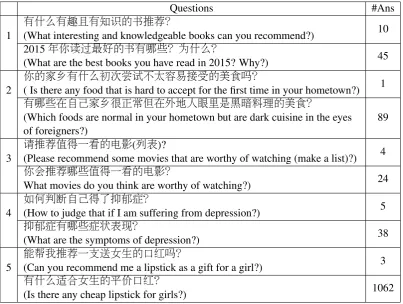
Questions #Ans
1
有什么有趣且有知识的书推荐?
(What interesting and knowledgeable books can you recommend?) 10 2015年你读过最好的书有哪些?为什么?
(What are the best books you have read in 2015? Why?) 45
2
你的家乡有什么初次尝试不太容易接受的美食吗?
( Is there any food that is hard to accept for the first time in your hometown?) 1 有哪些在自己家乡很正常但在外地人眼里是黑暗料理的美食?
(Which foods are normal in your hometown but are dark cuisine in the eyes of foreigners?)
89
3
请推荐值得一看的电影(列表)?
(Please recommend some movies that are worthy of watching (make a list)?) 4 你会推荐哪些值得一看的电影?
What movies do you think are worthy of watching?) 24
4
如何判断自己得了抑郁症?
(How to judge that if I am suffering from depression?) 5 抑郁症有哪些症状表现?
(What are the symptoms of depression?) 38
5
能帮我推荐一支送女生的口红吗?
(Can you recommend me a lipstick as a gift for a girl?) 3 有什么适合女生的平价口红?
[image:14.595.98.502.416.720.2](Is there any cheap lipstick for girls?) 1062
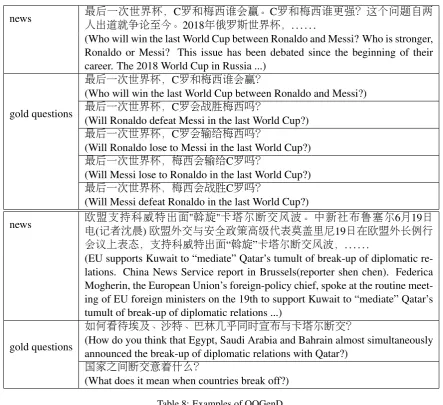
news 最后一次世界杯,C罗和梅西谁会赢。C罗和梅西谁更强?这个问题自两 人出道就争论至今。2018年俄罗斯世界杯,. . . .
(Who will win the last World Cup between Ronaldo and Messi? Who is stronger, Ronaldo or Messi? This issue has been debated since the beginning of their career. The 2018 World Cup in Russia ...)
gold questions
最后一次世界杯,C罗和梅西谁会赢?
(Who will win the last World Cup between Ronaldo and Messi?) 最后一次世界杯,C罗会战胜梅西吗?
(Will Ronaldo defeat Messi in the last World Cup?) 最后一次世界杯,C罗会输给梅西吗?
(Will Ronaldo lose to Messi in the last World Cup?) 最后一次世界杯,梅西会输给C罗吗?
(Will Messi lose to Ronaldo in the last World Cup?) 最后一次世界杯,梅西会战胜C罗吗?
(Will Messi defeat Ronaldo in the last World Cup?)
news 欧电盟支持科威特出面"斡旋"卡塔尔断交风波。中新社布鲁塞尔6月19日 (记者沈晨)欧盟外交与安全政策高级代表莫盖里尼19日在欧盟外长例行 会议上表态,支持科威特出面“斡旋”卡塔尔断交风波,. . . .
(EU supports Kuwait to “mediate” Qatar’s tumult of break-up of diplomatic re-lations. China News Service report in Brussels(reporter shen chen). Federica Mogherin, the European Union’s foreign-policy chief, spoke at the routine meet-ing of EU foreign ministers on the 19th to support Kuwait to “mediate” Qatar’s tumult of break-up of diplomatic relations ...)
gold questions
如何看待埃及、沙特、巴林几乎同时宣布与卡塔尔断交?
(How do you think that Egypt, Saudi Arabia and Bahrain almost simultaneously announced the break-up of diplomatic relations with Qatar?)
国家之间断交意着什么?
[image:15.595.77.521.205.610.2](What does it mean when countries break off?)