654
Neural Document Summarization by Jointly
Learning to Score and Select Sentences
Qingyu Zhou†∗, Nan Yang‡, Furu Wei‡, Shaohan Huang‡, Ming Zhou‡, Tiejun Zhao† †Harbin Institute of Technology, Harbin, China
‡Microsoft Research, Beijing, China
{qyzhou,tjzhao}@hit.edu.cn
{nanya,fuwei,shaohanh,mingzhou}@microsoft.com
Abstract
Sentence scoring and sentence selection are two main steps in extractive docu-ment summarization systems. However, previous works treat them as two sepa-rated subtasks. In this paper, we present a novel end-to-end neural network frame-work for extractive document summariza-tion by jointly learning to score and se-lect sentences. It first reads the doc-ument sentences with a hierarchical en-coder to obtain the representation of sen-tences. Then it builds the output sum-mary by extracting sentences one by one. Different from previous methods, our ap-proach integrates the selection strategy into the scoring model, which directly pre-dicts the relative importance given previ-ously selected sentences. Experiments on the CNN/Daily Mail dataset show that the proposed framework significantly outper-forms the state-of-the-art extractive sum-marization models.
1 Introduction
Traditional approaches to automatic text summa-rization focus on identifying important content, usually at sentence level (Nenkova and McKeown,
2011). With the identified important sentences, a summarization system can extract them to form an output summary. In recent years, extractive methodsfor summarization have proven effective in many systems (Carbonell and Goldstein,1998;
Mihalcea and Tarau,2004;McDonald,2007;Cao et al.,2015a). In previous works that use extrac-tive methods, text summarization is decomposed into two subtasks, i.e., sentence scoring and sen-tence selection.
∗
Contribution during internship at Microsoft Research.
Sentence scoring aims to assign an importance score to each sentence, and has been broadly studied in many previous works. Feature-based methods are popular and have proven effective, such as word probability, TF*IDF weights, sen-tence position and sensen-tence length features (Luhn,
1958; Hovy and Lin, 1998; Ren et al., 2017). Graph-based methods such as TextRank ( Mihal-cea and Tarau, 2004) and LexRank (Erkan and Radev,2004) measure sentence importance using weighted-graphs. In recent years, neural network has also been applied to sentence modeling and scoring (Cao et al.,2015a;Ren et al.,2017).
For the second step, sentence selection adopts a particular strategy to choose content sentence by sentence. Maximal Marginal Relevance ( Car-bonell and Goldstein, 1998) based methods se-lect the sentence that has the maximal score and is minimally redundant with sentences already in-cluded in the summary. Integer Linear Program-ming based methods (McDonald,2007) treat sen-tence selection as an optimization problem under some constraints such as summary length. Sub-modular functions (Lin and Bilmes, 2011) have also been applied to solving the optimization prob-lem of finding the optimal subset of sentences in a document. Ren et al.(2016) train two neural net-works with handcrafted features. One is used to rank sentences, and the other one is used to model redundancy during sentence selection.
In this paper, we present a neural extractive document summarization (NEUSUM) framework which jointly learns to score and select sentences. Different from previous methods that treat sen-tence scoring and sensen-tence selection as two tasks, our method integrates the two steps into one end-to-end trainable model. Specifically, NEUSUMis
measured as the gain over previously selected sen-tences. Therefore, each time the proposed model selects one sentence, it scores the sentences con-sidering both sentence saliency and previously se-lected sentences. Through the joint learning pro-cess, the model learns to predict the relative gain given the sentence extraction state and the partial output summary.
The proposed model consists of two parts, i.e., the document encoder and the sentence extractor. The document encoder has a hierarchical archi-tecture, which suits the compositionality of doc-uments. The sentence extractor is built with recur-rent neural networks (RNN), which provides two main functionalities. On one hand, the RNN is used to remember the partial output summary by feeding the selected sentence into it. On the other hand, it is used to provide a sentence extraction state that can be used to score sentences with their representations. At each step during extraction, the sentence extractor reads the representation of the last extracted sentence. It then produces a new sentence extraction state and uses it to score the relative importance of the rest sentences.
We conduct experiments on the CNN/Daily Mail dataset. The experimental results demon-strate that the proposed NEUSUMby jointly scor-ing and selectscor-ing sentences achieves significant improvements over separated methods. Our con-tributions are as follows:
• We propose a joint sentence scoring and se-lection model for extractive document sum-marization.
• The proposed model can be end-to-end trained without handcrafted features.
• The proposed model significantly outper-forms state-of-the-art methods and achieves the best result onCNN/Daily Maildataset.
2 Related Work
Extractive document summarization has been ex-tensively studied for years. As an effective ap-proach, extractive methods are popular and dom-inate the summarization research. Traditional ex-tractive summarization systems use two key tech-niques to form the summary, sentence scoring and sentence selection. Sentence scoring is critical since it is used to measure the saliency of a sen-tence. Sentence selection is based on the scores of
sentences to determine which sentence should be extracted, which is usually done heuristically.
Many techniques have been proposed to model and score sentences. Unsupervised methods do not require model training or data annotation. In these methods, many surface features are useful, such as term frequency (Luhn, 1958), TF*IDF weights (Erkan and Radev,2004), sentence length (Cao et al., 2015a) and sentence positions (Ren et al.,2017). These features can be used alone or combined with weights.
Graph-based methods (Erkan and Radev,2004;
Mihalcea and Tarau, 2004;Wan and Yang,2006) are also applied broadly to ranking sentences. In these methods, the input document is represented as a connected graph. The vertices represent the sentences, and the edges between vertices have at-tached weights that show the similarity of the two sentences. The score of a sentence is the impor-tance of its corresponding vertex, which can be computed using graph algorithms.
Machine learning techniques are also widely used for better sentence modeling and importance estimation.Kupiec et al.(1995) use a Naive Bayes classifier to learn feature combinations. Conroy and O’leary(2001) further use a Hidden Markov Model in document summarization. Gillick and Favre(2009) find that using bigram features con-sistently yields better performance than unigrams or trigrams for ROUGE (Lin,2004) measures.
Carbonell and Goldstein (1998) proposed the Maximal Marginal Relevance (MMR) method as a heuristic in sentence selection. Systems using MMR select the sentence which has the maximal score and is minimally redundant with previous selected sentences. McDonald (2007) treats sen-tence selection as an optimization problem under some constraints such as summary length. There-fore, he uses Integer Linear Programming (ILP) to solve this optimization problem. Sentence selec-tion can also be seen as finding the optimal sub-set of sentences in a document. Lin and Bilmes
(2011) propose using submodular functions to find the subset.
a two-level attention mechanism to measure the contextual relations of sentences.Cheng and Lap-ata(2016) propose treating document summariza-tion as a sequence labeling task. They first en-code the sentences in the document and then clas-sify each sentence into two classes, i.e., extraction or not. Nallapati et al. (2017) propose a system called SummaRuNNer with more features, which also treat extractive document summarization as a sequence labeling task. The two works are both in the separated paradigm, as they first assign a probability of being extracted to each sentence, and then select sentences according to the prob-ability until reaching the length limit. Ren et al.
(2016) train two neural networks with handcrafted features. One is used to rank the sentences to se-lect the first sentence, and the other one is used to model the redundancy during sentence selec-tion. However, their model of measuring the re-dundancy only considers the rere-dundancy between the sentence that has the maximal score, which lacks the modeling of all the selection history.
3 Problem Formulation
Extractive document summarization aims to ex-tract informative sentences to represent the im-portant meanings of a document. Given a doc-ument D = (S1, S2, . . . , SL) containing L
sen-tences, an extractive summarization system should select a subset ofD to form the output summary
S = {Sˆi|Sˆi ∈ D}. During the training phase, the reference summaryS∗and the score of an
out-put summaryS under a given evaluation function r(S|S∗) are available. The goal of training is to learn a scoring functionf(S) which can be used to find the best summary during testing:
arg max S
f(S)
s.t. S={Sˆi|Sˆi ∈ D}
|S| ≤l.
wherelis length limit of the output summary. In this paper,lis the sentence number limit.
Previous state-of-the-art summarization sys-tems search the best solution using the learned scoring function f(·) with two methods, MMR and ILP. In this paper, we adopt the MMR method. Since MMR tries to maximize the relative gain given previous extracted sentences, we let the model to learn to score this gain. Previous works adopt ROUGE recall as the evaluation r(·)
con-sidering the DUC tasks have byte length limit for summaries. In this work, we adopt theCNN/Daily Mail dataset to train the neural network model, which does not have this length limit. To prevent the tendency of choosing longer sentences, we use ROUGEF1 as the evaluation functionr(·), and set the length limitlas a fixed number of sentences.
Therefore, the proposed model is trained to learn a scoring function g(·) of the ROUGE F1 gain, specifically:
g(St|St−1) =r(St−1∪ {St})−r(St−1) (1)
where St−1 is the set of previously selected
sen-tences, and we omit the condition S∗ ofr(·) for simplicity. At each timet, the summarization sys-tem chooses the sentence with maximal ROUGE
F1 gain until reaching the sentence number limit.
4 Neural Document Summarization
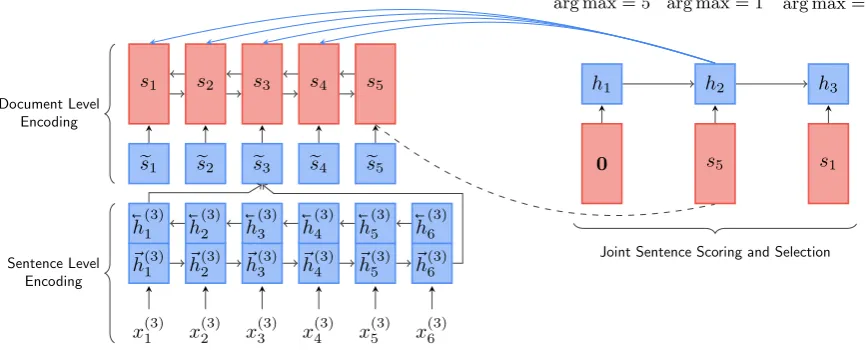
Figure1 gives the overview of NEUSUM, which consists of a hierarchical document encoder, and a sentence extractor. Considering the intrinsic hier-archy nature of documents, that words form a sen-tence and sensen-tences form a document, we employ a hierarchical document encoder to reflect this hi-erarchy structure. The sentence extractor scores the encoded sentences and extracts one of them at each step until reaching the output sentence num-ber limit. In this section, we will first introduce the hierarchical document encoder, and then de-scribe how the model produces summary by joint sentence scoring and selection.
4.1 Document Encoding
We employ a hierarchical document encoder to represent the sentences in the input document. We encode the document in two levels, i.e., sentence level encoding and document level encoding. Given a documentD= (S1, S2, . . . , SL) contain-ingLsentences. The sentence level encoder reads thej-th input sentenceSj = (x
(j) 1 , x
(j) 2 , . . . , x
(j) nj)
and constructs the basic sentence representation
e
sj. Here we employ a bidirectional GRU (BiGRU) (Cho et al.,2014) as the recurrent unit, where GRU is defined as:
zi =σ(Wz[xi, hi−1])
ri =σ(Wr[xi, hi−1])
ehi = tanh(Wh[xi, rihi−1])
hi = (1−zi)hi−1+ziehi
(2)
(3)
(4)
~h(3) 1
x(3)1
~h
(3) 1
~h(3) 2
x(3)2
~h
(3) 2
~h(3) 3
x(3)3
~h
(3) 3
~h(3) 4
x(3)4
~h
(3) 4
~h(3) 5
x(3)5
~h
(3) 5
~h(3) 6
x(3)6
~h
(3) 6 s1
e
s1 s2
e
s2 s3
e
s3 s4
e
s4 s5
e
s5
Sentence Level Encoding Document Level
Encoding
h1
0
h2
s5
h3
s1
Joint Sentence Scoring and Selection
[image:4.595.80.514.68.243.2]arg max = 5 arg max = 1 arg max =?
Figure 1: Overview of the NEUSUMmodel. The model extractsS5andS1at the first two steps. At the
first step, we feed the model a zero vector0to represent empty partial output summary. At the second and third steps, the representations of previously selected sentencesS5 andS1, i.e.,s5 ands1, are fed
into the extractor RNN. At the second step, the model only scores the first 4 sentences since the 5th one is already included in the partial output summary.
whereWz,WrandWhare weight matrices. The BiGRU consists of a forward GRU and a backward GRU. The forward GRU reads the word embeddings in sentence Sj from left to right and gets a sequence of hidden states, (~h(1j), ~h2(j), . . . ,~h(njj)). The backward GRU reads
the input sentence embeddings reversely, from right to left, and results in another sequence of
hid-den states,( (1~hj), ~h2(j), . . . , ~h(njj)):
~h(j)
i =GRU(x (j) i ,~h
(j) i−1)
~h
(j)
i =GRU(x (j) i , ~h
(j) i+1)
(6)
(7)
where the initial states of the BiGRU are set to zero vectors, i.e.,~h(1j)= 0and ~h(njj)= 0.
After reading the words of the sentenceSj, we construct its sentence level representation esj by concatenating the last forward and backward GRU hidden vectors:
e
sj =
"
~h
(j) 1
~h(j) nj
#
(8)
We use another BiGRU as the document level encoder to read the sentences. With the sen-tence level encoded vectors (se1,se2, . . . ,esL) as inputs, the document level encoder does for-ward and backfor-ward GRU encoding and produces two list of hidden vectors: (~s1, ~s2, . . . , ~sL) and ( 1~s , ~s2, . . . , ~sL). The document level
representa-tion si of sentence Si is the concatenation of the
forward and backward hidden vectors:
si =
~si
~s
i
(9)
We then get the final sentence vectors in the given document:D= (s1, s2, . . . , sL). We use sentence
Siand its representative vectorsiinterchangeably in this paper.
4.2 Joint Sentence Scoring and Selection
Since the separated sentence scoring and selection cannot utilize the information of each other, the goal of our model is to make them benefit each other. We couple these two steps together so that: a) sentence scoring can be aware of previously se-lected sentences; b) sentence selection can be sim-plified since the scoring function is learned to be the ROUGEscore gain as described in section3.
Given the last extracted sentenceSˆt−1, the
the document sentences. Specifically, the GRU takes the document level representationst−1of the
last extracted sentence Sˆt−1 as input to produce
its current hidden state ht. The sentence scorer, which is a two-layer MLP, takes two input vec-tors, namely the current hidden state ht and the sentence representation vectorsi, to calculate the scoreδ(Si)of sentenceSi.
ht=GRU(st−1, ht−1)
δ(Si) =Wstanh (Wqht+Wdsi)
(10) (11)
whereWs,WqandWdare learnable parameters, and we omit the bias parameters for simplicity.
When extracting the first sentence, we initialize the GRU hidden stateh0 with a linear layer with
tanh activation function:
h0= tanh (Wm 1~s +bm)
S0=∅
s0=0
(12)
(13)
(14)
whereWm andbm are learnable parameters, and
~s
1is the last backward state of the document level
encoder BiGRU. Since we do not have any sen-tences extracted yet, we use a zero vector to repre-sent the previous extracted repre-sentence, i.e.,s0=0.
With the scores of all sentences at time t, we choose the sentence with maximal gain score:
ˆ
St= arg max Si∈D
δ(Si) (15)
4.3 Objective Function
Inspired by Inan et al. (2017), we optimize the Kullback-Leibler (KL) divergence of the model predictionPand the labeled training data distribu-tionQ. We normalize the predicted sentence score δ(Si)with softmax function to get the model pre-diction distributionP:
P( ˆSt=Si) =
exp (δ(Si))
PL
k=1exp (δ(Sk))
(16)
During training, the model is expected to learn the relative ROUGEF1 gain at time steptwith
pre-viously selected sentencesSt−1. Considering that
the F1 gain value might be negative in the labeled data, we follow previous works (Ren et al.,2017) to use Min-Max Normalization to rescale the gain value to[0,1]:
g(Si) =r(St−1∪ {Si})−r(St−1)
e
g(Si) =
g(Si)−min (g(S)) max (g(S))−min (g(S))
(17)
(18)
We then apply a softmax operation with tempera-tureτ(Hinton et al.,2015)1to produce the labeled data distributionQas the training target. We apply the temperatureτas a smoothing factor to produce a smoothed label distributionQ:
Q(Si) = PLexp (τeg(Si)) k=1exp (τeg(Sk))
(19)
Therefore, we minimize theKLloss functionJ:
J =DKL(P kQ) (20)
5 Experiments
5.1 Dataset
A large scale dataset is essential for training neu-ral network-based summarization models. We use theCNN/Daily Maildataset (Hermann et al.,2015;
Nallapati et al., 2016) as the training set in our experiments. TheCNN/Daily Mail news contain articles and their corresponding highlights. The highlights are created by human editors and are abstractive summaries. Therefore, the highlights are not ready for training extractive systems due to the lack of supervisions.
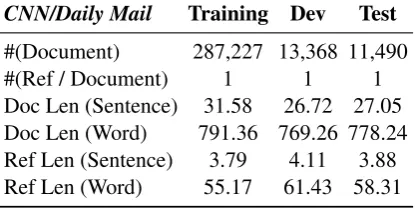
We create an extractive summarization train-ing set based onCNN/Daily Mailcorpus. To de-termine the sentences to be extracted, we design a rule-based system to label the sentences in a given document similar toNallapati et al.(2017). Specifically, we construct training data by maxi-mizing the ROUGE-2 F1 score. Since it is com-putationally expensive to find the global optimal combination of sentences, we employ a greedy ap-proach. Given a document withn sentences, we enumerate the candidates from1-combination n1 to n-combination nn. We stop searching if the highest ROUGE-2 F1 score in nk is less than the best one in k−1n . Table 1 shows the data statistics of theCNN/Daily Maildataset.
We conduct data preprocessing using the same method2 inSee et al. (2017), including sentence splitting and word tokenization. Both Nallapati et al.(2016,2017) use theanonymizedversion of the data, where the named entities are replaced by identifiers such asentity4. FollowingSee et al.
(2017), we use thenon-anonymizedversion so we can directly operate on the original text.
1
We setτ = 20empirically according to the model per-formance on the development set.
CNN/Daily Mail Training Dev Test
#(Document) 287,227 13,368 11,490
#(Ref / Document) 1 1 1
[image:6.595.78.286.66.170.2]Doc Len (Sentence) 31.58 26.72 27.05 Doc Len (Word) 791.36 769.26 778.24 Ref Len (Sentence) 3.79 4.11 3.88 Ref Len (Word) 55.17 61.43 58.31
Table 1: Data statistics ofCNN/Daily Maildataset.
5.2 Implementation Details
Model Parameters The vocabulary is collected from theCNN/Daily Mailtraining data. We lower-case the text and there are 732,304 unique word types. We use the top 100,000 words as the model vocabulary since they can cover 98.23% of the training data. The size of word embedding, sen-tence level encoder GRU, document level encoder GRU are set to 50, 256, and 256 respectively. We set the sentence extractor GRU hidden size to 256.
Model Training We initialize the model param-eters randomly using a Gaussian distribution with Xavier scheme (Glorot and Bengio, 2010). The word embedding matrix is initialized using pre-trained 50-dimension GloVe vectors (Pennington et al., 2014)3. We found that larger size GloVe does not lead to improvement. Therefore, we use 50-dim word embeddings for fast training. The pre-trained GloVe vectors contain 400,000 words and cover 90.39% of our model vocabulary. We initialize the rest of the word embeddings ran-domly using a Gaussian distribution with Xavier scheme. The word embedding matrix is not up-dated during training. We use Adam (Kingma and Ba, 2015) as our optimizing algorithm. For the hyperparameters of Adam optimizer, we set the learning rate α = 0.001, two momentum param-etersβ1 = 0.9andβ2 = 0.999respectively, and
= 10−8. We also apply gradient clipping ( Pas-canu et al.,2013) with range[−5,5]during train-ing. We use dropout (Srivastava et al., 2014) as regularization with probability p = 0.3 after the sentence level encoder andp = 0.2after the doc-ument level encoder. We truncate each article to 80 sentences and each sentence to 100 words dur-ing both traindur-ing and testdur-ing. The model is imple-mented with PyTorch (Paszke et al., 2017). We
3https://nlp.stanford.edu/projects/
glove/
release the source code and related resources at
https://res.qyzhou.me.
Model Testing At test time, considering that LEAD3 is a commonly used and strong extractive baseline, we make NEUSUMand the baselines ex-tract 3 sentences to make them all comparable.
5.3 Baseline
We compare NEUSUM model with the following state-of-the-art baselines:
LEAD3 The commonly used baseline by select-ing the first three sentences as the summary.
TEXTRANK An unsupervised algorithm based on weighted-graphs proposed by Mihalcea and Tarau (2004). We use the implementa-tion in Gensim (Reh˚uˇrek and Sojkaˇ ,2010).
CRSUM Ren et al.(2017) propose an extractive summarization system which considers the contextual information of a sentence. We train this baseline model with the same train-ing data as our approach.
NN-SE Cheng and Lapata(2016) propose an ex-tractive system which models document sum-marization as a sequence labeling task. We train this baseline model with the same train-ing data as our approach.
SUMMARUNNER Nallapati et al.(2017) propose to add some interpretable features such as sentence absolute and relative positions.
PGN Pointer-Generator Network (PGN). A state-of-the-art abstractive document summariza-tion system proposed by See et al. (2017), which incorporates copying and coverage mechanisms.
5.4 Evaluation Metric
We employ ROUGE(Lin,2004) as our evaluation
5.5 Results
We use the official ROUGE script4(version 1.5.5) to evaluate the summarization output. Table 2
summarizes the results on CNN/Daily Mail data set using full length ROUGE-F15evaluation. It in-cludes two unsupervised baselines, LEAD3 and TEXTRANK. The table also includes three state-of-the-art neural network based extractive models, i.e., CRSUM, NN-SE and SUMMARUNNER. In addition, we report the state-of-the-art abstractive PGN model. The result of SUMMARUNNERis on theanonymized dataset and not strictly compara-ble to our results on the non-anonymizedversion dataset. Therefore, we also include the result of LEAD3 on theanonymizeddataset as a reference.
Models ROUGE-1 ROUGE-2 ROUGE-L
LEAD3 40.24- 17.70- 36.45 -TEXTRANK 40.20- 17.56- 36.44 -CRSUM 40.52- 18.08- 36.81 -NN-SE 41.13- 18.59- 37.40 -PGN‡ 39.53- 17.28- 36.38
-LEAD3‡* 39.2 15.7 35.5
SUMMARUNNER‡* 39.6 16.2 35.3
[image:7.595.333.501.225.275.2]NEUSUM 41.59 19.01 37.98
Table 2: Full length ROUGE F1 evaluation (%) onCNN/Daily Mailtest set. Results with‡ mark are taken from the corresponding papers. Those marked with * were trained and evaluated on the anonymized dataset, and so are not strictly com-parable to our results on the original text. All our ROUGEscores have a 95% confidence interval of at most±0.22 as reported by the official ROUGE script. The improvement is statistically significant with respect to the results with superscript-mark.
NEUSUMachieves 19.01 ROUGE-2 F1 score on theCNN/Daily Maildataset. Compared to the un-supervised baseline methods, NEUSUMperforms
better by a large margin. In terms of ROUGE -2 F1, NEUSUM outperforms the strong baseline LEAD3 by 1.31 points. NEUSUM also
outper-forms the neural network based models. Com-pared to the state-of-the-art extractive model NN-SE (Cheng and Lapata,2016), NEUSUMperforms
significantly better in terms of ROUGE-1, ROUGE -2 and ROUGE-L F1 scores. Shallow features, such
4
http://www.berouge.com/ 5The ROUGE evaluation option is, -m -n 2
as sentence position, have proven effective in doc-ument summarization (Ren et al.,2017;Nallapati et al., 2017). Without any hand-crafted features, NEUSUM performs better than the CRSUM and SUMMARUNNER baseline models with features. As given by the 95% confidence interval in the of-ficial ROUGE script, our model achieves
statisti-cally significant improvements over all the base-line models. To the best of our knowledge, the pro-posed NEUSUMmodel achieves the best results on
theCNN/Daily Maildataset.
Models Info Rdnd Overall
NN-SE 1.36 1.29 1.39
NEUSUM 1.33 1.21 1.34
Table 3: Rankings of NEUSUM and NN-SE in terms of informativeness (Info), redundancy (Rdnd) and overall quality by human participants (lower is better).
We also provide human evaluation results on a sample of test set. We random sample 50 docu-ments and ask three volunteers to evaluate the out-put of NEUSUMand the NN-SE baseline models. They are asked to rank the output summaries from best to worst (with ties allowed) regarding infor-mativeness, redundancy and overall quality. Table
3shows the human evaluation results. NEUSUM
performs better than the NN-SE baseline on all three aspects, especially in redundancy. This in-dicates that by jointly scoring and selecting sen-tences, NEUSUMcan produce summary with less
content overlap since it re-estimates the saliency of remaining sentences considering both their con-tents and previously selected sentences.
6 Discussion
6.1 Precision at Step-t
We analyze the accuracy of sentence selection at each step. Since we extract 3 sentences at test time, we show how NEUSUM performs when ex-tracting each sentence. Given a document D in test set T, NEUSUM predicted summary S, its reference summary S∗, and the extractive oracle summaryOwith respect toDandS∗(we use the method described in section 5.1 to construct O), we define the precision at steptasp(@t):
p(@t) = 1
|T| X
D∈T
1 2 3 4 5 6 7 8 9 10 11 12 13 14 15 16 17 18 19 20 21 22 23 24 25 26 27 28 29 30
0
10
20
30
% of sentence position
[image:8.595.80.524.70.188.2]NN-SE
NeuSum
oracle
Figure 2: Position distribution of selected sentences of the NN-SE baseline, our NEUSUMmodel and
oracle on the test set. We only draw the first 30 sentences since the average document length is 27.05.
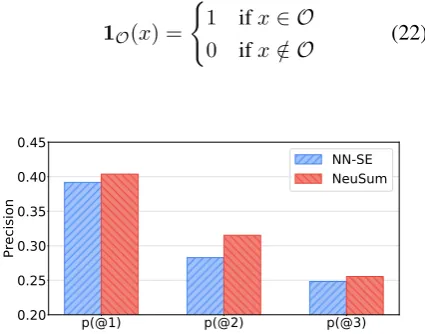
whereS[t]is the sentence extracted at stept, and
1O is the indicator function defined as:
1O(x) =
(
1 ifx∈ O
0 ifx /∈ O (22)
p(@1) p(@2) p(@3) 0.20
0.25 0.30 0.35 0.40 0.45
Precision
[image:8.595.76.289.291.458.2]NN-SE NeuSum
Figure 3: Precision of extracted sentence at stept of the NN-SE baseline and the NEUSUMmodel.
Figure3shows the precision at steptof NN-SE baseline and our NEUSUM. It can be observed that
NEUSUMachieves better precision than the NN-SE baseline at each step. For the first sentence, both NEUSUMand NN-SE achieves good
perfor-mance. The NN-SE baseline has 39.18% preci-sion at the first step, and NEUSUM outperforms it by 1.2 points. At the second step, NEUSUM
outperforms NN-SE by a large margin. In this step, the NEUSUM model extracts 31.52% sen-tences correctly, which is 3.24 percent higher than 28.28% of NN-SE. We think the second step se-lection benefits from the first step in NEUSUM
since it can remember the selection history, while the separated models lack this ability.
However, we can notice the trend that the pre-cision drops fast after each selection. We think this is due to two main reasons. First, we think that the error propagation leads to worse selection
for the third selection. As shown in Figure 2, the p(@1)andp(@2)are 40.38% and 31.52% respec-tively, so the history is less reliable for the third selection. Second, intuitively, we think the later selections are more difficult compared to the pre-vious ones since the most important sentences are already selected.
6.2 Position of Selected Sentences
Early works (Ren et al., 2017; Nallapati et al.,
2017) have shown that sentence position is an im-portant feature in extractive document summariza-tion. Figure2 shows the position distributions of the NN-SE baseline, our NEUSUMmodel and or-acle on theCNN/Daily Mailtest set. It can be seen that the NN-SE baseline model tends to extract large amount of leading sentences, especially the leading three sentences. According to the statis-tics, about 80.91% sentences selected by NN-SE baseline are in leading three sentences.
In the meanwhile, our NEUSUM model selects 58.64% leading three sentences. We can notice that in the oracle, the percentage of selecting lead-ing sentences (sentence 1 to 5) is moderate, which is around 10%. Compared to NN-SE, the posi-tion of selected sentences in NEUSUMis closer to
the oracle. Although NEUSUMalso extracts more leading sentences than the oracle, it selects more tailing ones. For example, our NEUSUM model
Intuitively, leading sentences are important for a well-organized article, especially for newswire ar-ticles. It is also well known that LEAD3 is a very strong baseline. In the training data, we found that 50.98% sentences labeled as “should be extracted” belongs to the first 5 sentences, which may cause the trained model tends to select more leading sen-tences. One possible situation is that one sentence in the tail of a document is more important than the leading sentences, but the margin between them is not large enough. The models which separately score and select sentences might not select sen-tences in the tail whose scores are not higher than the leading ones. These methods may choose the safer leading sentences as a fallback in such con-fusing situation because there is no direct competi-tion between the leading and tailing candidates. In our NEUSUMmodel, the scoring and selection are jointly learned, and at each step the tailing candi-dates can compete directly with the leading ones. Therefore, NEUSUMcan be more discriminating when dealing with this situation.
7 Conclusion
Conventional approaches to extractive document summarization contain two separated steps: sen-tence scoring and sensen-tence selection. In this pa-per, we present a novel neural network frame-work for extractive document summarization by jointly learning to score and select sentences to ad-dress this issue. The most distinguishing feature of our approach from previous methods is that it combines sentence scoring and selection into one phase. Every time it selects a sentence, it scores the sentences according to the partial output sum-mary and current extraction state. ROUGE evalua-tion results show that the proposed joint sentence scoring and selection approach significantly out-performs previous separated methods.
Acknowledgments
We thank three anonymous reviewers for their helpful comments. We also thank Danqing Huang, Chuanqi Tan, Zhirui Zhang, Shuangzhi Wu and Wei Jia for helpful discussions. The work of this paper is funded by the project of National Key Research and Development Program of China (No. 2017YFB1002102) and the project of Na-tional Natural Science Foundation of China (No. 91520204). The first author is funded by the Harbin Institute of Technology Scholarship Fund.
References
Ziqiang Cao, Furu Wei, Li Dong, Sujian Li, and Ming Zhou. 2015a. Ranking with recursive neural net-works and its application to multi-document sum-marization. InAAAI, pages 2153–2159.
Ziqiang Cao, Furu Wei, Sujian Li, Wenjie Li, Ming Zhou, and WANG Houfeng. 2015b. Learning sum-mary prior representation for extractive summariza-tion. In Proceedings of the 53rd Annual Meet-ing of the Association for Computational LMeet-inguistics and the 7th International Joint Conference on Natu-ral Language Processing (Volume 2: Short Papers), volume 2, pages 829–833.
Jaime Carbonell and Jade Goldstein. 1998. The use of mmr, diversity-based reranking for reordering doc-uments and producing summaries. InProceedings of the 21st annual international ACM SIGIR confer-ence on Research and development in information retrieval, pages 335–336. ACM.
Jianpeng Cheng and Mirella Lapata. 2016. Neural summarization by extracting sentences and words. In Proceedings of the 54th Annual Meeting of the Association for Computational Linguistics (Volume 1: Long Papers), pages 484–494, Berlin, Germany. Association for Computational Linguistics.
Kyunghyun Cho, Bart van Merrienboer, Caglar Gul-cehre, Dzmitry Bahdanau, Fethi Bougares, Holger Schwenk, and Yoshua Bengio. 2014. Learning phrase representations using rnn encoder–decoder for statistical machine translation. InProceedings of EMNLP 2014, pages 1724–1734, Doha, Qatar. As-sociation for Computational Linguistics.
John M Conroy and Dianne P O’leary. 2001. Text sum-marization via hidden markov models. In Proceed-ings of the 24th annual international ACM SIGIR conference on Research and development in infor-mation retrieval, pages 406–407. ACM.
G¨unes Erkan and Dragomir R Radev. 2004. Lexrank: Graph-based lexical centrality as salience in text summarization. Journal of Artificial Intelligence Research, 22:457–479.
Dan Gillick and Benoit Favre. 2009. A scalable global model for summarization. In Proceedings of the Workshop on Integer Linear Programming for Natu-ral Langauge Processing, pages 10–18. Association for Computational Linguistics.
Xavier Glorot and Yoshua Bengio. 2010. Understand-ing the difficulty of trainUnderstand-ing deep feedforward neural networks. InAistats, volume 9, pages 249–256.
Geoffrey Hinton, Oriol Vinyals, and Jeff Dean. 2015. Distilling the knowledge in a neural network. arXiv preprint arXiv:1503.02531.
Eduard Hovy and Chin-Yew Lin. 1998. Automated text summarization and the summarist system. In Pro-ceedings of a workshop on held at Baltimore, Mary-land: October 13-15, 1998, pages 197–214. Associ-ation for ComputAssoci-ational Linguistics.
Hakan Inan, Khashayar Khosravi, and Richard Socher. 2017. Tying word vectors and word classifiers: A loss framework for language modeling. In Proceed-ings of 5th International Conference for Learning Representations.
Diederik Kingma and Jimmy Ba. 2015. Adam: A method for stochastic optimization. InProceedings of 3rd International Conference for Learning Repre-sentations, San Diego.
Julian Kupiec, Jan Pedersen, and Francine Chen. 1995. A trainable document summarizer. InProceedings of the 18th annual international ACM SIGIR confer-ence on Research and development in information retrieval, pages 68–73. ACM.
Chin-Yew Lin. 2004. Rouge: A package for auto-matic evaluation of summaries. InText summariza-tion branches out: Proceedings of the ACL-04 work-shop, volume 8. Barcelona, Spain.
Hui Lin and Jeff Bilmes. 2011. A class of submodu-lar functions for document summarization. In Pro-ceedings of the 49th Annual Meeting of the Associ-ation for ComputAssoci-ational Linguistics: Human Lan-guage Technologies-Volume 1, pages 510–520. As-sociation for Computational Linguistics.
Hans Peter Luhn. 1958. The automatic creation of lit-erature abstracts. IBM Journal of research and de-velopment, 2(2):159–165.
Ryan McDonald. 2007. A study of global inference al-gorithms in multi-document summarization. In Eu-ropean Conference on Information Retrieval, pages 557–564. Springer.
Rada Mihalcea and Paul Tarau. 2004. Textrank: Bring-ing order into text. InProceedings of the 2004 con-ference on empirical methods in natural language processing.
Ramesh Nallapati, Feifei Zhai, and Bowen Zhou. 2017. Summarunner: A recurrent neural network based se-quence model for extractive summarization of docu-ments. InAAAI, pages 3075–3081.
Ramesh Nallapati, Bowen Zhou, C¸ a glar Gulc¸ehre, and Bing Xiang. 2016. Abstractive text summariza-tion using sequence-to-sequence rnns and beyond. InProceedings of The 20th SIGNLL Conference on Computational Natural Language Learning.
Ani Nenkova and Kathleen McKeown. 2011. Auto-matic summarization. Foundations and TrendsR in Information Retrieval, 5(2–3):103–233.
Razvan Pascanu, Tomas Mikolov, and Yoshua Bengio. 2013. On the difficulty of training recurrent neural networks. ICML (3), 28:1310–1318.
Adam Paszke, Sam Gross, Soumith Chintala, Gre-gory Chanan, Edward Yang, Zachary DeVito, Zem-ing Lin, Alban Desmaison, Luca Antiga, and Adam Lerer. 2017. Automatic differentiation in pytorch.
Jeffrey Pennington, Richard Socher, and Christo-pher D. Manning. 2014. Glove: Global vectors for word representation. InEmpirical Methods in Nat-ural Language Processing (EMNLP), pages 1532– 1543.
Radim ˇReh˚uˇrek and Petr Sojka. 2010. Software Frame-work for Topic Modelling with Large Corpora. In Proceedings of the LREC 2010 Workshop on New Challenges for NLP Frameworks, pages 45–50, Val-letta, Malta. ELRA.
Pengjie Ren, Zhumin Chen, Zhaochun Ren, Furu Wei, Jun Ma, and Maarten de Rijke. 2017. Leveraging contextual sentence relations for extractive summa-rization using a neural attention model. In Pro-ceedings of the 40th International ACM SIGIR Con-ference on Research and Development in Informa-tion Retrieval, pages 95–104, New York, NY, USA. ACM.
Pengjie Ren, Furu Wei, CHEN Zhumin, MA Jun, and Ming Zhou. 2016. A redundancy-aware sentence regression framework for extractive summarization. In Proceedings of COLING 2016, the 26th Inter-national Conference on Computational Linguistics: Technical Papers, pages 33–43.
Abigail See, Peter J. Liu, and Christopher D. Manning. 2017. Get to the point: Summarization with pointer-generator networks. InProceedings of the 55th An-nual Meeting of the Association for Computational Linguistics (Volume 1: Long Papers), pages 1073– 1083, Vancouver, Canada. Association for Compu-tational Linguistics.
Nitish Srivastava, Geoffrey E Hinton, Alex Krizhevsky, Ilya Sutskever, and Ruslan Salakhutdinov. 2014. Dropout: a simple way to prevent neural networks from overfitting. Journal of Machine Learning Re-search, 15(1):1929–1958.