Modeling Coverage for Neural Machine Translation
Zhaopeng Tu† Zhengdong Lu† Yang Liu‡ Xiaohua Liu† Hang Li†
†Noah’s Ark Lab, Huawei Technologies, Hong Kong
{tu.zhaopeng,lu.zhengdong,liuxiaohua3,hangli.hl}@huawei.com ‡Department of Computer Science and Technology, Tsinghua University, Beijing
Abstract
Attention mechanism has enhanced state-of-the-art Neural Machine Translation (NMT) by jointly learning to align and translate. It tends to ignore past alignment information, however, which often leads to over-translation and under-translation. To address this problem, we propose coverage-based NMT in this paper. We maintain a coverage vector to keep track of the attention history. The coverage vec-tor is fed to the attention model to help ad-just future attention, which lets NMT sys-tem to consider more about untranslated source words. Experiments show that the proposed approach significantly im-proves both translation quality and align-ment quality over standard attention-based NMT.1
1 Introduction
The past several years have witnessed the rapid progress of end-to-end Neural Machine Transla-tion (NMT) (Sutskever et al., 2014; Bahdanau et al., 2015). Unlike conventional Statistical Ma-chine Translation (SMT) (Koehn et al., 2003; Chi-ang, 2007), NMT uses a single and large neural network to model the entire translation process. It enjoys the following advantages. First, the use of distributed representations of words can alleviate the curse of dimensionality (Bengio et al., 2003). Second, there is no need to explicitly design fea-tures to capture translation regularities, which is quite difficult in SMT. Instead, NMT is capable of learning representations directly from the training data. Third, Long Short-Term Memory (Hochre-iter and Schmidhuber, 1997) enables NMT to
cap-1Our code is publicly available athttps://github.
com/tuzhaopeng/NMT-Coverage.
ture long-distance reordering, which is a signifi-cant challenge in SMT.
NMT has a serious problem, however, namely lack of coverage. In phrase-based SMT (Koehn et al., 2003), a decoder maintains a coverage vec-tor to indicate whether a source word is translated or not. This is important for ensuring that each source word is translated in decoding. The decod-ing process is completed when all source words are “covered” or translated. In NMT, there is no such coverage vector and the decoding process ends only when the end-of-sentence mark is pro-duced. We believe that lacking coverage might result in the following problems in conventional NMT:
1. Over-translation: some words are unneces-sarily translated for multiple times;
2. Under-translation: some words are mistak-enly untranslated.
Specifically, in the state-of-the-art attention-based NMT model (Bahdanau et al., 2015), generating a target word heavily depends on the relevant parts of the source sentence, and a source word is in-volved in generation of all target words. As a result, over-translation and under-translation in-evitably happen because of ignoring the “cover-age” of source words (i.e., number of times a source word is translated to a target word). Fig-ure 1(a) shows an example: the Chinese word “gu¯anb`ı” is over translated to “close(d)” twice, while “b`eip`o” (means “be forced to”) is mistak-enly untranslated.
In this work, we propose a coverage mechanism to NMT (NMT-COVERAGE) to alleviate the
over-translation and under-over-translation problems. Basi-cally, we append a coverage vector to the inter-mediate representations of an NMT model, which are sequentially updated after each attentive read
(a) Over-translation and under-translation
[image:2.595.322.503.77.269.2]generated by NMT. (b) Coverage model alleviates the problems ofover-translation and under-translation.
Figure 1: Example translations of (a) NMT without coverage, and (b) NMT with coverage. In conven-tional NMT without coverage, the Chinese word “gu¯anb`ı” is over translated to “close(d)” twice, while “b`eip`o” (means “be forced to”) is mistakenly untranslated. Coverage model alleviates these problems by tracking the “coverage” of source words.
during the decoding process, to keep track of the attention history. The coverage vector, when en-tering into attention model, can help adjust the fu-ture attention and significantly improve the over-all alignment between the source and target sen-tences. This design contains many particular cases for coverage modeling with contrasting character-istics, which all share a clear linguistic intuition and yet can be trained in a data driven fashion. No-tably, we achieve significant improvement even by simply using the sum of previous alignment prob-abilities as coverage for each word, as a success-ful example of incorporating linguistic knowledge into neural network based NLP models.
Experiments show that NMT-COVERAGE
sig-nificantly outperforms conventional attention-based NMT on both translation and alignment tasks. Figure 1(b) shows an example, in which NMT-COVERAGE alleviates the over-translation
and under-translation problems that NMT without coverage suffers from.
2 Background
[image:2.595.314.522.394.527.2]Our work is built on attention-based NMT (Bah-danau et al., 2015), which simultaneously con-ducts dynamic alignment and generation of the target sentence, as illustrated in Figure 2. It
Figure 2: Architecture of attention-based NMT. Whenever possible, we omit the source indexjto make the illustration less cluttered.
produces the translation by generating one target wordyiat each time step. Given an input sentence
x={x1, . . . , xJ}and previously generated words {y1, . . . , yi−1}, the probability of generating next
wordyi is
P(yi|y<i,x) =softmax g(yi−1,ti,si) (1)
wheregis a non-linear function, andtiis a
decod-ing state for time stepi, computed by
ti =f(ti−1, yi−1,si) (2)
a distinct source representation for time i, calcu-lated as a weighted sum of the source annotations:
si = J
X
j=1
αi,j·hj (3)
where hj = [−→h>j ;←−h>j ]
>
is the annotation of xj from a bi-directional Recurrent Neural
Net-work (RNN) (Schuster and Paliwal, 1997), and its weightαi,j is computed by
αi,j = PJexp(ei,j)
k=1exp(ei,k) (4)
and
ei,j =a(ti−1,hj)
=va>tanh(Wati−1+Uahj) (5)
is anattention modelthat scores how well yi and
hj match. With the attention model, it avoids the
need to represent the entire source sentence with a single vector. Instead, the decoder selects parts of the source sentence to pay attention to, thus exploits an expected annotation si over possible
alignmentsαi,j for each time stepi.
However, the attention model fails to take ad-vantage of past alignment information, which is found useful to avoid over-translation and under-translation problems in conventional SMT (Koehn et al., 2003). For example, if a source word is translated in the past, it is less likely to be trans-lated again and should be assigned a lower align-ment probability.
3 Coverage Model for NMT
In SMT, a coverage set is maintained to keep track of which source words have been translated (“cov-ered”) in the past. Let us takex={x1, x2, x3, x4}
as an example of input sentence. The initial cov-erage set is C = {0,0,0,0} which denotes that no source word is yet translated. When a trans-lation rulebp = (x2x3, ymym+1) is applied, we
produce one hypothesis labelled with coverage
[image:3.595.323.511.60.162.2]C={0,1,1,0}. It means that the second and third source words are translated. The goal is to gener-ate translation with full coverageC ={1,1,1,1}. A source word is translated when it is covered by one translation rule, and it is not allowed to be translated again in the future (i.e.,hard coverage). In this way, each source word is guaranteed to be translated and only be translated once. As shown,
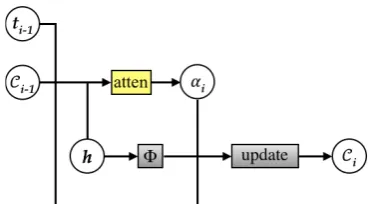
Figure 3: Architecture of coverage-based attention model. A coverage vector Ci−1 is maintained to
keep track of which source words have been trans-lated before time i. Alignment decisions αi are
made jointly taking into account past alignment information embedded inCi−1, which lets the
at-tention model to consider more about untranslated source words.
coverage is essential for SMT since it avoids gaps and overlaps in translation of source words.
Modeling coverage is also important for attention-based NMT models, since they gener-ally lack a mechanism to indicate whether a cer-tain source word has been translated, and there-fore are prone to the “coverage” mistakes: some parts of source sentence have been translated more than once or not translated. For NMT models, di-rectly modeling coverage is less straightforward, but the problem can be significantly alleviated by keeping track of the attention signal during the de-coding process. The most natural way for doing that would be to append a coverage vector to the annotation of each source word (i.e., hj), which
is initialized as a zero vector but updated after ev-ery attentive read of the corresponding annotation. The coverage vector is fed to the attention model to help adjust future attention, which lets NMT system to consider more about untranslated source words, as illustrated in Figure 3.
3.1 Coverage Model
Since the coverage vector summarizes the atten-tion record forhj (and therefore for a small
neigh-bor centering at the jth source word), it will
Formally, the coverage model is given by
Ci,j =gupdate Ci−1,j, αi,j,Φ(hj),Ψ (6)
where
• gupdate(·)is the function that updatesCi,j
af-ter the new attentionαi,jat time stepiin the
decoding process;
• Ci,j is ad-dimensional coverage vector
sum-marizing the history of attention till time step ionhj;
• Φ(hj)is a word-specific feature with its own
parameters;
• Ψare auxiliary inputs exploited in different sorts of coverage models.
Equation 6 gives a rather general model, which could take different function forms forgupdate(·)
and Φ(·), and different auxiliary inputs Ψ (e.g., previous decoding state ti−1). In the rest of this
section, we will give a number of representative implementations of the coverage model, which either leverage more linguistic information (Sec-tion 3.1.1) or resort to the flexibility of neural net-work approximation (Section 3.1.2).
3.1.1 Linguistic Coverage Model
We first consider at linguistically inspired model which has a small number of parameters, as well as clear interpretation. While the linguistically-inspired coverage in NMT is similar to that in SMT, there is one key difference: it indicates what percentage of source words have been translated (i.e.,soft coverage). In NMT, each target wordyi
is generated from all source words with probabil-ity αi,j for source word xj. In other words, the
source word xj is involved in generating all
tar-get words and the probability of generating tartar-get word yi at time step i is αi,j. Note that unlike
in SMT in which each source word isfully trans-latedat one decoding step, the source word xj is partially translatedat each decoding step in NMT. Therefore, the coverage at time stepidenotes the translated ratio of that each source word is trans-lated.
We use a scalar (d = 1) to represent linguis-tic coverage for each source word and employ an accumulate operation for gupdate. The initial
value of linguistic coverage is zero, which de-notes that the corresponding source word is not
translated yet. We iteratively construct linguis-tic coverages through accumulation of alignment probabilities generated by the attention model, each of which is normalized by a distinct context-dependent weight. The coverage of source word xj at time stepiis computed by
Ci,j =Ci−1,j+Φ1 jαi,j =
1 Φj
i
X
k=1
αk,j (7)
whereΦj is a pre-defined weight which indicates
the number of target wordsxjis expected to
gener-ate. The simplest way is to follow Xu et al. (2015) in image-to-caption translation to fixΦ = 1for all source words, which means that we directly use the sum of previous alignment probabilities with-out normalization as coverage for each word, as done in (Cohn et al., 2016).
However, in machine translation, different types of source words may contribute differently to the generation of target sentence. Let us take the sentence pairs in Figure 1 as an example. The noun in the source sentence “j¯ıchˇang” is translated into one target word “airports”, while the adjec-tive “b`eip`o” is translated into three words “were forced to”. Therefore, we need to assign a dis-tinctΦj for each source word. Ideally, we expect
Φj = PIi=1αi,j with I being the total number
of time steps in decoding. However, such desired value is not available before decoding, thus is not suitable in this scenario.
Fertility To predict Φj, we introduce the
con-cept offertility, which is firstly proposed in word-level SMT (Brown et al., 1993). Fertility of source wordxjtells how many target wordsxjproduces.
In SMT, the fertility is a random variable Φj,
whose distribution p(Φj = φ) is determined by
the parameters of word alignment models (e.g., IBM models). In this work, we simplify and adapt fertility from the original model and compute the fertilityΦj by2
Φj =N(xj|x) =N ·σ(Ufhj) (8)
whereN ∈ Ris a predefined constant to denote the maximum number of target words one source
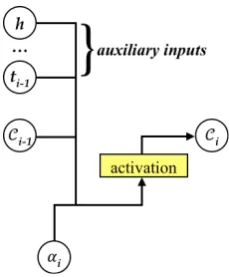
Figure 4: NN-based coverage model.
word can produce,σ(·)is a logistic sigmoid func-tion, andUf ∈ R1×2nis the weight matrix. Here
we usehj to denote(xj|x)sincehj contains
in-formation about the whole input sentence with a strong focus on the parts surrounding xj
(Bah-danau et al., 2015). SinceΦj does not depend on
i, we can pre-compute it before decoding to mini-mize the computational cost.
3.1.2 Neural Network Based Coverage Model
We next consider Neural Network (NN) based coverage model. WhenCi,jis a vector (d >1) and
gupdate(·) is a neural network, we actually have
an RNN model for coverage, as illustrated in Fig-ure 4. In this work, we take the following form:
Ci,j =f(Ci−1,j, αi,j,hj,ti−1)
wheref(·) is a nonlinear activation function and
ti−1is the auxiliary input that encodes past
trans-lation information. Note that we leave out the word-specific feature functionΦ(·) and only take the input annotation hj as the input to the
cov-erage RNN. It is important to emphasize that the NN-based coverage model is able to be fed with arbitrary inputs, such as the previous attentional contextsi−1. Here we only employCi−1,jfor past
alignment information,ti−1for past translation
in-formation, andhj for word-specific bias.3
Gating The neural functionf(·)can be either a
simple activation function tanhor a gating func-tion that proves useful to capture long-distance
3In our preliminary experiments, considering more inputs (e.g., current and previous attentional contexts, unnormal-ized attention weights ei,j) does not always lead to better translation quality. Possible reasons include: 1) the inputs contains duplicate information, and 2) more inputs introduce more back-propagation paths and therefore make it difficult to train. In our experience, one principle is to only feed the coverage model inputs that contain distinct information, which are complementary to each other.
dependencies. In this work, we adopt GRU for the gating activation since it is simple yet power-ful (Chung et al., 2014). Please refer to (Cho et al., 2014b) for more details about GRU.
Discussion Intuitively, the two types of models
summarize coverage information in “different lan-guages”. Linguistic models summarize coverage information in human language, which has a clear interpretation to humans. Neural models encode coverage information in “neural language”, which can be “understood” by neural networks and let them to decide how to make use of the encoded coverage information.
3.2 Integrating Coverage into NMT
Although attention based model has the capabil-ity of jointly making alignment and translation, it does not take into consideration translation his-tory. Specifically, a source word that has sig-nificantly contributed to the generation of target words in the past, should be assigned lower align-ment probabilities, which may not be the case in attention based NMT. To address this problem, we propose to calculate the alignment probabilities by incorporating past alignment information embed-ded in the coverage model.
Intuitively, at each time step iin the decoding phase, coverage from time step (i−1) serves as an additional input to the attention model, which provides complementary information of that how likely the source words are translated in the past. We expect the coverage information would guide the attention model to focus more on untranslated source words (i.e., assign higher alignment prob-abilities). In practice, we find that the coverage model does fulfill the expectation (see Section 5). The translated ratios of source words from lin-guistic coverages negatively correlate to the cor-responding alignment probabilities.
More formally, we rewrite the attention model in Equation 5 as
ei,j =a(ti−1,hj,Ci−1,j)
=va>tanh(Wati−1+Uahj+VaCi−1,j)
whereCi−1,jis the coverage of source wordxj
be-fore timei. Va ∈ Rn×d is the weight matrix for
4 Training
We take end-to-end learning for the NMT-COVERAGE model, which learns not only the
pa-rameters for the “original” NMT (i.e.,θfor encod-ing RNN, decodencod-ing RNN, and attention model) but also the parameters for coverage modeling (i.e.,η for annotation and guidance of attention) . More specifically, we choose to maximize the like-lihood of reference sentences as most other NMT models (see, however (Shen et al., 2016)):
(θ∗, η∗) = arg max
θ,η N
X
n=1
logP(yn|xn;θ, η) (9)
No auxiliary objective For the coverage model
with a clearer linguistic interpretation (Section 3.1.1), it is possible to inject an auxiliary objec-tive function on some intermediate representation. More specifically, we may have the following ob-jective:
(θ∗, η∗) = arg max
θ,η N
X
n=1
(
logP(yn|xn;θ, η)
−λnXJ
j=1
(Φj− I
X
i=1
αi,j)2;η
o)
where the term PJj=1(Φj−PIi=1αi,j)2;η
pe-nalizes the discrepancy between the sum of align-ment probabilities and the expected fertility for linguistic coverage. This is similar to the more explicit training for fertility as in Xu et al. (2015), which encourages the model to pay equal attention to every part of the image (i.e.,Φj = 1). However,
our empirical study shows that the combined ob-jective consistently worsens the translation quality while slightly improves the alignment quality.
Our training strategy poses less constraints on the dependency betweenΦj and the attention than
a more explicit strategy taken in (Xu et al., 2015). We let the objective associated with the transla-tion quality (i.e., the likelihood) to drive the train-ing, as in Equation 9. This strategy is arguably advantageous, since the attention weight on a hid-den state hj cannot be interpreted as the
propor-tion of the corresponding word being translated in the target sentence. For one thing, the hidden state
hj, after the transformation from encoding RNN,
bears the contextual information from other parts of the source sentence, and thus loses the rigid cor-respondence with the corresponding word. There-fore, penalizing the discrepancy between the sum
of alignment probabilities and the expected fertil-ity does not hold in this scenario.
5 Experiments
5.1 Setup
We carry out experiments on a Chinese-English translation task. Our training data for the trans-lation task consists of 1.25M sentence pairs ex-tracted from LDC corpora4, with 27.9M Chinese words and 34.5M English words respectively. We choose NIST 2002 dataset as our development set, and the NIST 2005, 2006 and 2008 datasets as our test sets. We carry out experiments of the align-ment task on the evaluation dataset from (Liu and Sun, 2015), which contains 900 manually aligned Chinese-English sentence pairs. We use the case-insensitive 4-gram NIST BLEU score (Papineni et al., 2002) for the translation task, and the align-ment error rate (AER) (Och and Ney, 2003) for the alignment task. To better estimate the qual-ity of the soft alignment probabilities generated by NMT, we propose a variant of AER, naming
SAER:
SAER= 1−|MA×|MMS|+|MA×MP| A|+|MS|
where A is a candidate alignment, and S and P are the sets of sure and possible links in the ref-erence alignment respectively (S ⊆ P). M de-notes alignment matrix, and for bothMSandMP
we assign the elements that correspond to the ex-isting links inS andP with probabilities1while assign the other elements with probabilities0. In this way, we are able to better evaluate the quality of the soft alignments produced by attention-based NMT. We use sign-test (Collins et al., 2005) for statistical significance test.
For efficient training of the neural networks, we limit the source and target vocabularies to the most frequent 30K words in Chinese and English, cov-ering approximately 97.7% and 99.3% of the two corpora respectively. All the out-of-vocabulary words are mapped to a special tokenUNK. We set N = 2for the fertility model in the linguistic cov-erages. We train each model with the sentences of length up to 80 words in the training data. The word embedding dimension is 620 and the size of a hidden layer is 1000. All the other settings are the same as in (Bahdanau et al., 2015).
# System #Params MT05 MT06 MT08 Avg.
1 Moses – 31.37 30.85 23.01 28.41
2 GroundHog 84.3M 30.61 31.12 23.23 28.32
3 + Linguistic coverage w/o fertility +1K 31.26† 32.16†‡ 24.84†‡ 29.42
4 + Linguistic coverage w/ fertility +3K 32.36†‡ 32.31†‡ 24.91†‡ 29.86
5 + NN-based coverage w/o gating (d= 1) +4K 31.94†‡ 32.11†‡ 23.31 29.12
6 + NN-based coverage w/ gating (d= 1) +10K 31.94†‡ 32.16†‡ 24.67†‡ 29.59
[image:7.595.84.518.62.173.2]7 + NN-based coverage w/ gating (d= 10) +100K 32.73†‡ 32.47†‡ 25.23†‡ 30.14
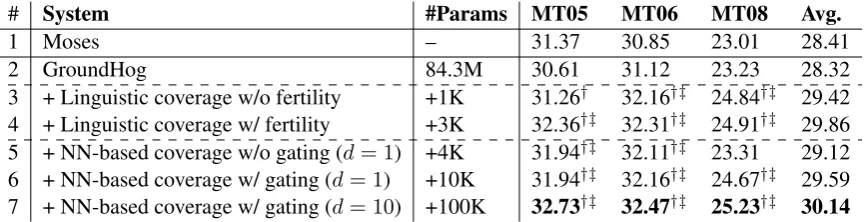
Table 1: Evaluation of translation quality. ddenotes the dimension of NN-based coverages, and†and‡
indicate statistically significant difference (p < 0.01) from GroundHog and Moses, respectively. “+” is on top of the baseline system GroundHog.
We compare our method with two state-of-the-art models of SMT and NMT5:
• Moses(Koehn et al., 2007): an open source
phrase-based translation system with default configuration and a 4-gram language model trained on the target portion of training data.
• GroundHog (Bahdanau et al., 2015): an
attention-based NMT system.
5.2 Translation Quality
Table 1 shows the translation performances mea-sured in BLEU score. Clearly the proposed NMT-COVERAGEsignificantly improves the translation
quality in all cases, although there are still consid-erable differences among different variants.
Parameters Coverage model introduces few
pa-rameters. The baseline model (i.e., GroundHog) has 84.3M parameters. The linguistic coverage using fertility introduces 3K parameters (2K for fertility model), and the NN-based coverage with gating introduces 10K×d parameters (6K×dfor gating), wheredis the dimension of the coverage vector. In this work, the most complex coverage model only introduces 0.1M additional parame-ters, which is quite small compared to the number of parameters in the existing model (i.e., 84.3M).
Speed Introducing the coverage model slows
down the training speed, but not significantly. When running on a single GPU device Tesla K80, the speed of the baseline model is 960 target words per second. System 4 (“+Linguistic coverage with fertility”) has a speed of 870 words per second, while System 7 (“+NN-based coverage (d=10)”) achieves a speed of 800 words per second.
5There are recent progress on aggregating multiple mod-els or enlarging the vocabulary(e.g., in (Jean et al., 2015)), but here we focus on the generic models.
Linguistic Coverages (Rows 3 and 4): Two
observations can be made. First, the simplest linguistic coverage (Row 3) already significantly improves translation performance by 1.1 BLEU points, indicating that coverage information is very important to the attention model. Second, in-corporating fertility model boosts the performance by better estimating the covered ratios of source words.
NN-based Coverages (Rows 5-7): (1) Gating
(Rows 5 and 6): Both variants of NN-based cover-ages outperform GroundHog with averaged gains of 0.8 and 1.3 BLEU points, respectively. In-troducing gating activation function improves the performance of coverage models, which is consis-tent with the results in other tasks (Chung et al., 2014). (2)Coverage dimensions(Rows 6 and 7): Increasing the dimension of coverage models fur-ther improves the translation performance by 0.6 point in BLEU score, at the cost of introducing more parameters (e.g., from 10K to 100K).6
5.3 Alignment Quality
Table 2 lists the alignment performances. We find that coverage information improves atten-tion model as expected by maintaining an annota-tion summarizing attenannota-tion history on each source word. More specifically, linguistic coverage with fertility significantly reduces alignment errors un-der both metrics, in which fertility plays an impor-tant role. NN-based coverages, however, does not significantly reduce alignment errors until increas-ing the coverage dimension from 1 to 10. It in-dicates that NN-based models need slightly more
(a) Groundhog (b) + NN cov. w/ gating(d= 10)
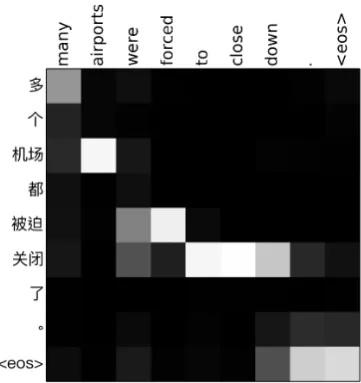
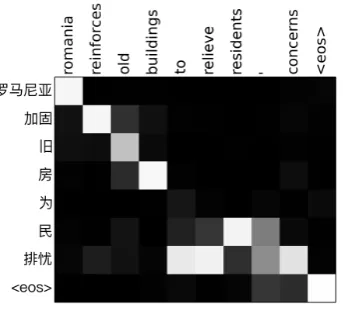
Figure 5: Example alignments. Using coverage mechanism, translated source words are less likely to contribute to generation of the target words next (e.g., top-right corner for the first four Chinese words.).
System SAER AER
GroundHog 67.00 54.67 + Ling. cov. w/o fertility 66.75 53.55 + Ling. cov. w/ fertility 64.85 52.13 + NN cov. w/o gating(d= 1) 67.10 54.46
+ NN cov. w/ gating(d= 1) 66.30 53.51
+ NN cov. w/ gating(d= 10) 64.25 50.50
Table 2: Evaluation of alignment quality. The lower the score, the better the alignment quality.
[image:8.595.340.512.77.234.2]dimensions to encode the coverage information. Figure 5 shows an example. The coverage mechanism does meet the expectation: the align-ments are more concentrated and most impor-tantly, translated source words are less likely to get involved in generation of the target words next. For example, the first four Chinese words are as-signed lower alignment probabilities (i.e., darker color) after the corresponding translation “ roma-nia reinforces old buildings” is produced.
5.4 Effects on Long Sentences
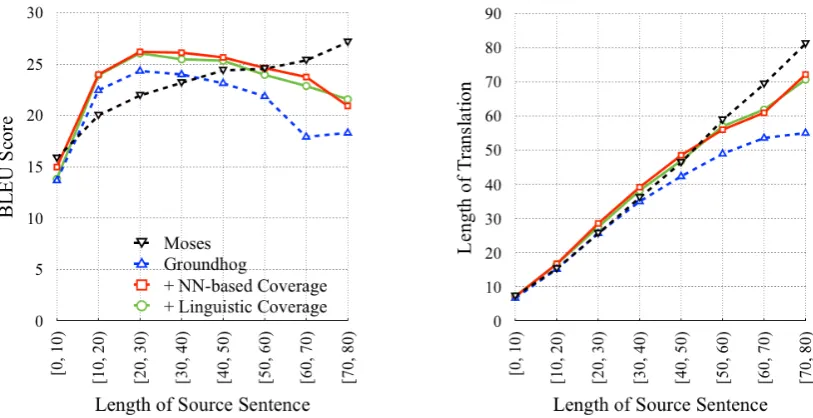
Following Bahdanau et al. (2015), we group sen-tences of similar lengths together and compute BLEU score and averaged length of translation for each group, as shown in Figure 6. Cho et al. (2014a) show that the performance of Ground-hog drops rapidly when the length of input sen-tence increases. Our results confirm these find-ings. One main reason is that Groundhog pro-duces much shorter translations on longer sen-tences (e.g., > 40, see right panel in Figure 6),
and thus faces a serious under-translation prob-lem. NMT-COVERAGEalleviates this problem by
incorporating coverage information into the atten-tion model, which in general pushes the attenatten-tion to untranslated parts of the source sentence and implicitly discourages early stop of decoding. It is worthy to emphasize that both NN-based cov-erages (with gating,d= 10) and linguistic cover-ages (with fertility) achieve similar performances on long sentences, reconfirming our claim that the two variants improve the attention model in their own ways.
As an example, consider this source sentence in the test set:
qi´aod¯an bˇen s`aij`ı p´ıngj¯un d´ef¯en 24.3f¯en , t¯a z`ai s¯an zh¯ou qi´an ji¯esh`ou shˇoush`u , qi´udu`ı z`ai cˇı q¯ıji¯an 4 sh`eng 8 f`u .
Groundhog translates this sentence into:
jordan achieved an average score of eight weeks ahead with a surgical oper-ation three weeks ago .
in which the sub-sentence “, qi´udu`ı z`ai cˇı q¯ıji¯an 4 sh`eng 8 f`u” is under-translated. With the (NN-based) coverage mechanism, NMT-COVERAGE
translates it into:
[image:8.595.74.290.316.410.2]Figure 6: Performance of the generated translations with respect to the lengths of the input sentences. Coverage models alleviate under-translation by producing longer translations on long sentences.
in which the under-translation is rectified.
The quantitative and qualitative results show that the coverage models indeed help to allevi-ate under-translation, especially for long sentences consisting of several sub-sentences.
6 Related Work
Our work is inspired by recent works on im-proving attention-based NMT with techniques that have been successfully applied to SMT. Follow-ing the success of Minimum Risk TrainFollow-ing (MRT) in SMT (Och, 2003), Shen et al. (2016) proposed MRT for end-to-end NMT to optimize model pa-rameters directly with respect to evaluation met-rics. Based on the observation that attention-based NMT only captures partial aspects of atten-tional regularities, Cheng et al. (2016) proposed agreement-based learning (Liang et al., 2006) to encourage bidirectional attention models to agree on parameterized alignment matrices. Along the same direction, inspired by the coverage mecha-nism in SMT, we propose a coverage-based ap-proach to NMT to alleviate the over-translation and under-translation problems.
Independent from our work, Cohn et al. (2016) and Feng et al. (2016) made use of the concept of “fertility” for the attention model, which is sim-ilar in spirit to our method for building the lin-guistically inspired coverage with fertility. Cohn et al. (2016) introduced a feature-based fertility that includes the total alignment scores for the
sur-rounding source words. In contrast, we make pre-diction of fertility before decoding, which works as a normalizer to better estimate the coverage ra-tio of each source word. Feng et al. (2016) used the previous attentional context to represent im-plicit fertilityand passed it to the attention model, which is in essence similar to the input-feed method proposed in (Luong et al., 2015). Compar-atively, we predictexplicit fertilityfor each source word based on its encoding annotation, and incor-porate it into the linguistic-inspired coverage for attention model.
7 Conclusion
Acknowledgement
This work is supported by China National 973 project 2014CB340301. Yang Liu is supported by the National Natural Science Foundation of China (No. 61522204) and the 863 Program (2015AA011808). We thank the anonymous re-viewers for their insightful comments.
References
[Bahdanau et al.2015] Dzmitry Bahdanau, Kyunghyun Cho, and Yoshua Bengio. 2015. Neural machine translation by jointly learning to align and translate. ICLR 2015.
[Bengio et al.2003] Yoshua Bengio, R´ejean Ducharme, Pascal Vincent, and Christian Janvin. 2003. A neu-ral probabilistic language model.JMLR.
[Brown et al.1993] Peter E. Brown, Stephen A. Della Pietra, Vincent J. Della Pietra, and Robert L. Mer-cer. 1993. The mathematics of statistical machine translation: Parameter estimation. Computational Linguistics, 19(2):263–311.
[Cheng et al.2016] Yong Cheng, Shiqi Shen, Zhongjun He, Wei He, Hua Wu, Maosong Sun, and Yang Liu. 2016. Agreement-based Joint Training for Bidirec-tional Attention-based Neural Machine Translation. InIJCAI 2016.
[Chiang2007] David Chiang. 2007. Hierarchical phrase-based translation.CL.
[Cho et al.2014a] Kyunghyun Cho, Bart van Merrien-boer, Dzmitry Bahdanau, and Yoshua Bengio. 2014a. On the properties of neural machine trans-lation: encoder–decoder approaches. InSSST 2014. [Cho et al.2014b] Kyunghyun Cho, Bart van Merrien-boer, Caglar Gulcehre, Fethi Bougares, Holger Schwenk, and Yoshua Bengio. 2014b. Learning phrase representations using rnn encoder-decoder for statistical machine translation. InEMNLP 2014. [Chung et al.2014] Junyoung Chung, Caglar Gulcehre, KyungHyun Cho, and Yoshua Bengio. 2014. Em-pirical evaluation of gated recurrent neural networks on sequence modeling. arXiv.
[Cohn et al.2016] Trevor Cohn, Cong Duy Vu Hoang, Ekaterina Vylomova, Kaisheng Yao, Chris Dyer, and Gholamreza Haffari. 2016. Incorporating Structural Alignment Biases into an Attentional Neural Translation Model. InNAACL 2016. [Collins et al.2005] Michael Collins, Philipp Koehn,
and Ivona Kuˇcerov´a. 2005. Clause restructuring for statistical machine translation. InACL 2005. [Feng et al.2016] Shi Feng, Shujie Liu, Mu Li, and
Ming Zhou. 2016. Implicit distortion and fertil-ity models for attention-based encoder-decoder nmt model. arXiv.
[Hochreiter and Schmidhuber1997] Sepp Hochreiter and J¨urgen Schmidhuber. 1997. Long short-term memory.Neural Computation.
[Jean et al.2015] S´ebastien Jean, Kyunghyun Cho, Roland Memisevic, and Yoshua Bengio. 2015. On using very large target vocabulary for neural ma-chine translation. InACL 2015.
[Koehn et al.2003] Philipp Koehn, Franz Josef Och, and Daniel Marcu. 2003. Statistical phrase-based translation. InNAACL 2003.
[Koehn et al.2007] Philipp Koehn, Hieu Hoang, Alexandra Birch, Chris Callison-Burch, Marcello Federico, Nicola Bertoldi, Brooke Cowan, Wade Shen, Christine Moran, Richard Zens, Chris Dyer, Ondrej Bojar, Alexandra Constantin, and Evan Herbst. 2007. Moses: open source toolkit for statistical machine translation. InACL 2007. [Liang et al.2006] Percy Liang, Ben Taskar, and Dan
Klein. 2006. Alignment by agreement. InNAACL 2006.
[Liu and Sun2015] Yang Liu and Maosong Sun. 2015. Contrastive unsupervised word alignment with non-local features. InAAAI 2015.
[Luong et al.2015] Minh-Thang Luong, Hieu Pham, and Christopher D Manning. 2015. Effective ap-proaches to attention-based neural machine transla-tion. InEMNLP 2015.
[Och and Ney2003] Franz J. Och and Hermann Ney. 2003. A systematic comparison of various statisti-cal alignment models. Computational Linguistics, 29(1):19–51.
[Och2003] Franz Josef Och. 2003. Minimum error rate training in statistical machine translation. In ACL 2003.
[Papineni et al.2002] Kishore Papineni, Salim Roukos, Todd Ward, and Wei-Jing Zhu. 2002. Bleu: a method for automatic evaluation of machine trans-lation. InACL 2002.
[Schuster and Paliwal1997] Mike Schuster and Kuldip K Paliwal. 1997. Bidirectional recur-rent neural networks. IEEE Transactions on Signal Processing, 45(11):2673–2681.
[Shen et al.2016] Shiqi Shen, Yong Cheng, Zhongjun He, Wei He, Hua Wu, Maosong Sun, and Yang Liu. 2016. Minimum Risk Training for Neural Machine Translation. InACL 2016.
[Sutskever et al.2014] Ilya Sutskever, Oriol Vinyals, and Quoc VV Le. 2014. Sequence to sequence learning with neural networks. InNIPS 2014. [Xu et al.2015] Kelvin Xu, Jimmy Ba, Ryan Kiros,