Proceedings of the 55th Annual Meeting of the Association for Computational Linguistics (Short Papers), pages 580–586 Vancouver, Canada, July 30 - August 4, 2017. c2017 Association for Computational Linguistics
Proceedings of the 55th Annual Meeting of the Association for Computational Linguistics (Short Papers), pages 580–586 Vancouver, Canada, July 30 - August 4, 2017. c2017 Association for Computational Linguistics
Chunk-Based Bi-Scale Decoder for Neural Machine Translation
Hao Zhou∗ Nanjing University [email protected]
Zhaopeng Tu∗ Tencent AI Lab [email protected]
Shujian Huang
Nanjing University [email protected]
Xiaohua Liu
Huawei Noah’s Ark Lab [email protected]
Hang Li
Huawei Noah’s Ark Lab [email protected]
Jiajun Chen
Nanjing University [email protected]
Abstract
In typical neural machine transla-tion (NMT), the decoder generates a sentence word by word, packing all linguistic granularities in the same time-scale of RNN. In this paper, we propose a new type of decoder for NMT, which splits the decode state into two parts and updates them in two different time-scales. Specifically, we first predict a chunk time-scale state for phrasal modeling, on top of which multiple word time-scale states are generated. In this way, the target sentence is translated hierarchically from chunks to words, with information in different granularities being leveraged. Experiments show that our proposed model significantly improves the transla-tion performance over the state-of-the-art NMT model.
1 Introduction
Recent work of neural machine translation (NMT) models propose to adopt the encoder-decoder
framework for machine translation (Kalchbrenner and Blunsom, 2013; Cho et al., 2014; Sutskever et al.,2014), which employs a recurrent neural net-work (RNN)encoderto model the source context information and a RNNdecoderto generate trans-lations, which is significantly different from previ-ous statistical machine translation systems (Koehn et al., 2003; Chiang, 2005). This framework is then extended by an attention mechanism, which acquires source sentence context dynamically at different decoding steps (Bahdanau et al., 2014;
Luong et al.,2015).
∗Work was done when Hao Zhou was interning and
Zhaopeng Tu was working at Huawei Noah’s Ark Lab.
The decoder state stores translation information at different granularities, determining which seg-ment should be expressed (phrasal), and which word should be generated (lexical), respectively. However, due to the extensive existence of multi-word phrases and expressions, the varying speed of the lexical component is much faster than the phrasal one. As in the generation of “the French Republic”, the lexical component in the decoder will change thrice, each of which for a sepa-rate word. But the phrasal component may only change once. The inconsistent varying speed of the two components may cause translation errors.
Typical NMT model generates target sentences in the word level, packing the phrasal and lexi-cal information in one hidden state, which is not necessarily the best for translation. Much previ-ous work propose to improve the NMT model by adopting fine-grained translation levels such as the character or sub-word levels, which can learn the intermediate information inside words (Ling et al.,
2015; Costa-juss`a and Fonollosa, 2016; Chung et al.,2016;Luong et al.,2016;Lee et al.,2016;
Sennrich and Haddow,2016;Sennrich et al.,2016;
Garc´ıa-Mart´ınez et al.,2016). However, high level structures such as phrases has not been explicitly explored in NMT, which is very useful for ma-chine translation (Koehn et al.,2007).
We propose a chunk-based bi-scale decoder for NMT, which explicitly splits the lexical and phrasal components into different time-scales.1 The proposed model generates target words in a hierarchical way, which deploys a standard word time-scale RNN (lexical modeling) on top of an additional chunk time-scale RNN (phrasal model-ing). At each step of decoding, our model first predict a chunk state with achunk attention, based on which multiple word states are generated with-1In this work, we focus on chunk-based well-formed phrases, which generally contain two to five words.
out attention. The word state is updated at every step, while the chunk state is only updated when the chunk boundary is detected by aboundary gate
automatically. In this way, we incorporate soft phrasesinto NMT, which makes the model flex-ible at capturing bothglobal reorderingof phrases and local translation inside phrases. Our model has following benefits:
1. The chunk-based NMT model explicitly splits the lexical and phrasal components of the decode state for different time-scales, which addresses the issue of inconsistent up-dating speeds of different components, mak-ing the model more flexible.
2. Our model recognizes phrase structures ex-plicitly. Phrase information are then used for word predictions, the representations of which are then used to help predict corre-sponding words.
3. Instead of incorporating source side linguistic information (Eriguchi et al.,2016;Sennrich and Haddow,2016), our model incorporates linguistic knowledges in the target side (for deciding chunks), which will guide the trans-lation more in line with linguistic grammars. 4. Given the predicted phrase representation, our NMT model could extract attentive source context bychunk attention, which is more specific and thus more useful compared to the word-level counterpart.
Experiments show that our proposed model obtains considerable BLEU score improvements upon an attention-based NMT baseline on the Chinese to English and the German to English datasets simultaneously.
2 Standard Neural Machine Translation Model
Generally, neural machine translation system di-rectly models the conditional probability of the translation y word by word (Bahdanau et al.,
2014). Formally, given an input sequence x = [x1, x2, . . . , xJ], and the previously generated
sequencey<t= [y1,y2,. . . ,yt−1], the probabil-ity of next target wordytis
P(yt|x) =sof tmax(f(eyt−1, st, ct)) (1)
where f(·) is a non-linear function, eyt−1 is the
embedding of yt−1; st is the decode state at the
time stept, which is computed by
st=g(st−1, eyt−1, ct) (2)
bush visits the french republic <eos>
UPDATE UPDATE COPY COPY UPDATE
Word Time-scale
Chunk Time-scale
Attention
布什 访问 法兰西 共和国
Hidden State
[image:2.595.308.540.67.213.2]Boundary Gate
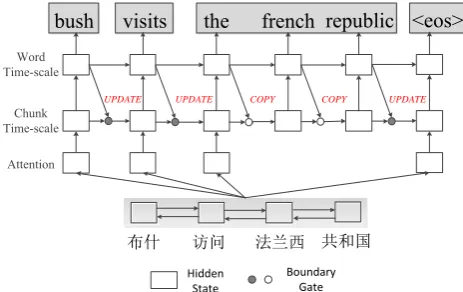
Figure 1: The architecture of the chunk-based bi-scale NMT.
Hereg(·)is a transition function of decoder RNN.
ctis the context vector computed by
ct= J !
j=1
ATT(st−1, hj)·hj = J !
j=1
αt,j·hj (3)
where ATT is an attention operation, which out-puts alignment distributionα:
αt,j =
exp(et,j) "Tx
k=1exp(et,k)
(4)
et,j =vTa tanh(Wast−1+Uahj) (5)
andh is the annotation ofxfrom a bi-directional
RNNs. The training objective is to maximize the likelihood of the training data. Beam search is adopted for decoding.
3 Chunk-Based Bi-Scale Neural Machine Translation Model
Instead of the word-based decoder, we propose to use a chunk-based bi-scale decoder, which gen-erates translation hierarchically with chunk and
word time-scales, as shown in Figure 1. Intu-itively, we firstly generate a chunk state with the attention model, which extracts the source con-text for the current phrasal scope. Then we gen-erate multiple lexical words based on the same chunk state, which does not require attention oper-ations. The boundary of a chunk is determined by aboundary gate, which decides whether to update the chunk state or not at each step.
Formally, the probability of next wordytis
P(yt|x) = sof tmax(f(eyt−1, st, pt)) (6)
hereptis the chunk state at stept. Compared with
Equations 1 and2, the generation of target word is based on the chunk state instead of the context vectorctproduced by the attention model.
Since a chunk may correspond to multiple words, we employ a boundary gate bt to decide
the boundary of each chunk:
p(bt) =sof tmax(st−1, eyt−1) (8)
btwill be0or1, where1denotes this is the
bound-ary of a new chunk while0denotes not. Two dif-ferent operations would be executed:
pt= #
pt−1, bt= 0(COPY)
g(pt−1, ept−1, pct), bt= 1(UPDATE)
In the COPYoperation, the chunk state is kept the same as the previous step. In the UPDATE op-eration, ept−1 is the representation of last chunk,
which is computed by the LSTM-minus approach (Wang and Chang,2016):
ept−1 =m(st−1, eyt−1)−m(st′, eyt′) (9)
heret′ is the boundary of last chunk andm(·)is a linear function.pctis the context vector for chunk
pt, which is calculated by achunk attentionmodel:
pct= Ts !
j=1
ATT(pt−1, hj)·hj (10)
The chunk attention model differs from the stan-dard word attention model (i.e., Equation 3) at: 1) it reads chunk statept−1rather than word state
st−1, and 2) it is only executed at boundary of each chunk rather than at each decoding step.
In this way, our model only extracts source con-text once for a chunk, and the words in one chunk will share the same context for word generation. The chunk attention mechanism adds a constrain that target words in the same chunk shares the same source context.
Training To encourage the proposed model to learn reasonable chunk state, we add two addi-tional objectives in training:
Chunk Tag Prediction: For each chunk, we
predict the probability of its tag P(lk|x) =
sof tmax$f(pt, ept, ct) %
, wherelkis the syntactic
tag of thek-th chunk such asNP(noun phrase) and
VP(verb phrase), andtis time step of its
bound-ary.
Chunk Boundary Prediction: At each decoding step, we predict the probability of chunk boundary
P(bt|x) =sof tmax(st−1, eyt−1).
Accordingly, given a set of training examples {[xn,yn]}Nn=1, the new training objective is
J(θ, γ) = arg max
N !
n=1
&
logP(yn|xn)
+ logP(ln|xn) + logP(bn|xn)
'
(11)
where ln and bn are chunk tag sequence and
boundary sequence onyn, respectively.
4 Experiments
We carry out experiments on a Chinese-English translation task. Our training data consists of 1.16M2 sentence pairs extracted from LDC cor-pora, with 25.1M Chinese words and 27.1M English words, respectively. We choose the NIST 2002 (MT02) dataset as our development set, and the NIST 2003 (MT03), 2004 (MT04) 2005 (MT05) datasets as our test sets. We also evaluate our model on the WMT translation task of German-English, newstest2014 (DE14) is adopted as development set and newstest2012, newstest2013 (DE1213) are adopted as testing set. The English sentences are labeled by a neural chunker, which is implemented according toZhou et al.(2015). We use the case-insensitive 4-gram NIST BLEU score as our evaluation metric ( Pap-ineni et al.,2002).
In training, we limit the source and target vo-cabularies to the most frequent 30K words. We train each model with the sentences of length up to 50 words. Sizes of the chunk representation and chunk hidden state are set to 1000. All the other settings are the same as inBahdanau et al.(2014).
4.1 Results on Chinese-English
We list the BLEU score of our proposed model in Table 1, comparing with Moses (Koehn et al.,
2007) and dl4mt3 (Bahdanau et al., 2014), which are state-of-the-art models of SMT and NMT, re-spective. For Moses, we use the default config-uration with a 4-gram language model trained on the target portion of the training data. For dl4mt, we also report the results (dl4mt-2) by using two 23LDC2002E18, LDC2003E14, the Hansards portion of LDC2004T08, and LDC2005T06.
System MT02 MT03 MT04 MT05 Ave.
Moses 30.10 28.82 31.22 27.78 29.48
dl4mt 31.66 29.92 32.76 28.88 30.81
dl4mt-2 31.01 28.74 31.71 27.95 29.85
[image:4.595.170.428.61.133.2]This Work 33.43 32.06 34.21 30.01 32.42
Table 1: BLEU scores for different systems.
Attention MT02 MT03 MT04 MT05 Ave.
Word 32.69 31.36 33.55 29.77 31.56
Chunk 33.43 32.06 34.21 30.01 32.42
Table 2: Results with different attention models.
decoder layers (Wu et al.,2016) for better compar-ison.
As shown in Table1, our proposed model out-performs different baselines on all sets, which ver-ifies that the chunk-based bi-scale decoder is ef-fective for NMT. Our model gives a 1.6 BLEU score improvement upon the standard NMT base-line (dl4mt). We conduct experiment with dl4mt-2 to see whether the neural NMT system can model the bi-scale components with different varying speeds automatically. Surprisingly, we find that dl4mt-2 obtains lower BLEU scores than dl4mt. We speculate that the more complex model dl4mt-2 may need more training data for obtaining rea-sonable results.
Effectiveness of Chunk Attention As de-scribed in Section3, we propose to use thechunk attentionto replace the word level attention in our model, in which the source context extracted by the chunk attention will be used for the corre-sponding word generations in the chunk. We also report the result of our model using conventional word attention for comparison. As shown in Table
2, our model with the chunk attention gives higher BLEU score than the word attention.
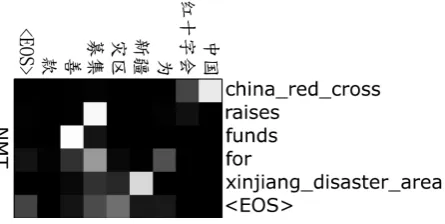
[image:4.595.313.536.255.367.2]Intuitively, we think chunks are more specific in semantics, thus could extract more specific source context for translation. The chunk attention could be considered as a compromise approach between encoding the whole source sentence into decoder without attention (Sutskever et al.,2014) and uti-lizing word level attention at each step (Bahdanau et al., 2014). We also draw the figure of align-ments by chunk attention (Figure2), from which we can see that our chunk attention model can well explore the alignments from phrases to words.
Figure 2: Alignments with chunk attention.
MT02 MT03 MT04 MT05
Boundary 89.97 88.81 89.64 89.25
Label 47.00 44.75 45.54 44.41
Table 3: Accuracies of predicted chunk boundary and chunk label.
Predictions of the Chunk Boundary and Chunk Label We also compute predicted accuracies of chunk boundaries and chunk labels on the auto-chunked development and testing data (Table3). We find that the chunk boundary could be pre-dicted well, with an average accuracy of 89%, which shows that our model could capture the phrasal boundary information in the translation process. However, our model could not pre-dict chunk labels as well as chunk boundaries. We speculate that more syntactic context features should be added to improve the performance of predicting chunk labels.
Subjective Evaluation Following Tu et al.
Model dl4mt Our Work
Adequacy 3.26 3.35
Fluency 3.69 3.71
Under-Translation 50% 47%
[image:5.595.91.274.61.131.2]Over-Translation 32% 26%
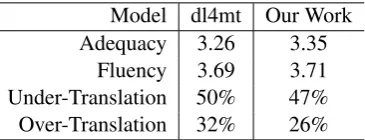
Table 4: Subjective evaluation results.
System DE-14 DE-1213
dl4mt 16.53 16.78
This Work 17.40 17.45
Table 5: Results on German-English
the translation is translated by. The human eval-uator is asked to give 4 scores: adequacy score and fluency score, which are between 0 and 5, the larger, the better; under-translation score and over-translation score, which are set to 1 when under or over translation errors occurs, otherwise set to 0.
We list the averaged scores in Table5. We find that our proposed model improves the dl4mt base-line on both the translation adequacy and fluency aspects. Specifically, the over translation error rate drops by 6%, which confirms the assumption in the introduction that splitting the fast and slow varying components in different time-scales could help alleviate the over translation errors.
4.2 Results on German-English
We evaluate our model on the WMT15 translation task from German to English. We find that our proposed chunk-based NMT model also obtains considerable accuracy improvements on German-English. However, the BLEU score gains are not as significant as on Chinese-English. We speculate that the difference between Chinese and English is larger than German and English. The chunk-based NMT model may be more useful for bilingual data with bigger difference.
5 Related Work
NMT with Various Granularities. A line of previous work propose to utilize other granulari-ties besides words for NMT. By further exploit-ing the character level (Ling et al., 2015; Costa-juss`a and Fonollosa,2016;Chung et al.,2016; Lu-ong et al.,2016;Lee et al.,2016), or the sub-word level (Sennrich and Haddow,2016;Sennrich et al.,
2016; Garc´ıa-Mart´ınez et al., 2016) information, the corresponding NMT models capture the
infor-mation inside the word and alleviate the problem of unknown words. While most of them focus on decomposing words into characters or sub-words, our work aims at composing words into phrases.
Incorporating Syntactic Information in NMT Syntactic information has been widely used in SMT (Liu et al.,2006;Marton and Resnik,2008;
Shen et al.,2008), and a lot of previous work ex-plore to incorporate the syntactic information in NMT, which shows the effectiveness of the syntac-tic information (Stahlberg et al.,2016). Shi et al.
(2016) give some empirical results that the deep networks of NMT are able to capture some use-ful syntactic information implicitly. Luong et al.
(2016) propose to use a multi-task framework for NMT and neural parsing, achieving promising re-sults. Eriguchi et al. (2016) propose a string-to-tree NMT system by end-to-end training. Differ-ent to previous work, we try to incorporate the syn-tactic information in the target side of NMT. Ishi-watari et al. (2017) concurrently propose to use chunk-based decoder to cope with the problem of free word-order languages. Differently, they adopt word-level attention, and predict the end of chunk by generating end-of-chunk tokens instead of us-ing boundary gate.
6 Conclusion
We propose a chunk-based bi-scale decoder for neural machine translation, in which way, the target sentence is translated hierarchically from chunks to words, with information in different granularities being leveraged. Experiments show that our proposed model outperforms the standard attention-based neural machine translation base-line. Future work includes abandoning labeled chunk data, adopting reinforcement learning to ex-plore the boundaries of phrase automatically (Mou et al., 2016). Our code is released on https:
//github.com/zhouh/chunk-nmt.
Acknowledge
References
Dzmitry Bahdanau, Kyunghyun Cho, and Yoshua Ben-gio. 2014. Neural machine translation by jointly learning to align and translate. InICLR 2015. David Chiang. 2005. A hierarchical phrase-based
model for statistical machine translation. In Pro-ceedings of the 43rd Annual Meeting on Associa-tion for ComputaAssocia-tional Linguistics. AssociaAssocia-tion for Computational Linguistics, pages 263–270. Kyunghyun Cho, Bart van Merrienboer, Caglar
Gul-cehre, Dzmitry Bahdanau, Fethi Bougares, Holger Schwenk, and Yoshua Bengio. 2014. Learning phrase representations using rnn encoder–decoder for statistical machine translation. InProceedings of the 2014 Conference on Empirical Methods in Nat-ural Language Processing (EMNLP). Association for Computational Linguistics, pages 1724–1734. https://doi.org/10.3115/v1/D14-1179.
Junyoung Chung, Kyunghyun Cho, and Yoshua Ben-gio. 2016. A character-level decoder without ex-plicit segmentation for neural machine translation. In Proceedings of the 54th Annual Meeting of the Association for Computational Linguistics (Volume 1: Long Papers). Association for Computational Linguistics, Berlin, Germany, pages 1693–1703. http://www.aclweb.org/anthology/P16-1160. R. Marta Costa-juss`a and R. Jos´e A. Fonollosa. 2016.
Character-based neural machine translation. In Pro-ceedings of the 54th Annual Meeting of the Associa-tion for ComputaAssocia-tional Linguistics (Volume 2: Short Papers). Association for Computational Linguistics, pages 357–361. https://doi.org/10.18653/v1/P16-2058.
Akiko Eriguchi, Kazuma Hashimoto, and Yoshimasa Tsuruoka. 2016. Tree-to-sequence attentional neu-ral machine translation. InProceedings of the 54th Annual Meeting of the Association for Computa-tional Linguistics (Volume 1: Long Papers). Associ-ation for ComputAssoci-ational Linguistics, pages 823–833. https://doi.org/10.18653/v1/P16-1078.
Mercedes Garc´ıa-Mart´ınez, Lo¨ıc Barrault, and Fethi Bougares. 2016. Factored neural machine transla-tion.arXiv preprint arXiv:1609.04621.
Shonosuke Ishiwatari, Jingtao Yao, Shujie Liu, Mu Li, Ming Zhou, Naoki Yoshinaga, Masaru Kitsuregawa, and Weijia Jia. 2017. Chunk-based decoder for neural machine translation. InProceedings of the 55th annual meeting of the Association for Compu-tational Linguistics. Association for CompuCompu-tational Linguistics.
Nal Kalchbrenner and Phil Blunsom. 2013. Recur-rent continuous translation models. In Proceed-ings of the 2013 Conference on Empirical Meth-ods in Natural Language Processing. Association for Computational Linguistics, pages 1700–1709. http://aclweb.org/anthology/D13-1176.
Philipp Koehn, Hieu Hoang, Alexandra Birch, Chris Callison-Burch, Marcello Federico, Nicola Bertoldi, Brooke Cowan, Wade Shen, Christine Moran, Richard Zens, et al. 2007. Moses: Open source toolkit for statistical machine translation. In Pro-ceedings of the 45th annual meeting of the ACL on interactive poster and demonstration sessions. As-sociation for Computational Linguistics, pages 177– 180.
Philipp Koehn, Franz Josef Och, and Daniel Marcu. 2003. Statistical phrase-based translation. In Proceedings of the 2003 Conference of the North American Chapter of the Association for Computa-tional Linguistics on Human Language Technology-Volume 1. Association for Computational Linguis-tics, pages 48–54.
Jason Lee, Kyunghyun Cho, and Thomas Hofmann. 2016. Fully character-level neural machine trans-lation without explicit segmentation. arXiv preprint arXiv:1610.03017.
Wang Ling, Isabel Trancoso, Chris Dyer, and Alan W Black. 2015. Character-based neural machine trans-lation.arXiv preprint arXiv:1511.04586.
Yang Liu, Qun Liu, and Shouxun Lin. 2006. Tree-to-string alignment template for statistical machine translation. InProceedings of the 21st International Conference on Computational Linguistics and the 44th annual meeting of the Association for Compu-tational Linguistics. Association for CompuCompu-tational Linguistics, pages 609–616.
Minh-Thang Luong, Quoc V. Le, Ilya Sutskever, Oriol Vinyals, and Lukasz Kaiser. 2016. Multi-task se-quence to sese-quence learning. InInternational Con-ference on Learning Representations (ICLR). San Juan, Puerto Rico.
Thang Luong, Hieu Pham, and D. Christopher Man-ning. 2015. Effective approaches to attention-based neural machine translation. In Proceed-ings of the 2015 Conference on Empirical Meth-ods in Natural Language Processing. Association for Computational Linguistics, pages 1412–1421. https://doi.org/10.18653/v1/D15-1166.
Yuval Marton and Philip Resnik. 2008. Soft syntac-tic constraints for hierarchical phrased-based trans-lation. InACL. pages 1003–1011.
Lili Mou, Zhengdong Lu, Hang Li, and Zhi Jin. 2016. Coupling distributed and symbolic execu-tion for natural language queries. arXiv preprint arXiv:1612.02741.
Rico Sennrich and Barry Haddow. 2016. Linguis-tic input features improve neural machine trans-lation. In Proceedings of the First Conference on Machine Translation. Association for Computa-tional Linguistics, Berlin, Germany, pages 83–91. http://www.aclweb.org/anthology/W16-2209.
Rico Sennrich, Barry Haddow, and Alexandra Birch. 2016. Neural machine translation of rare words with subword units. InProceedings of the 54th An-nual Meeting of the Association for Computational Linguistics (Volume 1: Long Papers). Association for Computational Linguistics, pages 1715–1725. https://doi.org/10.18653/v1/P16-1162.
Libin Shen, Jinxi Xu, and Ralph M Weischedel. 2008. A new string-to-dependency machine translation al-gorithm with a target dependency language model. InACL. pages 577–585.
Xing Shi, Inkit Padhi, and Kevin Knight. 2016. Does string-based neural mt learn source syntax? In Proceedings of the 2016 Conference on Empirical Methods in Natural Language Processing. Associ-ation for ComputAssoci-ational Linguistics, pages 1526– 1534.http://aclweb.org/anthology/D16-1159.
Felix Stahlberg, Eva Hasler, Aurelien Waite, and Bill Byrne. 2016. Syntactically guided neural ma-chine translation. In Proceedings of the 54th An-nual Meeting of the Association for Computational Linguistics (Volume 2: Short Papers). Associa-tion for ComputaAssocia-tional Linguistics, pages 299–305. https://doi.org/10.18653/v1/P16-2049.
Ilya Sutskever, Oriol Vinyals, and Quoc V Le. 2014. Sequence to sequence learning with neural net-works. InAdvances in neural information process-ing systems. pages 3104–3112.
Zhaopeng Tu, Yang Liu, Zhengdong Lu, Xiaohua Liu, and Hang Li. 2017a. Context gates for neural ma-chine translation. Transactions of the Association for Computational Linguistics5:87–99.
Zhaopeng Tu, Yang Liu, Lifeng Shang, Xiaohua Liu, and Hang Li. 2017b. Neural machine translation with reconstruction. InProceedings of AAAI 2017. pages 3097–3103.
Zhaopeng Tu, Zhengdong Lu, Yang Liu, Xiaohua Liu, and Hang Li. 2016. Modeling coverage for neu-ral machine translation. InProceedings of the 54th Annual Meeting of the Association for Computa-tional Linguistics (Volume 1: Long Papers). Asso-ciation for Computational Linguistics, pages 76–85. https://doi.org/10.18653/v1/P16-1008.
Wenhui Wang and Baobao Chang. 2016. Graph-based dependency parsing with bidirectional lstm. In Pro-ceedings of ACL. volume 1, pages 2306–2315. Yonghui Wu, Mike Schuster, Zhifeng Chen, Quoc V
Le, Mohammad Norouzi, Wolfgang Macherey, Maxim Krikun, Yuan Cao, Qin Gao, Klaus Macherey, et al. 2016. Google’s neural ma-chine translation system: Bridging the gap between human and machine translation. arXiv preprint arXiv:1609.08144.