Optimization of Hot Rolling Process
of Gravity Cast AZ31-
x
Ca (
x
¼
0
2
:
0
mass%) Alloys
Chang Dong Yim
1, Bong Sun You
1, Jin Su Lee
2and Wan Chul Kim
21
Materials Technology Department, Korea Institute of Machinery and Materials, Gyeongnam 641-010, Korea
2School of Materials Science and Engineering, Hong-ik University, Chungnam 339-701, Korea
In this study, the effects of Ca content and processing variables on the external surfaces and tensile properties of hot-rolled AZ31-xCa sheets were evaluated systematically. The number and length of side crack were decreased with increasing preheating temperature and decreasing reduction ratio per pass and Ca content. The UTS and YS were not strongly dependent on the Ca content but the elongation decrease with increasing Ca content. The amount of decrease in elongation due to increase in Ca content was least when the sheets were fabricated under preheating temperature of 400C and reduction ratio per pass of 15%. The sheets had the sound external features with little side cracks by
homogenization of gravity cast AZ31-xCa alloys before hot rolling. In the cases of AZ31-xCa alloys containing under 1 mass% Ca, the annealed sheets after homogenization and hot rolling had the similar tensile properties to those of AZ31 sheet.
(Received July 5, 2004; Accepted August 23, 2004)
Keywords: hot rolling, magnesium alloys sheets, homogenization, annealing
1. Introduction
In recent the application of magnesium alloys to structural parts has been increased rapidly because of the lightest weight of commercialized metallic materials, excellent specific strength, castability, machinability, fatigue proper-ties and damping capacity. Nowadays most of magnesium alloys structural parts have been produced by die casting process. But, in case of plate-shape products with thin wall such as notebook case, the cost for post casting processes is very expensive and the size of products is limited due to casting defects. So the researches for applying the sheets produced by rolling to the structural parts with thin wall are being carried out actively in the world as one of alternative processing routes. There are various processes in order to produce the plates and sheets including DC casting, hori-zontal continuous casting, twin-roll casting and wheel band casting. But the magnesium alloys have high reactivity with oxygen in the air and ignition or combustion occurs rapidly when they are in contact with oxygen in the molten state, which results in pollution and loss of melt. So the reaction between melts and oxygen must be prohibited using a proper melt protection method in order to decrease the loss of melt and improve the quality of products during producing the plates and sheets by casting. In general the fluxless method using the mixed gas of air, CO2and SF6gases is widely used in order to protect the magnesium alloy melt. But CO2 and SF6 gases are green house gases being the source of global warming, so their usage will be reduced or prohibited in near future. The new melt protection method decreasing the environmental pollution must be developed in order to apply the magnesium alloys to structural parts and widen its application field. There are some methods being developed as new melt protection methods including application of new protection gas1,2) and addition of alloying elements.3–8) The method of addition of alloying elements has some benefits in respect of process because special equipment for blowing protection gas on the melt surface during melting and casting is not needed. Ca and Be are known to be effective for
improving the oxidation resistance of magnesium alloy melt.7–11) Especially, the alloys with above 1 mass%Ca did
not burn at temperature above liquidus temperature by 50C.7,8)But it was reported that the addition of Ca would be
resulted in the degradation of tensile properties, especially elongation of magnesium alloys.9,10)So the adequate combi-nation of various processing parameters is important to produce the sound sheets of Ca containing magnesium alloys with equivalent properties to those of commercialized magnesium alloy sheets such as AZ31B.
In this study the effects of various processing parameters including preheating temperature, reduction ratio per pass, homogenization treatment and annealing after rolling on the external features, microstructures and tensile properties of hot-rolled AZ31-xCa (x¼02:0mass%) were examined in order to evaluate the possibility of non-combustible Ca-containing magnesium alloys as wrought alloy.
2. Experimental Procedure
2.5 kg of AZ31B alloy was inserted into a steel crucible and heated to 720C. Ca pellet was added into a molten AZ31 alloy and the melt was held at 720C for 1.8 ks in order to homogenize the melt. The amount of Ca added into AZ31 alloy was changed from 0 to 2 mass%. After homogenization, the vacuum treatment of molten alloy was carried out for 60 s in order to remove the impure inclusions and then the melt was poured into the plate-type steel mold with dimensions of 30200250mm3without protective gas. The plates with dimensions of10100150mm3were machined from as-cast ingots as raw materials for rolling. The machined plates were preheated to given temperatures of 350400C and
held isothermally for 1.8 ks before rolling. Some of plates were homogenized at 400C for 86.4 ks before preheating.
1515mm2 were cut from as-rolled and annealed sheets and mounted into epoxy resin. The mounted specimens were polished mechanically using silicon carbide paper and diamond paste. The polished specimens were etched using the picric acid 4.2 g + acetic acid 10 ml + distilled water 10 ml + ethyl alcohol 70 ml solution in order to reveal the microstructural characteristics of specimens clearly. The specimens for tensile test were machined from as-rolled and annealed sheets with thickness of 1 mm according to ASTM E 8 M. The width and length of gage were 6 mm and 25 mm, respectively. After polishing the surface of tensile specimens mechanically with silicon carbide papers, the uniaxial tensile force was acted on the specimens at initial strain rate of 1103s1.
3. Results and Discussion
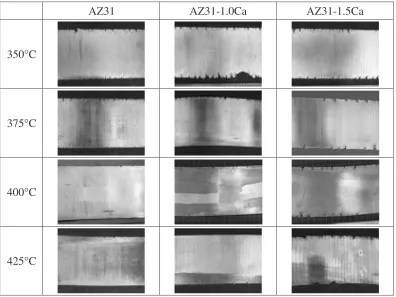
Figure 1 shows the change in external features of hot-rolled AZ31-xCa sheets (t¼1mm) with preheating temper-ature. The number and length of side crack increased with decreasing the preheating temperature. In general additional stress is applied to side of sheet during rolling by the difference of plastic deformations in direction of width between center and side or inhomogeneous deformation in direction of thickness, which results in cracking at side if a material cannot accommodate the additional stress. The magnesium alloys have the HCP structure, which limits the plastic deformation at ambient temperature. The additional deformation modes such as non-basal slip, cross slip and grain boundary sliding will be operated at high temperature and their activities will be increased with temperature. So the
additional stress at side of sheet during hot rolling will be more easily accommodated with increasing of preheating temperature, which results in decrease in side cracking.
The number and length of side crack also increased with Ca content. It was reported that the cracks were initiated at the brittle precipitate at grain boundary and propagated rapidly along precipitates in magnesium alloys when the external stress was applied.11,12) During solidification of
AZ31-xCa alloys brittle Mg17Al12 and Al2Ca precipitates were formed along grain boundary and the fraction of Al2Ca precipitate increased with increasing Ca content.10,13) The
strength of Mg17Al12phase is higher than that of Al2Ca phase and the resistance to the cracking is also higher. So the side cracking of sheets during hot rolling of AZ31-xCa alloys would be initiated at the brittle phases when the additional stress was applied at side of sheets and the possibility of side cracking would be increased with amount of Al2Ca phase. Figure 2 shows the microstructure of crack tip of side crack in hot-rolled AZ31-1.5Ca sheet. The cracks were initiated at the brittle second phases whereas any crack was not observed in the -Mg matrix. Figure 3 shows the change in tensile properties of hot-rolled AZ31-xCa sheets (t¼1mm) with preheating temperature and Ca content. The dependency of tensile properties on the preheating temperature was not verified obviously, but the differences in the tensile proper-ties of AZ31-xCa sheets with different amount of Ca were least at preheating temperature of 400C.
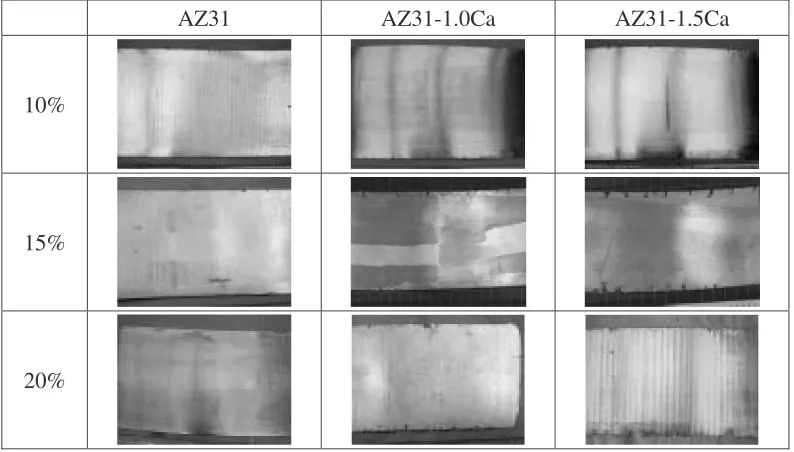
Figure 4 shows the change in external features of hot-rolled AZ31-xCa sheets (t¼1mm) with reduction ratio per pass. The number and length of side crack increased with increasing reduction ratio per pass. It seemed that the
AZ31
AZ31-1.0Ca
AZ31-1.5Ca
350
°
C
375
°
C
400
°
C
425
°
C
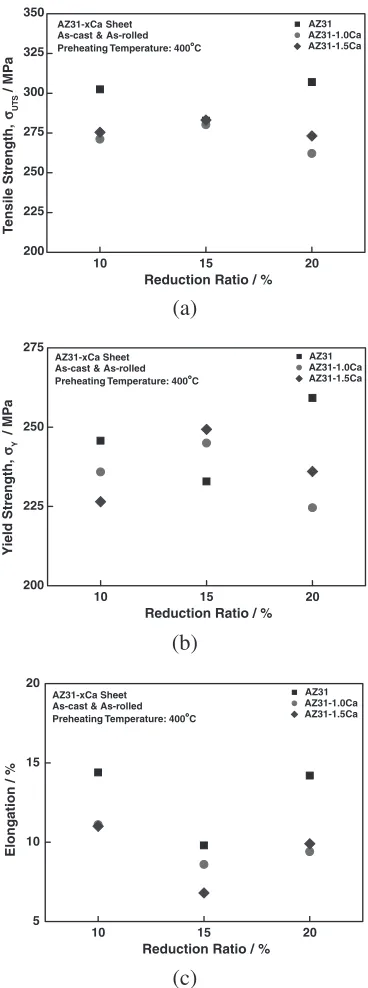
[image:2.595.101.497.72.369.2]homogeneity in plastic deformation in thickness direction would be decreased when the reduction ratio per pass increased, which resulted in the higher additional stress at side of sheet. So the possibility of side cracking would be increased with increasing reduction ratio per pass. Figure 5 shows the change in tensile properties of hot-rolled AZ31-xCa sheets (t¼1mm) with reduction ratio per pass and Ca content. The dependency of tensile properties on the reduction ratio per pass was also not verified obviously, but the differences in the tensile properties of AZ31-xCa sheets with different amount of Ca were least at reduction ratio per pass of 15%.
Figure 6 shows the change in external features of hot-rolled AZ31-xCa sheets under condition of preheating temperature of 400C and reduction ratio per pass of 15%
in as-cast and homogenized state at 400C for 86.4 ks with Ca
content. The number of side crack decreased remarkably when gravity cast AZ31-xCa alloys were homogenized before hot rolling. Especially, in case of AZ31-2.0Ca alloy, the sound sheets could not be fabricated due to severe side cracking and alligatoring in as-cast state whereas the sound
sheets could be fabricated through hot rolling by homoge-nization of gravity cast AZ31-2.0Ca alloy. As mentioned above, the Mg17Al12 phases are formed discontinuously at the grain boundaries during solidification in magnesium alloys containing Al. The Mg17Al12 phases at grain bounda-ries would be solved completely into -Mg matrix during homogenization treatment due to low melting temperature of 437C, which resulted in decrease in the possibility of
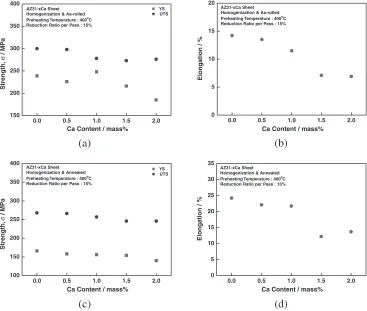
cracking at the brittle second phase. Figure 7 shows the change in tensile properties of homogenized at 400C for
86.4 ks and hot-rolled AZ31-xCa sheets (t¼1mm) under condition of preheating temperature of 400C and reduction
ratio per pass of 15%. The UTS and YS of AZ31-xCa sheets in as-rolled state were higher than those of AZ31-xCa sheets after annealing, but elongation increased by annealing after hot rolling. These changes in tensile properties would be resulted from the differences in microstructures of sheets in as-rolled and annealed states as shown in Fig. 8. As shown in Fig. 8(a), the dynamic recrystallization occurred partially and some grains contained dislocation and twins by plastic deformation during hot rolling in as-rolled state. But the strain-free new grains would be formed at old grain boundaries and twin boundaries by recrystallization during annealing as shown in Fig. 8(b), which resulted in eliminat-ing of all effects of strain hardeneliminat-ing. So the strength decreased and elongation increased by annealing after hot rolling. In the case of annealing after hot rolling, the UTS and YS were rarely changed with Ca content but the elongation decreased dramatically above 1 mass% Ca.
4. Conclusion
The frequency and length of side crack in hot-rolled AZ31-xCa sheets decreased with increasing preheating temperature and decreasing reduction ratio per pass. With increasing pre-heating temperature, the additional deformation modes be-sides basal slip would be more active and the accommodation of additional stress at side of sheets by inhomogeneous defor-10µm
Fig. 2 Microstructure of crack tip of side crack in hot-rolled AZ31-1.5Ca sheet.
AZ31 AZ31-1.0Ca
AZ31-1.5Ca
10%
15%
20%
[image:3.595.54.283.72.222.2] [image:3.595.100.497.542.768.2]10 15 20 200
225 250 275 300 325 350
AZ31 AZ31-1.0Ca AZ31-1.5Ca AZ31-xCa Sheet
As-cast & As-rolled
Preheating Temperature: 400°C
T
e
nsile Strength,
σUT
S
/ MP
a
Reduction Ratio / %
(a)
10 15 20
200 225 250 275
AZ31 AZ31-1.0Ca AZ31-1.5Ca AZ31-xCa Sheet
As-cast & As-rolled
Preheating Temperature: 400°C
Yield Strength,
σY
/ MP
a
Reduction Ratio / %
(b)
10 15 20
5 10 15 20
AZ31 AZ31-1.0Ca AZ31-1.5Ca AZ31-xCa Sheet
As-cast & As-rolled
Preheating Temperature: 400°C
Elongation / %
Reduction Ratio / %
(c)
Fig. 5 Change in tensile properties of hot-rolled AZ31-xCa sheets (t¼1mm) with reduction ratio per pass and Ca content; (a) UTS (b) YS (c) elongation.
350 375 400 425
250 275 300 325 350
AZ31 AZ31-1.0Ca AZ31-1.5Ca
AZ31-xCa Sheet As-cast & As-rolled Reduction Raito per Pass: 15%
T
ensile Strength,
σUTS
/ MP
a
Preheating Temperature, T / °C
(a)
350 375 400 425
200 225 250 275 300 325
AZ31 AZ31-1.0Ca AZ31-1.5Ca AZ31-xCa Sheet
As-cast & As-rolled Reduction Raito per Pass: 15%
Yield Strength,
σY
/ MP
a
Preheating Temperature, T / °C
Preheating Temperature, T / °C
(b)
350 375 400 425
0 5 10 15 20
AZ31 AZ31-1.0Ca AZ31-1.5Ca AZ31-xCa Sheet
As-cast & As-rolled Reduction Raito per Pass: 15%
Elongation / %
(c)
Fig. 3 Change in tensile properties of hot-rolled AZ31-xCa sheets (t¼1mm) with preheating temperature and Ca content; (a) UTS (b) YS (c) elongation.
AZ31
As-cast
Heat Treated
AZ31-1.0Ca AZ31-1.5Ca AZ31-2.0Ca
Fig. 6 Change in external features of hot-rolled AZ31-xCa sheets under condition of preheating temperature of 400C and reduction ratio
[image:4.595.335.519.71.565.2] [image:4.595.76.264.77.567.2] [image:4.595.143.455.628.758.2]mation would be accomplished more easily, which resulted in decrease in possibility of cracking. With increasing Ca con-tent, the volume fraction of Al2Ca phase which is more sus-ceptible to cracking increased, and the frequency and length of side crack increased. More sound sheets could be fabricat-ed by hot rolling after homogenization of gravity cast AZ31-xCa alloys because the brittle Mg17Al12phase was complete-ly solved into-Mg matrix and the inhomogeneity in the as-cast microstructure would be reduced by homogenization. In the cases of AZ31-xCa alloys containing under 1 mass% Ca, the annealed sheets after homogenization and hot rolling had the similar tensile properties to those of AZ31 sheet.
Acknowledgements
This study was financially supported by Korea Ministry of Science and Technology through 21C Frontier R&D Program organized by Center of Advanced Materials Processing.
REFERENCES
1) S. Cashion and N. Ricketts:Magnesium Technology 2000, ed. by H. I. Kaplan, J. N. Hryn and B. B. Clow, (TMS, 2000) pp. 77–81. 2) N. Ricketts and S. Cashion:Magnesium Technology 2001, ed. by J. N.
Hyrn, (TMS, 2001) pp. 31–36.
3) M. Sakamoto, S. Akiyama, T. Hagio and K. Ogi: J. Jpn. Foundry Eng. Soc.69(1997) 227–233.
4) S. Y. Chang and J. C. Choi: Met. and Mater. Inter.4(1998) 165–171. 5) M. H. Kim, W. W. Park, B. S. You, Y. B. Huang and W. C. Kim: Mater.
Sci. Forum419–422(2003) 575–580.
6) B. S. You, M. H. Kim, W. W. Park and I. S. Chung: Mater. Sci. Forum 419–422(2003) 581–586.
7) B. H. Choi, B. S. You, W. W. Park, Y. B. Huang and I. M. Park: Met. and Mater. Inter.9(2003) 395–398.
8) Y. B. Huang, I. S. Chung, B. S. You, W. W. Park and B. H. Choi: Met. and Mater. Inter.10(2004) 7–11.
9) X. Q. Zeng, Q. D. Wang, Y. Z. Lu, W. J. Ding, C. Lu, Y. P. Zhu, C. Q. Zhai CQ and X. P. Xu: J. Mater. Sci.36(2001) 2499–2504. 10) Q. Jin, J. P. Eom, S. G. Lim, W. W. Park and B. S. You: J. Kor.
Foundrymen’s Soc.23(2003) 251–256.
11) S. H. Lee, S. Lee and D. H. Kim: J. Kor. Inst. Met. & Mater.34(1996) 585–595.
12) C. D. Yim, S. H. Kim, B. S. You, J. S. Lee and W. C. Kim: J. Kor. Inst. Met. & Mater.42(2004) 521–529.
13) W. Qudong, C. Wenzhou, Z. Xiaoquin, L. Yizhen, D. Wenjiang, Z. Yanping and X. Xiaoping: J. Mater. Sci.36(2001) 3035–3040.
0.0 0.5 1.0 1.5 2.0 150
200 250 300 350 400
YS UTS AZ31-xCa Sheet
Homogenization & As-rolled Preheating Temperature : 400°C Reduction Ratio per Pass : 15%
Strength,
σ
/ MP
a
Ca Content / mass%
0.0 0.5 1.0 1.5 2.0 0
5 10 15 20
AZ31-xCa Sheet Homogenization & As-rolled Preheating Temperature : 400°C Reduction Ratio per Pass : 15%
Elongation / %
Ca Content / mass%
(a)
(b)
(d)
0.0 0.5 1.0 1.5 2.0 100
150 200 250 300 350 400
YS UTS AZ31-xCa Sheet
Homogenization & Annealed Preheating Temperature : 400°C Reduction Ratio per Pass : 15%
Strength,
σ
/ MP
a
Ca Content / mass%
(c)
0.0 0.5 1.0 1.5 2.0 0
5 10 15 20 25 30 35
AZ31-xCa Sheet Homogenization & Annealed Preheating Temperature : 400°C Reduction Ratio per Pass : 15%
Elongation / %
Ca Content / mass%
Fig. 7 Change in tensile properties of homogenized at 400C for 86.4 ks and hot-rolled AZ31-xCa sheets (t¼1mm) under condition of
preheating temperature of 400C and reduction ratio per pass of 15% with Ca content; (a) and (b) as-rolled state, (c) and (d) annealed state
at 300C for 3.6 ks.
25µm 25µm
(a) (b)
Fig. 8 Microstructures of homogenized and hot-rolled AZ31-1.0Ca sheets (t¼1mm) under condition of preheating temperature of 400C and
[image:5.595.115.482.74.385.2] [image:5.595.49.291.453.567.2]