Comparison of three methods for rendering plant fat
transesterifi cation
A. Prošková
1, J. Kuera
1, Z. Kopicová
1, L. Škarková
21
Food Research Institute Prague, Prague, Czech Republic
2
Department of Technological Equipment of Buildings, Faculty of Engineering,
Czech University of Life Sciences Prague, Prague, Czech Republic
Abstract
Prošková A., Kuera J., Kopicová Z., Škarková L., 2013. Comparison of three methods for rendering plant
fat transesterifi cation.Res. Agr. Eng., 59: 51–55.
Th ree most frequently used methods for fat transesterifi cation were compared using rendering plant fat (RPF) as model.
Acid-catalysed transesterifi cation was found to be the most eff ective (conversion 90%) at optimum conditions (fat: methanol ratio 1:10, sulphuric acid amount of 2% v/v, temperature 95°C). Base-catalysed transesterifi cation of RPF on the other hand, results in much lower conversion (45%) at optimum conditions (fat:methanol ratio 1:20, NaOH amount
8% w/v, optimum temperature 95°C). Th e diff erence is done (among others) by the fact that RPF has high concentration
of free acid (high acidity number) compared with the fats usually used for transesterifi cation and that free acids are not esterifi ed in alkaline media. Enzyme-(lipase) catalysed reaction could lead to partial esterifi cation of free fatty acids, but
with much lower reaction velocity. Th is fact leads to higher conversion in the case of enzyme-catalysed transesterifi
ca-tion of RPF compared with base-catalysed reacca-tion; nevertheless, even in this case the conversion is much lower in
comparison with acid-catalysed reaction. Th e optimum conversion in enzyme-catalysed reaction was 55%.
Keywords: biofuel; biodiesel; animal waste fat; esterifi cation; methanol
Starting from the fi rst oil crisis (1974) continuously increasing demand for energy and decreasing sources of petroleum resources has led to the search for al-ternative renewable and sustainable fuel. Biodiesel is one of the promising substitutes for petro-diesel. Bio-diesel prepared by transesterifi cation of any material non-utilizable for food is to be preferred, as such ma-terial does not compete with food production. Ren-dering plant fat is of advantage. Th is fat not only does not compete with food production but even does not occupy agricultural area (Atadashi et al. 2010). Fats of plant as well as animal origin were used for transes-terifi cation (Altun 2011). Animal fat mostly used for transesterifi cation is beef tallow (Araujo et al. 2010;
Thamsiriroj, Murphy 2010). Production of biofuel competes with the needs of fat for food (Stein 2007). Th is situation leads to the search for non-food fats or plants cultivated only for the technical oil production for transesterifi cation. Th e most popular in this sense is jatropa (Jatropa curcas) (Berchmans et al. 2010; Chen et al. 2010; Corro et al. 2010). Very attractive sources of fats for transesterifi cation are also diff erent waste fats, like restaurant waste oil (Canakci 2007), municipal savage sludge (Cydzik-Kwiatkowska et al. 2010; Kargbo 2010) etc.
One of the animal waste fats is rendering plant fat (RPF), which is relatively cheap, is available at large quantities in localized plants and could be
terifi ed like any other animal fat. RPF has relatively high acidity number (as high as 24 mg KOH/g), which is hindrance to the application of base-cata-lysed transesterifi cation, as esterifi cation of free acid is impossible in alkaline media. Other conditions for transesterifi cation of RPF are very similar to the transesterifi cation of tallow or other animal fats.
Diff erent methods could be used for transesteri-fi cation. Acid-catalysed transesteritransesteri-fi cation is most frequently used one with sulphuric acid as catalyst (Deng et al. 2010), second is base-catalyzed trans-esterifi cation with sodium hydroxide as catalyst, less frequently potassium hydroxide (Berchmans et al. 2010; Deng et al. 2010). Recently the hetero-geneous catalysis was studied, using bases or acids like calcium oxide, SrO, TiO2 or ZrO2 (Qian et al. 2010; Yoo et al. 2010). Interesting is also the appli-cation of quail and chicken egg-shells as catalyst for transesterifi cation (Cho, Seo 2010).
Lipases are also convenient catalysts for transes-terifi cation of plant oils and animal fat (Calabro et al. 2010; Raita et al. 2010). Lipase is able to catalyze oil transesterifi cation with comparable ef-fi ciency like other methods but the esterief-fi cation process is much slower compared with acid-cata-lysed one. Really, enzyme-cataacid-cata-lysed esterifi cation of free fatty acid is too slow to have a practical sig-nifi cance. Lipases are also destroyed with organic solvent (even methanol) at slightly elevated tem-perature. In present work we compare three meth-ods of transesterifi cation, acid-catalysed, base-cat-alysed, and enzyme-catalysed reaction.
MATERIAL AND METHODS
RPF was obtained from the Czech University of Life Sciences Prague. Th is fat was produced mainly from pork and cattle with only small amount of oth-ers. Separation of this fat includes expansive drying, separation by elevated temperature under pressure, and cooling. Acidity number of RPF is usually in the range of 20 to 40 mg KOH/g depending on the time of storage and the method of preparation. In our case acidity number was 23.63 mg KOH/g.
Fatty acids methyl esters (FAME) content in reac-tion mixture was measured by gas liquid chromatog-raphy (GLC) according to the method of Bannon et al. (1985) with the use of capillary gas chromatograph Hewlett-Packard, model 6890N (San Francisco, USA) with fl ame ionization detector and a polar capillary column. According to the content of fatty acids in
RPF the theoretical yield of methyl esters was calcu-lated to be 808 mg FAME from 1 g of RPF.
Acidity number was determined according to the ČSN 58 0130. Transesterifi cation was accom-plished in 500 ml round-bottom fl asks at diff erent temperatures and diff erent amount of catalyst (sul-furic acid, sodium hydroxide) and diff erent excess of methanol under refl ux. Th e excess of methanol was from twice the amount of RPF to thirty times, reaction time was from 2 to 9 h, reaction temper-ature from 70 to 95°C, and load of sulphuric acid from 1 to 5%, of sodium hydroxide 1 to 12%.
Diff erent procedure was used for enzyme-cata-lysed transesterifi cation. Enzyme-cataenzyme-cata-lysed transes-terifi cation was carried-out at optimum pH of the enzyme on the shaker (GFL 1083, GFL, Burgwedel, Germany). Temperature range for transesterifi ca-tion catalyzed with lipase (Novozym 435, Novozym, Bagsvaerd, Denmark) was lower than for acid or base-catalyzed reaction due to low stability of en-zyme at higher temperature.
Lipase (acylglycerol acylhydrolase E.C. 3.1.1.3) used in this work were products of the Novozymes (Bagsvaerd, Denmark) produced of Candida ant-arctica recombinant in Aspergillus niger under commercial name Novozym 435 for immobilized enzyme. Novozym 435 is Lipozyme CALB L im-mobilized by sorption on cross-linked poly (methyl methacrylate) (Pierreet al. 2006).
Lipase activity was measured according to Hum-bert et al. (1997) by incubation of samples with 50-mM-p-nitrophenyl butyrate in acetonitrile as substrate at 37°C. After adding inhibiting mixture the absorbance at 420 nm was read. Values for ab-sorbance were converted to mol p-nitrophenol using a standard curve.
Optimization was carried-out in the order meth-anol excess, catalyst amount (see the diff erence in the case of enzyme), reaction temperature, reaction time. In each next step, the optimum conditions from previous step were used.
RESULTS AND DISCUSION
of enzyme in organic media, involving methanol. Re-action temperature was 30°C, reRe-action time 5 h and enzyme dose 1000 U/g RPF. Starting conditions for base-catalysed reaction were diff erent, which is done by the fact, that in the fi rst instance it is necessary to neutralize free fatty acids (the catalyst concentration was as high as 6%), temperature was raised to 80°C and reaction time was shortened to 4 hours. Acid-cat-alysed transesterifi cation of RPF represents two reac-tions, the fi rst is esterifi cation of free fatty acids, and the second one is true transesterifi cation. For this, the
stronger conditions are needed; the temperature was raised to 95°C. In acid-catalyzed transesterifi cation the acid is true catalyst and is not consumed during reaction. If such, the concentration of acid could be lower compared with the concentration of base in base-catalysed reaction. Th e concentration of sulphu-ric acid was lowered to 1%. Th e reaction time was for acid-catalysed reaction 7 hours. At these conditions the conversion of RPF to FAME was measured in the range of methanol excess 1 to 30-fold of the weight of RPF. 0.5 % was the minimum concentration methanol 0
10 20 30 40 50 60 70 80 90 100
0 20 40
Conversi
o
n
(%
)
[image:3.595.79.262.82.243.2]Methanol excess (w/w) acid base enzyme
Fig. 1. Relation between methanol excess and conversion in rendering plant fat transesterifi cation
Acid-catalysed: temperature 95°C, sulphuric acid concen-tration 1%, reaction time 7 h; base-catalysed: temperature 80°C, sodium hydroxide concentration 6%, reaction time 4 h; enzyme-catalysed: temperature 30°C, enzyme dose 600 units/g RPF, reaction time 5 h
0 10 20 30 40 50 60 70 80 90 100
0 5 10 15
Conversi
o
n
(%
)
[image:3.595.305.529.86.243.2]Catalyst amount (%) acid base
Fig. 2. Relation between catalyst (acid or base) doses and conversion in rendering plant fat transesterifi cation
Acid-catalysed: temperature 95°C, methanol excess 10-fold, reaction time 7 h; base-catalysed: temperature 80°C, methanol excess 20-fold, reaction time 4 h
0 10 20 30 40 50 60
300 400 500 600 700 800
Conversi
o
n
(%
)
Enzyme (U/g RPF)
Fig. 3. Relation between enzyme dose and conversion in rendering plant fat transesterifi cation
Enzyme-catalysed: temperature 30°C, methanol relation 1:1, reaction time 7 h
0 10 20 30 40 50 60 70 80 90 100
30 50 70 90
Conversi
o
n
(%
)
Temperature (°C) enzyme
[image:3.595.301.503.352.507.2]acid base
Fig. 4. Infl uence of reaction temperature in rendering plant fat transesterifi cation
[image:3.595.80.268.359.508.2]used for enzyme-catalysed reaction. Th e course of re-action is shown in Fig. 1.
Th e curves in Fig. 1 are very diff erent. Acid-cata-lyzed reaction gives high conversion in all methanol concentration, while conversion in both base-cat-alyzed as well as enzyme-catbase-cat-alyzed reaction is low. Acid-catalysed reaction shows fl at maximum approx-imately at 10-fold excess of methanol, base-catalysed reaction has fl at maximum at 20-fold excess and en-zyme-catalysed transesterifi cation shows maximum at 1:1 relation of RPF:methanol. Th e last relation is done preferentially by the low enzyme stability in higher concentration of methanol. Th ese concentra-tions of methanol were used for the next step.
One problem appeared in the study of catalyst con-centration. Concentration of acid or base could be calculated as percentage, but concentration of en-zyme is necessary to be calculated in enen-zyme units per substrate mass. Th e fi gure, as a consequence, must be diff erent for acid- and base-catalysed reaction and enzyme-catalysed reaction. Due to the fi rst step of optimization (methanol excess optimization) the conversion was raised. Acid-catalysed reaction gives
conversion as high as 94% at acid concentration of 2%. Conversion of 46% was achieved in base-catalysed reaction at sodium hydroxide concentration 8%, and even enzyme-catalysed transesterifi cation give higher result, 51% at enzyme dose 600 U/g RPF. Th e results are shown in Figs 2 and 3. Th e next step was the opti-mization of reaction temperature. Again, the remark-able diff erences must be adopted in acid-base catalysis and enzyme catalysis due to the enzyme stability. Op-timized parameters from previous experiments were used. Fig. 4 shows the results. Conversion higher than 50% was achieved in enzyme transesterifi cation, con-version more than 40% in the case of base-catalysed reaction and 92% in acid-catalysed reaction.
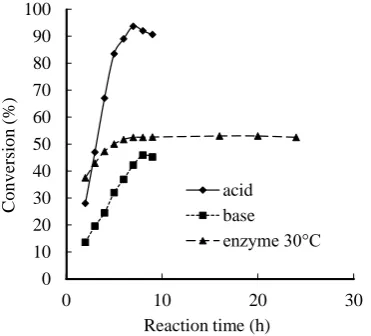
Th e last optimization step concerned the reaction time. Th e result shows in this case only the minimum reaction time needed for maximum conversion and, as a consequence, is not crucial. Nevertheless, some improvements were also attained, as shown in Fig. 5. Rendering plant fat is one of the most promising sources of primary material for biodiesel produc-tion. Th is material fulfi ls two crucial requirements for base material for this process. RPF is available in large quantities in localized plants and, second-ly, this material is neither use as food nor use the farmland dedicated for production of food. RPF can be transesterifi ed using acid-catalysed, base-catalysed or enzyme-base-catalysed reaction, which has diff erent requirements for the reaction conditions, but has closely similar application. Th e optimum conditions, as well as the conversion at these con-ditions are summarized in Table 1.
CONCLUSION
We compared three methods and we are able to draw some common conclusions. In the fi rst in-stance, the acid-catalysed method is the most uni-versal. As RPF suff ers partial hydrolysis during ex-traction and stocking, the resulting fat contains free acid. Only at acid-catalysed reaction free fatty acids can be esterifi ed. Th ey are esterifi ed neither during base-catalyzed reaction nor during enzyme-cata-0
10 20 30 40 50 60 70 80 90 100
0 10 20 30
Conversi
o
n
(%
)
Reaction time (h) acid base
[image:4.595.90.276.85.253.2]enzyme 30°C
Fig. 5. Infl uence of reaction time in rendering plant fat transesterifi cation
Acid-catalysed: methanol excess 10-fold, sulfuric acid con-centration 2%, reaction temperature 95°C; acid-catalysed: methanol excess 20-fold, sodium hydroxide concentration 8%, reaction temperature 80°C; enzyme-catalysed: methanol:RPF ratio 1:1, enzyme 700 units/g RPF, reaction temperature 30°C
Table 1. Optimum conditions and conversion in rendering plant fat transesterifi cation
Catalyst Optimum conditions Conversion
(%) methanol excess (x-fold) catalyst amount (%) reaction temperature (°C) reaction time (h)
Acid 10 2 95 7 94
Base 20 8 80 7 53
[image:4.595.62.530.685.757.2]lysed reaction. For this fact, the acid-catalysed reac-tion gives much higher conversion compared with both others. Very promising is the possibility of di-rect transesterifi cation of slaughter-house waste fat without extraction (Prošková, Kuera 2010).
Biodiesel (fatty acid methyl esters) produced from slaughterhouses waste have some advantages (rela-tively cheap, does not occupy agricultural area) but also some disadvantages (bad cold fl ow properties and oxidation stability). FAME from these sources have worse cold fl ow properties compared with petrochemical diesel, so it cannot be used in many parts of world in winter months. Very often it also shows poor oxidative stability that causes the bio-diesel molecules to react with oxygen and produce sediments. From this point of view the presence of synthetic antioxidants is necessary to improve oxi-dative stability. Th e best way to stabilize biodiesel is to blend it with petroleum diesel.
R e f e r e n c e s
Altun S., 2011. Fuel properties of biodiesels produced from diff erent feedstocks. Energy Education Science and Tech-nology Part A. Energy Science and Research, 26: 165–174. Araujo B.Q., Nunes R.C.D., De Moura C.V.R., De Moura
E.M., Cito A.M.D.L., Dos Santos J.R., 2010. Synthesis and characterization of beef tallow biodiesel. Energy & Fuels, 24: 4476–4480.
Atadashi I.M., Aroua M.K., Aziz A.A., 2010. High qual-ity biodiesel and its diesel engine application. A review. Renewable & Sustainable Energy Reviews, 14: 1999–2008. Bannon C.D., Craske J.D., Hilliker A.E., 1985. Analysis of
fatty acid methylesters with high accuracy and reliability. Journal of the Association of Off cial Analytical Chemists,
62: 1501–1507.
Berchmans H.J., Morishita K., Takarada T., 2010. Kinetic study of methanolysis of Jatropha curcas-waste food oil mix-ture. Journal of Chemical Engineering of Japan, 43: 661–670. Calabro V., Ricca E., De Paola M.G., Curcio S., Iorio G.,
2010. Kinetics of enzymatic trans-esterifi cation of glycer-ides for biodiesel production. Bioprocess and Biosystems Engineering, 33: 701–710.
Canakci M., 2007. Th e potential of restaurant waste lipids as biodiesel feedstocks. Bioresource Technology, 98: 183–190. Chen C.H., Chen W.H., Chang C.M.J., Lai S.M., Tu C.H.,
2010. Biodiesel production from supercritical carbon dioxide extracted Jatropha oil using subcritical hydrolysis
and supercritical methylation. Journal of Supercritical Fluids, 52: 228–234.
Cho Y.B., Seo G., 2010. High activity of acid-treated quail eggshell catalysts in the transesterifi cation of palm oil with methanol. Bioresource Technology, 101: 8515–8519. Corro G., Tellez N., Ayala E., Marinez-Ayala A., 2010.
Two-step biodiesel production from Jatropha curcas crude oil using SiO2 center dot HF solid catalyst for FFA esteri-fi cation step. Fuel, 89: 2815–2821.
ČSN 580130, 1986. Metody zkoušení tuků a olejů. Stanovení čísla kyselosti. (Animal and vegetable oils. Methods of determination of acid number).
Cydzik-Kwiatkowska A., Wojnowska-Baryla I., Selew-ska K., 2010. Granulation of sludge under diff erent loads of a glycerol fraction from biodiesel production. European Journal of Lipid Science and Technology, 112: 609–613. Deng X., Fang Z., Liu Y.H., 2010. Ultrasonic transesterifi
ca-tion of Jatropha curcas L. oil to biodiesel by a two-step pro-cess. Energy Conversion and Management, 51: 2802–2807. Humbert G., Guingamp M.F., Linden G., 1997. Method
for the measurement of lipase activity in milk. Journal of Diary Research, 64: 465–469.
Kargbo D.M., 2010. Biodiesel production from municipal sewage sludges. Energy & Fuels, 24: 2791–2794.
Pierre S.J., Thies J.C., Dureault A., Cameron N.R., van Hest C.M.J., Carette N., Michon T., Weberskirch R., 2006. Covalent enzyme immobilization onto photopoly-merized highly porous monoliths. Advanced Materials,
18: 1822–1826.
Prošková A., Kuera J., 2010. Biopalivo z živočišných tuků (Biofuel from animal fat). Czech Patent 21424.
Qian J.F., Yun Z., Shi H.X., 2010. Cogeneration of biodiesel and nontoxic cottonseed meal from cottonseed processed by two-phase solvent extraction. Energy Conversion and Management, 51:2750–2756.
Raita M., Champreda V., Laosiripojana N., 2010. Bio-catalytic ethanolysis of palm oil for biodiesel production using microcrystalline lipase in tert-butanol system. Pro-cess Biochemistry, 45: 829–834.
Stein K., 2007. Food vs. biofuel. Journal of the American Dietetic Association, 107: 1870–1878.
Thamsiriroj T., Murphy J.D., 2010. How much of the target for biofuels can be met by biodiesel generated from residues in Ireland? Fuel, 89: 3579–3589.
Yoo S.J., Lee H.S., Veriansyah B., Kim J., Kim J.D., Lee Y.W., 2010. Synthesis of biodiesel from rapeseed oil using super-critical methanol with metal oxide catalysts. Bioresource Technology, 101: 8686–8689.
Received for publication March 1, 2011 Accepted after corrections July 13, 2012
Corresponding author: