Content changes of adsorbable organically bound
halogens during sludge centrifugation and drying
K. Hrich
1, B. Groda
21
Faculty of Civil Engineering, Brno University of Technology, Brno, Czech Republic
2Faculty of Agronomy, Mendel University, Brno, Czech Republic
Abstract
Hrich K., Groda B., 2011. Content changes of adsorbable organically bound halogens during sludge
centrifu-gation and drying. Res. Agr. Eng., 57: 30–36.
A wastewater treatment plant in Brno may be one of the wastewater treatment plants in the Czech Republic using a dryer for dewatering the sludge. The results of an adsorbable organically bound halogens balance analysis measured on the sludge dryer at the waste water treatment plant in Brno are demonstrated in this work. The aim of this work was to calculate the material balance in the treatment process (centrifugation and drying). Control places were chosen and then samples of water and sludge (at the inlet and outlet of the system) were collected. The adsorbable organically bound halogens concentration was detected in these samples by the coulometric method.
Keywords: wastewater treatment plant; anaerobically stabilized sludge; water from centrifuge; dried solid content;
waste water
Sludge is a mixture of water and solids separated from the waste water in various ways. The volume of sludge is around 1–2% of the purified waste water; however, it contains 50–80% of the initial pollution (Kutil, Dohányos 2005; Malý, Malá 2006). It is not possible to clearly describe the types and substances of the sludge, because it could have different locations and annual periods of origin. If necessary, the production of a stable and long-term storable sludge uses “complete drying”. In this case, the sludge is dried to 90–95% dried solid content (Dohányos, Zimová 2001). Drying also causes any harmful volatile components of the waste to be removed Kuraš et al. (2008). The ideal status would be to use all sludge as fertilizer for agricultural land to replace mineral fertilizers. As mentioned, sludge contains large amounts of pollution which was originally located in sewage. This limits its use on agricultural land, which modifies Czech regulation No. 504/2004 Coll. (The requirements for fertiliza-tion of agricultural land with sludge), which
This work is focused on finding content of AOX precisely because this is one of the parameters mon-itored in the use of sludge on agricultural land. AOX are also part of the total concentration of chlorine in sludge, and therefore they limit its use in cement factories. AOX are a combination of a wide range of individual substances, which have different haz-ardous characteristics, for example toxicity, muta-genicity, and so on. Most of them are artificial or are created during production as by-products. It is also necessary to verify what happens to these sub-stances (AOX) in the final treatment of sludge (cen-trifugation, drying). It is a prerequisite that most of these substances (50–80%) remain in the sludge, but 20–50% leave the sludge. A hypothesis is that the substance may be released into the air of the dryer building and could thus endanger the health of oper-ators. Therefore it was necessary to sample all inlets and outlets of the drying and centrifugation proc-esses and to perform the material balance.
MAteriAl And MetHods
determination of locations for sampling
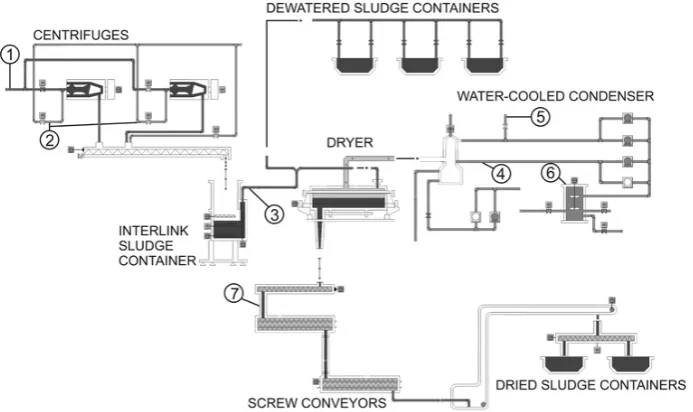
Eight locations were established (Fig. 1): (1) anaer-obically stabilized sludge entering the centrifuges, (2) water from centrifuges, (3) sludge entering the dryer (centrifuged sludge), (4) the cooling water en-tering the gas condenser, (5) industrial water enter-ing the gas condenser, (6) the mixture of water and condensation leaving the gas condenser, (7) dried
sludge, (8) air in the dryer building before it enters the filters for deodorizing (not marked in Fig. 1).
Water samples were collected in bottles with a capacity of 500 ml and rigid samples were collect-ed in 500 ml plastic cups uscollect-ed for the sampling of sludge cakes. They were dated and marked with the number of the sampling point. Samples and their detected concentrations of AOX were made imme-diately after removal. When this was not possible, the samples were immediately frozen and analysed as soon as possible.
Air was sampled by the HS-SPME method (head space-solid phase micro extraction), in which the sampled air was caught in a prepared container and allowed to react on a fibre impregnated with suit-able sorbent. The sample was then analysed by gas chromatography (GC).
Analysis of adsorbable organically bound halogens (AoX)
The procedure is based on the ČSN EN 1485 (1998). For the purpose of these analyses Euroglas AOX-Analyzer ECS 1200 (Thermo Scientific, Nijkerk, the Netherlands) was purchased for the laboratory of the Modřice waste water treatment plant (WWTP).
The reagents needed for the analysis were sulfuric acid p.a. (conc.), acetic acid p.a. (75%), nitric acid p.a. (conc.), sodium nitrate p.a., activated carbon for the batch method of AOX, sodium sulfite p.a.,
[image:2.595.133.480.87.293.2]p-chlorophenol (standard solution Cl 200 mg/l), and sodium chloride (standard solution 2 mmol/l).
Instruments and utilities used for this analysis were a Euroglas AOX-Analyzer ECS 1200, pressure filter unit EFU 1000 (Thermo Scientific, Nijkerk, the Netherlands), compressed gases filtration and combustion: nitrogen (class of purity 4.0), oxygen (class 2.5), argon (class of purity 4.6), Erlenmeyer flask with ground joint (250 ml), water sampling bottle with ground joint (250 ml), volumetric flasks 100 and 1,000 ml, pipettes (0.5, 1.0, 10, 20, and 25 ml), tweezers, glass powder jar, valve desiccator, and shaking machine.
sample conditioning before analysis
One hundred millilitres of the sample are put into the Erlenmeyer flask, 5 ml of nitrate solution is added to adjust the pH (17 g sodium nitrate dis-solved in 800 ml redistilled water (RDW), with 1 ml conc. nitric acid was added, and made up to the 1,000 ml mark with RDW in a volumetric flask). The required pH must be below 2. Spoon of acti-vated carbon (about 50 mg) is added, the stopper is replaced, and it is shaken for 1 h. Then filtration under pressure on siliceous frit and flush filter cake with 25 ml nitrate solution (diluted solution in the proportion 1:50 DW) is carried out. The frit is dried for 1–2 min by nitrogen and put into the analyser for incineration. In a sequence of real samples a blank test solution and nitrate solution are used. The maximum permissible value blank is 3 µg Cl abso-lutely or 30 µg/l. The analysed samples containing over 10 mg/lDOC (Dissolved organic carbon) are reduced to a proportionately smaller volume, which makes up to 100 ml RDW. When the AOX bound in the sludge are analysed, the samples are dried (at 130°C) and homogenized to spherical particles of less than 0.1 mm. Conditioned sludge (10–100 mg in weight) is put into the Erlenmeyer flask, 10 ml of nitrate solution is added to adjust the pH, a spoon-ful of activated carbon is added, and the mixture is shaken for 1 h. The next procedure is identical to the analysis of liquid samples. The result is converted to the weight and dried solid content of the sample, as set out at the same time.
the sample analysis
The sample is inserted on a shuttle into the fur-nace in a stream of oxygen or argon. The oven tem-perature is divided into two zones. The
tempera-ture in each zone can be adjusted to a temperatempera-ture of up to 1,100°C. The duration of the combustion of a sample in each zone can also be configured. The sample is oxidized to gas in an oven. In the case of incomplete combustion a black gas may be cre-ated. Combustion gases arising are conducted from the furnace by a glass tube outlet, which leads to the gas washer. The output is maintained at a high temperature with wire to avoid condensation. This output is located to bypass the flow of oxygen to prevent re-burning of sulphuric acid in the furnace. From the gas washer, the gas continues to the other washer (NOx). After gas conditioning the sample is detected in a volumetrical cuvette (cuvette for coulometric titration of halides by silver). Signals from the volumetrical cuvette go directly into the computer, where the data are collected and proc-essed. Interpretation of the results is done using installed software in µg/l or mg/l. This takes place after measuring and entering the current values of the blank.
Air sampling and analysis by Hs-sPMe and GC-Ms methods
From a variety of methods used, SPME (solid phase micro extraction) was selected as the most appropriate method. The principle of this method is the retention of controlled substances on suit-able sorbent, which is applied on the siliceous fibre or wire. In our case it was a sorbent PDMS (poly-dimethylsiloxane), which is appropriate for the ex-traction of chlorinated hydrocarbons. The HS (head space) method involves sampling the analyte from the space above the aqueous or solid substance, so it can be used for sampling air. In the dryer build-ing, air was collected in a glass bottle and then a cylinder needle with PDMS fibre was inserted (Bocchini et al. 2009). The duration of extraction on the fibre was 15 min. Desorption in a GC-MS analyser (gas chromatography and mass spectrom-etry) took 1 min at a temperature of 250°C.
results And disCussion
oscil-Table 1. Percentage of adsorbable organically bound halogens (AOX): centrifugation process
Time of measurement (h) 14 April Arithmetic mean
0:00 4:00 8:00 12:00 16:00 20:00 AOX in Anaerobically stabilized sludge
(kg/h) 0.188 0.248 0.196 0.224 0.247 0.184 0.215
Centrifuged sludge (%) 84.75 73.09 78.03 69.41 62.18 78.55 74.33 Water from centrifuge (%) 9.47 5.89 8.11 7.82 9.38 9.48 8.36 Difference between inlet and outlets (%) 5.79 21.01 13.85 22.77 28.45 11.97 17.31
Time of measurement (h) 15 April Arithmetic mean
0:00 4:00 8:00 12:00 16:00 20:00 AOX in Anaerobically stabilized sludge
(kg/h) 0.251 0.318 0.237 0.262 0.222 0.254 0.257
Centrifuged sludge (%) 58.69 39.97 71.34 79.70 60.76 61.36 61.97 Water from centrifuge (%) 11.92 13.01 13.36 13.14 13.07 10.69 12.53 Difference between inlet and outlets (%) 29.39 47.03 15.30 7.17 26.17 27.95 25.50
Time of measurement (h) 9 June Arithmetic mean
0:00 4:00 8:00 12:00 16:00 20:00 AOX in Anaerobically stabilized sludge
(kg/h) 0.260 0.238 0.365 0.390 0.354 0.853 0.410
Centrifuged sludge (%) 77.22 65.60 51.80 29.39 63.41 25.24 52.11 Water from centrifuge (%) 4.27 4.06 2.44 2.13 3.74 1.30 2.99 Difference between inlet and outlets (%) 18.50 30.35 45.76 68.48 32.86 73.46 44.90
Time of measurement (h) 10 June Arithmetic mean
0:00 4:00 8:00 12:00 16:00 20:00 AOX in Anaerobically stabilized sludge
(kg/h) 0.232 0.296 0.280 0.218 0.220 0.175 0.237
Centrifuged sludge (%) 82.18 54.19 65.65 92.39 95.51 92.23 80.36 Water from centrifuge (%) 2.79 5.19 4.46 5.69 4.49 6.35 4.83 Difference between inlet and outlets (%) 15.03 40.63 29.89 1.92 0.00 1.42 14.82 Time of measurement 10 Oct 11 Oct 12 Oct 13 Oct 14 Oct 15 Oct 16 Oct AOX in Anaerobically stabilized sludge
(kg/d) 6.43 7.30 6.93 6.28 7.37 6.54 7.43
Centrifuged sludge (%) 92.60 90.16 90.21 92.78 92.22 92.84 91.91 Water from centrifuge (%) 3.17 2.82 3.04 2.86 3.26 3.35 4.00 Difference between inlet and outlets (%) 4.24 7.02 6.75 4.36 4.52 3.81 4.09
Time of measurement (h) 24–25 October Arithmetic mean
10:00 16:00 22:00 4:00
AOX in Anaerobically stabilized sludge
(kg/h) 0.371 0.340 0.418 0.249 0.345
Centrifuged sludge (%) 95.91 95.13 93.91 90.48 93.86
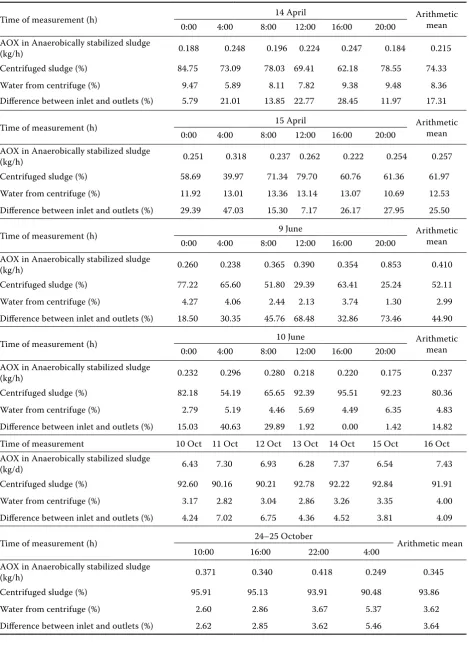
[image:4.595.64.534.100.746.2]lated from 62.18–84.75%. In water from the centri-fuge the proportion of AOX was from 5.89–9.48%. On the basis of these values, the difference between input and output can also be calculated, and in this case it was found to be from 5.79% up to 28.45%. On 15 April, 2007 the quantity of AOX left in the centrifuged sludge expressed as a percentage of this time was between 39.97% and 79.70%. In wa-ter from the centrifuge 10.69–13.36% AOX were found and the difference again oscillated between 7.17% and 47.05% (Table 1.). On 9 June, 2007 the percentage of AOX in centrifuged sludge in this case was between 25.24% and 77.22%. In water, 1 to 4.27% AOX remained and the difference between input and output amounted to 18.50% to 73.46%
[image:5.595.62.538.101.260.2](Table 1.). On 10 June, 2007 the quantity of AOX remaining after centrifugation in sludge varied from 54.19–95.51%. In water a minimum quantity of 2.79–6.35% remained compared with stabilized sludge. The difference between inlet and outlets from the centrifugation process ranged widely from 0–40.63% (Table 1.). These oscillations appeared only during centrifugation. The most likely con-clusion is that in the process substances are intro-duced from somewhere other than the monitored sources. This will probably be the chlorine that is supplied with drinking and industrial water. This water is introduced into the process when washing and cleaning centrifuges. As found, the incoming stabilized sludge is diluted to the optimum density
Table 2. Percentage of adsorbable organically bound halogens (AOX): drying process
Date of measurement 10 Oct 11 Oct 12 Oct 13 Oct 14 Oct 15 Oct 16 Oct
Dried sludge (%) 97.93 98.11 98.42 97.38 97.97 97.11 96.93
Vaporized water (%) 0.15 0.18 0.22 0.15 0.18 0.22 0.19
Air in the dryer building (%) 0.48 0.38 0.43 0.49 0.28 0.48 0.52 Difference between inlet and outlets (%) 1.45 1.71 1.36 2.47 1.85 2.67 2.88
Time of measurement (h) 24–25 October Arithmetic mean
10:00 16:00 22:00 4:00
Dried sludge (%) 92.67 98.13 92.65 96.71 95.04
Vaporized water (%) 0.18 0.23 0.22 0.25 0.22
Air from dryer building (%) 0.55 0.54 0.83 0.57 0.62
Difference between inlet and outlets (%) 6.60 0.93 7.06 1.27 3.96
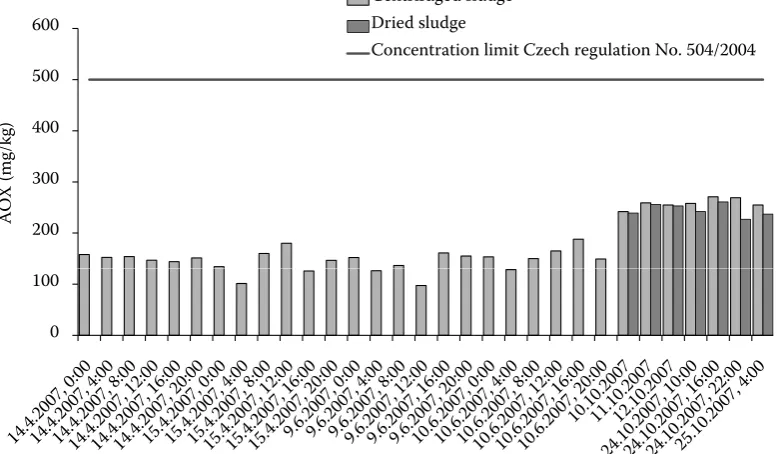
Fig. 2. Concentration of adsorbable organically bound halogens (AOX) in centrifuged and dried sluges: comparison with the Czech regulation
200 300 400 500 600
A
O
X
(m
g/
kg
)
Centrifuged sludge Dried sludge
Concentration limit Czech regulation No. 504/2004
[image:5.595.108.498.497.724.2]suitable for centrifugation, which averages about 4% dried solid content. When the operator finds a higher concentration of dried solid content, he or she can immediately add water to the process to dilute the sludge. However, this would probably be monitored in the first sample. Another way in which the quantity of AOX in the process may in-crease is that a flocculating agent may be added to the sludge inlets of the centrifuge. This flocculat-ing agent itself contains no halogens, but is carried as a solid and then diluted to the required concen-tration. Again, drinking, and industrial waters are used for dilution. These possibilities were verified; industrial water, unlike drinking water, has a much higher content of active chlorine. It can of course bind to the organic substances, creating substanc-es covered with determination AOX. As there are two separable processes, centrifugation and dry-ing, comments on percentages are always linked back to the input value. For centrifugation, this is the quantity of AOX in stabilized sludge (Table 1), and for drying, it is the AOX in centrifuged sludge (Table 2). Between 10 and 16 October, 2007, in the first of the above processes, the amount of AOX left in centrifuged sludge was 90.15–92.78%. In water from the centrifuge, the amount of AOX remained at 2.62–4%. The difference between input and out-put ranged between 3.81% and 7.02% (Table 1). AOX dried sludge quantities related to centrifuged sludge were very high and attained values of 96.93% to 98.42%. In vaporized water and air from the dryer building the percentage does not exceed 1% (vaporized water 0.15–0.22%, air 0.28–0.52%). The difference between input and outputs was between 1.45% and 2.88% (Table 2.).
The last measurement was done again during the day. The time intervals were extended from 4–6 h. The results from this measurement had less oscillation and approached the values measured as the daily av-erage (24–25 October, 2007). The percentage of AOX in centrifuged sludge was 90.48%–95.91%. In water from the centrifuge the percentage of AOX remained at 2.60–5.37%. The difference between input and outputs ranged between 2.62% and 5.46% (Table 1.). The amount of AOX in dried sludge was very high and attained values of 92.65%–98.13%. In vaporized water and air from the dryer building it did not ex-ceed the value of 1% (vaporized water 0.18–0.25%, air 0.54–0.83%). The difference between input and out-puts was in the range of 0.93–7.06% (Table 2).
The disposal of sludge containing AOX is also an important question. It is one of the limiting factors
that restrict the use of this source of basic nutri-ents (N, P, K). As shown in Fig. 2, the AOX content in sludge is below the limit value, so from the per-spective of AOX content, the sludge can be used to fertilize agricultural land. It is possible that this application does not allow excess content of other pollutants such as heavy metals.
As already indicated, co-incineration in a ce-ment furnace is possible. Organic substances are not a problem, but they do at least have a calorific value (usually the calorific value of dried sludge ap-proaches that of brown coal dust). Heavy metals are also not a problem. At high temperatures oxidation occurs and these oxides (products of oxidation) are subsequently collected in the chimney filters of ce-ment factories. One problem in sludge is the high concentration of total chlorine, to which AOX be-longs. The largest proportions comprise inorganic forms, in particular sodium, potassium, calcium, and ammonium chlorides. The cement factory is required to have a maximum total chlorine level which does not exceed 0.08 weight percentage. This is equivalent to 0.8 g total chlorine in 1 kg of dried solid content. In this regard sludge is usually suit-able for the cement factory. In 2007, conditions of the contract with the cement factory had not been negotiated, and so the total chlorine level had not been measured. In 2008 the total chlorine level was usually just 0.052 weight percentage. So it is possi-ble to use it as a secondary resource as is clear from the results from the laboratory of Modřice waste water treatment plant (WWTP).
ConClusions
40%. In the process a larger quantity of AOX that was not captured anywhere increased.
Sludge samples did not contain higher amount of AOX (Fig 2), which would restrain their use on ag-ricultural land or incinerating in cement work.
references
Bocchini P., Monaco D.D., Pozzi R., Pinelli F.,Galletti G.C., 2009. Solid-phase microextraction coupled to gas chromatography with flame ionization detection for moni-toring of organic solvents in working areas. Microchimica Acta, 165: 271–278.
ČSN EN 1485, 1998. Jakost vod – Stanovení adsorbovatel-ných organicky vázaadsorbovatel-ných halogenů (AOX) (Water quality – The determination of adsorbable organically bound halogens). Prague, Czech Office for Standards, Metrology and Testing.
Dohányos M., Zimová M., 2001. Hygienizace kalů (Hygi-enization of Sludge). In: Sborník přednášek: Hygienizace čistírenských kalů (Proceedings: Hygienization of sewage sludge). Asociace čistírenských expertů České republiky, Prague: 77–84.
Kutil J., Dohányos M., 2005. Efficient use and disposal of sewage sludge. Biom (Efektivní využití a likvidace čistírenských kalů. Biom). Available at: http://biom.cz/ cz/odborne-clanky/efektivni-vyuziti-a-likvidace-cistiren-skych-kalu-2 (accessed April, 2009)
Kuraš M., Dirner V., Slivka V., Březina M., 2008. Odpa-dové hospodářství (Waste management). Chrudim, Vodní zdroje Ekomonitor spol. s r.o.
Malý J., Malá J., 2006. Chemie a technologie vody (Chem-istry and technology of water). 2nd Ed. Brno, Ardec, Ltd.
Received for publication April 21, 2010 Accepted after corrections November 29, 2010
Corresponding author:
Karel Hrich, Brno University of Technology, Faculty of Civil Engineering, Institute of Chemistry, Veveří 95, Brno, Czech Republic