According to the Czech Capital Information Agency (ČEKIA), agriculture, manufacturing industry, trade and transport belong to the most risky branches of business. The steadiest are the companies which carry business in financial service, education, health service and energy. It results from the analyses of the layout of the riskiness and stability of the firms in the individual sectors of business. These methodologies for the risk rating of the business branch issue from the rating models of the so-called “Stability Rating”; they have the aim to estimate the risk of bankruptcy of the firm during a certain time period (usually in the following 12 months). A detailed analyses made by ČEKIA showed that approximately every third com-pany carrying business in agriculture and every fourth company from the manufacturing industry, trade and transport is threatened by bankruptcy. It would be advisable possibly in a general way to propose from this point of view an applicable management strategy of agricultural business subjects running which would also respect next to the objectively proven measure and relevance of the risk also an individual liability of the business subject to the risk. By this individual access to the rating of the risk, there is understood the measure of its aversion/or of the positive access to the given risk. It is possible to use the stochastic model
of the so-called value of perfect information (Kavan 2003) from the practical point of view regarding the knowledge of probability magnitudes influencing the decision-making. Some authors propose a system for support of decision through the rating of the inner functional organisation areas (Srnec and Svobodová 2009;Tomšík and Svoboda 2010). Other authors try to prove that it is possible to optimize the business decision on the base of the convergence of the non-rational to the non-rational decision process (Vasconcelos 2009). Dutta and Vandermeer (2011), who prefer the decisive models optimising the source use, choose another access in their paper. Another possibility how to model the business decisive processes is the possibility to use the fuzzy logic access (Chen and Ting 2009; Bashiri and Badri 2010). It is possible to view the problematic of manager decision in a wider social context, it means in which way the successful businessman influences his/her wider surrounding (Jeníček and Krepl 2008).
There exists a true presumption that is based on an empirical-cognitive basis that the ability to accept the relative level of risk relates to the whole source security through which it is possible to compensate the appropriate loss originated as a negative conse-quence of the risky condition.
The theory of preferential choice and its utilization
in managerial decision-making
Jan HRON, Tomas MACAK, Andrea JINDROVA
Department of Management, Faculty of Economics and Management,
Czech University of Life Sciences, Prague, Czech Republic
Abstract: At the theoretical level (respectively in the level of basic research), the aim of the submitted article is to form the theories of preferential choice in the area of higher utility vs. lower risk at interchangeable alternatives. Different or common features of utility vs. stochastic rating at agricultural subject are identified on the bases of this initial (axioma-tically understood) theory. The consecutive (applicably usable) aim is then the commercialisation of the created theory of the preferential choice as a possible instrument which suits many times the controversial results and which brings the application of utilitarian and stochastic access to the decision at not only agricultural business subjects. The determination of the knowledge system for support of determination will be in that way the practical ascent for which the method of the manager decision making is for the certain situation (of information uncertainty) the most suitable (Laplace, Hurwitz, mini-Max).
Key words: theory of preferential choice, managerial decisions, the certainty of information, subsidies in agriculture
ObjecTives And meThOdOlOgy
At the theoretical level (respectively in the level of basic research), the aim of the submitted article is to
form the theories of preferential choice in the area of higher utility vs. lower risk at interchangeable alter-natives. Different or common features of utility vs. stochastic rating at agricultural subject are identified on the bases of this initial (axiomatically understood) theory. The consecutive (applicably usable) aim is then the commercialisation of the created theory of the preferential choice as a possible instrument which suits many times the controversial results and which brings the application of utilitarian and stochastic access to the decision at not only agricultural busi-ness subjects. The determination of the knowledge system for the support of determination will be in that way the practical ascent for which the method of the manager decision making is for the certain situ-ation (of informsitu-ation uncertainty) the most suitable (Laplace, Hurwitz, mini-Max).
The methodology for creation of the basic theory of the preference choice is based on the comparison and the following integration of two separately un-derstood consumptive utility theories:
– Cardinal expression of utility according to Jevons and Marshal: it comes to increasing of the whole utility about an additional consumption to the relative decline of utility of other units (Baldwin 2003). If we inscribe the limiting utility as MU, the differential change of a unit (here monetary) as dp, and a differential change of the whole use as dU, then it is possible to express this theory in a formalized way as:
ܯܷ ൌ ܷ݀݀ ൏ Ͳ (1)
– Stochastic understanding of consumption use ex-pressed through a middle profit AU which arises as a coefficient of the expected use EU at the re-alisation business event with the birth probability of this event p:
ܣܷ ൌ ܧܷ ൈ (2)
The following model situation serves for the illus-tration of the preference choice principle, in which the subject directing its business activities to agri-cultural production or to manufacturing industry in agriculture gets into the decision-making situation. It has the choice from two alternatives in this deci-sion-making situation:
(a) To ask for a grant at the Support and Guarantee Agricultural and Forestry Fund, a.s. (further only SGAFF) regarding which it knows that its
pre-tension amount in the height 1 mil. CzK will be gained with the 100% certainty (and in the full level), because the SGAFF has the finances to its disposal overreaching the present pretension requirements from all applicants. Theoretically, only an administrative mistake could threaten the obtaining of this grant.
(b) To ask for the grant of the Department of Ag-riculture (next only DA). The business subject knows regarding this grant that it will be pos-sible to claim the amount in the level of 4 mil., but this level of the grant will be gained only with the 50% certainty because the AD fund has at its disposal the finances equal only to 50% of the whole claimed requirements from all granted applicants. Also an administrative mistake could threaten the grant obtaining even in this case. It is stated in the conditions for the SGAFF grants, as well as in the conditions of the AD, that the applicant for a grant cannot be a subject that is simultaneously the current applicant for the second provider or which has gained in the relevant year the grant from another budget sections of the state budget. That is why the business subject must decide, if it shall ask for a grant either from the SGAFF (alternative a) or the AD (alternative b). The task is to set the common criterion which could enable to identify the expediency of the choice of the alternative a – (prioritize the law of the declining limiting utility) or the alternative b – (prioritize the middle profit value).
If we accept the easily realizable presumptions in practice, that the whole utility function in the depend-ence on the disposable quantity or a certain source (for instance financial resources) is purely concave, monotonously raising function, then the differential change of the whole utility U in the dependence on the differential increase of the quantity of disposable finances p of a certain agricultural subject will fulfil the condition:
ܷ݀
݀ Ͳ (3)
while ݀ଶܷ
݀ଶ ൏ Ͳ (4)
at the given agricultural subject. This indifferent limit is expressed by the condition of the relative increase levelling ∆U and the relative increase of financial resources ∆p which the business subject has at disposal.
οܷ οୀǨ (5)
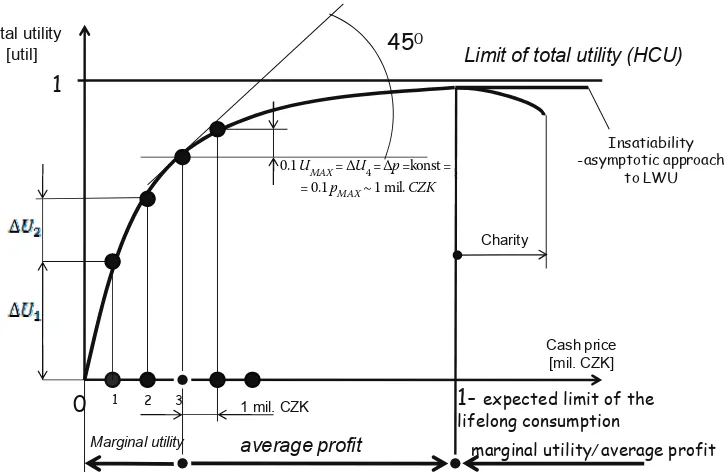
If we transform both magnitudes U and p into the closed interval of values οܷ א ۃͲǡͳۄ and ο א ۃͲǡͳۄ, then the absolute changes in the geometrical inter-pretation mean the relative changes in arithmetical meaning and the indifferential limit will be in such a point of the function U = f(p), where according to (5) the increase will equal in the vertical axis to the increase on the horizontal axis. Because both magnitudes Uand p are transformed into the cally big interval of values, this point will be identi-fied with the 45° tangent coefficient to the function
U = f(p), see the Figure 1.
The indifferent point UINDIF of the function U =
f(p) divides the interval of values א ۃͲǡͳۄ into two areas on the Figure 1. The first area, delimited by the interval of independent values 0 to PINDF (PINDF = 3 million CzK), represents the cases, where it is useful for the appropriate agricultural subject to run its decision-making strategy on the bases of declin-ing limit utility law, it means that it chooses in the presented model situation the alternative a in the form of application for the grant form the SGAFF. Here the first million CzK gained by the grant is connected with the relatively greater increase of
utility ∆U, before it reaches the relative increase of financial resource ∆p. The second area delimited by the interval of independent values PINDIF to p, where the whole utility U equals the maximum of (U = 1), the interval of pjrepresents values, where it is useful to choose the alternative b in the form of an application for the grant from the AD fund. The increase acceleration of the benefit function in the dependence on the money resource is at this interval negative, that is why it comes to the speed deceleration of the function increase U = f(p). The
deceleration of the speed of the function growth is the attendant effect, where a particular business subject is willing to undergo the risk of failure at an application for the grant, because it is able to realize its business intentions also without gaining a grant owing to a greater money resource. In addition, also an individually perceived relative measure of utility from the gained grand is declined.
The run of function U = f(p) behind the limit, where
p = 1, shows two different ways of reception of the
[image:3.595.120.484.495.731.2]value money reserve which is bigger than the busi-ness subject (or physical entity) supposes that it will need for the investment during the existence of the particular business subject (or during the life of the physical entity). Basically it is possible to reveal the display of insatiability (at the asymptotical approach of function U = f (p) to the limit of the whole utility), or the declining run of the function U = f(p) (at the tendencies of using the excess money savings to the activities out of the frame of business.
Figure 1. Deduction of the expediency condition in the use of the Limiting Utility vs. Middle Profit at the decision-making of an agricultural subject
Figure 1: Deduction of the expediency condition in the use of Limiting Utility vs. Middle Profit at the decision-making of an agricultural subject
Total utility [util]
1
1- expected limit of the lifelong consumption
0 1 mil. CZK
Cash price [mil. CZK]
450
1 2 3
Limit of total utility (HCU)
Charity
average profit marginal utility/average profit Insatiability -asymptotic approach
to LWU
Marginal utility
discUssiOn OF ResUlTs
At first a pilot research was made in the form of statistic interference on the sample of 60 agriculture subject informants to the verification of the introduced theory. The gained data were then put through an analysis of the magnitude dependence of an ordinal and nominal type through the independence testing. Statistic calculations were performed in the sur-rounding of the statistic software SPSS, version 18. The hypothesis about the independence of the money savings size Ho, related to the supposed lifelong consumption (event. to the property used as capital source) and the tendency to prefer the middle profit to declining limiting utility in the frame of business decision-making, was tested on a symptomatic level of importance α = 0.05. The “Chi-quadrate” test about the independence of marks was used for the testing in the pivot tables, because the conditions of good approximation for the so-called Pearson Test Statistic defined e.g. in (Cohen 2003) were fulfilled.
It was not possible to reject the zero hypotheses Ho
in the frame of this research and to tend to the validity of the alternative hypothesis which would express the practical functionality of the developed preference choice theory. However, because the values of the cat-egorical-interpreted data recorded the growing trend of dependence on the change of the relative level of financial saving, the providential result about a possible reason of the impossibility to reject the hypothesis Ho was made. Too small range of the casual choice of business subject could be the possible reason. That’s why it was carried out a bigger choice representing 611 informants after this pilot research, nevertheless, 14 informants were set aside, because they did not satisfy the transitivity principal which we used at the questionnaire research to the selection of unreliable informants. The disturbance of transitivity happened in the situation, where the informant of the questionnaire research was not consistent in his/her preferences. This was in this case signalized by two combinations between two answers of the questionnaire:
(1) The mark from “SMALL” set of the average yearly incomes during the past three years period repre-sented the answer on the sixth question, the mark of the fifth category of the dichotomic parameter presented the value “YES” (on the question, if the informant ever donated money for charity) and the mark of the sixth dichotomic parameter presented the value “NO” (he/she is not willing to donate money on charity, even if the saving is bigger than the lifelong consumption).
(2) The mark from “BIG” set of the average yearly incomes during the past three years period
repre-sented the answer on the sixth question, the mark of the firth category of the dichotomic parameter represented the value “NO” (on the question, if the informant ever donated money for charity) and the mark of the sixth dichotomic parameter represented the value “YES” (he/she is willing to donate money for charity, when the saving is bigger than the lifelong consumption).
If we express these two rules with the use of impli-cation (IF) and conjunction (AND), we can formally write:
۷۴ሺρሺɁሻ ൌ ܁ۻۯۺۺሻۯۼ۲ሺρହሺԂሻ ൌ ܇۳܁ሻ܂۶۳ۼሺρ ሺሻ ൌ ۷ۼ۱۽ۼ܁۷܁܂۳ۼ۱܇
۷۴ሺρሺɁሻ ൌ ܁ۻۯۺۺሻۯۼ۲ሺρହሺԂሻ ൌ ܇۳܁ሻ܂۶۳ۼሺρሺሻ ൌ ۷ۼ۱۽ۼ܁۷܁܂۳ۼ۱܇
۷۴ሺρሺɁሻ ൌ ۶۷۵۶ሻۯۼ۲ሺρହሺԂሻ ൌ ۼ۽ሻ܂۶۳ۼሺρ୭ሺݑሻ ൌ ۷ۼ۱۽ۼ܁۷܁܂۳ۼ۱܇
۷۴ሺρሺɁሻ ൌ ۶۷۵۶ሻۯۼ۲ሺρହሺԂሻ ൌ ۼ۽ሻ܂۶۳ۼሺρ୭ሺݑሻ ൌ ۷ۼ۱۽ۼ܁۷܁܂۳ۼ۱܇
where:
ρሺɁሻ = i set of the ordinal mark measured by the ques-
tionnaire
ρሺԂሻ = j set of the mark of the dichotomist parameter
measured by the questionnaire.
As the Table 1 shows, here the hypothesis Ho was rejected on the level of significance α = 0.05 and next the middle dependence between the preference level of the middle profit before the limit utility at the growth of financial savings outspread to the sup-posed lifelong consumption at the given agricultural subject was confirmed through the Kramér coefficient
V = 0.36.
ܸ ൌ ඨ݊ ൈ ሺ݉ െ ͳሻ ൌܭ ඨ ͶǤͳ
͵Ͳ ൈ ሺʹ െ ͳሻ ൌ ͲǤ͵ (6)
middle dependence
For the certification of the functionality of the preference choice theory, it is possible to go over to its practical use in the form of the knowledge system on the decision-making support. This knowledge system helps at the decision-making about the fact which method of the manager decision-making is the most suitable for the particular situation (Laplace, Hurwitz, Mini-Max), e.g. for the decision-making about the grant provider for agricultural business.
According to (Anderson 1994; Fort 2000), the Laplace’s criterion of the optimal choice is based on the selection of just such a strategy the middle value of economic consequences of the decision ESj of which is the biggest. More exactly expressed, the maximum middle value is the most advantageous at the criterion with the growing preference of values; the smallest middle profit is the most advantageous at the criterion with the declining preference of values. It is possible to use alternatively the access “Mini-Max”, when this variation is supposed as the best, where the less favourable economic result (i.e. minimum) of the manager decision is the best (i.e. maximum). The third alternative for the decision-making in the uncertainty is the Hurwitz criterion which according to (Anderson 1994; Fotr 2000) prefers the variation (resp. strategy vs. real situation) the weighted aver-age of which (Ej) from the smallest (min Eij) and
the biggest (max Eij) economic consequence of the manager decision is the biggest.
ܧൌ ܽ ൈ ܧ ܾ ൈ ܧ (7)
where: a + b = 1.00 a = coefficient of pessimism b = coefficient of optimism
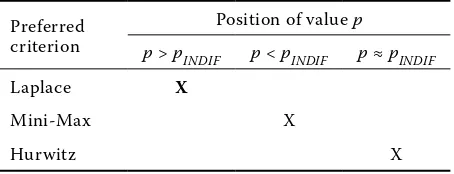
The Table 2 expresses the rules in the matching of a certain decision-making method on the dependence of the result, into which interval the factor value R5c in the given situation belongs. The value p lying in the interval 0 until PINDIF(PINDIF = 3 mil CzK), represents the cases, when it is very suitable for the appropriate business (agricultural) subject to choose the access “Mini-Max”. If the value p lies in the interval PINDIF
until1, it is suitable to consider the Laplace’s criterion for the criterion of the optimal choice. If the value p is situated in the near surrounding of the point PINDIF, then it is suitable to choose the Hurwitz criterion as optimal. Nevertheless, it holds for the rate between the coefficient of optimism a and pessimism b:
ܽ ܾ ൌ
ȁͲ െ ூேூிȁ
ȁூேூிെ ͳȁ (8)
cOnclUsiOn
[image:5.595.62.533.98.264.2]The complex of human cognition interferes always with all parts of our lives more stridently. There does not exist any area of human activity which would not be touched and influenced by this fact. The orientation in the branches of human activities and in their results is always more exacting through the influence of a growing extension of information, as well as its price. The development of knowledge went historically on the way of specialisation and division of labour and Table 1. Pivot table for certification of the dependence between the relative financial saving and the preference of the declining limiting utility in the frame of the business decision making
Financial saving in the rate of the whole consumption in the frame of the subject lifetime
Total debt to 0% saving between 0% to 33% of saving more than 33% of saving
Average profit 1 118 257 74 449
Marginal utility 2 19 72 57 148
Total 137 329 131 597
symmetric measures
Value Approx. sig.
Nominal by nominal Contingency coefficient 0.256 0.000
N of valid cases 600
Table 2. Matching of the decision-making method in the dependence of the interval position of the value p
Preferred criterion
Position of value p
p > pINDIF p < pINDIF p ≈ pINDIF
Laplace X
Mini-Max X
[image:5.595.64.291.679.766.2]it called many science branches and disciplines into existence, which reached in a high number of cases to the limit of possibilities of human knowledge as such and led to the revelation of basic features and regularity in these areas. These branches created in the process their individual intellectual schemes and notional equipment which created certain barriers for the cognition and understanding of phenomena and processes and the mutual contexts between them from the aspect overreaching the frame of these branches.
The contemporary processes of science knowledge, in the reaction to the inner specialisation, find often its other potential in the interdisciplinary relations which bring many times new and surprising cognitions that have the premise to become a new paradigm of the 21st century science. It appears as meaningful from the point of view of these facts to connect syntheti-cally the various theoretical accesses to the purpose of optimizing not only the manager decision-mak-ing process. This connection of different accesses is practically possible only after the discovery of certain “criterion” through which it is possible to character-ize the principally different theoretical methods and on the basis of the following comparing to delimitate the limitation in their practical use. The theory of preference choice represents one of the possible examples of such procedure and its commercialized output can be used at the decision-making about the grant policy regarding agricultural subjects.
ReFeRences
Anderson D.R., Sweeenez D.J. (1994): An Introduction to Management Science: Quantitative Approaches to Decision Making. West Publishing, Minneapolis.
Baldwin T. (2003): Cambridge History of Philosophy 1870– 1945. Cambridge University Press, Cambridge. Bashiri M., Badri H.A. (2010): A group decision
mak-ing procedure for fuzzy interactive linear assignment programming. Expert Systems with Applications, 38: 561–568.
Chen T.Y., Wang H.P. (2010): A multi-criteria group deci-sion-making approach based on interval-valued intui-tionist fuzzy sets: A comparative perspective. Expert Systems with Applications, 38: 47–58.
Cohen J., West S.G., Aiken L.S. (2003): Applied Multi-ple Regression/Correlation Analysis for the Behavior Science. Hillsdale, NJ, Lawrence Erlbaum Associates, New York.
Dutta K., Vandermeer D. (2011): Cost-based decision-mak-ing middleware virtualization environments. European Journal of Operational Research, 210: 334–347. Fotr J., Dedina J. (2000): Managerial Decision Making.
Ekoperss Publishing, Prague; ISBN 80-86119-20-3. Jenicek V., Krepl V. (2008): All-human social, humanitarian,
cultural and security problems of the Word. Agricultural Economics – Czech, 54: 263–268.
Kavan M. (2004): Creating a Sustainable Manufactur-ing Strategy. In: ProceedManufactur-ings of Workshop 2004. CTU, Prague, Vol. B: 1030–1031; ISBN 80-01-02945-X. Srnec K, Svobodova E. (2009): Microfinance in less
de-veloped countries: history, progress, present – char-ity or business? Agricultural Economics – Czech, 55: 467–474.
Tomsik P., Svoboda E. (2010): Diagnostics and decision-making of the company management within the period of economic crisis and recession. Agricultural Economics – Czech, 56: 303–309.
Vasconcelos A.F. (2009): Intuition, prayer, and managerial decision-making processes: a religion-based framework. Management Decision, 47: 930–949.
Arrived on 17th March 2011
Contact address:
Jan Hron, Tomas Macak, Andrea Jindrova, Czech University of Life Sciences Prague, Kamýcká 129, 165 21 Prague 6, Czech Republic