Bacteriocin Activity of Enterococci
and Presence of Genes Related to Pathogenesis
Krina Trivedi
1, radmila SedmíKová
1and renáta KarpíšKová
1,21department of milk Hygiene and Technology, Faculty of veterinary Hygiene and ecology,
University of veterinary and pharmaceutical Sciences Brno, Czech republic; 2National institute of public Health, Brno, Czech republic
Abstract
Trivedi K., Sedmíková R., Karpíšková R. (2012): Bacteriocin activity of enterococci and presence of genes related to pathogenesis.Czech J. Food Sci., 30: 330–335.
In total 228 enterococci strains isolated from food were studied. enterococcus faecalis, e. faecium, and e. casseliflavus
were found to be the dominant strains while e. durans and e. mundtii were present in a smaller extent. Antimicrobial activity determined by double layer technique revealed that 150 (65.7%) strains showed antimicrobial activity against the individual tested pathogenic strains of Listeria monocytogenes, Staphylococcus aureus, and methicilin resistant
S. aureus (MRSA). Cell-free neutralised supernatants (CFNS) were prepared from 150 potential bacteriocin producers. Of these 150, CFNS 107 (71.3%) strains were active in the bacteriocin production against one or more pathogenic strains tested. S. aureus and MRSA were found to be more sensitive to the antimicrobial substances than L. monocytogenes. Multiplex PCR for the detection of seven virulence genes in bacteriocin producing strains showed that 47.6% of strains were able to amplify one or more virulence genes. e. faecalis was the most virulent species. The presence of tyrdc gene was seen in all bacteriocin producing strains. None of the strains carried genes encoding the resistance to vancomycin.
Keywords: food; antimicrobial activity; virulence genes; tyrdc gene; Listeria monocytogenes; Staphylococcus aureus; methicilin resistant Staphylococcusaureus
Enterococci can be found in many foods of both animal and vegetable origins (Murray 1990;
Mul-ler et al. 2001; Ben Omar et al. 2004). They are able
to survive the heat treatment and other adverse conditions during the food processing. On the other hand, they can be used to extend the shelf life and improve the hygienic safety of foodstuffs because they produce several antimicrobial substances such as lactic acid, hydrogen peroxide, and bacterioc-ins (Martín-Platero et al. 2009). Bacteriocins are ribosomally synthesised peptides or proteins produced by bacteria that exhibit antimicrobial
activity against other more or less related bacteria (Klaenhammer 1993). Enterocins are bacteriocins produced by enterococcus spp. They are mainly Class II bacteriocins and are distinguished by their activity against Listeria spp. The encoding of multiple enterocin genes in the genomes of enterococci is not unusual and the production of more than one enterocins by an enterococcal strain is of technological and commercial inter-est. Several researchers have isolated enterococci producing enterocins (Foulquié-Moreno et al. 2006; Chanos & Williams 2011). As enterococci
are commonly present in many food systems and their technological and probiotic benefits are so well known, their production of bacteriocins (en-terocins) has become a subject of great interest since they are found to be active against various pathogens such as Listeria monocytogenes,
Staphy-lococcus aureus, and Clostridium botulinum (Sabia
et al. 2007). Bacteriocin producing enterococci
can be intended only for such food products, in which their negative interference with other lactic acid bacteria used for the production of this food product is not expected. The ambivalence of ente-rococci consists in both the positive and negative roles. Some strains are used as probiotics whereas others are also recognised as serious nosocomial pathogens causing bacteraemia, urinary tract infec-tions, and endocarditis (Kučerová et al. 2009a). However, enterococci have been involved in food spoilage (Franz et al. 1999), in food intoxi-cation (Gardini et al. 2002), and in spreading the antibiotic resistance through the food chain (Giraffa 2003). Food intoxication associated with a higher consumption of biogenic amines such as tyramine and histamine has been widely studied in recent years. The diet rich in tyramine can increase blood pressure and cause migraines, and that imbalance in the level of tyramine is thought to underlie altered brain function in many patho-logical conditions, including dystonias, Parkin-son’s disease, schizophrenia, drug addiction, and mood disorders (Marcobal et al. 2006). Several putative virulence factors have been described in enterococci such as aggregation substances, gelatinase, cytolysin, enterococcal surface protein, hyaluronidase, accessory colonisation factor, and endocarditis antigen (Martín-Platero et al. 2009). Until now, a major focus in most of the stud-ies has been on two main specstud-ies of enterococci,
enterococcus faecalis and e. faecium. These are
most prominently occurring species in the entire habitat. Also, e. faeacalis and e. faecium have been found to be responsible for the presence of higher numbers of virulent genes causing serious nosocomial infections (Jett et al. 1998). Thus, the focus on the enterococcal species with less virulent traits and better bacteriocin producing capacity should be taken into consideration for the food processing application.
The aim of the study was to detect the bacterio- cin producing enterococci isolated from various foodstuffs and to characterise them for the general risks associated with their occurrence in foods.
MATERIAL AND METHODS
Enterococci. In total 228 enterococci strains were isolated from various foodstuffs and stored at –75°C in 20% glycerol medium in the strain collection of the Department of Milk Hygiene and Technology (University of Veterinary and Phar-maceutical Sciences Brno, Czech Republic). The strains were resuscitated on the Slanetz Bartley medium (HiMedia, Mumbai, India) at 37°C for 24 h and characterised on the species level according to (Jackson et al. 2004). Detailed characteristic of the strains is given in Table 1.
Collection strains.MRSA S15 (Department of Milk Hygiene and Technology, Brno, Czech Re-public), Listeria monocytogenes LM CCM 4699, and
Staphylococcus aureus SA CCM 4223 (Czech Culture
Collection Centre, Masaryk University, Brno, Czech Republic) were used for testing the antibacterial activity of bacteriocins. Lyophilised strains were resuscitated according to the CCM procedure in Nutrient broth aerobically at 37°C for 24 hours. After incubation, the cultures were streaked on Nutrient agar and stored in refrigerator until the use.
Screening of enterococci for antibacterial ac-tivity. The antibacterial activity of the enterococci strains against selected Gram-positive bacteria was tested by double layer technique. Culture suspen-sions of 2 McFarland in physiological solution were prepared from fresh overnight cultures of pure enterococcal strains. Drops of 5 µl volume of enterococci culture suspensions were spotted onto plates containing 10 ml of GM-17 agar i.e. M-17 agar (Oxoid, Hampshire, UK) plus 1% d-glucose (Penta, Prague, Czech Republic) medium dissolved in 0.1M pH 7.2 sodium phosphate buffer (GM-17-B). The plates were incubated at 37°C for 18–24 hours. After the growth of enterococci strains on GM-17 agar, the plates were overlaid with 1 ml of Brain Heart Infusion broth (BHI; HiMedia, Mumbai, India) inoculated with an overnight culture with the cell density approx. 1–5 × 10⁸ CFU of the tested strains and incubated once again at 37°C for 18–24 h to allow the growth of the tested strain. The appearance of a clear inhibition zone around the strain spot indicated the production of an inhibitor substance active against the indicator strain (Martín-Platero et al. 2009).
for 15 min; the cell-free supernatant was neutralised to pH 6.0 using NaOH (100 g/l solution) and heated at 90°C for 10 min to inactivate the remaining cells. The cell-free, neutralised supernatant (CFNS) was used in further bacteriocin assay by the above men-tioned agar spot method (Kučerová et al. 2009b). Method based on tyrdc gene detection (PCR). DNA extraction was performed by the boiling procedure (Peréz-Hernández et al. 2002) with a slight change in the process. Here, the cell suspen-sion was prepared in 5% chelex (Bio Rad, Munich, Germany) instead of water. A multiplex PCR was designed to look for the production of tyramine by the detection of tyrdc gene. Primers used and the amplification program were identical to that of Trivedi et al. 2009.
Multiplex PCR for identification of virulence genes and vancomycin resistant genes. Three
different multiplex PCR were carried out for the screening of seven different virulence factors gelE (Gelatinase), hyl (Hyaluronidase), asa1 (Aggrega-tion substances), esp (Enterococcal surface protein), cylA (Cytolysin), efaA (Endocarditis antigen), ace (Adhesion of collagen protein), and two vancomy-cin resistant (vanA and vanB) genes. The primers used and conditions for the PCR were according to Martín-Platero et al. (2009).
RESULTS AND DISCUSSION
Spectrum of enterococci species tested
[image:3.595.66.534.351.754.2]Out of 228 enterococci strains, 150 (65.7%) were of dairy origin. The remaining 25 (10.96%) were of meat origin, 25 (10.96%) of fruits and vegetable
Table 1. Antibacterial effects of various enterococci strains isolated from various food-stuffs
Or
ig
in
Species of strains No. (%)
No. of enterococcal strains producing antibacterial substance (%) against selected Gram-positive bacteria
SA CCM 4223 S15 MRSA LM CCM 4699 without CFNS with CFNS without CFNS with CFNS without CFNS with CFNS
D
air
y
E. faecalis 103 (68.7) 79 (76.6) 39 (49.3) 67 (65.1) 47 (70.1) 12 (11.6) 3 (25)
e. faecium 43 (28.7) 36 (83.7) 18 (50) 24 (55.8) 13 (54.1) 2 (4.6) 0 (0)
e. casseliflavus 3 (2) 3 (100) 1 (33.3) 3 (100) 1 (33.3) 0 (0) 0 (0)
e. durans 1 (0.7) 1 (100) 0 (0) 1 (100) 0 (0) 0 (0) 0 (0) Total 150 119 (79.33) 58 (48.7) 94 (62.6) 61 (64.8) 14 (9.33) 3 (21.4)
M
eat
e. faecalis 9 (36) 7 (77.7) 4 (57.1) 5 (55.5) 2 (20) 4 (44.4) 1 (25)
e. faecium 12 (48) 7 (58.3) 3 (42.8) 3 (25) 1 (33.3) 5 (41.6) 2 (20)
e. casseliflavus 1 (4) 1 (100) 0 (0) 1 (100) 0 (0) 0 (0) 0 (0)
e. mundtii 2 (8) 2 (50) 0 (0) 1 (50) 0 (0) 2 (100) 0 (0)
e. hirae 1 (4) 0 (0) 0 (0) 0 (0) 0 (0) 0 (0) 0 (0) Total 25 17 (68) 7 (41.1) 10 (40) 3 (30) 11 (44) 3 (27.2)
Fr
uit
s and ve
ge
ta
ble
s e. faecalis 10 (40) 10 (100) 5 (40) 6 (60) 3 (50) 6 (60) 3 (33.3)
e. faecium 9 (36) 6 (66.6) 2 (33.3) 4 (44.4) 1 (25) 4 (44.4) 2 (50)
e. casseliflavus 3 (16) 2 (66.6) 1 (50) 0 (0) 0 (0) 0 (0) 0 (0)
e. mundtii 3 (12) 2 (66.6) 0 (0) 1 (33.3) 0 (0) 0 (0) 0 (0) Total 25 20 (80) 8 (32) 11 (44) 4 (36.3) 10 (40) 5 (50)
Re
tail
e. faecalis 26 (92.8) 3 (11.5) 0 (0) 0 (0) 0 (0) 0 (0) 0 (0)
e. faecium 1 (3.6) 0 (0) 0 (0) 0 (0) 0 (0) 0 (0) 0 (0)
origins, and 28 (12.2%) came from foods available in the commercial market. Five different species of enterococci were recovered from this analysis. Of these, e. faecalis followed by e. faecium were found to be dominating in all origins. The presence
of e. casseliflavus and e. durans was also seen in
the strains of dairy origin. The presence of e. hirae
and e. mundtii along with e. casseliflavus was
evident in the case of meat origin. The strains of fruit and vegetable origins revealed the presence
of e. mundtii along with e. casseliflavus (Table 1).
Bacteriocin production
The production of antimicrobial substances against Staphylococcus aureus, MRSA, and Listeria
monocytogenes was tested with all the enterococci
strains isolated from various foodstuffs. Out of 228 samples, 150 (65.7%) of the strains were able to produce antimicrobial substances against the individual pathogens tested. The CFNS was pre-pared from the positive isolates and than tested for the potential bacteriocin production.
Of these 150, CFNS 107 (71.3%) were found to be active in the production of bacteriocin against one or more pathogenic strains tested. 83 (55.3%) were found to be active in the production of enterocins against S. aureus strain, 48 (32%) strains were found to be active against MRSA, and 24 (16%) strains were active against L. monocytogenes. S. aureus and MRSA were found to be more sensitive to antimicrobial substances than L. monocytogenes. Only 10 bacteriocins (6.7%) were found to be ac-tive against all three pathogens.
e. faecium along with other isolated species
was found to be highly active in the production of enterocins. Our results in terms of e. faecium
were in agreement with that of Chanos and Wil-liams (2011).
Multiplex PCR for tyrdc gene, virulence factors and vancomycin resistant genes
The selected enterococci strains have been used for decades in the production of various fermented foods and cheeses. In spite of this they have not yet obtained the GRAS (Generally Recognize as Safe) status (Ogier & Serror 2008). This might be due to the involvement of these bacterial strains in nosocomial infections (Giraffa 2003) and other health risks associated with them.
All the potentially bacteriocin producing ente-rococci strains characterised in this study showed the presence of tyrdc gene and can be concerned as potential producers of tyramine.
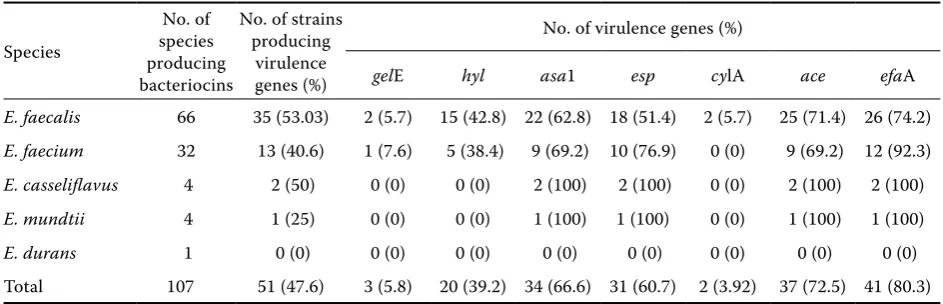
One of the major concerns along with the pro-duction of biogenic amines is the potential patho-genicity of the enterococci. They are emerging pathogens involved in urinary-tract infections, bacteraemia, endocarditis, and multiple antibiotic resistance (Franz et al. 1999), their virulence and pathogenic mechanisms still being largely unknown (Creti et al. 2004). In our work, we have concentrated on the study of seven different virulence genes (gelE, hyl, asa1, esp, cylA, ace, and efaA) from the 107 bacteriocin producing strains. PCR amplification of these genes yielded positive results with 51 (47.6%) samples of all the identified species. We were able to detect these genes in all the species which had been tested but their expression was not tested. The incidence of gelE was found to be the least in our study and the products from meat and retail did not show the presence of gelE. These results were in
con-Table 2. Virulence genes in bacteriocin producing enterococci strains isolated from food-stuffs
Species
No. of species producing bacteriocins
No. of strains producing
virulence genes (%)
No. of virulence genes (%)
gelE hyl asa1 esp cylA ace efaA
e. faecalis 66 35 (53.03) 2 (5.7) 15 (42.8) 22 (62.8) 18 (51.4) 2 (5.7) 25 (71.4) 26 (74.2)
e. faecium 32 13 (40.6) 1 (7.6) 5 (38.4) 9 (69.2) 10 (76.9) 0 (0) 9 (69.2) 12 (92.3)
e. casseliflavus 4 2 (50) 0 (0) 0 (0) 2 (100) 2 (100) 0 (0) 2 (100) 2 (100)
e. mundtii 4 1 (25) 0 (0) 0 (0) 1 (100) 1 (100) 0 (0) 1 (100) 1 (100)
[image:4.595.62.534.605.757.2]tradiction to those of (Creti et al. 2004), who had referred to a higher incidence of gelE genes in
e. faecalis strains. The incidence of hyl, asa1, esp,
ace, and efaA was evident to be the highest in our study. Also, e. faecalis was found to be the most active in the production of the virulence genes while the presence of the virulence genes in other species was evident but to a lesser extent. Here,
e. durans, e. casseliflavus, e. mundtii irrespective
of the origin were found to be the least active in the production of the virulence genes. The highest numbers of positive results were harboured from
e. faecalis. Detailed results are shown in Table 2.
The use of antimicrobials in animal feed as growth promoters have created large reservoirs of transferable antibiotic resistance genes in several ecosystems, and consequently a possible route of the transmission of resistant enterococcus spp. via the food chain could be suggested (Riboldi
et al. 2009). A specific cause for concern and
con-tributing factor to pathogenesis of enterococci is their resistance to a wide variety of antibiotics, especially vancomycin (Franz et al. 2001). None of the food isolate in our study was found to carry the vancomycin resistant gene.
CONCLUSION
Nearly half of the enterococci tested showed inhibitory effects (potentially bacteriocins). All the enterococci tested in this study contained the gene encoding the production of tyramine.
e. faecalis showed to be the most virulent species,
but the genes encoding virulence were detected also in other species. This fact should be taken into consideration in view of the use of entero-cocci in the food processing. In the agreement with the GRAS definition, such strains should be free from the virulence genes, genes coding resistance to antimicrobials, and should belong to low tyramine producers.
References
Ben Omar N., Castro A., Lucas R., Abriouel H., Yousif N.M.K., Franz C.M.A.P., Holzapfel W.H., Pérez-Pu-lido R., Martínez-Canamero M., Gálvez A. (2004): Functional and safety aspects of enterococci isolated from different Spanish foods. Systematic and Applied Microbiology,27: 118–130.
Chanos P., Williams D.R. (2011): Anti-Listeria bac-teriocin-producing bacteria from raw ewe’s milk in northern Greece. Journal of Applied Microbiology,
110: 757–768.
Creti R., Imperi M., Bertuccini L., Fabretti F., Orefici G., Di Rosa R., Baldassarri L. (2004): Survey for viru-lence determinants among enterococcus faecalis isolated from different sources. Journal of Medical Microbiology,
53: 13–20.
Foulquié Moreno M.R., Sarantinopoulos P., Tsaka-lidou E., De Vuyst L. (2006): The role and application of enterococci in food and health. International Journal of Food Microbiology, 106: 1–24.
Franz C.M., Holzaphel W.H., Stiles M.E. (1999): En-terococci at the crossroads of food safety? International Journal of Food Microbiology, 47: 1–24.
Franz C.M.A.P., Muscholll-Sillberhorn A.B., Yousif N.M.K., Vancanneyt M., Swings J., Holzapfel W.H. (2001): Incidence of virulence factors and antibiotic re-sistance among enterococci isolated from food. Applied and Environmental Microbiology, 67: 4385–4389.
Gardini F., Martuscelli M., Caruso M.C., Galgano F., Crudrle M.A., Giraffa G. (2002): Enterococci from foods. FEMS Microbiology Reviews, 26: 163–171. Giraffa G. (2003): Functionality of enterococci in dairy
products. International Journal of Food Microbiology,
88: 215–222.
Jackson C.H., Fedorka-Cray P.J., Barrett J.B. (2004): Use of genus and species-specific multiplex PCR for identification of enterococci. Journal of Clinical Micro-biology, 42: 3558–3565.
Jett B.D., Atkuri R.V., Gilmore M.S. (1998): enterococcus faecalis localization in experimental endophthalmitis: Role of plasmid-encoded aggregation substance. Infection and Immunity, 66: 843–848.
Klaenhammer T.R. (1993): Genetics of bacteriocins pro-duced by lactic acid bacteria. FEMS Microbiology Re-views, 12: 39–85.
Kučerová K., Svobodová H., Tůma Š., Ondráčková I., Plocková M. (2009a): Production of biogenic amines by enterococci. Czech Journal of Food Sciences, 27 (Special Issue 2): S2-50–S2 55.
Kučerová K., Korbová I., Horáčková Š., Šviráková E., Plocková M. (2009b): Influence of Enterococci and Lactobacilli on Listeria. Czech Journal of Food Sciences,
27 (Special Isssue 2): S2-12–S2-17.
Martín-Platero A.M., Valdivia E., Maqueda M., Mar-tínez-Bueno M. (2009): Characterization and safety evaluation of enterococci isolated from Spanish goats’ milk cheeses. International Journal of Food Microbiol-ogy, 132: 24–32.
Muller T., Ulrich A., Ott E.M., Muller M. (2001): Identi-fication of plant associated enterococci, Journal of Applied Microbiology, 91: 268–278.
Murray B.E. (1990): The life and times of the enterococcus. Clinical Microbiology Reviews, 3: 46–65.
Ogier J.C., Serror P. (2008): Safety assessment of dairy microorganisms: the enterococcus genus. International Journal of Food Microbiology, 126: 291–301.
Peréz-Hernández X., Méndez-Álvarez S., Claverie-Martín F. (2002): A PCR assay for rapid detection of vancomycin-resistant enterococci. Diagnostic Microbiol-ogy and Infectious Disease, 42: 273–277.
Riboldi G.P., Frazzon J., Azevdo P.A., Frazon A.P.G. (2009): Antimicrobial resistance profile of enterococcus
spp. isolated from food in southern Brazil. Brazilian Journal of Microbiology, 40: 125–128.
Sabia C.S., De Niederhausern E., Guerrieri P., Messi I., Anacarso G., Manicardi G., Bondi M. (2007): De-tection of bacteriocin production and virulence traits in vancomycin- resistant enterococci of different sources. Journal of Applied Microbiology, 104: 970–979. Trivedi K., Borkovcová I., Karpíšková R. (2009):
Tyramine production by Enterococci from various food-stuffs: A threat to the consumers. Czech Journal of Food Sciences, 27 (Special Issue): S357–S360.
Received for publication April 20, 2011 Accepted after corrections June 27, 2011
Corresponding author:
Krina Trivedi, M.Sc., Veterinární a farmaceutická univerzita Brno, Fakulta veterinární hygieny a ekologie,