Dynamics of 5-Hydroxymethylfurfural Formation
in Shortbreads during Thermal Processing
Stanisław KOWALSKI
1, Marcin LUKASIEWICZ
1, Lesław JUSZCZAK
2and Edyta Maja KUTYŁA-KUPIDURA
11Department of Carbohydrate Technology and 2Department of Analysis and Evaluation
of Food Quality, University of Agriculture in Krakow, Krakow, Poland
Abstract
KowalskiS., Lukasiewicz M., Juszczak L., Kutyła-KupiduraE.M. (2013):Dynamics of 5-hydroxymethyl- furfural formation in shortbreads during thermal processing. Czech J. Food Sci., 31: 33–42.
The analysis was carried out of 5-hydroxymethyl-2-furfural (HMF) formation during the baking of shortbreads. The investigation was done on three types of shortbread in which sucrose, glucose, or fructose were used as sweeteners. In all the samples the concentration of sugar was 20% (w/w). The cookies were baked in a laboratory oven at temperatures of 200, 215, 230, and 245°C. The samples for the HMF determination were taken at intervals from 5 to 18 min depending on the baking temperature. It was found that HMF formation can be described by exponential equation. The HMF formation was correlated with the colour changes of the cakes determined according to CIELab system. Different parameters of colour were investigated, however, only in the case of brightness difference may the correlation be treated as statistically important.
Keywords: HMF; sweeteners; cookies; colour changes
Thermal food processing may be classified as a unit operation in blanching, cooking, baking, frying, drying, pasteurisation, sterilisation, thaw-ing etc. It involves raisthaw-ing the product to some final temperature (surface or inner) that depends on the particular objective of the process (Sun 2005). The process of baking is commonly used to obtain certain sensory or textural features, or to assure microbiological safety as well as to elimi-nate enzymatic activities for manufacturing shelf stable food products (Tewari & Juneja 2007). On the other hand, sensory attributes including aroma, taste, and colour are strictly correlated with chemical processes when higher temperature is used to prepare food products. Good examples are: bread, cereals, chocolate, coffee, nuts, malt, or grilled meat. Thermal operations taking place in food products are associated with the occur-rence of non-enzymatic browning phenomena or so-called Maillard reaction (Richardson 2001). Processes like roasting and baking are connected
with a very intensive thermal treatment. In some cases, the temperature and time of the process are highly correlated with the product dimensions. In bread baking, small products (about 45 g) can be processed for about 20 min at 240–250°C, while bigger ones (up to 1000 g) can be heated up to 60 min or longer at 220°C.
One of them includes the transformation of fructofuranose ring, while in the second one an acyclic intermediate may be observed. The basic substrates for HMF production are monosaccha-rides i.e. fructose or glucose (Corma et al. 2007). Either of them may be used as a primary substrate or obtained in the process of disaccharide (sucrose) acidic hydrolysis, which leads to fructose/glucose equimolar mixture. It is known that the dehydra-tion of fructose is more effective and faster than that of glucose (Perez Locas & Yaylayan 2004; Yaylayan 2006; Zhao et al. 2007). Glucose as an aldohexose may be involved in competing reac-tion pathways leading to nonfuran cyclic ethers by-products formation or may be isomerised into fructose according to Lobry de Bruyn-Alberda van Ekenstein transformation (Miljkovic 2009).
Despite many studies on the HMF effects on hu-man health, an unambiguous interpretation exists of its influence on the human body. LD50 dose of 3.1 g/kg body weight in the case of oral administration was established based on studies on rats (Ulbricht
et al. 1984). Potential cytotoxicity and
carcino-genicity of this compound was also confirmed by numerous studies. According to these, harmful effects may be a direct result of HMF impact or the result of HMF transition to the 5-sulphooxy-methylfurfural (5-SMF) and other metabolites (Delgado-Andrade et al. 2008; Bakhiya et al. 2009; NTP Technical Report 2010).
[image:2.595.68.536.81.383.2]It is also worth pointing out that reports can be frequently found dealing with beneficial effects of HMF or its derivatives on the human body, or even therapeutic possibilities in the fight against cancer
Table 1. Ingredients used for shortbreads baking (all values in g)
Wheat flour Saccharose Fructose Glucose Confectionery fat Sum of components
300 120 – – 180 600
300 – 120 – 180 600
[image:2.595.67.532.692.756.2]300 – – 120 180 600
Figure 1. Simplified HMF formation mechanism: A – main mechanism of fructose dehydratation; B – inversion of sucrose; C – Lobry de Bruyn-Alberda van Ekenstein isomerisation; D – side path of glucose transformation (Antal et al. 1990)
Sucrose
Frucrose Glucose
D B
A
C
–
–
or H1N1 virus (Chuda et al. 1999; Utsunomiya
et al. 2002; Ding et al. 2010; Wang et al. 2010;
Sriwilaijaroen et al. 2011).
Compounds like 5-hydroxymethyl-2-furfural or furosine are usually used for monitoring the intensity of changes detected during thermal pro-cessing of food. HMF has been widely used for this purpose (Delgado-Andrade et al. 2007; Cioroi 2008; Rufián-Henares et al. 2008; Morales
et al. 2009; Mesías-García et al. 2010). On the
other hand, HMF present in foodstuffs seems to be studied extensively also as a food contaminant with potential harmful properties (Lee et al. 1995; Hiramoto et al. 1996; Albala-Hurtado et al. 1998; Hidalgo & Pompei 2000; Fallico et al. 2003; Gökmen et al. 2008; Husoy et al. 2008).
Outside food technology, HMF is known as a compound in the scope of interest of chemical industry, among other things due to the numer-ous possibilities for its use in macromolecular compounds synthesis (Román-Leshkov et al. 2006; James et al. 2010).
The aim of the present study was to determine if the replacement of sucrose by different sugars (glucose or fructose) in the dough destined for the production of brittle biscuit word(s) missing. The investigation of HMF dynamics during bak-ing was also done based on the known mono- and disaccharide reactions mechanisms. The research was focused on the influence of the sugar type and baking temperature on the quantity of 5-hydroxy-methylfurfural formed during baking as well as on the colour changes of shortbreads.
MATERIAL AND METHODS
The research was carried out using samples of cookies baked in a laboratory oven (Miwe Condo, Arnstein, Germany) at different temperatures: 200, 215, 230, and 245°C, respectively. Three different sugars (glucose, fructose, sucrose) at a concentra-tion of 20% (w/w) per dough were applied as cookies sweeteners (Table 1). For the dough preparation, wheat flour (type 550) and confectionery fat Kasia were used. After weighing, the ingredients were mixed and kneaded by hand to achieve a uniform dough mass. The dough was allowed to rest in the refrigerator for 30 minutes. After this period of time, shortbreads were formed (5 mm high and 50 mm diameter). At specific periods of the baking time, samples of cookies were taken and analysed for HMF
content using high performance liquid chromatog-raphy (HPLC). The colour analysis of the cookies by means of CIELab system was done as well.
Chromatographic analysis. For
chromatograph-ic analysis, 1 g of ground cookies were weighed into 25 ml centrifuge tube with a cap. 10 ml of water was added as well as 2.5 ml trichloroacetic acid water solution (40% (w/v)) (Ameur et al. 2006). The sample was vortexed intensively for 5 minutes. The suspension was than centrifuged for 20 min at 12 000 rpm (4°C). The extraction process was repeated twice for the same sample except that 5 ml of water was used instead of 10 ml. Supernatants were collected in 25 ml volumetric flask and made up to the mark with water. Before chromatographic analysis, the samples were filtered through 0.45 µm disc filter.
HMF was determined by HPLC using a Knauer chromatograph equipped with spectrophotometric detection (Knauer, Berlin, Germany). The measure-ment parameters were as follows: eluent – water/ methanol 9:1 (v/v), flow 1 ml/min, UV detection – 285 nm, column RP-18 Lichrosphere (250 × 4 mm, 10 µm particle size) (Knauer, Berlin, Germany), sample volume 20 µl. The measurements were done in duplicate.
Colour analysis. The colour analysis was
per-formed in the CIELab system using a X-Rite Color i5 (X-Rite Inc., Grand Rapids, USA) spectrophotom-eter (illuminant D65, measurement geometry d/8, spectral range 400–700 nm). The analysis was done on ground cookies samples. The results (L * – lu-minance, a* – position between red (magenta) and green, b* – position between yellow and blue) were correlated with HMF concentration. Total colour change ΔE was calculated as follows:
ΔE = (ΔL2 + Δa2 + Δb2)1/2 (1)
where:
ΔL – brightness difference
Δa – redness difference
Δb – yellowness difference (Fernandez-Artigas et al.
1999)
Calculation of induction time and HMF
for-mation dynamics. For the estimation of HMF
formation induction time, the graphical method was employed. The point of intersection of two linear functions fitted to the experimental points was determined analytically.
F(t) = aebt (2)
where:
t – time
b – exponential factor– EF
a – pre-exponential factor – PEF
Statistical analysis. Statistical analysis was
performed using Statistica Version 9.0 (StatSoft, Krakow, Poland). The analysis was done of the cor-relation between the colour parameters and HMF concentration. The significance of the correlation coefficients values was tested by t-Student test.
RESULTS AND DISCUSSION
HMF formation during shortbreads processing
Sucrose is the main sweetener that is commonly used in confectionary where baking goods are produced, however, glucose and fructose may also serve as efficient sweeteners. All of them are able
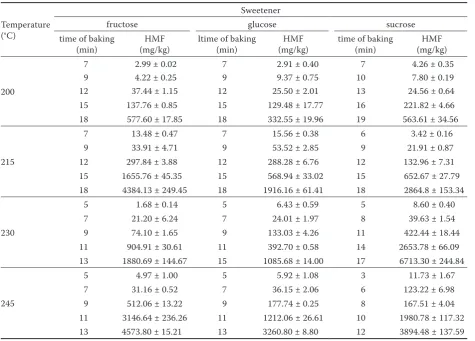
to be converted into HMF. The increase in HMF content as a function of the baking time and tem-perature is shown for all sweeteners investigated in Table 2. According to the results obtained, we can state that in the case of fructose sweetened cookies, HMF content reaches the highest value at all temperatures investigated except 230°C. In general, HMF level drops in the order fructose > sucrose > glucose. The interpretation of this phe-nomenon is hidden in the reaction mechanism (Figure 1) and subsequent number of the reac-tion steps i.e. direct dehydrareac-tion of fructose (one step), isomerisation of glucose into fructose and subsequent dehydration (two steps), hydrolysis of sucrose and parallel dehydration of fructose and isomerisation and dehydratation of glucose. The detailed mechanistic discussion was described in the introduction section.
[image:4.595.63.539.419.760.2]Going into detail of HMF formation during baking, it may be stated that the increase in the baking temperature results in shortening the bak-ing time as well as increasbak-ing HMF content in cookies (Table 2). In other research, it has been
Table 2. 5-Hydroxymethyl-2-furfural (HMF) content in investigated shortbreads
Temperature (°C)
Sweetener
fructose glucose sucrose
time of baking
(min) (mg/kg)HMF Itime of baking (min) (mg/kg)HMF time of baking (min) (mg/kg)HMF
200
7 2.99 ± 0.02 7 2.91 ± 0.40 7 4.26 ± 0.35 9 4.22 ± 0.25 9 9.37 ± 0.75 10 7.80 ± 0.19 12 37.44 ± 1.15 12 25.50 ± 2.01 13 24.56 ± 0.64 15 137.76 ± 0.85 15 129.48 ± 17.77 16 221.82 ± 4.66 18 577.60 ± 17.85 18 332.55 ± 19.96 19 563.61 ± 34.56
215
7 13.48 ± 0.47 7 15.56 ± 0.38 6 3.42 ± 0.16 9 33.91 ± 4.71 9 53.52 ± 2.85 9 21.91 ± 0.87 12 297.84 ± 3.88 12 288.28 ± 6.76 12 132.96 ± 7.31 15 1655.76 ± 45.35 15 568.94 ± 33.02 15 652.67 ± 27.79 18 4384.13 ± 249.45 18 1916.16 ± 61.41 18 2864.8 ± 153.34
230
5 1.68 ± 0.14 5 6.43 ± 0.59 5 8.60 ± 0.40 7 21.20 ± 6.24 7 24.01 ± 1.97 8 39.63 ± 1.54 9 74.10 ± 1.65 9 133.03 ± 4.26 11 422.44 ± 18.44 11 904.91 ± 30.61 11 392.70 ± 0.58 14 2653.78 ± 66.09 13 1880.69 ± 144.67 15 1085.68 ± 14.00 17 6713.30 ± 244.84
245
found that at temperatures below 300°C (200 and 250°C, respectively) the amount of HMF is lower when sucrose is used as a sweetener in compari-son with glucose and fructose. The research was conducted on cookies with 30% of sweetener in the dough (Ameur et al. 2007). The results obtained corroborate our observation although some dif-ferentiation between glucose and fructose is also important when focused on the reaction mecha-nism as described above. The observations made by Ameur et al. (2007)were also confirmed in a work on glucose-sweetened cookies done by Gökmen et al. (2007). The authors observed an increase in HMF concentration with temperature rising during baking (from 160 to 230°C).
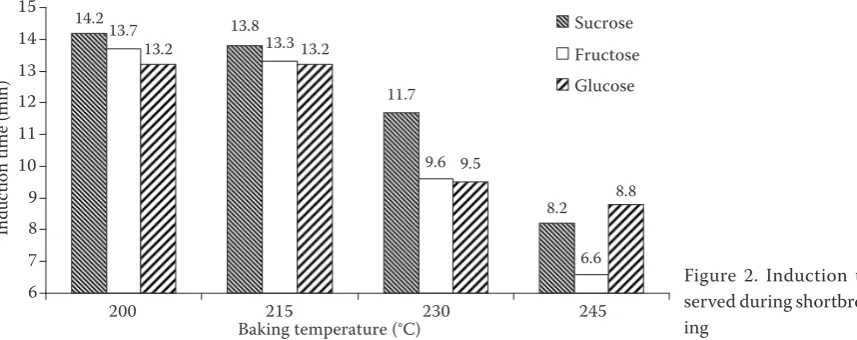
The dynamics of the sugar transformation into HMF may be described using the exponential equation. In some publications, the authors have described the dynamics of HMF synthesis using the first order kinetics (Ameur et al. 2006, 2007). In fact, the corresponding curves may suggest the first order kinetics although, as mentioned above, the reaction mechanism involves some intermediates and thus the process is a consecutive reaction and cannot be treated using simple kinetic equations. The question also arises about the validity of such an approach in which the kinetic constants are estimated to describe the reactions occurring dur-ing bakdur-ing. Accorddur-ing to the consecutive reaction properties, the induction time may be observed in the process (Figure 2). As can be seen, the induction time shortens as the temperature increases. The shortest induction time was observed in the case of fructose at higher temperatures. It may testify that the rate of fructose conversion into the first intermediate is the highest. On the other hand the induction times observed with sucrose are much longer due to the hydrolysis step (sucrose
inversion into monosaccharides). It is also worth pointing out that at higher temperature (245°C) the induction time for glucose transformation is longer than that observed for sucrose. This may be the result of differences between two reactions rates. The inversion of sucrose is faster than the isomerisation of glucose into fructose accord-ing to Lobry de Bruyn-Alberda van Ekenstein transformation. In that case, the inversion reac-tion may be speeded up by the product (fructose) removal that is constantly consumed for the first transformation leading to HMF. This phenomenon was also observed by Gökmen et al. (2007) when a rapid increase in HMF content with decreasing pH accrued.
According to Eq. (2), exponential factors (EF) were estimated in sucrose based experiments (Ta-ble 3). The EF coefficient increases during the baking progress when the temperature is rising. It is an obvious phenomenon even in highly vis-cous reaction systems, i.e. dough. The values of a pre-expotential factors rise as well, however, their changes do not influence the process course as much as EF factors. The substitution of common sugar by fructose results in a faster HMF forma-tion which mirrors in EF factors that almost reach the value above 0.9. An increase of the overall reaction dynamics is observed in this case. On the other hand, baking of cookies sweetened with glucose results in a far slower increase in HMF content when compared to sucrose based cookies, although in this case the exponential equation fits the experimental points as well. Exclusively at 245°C was EF higher than in the case of sucrose and equalled to 0.8067. The results obtained by fitting the experimental data confirm the differ-ences between the reaction mechanisms discussed above. Therefore, the conclusion may be made that
14.2 13.8
11.7
8.2
13.7 13.3
9.6
6.6
13.2 13.2
9.5
8.8
6 7 8 9 10 11 12 13 14 15
200 215 230 245 Baking temperature (°C)
In
du
ct
io
n
tim
e
(m
in
)
[image:5.595.67.496.588.758.2]Sucrose Fructose Glucose
if a low level of HMF is needed, only glucose may be the sugar substitute in the cookies preparation. Fructose is sometimes recommended for diabetics because it does not influence the insulin forma-tion (Grant et al. 1980). Fructose has also a low glycemic index of 19 ± 2, as compared with those calculated for glucose (100) and sucrose (68 ± 5) (Atkinson et al. 2008). Based on the results of the experiments, it may be stated that the benefits of fructose substitution are covered by some drawbacks including higher levels of HMF that is known as potentially harmful. On the other hand, fructose is also more than by seventy percent sweeter than sucrose (Hanover & White 1993), so the
substitu-tion using this monosaccharide at lower concentra-tions would lead to an acceptable HMF content.
Colour changes during shortbreads processing and their correlation with HMF content
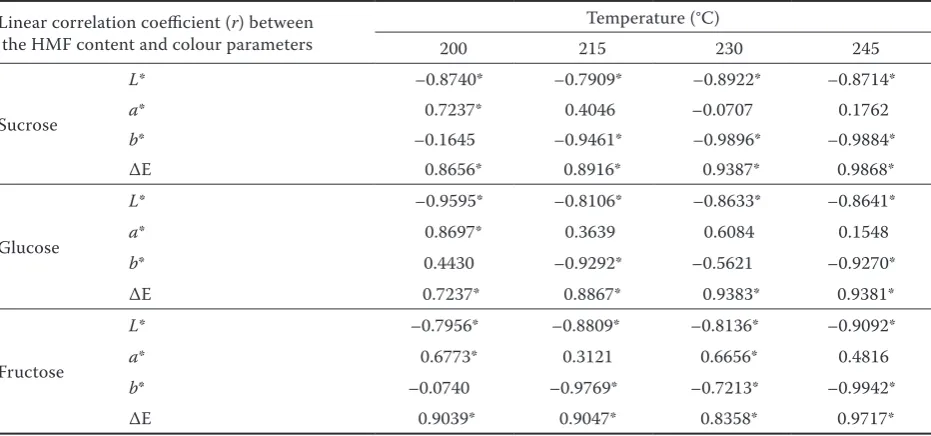
[image:6.595.63.532.102.276.2]With all the investigated shortbreads, the colour changes during baking as the results of HMF for-mation were investigated. Detailed colour analysis showed a positive linear correlation between the total colour change (ΔE) and HMF content (Ta-ble 4). The correlation coefficient increased with increasing temperature with all sweeteners except Table 3. Dynamics of HMF formation
Sweetener Temperature (°C)
200 215 230 245
Sucrose
EF 0.4372 0.5619 0.5842 0.6550
PEF 0.1359 0.1335 0.4911 1.7193
R2 HMF vs. time 0.9635 0.9976 0.9829 0.9622
Glucose
EF 0.4306 0.4567 0.5224 0.8067
PEF 0.1637 0.7972 0.7178 0.1208
R2 HMF vs. time 0.9915 0.9615 0.9393 0.9916
Fructose
EF 0.5030 0.5314 0.8901 0.9132
PEF 0.0708 0.3002 0.0283 0.0695
R2HMF vs. time 0.9851 0.9848 0.9735 0.9515
EF – exponential factors; PEF – pre-exponential factor; HMF – 5-hydroxymethyl-2-furfural; R2 – correlation coefficients
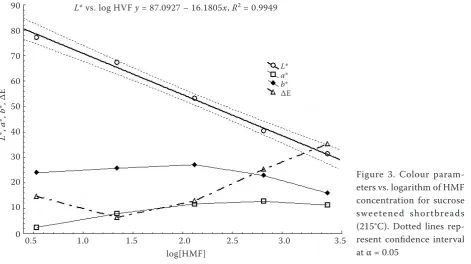
Figure 3. Colour param-eters vs. logarithm of HMF concentration for sucrose sweetened shortbreads (215°C). Dotted lines rep-resent confidence interval at α = 0.05
90
80
70
60
50
40
30
20
10
0
L*
a*
b* ΔE
0.5 1.0 1.5 2.0 2.5 3.0 3.5 log[HMF]
L* vs. log HVF y = 87.0927 – 16.1805x, R2 = 0.9949
L
*,
a
*,
b
*,
Δ
[image:6.595.66.538.498.762.2]fructose at 230°C. The increase in temperature was strongly correlated with HMF content in the sample and also influenced the cookies colour. Ac-cording to Gökmen et al. (2008), the total colour change of about 10 is expected for all the range of goods. On the other hand, the value higher than 25 testifies to browning the cookies surface (Gökmen et al. 2008). In our studies, the value of ΔE higher than 25 was connected with HMF concentration over 500 mg/kg in the case of
glu-cose and fructose, and 630 mg/kg in the case of sucrose-based shortbreads (Figures 3–5).
[image:7.595.66.404.84.343.2]The positive correlation was established not only in the case of ΔE. The b* parameter was found to correlate also with HMF in the samples, especially at temperatures above 200°C. This parameter de-scribes blue-yellow colour changes. The decrease of b* means that the yellow colour of raw dough disappears during baking. The L* also revealed a significant (negative) correlation with HMF
Table 4. Correlation factors for 5-hydroxymethyl-2-furfural and colour parameters changes during baking of shortbreads
Linear correlation coefficient (r) between the HMF content and colour parameters
Temperature (°C)
200 215 230 245
Sucrose
L* –0.8740* –0.7909* –0.8922* –0.8714*
a* 0.7237* 0.4046 –0.0707 0.1762
b* –0.1645 –0.9461* –0.9896* –0.9884* ΔE 0.8656* 0.8916* 0.9387* 0.9868*
Glucose
L* –0.9595* –0.8106* –0.8633* –0.8641*
a* 0.8697* 0.3639 0.6084 0.1548
b* 0.4430 –0.9292* –0.5621 –0.9270* ΔE 0.7237* 0.8867* 0.9383* 0.9381*
Fructose
L* –0.7956* –0.8809* –0.8136* –0.9092*
a* 0.6773* 0.3121 0.6656* 0.4816
b* –0.0740 –0.9769* –0.7213* –0.9942* ΔE 0.9039* 0.9047* 0.8358* 0.9717*
[image:7.595.65.531.519.737.2]*correlation coefficients statistically significant at P < 0.05
Figure 4 Colour param-eters HMF concentration dependence for glucose sweetened shortbreads (215°C). Dotted lines rep-resent confidence interval at α = 0.05
80
70
60
50
40
30
20
10
0
L*
a*
b* ΔE
1.2 1.4 1.6 1.8 2.0 2.2 2.4 2.6 2.8 3.0 3.2 3.4 log[HMF]
L* vs. log HVF y = 98.2976 – 20.957x, R2 = 0.9898
L
*,
a
*,
b
*,
Δ
formation during baking. In baking, the cakes become darker according to the carbohydrate trans-formation including caramelisation. On the other hand, we found that luminance L* correlated very strongly with the logarithm of HMF concentration (Figures 3–5). At all temperatures, R2 were at least
0.99. The relation between L* and HMF content gives the opportunity to link the changes in the cookie colour with thermal degradation and dehy-dration of sugars in even as viscous environment as the dough. However, it is also known that in food may HMF undergo several further transformation steps including polymerisation or degradation to simple acids (oxopentanoic acid and formic acid) (Lewkowski 2001). In this complicated series of side reactions, only HMF and melanoid polymers are able to influence the product brightness due to their natural colour. According to the results obtained, the overall luminance may be the meas-ure of HMF content and the relation is adaptable for confectionary sugar as well as for glucose and fructose. Additionally, in the case of fructose, a strict logarithmic relationship existed between ΔE and HMF concentration (Figure 5). The phenom-enon confirms the fructose path in the discussed dehydration mechanism. In baking, the changes in luminance and the overall colour take place. With other sugars, the luminance changes as well because some parts of the sugars are converted into fructose by means of hydrolysis or isomeri-sation. But the colour relations take place in
fur-ther steps of the process due to interferences of colourless compounds (sucrose or glucose) at low temperature. It can also mean that the hydrolysis or isomerisation steps are the slowest andthe overall reaction of the transformation of sugars into HMF depends on their rate(the overall sugars to HMF transformation reaction depends on their rate) i.e. the slow step is considered as the rate deter-mining step. The last discussed factor in CIELab system was a*. The coefficient shows the changes of colour in the range of green to magenta. In the cakes investigated, no correlation was found for this factor except at the lowest temperature. In fact, the baking of cakes does not influence the respective colour domain, thus a* remains nearly stable during baking.
CONCLUSIONS
[image:8.595.65.403.86.342.2]The investigation conducted allows to estimate the correlation between the colour and HMF con-tent in shortbread cookies. The results allow to establish that the luminance of cookies is strictly linked with HMF content regardless of the sweet-ener used for the dough preparation which may lead to the creation of a new and simple tool for HMF content estimation. On the other hand, total colour change in shortbreads sweetened with fructose reveals a strong linear correlation with HMF concentration. The differences in total Figure 5. Colour parameters HMF concentration depend-ence for fructose sweetened shortbreads (215°C). Dotted lines represent confidence interval at α = 0.05
70
60
50
40
30
20
10
0
L*
a*
b* ΔE
1.0 1.2 1.4 1.6 1.8 2.0 2.2 2.4 2.6 2.8 3.0 3.2 3.4 3.6 3.8 log[HMF]
L* vs. log HVF y = 82.8991 – 14.7632x, R2 = 0.9949
ΔE vs. log HVF y = –11.5273 + 13.5588x, R2 = 0.9866
L
*,
a
*,
b
*,
Δ
colour/HMF relations probably lie in the HMF formation mechanism. The distinction in the reac-tion mechanisms involved in sucrose, glucose, or fructose transformation to HMF was confirmed by changes in both the colour parameters and induction times. The induction times observed in the process suggest that sugar-HMF reaction cannot be described by simple kinetics, being a complex transformation with several consecutive reaction steps. On the other hand, the differences in HMF formation open the gate for glucose as a sweetener in shortbreads like cookies when a low level of HMF is needed. The replacement of sucrose by fructose, however, needs further study focused on the sweetening power-HMF relationship.
References
Albala-Hurtado S., Veciana-Nogues M.T., Marine-Font A., Vidal-Carou M.C. (1998): Changes in furfural compounds during storage of infant milks. Journal of Agricultural and Food Chemistry, 46: 2998–3003. Ameur L.A., Trystram G., Birlouez-Aragon I. (2006):
Accumulation of 5-hydroxymethyl-2-furfural in cookies during the backing process: Validation of an extraction method. Food Chemistry, 98: 790–796.
Ameur L.A., Mathieu O., Lalanne V., Trystram G., Birlouez-Aragon I. (2007): Comparison of the effects of sucrose and hexose on furfural formation and brown-ing in cookies baked at different temperatures. Food Chemistry, 101: 1407–1416.
Antal M.J., Mok W.S.L., Richards G.N. (1990): Mechanism of formation of 5-(hydroxymethyl)-2-furaldehyde from d-fructose and sucrose. Carbohydrate Research, 199: 91–109.
Atkinson F.S., Foster-Powell K., Brand-Miller J.C. (2008): International tables of glycemic index and gly-cemic load values: 2008. Diabetes Care, 31: 2281–2283. Bakhiya N., Monien B., Frank H., Seidel A., Glatt
H. (2009): Renal organic anion transporters OAT1 and OAT3 mediate the cellular accumulation of 5-sulfooxy-methylfurfural, a reactive, nephrotoxic metabolite of the Maillard product 5-hydroxymethylfurfural. Biochemical Pharmacology, 78: 414–419.
Capuano E., Fogliano V. (2011): Acrylamide and 5-hy-droxymethylfurfural (HMF): A review on metabolism, toxicity, occurrence in food and mitigation strategies. LWT-Food Science and Technology, 44: 793–810. Chuda Y., Ono H., Ohnishi-Kameyama M.,
Matsumo-to K., Nagata T., Kikuchi Y. (1999): Mumefural, citric acid derivative improving blood fluidity from fruit-juice
concentrate of japanese apricot (Prunus mume Sieb. et Zucc). Journal of Agricultural and Food Chemistry, 47: 828–831.
Cioroi M. (2008): 5-Hydroxymethylfurfural – A possible indicator in the prezervation abilities of the thermally processed food. Revue Roumaine de Chimie, 53: 379–382. Corma A., Iborra S., Velty A. (2007): Chemical routes for
the transformation of biomass into chemicals. Chemical Reviews, 107: 2411–2502.
Delgado-Andrade C., Seiquer I., Navarro M.P., Mo-rales F.J. (2007): Maillard reaction indicators in diets usually consumed by adolescent population. Molecular Nutrition & Food Research, 51: 341–351.
Delgado-Andrade C., Seiquer I., Navarro M.P., Mo-rales F.J. (2008): Estimation of hydroxymethylfurfural availability in breakfast cereals. Studies in Caco-2 cells. Food and Chemical Toxicology, 46: 1600–1607.
Ding X., Wang M.-Y., Yao Y.-X., Li G.-Y., Cai B.-C. (2010): Protective effect of 5-hydroxymethylfurfural derived from processed Fructus Corni on human hepatocyte LO2 injured by hydrogen peroxide and its mechanism. Journal of Ethnopharmacology, 128: 373–376.
Fallico B., Arena E., Zappalà M. (2003): Roasting of hazelnuts. Role of oil in colour development and hydroxy-methylfurfural formation. Food Chemistry, 81: 569–573. Fernandez-Artigas P., Guerra-Hernandez E., Garcia-Villanova B. (1999): Browning indicators in model systems and baby cereals. Journal of Agricultural and Food Chemistry, 47: 2872–2878.
Gökmen V., Açar Özge Ç., Köksel H., Acar J. (2007): Effects of dough formula and baking conditions on acryla-mide and hydroxymethylfurfural formation in cookies. Food Chemistry, 104: 1136–1142.
Gökmen V., Açar Özge Ç., Arda S., Francisco J.M. (2008): Effect of leavening agents and sugars on the for-mation of hydroxymethylfurfural in cookies during baking. European Food Research and Technology, 226: 1031–1037. Grant A.M., Christie M.R., Ashcroft S.J.H. (1980):
Insulin release from human pancreatic islets in vitro. Diabetologia, 19: 114–117.
Hanover L.M., White J.S. (1993): Manufacturing, com-position, and applications of fructose. American Journal of Clinical Nutrition, 58: 724–732.
Hidalgo A., Pompei C. (2000): Hydroxymethylfurfural and furosine reaction kinetics in tomato products. Journal of Agricultural and Food Chemistry, 48: 78–82.
Husoy T., Haugen M., Murkovic M., Jobstl D., Stolen L.H., Bjellaas T., Ronningborg C., Glatt H., Alexan- der J. (2008): Dietary exposure to 5-hydroxymethylfur-fural from Norwegian food and correlations with urine metabolites of short-term exposure. Food and Chemical Toxicology, 46: 3697–3702.
James O.O., Maity S., Usman L.A., Ajanaku K.O., Ajani O.O., Siyanbola T.O., Sahu S., Chaubey R. (2010): Towards the conversion of carbohydrate biomass feed-stocks to biofuels via hydroxylmethylfurfural. Energy & Environmental Science, 3: 1833–1850.
Lee Y.C., Shlyankevich M., Jeong H.K., Douglas J.S., Surh Y.J. (1995): Bioactivation of 5-hydroxymethyl-2-furaldehyde to an electrophilic and mutagenic allylic sulfuric acid ester. Biochemical and Biophysical Research Communications, 209: 996–1002.
Lewkowski J. (2001): Synthesis chemistry and applica-tion of 5-hydroxymethylfurfural and its derivatives. ARKIVOC, 2001: 17–54.
Mesías-García M., Guerra-Hernández E., García-Villanova B. (2010): Determination of furan precursors and some thermal damage markers in baby foods: ascorbic acid, dehydroascorbic acid, hydroxymethylfurfural and furfural. Journal of Agricultural and Food Chemistry,
58: 6027–6032.
Miljkovic M. (2009): Carbohydrates: Synthesis, Mecha-nisms, and Stereoelectronic Effects. 1st Ed.
Springer-Verlag, New York.
Morales V., Sanz M.L., Martín-Álvarez P.J., Corzo N. (2009): Combined use of HMF and furosine to assess fresh honey quality. Journal of the Science of Food and Agriculture, 89: 1332–1338.
NTP Technical Report (2010): Toxicology and carcinogen-esis studies of 5-(hydroxymethyl)-2-furfural. National Institutes of Health, 10-5895: 1-180.
Perez Locas C., Yaylayan V.A. (2008): Isotope labeling studies on the formation of 5-(hydroxymethyl)-2-furalde-hyde (HMF) from sucrose by pyrolysis-GC/MS. Journal of Agricultural and Food Chemistry, 56: 6717–6723. Perez Locas C., Yaylayan V.A. (2004): Origin and
mecha-nistic pathways of formation of the parent furana food toxicant. Journal of Agricultural and Food Chemistry,
52: 6830–6836.
Richardson P. (2001): Thermal Technologies in Food Processing. Part 1. CRC Press, Boca Raton.
Román-Leshkov Y., Chheda J.N., Dumesic J.A. (2006): Phase modifiers promote efficient production of hydroxy-methylfurfural from fructose. Science, 312: 1933–1937. Rufián-Henares J.A., García-Villanova B., Guerra-Hernández E. (2008): Occurrence of furosine and hy-droxymethylfurfural as markers of thermal damage in dehydrated vegetables. European Food Research and Technology, 228: 249–256.
Sriwilaijaroen N., Kadowaki A., Onishi Y., Gato N., Ujike M., Odagiri T., Tashiro M., Suzuki Y. (2011): Mumefural and related HMF derivatives from Japanese apricot fruit juice concentrate show multiple inhibitory effects on pandemic influenza A (H1N1) virus. Food Chem-istry, 127: 1–9.
Sun D.-W. (2005): Thermal Food Processing: New Tech-nologies and Quality Issues. CRC Press, Boca Raton. Tewari G., Juneja V. (2007): Advances in Thermal and
Non-Thermal Food Preservation. Wiley-Blackwell, Ames. Ulbricht R.J., Northup S.J., Thomas J.A. (1984): A
review of 5-hydroxymethylfurfural (HMF) in parenter-al solutions. Fundamentparenter-al and Applied Toxicology, 4: 843–853.
Utsunomiya H., Takekoshi S., Gato N., Utatsu H., Motley E.D., Eguchi K., Fitzgerald T.G., Mifune M., Frank G.D., Eguchi S. (2002): Fruit-juice concentrate of Asian plum inhibits growth signals of vascular smooth muscle cells induced by angiotensin II. Life Sciences, 72: 659–667.
Wang M.-Y., Zhao F.-M., Peng H.-Y., Lou C.-H., Li Y., Ding X., Yu X.-Y., Yang G.-M., Xu D.-Q.,Ye L.-H., Cai B.-Ch. (2010): Investigation on the morphological pro-tective effect of 5-hydroxymethylfurfural extracted from wine-processed Fructus corni on human L02 hepatocytes. Journal of Ethnopharmacology, 130: 424–428.
Yaylayan V. (1997): Classification of the Maillard reac-tion: A conceptual approach. Trends in Food Science & Technology, 8: 13–18.
Yaylayan V.A. (2006): Precursors, formation and determi-nation of furan in food. Journal für Verbraucherschutz und Lebensmittelsicherheit, 1: 5–9.
Zhao H., Holladay J. E., Brown H., Zhang Z. C. (2007): Metal chlorides in ionic liquid solvents convert sugars to 5-hydroxymethylfurfural. Science, 316: 1597–1600.
Received for publication February 28, 2012 Accepted after corrections June 4, 2012
Corresponding author: