Cheese, considered on the one hand healthy and recommendable food, is on the other hand one of the most important suppliers of biogenic amines (BA), the low-molecular organic bases formed mainly by decarboxylation of amino acids (SILLA-SANTOS 1996), into the human organism. This usually poses no problem with healthy people, but with allergic individuals or people administered monoamine oxidase (MAO) inhibitors, negative health effects after the intake of relatively low levels of BA (e.g. 6 mg of tyramine; SILLA-SANTOS 1996) can be expected. Apart from the vasoac-tive amines tyramine (hypertension, headache)
or histamine (hypotension, headache, flushing, abdominal cramps; STRATTON et al. 1991), grow-ing attention is paid at present to the polyamines spermidine and spermine, including diamines putrescine and cadaverine, due to their ability to form stable carcinogenic N-nitroso compounds and to enhance the growth of chemically induced aberrant crypt foci in the intestine (PAULSEN et al. 1997). Polyamines, both formed endogenously and taken from the diet, can be involved in the tumor development (KALAČ & KRAUSOVÁ 2005).
Although BA content has been evaluated suf-ficiently in ripening cheeses (PETRIDIS &
STEIN-Supported by the Ministry of Education, Youth and Sports of the Czech Republic, Project No. MSM 6215648901.
Biogenic Amine Content in Sterilised and Pasteurised
Long-Term Stored Processed Cheese
TOMÁŠ KOMPRDA
1, KATEŘINA NOVICKÁ
1, LIBOR KALHOTKA
1and DANA SMĚLÁ
21
Department of Food Technology,
Faculty of Agronomy, Mendel University
of Agriculture and Forestry Brno, Brno, Czech Republic;
2Czech Agriculture
and Food Inspection Authority, Brno, Czech Republic
Abstract
KOMPRDA T., NOVICKÁ K., KALHOTKA L., SMĚLÁ D. (2005): Biogenic amine content in sterilised and pasteurised long-term stored processed cheese. Czech J. Food Sci., 23: 209–216.
The contents of eight biogenic amines (tryptamine, phenylethylamine, histamine, tyramine, putrescine, cadaverine, spermidine and spermine) were determined in samples of processed cheese, either pasteurised (P) or sterilised (S), and consequently stored for either 22 or 57 weeks at the temperatures of 8°C and 22°C, respectively. Tyramine was quantitatively the most important biogenic amine (1.3–29.3 mg/kg); the highest level (P < 0.05) was found in P cheese stored for 22 weeks after processing at 8°C (P1). Regardless of tyramine, and with the exception of putrescine in S cheese stored for 57 weeks (2.2 mg/kg), the content of no biogenic amine exceeded 2 mg/kgin any tested sample. Significantly higher (by five to six orders of magnitude; P < 0.05) counts of total aerobic and facultative anaerobic microorganisms in P1 sample in comparison with all other samples were indicative of the cover leakage. No lactic acid bacteria were detected in any sample, the counts of coliforms and total anaerobes, respectively, were negligible and did not differ (P > 0.05) between samples. No sample of the tested long-term stored processed cheese was considered unsafe from the toxicological viewpoint.
Vol. 23, No. 5: 209–216 Czech J. Food Sci.
HART 1996a, b), the data regarding processed cheese are very scarce in the available literature (EL-SAYED 1996).
The two objectives of the present experiment were as follows. Firstly, within the scope of quality evaluation of the processed cheese produced for the military purposes of the long-term storage, to compare the contents of biogenic amines in the samples either sterilised or pasteurised after processing and subsequently long-term stored at the refrigerator and at room temperature, respec-tively. Secondly, in connection with the former task, to evaluate the suitability of the high-pressure liquid chromatography method for the determina-tion of biogenic amines in processed cheese, i.e. the matrix with presumably very low biogenic amine content.
MATERIALS AND METHODS
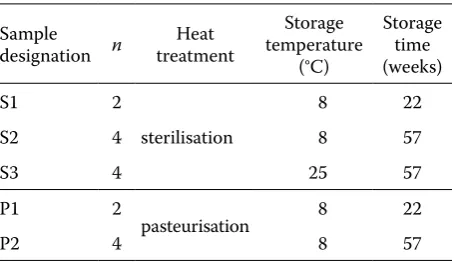
Cheesesamples. The cheese samples were pro-duced for the military purposes of the long-term storage (“military academy” samples). On delivery to our laboratory, the cheese samples were declared to have been produced within one batch consisting of the same ingredients: blocks of Edam cheese (45% fat in dry matter), Moravian block cheese, butter, curd, water, and an emulsifying agent. All ingredients were put into the processed cheese kettle equipped with a steam-heated shell and a direct steam injection. The mixture was processed 10 min at the temperature of 85°C under stirring. The processed matter was filled into aluminum boxes in the amounts of 200 g and the lids were fused. The set of the samples of the processed cheese was divided into two parts. One part was cooled to the temperature of 10°C, this cheese was designated as pasteurised processed cheese – P (that is the cheese treated only by the temperature 85°C for 10 min). The second part of the samples was put into a laboratory autoclave (Labo Auto-clave Sanyo, model MLS 3780), sterilised 20 min under the pressure of 0.25 MPa at the temperature of 117°C, and subsequently cooled. These samples were designated as sterilised processed cheese – S. The samples of both pasteurised and sterilised processed cheese were stored either 22 or 57 weeks, the pasteurised cheese at the temperature of 8°C, the sterilised cheese at the temperature of either 8°C or 25°C (Table 1).
Biogenic amine determination. 10 g (± 1 mg) of the sample was weighed into an 85 ml test tube,
0.5 ml of an internal standard (1,7-diaminohep-tane; concentration 1 mg/ml) was added and the sample was extracted for two minutes with 20 ml of 0.1M HCl using the disintegrator Heidolph Diax 900 (Germany). The suspension was centrifuged at 755 × g for 10 min at 4°C. The supernatant was filtered through paper filter and the solid residue was repeatedly extracted as above. The combined extracts were made up to 50 ml with deionised water and filtered through a disposable nylon membrane filter (13 mm, 0.45 µm).
An aliquot of the extract was derivatised with dansyl chloride (5-dimethylaminonaphthalene-1-sulfonyl chloride, DCl) as follows: 1 ml of the extract (or standard) was mixed with 0.5 ml of saturated Na2CO3, 1 ml of DCl was added (Sigma-Aldrich, Germany; the agent was prepared by dis-solving of 5 mg of DCl in 1 ml of acetone), and the mixture was shaken for 1 min (MS2 Minishaker IKA Werke, Germany). Derivatisation proceeded for 1 h in the dark at 40°C. After derivatisation, 250 µl of ammonia was added to remove excess DCl. After 30 min, the amine derivatives were extracted by diethyether (3 × 1 ml), the organic phase was evaporated to dryness under nitrogen, and the solid residue was dissolved in 0.5 ml of ac-etonitrile (ACN). The solution was filtered through the nylon membrane filter 0.45 µm and injected onto the chromatographic column.
[image:2.595.305.533.113.244.2]Biogenic amines were separated using a liquid chromatograph HP 1100 (Agilent Technologies, Waldbronn, Germany) consisting of the quarter-nary pump (G1311A), vacuum degasser (G1322A), automatic sampler (G1313A), UV/VIS detector with the variable wave-length (G1314A) and a fluorescence detector (G1321A). The separation
Table 1. Identification of the analysed samples of pro-cessed cheese
Sample
designation n treatmentHeat
Storage temperature
(°C)
Storage time (weeks)
S1 2
sterilisation
8 22
S2 4 8 57
S3 4 25 57
P1 2
pasteurisation 8 22
P2 4 8 57
after DCl derivatisation was carried out by gradi-ent elution with H2O/ACN (time 0–23 min: H2O 35–0%, ACN 65–100%) on the Zorbax Eclipse XDB C18 column (150 mm × 4.6 mm, particle size 5 µm) with the guard column Meta Guard ODS-2 (30 mm × 4.6 mm, particle size 5 µm) at the flow rate of 0.8 ml/min using photometric UV/VIS detector at 254 nm.
Regarding several steps of the sample preparation, the concentration of a given biogenic amine in the sample (cx) was corrected based on the method of internal standard as follows:
cx = cIS × Ax/AIS × RFx
where: cIS – concentration of an internal standard
(in mg/kg)
AIS – peak area of the internal standard
(in area units)
Ax – peak area of the biogenic amine
(in area units)
RFx – response factor of the amine
RFx = cxr/cISr × AISr/Axr
where: cxr – concentration of biogenic amine in the ref-
erence sample (mg/kg)
cISr – concentration of an internal standard
added to the reference sample (mg/kg)
AISr – peak area of the internal standard in the
reference sample (in area units)
Axr – peak area of the biogenic amine in the ref-
erence sample (in area units)
The separated amines (histamine, tyramine, tryp-tamine, putrescine, 2-phenylethylamine, cadaverine, spermidine, spermine) were identified by compari-son of the retention times of the standards (used as the respective hydrochlorides, Sigma-Aldrich, Germany). Their concentrations after DCl deri-vatisation were expressed in mg/kg of the original (fresh) matter.
The repeatability of the determination and the recoveries of particular biogenic amines were estimeted with a cheese sample different from the “military academy” samples used in the experi-ment proper, with no strictly defined origin, but with a supposedly similar (that is relatively low) biogenic amine content (a “standard” sample). Five extracts of this sample (prepared as above-mentioned) after derivatisation with DCl were used for the repeatability (expressed as a relative standard deviation, RSD in %) determination of the entire analytical procedure (method). Ten times injected mixture of the BA standards after DCl derivatisation was used for characterising
the repeatability of the chromatographic system (instrument). The recoveries were evaluated using the “standard” sample spiked with the mixture of the BA standards on the concentration level 1 and 2 mg/kg, respectively, measured five times. The recovery (R) was calculated as
% R = [(CF – CU)/CA] × 100
where: CU – concentration in the original sample
CA – concentration of the analyte added
CF – concentration in the spiked sample
The concentrations of the particular amines in the “military academy” samples of long-term stored processed cheese were not corrected for the respective recovery.
Microbiological analysis. 20 g of cheese were taken aseptically from the sample, homogenised in the stomacher with 180 ml of distilled water, and serial decimal dilutions were prepared. The follow-ing groups of microorganisms were determined: total counts of aerobic and facultative anaerobic mesophilic microorganisms (TAC) on Plate Count Agar (PCA; Biokar Diagnostics, France) after 72 h at 30°C; lactic acid bacteria (LAB) on De Man-Rogosa-Sharpe medium (MRS; Biokar) after 72 h at 37°C; coliforms on Violet Red Bile Agar (Biokar) after 72 h at 37°C; total anaerobic counts (TAN) on PCA (Biokar) after 120 h at 30°C (1 ml of the sample was overlaid in the test tube with the 10 cm agar column); yeasts + moulds on glucose-yeast extract-chloramphenicol agar (Noack, Vienna, Austria) after 120 h at 25°C.
Statistical evaluation. One-way classification of the variance-ration test, including Duncan’s multiple range test, was used for the calculation of the difference between biogenic amine contents in the samples using the Unistat package, version 4.53 (Unistat, Ltd., London).
RESULTS
Vol. 23, No. 5: 209–216 Czech J. Food Sci.
6.8% for phenylethylamine. The recovery of the biogenic amines determined in the “standard” cheese sample spiked with the mixture of BA standards at the concentration level 2 mg/kg was in the range of 50.2% for spermine to 94.9% for tryptamine.
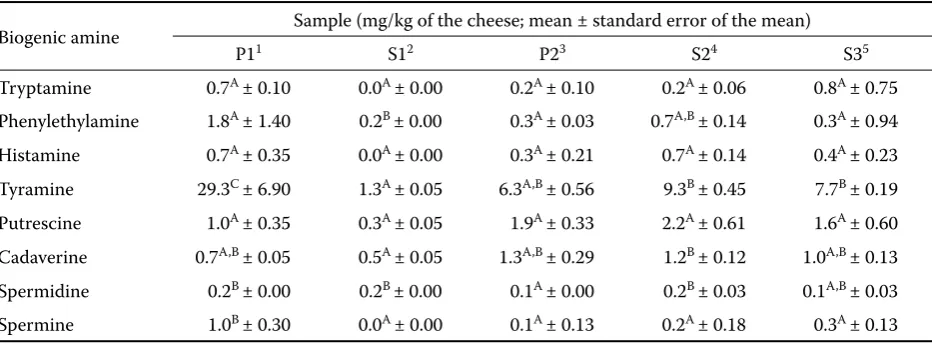
Biogenic amine contents in the samples of long-term stored processed cheese from military acad-emy are shown in Table 3. Quantitatively most important biogenic amine in all tested samples was tyramine. The tyramine content in pasteurised cheese stored for 22 weeks after processing (P1)
was significantly higher (P < 0.05) in comparison with the sterilised cheese stored for the same time interval (S1) and also in comparison with all other tested samples. On the other hand, the tyramine content in sterilised cheese stored for 22 weeks at the temperature of 8°C was lower (P < 0.05) than in the sterilised samples stored for 57 weeks both at the temperature of 8°C and at the temperature of 25°C.
[image:4.595.64.533.114.286.2]Regardless of tyramine, and with the exception of putrescine in S2 (cheese sterilised after processing
Table 3. Biogenic amine contents in the samples of the long-term stored processed cheese
Biogenic amine Sample (mg/kg of the cheese; mean ± standard error of the mean)
P11 S12 P23 S24 S35
Tryptamine 0.7A ± 0.10 0.0A ± 0.00 0.2A ± 0.10 0.2A ± 0.06 0.8A ± 0.75
Phenylethylamine 1.8A ± 1.40 0.2B ± 0.00 0.3A ± 0.03 0.7A,B ± 0.14 0.3A ± 0.94
Histamine 0.7A ± 0.35 0.0A ± 0.00 0.3A ± 0.21 0.7A ± 0.14 0.4A ± 0.23
Tyramine 29.3C ± 6.90 1.3A ± 0.05 6.3A,B ± 0.56 9.3B ± 0.45 7.7B ± 0.19
Putrescine 1.0A ± 0.35 0.3A ± 0.05 1.9A ± 0.33 2.2A ± 0.61 1.6A ± 0.60
Cadaverine 0.7A,B ± 0.05 0.5A ± 0.05 1.3A,B ± 0.29 1.2B ± 0.12 1.0A,B ± 0.13
Spermidine 0.2B ± 0.00 0.2B ± 0.00 0.1A ± 0.00 0.2B ± 0.03 0.1A,B ± 0.03
Spermine 1.0B ± 0.30 0.0A ± 0.00 0.1A ± 0.13 0.2A ± 0.18 0.3A ± 0.13
1pasteurised, stored 22 weeks at 8°C; 2sterilised, stored 22 weeks at 8°C; 3pasteurised, stored 57 weeks at 8°C; 4 sterilised,
stored 57 weeks at 8°C; 5sterilised, stored 57 weeks at 25°C;
[image:4.595.65.534.537.709.2]A,B,Cmeans with different superscripts in lines differ significantly (P < 0.05)
Table 2. Repeatability (expressed as a relative standard deviation, RSD in %) of the biogenic amine determination, and recovery of the biogenic amines determined in the cheese samples
Biogenic amine Instrument¹(RSD, %) Method²(RSD, %) Recovery³ (%)
1 mg/kg 2 mg/kg
Tryptamine 0.3 ND4 75.1 94.9
Phenylethylamine 0.4 6.8 78.4 90.3
Histamine 0.3 5.8 115.4 93.6
Tyramine 1.6 5.0 59.8 56.1
Putrescine 0.3 3.0 65.1 57.2
Cadaverine 0.3 2.9 74.6 71.3
Spermidine 0.3 1.9 63.3 52.6
Spermine 0.2 5.4 66.6 50.2
1mixture of the biogenic amine standards after derivatisation was injected ten times; 2five extracts of the same cheese sample
after derivatisation was used; 3cheese sample spiked with the mixture of biogenic amine standards on the concentration
and stored for 57 weeks thereafter), the content of no biogenic amine exceeded 2 mg/kgin any sample tested.
The highest (P < 0.05) content of all biogenic amines (calculated as a sum of all determined BA) was found in pasteurised cheese stored for 22 weeks at 8°C (P1; Figure 1). On the other hand, the sum of all BAs in the sterilised cheese stored for the same time interval at the same temperature (22 weeks at 8°C; S1) was lower (P < 0.05) not only in comparison with P1 sample, but also in comparison with both sterilised samples stored for 57 weeks at both temperatures (8°C and 25°C, respectively). Also the sum of polyamines in S1 cheese was lower (P < 0.05) in comparison with the sterilised sample stored for 57 weeks both at the refrigerating temperature and at the room temperature. However, generally speaking, the sum of polyamines was very low in all cheeses and did not exceed 2.5 mg/kg in any sample.
As far as microbiological analysis is concerned, the total aerobic counts in P1 sample were 1.3 × 10⁶ cfu (colony-forming units) per g, which was a higher (P < 0.05) value in comparison with TAC in all the other samples of the processed cheese (the range 2.5 × 100 to 6.5 × 101 cfu/g; the differences were insignificant, P > 0.05). The analyses of lactic acid bacteria and yeasts and moulds, respectively, gave negative results in all tested samples of the
processed cheese in the present experiment. Coli- forms were detected (in negligible amounts, 11 to 28 cfu/g) only in samples stored for 57 weeks. The counts of anaerobic bacteria were also very low in all analysed samples (the range 11 to 35 cfu/g). No differences (P > 0.05) between the samples of the long-term stored processed cheese were found regarding the content of coliforms and TAN, re-spectively (detection of LAB and yeasts + moulds, as mentioned above, was negative in all cases).
DISCUSSION
Because only strictly limited number of two-hundred g samples of the long-term stored proc-essed cheese was available for both chemical and microbiological analyses, the qualimetric deter-minations were carried out with different cheese samples than those used in the experiment proper, but with supposedly similar contents of biogenic amines. Our results regarding the repeatability of the chromatographic system and analytical procedure, including BA recoveries (Table 2), are fully comparable with, in many cases even better than, the data of MORET and CONTE (1996), who reported the repeatability in the range of 3.4% for tyramine to 12.5% for spermidine when analys-ing the biogenic amine content in Grana Padano cheese. As far as the recoveries are concerned,
[image:5.595.133.469.83.292.2]A,B,Cmeans with different superscripts within the particular group differ significantly (P < 0.05)
Figure 1. Sum of all determined biogenic amines (tryptamine, phenylethylamine, histamine, tyramine, putrescine, cadaverine, spermidine, spermine) and sum of polyamines (putrescine, cadaverine, spermidine, spermine) in the samples of long-term stored processed cheese
B C
B A,B
A
A B
B
B B
0 5 10 15 20 25 30 35 40 45
Sum of biogenic amines Polyamines
Amines
content
(mg/kg)
B A,B
B A
A B
B B
B
0 5 10 15 20 25 30 35 40
Sum of biogenic amines Polyamines
A
m
in
es
c
on
te
nt
(m
g/
kg
)
P1 P2 S1 S2 S3
Vol. 23, No. 5: 209–216 Czech J. Food Sci.
our results are not worse (often better) both a in comparison with the data of MORET and CONTE (1996) and VALE and GLÓRIA (1997) regarding biogenic amines in Grana Padano cheese (2.5% for putrescine to 79% for spermidine) and Parmesan cheese (71.4% for spermidine to 95.4% for hista-mine), respectively.
Regarding one of the objectives of the present study, i.e. testing the surmised effect of the process-ing temperature on the microbial status and, con-sequently, on the BA content, the higher tyramine concentration in P1 than in S1 sample (pasteurised vs. sterilised cheese stored 22 weeks) was contrary to the expectations. There are at least three accept-able explanations for the conspicuously different (P < 0.05) tyramine content in P1 as compared not only to S1 but also to all other samples.
Firstly, the obvious reason for the presence of biogenic amines in processed cheese is the trans-fer of these substances from the ripening cheese used as a raw material in the processed cheese production. Based on the data of EL-SAYED (1996), an effect of high temperature on biogenic amine content already present in the raw material (rip-ening cheese) is improbable. One of the possible explanations of the above difference between P1 and S1 samples in the present study is therefore the use of different raw materials for the production of processed cheese designated as pasteurised and sterilised, respectively (Table 1). In other words, the samples of the processed cheese, which were delivered to our laboratory, could have originated not from a single batch as declared, but from two (or even more) batches.
Another possibility, still presuming the samples originated from a single batch, is the use of raw materials (Edam cheese and Moravian block) with varying original tyramine contents, which were not uniformly distributed in the resulting cheese during processing.
Biogenic amines (with the exception of spermi-dine and spermine) are usually formed in cheese by an action of microbial decarboxylases. Therefore, thirdly, the surprisingly higher (P < 0.05) tyramine content in pasteurised cheese stored for 22 weeks (P1) as compared even to sterilised cheese stored 57 weeks at the room temperature (S3; Table 3) could be most probably indicative of the second-ary microbial contamination as a consequence of the cover leakage. This possibility was supported by the data of the microbiological analysis. Not-withstanding either zero or negligible (and not
different, P > 0.05) counts of LAB, TAN, coliforms, and yeasts + moulds, respectively, significantly higher (P < 0.05) counts of total aerobes were found in P1 sample in comparison with TAC in all the other samples of the processed cheese. It is generally accepted that the counts of microor-ganisms, usually analysed in foods, do not often correlate with the biogenic amine content, due to the fact that the amine production is not the matter of particular microbial groups, genera or species, but rather the matter of particular strains within the given species (BOVER-CID et al. 2000). However, the above difference of five to six orders of magnitude in the TAC between P1 sample and all other samples, together with nearly five times as high tyramine content in P1 in comparison with an average value of four other samples in the present experiment, is sufficiently persuasive of the secondary contamination by microorganisms, including some strains (not specified in detail in the present experiment) possessing decarboxylase activity.
As far as both pasteurised samples (P1 vs. P2) are concerned, no reasonable conclusion was possible to draw regarding the storage time (these samples differed only in this parameter), because both the tyramine content (Table 3) and the content of total BA (Figure 1) were lower (P < 0.05) in the sample stored by 35 weeks longer. Contrary to this result, it would be logical to presume an increase of BA content with increasing storage time (VAL-SAMAKI et al. 2000). Biogenic amine degradation in the food matrix is possible (LEUSCHNER et al. 1998), but in the present experiment improbable (although it is true that the microorganisms with a known potential to degrade biogenic amines, especially histamine and tyramine, e.g. some strains of Brevibacterium linens, Staphylococcus carno-sus, Geotrichum candidum, Micrococcus varians, werenot analysed in the present experiment). It could be concluded that any possible effect of the storage time was masked by the above-mentioned uncontrolled factors.
in comparison with the pasteurised samples (P2). This, again, is not logical, if the heat treatment is considered the only important controlling factor (more thorough elimination of microorganisms by sterilisation). Because microbial analysis did not provide any guidance in this case (no differences in the microbial traits between the samples P2 and S2 were found, and therefore no secondary contamination could be supposed), the most prob-able explanation is the production of the P2 and S2 samples not within one batch (as declared), but within two different batches processed from the raw materials (i.e. ripeningcheeses) with different original BA contents.
Contrary to the effect of the storage time in the pasteurised samples (see above), the high-er (P < 0.05) tyramine content and the higher (P < 0.05) content of the sum of BA in the steri-lised samples S2 and S3 in comparison with the sample S1 (Table 3, Figure 1) could be explained by a longer storage interval (57 weeks in the case of S2 and S3, 22 weeks in the case of the sample S1). However, also this explanation should be taken with caution, because the increase of BA content with increasing storage time is relevant only for the ripening cheese (VALSAMAKI et al. 2000). In properly produced and stored processed cheese, no substantial increase of any microorganisms possessing decarboxylase activity (in fact of any microorganisms whatsoever) should be presumed. It is questionable if the amounts of coliform mi-croorganisms found in the samples stored for 57 weeks (11–28 cfu/g) in the present experiment could be sufficient to cause the observed differ-ences in BA content.
The samples of processed cheese evaluated in the present study were analysed on request of a military academy. From the methodological viewpoint, when the samples were delivered to our laboratory, the only presumed variability fac-tors which were declared, were the processing temperature, the storage time, and the storage temperature. However, as follows from the results, some other factors influencing biogenic amine content in the analysed samples were probably not sufficiently controlled or the conditions of the sample preparation and storage were not properly kept. Therefore no conclusions regarding the effect of the processing temperature, storage tempera-ture or storage time period on the biogenic amine content in the processed cheese were possible in the present experiment.
The only possible conclusion is a general state-ment that none of the tested samples, including P1, would present health hazard from the toxico-logical viewpoint. Toxicotoxico-logical level of tyramine, the most toxic biogenic amine (a potent vasoactive substance), is above 100 mg/kg of the consumed food (SILLA-SANTOS 1996). Similarly, the sum of all biogenic amines in the tested samples in the present experiment, including P1 (Figure 1), was well under the safety limit of 900 mg/kg for the sum of tyramine + histamine + putrescine + cadaverine according to VALSAMAKI et al. (2000). One-hundred gram portion of the P1 cheese would be considered safe even in patients receiving non-selective MAO inhibitors, where the toxic dose was suggested to be 6 mg of tyramine (NOVELLA-RODRÍGUES et al. 2003).
Moreover, biogenic amine content in the cheese samples analysed in the present experiment was substantially lower not only in comparison with usual levels being found in ripening cheeses (e.g. histidine, tyramine, cadaverine and putrescine con-tent in Swiss-type cheese stored for 5 months at 5°C was 250, 320, 170 and 160 mg/kg, respectively, in the experiment of PETRIDIS and STEINHART (1996b), but even in comparison with the average values within the set of different kinds of processed cheese reported by EL-SAYED (1996): tyramine 58.7 mg/kg, spermine 56.0, putrescine 21.1 mg/kg.
The use of milk of a good hygienic quality and, consequently, the use of the ripening cheese in relatively low ripening grade as a raw material for the production of the processed cheese analysed in the present experiment, can be implied from the above comparisons and also from a very low content of polyamines spermidine and spermine in the final product (Table 3). Spermidine and spermine are not formed by the microbial action in the cheese but pass from the milk to the product (NOVELLA-RODRÍGUES et al. 2003).
Vol. 23, No. 5: 209–216 Czech J. Food Sci.
CONCLUSIONS
The results of the present study demonstrated the suitability of the high-pressure liquid chro-matography method, including dansyl chloride derivatisation and UV detection, for the determi-nation of biogenic amines in processed cheese, a matrix with a very low levels of these toxicologi-cally interesting substances.
On the other hand, no conclusion regarding a surmised effect of the processing temperature, storage temperature, or storage time period on the biogenic amine content in the processed cheese analysed in this experiment was possible. Two likely reasons were considered. Firstly, some other fac-tors apart from the above-mentioned (processing temperature, storage temperature, storage time interval) were not controlled, e.g. not the same raw materials were used for the production of all samples of the processed cheese. Secondly, though not visibly apparent, some cover damage of one of the samples was supposed based on the microbial analysis and the outlying results regarding tyramine content in this sample. It could only be concluded that, despite the above shortcomings, none of the tested samples would present health hazard from the toxicological viewpoint.
Acknowledgement.The authors also wish to thank Dr. FRANTIŠEK BUŇKA, Tomáš Baťa University Zlín, for providing the samples of processed cheese.
References
BOVER-CID S., IZQUIERDO-PULIDO M., VIDAL-CAROU M.C. (2000): Influence of hygienic quality of raw ma-terials on biogenic amine production during ripening and storage of dry fermented sausage. Journal of Food
Protection, 63: 1544–1550.
EL-SAYED M.M. (1996): Biogenic amines in processed cheese available in Egypt. International Dairy Journal,
6: 1079–1086.
KALAČ P., KRAUSOVÁ P. (2005): A review of dietary polya-mines: Formation, implications for growth and health and
occurrence in foods. Food Chemistry, 90: 219–230.
LEUSCHNER R., HEIDEL M., HAMMES W.P. (1998): Hista-mine and tyraHista-mine degradation by food fermenting microorganisms. International Journal of Food
Micro-biology, 39: 1–10.
MORET S., CONTE L.S. (1996): High-performance liquid chromatography evaluation of biogenic amines in food. An analysis of different methods of sample preparation in relation to food characteristics. Journal of
Chroma-tography A, 729: 363–369.
NOVELLA-RODRÍGUES S., VECIANA-NOGUÉS M.T., IZQUER-DO-PULIDO M., VIDAL-CAROU M.C. (2003): Distribution of biogenic amines and polyamines in cheese. Journal
of Food Science, 68: 750–755.
PAULSEN J.E., REISTAD R., ELIASSEN K.A., SJAASTAD O.V., ALEXANDER J. (1997): Dietary polyamines promote the growth of azoxymethane-induced aberrant crypt foci
in rat colon. Carcinogenesis, 18: 1871–1875.
PETRIDIS K.D., STEINHART H. (1996a): Biogene Amine in der Hartkäseproduktion: I. Einfluß verschiedener Parameter auf den Amingehalt im Endprodukt am Beispiel von Emmentaler Käse. Deutsche
Lebensmittel--Rundschau, 92: 114–120.
PETRIDIS K.D., STEINHART H. (1996b): Biogene Amine in der Hartkäseproduktion: II. Stufenkontroll-Studie einer standardisierten Emmentalerkäse-Produktion.
Deutsche Lebensmittel-Rundschau, 92: 142–146.
SILLA-SANTOS M.H. (1996): Biogenic amines: their im-portance in foods. International Journal of Food
Micro-biology, 29: 213–231.
STRATTON J.E., HUTKINS R.V., TAYLOR S.L. (1991): Bio-genic amines in cheese and other fermented foods. A
review. Journal of Food Protection, 54: 460–470.
VALE S., GLÓRIA M.B. (1997): Determination of biogenic
amines in cheese. Journal AOAC International, 80:
1006–1012.
VALSAMAKI K., MICHAELIDOU A., POLYCHRONIADOU A. (2000): Biogenic amine production in Feta cheese.
Food Chemistry, 71: 259–266.
WOLTER F., ULRICH S., STEIN J. (2004): Molecular mecha-nisms of the chemopreventive effects of resveratrol and its analogs in colorectal cancer: Key role of polyamines?
Journal of Nutrition, 134: 3219–3222.
Received for publication April 15, 2005 Accepted after corrections June 9, 2005
Corresponding author:
Prof. MVDr. Ing. TOMÁŠ KOMPRDA, CSc., Mendelova zemědělská a lesnická univerzita v Brně, Agronomická fakulta, Ústav technologie potravin, Zemědělská 1, 613 00 Brno, Česká republika