1806
https://doi.org/10.1107/S2056989017015638 Acta Cryst.(2017). E73, 1806–1811research communications
Received 30 September 2017 Accepted 26 October 2017
Edited by O. Bu¨yu¨kgu¨ngo¨r, Ondokuz Mayıs University, Turkey
Keywords:crystal structure; coordination polymer; barium; cobalt; macrocycle.
CCDC reference:1582341
Supporting information:this article has supporting information at journals.iucr.org/e
Crystal structure of the Ba
II-based Co
II-containing
one-dimensional coordination polymer
poly[[aqua-{
l
4-2,2
000-[(4,10-dimethyl-1,4,7,10-tetraazacyclo-
dodecane-1,7-diyl)bis(methylidene)]bis(4-oxo-4H-pyran-3-olato)}perchloratocobaltbarium]
perchlorate]
Paola Paoli,aEleonora Macedi,a* Patrizia Rossi,aLuca Giorgi,bMauro Formicaband Vieri Fusib
a
Department of Industrial Engineering, University of Firenze, via Santa Marta 3, I-50139 Firenze, Italy, andbDepartment of Pure and Applied Sciences, Lab of Supramolecular Chemistry, University of Urbino, via della Stazione, 4, I-61029 Urbino, Italy. *Correspondence e-mail: [email protected]
The title compound, {[Ba{Co(H-2L1)}(ClO4)(H2O)]ClO4}n, L1 =
4,10-bis[(3-hydroxy-4-pyron-2-yl)methyl]-1,7-dimethyl-1,4,7,10-tetraazacyclododecane, is a one-dimensional coordination polymer. The asymmetric unit consists of a {Ba[Co(H–2L1)](ClO4)(H2O)}
+
cationic fragment and a non-coordinating ClO4
anion. In the neutral [Co(H–2L1)] moiety, the cobalt ion is hexacoordinated in a
trigonal–prismatic fashion by the surrounding N4O2donor set. The Ba 2+
ion is nine-coordinated and exhibits a distorted [BaO9] monocapped
square-anti-prismatic geometry, the six oxygen atoms coming from three distinct [Co(H–2L1)] moieties, while the remaining three vertices are occupied by the
oxygen atoms of a bidentate perchlorate anion and a water molecule. A barium– 2-oxygen motif develops along the a axis, connecting symmetry-related
dinuclear BaII–CoII cationic fragments in a wave-like chain, forming a one-dimensional metal coordination polymer. Non-coordinating ClO4
anions are located in the space between the chains. Weak C—H O hydrogen bonds involving both coordinating and non-coordinating perchlorate anions build the whole crystal architecture. To our knowledge, this is the first example of a macrocyclic ligand forming a BaII-based one-dimensional coordination polymer, containing CoIIions surrounded by a N4O2donor set.
1. Chemical context
Metal coordination polymers (CPs) have witnessed contin-uous growth, owing to their fascinating structural diversity in terms of architecture and topology and also their numerous potential applications, such as gas storage (Banerjee et al., 2016; Fracaroliet al., 2014; Sumidaet al., 2012; Suhet al., 2012), chemical sensing (Campbellet al., 2015; Huet al., 2014; Wang
et al., 2013; Krenoet al., 2012), catalysis (Chughtaiet al., 2015; Moet al., 2014; Yoonet al., 2012; Liu, Xuanet al., 2010) and so forth. Recently, the interest in alkaline-earth metal ion-based CPs has been growing due to their unusual advantages such as low toxicity, wide distribution and low cost, which are of benefit for applications in the field of materials science (Raja
et al., 2014; Fooet al., 2012, 2013; Xiaoet al., 2012).
According to a Cambridge Structural Database (CSD, Version 5.38, May 2017; Groomet al., 2016) search,
earth metal-based CPs are less common compared to the reported transition metal and rare-earth metal CPs (Caiet al., 2017). Indeed, the study of alkaline-earth–metal systems is limited by challenges in the synthesis (Lian et al., 2016; Douvaliet al., 2015; Maliet al., 2015; Chakrabortyet al., 2014; Zhang, Huang et al., 2012; Liu, Tsao et al., 2010), the main reason being the variable coordination numbers (the most preferred coordination numbers are six for magnesium, six to eight for calcium, and six to twelve for strontium and barium), which lead to uncontrolled coordination geometries around the metal centre (Cai et al., 2016; Fenget al., 2015; Shiet al., 2015; Zhenget al., 2015; Jia et al., 2014; Zhang, Yuanet al., 2013; Smithet al., 2013; Zhai et al., 2013; Zhang, Guoet al., 2013; Denget al., 2012; Fooet al., 2012; Xiaoet al., 2012; Xieet al., 2012; Zhang, Luoet al., 2012; Jinget al., 2010; Zhanget al., 2010; Liet al., 2009).
Besides, the ability of a system to bind alkaline-earth metal ions in aqueous solution is highly desirable and can be achieved thanks to the presence of oxygenated ligands and the preorganization of the receptor, which satisfies the need for a high coordination number without specific coordination requirements.
Ligand L1 {4,10-bis[(3-hydroxy-4-pyron-2-yl)methyl]-1,7-dimethyl-1,4,7,10-tetraazacyclododecane} is a Maltol-based macrocycle (Amatoriet al., 2012) and is able to form discrete heteropolynuclear complexes. It has already proved to able form a CoIIspecies (Borgogelliet al., 2013) that is able to bind hard metal ions such asLnIII(Ln= Gd, Eu) and Na(I). In the case of LnIII ions, heterotrinuclear CoII–LnIII–CoII systems form, where the CoIIcation preorganizes the system and two CoIIspecies are involved in the coordination of oneLnIIIion (Benelli et al., 2013; Rossi et al., 2017). In the case of the alkaline ion, a heterodinuclear complex forms, involving only one CoIIspecies (Borgogelliet al., 2013).
Herein we present a BaII–CoII heterodinuclear metal coordination compound of L1, where a one-dimensional wave-like infinite array of barium ions bridges the [Co(H–2L1)] moieties through a barium–2-oxygen motif. This
is the first time thatL1has proven able to form a coordination polymer and, to our knowledge, this is the first example of a macrocyclic ligand forming a BaII-based 1D-CP containing CoIIions surrounded by an N4O2donor set.
2. Structural commentary
The title compound is the BaII-based CoII-containing 1D-CP of L1 of formula {{Ba[Co(H–2L1)](ClO4)(H2O)}ClO4}n and
crystallizes in the monoclinic system in space groupP21/n, with
a {Ba[Co(H–2L1)](ClO4)(H2O)} +
cationic fragment (Fig. 1) and a (ClO4)
anion in the asymmetric unit. In the neutral [Co(H-2L1)] moiety, the Co
2+
ion is hexa-coordinated and exhibits a distorted trigonal–prismatic geometry (Muetterties & Guggenberger, 1974), where the cobalt ion is surrounded by four nitrogen atoms of the macrocyclic base and two deprotonated hydroxyl oxygen atoms provided by both maltolate rings of the ligand. In the distorted trigonal prism, the O1,N2,N3/O4,N1,N4 atoms define the two triangular faces, which are parallel within 12.51 (11) (Fig. 2). The cobalt ion is displaced 1.0971 (5) A˚
above the mean plane described by the four nitrogen atoms of the tetraazamacrocycle [maximum deviation of 0.068 (4) A˚ for N3] and falls, together with the Co—N(CH3) and Co—O bond
distances (Table 1), in the expected range for Co-[12]aneN4
complexes where the cobalt ion is hexacoordinated with a N4O2 donor set (Fig. 3, left). The Co—N(Maltol) bond
distances, instead, are longer (Table 1) than the Co—N(CH3)
ones and longer with respect to those reported for other Co–
L1complexes [Co—N(Maltol): range 2.26–2.44; Co—N(CH3)
range: 2.13–2.19; Benelliet al., 2013; Borgogelliet al., 2013; Rossiet al., 2017].
The conformation of the [12]aneN4macrocycle is the usual
[3333]C-corners one (Meurant, 1987) with thetransnitrogen distances in agreement with those reported in the CSD for this conformation type, but the N2 N4 distance being longer than the N1 N3 one by 0.26 A˚ (Table 1), as found only in
research communications
Acta Cryst.(2017). E73, 1806–1811 Paoliet al. [BaCo(C
[image:2.610.313.565.461.687.2] [image:2.610.44.299.585.722.2]22H28N4O6)(ClO4)(H2O)]ClO4
1807
Figure 1
The molecular structure of the {Ba[Co(H–2L1)](ClO4)(H2O)} +
36% of cases. This is probably due to the fact that the Maltol units linked to atoms N2 and N4 are involved in chelate six-membered rings, which stiffen the system and force those nitrogen atoms to move farther apart.
The two maltolate rings are almost orthogonal to each other (dihedral angle between ring mean planes about 71); both
rings form similar angles (about 55) with the mean plane
N1,N2,N3,N4. The dimensions of the binding area defined by the four oxygen donor atoms of the ligand, as roughly esti-mated by the distances separating the opposite O1 O5 and O2 O4 atoms, are quite similar (about 4.5 A˚ ).
Tha Ba2+ ion is nine-coordinated and exhibits a distorted [BaO9] monocapped square-antiprismatic geometry
(Guggenberger & Muetterties, 1976), Fig. 2, where the barium cation is surrounded by six oxygen atoms from three distinct [Co(H–2L1)] moieties {four from two maltolate groups of a
moiety and two from the carbonyl groups belonging to two distinct symmetry-related moieties, O2i and O5ii [symmetry codes: (i)x+ 1,y, z; (ii) x+ 2, y, z]}, an oxygen atom of a disordered water molecule and two oxygen atoms of a disordered perchlorate anion, the latter acting as a bidentate ligand (Fig. 1). In the distorted monocapped square antiprism, the O5 oxygen atom caps the O5ii, O4, O1W, O12 face (Fig. 2,
right). All bond distances (Table 1) are in agreement with data found in the CSD.
The Ba2+ and Co2+ cations are located 3.9799 (7) A˚ apart from each other, the line connecting them being normal to the mean plane described by the four nitrogen atoms of the macrocycle [angle value: 87.59 (7); Fig. 1]. As for the bridged
Co–O–Ba moiety (Fig. 3, right), while the Ba—O and Co—O bond distances and the Ba Co distance are in agreement with those found in the CSD, the corresponding Ba—O—Co angles (Table 1) are outside the observed range (89.5–111.4).
3. Supramolecular features
The title compound forms wave-like chains with a repeating unit comprising a dinuclear BaII–CoIIcationic fragment with associated coordinating water molecules and perchlorate ions (Fig. 4). Non-coordinating ClO4
anions are located in the space between the chains.
A barium–2-oxygen motif develops along theaaxis, the
angle between the two mean planes formed by atoms Ba, O2,
1808
Paoliet al. [BaCo(C22H28N4O6)(ClO4)(H2O)]ClO4 Acta Cryst.(2017). E73, 1806–1811
[image:3.610.45.297.83.340.2]research communications
Table 2
Hydrogen-bond geometry (A˚ ,).
D—H D—H H A D A D—H A
C8—H8A O21 0.99 2.91/2.62 3.877 (12)/3.60 (3) 165.3/172.3 C3—H3A O22iii 0.99 2.65/2.48 3.577 (11)/3.46 (3) 155.7/166.7 C8—H8B O13iv 0.99 2.49/2.59 3.46 (2)/3.524 (15) 168.5/156.6
C22—H22 O21v 0.95 2.62/2.66 3.482 (11)/3.51 (3) 151.4/149.2 C22—H22 O23v 0.95 2.57/2.54 3.455 (11)/3.39 (4) 155.1/149.9
Symmetry codes: (iii)x+3 2,y
1 2,z+
1 2; (iv)x+
1 2,y+
1 2,z
1
2; (v)x1,y,z. Note: the
first and second values for each entry refer to theAandBoxygen atoms, respectively, of the disordered perchlorate anion (seeRefinementsection).
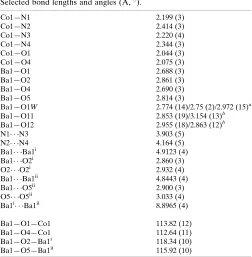
Table 1
Selected bond lengths and angles (A˚ ,).
Co1—N1 2.199 (3)
Co1—N2 2.414 (3)
Co1—N3 2.220 (4)
Co1—N4 2.344 (3)
Co1—O1 2.044 (3)
Co1—O4 2.075 (3)
Ba1—O1 2.688 (3)
Ba1—O2 2.861 (3)
Ba1—O4 2.690 (3)
Ba1—O5 2.814 (3)
Ba1—O1W 2.774 (14)/2.75 (2)/2.972 (15)a
Ba1—O11 2.853 (19)/3.154 (13)b
Ba1—O12 2.955 (18)/2.863 (12)b
N1 N3 3.903 (5)
N2 N4 4.164 (5)
Ba1 Ba1i 4.9123 (4)
Ba1 O2i 2.860 (3)
O2 O2i 2.932 (4)
Ba1 Ba1ii 4.8443 (4)
Ba1 O5ii 2.900 (3)
O5 O5ii 3.033 (4)
Ba1i Ba1ii 8.8965 (4)
Ba1—O1—Co1 113.82 (12)
Ba1—O4—Co1 112.64 (11)
Ba1—O2—Ba1i 118.34 (10)
Ba1—O5—Ba1ii 115.92 (10)
[image:3.610.310.567.83.160.2]Symmetry codes: (i) =x+ 1,y,z; (ii) =x+ 2,y,z. Notes: (a) the values refer to O1WA/B/C atoms, respectively; (b) the values refer to the A/B oxygen atoms, respectively, of the disordered perchlorate anion (seeRefinementsection).
Figure 2
Coordination polyhedra around cobalt (left) and barium (right) ions. [Symmetry codes: (i)x+ 1,y,z; (ii)x+ 2,y,z.]
Figure 3
[image:3.610.46.295.557.711.2]Bai and O2i and atoms Ba, O5, Baii and O5ii is about 40
[symmetry codes: (i) x+ 1, y, z; (ii)x+ 2, y, z], Fig. 4. The Ba—O bond distances, the O O and Ba Ba distances and the Ba—O—Ba angle values within each plane and the Bai Baiidistance (Table 1) are in agreement with data reported in the CSD.
Weak C—H O hydrogen bonds (Desiraju & Steiner, 1999) involving both coordinating and non-coordinating perchlorate anions build the whole crystal architecture (Table 2). Distinct 1D-CPs are held together by weak C— H O interactions between the coordinating perchlorate anions belonging to a CP and methylene hydrogen atoms belonging to the adjacent CPs (Fig. 5).
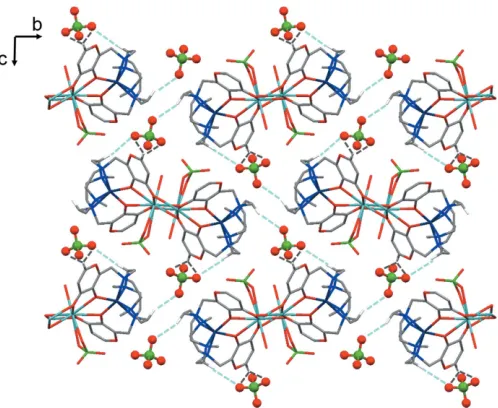
The non-coordinating perchlorate anion connects,viaa net of weak hydrogen bonds, three {Ba[Co(H-2L1)](ClO4)(H2O)}
+
cationic fragments belonging to two different 1D-CPs wave-like disposed along thebaxis (Fig. 6).
4. Database survey
Five structures containingL1 were found in a search of the CSD (Version 5.38, May 2017; Groomet al., 2016), three of them containing CoII: a hetero-trinuclear GdIII–CoII–GdIII dimer, a hetero-dinuclear NaI–CoII complex and a CoII complex (Benelliet al., 2013; Amatoriet al., 2012; Borgogelliet al., 2013). In addition, our group recently published the
research communications
Acta Cryst.(2017). E73, 1806–1811 Paoliet al. [BaCo(C
[image:4.610.123.476.73.227.2]22H28N4O6)(ClO4)(H2O)]ClO4
1809
Figure 5
Adjacent CPs connectedviahydrogen bonds involving the coordinating ClO4
anions as viewed along thebaxis. The coordinating ClO4
[image:4.610.316.565.430.634.2]anions are depicted in ball and stick mode. Hydrogen bonds are depicted as light-blue dotted lines. Only H atoms involved in the C—H O interactions and only one component of the disordered perchlorate anion and water molecule are shown.
Figure 6
Crystal packing of the title compound as viewed along theaaxis. The non-coordinating ClO4anions are depicted in ball and stick mode. Hydrogen
bonds involving the non-coordinating ClO4 anion and two
{Ba[Co(H–2L1)](ClO4)(H2O)}+ cationic fragments on the same plane
are depicted in light-blue dotted lines. Hydrogen bonds involving the non-coordinating ClO4
anion and a {Ba[Co(H–2L1)](ClO4)(H2O)} +
cationic fragment out of plane (symmetry operation x 1,y, z) are depicted in grey dotted lines. Only H atoms involved in the C—H O interactions and only one component of the disordered perchlorate anion and water molecule are shown.
Figure 4
Wave-like one-dimensional BaII-based coordination polymer that develops along theaaxis. The oxygen and barium atoms belonging to the barium– 2
-oxygen motif are depicted in ball and stick mode. Only one component of the disordered perchlorate anion and water molecule is shown. H atoms and the non-coordinating ClO4
[image:4.610.47.294.471.680.2]
corresponding hetero-trinuclear Eu–Co–Eu dimer (Rossi et al., 2017).
A general search for structures containing both CoII and BaIIions revealed 61 hits, 20 of which are polymeric structures formed by organic ligands containing both oxygen and nitro-gen donor atoms and only two being 1D-CPs. It is noteworthy that none of the 20 structures contains either macrocyclic ligands or an N4O2donor set around the CoIIion. In eight out
of those 20 polymeric structures, the BaIIand CoII ions are bridged by oxygen atoms and ten out of 20 show oxygen-bridged BaII ions (only eight forming an infinite chain). Finally, only six out of the 20 polymeric structures contain both oxygen-bridged BaII ions and oxygen-bridged BaIIand CoIIions.
All these data suggest that structures containing both oxygen-bridged BaII ions and oxygen-bridged BaII and CoII ions are not common and that no BaII-based 1D-CPs formed by macrocyclic ligands and containing CoIIions surrounded by an N4O2donor set are present in the CSD.
5. Synthesis and crystallization
CompoundL1was obtained following the synthetic procedure previously reported (Amatoriet al., 2012).
To obtain the BaII-based CoII-containing 1D-CP of L1, {{Ba[Co(H–2L1)](ClO4)(H2O)}ClO4}n, 0.1 mmol of CoCl2
6H2O in water (10 mL) were added to an aqueous solution
(20 mL) containing 0.1 mmol of L13HClO4H2O. The
solu-tion was adjusted to pH 7 with 0.1 MN(CH3)4OH and then
0.05 mmol of BaCl2 2H2O were added. The solution was
saturated with NaClO4. The Ba II
–CoII1D-CP of L1 quickly precipitated as a microcrystalline pink solid. Crystals suitable for X-ray analysis were instead obtained by slow evaporation of a more diluted aqueous solution.
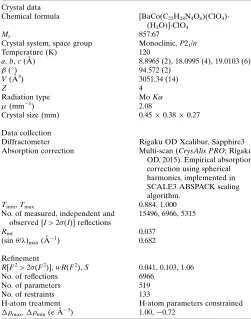
6. Refinement
Crystal data, data collection and structure refinement details are summarized in Table 3. All hydrogen atoms of the macrocycle were positioned geometrically and refined as riding with C—H = 0.95–0.99 A˚ with Uiso(H) = 1.5Ueq
(C-methyl) and = 1.2Ueq(C) for other H atoms. Both perchlorate
anions are disordered, all oxygen and chlorine atoms were set in double positions [anion 1: Cl1A/B, O11A/B, O12A/B, O13A/B, O14A/B, occupancy factor: 0.40 (3) and 0.60 (3); anion 2: Cl2A/B, O21A/B, O22A/B, O23A/B, O24A/B, occu-pancy factor: 0.78 (3) and 0.22 (3)]. The water molecule is disordered over three positions [SUMP command was used, occupancies 0.49 (3), 0.27 (3) and 0.24 (3)], the hydrogen atoms were not found in the Fourier-difference map and they were not introduced in the refinement. All non-hydrogen atoms were anisotropically refined: as for the disordered perchlorate anions, the SIMU instruction was used to restrain the anisotropic displacement parameters of the disordered atoms, while the ISOR instruction was used to model the disordered water oxygen atoms.
Acknowledgements
The authors acknowledge the CRIST (Centro di Cristallo-grafia Strutturale, University of Firenze) where the data collection was performed.
Funding information
Funding for this research was provided by: MIUR PRIN 2015.
References
Amatori, S., Ambrosi, G., Fanelli, M., Formica, M., Fusi, V., Giorgi, L., Macedi, E., Micheloni, M., Paoli, P., Pontellini, R. & Rossi, P. (2012).J. Org. Chem.77, 2207–2218.
Banerjee, D., Simon, C. M., Plonka, A. M., Motkuri, R. K., Liu, J., Chen, X. Y., Smit, B., Parise, J. B., Haranczyk, M. & Thallapally, P. K. (2016).Nat. Commun.7, 11831.
Benelli, C., Borgogelli, E., Formica, M., Fusi, V., Giorgi, L., Macedi, E., Micheloni, M., Paoli, P. & Rossi, P. (2013).Dalton Trans. 42, 5848–5859.
Borgogelli, E., Formica, M., Fusi, V., Giorgi, L., Macedi, E., Micheloni, M., Paoli, P. & Rossi, P. (2013). Dalton Trans. 42, 2902–2912.
Burla, M. C., Caliandro, R., Carrozzini, B., Cascarano, G. L., Cuocci, C., Giacovazzo, C., Mallamo, M., Mazzone, A. & Polidori, G. (2015).J. Appl. Cryst.48, 306–309.
1810
Paoliet al. [BaCo(C22H28N4O6)(ClO4)(H2O)]ClO4 Acta Cryst.(2017). E73, 1806–1811
[image:5.610.313.564.93.412.2]research communications
Table 3
Experimental details.
Crystal data
Chemical formula [BaCo(C22H28N4O6)(ClO4
)-(H2O)]ClO4
Mr 857.67
Crystal system, space group Monoclinic,P21/n
Temperature (K) 120
a,b,c(A˚ ) 8.8965 (2), 18.0995 (4), 19.0103 (6)
(
) 94.572 (2)
V(A˚3) 3051.34 (14)
Z 4
Radiation type MoK
(mm1) 2.08
Crystal size (mm) 0.450.380.27
Data collection
Diffractometer Rigaku OD Xcalibur, Sapphire3
Absorption correction Multi-scan (CrysAlis PRO; Rigaku
OD, 2015). Empirical absorption correction using spherical harmonics, implemented in SCALE3 ABSPACK scaling algorithm.
Tmin,Tmax 0.884, 1.000
No. of measured, independent and observed [I> 2(I)] reflections
15496, 6966, 5315
Rint 0.037
(sin/)max(A˚
1) 0.682
Refinement
R[F2> 2(F2)],wR(F2),S 0.041, 0.103, 1.06
No. of reflections 6966
No. of parameters 519
No. of restraints 133
H-atom treatment H-atom parameters constrained
max,min(e A˚
3) 1.00,0.72
Cai, S.-L., He, Z.-H., Wu, W.-H., Liu, F.-X., Huang, X.-L., Zheng, S.-R., Fan, J. & Zhang, W. (2017).CrystEngComm,19, 3003–3016. Cai, S. L., Zheng, S. R., Fan, J., Zeng, R. H. & Zhang, W. G. (2016).
CrystEngComm,18, 1174–1183.
Campbell, M. G., Sheberla, D., Liu, S. F., Swager, T. M. & Dinca˘, M. (2015).Angew. Chem. Int. Ed.54, 4349–4352.
Chakraborty, A. & Maji, T. K. (2014).APL Mater2, 124107-7. Chughtai, A. H., Ahmad, N., Younus, H. A., Laypkov, A. & Verpoort,
F. (2015).Chem. Soc. Rev.44, 6804–6849.
Deng, J. H., Zhong, D. C., Luo, X. Z., Liu, H. J. & Lu, T. B. (2012).
Cryst. Growth Des.12, 4861–4869.
Desiraju, G. R. & Steiner, T. (1999). The Weak Hydrogen Bond in Structural Chemistry and Biology. IUCr Monographs on Crystal-lography, Vol. 9. New York: Oxford University Press.
Douvali, A., Papaefstathiou, G. S., Gullo, M. P., Barbieri, A., Tsipis, A. C., Malliakas, C. D., Kanatzidis, M. G., Papadas, I., Armatas, G. S., Hatzidimitriou, A. G., Lazarides, T. & Manos, M. J. (2015).
Inorg. Chem.54, 5813–5826.
Feng, X., Feng, Y. Q., Chen, J. J., Ng, S. W., Wang, L. Y. & Guo, J. Z. (2015).Dalton Trans.44, 804–816.
Foo, M. L., Horike, S., Duan, J., Chen, W. & Kitagawa, S. (2013).
Cryst. Growth Des.13, 2965–2972.
Foo, M. L., Horike, S., Inubushi, Y. & Kitagawa, S. (2012).Angew. Chem. Int. Ed.51, 6107–6111.
Fracaroli, A. M., Furukawa, H., Suzuki, M., Dodd, M., Okajima, S., Ga´ndara, F., Reimer, J. A. & Yaghi, O. M. (2014).J. Am. Chem. Soc.
136, 8863–8866.
Groom, C. R., Bruno, I. J., Lightfoot, M. P. & Ward, S. C. (2016).Acta Cryst.B72, 171–179.
Guggenberger, L. J. & Muetterties, E. L. (1976).J. Am. Chem. Soc.98, 7221–7225.
Hu, Z. C., Deibert, B. J. & Li, J. (2014).Chem. Soc. Rev.43, 5815– 5840.
Jia, H. L., Li, Y. L., Xiong, Z. F., Wang, C. J. & Li, G. (2014).Dalton Trans.43, 3704–3715.
Jing, X. M., Zhang, L. R., Ma, T. L., Li, G. H., Yu, Y., Huo, Q. S., Eddaoudi, M. & Liu, Y. L. (2010).Cryst. Growth Des.10, 492–494. Kreno, L. E., Leong, K., Farha, O. K., Allendorf, M., Van Duyne, R. P.
& Hupp, J. T. (2012).Chem. Rev.112, 1105–1125.
Li, X., Wu, B. L., Niu, C. Y., Niu, Y. Y. & Zhang, H. Y. (2009).Cryst. Growth Des.9, 3423–3431.
Lian, C., Liu, L., Guo, X., Long, Y., Jia, S., Li, H. & Yang, L. (2016).J. Solid State Chem.233, 229–235.
Liu, H. K., Tsao, T. H., Lin, C. H. & Zima, V. (2010).CrystEngComm, 12, 1044–1047.
Liu, Y., Xuan, W. M. & Cui, Y. (2010).Adv. Mater.22, 4112–4135.
Mali, G., Trebosc, J., Martineau, C. & Mazaj, M. (2015). J. Phys. Chem. C,119, 7831–7841.
Meurant, G. (1987).Stereochemical and Stereophysical Behaviour of Macrocycles, edited by I. Bernal. Amsterdam; New York: Elsevier. Mo, K., Yang, Y. & Cui, Y. (2014).J. Am. Chem. Soc.136, 1746–1749. Muetterties, E. L. & Guggenberger, L. J. (1974).J. Am. Chem. Soc.96,
1748–1756.
Raja, D. S., Luo, J. H., Yeh, C. T., Jiang, Y. C., Hsu, K. F. & Lin, C. H. (2014).CrystEngComm,16, 1985–1994.
Rigaku OD (2015).CrysAlis PRO. Rigaku Oxford Diffraction Ltd., Abingdon, UK.
Rossi, P., Ciattini, S., Formica, M., Fusi, V., Giorgi, L., Macedi, E., Micheloni, M. & Paoli, P. (2017).Inorg. Chim. Acta, doi: 10.1016/j. ica. 2017.06.033.
Sheldrick, G. M. (2015).Acta Cryst. C71, 3–8.
Shi, B. B., Zhong, Y. H., Guo, L. L. & Li, G. (2015).Dalton Trans.44, 4362–4369.
Smith, N. D., Roppe, J. R., Bonnefous, C., Payne, J. E., Zhang, H., Chen, X. H., Lindstrom, A. K., Duron, S. G., Hassing, C. A. & Noble, S. A. (2013). US patent 20080139558–A1.
Suh, M. P., Park, H. J., Prasad, T. K. & Lim, D. W. (2012).Chem. Rev.
112, 782–835.
Sumida, K., Rogow, D. L., Mason, J. A., McDonald, T. M., Bloch, E. D., Herm, Z. R., Bae, T. H. & Long, J. R. (2012).Chem. Rev.112, 724–781.
Wang, J. H., Li, M. & Li, D. (2013).Chem. Sci.4, 1793–1801. Xiao, D., Chen, H., Sun, D., He, J., Yan, S., Yang, J., Wang, X., Yuan,
R. & Wang, E. (2012).CrystEngComm,14, 2849–2858.
Xie, L. X., Hou, X. W., Fan, Y. T. & Hou, H. W. (2012).Cryst. Growth Des.12, 1282–1291.
Yoon, M., Srirambalaji, R. & Kim, K. (2012).Chem. Rev.112, 1196– 1231.
Zhai, Q. G., Zeng, R. R., Li, S. N., Jiang, Y. C. & Hu, M. C. (2013).
CrystEngComm,15, 965–976.
Zhang, Y., Guo, B. B., Li, L., Liu, S. F. & Li, G. (2013).Cryst. Growth Des.13, 367–376.
Zhang, X., Huang, Y.-Y., Zhang, M.-J., Zhang, J. & Yao, Y.-G. (2012).
Cryst. Growth Des.12, 3231–3238.
Zhang, F. W., Li, Z. F., Ge, T. Z., Yao, H. C., Li, G., Lu, H. J. & Zhu, Y. Y. (2010).Inorg. Chem.49, 3776–3788.
Zhang, Y., Luo, X. B., Yang, Z. L. & Li, G. (2012).CrystEngComm, 14, 7382–7397.
Zhang, Y., Yuan, P., Zhu, Y. & Li, G. (2013).Dalton Trans.42, 14776– 14785.
Zheng, S. R., Wen, Z. Z., Chen, Y. Y., Cai, S. L., Fan, J. & Zhang, W. G. (2015).Inorg. Chem. Commun.55, 165–168.
research communications
Acta Cryst.(2017). E73, 1806–1811 Paoliet al. [BaCo(C
supporting information
sup-1
Acta Cryst. (2017). E73, 1806-1811
supporting information
Acta Cryst. (2017). E73, 1806-1811 [https://doi.org/10.1107/S2056989017015638]
Crystal structure of the Ba
II-based Co
II-containing one-dimensional
coordination polymer poly[[aqua{
µ
4-2,2
′
-[(4,10-dimethyl-1,4,7,10-tetraaza-cyclododecane-1,7-diyl)bis(methylidene)]bis(4-oxo-4
H
-pyran-3-olato)}perchloratocobaltbarium] perchlorate]
Paola Paoli, Eleonora Macedi, Patrizia Rossi, Luca Giorgi, Mauro Formica and Vieri Fusi
Computing details
Data collection: CrysAlis PRO (Rigaku OD, 2015); cell refinement: CrysAlis PRO (Rigaku OD, 2015); data reduction:
CrysAlis PRO (Rigaku OD, 2015); program(s) used to solve structure: SIR2014 (Burla, 2015); program(s) used to refine structure: SHELXL2014/7 (Sheldrick, 2015); molecular graphics: SHELXL2014/7 (Sheldrick, 2015); software used to prepare material for publication: SHELXL2014/7 (Sheldrick, 2015).
Poly[[aqua{µ4-2,2′
-[(4,10-dimethyl-1,4,7,10-tetraazacyclododecane-1,7-diyl)bis(methylidene)]bis(4-oxo-4H-pyran-3-olato)}perchloratocobaltbarium] perchlorate]
Crystal data
[BaCo(C22H28N4O6)(ClO4)(H2O)]ClO4 Mr = 857.67
Monoclinic, P21/n a = 8.8965 (2) Å
b = 18.0995 (4) Å
c = 19.0103 (6) Å
β = 94.572 (2)°
V = 3051.34 (14) Å3 Z = 4
F(000) = 1708
Dx = 1.867 Mg m−3
Mo Kα radiation, λ = 0.71073 Å Cell parameters from 4989 reflections
θ = 2.2–27.7°
µ = 2.08 mm−1 T = 120 K Prism, pink
0.45 × 0.38 × 0.27 mm
Data collection
Rigaku OD Xcalibur, Sapphire3 diffractometer
Radiation source: fine-focus sealed X-ray tube, Enhance (Mo) X-ray Source
Graphite monochromator
Detector resolution: 16.4547 pixels mm-1 ω scans
Absorption correction: multi-scan
(CrysAlisPro; Rigaku OD, 2015) Empirical absorption correction using spherical harmonics, implemented in SCALE3 ABSPACK scaling algorithm.
Tmin = 0.884, Tmax = 1.000
15496 measured reflections 6966 independent reflections 5315 reflections with I > 2σ(I)
Rint = 0.037
θmax = 29.0°, θmin = 2.2° h = −12→11
k = −22→22
supporting information
sup-2
Acta Cryst. (2017). E73, 1806-1811
Refinement
Refinement on F2
Least-squares matrix: full
R[F2 > 2σ(F2)] = 0.041 wR(F2) = 0.103 S = 1.06 6966 reflections 519 parameters 133 restraints
Hydrogen site location: inferred from neighbouring sites
H-atom parameters constrained
w = 1/[σ2(F
o2) + (0.037P)2 + 2.9358P]
where P = (Fo2 + 2Fc2)/3
(Δ/σ)max = 0.001
Δρmax = 1.00 e Å−3
Δρmin = −0.72 e Å−3
Special details
Geometry. All esds (except the esd in the dihedral angle between two l.s. planes) are estimated using the full covariance matrix. The cell esds are taken into account individually in the estimation of esds in distances, angles and torsion angles; correlations between esds in cell parameters are only used when they are defined by crystal symmetry. An approximate (isotropic) treatment of cell esds is used for estimating esds involving l.s. planes.
Fractional atomic coordinates and isotropic or equivalent isotropic displacement parameters (Å2)
x y z Uiso*/Ueq Occ. (<1)
supporting information
sup-3
Acta Cryst. (2017). E73, 1806-1811
C7 0.7907 (5) 0.3517 (3) 0.2110 (3) 0.0426 (11) H7A 0.7868 0.4003 0.1870 0.051* H7B 0.8308 0.3593 0.2606 0.051* C8 0.6351 (5) 0.3191 (3) 0.2090 (3) 0.0442 (12) H8A 0.6387 0.2719 0.2353 0.053* H8B 0.5678 0.3533 0.2324 0.053* C9 0.4532 (6) 0.2506 (3) 0.1367 (3) 0.0589 (15) H9A 0.4106 0.2409 0.0885 0.088* H9B 0.4947 0.2047 0.1576 0.088* H9C 0.3738 0.2691 0.1650 0.088* C10 1.0466 (5) 0.2848 (3) 0.0060 (3) 0.0500 (13) H10A 1.0003 0.2536 −0.0319 0.075* H10B 1.1274 0.3143 −0.0121 0.075* H10C 1.0886 0.2536 0.0448 0.075* C11 0.5658 (5) 0.3217 (2) −0.0762 (2) 0.0395 (10) H11A 0.5112 0.3604 −0.1049 0.047* H11B 0.6556 0.3072 −0.1006 0.047* C12 0.4661 (5) 0.2566 (2) −0.0707 (2) 0.0318 (9) C13 0.5033 (4) 0.1960 (2) −0.0315 (2) 0.0316 (9) C14 0.3993 (4) 0.1344 (2) −0.0339 (2) 0.0325 (9) C15 0.2580 (4) 0.1477 (2) −0.0733 (2) 0.0310 (9) H15 0.1815 0.1109 −0.0739 0.037* C16 0.2308 (5) 0.2098 (3) −0.1090 (2) 0.0367 (10) H16 0.1358 0.2158 −0.1349 0.044* C17 0.9321 (5) 0.2400 (2) 0.2241 (2) 0.0404 (11) H17A 0.9863 0.2604 0.2673 0.048* H17B 0.8390 0.2160 0.2380 0.048* C18 1.0276 (5) 0.1841 (2) 0.1936 (2) 0.0354 (10) C19 0.9936 (4) 0.1509 (2) 0.1305 (2) 0.0307 (9) C20 1.0956 (5) 0.0936 (2) 0.1072 (2) 0.0364 (10) C21 1.2276 (5) 0.0819 (3) 0.1537 (3) 0.0479 (12) H21 1.3017 0.0479 0.1404 0.058* C22 1.2496 (6) 0.1168 (3) 0.2147 (3) 0.0536 (14) H22 1.3377 0.1056 0.2443 0.064*
supporting information
sup-4
Acta Cryst. (2017). E73, 1806-1811
O24A 0.7821 (9) 0.0858 (7) 0.2801 (4) 0.081 (3) 0.78 (3) Cl2B 0.661 (4) 0.073 (2) 0.317 (2) 0.060 (5) 0.22 (3) O21B 0.610 (4) 0.1450 (16) 0.2989 (19) 0.053 (6) 0.22 (3) O22B 0.733 (4) 0.0437 (17) 0.381 (2) 0.065 (5) 0.22 (3) O23B 0.571 (4) 0.027 (2) 0.272 (2) 0.066 (5) 0.22 (3) O24B 0.783 (3) 0.049 (2) 0.2882 (15) 0.071 (5) 0.22 (3) O1WA 0.6542 (14) 0.0192 (9) 0.1411 (7) 0.079 (4) 0.493 (3) O1WB 0.721 (2) 0.0144 (13) 0.1481 (12) 0.054 (5) 0.268 (3) O1WC 0.842 (2) −0.0011 (8) 0.1552 (8) 0.058 (4) 0.239 (3)
Atomic displacement parameters (Å2)
U11 U22 U33 U12 U13 U23
supporting information
sup-5
Acta Cryst. (2017). E73, 1806-1811
O11A 0.047 (5) 0.039 (5) 0.055 (5) −0.001 (4) 0.003 (4) 0.015 (4) O12A 0.050 (5) 0.049 (5) 0.058 (5) 0.007 (4) 0.003 (4) 0.005 (4) O13A 0.065 (7) 0.063 (6) 0.062 (7) 0.013 (5) 0.022 (5) 0.006 (5) O14A 0.073 (8) 0.053 (7) 0.093 (8) 0.006 (7) −0.019 (7) 0.024 (6) Cl1B 0.049 (3) 0.057 (3) 0.037 (2) 0.0143 (18) 0.0014 (18) 0.0026 (18) O11B 0.042 (3) 0.064 (5) 0.049 (4) 0.011 (4) 0.008 (3) 0.006 (4) O12B 0.049 (3) 0.066 (4) 0.051 (4) 0.009 (4) −0.006 (3) 0.001 (4) O13B 0.058 (5) 0.100 (6) 0.035 (4) 0.024 (5) 0.006 (4) −0.002 (4) O14B 0.081 (7) 0.063 (5) 0.080 (6) 0.004 (6) −0.018 (5) 0.025 (4) Cl2A 0.0529 (19) 0.035 (2) 0.0386 (17) −0.0050 (18) −0.0023 (13) 0.0003 (14) O21A 0.076 (5) 0.045 (3) 0.074 (5) 0.008 (3) −0.011 (4) −0.010 (4) O22A 0.074 (4) 0.065 (5) 0.046 (4) 0.015 (3) −0.001 (3) 0.007 (3) O23A 0.082 (4) 0.034 (3) 0.074 (5) −0.020 (3) −0.022 (4) 0.006 (4) O24A 0.097 (4) 0.070 (6) 0.083 (4) −0.021 (4) 0.046 (3) −0.011 (4) Cl2B 0.075 (8) 0.034 (6) 0.069 (9) 0.014 (5) 0.002 (6) −0.003 (5) O21B 0.071 (10) 0.020 (8) 0.066 (12) −0.001 (7) −0.002 (9) 0.004 (8) O22B 0.086 (10) 0.039 (9) 0.068 (10) 0.012 (7) −0.003 (8) −0.002 (7) O23B 0.086 (9) 0.043 (9) 0.069 (11) 0.000 (7) 0.008 (8) −0.007 (8) O24B 0.091 (9) 0.046 (8) 0.076 (10) 0.009 (7) 0.012 (7) −0.006 (7) O1WA 0.100 (8) 0.095 (7) 0.042 (5) 0.000 (7) 0.005 (6) −0.007 (5) O1WB 0.067 (9) 0.056 (8) 0.038 (8) −0.005 (8) 0.004 (8) 0.001 (6) O1WC 0.077 (8) 0.045 (7) 0.052 (8) −0.012 (6) 0.010 (6) −0.012 (6)
Geometric parameters (Å, º)
Ba1—O1 2.688 (3) C5—H5B 0.9900 Ba1—O4 2.690 (3) O6—C22 1.339 (6) Ba1—O1WB 2.75 (2) O6—C18 1.370 (5) Ba1—O1WA 2.774 (14) C6—H6A 0.9900 Ba1—O5 2.814 (3) C6—H6B 0.9900 Ba1—O11A 2.853 (19) C7—C8 1.503 (6) Ba1—O2i 2.860 (3) C7—H7A 0.9900
Ba1—O2 2.861 (3) C7—H7B 0.9900 Ba1—O12B 2.863 (10) C8—H8A 0.9900 Ba1—O5ii 2.901 (3) C8—H8B 0.9900
supporting information
sup-6
Acta Cryst. (2017). E73, 1806-1811
C1—N3 1.492 (6) C15—H15 0.9500 C1—H1A 0.9900 C16—H16 0.9500 C1—H1B 0.9900 C17—C18 1.471 (6) O2—C14 1.252 (5) C17—H17A 0.9900 O2—Ba1i 2.860 (3) C17—H17B 0.9900
N2—C3 1.466 (6) C18—C19 1.353 (6) N2—C2 1.479 (5) C19—C20 1.469 (6) N2—C11 1.486 (6) C20—C21 1.429 (6) C2—H2A 0.9900 C21—C22 1.320 (7) C2—H2B 0.9900 C21—H21 0.9500 O3—C16 1.334 (5) C22—H22 0.9500 O3—C12 1.366 (5) Cl1A—O12A 1.35 (2) N3—C9 1.470 (6) Cl1A—O13A 1.40 (2) N3—C8 1.481 (6) Cl1A—O14A 1.47 (3) C3—C4 1.511 (6) Cl1A—O11A 1.59 (2) C3—H3A 0.9900 Cl1B—O11B 1.342 (18) C3—H3B 0.9900 Cl1B—O14B 1.383 (17) O4—C19 1.325 (5) Cl1B—O13B 1.433 (15) N4—C17 1.471 (5) Cl1B—O12B 1.484 (15) N4—C7 1.477 (5) Cl2A—O22A 1.423 (11) N4—C6 1.490 (5) Cl2A—O21A 1.425 (12) C4—H4A 0.9900 Cl2A—O23A 1.434 (10) C4—H4B 0.9900 Cl2A—O24A 1.444 (11) O5—C20 1.254 (5) Cl2B—O24B 1.33 (5) O5—Ba1ii 2.901 (3) Cl2B—O23B 1.40 (4)
C5—C6 1.497 (6) Cl2B—O21B 1.42 (4) C5—H5A 0.9900 Cl2B—O22B 1.43 (5)
O1—Ba1—O4 56.75 (8) N1—C4—H4A 109.6 O1—Ba1—O1WB 101.1 (5) C3—C4—H4A 109.6 O4—Ba1—O1WB 74.2 (5) N1—C4—H4B 109.6 O1—Ba1—O1WA 94.5 (3) C3—C4—H4B 109.6 O4—Ba1—O1WA 78.8 (3) H4A—C4—H4B 108.1 O1—Ba1—O5 111.22 (8) C20—O5—Ba1 112.8 (3) O4—Ba1—O5 60.20 (8) C20—O5—Ba1ii 127.8 (3)
O1WB—Ba1—O5 85.5 (4) Ba1—O5—Ba1ii 115.92 (10)
O1WA—Ba1—O5 97.9 (3) N1—C5—C6 112.4 (4) O1—Ba1—O11A 73.1 (4) N1—C5—H5A 109.1 O4—Ba1—O11A 117.6 (4) C6—C5—H5A 109.1 O1WA—Ba1—O11A 144.0 (5) N1—C5—H5B 109.1 O5—Ba1—O11A 118.1 (4) C6—C5—H5B 109.1 O1—Ba1—O2i 121.15 (8) H5A—C5—H5B 107.9
O4—Ba1—O2i 146.50 (9) C22—O6—C18 118.5 (4)
O1WB—Ba1—O2i 73.8 (5) N4—C6—C5 110.4 (4)
O1WA—Ba1—O2i 67.9 (3) N4—C6—H6A 109.6
O5—Ba1—O2i 126.20 (8) C5—C6—H6A 109.6
O11A—Ba1—O2i 89.4 (4) N4—C6—H6B 109.6
supporting information
sup-7
Acta Cryst. (2017). E73, 1806-1811
O4—Ba1—O2 107.01 (8) H6A—C6—H6B 108.1 O1WB—Ba1—O2 87.0 (5) N4—C7—C8 109.4 (4) O1WA—Ba1—O2 74.4 (3) N4—C7—H7A 109.8 O5—Ba1—O2 166.61 (9) C8—C7—H7A 109.8 O11A—Ba1—O2 70.2 (4) N4—C7—H7B 109.8 O2i—Ba1—O2 61.66 (10) C8—C7—H7B 109.8
O1—Ba1—O12B 76.5 (3) H7A—C7—H7B 108.2 O4—Ba1—O12B 84.3 (3) N3—C8—C7 110.9 (4) O1WB—Ba1—O12B 155.1 (5) N3—C8—H8A 109.5 O5—Ba1—O12B 72.8 (2) C7—C8—H8A 109.5 O2i—Ba1—O12B 129.0 (3) N3—C8—H8B 109.5
O2—Ba1—O12B 111.7 (2) C7—C8—H8B 109.5 O1—Ba1—O5ii 149.97 (9) H8A—C8—H8B 108.1
O4—Ba1—O5ii 123.92 (8) N3—C9—H9A 109.5
O1WB—Ba1—O5ii 107.8 (5) N3—C9—H9B 109.5
O1WA—Ba1—O5ii 115.4 (3) H9A—C9—H9B 109.5
O5—Ba1—O5ii 64.08 (10) N3—C9—H9C 109.5
O11A—Ba1—O5ii 83.3 (4) H9A—C9—H9C 109.5
O2i—Ba1—O5ii 75.82 (9) H9B—C9—H9C 109.5
O2—Ba1—O5ii 128.99 (9) N1—C10—H10A 109.5
O12B—Ba1—O5ii 73.8 (3) N1—C10—H10B 109.5
O1—Ba1—O12A 85.8 (4) H10A—C10—H10B 109.5 O4—Ba1—O12A 93.0 (4) N1—C10—H10C 109.5 O1WA—Ba1—O12A 169.9 (4) H10A—C10—H10C 109.5 O5—Ba1—O12A 72.6 (3) H10B—C10—H10C 109.5 O11A—Ba1—O12A 45.6 (5) C12—C11—N2 111.3 (4) O2i—Ba1—O12A 120.5 (4) C12—C11—H11A 109.4
O2—Ba1—O12A 114.1 (3) N2—C11—H11A 109.4 O5ii—Ba1—O12A 64.3 (4) C12—C11—H11B 109.4
O1—Ba1—O1WC 114.0 (3) N2—C11—H11B 109.4 O4—Ba1—O1WC 71.0 (3) H11A—C11—H11B 108.0 O5—Ba1—O1WC 64.8 (3) C13—C12—O3 123.3 (4) O2i—Ba1—O1WC 82.8 (3) C13—C12—C11 124.2 (4)
O2—Ba1—O1WC 108.7 (3) O3—C12—C11 112.5 (4) O5ii—Ba1—O1WC 91.4 (3) O1—C13—C12 121.8 (4)
supporting information
sup-8
Acta Cryst. (2017). E73, 1806-1811
N3—Co1—N2 75.99 (13) N4—C17—H17A 109.0 N4—Co1—N2 122.15 (12) C18—C17—H17B 109.0 C13—O1—Co1 131.9 (2) N4—C17—H17B 109.0 C13—O1—Ba1 114.1 (2) H17A—C17—H17B 107.8 Co1—O1—Ba1 113.82 (11) C19—C18—O6 123.0 (4) C5—N1—C10 110.3 (4) C19—C18—C17 124.1 (4) C5—N1—C4 108.4 (3) O6—C18—C17 112.9 (4) C10—N1—C4 108.1 (4) O4—C19—C18 122.3 (4) C5—N1—Co1 110.6 (3) O4—C19—C20 118.9 (4) C10—N1—Co1 107.3 (3) C18—C19—C20 118.7 (4) C4—N1—Co1 112.1 (3) O5—C20—C21 124.2 (4) C2—C1—N3 112.0 (4) O5—C20—C19 121.3 (4) C2—C1—H1A 109.2 C21—C20—C19 114.5 (4) N3—C1—H1A 109.2 C22—C21—C20 122.0 (4) C2—C1—H1B 109.2 C22—C21—H21 119.0 N3—C1—H1B 109.2 C20—C21—H21 119.0 H1A—C1—H1B 107.9 C21—C22—O6 123.1 (4) C14—O2—Ba1i 124.5 (3) C21—C22—H22 118.4
C14—O2—Ba1 111.2 (2) O6—C22—H22 118.4 Ba1i—O2—Ba1 118.33 (10) O12A—Cl1A—O13A 89.8 (18)
supporting information
sup-9
Acta Cryst. (2017). E73, 1806-1811
C17—N4—C7 107.8 (3) O23A—Cl2A—O24A 113.9 (9) C17—N4—C6 110.0 (3) O24B—Cl2B—O23B 90 (3) C7—N4—C6 109.9 (3) O24B—Cl2B—O21B 116 (3) C17—N4—Co1 114.3 (3) O23B—Cl2B—O21B 104 (3) C7—N4—Co1 105.7 (3) O24B—Cl2B—O22B 85 (3) C6—N4—Co1 108.8 (3) O23B—Cl2B—O22B 120 (3) N1—C4—C3 110.4 (4) O21B—Cl2B—O22B 131 (3)
(H2O)}+ cationicfragment, with the atom labelling and 30% probability displacementellipsoids](https://thumb-us.123doks.com/thumbv2/123dok_us/401012.537617/2.610.313.565.461.687/figure-the-molecular-structure-cationicfragment-labelling-probability-displacementellipsoids.webp)