Mobile (bio)available metal concentration in con-taminated soils can be minimized through biological immobilization and stabilization methods using a range of organic compounds, such as biochar, which is a form of environmental black carbon produced using the pyrolysis of C-based biomass (Verheijen et al. 2010). Incorporation of biochar can influence soil structure, texture, porosity, particle size distribution and density, thereby potentially altering air oxygen content, water storage capacity and microbial and nutritional status of the soil within the plant root-ing zone (Amonette and Joseph 2009). Biochar soil additions also influence chemical properties of the soil such as changes in pH, electrical conductivity (EC), cation exchange capacity (CEC), nutrient levels (Gundale and DeLuca 2007, Warnock et al. 2007, Amonette and Joseph 2009) and consequently metal sorption efficiency (Beesley et al. 2010, Uchimiya et al. 2010).
Sorption efficiency as a major process responsible for the fate of metals in soils is usually based on laboratory batch experiments aimed to quantify the distribution coefficient, an operational pa-rameter that relates the amount of metal sorbed in the soil solid phase to the metal concentration in the soil solution at equilibrium (Vidal et al. 2009). In order to describe the sorption behavior of metals onto the soil, several models (empirical/ mechanistic), which describe the distribution of the metal between the solid and the liquid phases, were proposed (Bradl 2004). The most commonly used are the Langmuir and the Freundlich iso-therms (Hinz 2001, Limousin et al. 2007).
According to Uchimiya et al. (2010) we try to evaluate metal sorption behavior after biochar application to a metal-contaminated soil (Gleyic Fluvisol from the alluvium of the Litavka river in the Příbram mining/smelting district, Czech
Biochar application to metal-contaminated soil: Evaluating
of Cd, Cu, Pb and Zn sorption behavior using single- and
multi-element sorption experiment
L. Trakal, M. Komárek, J. Száková, V. Zemanová, P. Tlustoš
Faculty of Agrobiology, Food and Natural Resources, Czech University of Life Sciences
Prague, Prague, Czech Republic
ABSTRACT
The aim of this study was to evaluate metals (Cd, Cu, Pb and Zn) sorption behavior after biochar application into a metal-contaminated soil. Additionally, two different types of biochar originated from the same organic material (contaminated and uncontaminated) at different application rates (1% and 2% w/w) were evaluated as a novelty of the experiment. Batch sorption/desorption experiments were established to compare the sorption behavior of metals originating from single- and multi-element solutions. Zinc as one of the main contaminants in the studied soil was easily desorbed in the presence of Cu, Pb and to a lesser extent by Cd. This desorption was reduced after biochar application. The obtained results proved the different sorption behavior of metals in the single-metal solu-tion compared to the multi-metal ones due to competisolu-tion effect. Moreover, during multi-element sorpsolu-tion, Zn was significantly desorbed. The applied biochar enhanced Cu and Pb sorption and no changes were observed when contaminated and uncontaminated biochar was used. Furthermore, the application rate (1% and 2% w/w) had no effect as well. In summary, it is needed to point out that the applied rates of biochars were insufficient for metal im-mobilization in such contaminated soils.
Keywords: biochar; metal retention; isotherms; contamination; soil
Republic) (Vaněk et al. 2008). This site belongs to the most polluted ones in Central Europe due to atmospheric deposition of potentially toxic metals from a Pb smelter that has been operational for over 50 years (Šichorová et al. 2004). Nevertheless, there is still limited information about metal sorp-tion/retention in biochar-amended soil.
The main aim of this study was to evaluate two different types of biochar originated from the same organic material (willows) at different application rates (1% and 2% w/w; according to Novak et al. 2009, Ding et al. 2010), which were grown at two different experimental sites (contaminated vs. uncontaminated) and to evaluate the sorption parameters of such treated soils (involving single- and multi-metal experimental solutions).
MATERIAL AND METHODS
Biochar and soil samples preparation. Stems of willow, which were growing on metal-contaminated and uncontaminated soil, were collected, chipped, air-dried and finally pyrolyzed, using autothermic regulated pyrolyser with oxygen-limited conditions (ÚVP Prague, Czech Republic). Temperature of pyrolysis process was continuously increased in steps 10°C per min to the maximum of 400°C. The resulting biochars were allowed to cool to room temperature overnight.
The experimental soil was collected in the smelt-ing area of Příbram, Czech Republic from the ar-able layer (0–25 cm). Soil samples were air-dried, sieved through a 2 mm sieve and homogenized.
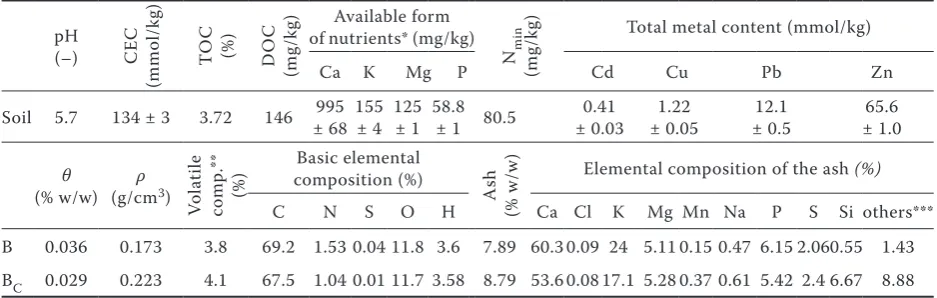
Biochar and soil characterization. Basic biochar characteristics (Table 1) were established accord-ing to (i) standard ČSN 44 1377/1980 (for water content); and (ii) standard CEN/TS 14775 (for ash
content); apparent density was established using free filling into 100 mL calibrated divider. Elemental composition (CHNS-O) was determined in two-step elemental analyses using CHNS-O Analyzer Flash 1112. Additionally, elemental composition of the ash was determined using sequential wave dispersed radiographic spectrometer.
Basic soil characteristics (Table 1) such as pH, cation exchange capacity (CEC), available forms of nutrients, content of mineral N, dissolved organic carbon (DOC) and total organic carbon (TOC) were performed according to Trakal et al. (2011 submitted). Analyses of the Cd, Cu, Pb, and Zn total concentration in the soil were determined according to Száková et al. (2009). The certified reference material (RM) 7003 Silty Clay Loam was used for quality assurance of the results. Metals in the digests were analyzed using inductively coupled plasma optical emission spectroscopy ICP-OES (Varian VistaPro, Mulgrave, Australia).
[image:2.595.63.532.583.732.2]Batch sorption/desorption experiment. According to Komárek et al. (2009) and Trakal et al. (2011 submitted) a desorption experiment was set up to determine concentrations of desorbed metals from the soils. Consequently, 0.01 mol/L KNO3 was chosen for the sorption experiment. For the equilibrium batch sorption experiment a volume of 20 mL of the solutions was added to 1 g of soil. The experimental single- and multi-element solutions were prepared from metal nitrate salts (Lach-Ner, Czech Republic) at six different con-centrations: Cu, Pb and Zn (0.1, 0.5, 1, 2, 4, and 8 mmol) and Cd (0.05, 0.25, 0.5, 1, 2, and 4 mmol), respectively. Each multi-elemental solution was prepared from the same concentrations of the four metals (mixture of Cd 0.05 mmol and Cu, Pb, Zn 0.1 mmol, etc.). According to Boudesocque et al. (2007) suspensions of the solution with the soil
Table 1. Physico-chemical characteristics and total initial metal concentration in the studied soil and biochars
pH (–) CEC
(m
m
ol
/k
g)
TO
C
(%
)
D
O
C
(m
g/
kg
) Available form of nutrients* (mg/kg)
Nm
in
(m
g/
kg
) Total metal content (mmol/kg)
Ca K Mg P Cd Cu Pb Zn
Soil 5.7 134 ± 3 3.72 146 995 ± 68 155 ± 4 125 ± 1 58.8 ± 1 80.5 ± 0.030.41 ± 0.051.22 ± 0.512.1 ± 1.065.6
θ
(% w/w) (g/cmρ 3)
Vo
la
til
e
co
m
p.*
*
(%
) composition (%)Basic elemental
A
sh
(%
w
/w
)
Elemental composition of the ash (%)
C N S O H Ca Cl K Mg Mn Na P S Si others***
B 0.036 0.173 3.8 69.2 1.53 0.04 11.8 3.6 7.89 60.3 0.09 24 5.11 0.15 0.47 6.15 2.060.55 1.43 BC 0.029 0.223 4.1 67.5 1.04 0.01 11.7 3.58 8.79 53.6 0.08 17.1 5.28 0.37 0.61 5.42 2.4 6.67 8.88
sample were shaken for 48 h in order to reach equilibrium, centrifuged and obtained superna-tants were analyzed using ICP-OES. The sorbed concentrations of metals were calculated according to equation (1):
csorb = c0 – (cdesorb + ceq) (1) where: csorb is the sorbed concentration, c0 is the initial concentration and cdesorb is the desorbed concentration and ceq is concentration in the solution. The obtained values of c0 and csorb were then used for the construction of Freundlich and Langmuir isotherm, described by equa-tions (2) and (3), respectively:
csorb = KF ceqn (2)
csorb = KF csorbmaxceq (3)
1 + KL ceq
where: csorb is sorbed concentration, csorbmax is the maxi-mum sorption concentration, KF and KL are the Freundlich and Langmuir sorption coefficient, is concentration in the solution and n is an empirical coefficient. The model of (Bolster and Hornberger 2007, Bolster 2008) was used to evaluate non-linear isotherm parameters and fitting models efficiencies (E).
RESULTS AND DISCUSSION
Desorption. The results obtained from the ex-periment showed a low desorption of Cd (3.29 ± 0.35 nmol/g) and Cu (4.48 ± 0.15 nmol/g), a
relatively low desorption of Pb (48.0 ± 2.4 nmol/g) and a high desorption of Zn (667 ± 25 nmol/g) in the presence of 0.01 mol/L KNO3. This finding was due to the initial low Cd and Cu total content and extremely high Zn and Pb total content in the studied soil. Moreover, Pb compared to Zn was reduced after desorption by 0.01 mol/L KNO3 due to their stronger fixation in the soil (Lair et al. 2007). No significant effect on desorption was observed when biochar was present in the soil, probably due to the rather high initial pH value of the soil (Table 1). This finding was in agreement with negligible pH effect of biochars amended vari-ants (6.95) in comparison with the control (6.88). Additionally, comparison of the contaminated vs. uncontaminated biochar and their application rates showed no significant concentration changes in the desorbed final solution.
The desorption of metals during single-metal sorp-tion experiments was also monitored. Cadmium and Zn were desorbed during Cu and Pb sorption. Copper and Pb desorption was negligible due to their strong fixation onto soil organic matter and their affinity for Mn and Fe (hydr)oxides (Bradl 2004). On the other hand, Cd and Zn desorption was high (mainly in the case of Zn with a 10-times increased concentration in the solution; (Figure 1). In general, Cd and Zn are easily desorbed in the presence of other competitive metals such as Cu and Pb due to their weaker bind-ing in the soil (Markiewicz-Patkowska et al. 2005, Trakal et al. 2011 submitted).
[image:3.595.114.450.496.745.2]Additionally, biochar application resulted in a significant reduction of desorbed Cd and Zn.
Figure 1. Relationship between metal sorption and desorption of Cd and ZnCdsorb (μmol g-1)
0 10 20 30 40 50
C 1% B 2% B 1% BC 2% BC
Pbsorb (μmol g-1)
0 50 100 150 200 250
Cusorb (μmol g-1)
0 50 100 150 200
Zndeso
rb
(
μ
mol
g
-1)
e0 e1 e2 e3 e4
Znsorb (μmol g-1)
0 30 60 90 120 150
Pbsorb (μmol g-1)
0 50 100 150 200 250
Cusorb (μmol g-1)
0 50 100 150 200
Cddes
orb
(
μ
mol
g
-1)
e-5 e-4 e-3 e-2 e-1
Cusorb (μmol/g) Pbsorb (μmol/g) Znsorb (μmol/g)
Cdde
sorb
(μmol/g)
Znde
sorb
(μmol/g)
C 1% B 2% B 1% Bc 2% Bc
0 50 100 150 200 0 50 100 150 200 250 0 10 20 30 40 50 0 50 100 150 200 0 50 100 150 200 250 0 30 60 90 120 150 e–1
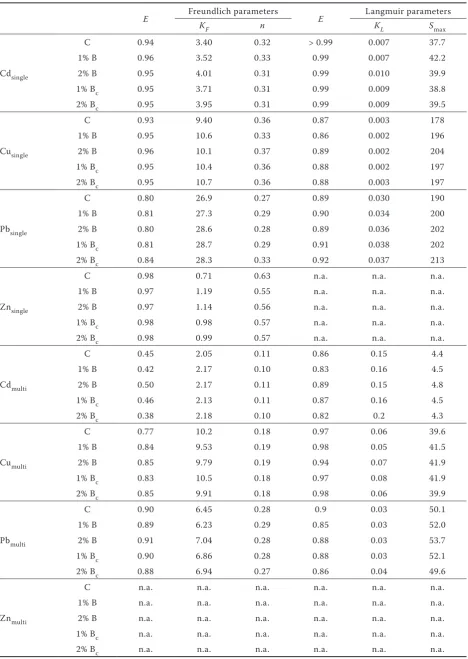
Table 2. Freundlich and Langmuir parameters and model efficiencies (E) obtained for the single- and multi-metal experiments
E Freundlich parameters E Langmuir parameters
KF n KL Smax
Cdsingle
C 0.94 3.40 0.32 > 0.99 0.007 37.7
1% B 0.96 3.52 0.33 0.99 0.007 42.2
2% B 0.95 4.01 0.31 0.99 0.010 39.9
1% Bc 0.95 3.71 0.31 0.99 0.009 38.8
2% Bc 0.95 3.95 0.31 0.99 0.009 39.5
Cusingle
C 0.93 9.40 0.36 0.87 0.003 178
1% B 0.95 10.6 0.33 0.86 0.002 196
2% B 0.96 10.1 0.37 0.89 0.002 204
1% Bc 0.95 10.4 0.36 0.88 0.002 197
2% Bc 0.95 10.7 0.36 0.88 0.003 197
Pbsingle
C 0.80 26.9 0.27 0.89 0.030 190
1% B 0.81 27.3 0.29 0.90 0.034 200
2% B 0.80 28.6 0.28 0.89 0.036 202
1% Bc 0.81 28.7 0.29 0.91 0.038 202
2% Bc 0.84 28.3 0.33 0.92 0.037 213
Znsingle
C 0.98 0.71 0.63 n.a. n.a. n.a.
1% B 0.97 1.19 0.55 n.a. n.a. n.a.
2% B 0.97 1.14 0.56 n.a. n.a. n.a.
1% Bc 0.98 0.98 0.57 n.a. n.a. n.a.
2% Bc 0.98 0.99 0.57 n.a. n.a. n.a.
Cdmulti
C 0.45 2.05 0.11 0.86 0.15 4.4
1% B 0.42 2.17 0.10 0.83 0.16 4.5
2% B 0.50 2.17 0.11 0.89 0.15 4.8
1% Bc 0.46 2.13 0.11 0.87 0.16 4.5
2% Bc 0.38 2.18 0.10 0.82 0.2 4.3
Cumulti
C 0.77 10.2 0.18 0.97 0.06 39.6
1% B 0.84 9.53 0.19 0.98 0.05 41.5
2% B 0.85 9.79 0.19 0.94 0.07 41.9
1% Bc 0.83 10.5 0.18 0.97 0.08 41.9
2% Bc 0.85 9.91 0.18 0.98 0.06 39.9
Pbmulti
C 0.90 6.45 0.28 0.9 0.03 50.1
1% B 0.89 6.23 0.29 0.85 0.03 52.0
2% B 0.91 7.04 0.28 0.88 0.03 53.7
1% Bc 0.90 6.86 0.28 0.88 0.03 52.1
2% Bc 0.88 6.94 0.27 0.86 0.04 49.6
Znmulti
C n.a. n.a. n.a. n.a. n.a. n.a.
1% B n.a. n.a. n.a. n.a. n.a. n.a.
2% B n.a. n.a. n.a. n.a. n.a. n.a.
1% Bc n.a. n.a. n.a. n.a. n.a. n.a.
2% Bc n.a. n.a. n.a. n.a. n.a. n.a.
This finding is in agreement with Beesley and Marmiroli (2011), who declared that biochar was an effective amendment for reducing high con-centrations of soluble Cd and Zn in contaminated soils. Furthermore, contaminated biochar and a lower rate of applied biochar showed no significant increase of desorbed Cd and Zn concentrations. Sorption. The sorption of metals in soils was evaluated from single- and multi-element metal so-lutions as a function of their initial concentrations (Vidal et al. 2009). For all experiments, Freundlich and Langmuir isotherms were used and compared. Table 2 shows that for described single-element sorption fitting, Langmuir isotherms were more suitable. However, the mathematical model was not able to determine isotherms parameters for Zn.
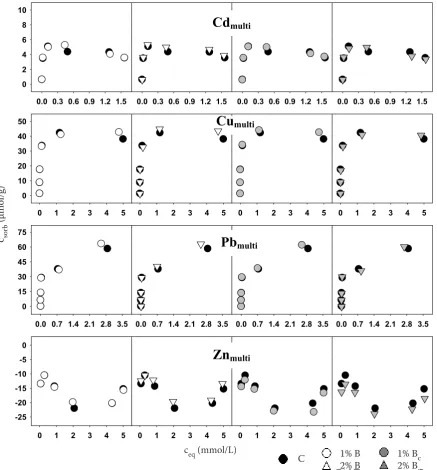
A significant Zn desorption occurred during the multi-element experiment; hence no evaluation of sorption efficiency was suitable. Additionally, the calculation of saturation indices using PHREEQC-2 software showed that Cu(OH)2 and Pb(OH)2 were close to equilibrium and some precipitation may have occurred. However, the final pH of the ex-periment solution (Figure 4) after the contact with the soil most probably maintained the metals solubilized.
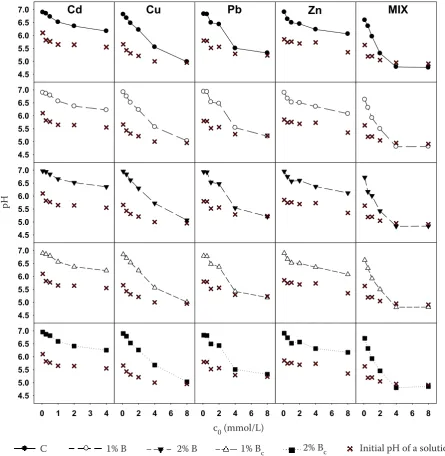
Evaluation of pH during the sorption experi-ment. Soil pH decreases at increased metal concen-trations during single- and multi-element sorption can be attributed to the hydrolysis effect and release of H+ from soil sorption sites (Ponizovsky et al.
2007, Mouta et al. 2008). As adverted in Figure4,
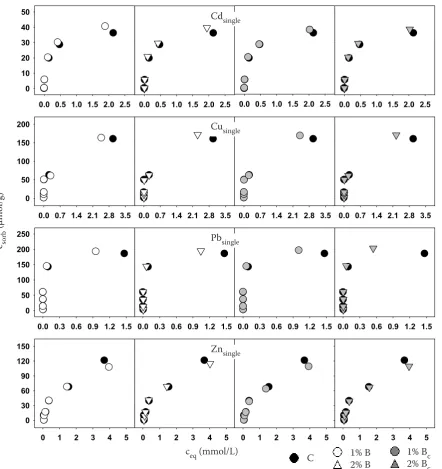
Figure 2. Sorption isotherms of the studied metals (single-metal sorption); csorb – sorbed metal at equilibrium; ceq – final solute metal concentration at equilibrium
0.0 0.5 1.0 1.5 2.0 2.5
Csorb (μ
mo
l g
-1 )
0 10 20 30 40 50
0.0 0.5 1.0 1.5 2.0 2.5 0.0 0.5 1.0 1.5 2.0 2.5 0.0 0.5 1.0 1.5 2.0 2.5
0.0 0.7 1.4 2.1 2.8 3.5 0
50 100 150 200
0.0 0.7 1.4 2.1 2.8 3.5 0.0 0.7 1.4 2.1 2.8 3.5 0.0 0.7 1.4 2.1 2.8 3.5
0.0 0.3 0.6 0.9 1.2 1.5 0
50 100 150 200 250
0.0 0.3 0.6 0.9 1.2 1.5 0.0 0.3 0.6 0.9 1.2 1.5 0.0 0.3 0.6 0.9 1.2 1.5
0 1 2 3 4 5
0 30 60 90 120 150
Ceq (mmol L-1)
0 1 2 3 4 5 0 1 2 3 4 5 0 1 2 3 4 5
ceq (mmol/L)
c sorb
(μmol/g)
Cdsingle
Cusingle
Pbsingle
Znsingle
0.0 0.3 0.6 0.9 1.2 1.5
Cso
rb
(μ
mol
g
-1 )
0 2 4 6 8 10
0.0 0.3 0.6 0.9 1.2 1.5 0.0 0.3 0.6 0.9 1.2 1.5 0.0 0.3 0.6 0.9 1.2 1.5
0 1 2 3 4 5
0 10 20 30 40 50
0 1 2 3 4 5 0 1 2 3 4 5 0 1 2 3 4 5
0.0 0.7 1.4 2.1 2.8 3.5 0
15 30 45 60 75
0.0 0.7 1.4 2.1 2.8 3.5 0.0 0.7 1.4 2.1 2.8 3.5 0.0 0.7 1.4 2.1 2.8 3.5
0 1 2 3 4 5
-25 -20 -15 -10 -5 0
0 1 2 3 4 5
Ceq (mmol L-1)
0 1 2 3 4 5 0 1 2 3 4 5
Cd
multiCu
multiPb
multiZn
multi1% Bc 2% Bc 1% B
pH decrease during single-element sorption at equilibrium was the most pronounced for Cu and followed the order Pb > Zn > Cd. Additionally, the final pH of multi-metal solutions decreased from 6.8 (lowest metals concentration) to 4.7 (highest metals concentration) with the major influence of Cu and Pb.
Single- and multi-metal sorption. The results from the single-element sorption confirmed the well-known fact that soil sorption decreased in the order Pb > Cu > Zn > Cd, which was previously reported by many authors (Sauvé et al. 2000, Sastre et al. 2007, Vidal et al. 2009). We also confirmed that sorption efficiency of studied metals was re-duced under competitive conditions represented
[image:6.595.71.509.257.728.2]in multi-metal experiments. This finding was also presented before by (Markiewicz-Patkowska et al. 2005, Vidal et al. 2009, Trakal et al. 2011 sub-mitted). Sorption efficiency of Cd and Zn as the target metals was mostly affected by the presence of Cu and Pb as competitive metals (Vidal et al. 2009). The maximum sorption concentration of Cd was 5-times lower in the presence of other com-petitive metals, whereas Zn was desorbed during multi-metal sorption probably due to (i) extremely high initial Zn content in the soil and (ii) its high desorption efficiency caused by other competi-tive metals (Cu and Pb; Figure 2, 3). Moreover, multi-metal sorption efficiency was affected also in the case of Cu and Pb despite their generally
Figure 3. Sorption isotherms of the studied metals (multi-metal sorption); csorb – sorbed metal at equilibrium; ceq – final solute metal concentration at equilibrium
0.0 0.3 0.6 0.9 1.2 1.5
Cso
rb
(
μ
mol
g
-1 )
0 2 4 6 8 10
0.0 0.3 0.6 0.9 1.2 1.5 0.0 0.3 0.6 0.9 1.2 1.5 0.0 0.3 0.6 0.9 1.2 1.5
0 1 2 3 4 5
0 10 20 30 40 50
0 1 2 3 4 5 0 1 2 3 4 5 0 1 2 3 4 5
0.0 0.7 1.4 2.1 2.8 3.5 0
15 30 45 60 75
0.0 0.7 1.4 2.1 2.8 3.5 0.0 0.7 1.4 2.1 2.8 3.5 0.0 0.7 1.4 2.1 2.8 3.5
0 1 2 3 4 5
-25 -20 -15 -10 -5 0
0 1 2 3 4 5
Ceq (mmol L-1)
0 1 2 3 4 5 0 1 2 3 4 5
Cd
multiCu
multiPb
multiZn
multicsorb
(μmol/g)
ceq (mmol/L)
C 1% B
high ability to sorb in the soil (Bradl 2004). This finding was probably caused by the low sorption capacity of the studied soil (low CEC; Table 1), high metal contents in the soil and due to their mutual competition during multi-element sorp-tion (Vidal et al. 2009).
Single- and multi-metal sorption in biochar amended soil. The addition of biochar (both contaminated and uncontaminated to the soil) increased the sorption efficiency of Cu and Pb in single- and multi-metal experiments (Figures 2 and 3), due to addition of the organic matter (in biochar form) into the soil. Results of Cu sorption are in agreement with (Uchimiya et al. 2011a,b). On the other hand, biochar amendment showed
no enhanced sorption of Cd and Zn as opposed to (Beesley and Marmiroli 2011), most probably due to (i) their lower sorption compared to Cu and Pb; (ii) Cd, Zn predominant fixation onto the Mn, Fe hydr(oxides) and clay minerals; and additionally due to (iii) high Zn content in the soil.
[image:7.595.65.511.260.717.2]A novel approach was to compare contaminated and uncontaminated biochar. Contaminated bio-char had no additional negative effect on metal sorption most probably due to the strong fixa-tion of metals on the biochar surface (Beesley et al. 2010, Uchimiya et al. 2010c). Additionally, a comparison of two different rates of applied biochars also showed no significant differences during single- and multi-metal sorption. It is also
Figure 4. Observed pH changes of the experimental solution during the sorption experiment, compared with the initial pH of the solutions (without soil); c0 – initial solute metal concentration; pH – final pH of the sorp-tion solusorp-tions at equilibrium
Cd
4.5 5.0 5.5 6.0 6.5
7.0 Cu Pb Zn MIX
4.5 5.0 5.5 6.0 6.5 7.0
pH
4.5 5.0 5.5 6.0 6.5 7.0
4.5 5.0 5.5 6.0 6.5 7.0
c0 (mmol L-1)
0 1 2 3 4
4.5 5.0 5.5 6.0 6.5 7.0
0 2 4 6 8 0 2 4 6 8 0 2 4 6 8 0 2 4 6 8
pH
c0 (mmol/L)
necessary to mention that the applied rates (1% and 2% w/w) were insufficient in several cases for such extremely contaminated soil, where intensive competition during sorption of studied metals was recorded. Other recent works conducted on contaminated soils and where biochar was applied at rates of (5%, 10%, and 20% w/w; Beesley et al. 2010, Uchimiya et al. 2011a,b) showed the most promising results.
In summary, metal sorption efficiency in metal-contaminated soil was studied with and without biochar application. Additionally, two different types (contaminated and uncontaminated) and rates (1% and 2% w/w) were compared. In gen-eral, biochar application enhanced Cu and Pb sorption in all cases, whereas Cd and Zn sorption efficiency showed no significant changes. Results indicate low desorption of Cu a rather low Cd and Pb desorption and a high desorption of Zn. Zinc was predominately desorbed during Cu and Pb single-metal sorption experiment. Biochar treat-ment reduced Zn and Cd desorption during the single-metal sorption experiment of other com-petitive metals. Comparison of biochars originated from contaminated and uncontaminated willows showed no significant difference on metal sorption. Furthermore, two different applied rates (1% and 2% w/w) had a negligible effect on metal sorp-tion. In summary, it is needed to point out that the applied rates of biochars were insufficient to significantly enhanced metal sorption efficiency.
Acknowledgements
The authors acknowledge Institute of Chemical Technology Prague (Department of Gas, Coke and Air Protection) for assistance with basic character-istics and elemental analyses of studied biochars. Authors also acknowledge the Institute for Research and Fuel Utilization a.s. for biochar preparation.
REFERENCES
Amonette J.E., Jospeh S. (2009): Characteristics of Biochar: Mi-crochemical Properties. In: Lehmann J., Joseph S. (eds.): Bio-char for Environmental Management Science and Technology. Earthscan, London, 33–43.
Beesley L., Moreno-Jiménez E., Gomez-Eyles J.L. (2010): Effects of biochar and greenwaste compost amendments on mobility, bioavailability and toxicity of inorganic and organic contami-nants in a multi-element polluted soil. Environmental Pollution,
158: 2282–2287.
Beesley L., Marmiroli M. (2011): The immobilization and retention of soluble arsenic, cadmium and zinc by biochar. Environmental Pollution, 159: 474–480.
Bolster C.H., Hornberger G.M. (2007): On the use of linearized Langmuir equations. Soil Science Society of America Journal,
71: 1796–1806.
Bolster C.H. (2008): Revisiting a statistical shortcoming when fitting the Langmuir model to sorption data. Journal of Envig-ronmental Quality, 37: 1986–1992.
Boudesocque S., Guillon E., Aplincourt M., Marceau E., Stievano L. (2007): Sorption of Cu(II) onto vineyard soils: Macroscopic
and spectroscopic investigations. Journal of Colloid and Inter-face Science, 307: 40–49.
Bradl H.B. (2004): Adsorption of heavy metal ions on soils and soils constituents. Journal of Colloid and Interface Science, 277: 1–18. Ding Y., Liu Y.X., Wu W.X., Shi D.Z., Yang M., Zhong Z.K. (2010):
Evaluation of biochar effects on nitrogen retention and leaching in multi-layered soil columns. Water, Air, and Soil Pollution,
213: 47–55.
Gundale M.J., DeLuca T.H. (2007): Charcoal effects on soil so-lution chemistry and growth of Koeleria macrantha in the ponderosa pine/Douglas-fir ecosystem. Biology and Fertility of Soils, 43: 303–311.
Hinz C. (2001): Description of sorption data with isotherm equa-tions. Geoderma, 99: 225–243.
Komárek M., Vaněk A., Chrastný V., Száková J., Kubová K., Dra-hota P., Balík J. (2009): Retention of copper originating from different fungicides in contrasting soil types. Journal of Hazi-ardous Materials, 166: 1395–1402.
Lair G.J., Gerzabek M.H., Haberhauer G. (2007): Sorption of heavy metals on organic and inorganic soil constituents. En-vironmental Chemistry Letters, 5: 23–27.
Limousin G., Gaudet J.-P., Charlet L., Szenknect S., Barthe’s V., Krimissa M. (2007): Sorption isotherms: A review on physical bases, modeling and measurements. Applied Geochemistry,
22: 249–275.
Markiewicz-Patkowska J., Hursthouse A., Przybyla-Kij H. (2005): The interaction of heavy metals with urban soils: sorption behaviour of Cd, Cu, Cr, Pb and Zn with a typical mixed brown-field deposit. Environment International, 31: 513–521. Mouta E.R., Soares M.R., Casagrande J.C. (2008): Copper
adsorp-tion as a funcadsorp-tion of soluadsorp-tion parameters of variable charge soils. Journal of Brazilian Chemical Society, 19: 996–1009. Novak J.M., Busscher W.J., Laird D.L., Ahmedna M., Watts D.W.,
Niandou M.A.S. (2009): Impact of biochar amendment on fertility of a southeastern coastal plain soil. Soil Science, 174: 105–112. Ponizovsky A.A., Allen H.E., Ackerman A.J. (2007): Copper
activity in soil solutions of calcareous soils. Environmental Pollution, 145: 1–6.
Sastre J., Rauret G., Vidal M. (2007): Sorption-desorption tests to assess the risk derived from metal contamination in mineral and organic soils. Environment International, 33: 246–256. Sauvé S., Hendershot W., Allen H.E. (2000): Solid-solution
Corresponding author:
Mgr. Lukáš Trakal, Česká zemědělská univerzita v Praze, Fakulta agrobiologie, potravinových a přírodních zdrojů, Katedra agroenvironmentální chemie a výživy rostlin, Kamýcká 129, 165 21 Praha, Česká republika
phone: + 420 224 382 740, e-mail: [email protected]
total metal burden, and organic matter. Environmental Science and Technology, 34: 1125–1131.
Šichorová K., Tlustoš P., Száková J., Kořínek K., Balík J. (2004): Horizontal and vertical variability of heavy metals in the soil of a polluted area. Plant, Soil and Environment, 50: 525–534. Száková J., Tlustoš P., Goessler W., Frková Z., Najmanová J. (2009):
Mobility of arsenic and its compounds in soil and soil solution: The effect of soil pretreatment and extraction methods. Journal of Hazardous Materials, 172: 1244–1251.
Trakal L., Komárek M., Száková J., Tlustoš P., Tejnecký V., Drábek O. (2011): Sorption behavior of Cd, Cu, Pb and Zn and their interactions in phytoremediated soil: Does phytoremediation influence metal sorption efficiency? International Journal of Phytoremediation. (In Press)
Uchimyia M., Lima I.M., Klasson K.T., Wartelle L.H. (2010): Con-taminant immobilization and release by biochar soil amendment: Roles of natural organic matter. Chemospere, 80: 935–940. Uchimyia M., Klasson K.T., Wartelle L.H., Lima I.M. (2011a):
Influence of soil properties on heavy metal sequestration by biochar amendment: 1. Copper sorption isotherms and the release of cations. Chemospere, 82: 1431–1437.
Uchimyia M., Klasson K.T., Wartelle L.H., Lima I.M. (2011b): Influence of soil properties on heavy metal sequestration by biochar amendment: 2. Copper desorption isotherms. Che-mospere, 82: 1438–1447.
Vaněk A., Ettler V., Grygar T., Borůvka L., Šebek O., Drábek O. (2008): Combined chemical and mineralogical evidence for heavy metal binding in mining- and smelting-affected alluvial soils. Pedosphere, 18: 464–478.
Verheijen F., Jeffery S., Bastos A.C., Van der Velde M., Diafas I. (2010): Biochar Application to Soils: A Critical Scientific Review of Effects of Soil Properties, Processes and Functions. JRC Scientific and Technical Reports, EUR 24099 – EN, Italy. Vidal M., Santos M.J., Abrao T., Rodriguez J., Rigol A. (2009):
Modeling competitive metal sorption in a mineral soil. Geo-derma, 149: 189–198.
Warnock D.D., Lehmann J., Kuyper T.W., Rillig M.C. (2007): Mycorrhizal responses to biochar in soil – concepts and mecha-nisms. Plant and Soil, 300: 9–20.
Zbíral J. (2000): Determination of phosphorus in calcareous soils by Mehlich 3, Mehlich 2, CAL, and Egner extractants. Com-munications in Soil Science and Plant Analysis, 31: 3037–3048.