warwick.ac.uk/lib-publications
A Thesis Submitted for the Degree of PhD at the University of Warwick
Permanent WRAP URL:
http://wrap.warwick.ac.uk/94472
Copyright and reuse:
This thesis is made available online and is protected by original copyright. Please scroll down to view the document itself.
Please refer to the repository record for this item for information to help you to cite it. Our policy information is available from the repository home page.
WITH UNEQUAL ERROR VARIANCES
GHULAM RASUL PASHA
THESIS SUBMITTED IN FULFILLMENT OF THE REQUIREMENTS
FOR THE DEGREE OF DOCTOR OF PHILOSOPHY
UNlVERS ITY OF WARWICK
DEPARTMENT OF STATISTICS
CHAPTER 1 2 3 4 5
TABLE OF CONTENTS
INTRODUCTION AND REVIEW OF EXISTING TECHNIQUES •••••••••••
1.1 1.2 1.3 1.4 1.5 1.6 1.7
Introduction ... .
The MINQUE Principle •••••••••••••••••••••••••••••••• Maximum Likelihood Estimation •••••••••••••••••••••••
Least Square Method •••••••••••••••••••.••••.•.••••••
Weighted Least Square Method ••••••••••••••••••••••••
Purpose of the Thesis ••••••••••••.••.••••••••.••••.• Outline of the Thesis •••••••.•..••••••.•••••••••••••
LARGE SAMPLE PROPERTIES OF WLS AND MINQU-BASED ESTnIATOrrS
2.1 2.2 2.3 2.4 2.5
Introduction . . . • . . . • . . . • • . . .
Asymptotic Results ••••••••••••••••••••.•••.•••••••••
Proof of Theorems ...•••..•.•... ~ ...•..
Non-Normal Case •••••••••••••••••••• e • • • • • • • • • • • • • • • • •
Special Cases of the Theorems •••••••••••••••••••••••
AN EMPIRICAL STUDY OF WLS AND MINQ-BASED ESTIMATORS FOR SMALL SA}1EtLE S. • • • • • • • • • • • • • • • • • • • • • • • • • • • • • • • • • • • • • • • • • • •
3.1 3.2 3.3 3.4
Introduction •••••••••••••••••••••••••••••••••••••••• Sampling Experiments and Computations •••••••••••••••
Empirical Results ... .
Results and Discussion ••••••••••••••••••••••••••••••
USE OF POSTERIOR LIKELIHOOD IN ESTIMATION ••••••••••••••••
4.1 4.2
4.3
4.4
Introduction ... .
Posterior Likelihood Estimators for the Regression
Model ••••••••••••••••••••••••••••••••••••••••.••••••
Empirical Results and Procedures ••••••••••••••••••••
Res ul ts an d Dis cussion ...•.•..• 0 • • • • • • •
ADAPTIVE PROCEDURES IN ESTIMATION OF REGRESSION PARAMETERS
5.1 5.2 5.3
Introduction ... : ... .
Tests of Variance Equality •••••••••••••••••••••••••• Adaptive Procedures for Estimation •• : •••••••••••••••
6 USE OF ADAPTIVE PROCEDURES IN THE ESTIMATION OF REGRESSION PARAMETERS BY GROUPING COMMON VARIANCES... 132
7
8
6.1 Introduction... 132
6.2 Multiple Comparison Methods... 132 6.3 A Multiple Comparisons Test for the Error Variances. 134
6.4 Conclusion 136
ESTIMATION FOR THE ERRORS-IN-VARIABLES MODEL ••••••••••••• 140
7.1 Introduction... 140
. 7.2 Maximum Likelihood Estimators (Equal Variances C~~a) 141 7.3 Maximum Likelihood Estimators (Different Variances
Case) . • . • . • • . • . • • • . . • • • • • • . . • . . • • • • . • • • • • • . • • . • . . • • . 144
7.4 Large Sample Properties of ML (Common Variance Case) 146 7.5 Large Sample Properties of ML (Unequal Variances
Case) • • • • . • . . • . • • . . . • . . . . • . • . • • • • . • . • • • . . . 148
7.6 Method of Least Squares... 150 7.7 Empirical Results... 152
CONCLUSIONS ••••••••••••••••• e.a • • • • • • • • • • • • • • • • • • • • • • • • • • • 155
ACKNOWLEDGEMENTS
As is true of any such intellectual effort. the fundamental
pre-requisite for success is a mentor who embellishes the intellectual
strengths and moral fibre of a student. Professor Keith Ord is a
prototype of an ideal mentor. His brilliance is only matched by his
tolerance for my shortcomings. I would like to thank him especially.
Thanks are also due to Professor P. J. Harrison. Chairman. Department
of Statistics. Warwick University. and Professor George Heitman. Chairman.
Division"of Management Science, The Pennsylvania State University, USA,
for their support and encouragement. I would also like to thank the
Centre for Research, College of Business Administration, The Pennsylvania
State University, for providing the computer time and Mrs. Bonnie K.
Henninger for typing.
I would like to thank my wife. who has endured my whimsical moods
and prolonged separation without the slightest hint of a complaint.
Finally. I would like to humbly dedicate this dissertation to my
supervisor. Professor Keith Ord. a helpful and patient mentor and to my
mother whose love and affection gave me ·the emotional strength to
In this dissertation, we consider estimation procedures for the linear model when the observations are replicated but the error variances are unequal.
The aim of this research was to consider several standard methods for parameter estimation, namely Ordinary Least Squares, Weighted Least Squares, and Maximum Likelihood and to compare these with newly developed procedures. These new techniques included the use of a prior likelihood function to induce "shrinkage" towards a common value among the estimators for the error variances and procedures based on preliminary tests of the hypothesis of variance equality. Both an overall test of equality and a multiple comparison method were considered. In addition, variance
estimates based on MINQUE (Minimum Norm Quadratic Unbiased Estimator) were investigated. The MINQU estimators tend to "stretch out" the variances and were found to be unsatisfactory.
The performance of the above-mentioned approaches was investigated both through asymptotic theoretical results and small samples simulation studies. The results from these two approaches were found to be in broad agreement.
Overall, the multiple comparison and prior likelihood procedures appear to perform best, but the prior likelihood depends upon the avail-ability of satisfactory prior information. So the multiple comparison procedure appears to be the most effective technique in general.
A further study was also conducted to examine the effects of "errors-in-variables." In general it is found that maximum likelihood is
CHAPTER 1
INTRODUCTION AND REVIEW OF EXISTING TECHNIQUES
1.1 Introduction
In the usual analysis of variance m~del, a typical observation is
considered to be the result of some fixed effects and an error term
combined in a linear fashion. In such models, interest mainly lies in
estimating linear functions of the effects. There are, however,
situations whe~e in addition to estimating the linear functions of
effects, the main interest is also concerned with the estimation of the
variances of the effects. Effects of this nature are called random effects
and variances associated with them are called variance components. A
linear model in its generality may, of course, include some fixed and
some random effects. Such a model is referred to as a variance
components model. A linear regression model with a diagonal covariance
matrix is a special case of the variance components model. In such a
model, estimation of the unequal variances is our main goal as a way
to generate improved estimators for the parameters describing the
effects.
There is a vast literature on the topic of estimation of variance
components. The usual mixed linear model discussed in the literature
on variance components is
(1.1.1)
\ is a fixed unknown p-vector of parameters, u
i is a given (nXni) matrix
and ~i is an ni-vector such that
(1.1.2)
2 The Unknown parameterso
i, i-1,2, ••• ,k are called variance components.
A systematic study of the estimation of variance components was
undertaken by Henderson (1953) who proposed three methods of estimation.
But some of the early users of such models are due to Cochran (1939),
Yates and Zacopancy (1935), Fairfield Smith (1936), Yates (1940), Panse
(1946), Rao (1947, 1953, 1956), Henderson (1950) and Brown1ee (1953)
in different fields of applications.
The general approach in all. these papers was to obtain k'
quadratic functions of !., say Y'A
i!., i-1,2, ••• ,1<:'--: which are invariant
for translation of Y by Xa where a is arbitrary, and solve the
equatiqns.'
(1.1.3)
The method of choosing the quadratic forms was intuitive in nature
(see Henderson, 1953) and did not depend on any stated criteria of
estimation. The entries in the ANOVA table giving the sumS of squares
due to different effects were considered as good choices of the
quadratic forms in general. The ANOVA technique provides good
esti-mators in what are called balanced designs (see Anderson, 1975;
Anderson and Crump, 1967) but, as shown by See1y (1975), such estimators
may be inefficient in more general linear models •. For a general
simplicity) and limitations (lack of uniqueness, inapplicability and
inefficiency in special cases), see the papers by Searle (1968, 1971),
See1y (1975), 01sen et al. (1976), and Harvi11e (1977).
Hart1ey and Rao (1967) initiated a different approach in the
maximum likelihood (ML) method. They· considered the likelihood of the
2
unknown parameters~, cri' i-1,2, ••• ,k~~ based on observed Y and obtained
the likelihood equations by computing the derivatives of the likelihood
w.r. to the parameters. Patterson and Thompson (1975) considered
another approach the marginal likelihood or the maximal invariant of
J. .
Y,
i.e., only one'Y
wheree -
X (matrix orthogona1to X) and obtainedwhat are called marginal maximum likelihood (MML) equations. Harvi11e
(1977) has reviewed the ML and MML meth~ds and the computational algorithms
associated with them.
Maximum likelihood estimators, though consistent,may be heavily
biased in small samples so that some caution is needed when they are
used as estimates of individual parameters. The problem is not acute if
the exact distribution of the ML estimator is known, since in that case,
appropriate bias adjustments can be made in the individual estimators
before using them. The general large sample properties associated with
ML estimators are misleading in the absence of studies on the orders of
sample sizes for which these properties hold in particular cases. The
bias in the MML estimators may be slight even in small samples. As
observed earlier, the MML estimator is, by construction, a function of
e'y
the maximal invariant of Y. It turns out that even the full MLestimator is a function of
e'y
although the likelihood is based on Y.There are important practical cases where reduction of Y to
e'y
resultin the non-identifiability of individual parameters, in which case,
C. R. Rao (1970, 1971a, 1971b, 1972, 1973) proposed a new principle
of estimating heteroscedastic variances and covariances components
called MINQUE (minimum norm quadratic unbiased estimation, estimator
or estimate, depending on context) the scope of which has been extended
to cover a variety of situations by Focke and Dewess (1972), Kleffe
(1975, 1976, 1977a, 1977b, 1978, 1979), J. N. K. Rao (1973), Fuller and
J. N. K. Rao (1978), P. S. R. S. Rao and Chaubey (1978), P. S. R. S.
Rao (1977), Puke1sheim (1977, 1978a), Sinha and Wieand (1977), and
RaO (1979).
1.2 The MINQUE Principle
Consider the variance component model
Y - X@.. + u ~ + ••• +u. ~
- 1-1 K-k (1.2.l)
where Y is an n-vector of observations, X is an (nxp) known matrix,
a
is a p-vector of parameters, u
i is a given (nxni) matrix and ~i is an ni-vector such that
We can express the above model in a compact form
Y - X~
+
Ui.where
u"
(ull.·.I~) andf' -
(~l'I···I~k')·From (1.2.2) we have
E(Y) - X~
(1.2.3)
c.
R. Rao (1971a) proposed to estimate a linear function2 2 2
a
P1or+ ••• +Pkok of the variance components 0l, ••• ,ok by a quadratic
function y' AY of random variab1es· .. Y. He developed the following criteria
for determining the matrix A.
1.2.1 Invariance Under Translation of the SParameters. Instead
of
B,
consider y •B-BO
as the unknown parameter, whereBO
is fixed.Model (1.2.3) becomes
Y - XB - Xy+Ut;
- -0 _
in which case the estimator of t
Pi~
is i(1.2.5)
(1.2.6)
But (1.2.6) should have the same numerical value as Y'AY whatever
BO
may be. Thus, we require that
- Y'AY + 28 'X'AY + ~
B
'X'AX8 •- . ~ -0 (1. 2.7)
The above equation is satisfied if
AX -
o.
(1.2.8)1.2.2 Unbiasedness. With restriction (1.2.8)
y'AY - ~'X'AX~+ 2~'X'AUt; + t;'U'AUt;
- -
-which reduces to
2 2
For Y'AY to be unbiased for rpiOi for all ai' we require
i
since
E(Y'Ay)
=
E(~'U'AU~)
=
r Pioii
k
E(~'U'AU ~) -
r
E(~i'ui'Aui~i) i-I(1.2.10)
k 2
- r
0i tr AVi (1.2.11)i-1
.
Here tr stands for trace and vi - ui'u
i • Equation (1.2.10) becomes
which implies that
i-1,2, ••• , k .
1.2.3 Minimum Norm. If the hypothetical variables
2
a natural unbiased estimator of L PiO
i would be
i
(1.2.13)
~ were known,
But the proposed estimator is ~'U'AU~. Hence we would like to
choose A such that the difference ~'(U'AU-~)~ is minimized. Since ~ is
unknown, Rao suggests that A is chosen to minimize
Ilu'
Au-~II,
where
11-11
denotes the norm of a matrix. In particular, with theEuc1idean norm, the matrix A of the quadratic form Y'AY should be
determined by minimizing
(1. 2.15)
subject to (1.2.8) and (1.2.13). Under the condition ·in (1.2.13)
Pi tr U'AU~ - t~AU~U' - tr AL - - u u '
i ni i i
and hence
tr(U'AU-~)2
-tr U'AUU'AU - 2 trU'AU~
+ tr~2
- tr U'AUU'AU _ tr
~2
2
- tr AVAV - tr ~
(1.2.16)
2
Thus minimizing tr(U'AU-6) , Subject
2 to (1.2.8) and (1.2.13) is equivalent to minimizing tr AVAV - tr 6 or
equivalently minimizing tr AVAV, since ~ is given, subject to (1.2.8)
and (1.2.13). Thus, the principle of estimation may be described as
follows.
The quadratic form Y'AY is said to be the MINQUE (Minimum Norm
2
Quadratic Unbiased Estimator) of L Piai where the matrix A is determined
i
such that tr AVAV is minimized subject to the conditions (1.2.8) and
(1. 2.13).
c.
R. Rao (1971a, 1972) also proposed the MINQUE principle withoutinvariance which may be stated as follows. The quadratic form Y'AY is
2
said to be the MINQUE without invariance of L Piai if the matrix A is 1
determined such that tr A(V + 1 XX')A(V + 1 XX') is minimized subject
2 2
to the conditions
X'AX -
0 and tr AVi - Pi' i-1,2, ••• ,k. (1.2.18)1.2.4 Examples of MINQUE. C. R. Rao (1970) derives the MINQUE
explicitly for some cases.
(i) When E(Y) -
X~
and D(Y) - 0'21, the MINQUE is the same as the usualGauss-Markov estimator.
(1i)
coincides with the estimator of Anscombe and Tukey (1963).
(iii) When E(Yi) - ~ and V(E 2
i) -
ai'
(i-1, ••• ,n), he obtains the MINQUE as2 s
2 where Y - (Lyifn) and (n-l)s
Note: An intuitively appealing but biased set of estimators for this'
-2 n - 2
problem would be a i - (n-l) (Yi-Y) ; (1.2.20)
By contrast with MINQUE which "stretches out" the estimators,
(1.2.20) provides an element of "shrinkage" towards the overall mean -2 1 2
a - n Lai .
(iv) For the one-way random effects model with E(y
ij) -1Jand V(Yij)
-a~
+
a2, (i-I, 2, ;,~.
,k;j-l, 2, ••• ,m), we have verified that the MINQUEfor a2 and a2 are the same as the usual ANOVA estimators.
Cl
(v) Now consider the multivariate model
i-I,2, ••• ,p (1. 2. 21)
where Y
i is an n vector, Xi is a known (nxmi) matrix,
a
i is an mivector and Ei is an n-vector with mean zero and E(EiE
j ') - oijI. For the restricted form the model is written as
Y -
xa
+
i
(1. 2.22)where y' - (Yl'IY2
'1 •••
IYp'),E' -
(E1'IE2'1 •••IEp~)'
X anda
arediagonal matrices with elements Xi and
a
i respectively. Writing D(~
in the form of (L:2.4), we obtain the MINQUE of 0ij as
a
ij - ei ej ftr QiQj
where Q - I - X (X 'X )~ X '
i i i i i~ Ze11ner and Huang (1962)
obtained this estimator for p-2 through a different approach. For the
Y
=
(I~)e + E (1.2.23)where ® denotes the Kronecker product of two matrices; and Y and E are
as above, but X - (X1Ix21 ••• Ix ) and e' - (el' Isi'I ••• le '). The MINQUE
p . p
can now be shown to be 0ij - ei'ej/tr Q where Q - I - X(X'X)-X' and
e
i
=
QY. This estimator is the same as the one obtained by Zellner(1962).
1.2.5 PropertiesofMINQUE. (i) Additivity: If SI and S2 are the
MINQUE of Pl'a and P2'a respectively, then (Sl+S2) is the MINQUE of
(Pl+P2)
'a.
(ii) Invariance: Consider a non-singular transformation Z - BY.
Clearly, E(Z)
=
~e - X*e andNow, the estimator of
p'a
is Z'CZ, where A - B'CB. C is obtained byminimizing tr CLCL subject to the conditions CX* - 0 and tr CL
i - Pi'
k
where L
=
L
Li • Here B is an orthogonal matrix. Rao (197la) further i=l
suggested that by transforming to Z - G'Y, where G is an nx{n-r) such
that G'X - 0, the computation can be further simplified.
(iii) Minimum Variance: When the elements of ~i have a common variance
a~
and a common fourth moment~4i'
the variance can be written ask 4
V(Y'AY) -
L
ai Yi tr AviAvi + 2 tr AD(Y)AD(Y) i-I
If ~i are normally distributed, the first term on the right-hand
side of (1.2.25) vanishes and, as Rao (1971b) points out, MINQUE coincides
with the MIVQUE (Minimum Variance Quadratic Unbiased Estimator).
1.2.6 Modifications and Extensions. C. R. Rao (1970) first
proposed the MINQUE principle for estimatirtg heteroscedastic variances in
a linear model. He also proposed usirtg the estimated variances obtained
throughMINQUE to carry out the Weighted Least Squares (WLS) procedure.
In a Monte Carlo study, J. N. K. Rao and Subrahmaniam (1971) used
MINQUE for two regression models and compares the WLS estimators of
regression parameters using these MINQUE's with some other estimators
of unequal variances.However, they ignored those samples which
produced at least one negative estimate of variance in their Monte Carlo
experiment for one of the models. On the same lines as Rao and
Subrahmaniam (1971), Chaubey and Rao (1976) considered the models
(1.2.26)
(1.2.27)
· 2 2 where Eij ~ N(O,a
i). They choose the patterns for ai from Cochran and
Carro1 (1953). Efficiencies of the MINQUE, Average of the Squared
2
Residua1s (ASR) and the sample variance Si were compared. When the
2
MINQUE took the negative values, it was replaced by Si or by a small
positive quantity. They examined the effects of the above estimators
on the WLS of a and
6.
J. N. K. Rao (1973) also evaluated the efficienciesof the above approaches for the variance estimators. Comparison
between AUE (Almost-Unbiased Estimators) and the above estimators are
For the model in (1.2.3)-(1~2.4), when the conditions AX • 0 and
tr AV
i • Pi are not consistent, Focke and Dewess (1972) replaced the
first condition with X'AX - O. The resulting principle for estimating
p'o given by Rao (197la) as mintmizing tr(V+XX')AV subject to X'AX • 0
and tr AV
i - Pi. He derives the solution for A and an alternative form
is given by Pringle (1974) as A - LAiRi and
(1.2.28)
where Ri •
Cv
+~
XX,)-l(Vi-PViP')(V+
~
XX,)-l and P is the projectionoperator X(X'V-lX)-X'V- l • With A in (1.2.28), Y'AY is unbiased for P'o
but does not have the translation invariance unless X'AX • 0 implies
AX
=
O.1.2.7 Some Merits and Drawbacks of MINQUE. The principle of MINQUE
seems to be as fundamental in nature as the LS and ML methods of
esti-mation.
The MINQUE is based on the LS residuals and possesses several
appealing optimum properties.
(a) One or more restrictions such as invariance, unbiasedness and
non-negative definiteness can be placed on Y'AY depending on the desired
properties of the estimators.
(b) For a suitable choice of the norm, MI~QU estimators provide
minimum variance estimators when Y is normally distributed.
Horn, Horn, and Duncan (1975) mentioned the following deficiencies
of the MINQUE.
(a) The MINQUE estimates 0i although unbiased may be negative. 2
(b) The MINQUE estimators require the inversion of an nxn matrix, i.e.,
(c) The MINQU estimators do not exist for some models of interest.
Recently, some numerical techniques for computing MINQUE's have
been tried by Ahrens (1978), Swallow and Sear1 (1978), Ahrens, et al.
(1979), Infante (1978), and K1effe (1980).
1.3 Maximum Likelihood Estimation (MLE)
1.3.1 The General Model. Consider the general model
Y - Xe +
i,
k
E(EE').
I
8 v - V- i-I i i
(1.3.1)
and the ML estimation of 8 under the assumption
!
~ N(Xe,V), ~ERm, eEF(open set) (1.3.2)we assume that V is p.d. for V8EF.
Harvi11e (1977) has presented a review of the ML estimation of
e
describing the contributions made b~ Hart1ey and Rao (1967), Anderson
(1973), Patterson and Thompson (1975), Henderson (1977), and Miller
(1977, 1979) and others. A brief description of these methods follows,
based on Harvi11e's (1977) review.
The log likelihood of the unknown parameters (S,9) is proportional
to
(1.3.3)
,..
,..
The proper ML estimators for (e,e) are a vector of values (~,~) such
that
,..
It is reported that such an estimator does not exist in an important
case considered by Focke and Dewess (1972). Neyman and Scott (1948)
pointed out that ML estimators of variance components are heavily biased
and in some cases they are not even consistent. In such cases, the use
of l1L estimators for drawing inferences on individual parameters may
lead to gross errors, unless the exact distribution of the Ht estimators
is known. The drawbacks and the computational difficulties involved in
obtaining the ML estimators palce some limitations on the use of the
ML
method in practical problems.1.3.2 Maximum Likelihood Equations. We assume that V > O(i.e., p.d.}
for 9EF. Taking the derivatives of (1.3.3) w.r.t. 8 and a
i and equating
them to zero, we obtain the ML equations.
(1. 3. 5)
-1 -1 -1
tr V vi - (Y-XS) 'V v iV (Y-X~.), i-l,2,; •• ,k (1.3.6)
Substituting for! in (1.3.6) from (1.3.5), the equations become
(1.3.7)
[T(9}]9 - t
I(y,9) (1. 3. 8)
-1 -1 th
where T(a) • (tr V viV v
j ) is a matrix and the i element tI(Y,a) is
(1.3.9)
We have the following comments about the equations (1.3.7) and
(1.3.8).
(i) The original
ML
equation (1.3.6) is unbiased while (1.3.8) whichE[tI(Y,B)] ; [T(B)]B. (1.3.10)
An alternative to equation (1.3.8) is the one obtained by equating
tI(Y,B) to its expectation
(1. 3.11)
which is the marginal ML equation. suggested by Patterson and Thompson
(1975) •
(ii) There may be n~ solution to (1.3.8) in the admissible set F to
which B belongs. This may happen when the supremum of the likelihood
is attained at a boundary point of F.
(iii) The ML equation (1.3.8) is the same as that suggested by C. R. Rao
(1979) for iterated MINQUE with the invariance property.
(iv) Maximum likelihood estimator of
e
is invariant for translationof Y by
xa
for a (where a is an apriori value ofe).
(v) Computational algorithms: The equation (1.3.8) for the estimation
. .
of
e
is, in general, ve~y complicated and no closed form solution ispossible. One has to 1.~"'!.Opt iterative procedures. Harville (1977)
reviewed some of the existing methods:
(a) If B " .. is the n th approximation to the solution of (1.3.8), l(
then (k+l)th approximation is
(1.3.12)
Equation (1.3.12) is suggested by Rao (1979) for iterative MINQUE with
invariance, provided by
e
is identifiable. Otherwise, the T matrix in(1.3.8) is not invertable. Iterative procedures of the type (1.3.12)
are mentioned by Anderson (1973), LaMotte (1973) and Harvi1le (1977) in
converges or whether it provides a solution at which the supremum of
the likelihood is attained.
(b) Hemmerle and Hart1ey (1973) and Godnight and Hennerle (1978)
suggested the method of W transformation for solving the ~fL equations.
Miller (1979) has proposed a different approach. Harville (1977) also
mentioned the variable-metric algorithms of Davidson-F1etcher-Powe11
described by Powel1 (1970). Further investigation is necessary for
finding a satisfactory method of solving equation (1.3.8) and ensuring
that the solution maximizes to likelihood.
1.3.2 Marginal Maximum Likelihood Equations. We already observed
that the ML equation derived from (1.3.8) is not ~nbiased, since
E[tr(Y,8)] ; [T(8)]8. (1.3.13)
However, we may replace equation (1.3.8) by
(1.3.14)
Equation (1.3.14) is obtained by Patterson and Thompson (1975) by
maximizing the likelihood of .8 based on L'Y, where L' is any choice of
L
X , which is maximal invariant of Y. Now
~(9,L',Y)
• - loglL'VLI -Y'L(L'VL)-~'Y
(1.3.15)Differentiating (1.3.15) w.r.t. 9
i, we obtain the MML equation
(1.3.16)
i=l, ••• ,k.
(1.3.17)
Equation (1.3.16) becomes
which is independent of the choice of t - ~ used in the construction
of the maximal invariant of .Y. It is easy to see that Equation (1.3.J.Z)
can be written as
(1.3.19)
which is Equation (1.3.14).
(i) Both the ML and MML estimates depend on the maximal invariant
t'Y of Y. Neither method is applicable when 9 is not identifiable on
the basis of t'Y.
(ii) The bias in MMLE may not be as heavy as in MLE and the MMLE may be
more useful as a point estimator~
(iii) The solution of (1.3.18) may not lie in the admissible set of 9.
(iv) A ~ ~
If 8k is the k approximation, then the (k+1) approximation· can be obtained as
(1. 3.20)
It is not known whether the process converges or yields a solution
which maximizes the marginal likelihood.
It would seem that the computational effort required for each of
1.4 Least Square Method (LS Method)
The principle of LS, while conceptually quite distinct" from the
ML method and possessed of its own optimum properties, coincides with
the ML method when the observations are normally distributed. It also
provides unbiased estimators, linear in the observations, which have
minimum variance. The assumption of normality is not required to
establish this optimal property of LS estimators.
1.4.1 Least Square Estimation in the Linear Model. Consider the
linear model
Y - XB
+
,i. (1.4.1)where Y is an (nxl) vector of observations, X is an (nxk) matrix of
known coefficient (n>k),
...
e
is a (kxl) vector of parameters and E is an(nx~) vector of random variables with E(,i) - 0
and dispersion matrix V(,i) - E(.!i') - (J 2
1
(1.4.2)
(1.4.3)
The elements of
i
are uncorre1ated and I is an (nxn) identity matrix.The LS method requires the minimization of the residual sum of squares.
5 - (Y-XB)'(Y-XB).
-""" - . . . " (1.4.4)
We obtain the L5 estimation ofB by differentiating (1.4.4) and equating
the derivative to zero, whence
e -
(X'X)-lX'Y (1.4.5)"
Note that B is exactly the same as MLE of
e.
We assume that (X'X), the matrix of sum of squares and products of the
.elements of the column-vector composing X, is non-singular and ~an
1.4.2 Properties of LS Uethod. (i) Unbiasedness: Rewriting (1.4.5),
we obtain
Hence, using (1.4.2)
"-E(S) - S (1.4.6)
-get
V(s) - cr2(X'X)-1. (1.4.7)
-
"-(ii)
S
is the LSE ofS
which minimized the residual sum of squaresi'i,
irrespective of any distribution properties of the error, but for testinghypothesis concerning the parameters, distributional assumptions are
necessary.
"
(iii) The elements of ~ are linear functions of the observation Y, and
provide unbiased estimates of the
S
which have minimum variances,-irrespective of distribution properties of the error.
(iv) Unbiased estimation of the variance:
Consider the set of residuals in L5 estimation
Y-XS - (XS+E) - X{(X'X)-lX'(Xe+E)} •
-...
...-
...-
(1.4.8)After simplification, (1.4.8) becomes
Y-XB • {I -X(X'X)-lX'}E
- - n . - (1.4.9)
The right-hand side of matrix in braces of (1.4.9) is symmetric and
(Y-X8)'(Y-XS) - E'lI -X(X'X)-lX']E - ... - - - n
-,,2
- tr[E(M~')] - cr tr(M)
"2 - (n-k)cr •
",,2
Thus an unbiased estimator of cr is, from (1.4.11),
S2 • (Y-XS)'(Y-XS)/(n-k).
-
-
--(1.4.10)
(1.4.11)
(v) If error vectors are independent and -' E ~ . N(O,cr 2 I), then ""
B
is theMLE of B.
-1.5 Weighted Least Square (WLS) Method
The least square estimators might not be "best" when the components
of the error vector! do not all "have the same chance of being small."
The algebra of the Gauss-Markov theo~em suggests the appropriate
modi-fication to the method of LS when the errors have different variances
or when they are correlated.
1.5.1 WLS Estimation in the Linear Model. Consider the model
Y • X~
+
i
(1.5.1)where E(!) • 0 and VC!) -
cr~,
whereV(~I)
is a known positive definitematrix.
where P is a non-singular matrix and set
1 1 -1
z
=
P~ Y, A = P- X, ~ -Pi.
Premultip1ying (1.5.1) by p-l, we obtain a new model as
applying (1.5.3) in (1.5.4), we get the model as
Z-AS+~
2 and E(~) - 0, Var(~) - a I.
(1.5.3)
(1.5.4)
(1.5.5)
Using the G~uss-Markov theorem on (1.5.5), the estimator for
B
isor (1.5.6)
" Similarly, the covariance matrix of
B
isIn practice, the WLS method is mostly applied when the observations
are independent but have different variances. It may be difficult to
obtain specific information on the form of V initially. For this
reason, it is sometimes necessary to begin with the assumption V -
a
21and then attempt to discover something about the form of V by examining
the residuals from the regression analysis.
If a WLS analysis was called for but a LS analysis was performed,
the estimates would still be unbiased but would not have minimum variance.
The WLS method was first developed by Aitken (1935): Goldman and
1.6 Purpose of the Thesis
It is the purpose of this thesis to develop the theoretical
properties and to compare the performance of the different estimators
-(e.g., OLS, WLS, ML, MINQUE, Modified MINQUE, Posterior Likelihood (PL),
etc.) for the linear model when variances are unknown and different.
We also wish to check the relative performance of large smaple properties
and small sample results for both normal and non-normal distributions.
We have already presented a brief review of the Ordinary Least
Squares (OLS) estimators and its modified form Weighted Least Squares
(WLS) estimators with their properties in Sectionsl.4 and 1.5
respectively. Another approach is estimation by maximum likelihood
assuming that the observations are normally distributed, which'is given
in Section 1.3. Another approach to the above problem is estimation by
quadratic functions of observations, based on sums ~f squares appearing
in the analysis of variance table (e.g., Renderson~ 1953; Searle, 1968,
1971). As remarked by Rao (1972), "In this method the theoretical
basis is not clear, the procedures suggested are ad hoc and much seems
to depend on intuition." This led C. R. Rao (1970) to introduce the
principle of MINQUE. In his paper, he suggested using the estimated
variances obtained through MINQUE principle to carry out the WLS
procedure for obtaining the estimates of regression in parameters.
There are some drawbacks in this method. The major drawback of
MINQUE is that it may give negative values for estimates of
non-negative variances, as noted by many authors (see Section 1.2). J. N.
K. Rao (1973) gave some modifications of MINQUE based on intuitive
grounds. A complete and detailed review of MINQUE technique with its
Due to the major drawbacks of the MINQUE technique, we also develop
another procedure on the basis of prior 1ike1ihoods called Posterior
Likelihood (PL) estimation, which is discussed and compared with other
techniques, in Chapter 4.
1.7 Outline of the Thesis
Chapter 1 provides the review of the literature on the existing
techniques for estimation of variances in the linear model.
In Chapter 2, we develop and present several theorems on the large
sample variances of estimates for the regression parameters for both
WLS and MINQU-based estimators for normal and non-normal distributions.
The main purpose of developing -these theorems is to provide a theoretical
basis for comparing the large sample properties of WLS and MINQU-based
estimators with small samples simulated results.
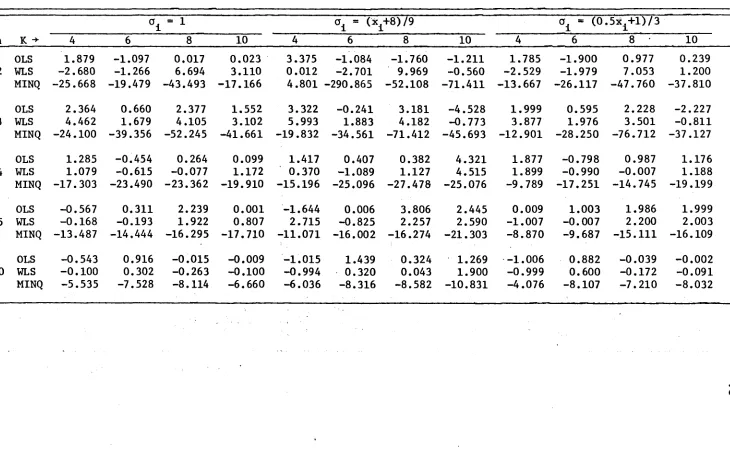
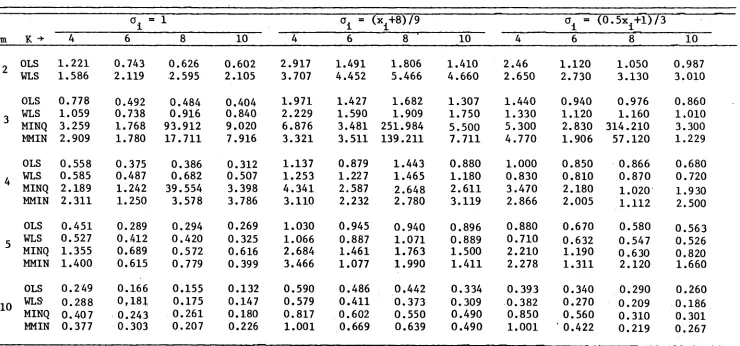
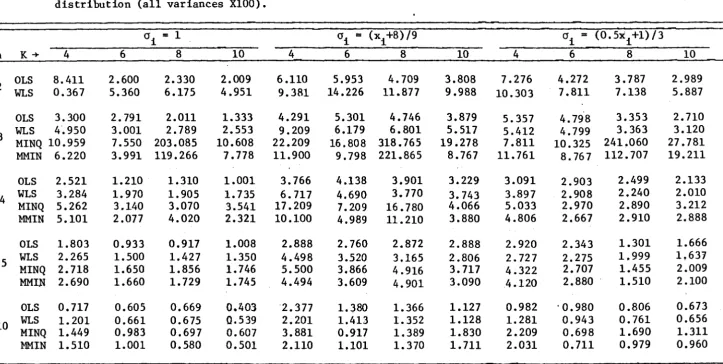
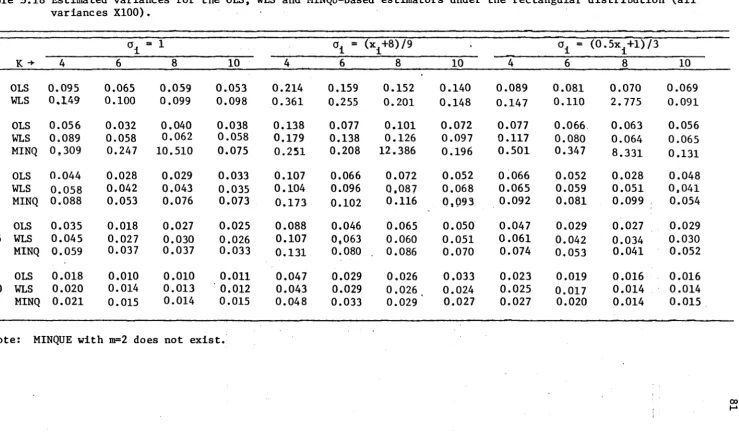
Chapter 3 provides a comparison of the theoretical results based
on Chapter 2 with simulated small samples results. These simulated and
theoretical results are based on WLS and MINQU-based estimators for normal
and non-normal distributions. A Monte Carlo comparison of the modified
MINQU-based, OLS and WLS estimators is also given.
In Chapter 4, we present the theoretical developments of the
Posterior Likelihood (PL) methodology and their theoretical properties.
"
Some theoretical results about the ~ and the variances are obtained
using Gamma prior likelihoods for the regression model. A comparative
empirical study on the basis of OLS, WLS, ML, and PL is also presented.
In Chapter 5, we present adaptive procedures for estimation. A
review of existing techniques for testing equality of variance~ is
parameters after using preliminary tests of variance equality are
discussed and empirical results on the adaptive estimators are also
provided.
Chapter 6 provides a review of the literature on multiple
comparisons and adaptive estimators using multiple comparisons procedures.
Empirical comparison of these adaptive estimators with other estimators
are also presented.
In Chapter 7~ we examine the effects of "errors in variables" upon
the different estimators. Empirical comparisons are again provided.
Finally, in Chapter 8, we present an overview of the results and
CHAPTER 2
LARGE SAMPLE PROPERTIES OF WLS AND MINQU-BASED ESTIMATORS
2.1 Introduction
The main purpose of this chapter is to determine the large sample
properties of WLS and MINQU-based estimators for the linear model. The
theoretical results of this chapter will be used in the next chapter for
comparison with the simulated small samples results.
In Section 2.2, we state a general Theorem 2.2.1 for the WLS and
MINQUE cases with normally distributed error terms, with zero means and
variances Oii for the n
i observations corresponding to Xi' i-l, ••• ,k.
We also develop several lemmas prior to prove the main theorem.
In Section 2.3, we present the complete proofs of Theorem 2.2.1
for the WLS and MINQUE cases.
In Section 2.4, we present and prove Theorem 2.4.1 for WLS and
MINQU-based estimators for non-normal distributions. Two new lemmas
are also derived to prove the results of Theorem 2.4.1.
To check the applicability of the above theorems for WLS and
MINQU-based estimators for normal and non-normal cases, we consider some special
cases of the above theorems in Section 2.5. In particular, we consider
the special cases when all the variances are equal and all the n
2.2 Asymptotic Results
In the next two sections, we shall state and prove theorems which
give the expected value and variance of WLS and MINQU-based estimators
for ~ in the linear model.
Theorem 2.2.1
Consider the linear model
Y = XJi
+
.i,
(2.2.1)k
where Y is a vector of n =
L
ni observations, X is a known matrix of i:ll1
order n x p, ~ is a vector of p unknown parameters and E is a vector of
n. Further, assume that
(2.2.2)
(i) The WLS Case
The WLS estimator is
(2.2.3)
where
"
0'11I n
1 0
"
V - (2.2.4)
0
'a
kk~ I" -1 n
i
- 2
A -2
Then E(~) =~; and to terms of O(n ),
where
A
o (pxp)
=
x(pXk)
o
and x has rows x., (i=1, ••• ,k).
-1
(11) The MINQUE Case
o
(kxk)
The MINQU-based .. estimator for 8 is
A
where V =
o
n and the MINQUE of (J = -..".;.:....~
11 n
i (n-2)
2 -1 - 2
where 5
=
(n-1) LL(yij-y).'0
Ikk~
l
-
2 52 (Y1j -Y) - n-2 i(2.2.5)
x' (2.2.6)
(kxp)
(2.2.7)
A A 2
Then E(~) =~, and to terms of O(n-.),
where t •.
. 1J
2 2 -1 -3 0ii 0jj ]x'Ao + O(n .).
,. ,. ) 1 -1
- cov(a •. ,a •. and g .• - x. Ao x .•
11 JJ 1J -1 -J
(2.2.9)
In order to prove the results of the above Theorem 2.2.1, we first
establish several lemmas.
Lemma 2.2.1
If the distribution of
i
is symmetric about zero, and gel) is aneven function of
i
with finite expectation then E{ig(~} - Q, provided the expectation exists.Proof:
1 Since P(~> 0) -
2
Let !l. == -
i .
. : E[ig(f)]
=
QLemma 2.2.2
(2.2.10)
V-I = V-I _ V-1(V_V)V-1 + V-l(V-V)V-1(V-V)V-1 0(V~~)3}.
A
Proof of Lemma 2.2.2
Directly:-~-1_V-1 __ V- 1 (V_V)V- 1
Also
so
-1 A -1 -1 A -1 A A _ I
and using
*
this=
-v
(V-V)V +v (v-v) v
(V-V)V-.The result follows directly by using
**
then*
recursively.Lemma 2.2.3
When V is estimatee by WLS,
E(VUV) - VUV + 2
a .. u ..
, [ 2 ] d1ag • 11 11
n.
1
where U is a known n n matrix with sub-matrices u .• of order n. x n.; and
1J 1 J
A
V is given in (2.2.4).
Proof:
vuv
A A h (..) th 1 • ,. d A • (A )as 1,J e ement 1S - cr •• cr .• u •. an V - d1ag cr .• ;
11 JJ 1J 11
,.
E(cr .. ) - cr •• ,
@
+a .. a.],
i"j,t 11 JJ
E
~
..
Ui]
-11 jj
Ear(~
.• ) +o~,
i"j,11 1
and the result follows since
... 2
var(o .. ) a 20 .. /n .• 11 11 1
Lennna 2.2.4
When V is estimated by MINQUE,
no ..
where Bl - liiij Cij], B2 - diag
~iiwiiJ,
wii; - n.<n~~)
2 [<n-4)oii+2aJ
1
k
and a ..
r
n.o .. /n. • 1 1 11U is a known matrix of n x n with sub-matrices u
ij of order ni x nj and
, /
o
"
V
=
o
"-The MINQUE of a
ii is given"in (2.2.8).
Proof:
E(VUV" ") has the diagonal e ements E uiia1 ( , , 2
ii) and off-diagonal elements
E(Gii) == a ii since HINQUE's are unbiased.
10utine calculations show that
-{I 2}
+ 2na i t a . - - - -n
i n-1
(2.2.15)
and
C C ( " " ) = 2(n-2)-2 t ij = ij == ov aii,ajj
(2.2.16)
it follows that
Lemma 2.2.5
Consider terms of the form
u -
HT(~'-V)Tll T12
....
Tlk·
where T = T2l T22
·
(nxn)
·
Tkl
...
Tkkk is a matrix of known terms, Tij is (n
i x nj) and n -
L
ni i-IO'llI
nl 0
" " "
H
=
V-V, V=
.
,
V has O'ii0 O'kkI
~
(2.2.17)
and
=
where ~=
Also V is the WLS estimator of V.
Then E(U) = 2VDT~V
where Tll~l
T~ is a block diagonal matrix, T~ =
( 1 f\
M
=
I - .--- 11" rr n-.1"
Proof:
and D =
o
o
"1 - I
~ ~
o
th
U has (r,q) block u
n
r _ 2
Now (n -1)0 =
r
(Yr -Yr) r rr i=l in r
=
r
since Y=
x'S + Er
i r ri i=l
~
,
n
r
r
E2 - n(E
)2 TEE'rs-s-q i=l r i r r
thus E (U )... E
--L.:=-=~-=-:(-n-_-=l~)--J..----rsq r
L..
If r of s of q
- cr T cr I • rr rs sq sq
or r - s, r of q ====> E(U rsq )
=
0 directly. or r of s, r = qif a of b,
if a
=
b,ErE E'
lE
E2 -n (E )21l
L-r-r r i r r
= - - -
nr
ErE E'
L-r-r
lE
E2-n
(E')21~
=
cr2[en
-1)+;/ r i r r -' rr r _(n +2)(n -1) 2
r r
= - - - c r n
r rr
(2.2.18)
th . ]
Substituting these values (2.2.18) will be as
2(,2
E ( ) urrr
=
n -1 rr rr T~I
-nr r
E (u ) ... 0, when r ..; q. rq
E(U ) .. rq
..
2(i
T rr rrn -1
r
20'2 T rr rr M
n -1 rr·
r
_ L
11-jn -r
:. E(U) .. 2VDT6.V.
Lemma 2.2.6
Consider terms of the.form
U .. HT(i!'-V)
where T
=
Tkk
when r ... q
k is a matrix of known terms, Tij is (n
i x nj ) and ri."
l
ni i-Io
(2.2.19)
H
= V-V,
whereV
=
A "
and V has O'ii in place of O'ii.
"-The MINQUE 0 f a ii (M) is given in (2. 2. 8) and
E
=
nx1
[~
)
Then E(U)
=
2CVDT~Vwhere
ii
=
where C
=
diag[{nr(~-2)
(n -1) }
- (n-1) (n-2)
T~ is the block diag matrix, T~
-o
M ,. (I -
1-
1 1 ?rr n - -r and D
=
o
Proof:
o
·1
- I
,
~ ~
U has (r,q)th block u ,.
I
(a
(M)-a (M»T (EE '-a I )rq s rr rr rs -s-q sq sq
n
~ I(n -1)0v r rr
where
0
(M) rr .:;r_-.--.,.---,... rr ,. n (n-2) - (n-1)(n-2)r
----E!.T M
2ci
[
n _ E(urrr(M» - n -1 rr rr n (n-2)n -1
l
(n-I) (n-2) _
r r
E(U)
=
2VCDT~V •Lennna 2.2.7
If X is a n x p matrix [
~
ni=
n] i-1g1I n 0 1
-1 Then diag(XA X')
-0
0
.
gkI~
and A
=
X'V-1X •o
(2.2.20)
1 . , . th
where gi ... ~'A~ xi' where the ni_1+1,ni_1-2, ••• ,ni rows of X are xi'·
Proof:
x ' -1
x '
-1
Since X ..
x ' -2
(nxp)
1.1 (n
1x1)
1:.
z
(n2x1)X
=
0
where
x ' -1
x' ==
(kXp)
.
~'.
Hence
=
x ' -1
.
0
_ L x'
(nxk) (kXp)
4:
(~X1)
,
.~~' (Z.2.21)
1
and 1
-, -1 xl A xII
- 0 - n
o
1
1
x 'A-1x I -2 0 -2 n
2
o
o
o
, by definition.
Lemma 2.2.8
If M is the diagonal matrix
1.1
0
M1 0 n1x1
1.2
M= and L =0 n
2x1
0
~
o
where M
=
(I -1-
1 1 '), then ML=
O. rr nr nr-r-rProof:
In matrix ML, all the terms on the block diagonal are alike, so it
will be sufficient to show that
ML=
Hence ML
=
O.Lemma 2.2.9
where
o
hll (kxk)
M 1 rr-r
=
0where M 1
=
(1rr-r n
r 1
- -- 1 1')1 - 1 - 1 = O.
n -r-r -r - r -r
r
Proof:
From (2.2.21), X
=
Lx'-L_ -1 -1. -1 hence X'V IffV X
=
xLV IffV Lx'(2.2.24)
But
so that (2.2.24) reduces, as required, to
(2.2.25)
2.3 Proof of Theorem 2.2.1
(i) The WLS Case
The linear model is Y ~
XB
+i.
The WLS estimator iso
A
where V
=
and....
Since V is an even function of il,.·.,in , it follows that
(X'V-lX)-lX'V-l is an even function of i l ' ••• '~. Thus, applying
Lemma 2.2.1,
Now
(2.3.1)
Let EE'
-
=
V + (EE'-V).-
(2.3.2) Since E(ii')=
V = E(V),(2.3.4)
"'-1
Applying Lemma 2.2.2 and substituting the values of V into the
.... -1 term (X'V X),
(X'V-LX)
=
x'{V-l_V-l(V-V)V-l+v-l(V-V)V-1(V-V)V-l}X + •••=
x,v-lx-X'V-l(V-V)V-lx+x'V-l(V-V)V-l(V_V)V-lX +_ ••and
then
Let
V -
V=
H,x'V-lx
=
AO'X'V-l(V-V)V-lX ~ x,v-~v-lx - AI'
X'V-l(V-V)V-l(V-V)V-lX - x,v-~v-lHV-lx - A
. . 2'
~
(X'V-lX)-l =~l
+~lArA~l
-A~lA2A~1
+~lAl~lAlA~l
+
terms of O(H3).(2.3.5)
Substituting the values of (2.3.6) up to 0(H 3) in (2.3.4)
where
Thus
(2.3.8)
which we write as
....
Var(~) - Term I + Term II. (2.3.9)
We will now examine these two terms separately.
Term II
=
E[FX'V-1(I_HV-1+(HV-1)2)2XF ]=
E[FX'V-1{I-2HV-1+3(~V-1)2+O(H3)}XF]
_ E[F{X'V-1X-2X'V-~v-lX+3X'V-l(HV-l)2X}F]
=
E[F(~1_2A1+3A2)FJ
-1 -1 -1 -1 -1 -1 -1 2 1
=
E.[{Aa +Aa AlAe -Aa A2AO +Ae . (AlAe ) }(Ae-2Al+3A2){A~ -1 -1 -1 -1 -1 -1 2 3+ ~ AlAO -AO A2AO +Ae (AlAO ) +0 (H )}]
(2.3.10)
Then, Term I = E[FX'V-1(l-HV-l)Q(l-HV-l)'V-l XF]
=
E[~lX'V-lQV-lXA~1_~lX'V-~V-lQV-l~1_A~lX'V-lQV-~V-1XA~1
+ A-lJLA-lX'V-lQV-lXA-l+A-lX'V-lQV-lXA-lA A-l+o( -3)]
o
-~ 0 . 0 0 0 I O n •Then we must evaluate the following terms:
E(QT1~)' E(~T1Q) in Term I.
E(A
2) - E(X'V-~V-~V-1X)
_ X'V-1E(HV-~)V-1X.
But
E(HV-~)
=
E(Y-V)V-1(y-V) - E(Vv-1y) - V •-1
Applying Lemma 2.2.: with U =
v[ai~In
1
..
E(HV-~)
- vv- V + 2 diag n ii1 - V
By (2.2.21) this becomes
(2.3.11)
(2.3.12)
By Lemma 2.2.9, this reduces to
(2.3.14)
Applying Lemma 2.2.3 with
rr
as x'Aax = G(say),we obtain
(2.3.15)
where gi
=
~'A~l~
as for Lemma 2.2.7.Substituting (2.3.13) and (2.3.15) into (2.3.10) we get
Now we shall evaluate some terms for Term I (2.3.11)
E(~lX'V-1QV-1~1) _ ~lX'E(V-1QV-1)XAQ1
=
A~lX'V-1E(EE'_V)V-1XA-1-1) - 0
= ~lX'V-1(V_V)V-1XA;1 _ 0
using Lemma 2.2.5
-1 -1 -L -1 -1 Similarly E(AO X'V QV IffV XAO)
=
(2.3.16)
(2.3.17)
(2.3.18)
Let T -_ -lXA-lX'V-l V 0
Applying Lemma 2.2.5
(2.3.20)
Similarly
(2.3.21)
Substituting the values of (2.3.17)-(2.3.20) in Equation (2.3.11) we
obtain
•
-1, "-L -- -1 -1, -1 -3 Term I
=
0-4AO X DV JMXAO +4AO X DT~XAO +O(~ )where
and
Lr
n 01 n1
D
=
O '1 - I
nk ~
-1 -1 -1 TlI
=
block diag(VXAa
X'MV ).
M-Using Lemma 2.2.7, Equation (2.3.23) beco~es
M1
0
(2.3.22)
o
.~
glM n 0 1
T = V-I
-1
V (2.3.24)
!J.
0 gkM n k
glM n
1 0
2 n10"11
(2.3.25) • DT
-••
!J,-gkM
~
0 2
~O"kk
Using Lemma 2.2.8
-x x' - 0 (2.3.26)
o
Using the results of (2.3.25), (2.3.26), and (2.3.17) in (2.3.22)
, -3 Term I ? 0 + O(n ).
(2.3.27)
Substituting the results of (2.3.16) and (2.3.27) in (2.3.9), we get
(ii) The MINQUE Case
Taking the linear model (2.2.1)
y
=
xS
+i
o
" where V
=
"
Using the UnTQUE of O"U·given in (2.2.8), it follows that, as before,
E(~)
=
~.
Now we wish to evaluate
The results up to (2.3.11) are the same, so we ~ill evaluate Terms
I and II. Starting with Term II
E(A) ..
E[X'V-~V-~-lXJ- X,v-lE[HV-~JV-~
2 .
.. -1
Applying Lemma 2.2.4 with U - V , we get
E(HV-~) ~ diag[(Ci~+2Wii)
II
[ i i ni- 2T~ say
where tii is given in (2.2.15).
(2.2.28)
-1 -1 -1 -1 -1 -1 Likewise E(~AO AI)
=
E(X'V RV XAa-X'V IHV XJ.Applying Lemma 2.2.4, it follows that
(2.2.29)
-1
where gij ..
:s}AO
~i and t ij is given by (2.2.16).Substituting (2.3.28) and (2.3.29) into Term II (2.3.10)
(2.3.30)
The results for Term I are as follows:
(2.3.31)
Using Lemma 2.2.6, the remaining terms of Term I «2.3.18)-2.3.21»
will be as follows:
1 -L_ -1 -1 -1 -1 -~A-1
E(A~ X'V ~V QV
XAo)
=
2AO X'CDV ~~E(~lX'V-1QV-1HV-1~1)
..2A~lX'CDV-~1
E(~lA1~lX'V-1QV-1XA~1)
-2A~lX'CDT~XA~1
and
E(A~~'V-1QV-~~lA1A~1)
=
2A~~'CDT~XA~1
-1 -1 -1 where T~
=
block diag(V XAO X'MV ).(2.3.32)
(2.3.33)
(2.3.34)
(2.3.35)
(2.3.36)
Substituting the values of (2.3.31)-(2.3.35) in (2.3.11),
(2.3.37)
o
o
where D
=
and M =o
DT
t:.
=
o
o
n CDTt:.
=
(n-2)o
o
1 (2.3.38)
- (n-1)(n-2)
o
Using Lemma 2.2.8 (ML
=
0), the termx'cDv-IMx -
xL'CDV-~'
-
o.
(2.3.39)Thus, using the results of (2.3.38) and (2.3.39) in (2.3.37)
. -3
Term I
=
0 + O(n ).A
So var(~}
=
Term I + Term II,yie1dsA _ -1 -1· ( / 3 ., -1 -1 2 2 -1
2.4 Non-Normal Case
Theorem 2.4.1
Consider the linear model
y=xS+i
k
where Y is a vector of n
=
L
ni observations, X is a known matrix of i=1order·n x p, ~ is a vector of p unknown parameters and
i
is a vector ofn. Also Eij ~ ID(Q,crii,yi ) where Yi is the measure of kurtosis. It is
assumed that the distribution of the Eij is symmetric.
(i) The WLS Case
As before, the estimator is ~
=
(X'V-lX)'X'v-lycrllI
nl 0
"
n i
- 2
" and
L
where
v-
crii .. (Yij-Yi ) /(ni-l).
" j=l
0 crkkInk
"-Then E (~) =~, and
(2.4.1)
(ii) MINQUE Case
As before, the estimator is ~
=
(X'V-l X)-lX'v-lyo
and the ~INQUE of
cr
ii is given in (2.2.8). Then E(~)
=
~ and(2.4.2)
where, again by routine calculation,
(2.4.3)
and
(2.4.4) ..
In order to prove Theorem 2.4.1, we first prove the following two
lemmas:
Lemma 2.4.1
,.,
When V is estimated by WLS
(J u (2+y)
( 2 1
E(VuV)
~
VUV + diag ii i!i io
....
v
=
l
o
Proof:
.... .... th ~~ .... .... VUV has (ij) element
=
~; O'ik.l\.rO'rj.... ....
where V
=
diag(O'ii)Now,
and
(ni-l~ (n i-3) 3
n i
2
(ni -3)O'ii 2 +0' (n -l)n ii '
i i
A "
Further, E(criicrj j)
=
criicrj j and all other terms in (2.4.5) are equal tozero. Thus E(VuV) has the (ij)th element
=
I I
E(criiUijcrjj) k=i r=j2
=
cr u ii ii" " • E(VUV)
Lemma 2.4.2
"
When V is estimated by MINQU,
U is a known matrix and
o
" V=
o
A
cr
ii being the MINQU estimator is given in (2.2.8).
Proof:
The proof is on the same lines as for Lemma 2.4.1.
.
,
if i;'j
where i=j.
A A A2
E(VUV) has diagonal elements E(UiiOii) and off-diagonal elements
It follows that
. and
Using the values of (2.4.3) and (2.4.4), we obtain
(2.4.7)
(i) Proof of Theorem 2.4.1 (WLS Case)
Given the symmetry of the
ii
distribution it follows by the samearguments that
A A
E(~) - ~.
For the variance, the results up to Equation (2.3.11) are the same. We
now evaluate Terms I and II. Starting with Term II,
-1
(2+Yi ]
... x diag
r
<1ii x'. (2.4.8)-1
Again using Lemma 2.4.1, with U ... V and Lemma 2.2.9, we obtain the
-1
expression for E(~Aa ~) as follows
(2.4.9)
In this case, all the terms of Term I vanish. Substituting the
values of Terms I and 11 in (2.3.9); we obtain
, -1 -3 x AO + O(n ).
(ii) Proof of Theorem 2.4.1 (MINQU Case)
Given the symmetry of the
ii
distribution it follows by the same arguments that"
For the variance, the results up to (2.3.11) are the same and the
terms of'Term I vanish by arguments similar to those in
(2.3.31)-(2.3.39). So
var(~)
=
Term 11.Now we evaluate Term 11.
. -1
Using Lemma 2.4.2 with U·· V
E(HV-~)
_ diag [2t11 II
[O'ii niwhere the value of tii is given in (2.4.3).
Likewise, applying Lemma 2.2.9 and Lemma 2.4.2,
where t
ij is given in (2.4.4).
(2.4.10)
(2.4.11)
(2.4.12)
Substituting the values of (2.4.11) and (2.4.12) into (2.4.10) ,
,
we obtainVar(~) A =
Aa
-1+2Aa
-1 x diag(nitii/O'ii)x AO 3 ,-1-2Aa
-1 x fninjtijgi1 2- 2- - x'~ 1 +O(n-3).. O'iiO'jj
2.5 Special Cases of the Theorems
•
In order to examine the effect of the second order terms, we consider
the following special case.
p
=
1, x=
(1,1, ••• ,1),and
It follows that
o
-1 -1
Aa
=
x'v
X=
xL'V Lx' - xHence gi
=
x'Aa
-1 x = a 2In.
Now we evaluate the variances for each case.
Example 2.5.1
Using WLS and assuming normality
V(~) A ... Aa +2Aa x diag -2--1 -1 {1 ( aii-nigi x )} ,-1
Aa
+O~n -3 ) ai i2
a
4k {1 1 } -3=
~ + 2 - 22" -
- 2 + O(n )n n a ka
_
o~
+
2:{
{k~l}
+
0(0-3)
_
~2
{l
+
2(~-1)}
+
O(n -3).
for i=1,2, ••• ,k.
x' _
~ I~
I
2l. ni vii - n a •
i-1
Example 2.5.2
Using MINQUE and assuming normality
wh~re tii and tij are given in (2.2.15) and (2.2.16).
This becomes
Var(~
_)=
(i
+
2k(14 [n {2k(14 _ 20'4 } /i/
"'M n n 2 Lk n-2 (n-l) (n-2) (1 -'
[
k.k _ k2
J
+
O(n -3) n-2 (n-l) (n-2) _= (12
+
4k(12 4(12 40'2+
4(12+
O(n-3)n n(n-2) - n(n-l) (n-2) - n(n-2) n(n-l) (n-2)
_ (12 [1
+
4(k-l)l
+
O(n -3).n (n-2) (2.5.2)
Example 2.5.3
Using WLS without assuming normality and taking all Y
i
=
y,(12 2 3
- -n
+ (2+y) 0'2 (k-1) + O(n- )n
Example 2.5.4
Using MINQUE without assuming normality and taking. all Y
i
=
y,where tii and t
ij are given in (2.4.3) and (2.4.4) respectively. It··
follows that
(2.5.4)
It .is apparent that the MINQU-based estimators have higher variances,