Master’s thesis
Double degree program “Innovation Management and Entrepreneurship”
FACILITATING EXPATRIATES’ CREATIVITY
Author:
R. Stasiunaite
Supervisors:
Dr. M. L. Ehrenhard (University of Twente) Prof. Dr. L. Leisyte (University of Twente) Dr. J. Rank (Technische Universität Berlin)
19th October, 2014
1
Abstract
In a frequently globalized work environment organizations increasingly consider employing expatriates due to their positive influence on creative, innovative outcomes. However, literature on the topic of how to facilitate their creativity is missing. The aim of this paper was to provide with an overview of critical factors affecting expatriates’ creativity and innovativeness, as well as implications on how managers could stimulate expatriates’ creativity. 16 expatriates from various countries working in professional service industries, namely, governmental, communication, consultancy and art; and 1 expert from the European Commission Directorate-General for Research and Innovation were interviewed in Brussels, Belgium. The findings suggest that non-hierarchical organizational structure; open communication and knowledge exchange; team diversity; equal treatment and social justice; clear long-term and short-term goals; expatriates’ personal traits are a few of the most important factors that affect expatriates’ creativity. Findings also reveal factors influencing expatriates’ creativity that are surprising, either contradicting (lack of resources; adjustment and integration only to a certain extent) or adding (expatriate status) to the existing theory and previous research. Several recommendations for managers who seek for expatriates’ creativity are presented, namely, non-work related guidance, mentoring and training programs, and manager’s international experience and awareness. At the end, limitations and directions for future research are presented.
2
Foreword
First, I would like to sincerely thank Michel Ehrenhard for his extensive help throughout this project. As Michel was operative and flexible, he provided with the relevant support in the beginning, and especially in the later stages despite the distance that limited our communication. I thank him for the collaboration, and sharing his knowledge and experience with me which made it possible to reach the best possible final results of this thesis.
Second, I thank Liudvika Leisyte who gave constructive feedback and useful insights which contributed as a great direction for the thesis’ integrity. The detailed, yet accurate comments led to the successful completion of this thesis.
Third, I would like to thank Johannes Rank who showed me the direction for the research in the first stage of this project. That allowed me to have more focus and clear ideas on what I want to achieve with this thesis.
Fourth, I send my thanks and warm greetings to all the interviewees and external reviewers who gave their input and were truly helpful. Without them, the thesis would not have given such interesting insights.
Finally, I want to extend my gratitude and appreciation to my family and biggest supporters back in the deep bosom of Lithuania, as well as here in the Netherlands/Belgium, and Germany. My biggest thank you goes to my partner for granting me infinite patience and unlimited support.
Thank you all very much for making it possible, ačiū jums visiems, Rūta Stasiūnaitė
3
Table of Contents
Abstract ... 1
List of Tables and Figures ... 5
1 Introduction... 6
1.1 Literature suggests directions for future research: academic and practical implications ... 7
1.2 Research goal and research question ... 8
2 Theory and Research ... 10
2.1 Organization-related factors ... 10
2.2 Management-related factors ... 11
2.3 Expatriate-related factors ... 14
3 Methodology ... 16
3.1 Research design ... 16
3.2 Sampling ... 18
3.3 Data collection ... 20
3.4 Data analysis ... 21
3.5 Reliability and validity ... 21
4 Findings ... 23
4.1 Organization-related factors ... 23
4.1.1 Non-hierarchical organizational structure ... 23
4.1.2 Available resources ... 24
4.2 Management-related factors ... 25
4.2.1 Open communication and knowledge exchange ... 25
4.2.2 Team diversity ... 27
4.2.3 Perceived equality and social justice ... 29
4.2.4 Clear long-term and short-term goals... 30
4.3 Expatriate-related factors ... 31
4.3.1 Expatriates’ personal traits ... 31
4.3.2 Expatriate status... 31
4.3.3 Adjustment and integration ... 33
5 Discussion ... 36
6 Conclusion and practical implications ... 40
4
5
List of Tables and Figures
Table 1. Map of research ethics. ... 17 Table 2. Research sample. ... 19
6
1
Introduction
The majority of organizations desire to achieve a competitive advantage, which is often related to creativity1 and innovation2 (e.g., Kandampully & Duddy, 1999). Creative or innovative performance involve own idea development, as well as application of new ideas, technologies or services. The competitive advantage can be acquired by international knowledge and experience of expatriates (Dickmann & Harris, 2005) due to communication and knowledge exchange between specialists with varying backgrounds and expertise which are crucial for creative and innovative performance (Kratzer et al., 2004). Therefore, companies scout for talents not only domestically, but also internationally.
In the last years, expatriate involvement in creative and innovative occupations became a generally accepted and commonly spread norm. However, expatriates have to adjust to the new country’s as well as organization’s culture, and often face difficulties when working abroad. Therefore, changes, contrasts and issues may be distinctly more dramatic for the international movers than those changing jobs domestically (Louis, 1980; Bonache, 2005). For example, expatriates usually experience more pressure and uncertainty. They may face a loss of status, and a lack of respect towards their acquired skills. On the other hand, they often get more challenging tasks, greater autonomy, variety and responsibility (Bonache, 2005).
Since expatriates are known to be facing more complicated situations than their local co-workers, team leaders and managers have to find the right way to positively influence their creative, innovative performance. Team leaders or managers can behave differently towards their diverse subordinates, thus applying various management practices. Leadership, which team leaders and managers apply, is “a process of social influence in which one person is able to enlist the aid and support of others in the accomplishment of a common task” (Chemers, 2000, p. 27). Therefore, team leaders or managers have to focus their social influence and management practices on expatriates in an appropriate way.
Overall, due to the expatriates’ cultural and experiential differences, as well as the issues they face working in another country, managers likely have to act differently towards expatriates in comparison with the local employees. As organizations desire to achieve the competitive advantage by employing expatriates, they have to apply appropriate management practices to facilitate expatriates’ creative performance.
1 Creativity is procuring useful ideas (Amabile, 1983, 1998; Amabile et al., 1996). 2
7
1.1
Literature suggests directions for future research: academic and practical
implications
In the last years, there has been research on personality traits (e.g., Peltokorpi & Froese, 2012), adjustment (e.g., Peltokorpi & Froese, 2012; Cole & McNulty, 2011; Selmer & Fenner, 2009b; Koo Moon et al., 2012; Sanchez et al., 2000), performance and work outcomes (e.g., Selmer & Fenner, 2009a), assignment effectiveness (e.g., Kim & Slocum Jr., 2008), motives (e.g., Selmer & Lauring, 2010), job embeddedness (e.g., Shen & Hall, 2009), intercultural communication (e.g., Peltokorpi, 2007), training (e.g., Koo Moon et al., 2012), expatriate failure (e.g., Harzing & Christensen, 2004), repatriation (e.g., Suutari & Brewster, 2003) and institutional injustice (e.g., Forstenlechner, 2010) towards expatriates who either choose to work abroad (i.e. self-initiated), or are assigned by their company to a subsidiary in a foreign country (i.e. company-assigned).
However, research on three concepts, namely, expatriates, creativity, and management, in one context has been ignored. Researchers have focused on expatriates’ creative performance; management for creativity; and management towards expatriates. These three issues bundled together opened space for identifying a gap within existing literature. Moreover, several studies suggested it as a direction for future research.
The recent literature review and interviews of international human resource managers conducted by McEvoy & Buller (2013) offered that more research on assignment acceptance, training attractiveness, career impact, compensation equity, repatriation processes, and expatriate job performance would enhance the knowledge of how to deal with expatriates. The needed focus on job performance was especially highlighted. Thus, research on creative and innovative expatriates’ performance would enhance the knowledge of their managers. Next to this, Doherty (2013) offered to look at the integration of various talents of expatriates, which might help managers when choosing appropriate strategies, policies and practices. One of the possible talents in this context might be creativity.
8
As suggested by previous studies, a research on aspects of management when seeking for expatriates’ creative, innovative outcomes would enhance the academic field. The research findings on this topic might give new insights for international human resource management, performance management and other potential areas of expatriates working in creative and innovative environments.
From the practical point of view, findings of this research would especially be beneficial for managers and team leaders working in MNCs, companies operating in creative, innovative, hi-tech business fields, and companies simply employing people from abroad. Senior executives might also find suggestions on what kind of rules, policies and management practices should be implemented towards expatriates, and what overall climate within the company is beneficial. Finally, it might be of interest to expatriates themselves, since they can “realize having a responsibility to demand leadership from their managers” (Interview 1). In this case, expatriates might inform the managers of what would motivate them to be more creative.
1.2
Research goal and research question
Although there was a wide spectrum of research on expatriates, creativity and management separately, the current study was based on the identified gap in the scientific literature, and suggested research directions. This study investigated the factors influencing expatriates’ creativity, and management practices which can be applied by the managers when seeking for expatriates’ creative and innovative performance. The research goal was:
To explore which factors have to be considered by managers when seeking for expatriates’ creative
performance from the perspective of expatriates working in professional service industries in
Brussels.
To achieve this goal the central research question was formulated:
Which factors should be considered by managers in order to positively influence expatriates’
creative performance?
Further, the following research sub-questions were developed:
1. Which factors do expatriates find important for their creative, innovative performance?
9
10
2
Theory and Research
Existing theory and previous research provide with knowledge of which factors managers should take into account when seeking to facilitate expatriate subordinates’ creativity. Shalley and Gilson (2004) divided the relevant factors enhancing employees’ creativity into individual-, job-, team- or work group-, and organizational-level factors based on Amabile’s (1996) and Woodman’s (1993) studies. In the current research this categorization is applied in the context of expatriates due to the similar aim of the study, as Shalley and Gilson (2004) also discuss practical implications for managers who seek for employees’ creativity. Therefore, the factors facilitating expatriates’ creative, innovative performance are divided into three groups, namely, organization-, management-, and expatriate-related factors. Important to notice, that expatriate-related factors of the current study represent the individual-level factors in the context of expatriates. Management-related factors of the current study stand for job- and team- or work-level factors since they represent actions which managers can apply when seeking for employees’ creativity (Shalley & Gilson, 2004). Due to the undiscovered topic, there likely are more factors that can be applied to expatriates but are not yet discovered by researchers.
2.1
Organization-related factors
11
private sector companies, on the other hand, may have fewer issues related to their hierarchical structure as the important actors are then recognized faster and easier; and these actors are motivated and rewarded accordingly (Shalley & Gilson, 2004).
With reference to the knowledge mentioned above it can be assumed that expatriates find a less hierarchical organizational structure important for facilitating their motivation to be more creative. Important organization-related factors influencing expatriates’ creativity may be highlighted by expatriates due to the cultural differences and expatriates’ traits. Consequently it is postulated that organization-related factors create influences that operate on expatriates to influence their creativity.
2.2
Management-related factors
12
increasing when there still is a similarity between motivation factors (e.g., rewards) and cultural values (Eisenberg, 1999).
Managers have to create flexible structure, provide with adequate resources and enriched jobs to encourage innovation (Livingstone et al., 1997). Flexible structures are associated with increased autonomy and the belief that new ideas will be accepted (Kanter, 1984). Enriched jobs enhance creativity because autonomy gives job holders more opportunities to make decisions themselves. Considering Hofstede’s dimensions (2001), in high degree individualism societies production of innovations is higher. Enriched jobs are more challenging and require more complex mental activities. They are also more meaningful to the person, and thus motivate the person to continually improve his or her performance (Livingstone et al., 1997). Research indicates that individuals who are encouraged to be creative at work have higher levels of job satisfaction, and are more satisfied and more fulfilled than individuals with fewer opportunities for creativity (Nicholson & West, 1988). On the other side, Atwater and Carmeli (2009) state that more enthusiastic and energized individuals are likely to be more creative because “without energy, creative abilities will not be optimized and the employees are less likely to be creatively involved in work” (p. 266). Moreover, joy is also found to encourage pushing limits and being creative (Spreitzer et al., 2005).
Creativity and innovativeness are known to be influenced by employee’s satisfaction and thriving at work. Thriving at work is “the psychological state in which individuals experience both, a sense of vitality3 and learning” (Spreitzer et al., 2005, p. 545), “which communicates a sense of progress or forward movement in one’s self-development” (Spreitzer et al., 2005, p. 538). It has been found that thriving at work enables more proactive and risky behaviors which bring new ideas. There is an indirect relationship between trust and thriving through connectivity; as well as between connectivity and innovative behavior through thriving (Carmeli & Spreitzer, 2009). Therefore, connectivity between co-workers “involves seeing the value of relationships for learning new things, generating new ideas, and seeking opportunities to explore and grow” (p. 174). Connectivity is an important factor influencing individual’s thriving, which facilitates innovative behavior. Carmeli and Spreitzer (2009) suggest to promote thriving at work (namely, the two composing elements: learning and vitality) to enable innovative outcomes, instead of offering expensive alternatives such as highly priced gourmet meals.
3
13
Based on the socially embedded model of thriving at work (Spreitzer et al., 2005), individuals are more likely to thrive and learn when they work in a decision-making discretion, broad information sharing, and a trustful and respectful context. Similarly to thriving at work, desired climate for creativity reflects a person’s need for a social environment that promotes creativity, e.g., through challenge, mutual trust, free flow of ideas, encouragement from leaders and peers (Anderson & West, 1998). These characteristics are also mentioned as factors for creative performance (e.g., Leenders et al., 2003). Since expatriation can often be seen as a mechanism of knowledge transfer, the knowledge complexity enhances the strategic importance of knowledge transfer through expatriates (Bonache & Brewster, 2001). “The personal relationship-development capability of an expatriate can be an important factor which can affect the knowledge transfer process” (Choi & Johanson, 2012, p. 1151). Hence, for expatriates it is essential to build relationships with co-workers, as it creates a well-communicated atmosphere.
Regarding employees’ communication with employers, according to the leader-member exchange theory, leaders often act differently towards their subordinates and develop contrasting relationships with each of them (Graen & Uhl-Bien, 1995). Such relationships are built upon trust and connectivity, which are important for increasing the emotional space needed for creativity (Losada, 1999). It has been proven that leader-member exchange positively relates to involvement in creative work (Atwater & Carmeli, 2009; Basu & Green, 1997). As Amabile (2012) states, individuals need creativity supporting environment for a creative work, which in part means an effective leader-subordinate communication. Moreover, expatriates are more likely than other employees to have a relational rather than a transactional contract with their employers (Baruch & Altman, 2002). Therefore, personalized communication between the manager and subordinate based on the leader-member exchange theory might be of benefit for expatriates. Having more willingness to build relationships and trust-based communication allows an easier exchange of knowledge; and brings more creative, innovative ideas at the end.
14
Hülsheger et al. (2009) found a negative relationship between background diversity and innovation. However, two members of the same cultural group can differ dramatically in terms of perspectives and their underlying complexity (Tadmor et al., 2012).
Overall, without a management that fits the expatriates’ background and experiences, expatriate failure can occur that has been explained as “a broad range of themes such as premature return, low performance, adjustment problems, etc.” (Harzing & Christensen, 2004, p. 616). As a result, for example, company-assigned expatriates “may quit their assignment and leave for better job offers outside the organization, they might get transferred to other positions within the organization, and some might get fired because they do not perform according to expectations” (Harzing & Christensen, 2004, p. 619). To avoid such failures, Harzing (2001) argues that expatriate management should not be seen as a one-size-fits-all function. As claimed by Wu & Ang (2011), “a system’s approach to expatriate supporting practices is essential for expatriate adjustments and outcomes” (p. 2696). Thus, as recently suggested by Bonache & Noethen (2014), “organizations cannot simply rely on expatriation ‘best practices’, but should analyze which type of assignment [guardian or star4] they are faced with, and then adapt management of the expatriate, along the expatriate cycle, accordingly” (p. 1966).
Considering the aforementioned factors and management practices enhancing employees’ creativity it can be assumed that management-related factors and practices are beneficial for expatriates’ creative and innovative performance. In addition, there likely are several management-related factors which are important for expatriates’ creativity that are not yet found by researchers. Therefore, specific management-related factors and management practices facilitating expatriates’ creativity are expected to be discovered as an addition to the already established knowledge in the theory and research.
2.3
Expatriate-related factors
Expatriate-related factors represent influences at the individual level that operate towards expatriates’ creativity. Previous studies by Arthur and Bennett (1995), and Teagarden and Gordon (1995) suggest that expatriates are often sent abroad without the skills necessary to successfully carry out their assignments, particularly in terms of cross-cultural and language skills. Cultural sensitivity, which means being confident, open-minded, nonjudgmental, socially relaxed and open
4
15
to experiences, plays an important role in expatriates’ creative performance (Zhao, 2002). As Dabic et al. (2013) state, “it is expected that expatriates are open-minded individuals because of their international experience” (p. 9), thus expatriates may assist in some key factors for competitiveness, e.g., innovation and entrepreneurship. According to Dabic et al. (2013), “hiring expatriates in innovation teams may make a difference” (p. 16), because “an experienced and highly knowledgeable expatriate can understand and identify market signals at a higher rate of effectiveness” (Choi & Johanson, 2012, p. 1150). However, expatriates do not only have to be cross-culturally aware, and be able to recognize individual and situational affects, but also understand the fit between demands for creativity and own abilities for creativity, which are related to lower strain and higher job satisfaction (Livingstone et al., 1997).
Similarly to aforementioned importance of cultural sensitivity for creative, innovative performance, Wu & Ang (2011) claim that companies should consider selecting expatriates with higher efficacy-based CQs (cultural quotient (or cultural intelligence) - the ability of individuals to acquire, store, and use cultural knowledge) (Earley & Ang, 2003). “Such individuals are likely to further enhance their adjustments in order to respond to the high level of support provided as they tend to set ambitious goals and are motivated to work toward these goals, which include both adjustment and performance goals. Therefore, companies could try to set challenging goals for this group of expatriates and provide them with the necessary support to encourage them to reach further toward their goals” (Wu & Ang, 2011, p. 2698).
As mentioned by Galinsky and Maddux (2009), working abroad boosts the degree of creativity through the effort of adapting to a new culture. Therefore the creative superiority of expatriates increases their penetration within organizations (Agor, 1990). Expatriates are interested in the new environment while penetrating within the organization and culture. Through this interest they broaden “perspectives by creating the urge to explore” (Spreitzer et al., 2005, p. 544). On the other hand, some researchers claim that expatriates have to already be successfully adjusted (Lee & Sukoco, 2010) and effective in the cultural manner (i.e., being able to interact and communicate with local co-workers) (Holopainen & Björkman, 2005) to bring new ideas. Therefore, there might be different correlations between the stages of adjustment and creativity of expatriates.
16
3
Methodology
3.1
Research design
Due to the identified gap within scientific literature on the topic of facilitating expatriates’ creative and innovative performance, qualitative research design has been chosen (Thompson & Walker, 1998). Qualitative research is a tool for bridging the gap between theory and practice, as well as between academic and practical contexts (Darlington & Scott, 2003). Instead of testing hypotheses or variables from existing literature, exploration of variables is important to capture new factors in this uninvestigated topic (Corbin & Strauss, 2008).
Qualitative research is mainly beneficial because of “its ability to study phenomena which are simply unavailable elsewhere” (Silverman, 2013, p. 97). Since there was no evidence on how the expatriates should be managed for their creative, innovative performance, there were almost no available variables for a quantitative testing. “Qualitative research can use naturally occurring data to find the sequences (“how”) in which participants’ meanings (“what”) are deployed” (Silverman, 2013, p. 97). Therefore, an inductive nature of the research can provide with ideas on how expatriates’ creativity (“what”) may be facilitated.
Due to the inductive nature of the research, the thesis was partially based on the grounded theory. Particularly, open, axial and selective coding techniques were used (Corbin & Strauss, 2008). However, because constructs were applied from established literature, it was not completely ‘grounded’ in the data. The aforementioned theory was used as the basis for exploratory approach of the study. The theory helped to make a comparison with real life situations of management towards expatriates’ creative, innovative outcomes.
The interpretivistic approach is important when trying to capture people’s perspectives in the context of the conditions and circumstances of their lives (Ritchie et al., 2013). It serves as a balance between the inductive and deductive approaches because of the analysis and interpretations of the data. The research design was built upon the existing theory and previous research. Then the focus switched onto exploring new aspects by obtaining as much detailed information as possible. At the end, the findings of the research were “put back into the context of *…+ theories or existing knowledge” (Ritchie et al., 2013, p. 22).
17
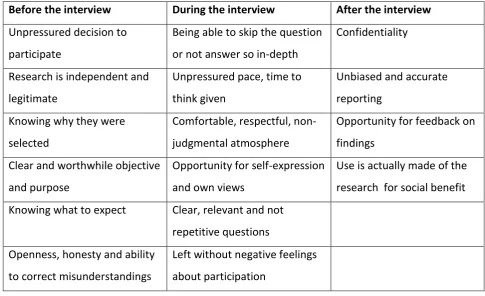
[image:18.595.82.568.362.658.2]considered as a core, and effective method for collecting qualitative data. The main strength of this method is the depth of focus on the individual: “they provide an opportunity for detailed investigation of each person’s individual perspective, for in-depth understanding of the personal context within which the research phenomenon is located, and for very detailed subject coverage” (p. 56). Importantly for the current study on facilitating expatriates’ creativity from the perspective of expatriates, interviews were suited for exploring impacts and outcomes (Ritchie et al., 2013). Since the participants had to display their attitude towards their managers, individual interviews were more suitable due to the confidentiality (Ritchie et al., 2013). To motivate the desire of interviewees to participate, interviews were based on research ethics framed by Graham et al. (2006) (see Table 1). To ensure the stated research ethical points, interviewees had to sign the participation in an interview consent forms.
Table 1. Map of research ethics.
Before the interview During the interview After the interview
Unpressured decision to participate
Being able to skip the question or not answer so in-depth
Confidentiality
Research is independent and legitimate
Unpressured pace, time to think given
Unbiased and accurate reporting
Knowing why they were selected
Comfortable, respectful, non-judgmental atmosphere
Opportunity for feedback on findings
Clear and worthwhile objective and purpose
Opportunity for self-expression and own views
Use is actually made of the research for social benefit Knowing what to expect Clear, relevant and not
repetitive questions Openness, honesty and ability
to correct misunderstandings
Left without negative feelings about participation
(Graham et al., 2006)
18
experiences with managers differ in home and host countries. Semi-structured interviews are beneficial due to the flexibility in designing and refining the interview guides, and in actually conducting the interviews (Humphrey & Lee, 2004). Therefore, semi-structured interviews were chosen in order to allow a degree of freedom to explain expatriates’ thoughts, as well as to enable certain responses to be questioned in greater depth by probing questions.
To capture the importance of management and beneficial management practices for expatriates’ creative and innovative work outcomes, as well as to ensure the level of validity of the research, the triangulation process was applied. The data triangulation is based on the sample which contains expatriate interviewees as well as 1 expert interviewee to gather data from different social contexts, and from variety of people (Denzin, 1970).
3.2
Sampling
For the study site Brussels has been chosen due to the cultural variety within the city. As Brussels is the capital of European Union, it attracts a high-skilled, experienced and talented labor from all over the world. Although Brussels is not considered as the most creative or innovative city, there are occupations which can be defined as creative or innovative. The research participants were involved in the four most active professional service (Von Nordenflycht, 2010) industries of Brussels, namely, governmental, communications, consultancy, and art. Organizations operating in these industries vary in many ways, for example, organization’s ownership style, hierarchical structure, size, etc. Therefore, the chosen industries represent different nature of business and operations, and likely various perspectives of expatriates.
19
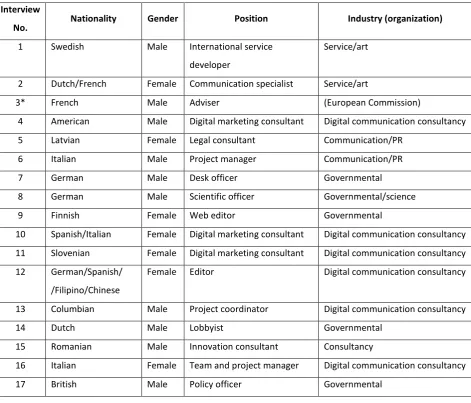
[image:20.595.92.564.295.698.2]One of the participants holding an adviser’s position in the Directorate-General for Research and Innovation of European Commission (Interview 3, see Table 2) has been selected due to the knowledge, experience and expertise in the creative and innovative environment. As the participant’s position was not entirely comparable to the rest of the sample due to the differing tasks and objectives given, as well as a higher level of expertise within research and innovation field, he has been called an expert to indicate the important distinction. Valuable adding or verifying insights were expected from this participant due to the likely differing perceptions mainly based on the expertise.
Table 2. Research sample.
Interview
No. Nationality Gender Position Industry (organization)
1 Swedish Male International service developer
Service/art
2 Dutch/French Female Communication specialist Service/art
3* French Male Adviser (European Commission)
4 American Male Digital marketing consultant Digital communication consultancy 5 Latvian Female Legal consultant Communication/PR
6 Italian Male Project manager Communication/PR
7 German Male Desk officer Governmental
8 German Male Scientific officer Governmental/science 9 Finnish Female Web editor Governmental
10 Spanish/Italian Female Digital marketing consultant Digital communication consultancy 11 Slovenian Female Digital marketing consultant Digital communication consultancy
12 German/Spanish/ /Filipino/Chinese
Female Editor Digital communication consultancy
13 Columbian Male Project coordinator Digital communication consultancy 14 Dutch Male Lobbyist Governmental
15 Romanian Male Innovation consultant Consultancy
16 Italian Female Team and project manager Digital communication consultancy 17 British Male Policy officer Governmental
* expert
20
participation in the research contained the abstract of the research, information of the relevance of the current study, and requests for confirmation on fitting the defined inclusion criteria. Several interviewees were identified and contacted using the snowball sampling method, when research participants recommended potential interviewees who may fit the inclusion criteria (Goodman, 1961).
To reach theoretical saturation (Corbin & Strauss, 2008) the number of interviews has been kept flexible. From the initiated 15-20 interviewees, 17 sufficient in-depth and phenomenological interviews from the sample were used for the research, because no more new insights were captured (Thompson & Walker, 1998; Symon & Cassell, 2012).
3.3
Data collection
21
contextual data was better captured and used in the data analysis. Since participants expressed their thoughts on creativity and innovativeness using various phrases, they were asked to confirm the statements to be referring to the exact constructs of creativity or innovativeness during the interviews. To reach theoretical saturation, the data analysis was conducted throughout the data collection process. When there were no more new insights discovered, data collection has been stopped.
3.4
Data analysis
Techniques from grounded theory and template analysis were used to sort the data. The obtained data was coded using open, axial and selective coding techniques, which means discovering, naming and categorizing data (Corbin & Strauss, 2008). The open coding process started immediately after conducting the first 3 interviews. First, the transcripts were broken down into short phrases and these phrases were named (or coded). A priori codes were derived from the aforementioned literature. As suggested by King et al. (2004), too many codes might blinker the analysis and prevent from discovering more pertinent ideas. However, too few codes can lead to a complex and rich data. Thus, the codes in this study were kept as clear and accurate as possible to ensure the optimal complexity (King et al., 2004). Then, the core concepts were identified among the codes and categorized by using axial coding technique. The frequency and distribution of codes were used as means of categorizing the data (Crabtree & Miller, 1999). Finally, categories were integrated and connections between them identified by using the selective coding technique. Effects of the concepts on each other were discovered.
After successful coding processes, new captured aspects within the topic were discovered. To ensure usefulness of the research, exploratory investigated topic was mutually enhanced with theoretical insights (Ritchie, 2013). The analysis of coded and categorized data continued by endorsing it with existing theory and previous research. The explored important points of management for expatriates’ creativity were explained and verified. However, some rich and valuable results were found to be adding or even opposing previous academic findings.
3.5
Reliability and validity
22
cannot expect answers on one occasion to necessarily replicate those on another, because they may emerge from different circumstances of production” (Silverman, 2010, p. 154). Therefore, reliability is often referred to stability and consistency (Morse et al., 2008).
Validity, on the other hand, refers to “testing the truthfulness of the analytic claims that are being made about these recordings” (Silverman, 2010, p. 366). It “concerns the interpretation of observations” (p. 367); and “involves correspondence between theoretical paradigm and the observations made by the researcher” (p. 371). The aim of the qualitative research is to ensure apparent validity: convincing and transparent true (Silverman, 2010).
Generalizability of the research (or extent to which the results of the research can be applied to other situations) is highly dependent on external validity (Saunders et al., 2009). The sample of the current study was composed of expatriates from different home countries, working in different industries, and holding different creative, innovative positions. Regarding the four industries included into the sample, the internal organization and nature of production of digital communication consultancy and communication/PR companies may differ in important ways from consultancy and governmental organizations. Therefore, the limits of generalizability are hard to define (Von Nordenflycht, 2007). Moreover, long experience and variety of gender, age and competences contribute to the external validity. However, due to the small sample the study can hardly be considered as generalizable.
23
4
Findings
After open and axial coding clear patterns of data were identified on the topic of facilitating expatriates’ creativity. There were 9 categories discovered and named. These categories contained of several codes, and defined the main factors influencing expatriates’ creative, innovative performance. In each category the reasons why interviewees believe them to have impact on expatriates’ creativity were explained, and suggestions on how the managers may benefit from it were given. The majority of the findings were found to be supporting the existing theory and previous research. However, a few categories, such as available resources, expatriate status, adjustment and integration provided with contradicting and/or new insights which were further discussed in the discussion chapter (see 5). All the findings were illustrated by citations from the conducted interviews. During the selective coding categories were grouped into 3 overarching themes as in the theory and research chapter (see 2), namely, organization-related factors (4.1), management-related factors (4.2), and expatriate-related factors (4.3).
4.1
Organization-related factors
4.1.1
Non-hierarchical organizational structure
The conducted interviews revealed that organizational structure is an important factor influencing expatriates’ creativity. 9 interviewees stated that a more democratic decision-making and a less hierarchical structure are needed to be motivated to deliver creative outcomes as expatriates have a feeling of appreciation and recognition. According to the interviewees, the de-motivation to be creative grows with the level of rejected ideas which usually occurs due to the strong hierarchical barriers. If the employees feel that their input is not recognized or valued but rather hits a barrier, they do not dare to put effort into generating new ideas anymore:
“Often the manager destroys it rejecting the idea. That de-motivates a lot” (Interview 2).
“You need to have a feeling that what you do is valued and considered. If you don’t have this
feeling, your creativity is going down the grain, because you’re just performing in a rather linear
and mechanical way” (Interview 8).
24
might get less (or more) motivated to be creative according to the differing decision-making process from their home country. For example, some cultures are more democratic, thus, more willing to accept ideas from all the team members:
“The Swedish way of making decisions is weird for people in Belgium. I am used to a more
democratic decision-making, and that motivates me more” (Interview 1).
As the expert claimed, the more hierarchical the structure of the company is, the more difficult it may be for the company to integrate the expatriate and the more difficult for the expatriate to adapt. The underlying reason for this idea is a closer interaction in less hierarchical organizations, where expatriates can easier adapt due to a higher level of interaction with the management. The degree of difficulty to adjust and integrate likely depends on the match between expatriate’s home and host cultures (considering the Hofstede’s power distance cultural dimension in this case (Hofstede & Bond, 1984)). However, there are certain tools to reduce the impact of bureaucracy and hierarchy. To make this hierarchical barrier smaller, companies have to create a space for informal communication, for example:
“People are looking for ways to overcome bureaucracy, and ICT is a key enabler” (Interview 17).
“Wiki-based tools stimulate willingness to exchange ideas” (Interview 3).
According to the expert, informal communication can be established by providing employees with wiki-based tools which allow communication avoiding hierarchical barriers. Hence, it would encourage the knowledge and information exchange among all members of an organization despite their status, background or role in the hierarchy.
4.1.2
Available resources
Resources have been mentioned as a factor for creative performance of expatriates. According to some interviewees, sometimes they are not provided with necessary tools to work. For example, employees are presented with tasks, but the information or tools to achieve it are not present. Therefore, they have to find creative ways to accomplish the task:
“The absence of tools gave me the freedom to invent new ways of doing what I had to do”
(Interview 2).
25
harmful for the creative performance in the later stages. Moreover, managers have to be aware of the need to inform the employees about the latest information. The up-to-date resources (ideas, technologies, etc.) have to be presented to the employees to encourage their creativity:
“Managers always provide with information and access to it, as well as access to necessary
resources. And that inspires us” (Interview 4).
Opposite to this approach, one interviewee claimed not believing in the lack of resources in the current world at all. According to the interviewee, the Internet is the biggest resource for new idea generation:
“I don’t think that the lack of resources boosts creativity. Nowadays it’s not the case. In the
Western countries the biggest resource is Internet. So you can get everything there. Everybody has
a laptop, everybody has an access to the Internet. If you have that access, you have billions of
creative inputs” (Interview 4).
As nowadays most of the creative, innovative works to a certain extent involve information, which may be defined as a resource, it is important to allow and encourage employees to use any tools available for getting new, inspiring and creativity-stimulating information.
4.2
Management-related factors
4.2.1
Open communication and knowledge exchange
Open communication and knowledge exchange within the team were identified as components leading to expatriates’ creative performance. According to nearly all interviewees, communication with the co-workers and managers on daily basis enhances knowledge exchange between each other, and thus stimulates creativity. As everyone learns from each other due to the varying points of view, informal communication is essential to foster this knowledge exchange:
“Often I just hang out with my colleagues and open my ears in the meetings. I constantly learn
from others. I think everybody feeds off each other which keep their gears moving” (Interview 4).
26
participate in discussions and overall interaction with local co-workers and managers. Therefore, managers have to take care that expatriates would not be singled out. Often, local employees already have a more or less established network, while expatriates usually do not:
“As an expat you don’t have a social network, so you spend more time to build it” (Interview 11).
In such cases managers should help expatriates by encouraging them to participate in discussions, events; bringing expatriates by hand to relevant people and introducing them to each other. Communication and relationships should be based on trust because then expatriates feel more comfortable in sharing their ideas with others. Communication is important not only among employees, but with the managers as well:
“My manager is quite empowering because he appreciates, respects my work. That makes me
want to work harder, innovate more, be more creative. He bases everything on communication,
good interaction. He just takes care of us” (Interview 7).
As the manager creates good basis for a trust-based communication with his or her expatriate employees, they feel more comfortable, respectful and trustful to share their ideas. Openness within an organization creates an atmosphere that is beneficial for employees’ creative performance. Organizational openness is the basis for establishing connectivity, interaction and knowledge exchange. If employees are aware that their ideas are valued and highly appreciated, they feel more motivated to be creative and to deliver, present creative ideas. Open environment allows a free flow of information and stimulates communication:
“What constantly helps me being more creative is being in this open and creative environment” (Interview 4).
Free flow of ideas, organizational openness and respect towards each other’s ideas are essential for any employee’s motivation to be creative. Employees have to know that they are welcome to speak which makes them feel comfortable to share the ideas they come up with:
“In this company nobody is blocked to come up with new ideas, actually they are rather stimulated
to always suggest whatever comes into their heads” (Interview 10).
27
4.2.2
Team diversity
Interviewees claimed that expatriates’ creative, innovative performance depends on the level of diversity within the organization or the department. The higher the diversity within the team, the bigger creative outcome can be achieved. 9 interviewees believe that diversity increases their creativity due to the learning effect:
“In this company people are from everywhere. I love that here. We are all in the same team to
achieve the same goal from such different backgrounds. I think that really can’t help but inspire
creativity” (Interview 4).
“If I was a CEO or an HR manager I would insist to recruit as many expatriates as possible. I think
expatriates deliver more value for most of the times. Although nowadays people travel more, so
the local people might also have good knowledge about different things. But I would search for
expats. They know more about other cultures. With the current globalized world it will always be
an additional value to have expatriates in your team. I don’t think there will be times when
managers will prefer locals” (Interview 4).
Important to mention, that there were no interviewees claiming that team diversity and knowledge exchange do not stimulate their creativity. Working in such diverse teams actually helps expatriates to feel comfortable as everyone has different backgrounds, and, as mentioned above (see 4.1.2.), the expatriate status does not exist anymore. Expatriates do not feel treated any differently from the local employees, thus, their creative performance is more stimulated by freedom. Therefore, in more homogeneous organizations creativity and innovativeness are often restricted by social norms and common mindset within that particular culture:
“Your creativity is stimulated in a diverse company because you are not restrained by the society”
(Interview 5).
Managers have to understand the diversity and may have to work accordingly by dealing with cultural differences, such as, different decision-making, language-related misunderstandings, etc. Awareness and management of diversity within the team and organization is essential for a good performance. Achieving that is a hard process:
“Managing diversity is a big issue because the leaders have to put together in coherence many
cultures of the subordinates as well as the culture of the manager himself. Trying to optimize it to
28
Even if the diversity is seen as an advantage due to the varying backgrounds when seeking for creative outcomes, as mentioned above (see 4.2.1), the diverse knowledge has to be encouraged to be exchanged among the team members.As expert suggests, one of the techniques to manage diverse teams is application of diverse communication (including the body language). Likely, expatriates should neither be treated differently from the locals (e.g. provide same social securities, incentives for creative performance), nor get significantly more attention, recognition and support:
“If I were a manager of a diverse team, I would not treat expatriates any differently. I would rather
remind them and the rest of the team that they have information and knowledge that can help us”
(Interview 4).
However, few interviewees claimed that treating everyone equally might reduce the creative potential of expatriates. According to them, expatriates are unique and this is why they may deliver more creative outcomes, and thus this advantage should not be suppressed. Overall, diversity is seen as an advantage for an organization that is seeking for creative, innovative outcomes, and should not be restrained.
Manager’s international experience and awareness
According to the expert, the role of the manager is bigger if the gap between the local culture and the expatriate’s culture is bigger. As the expert suggested, managers should be trained how to manage multi-cultural teams:
“The leadership is perhaps established when people are aware of the need to respect the diversity
and to understand it. Managers would have to have some kind of training on the diversity and
working with different cultures” (Interview 3).
International experience of a manager might positively influence the creativity of an expatriate. Managers with international experience likely have higher awareness of possible cultural differences between expatriates and local employees as well as the manager himself. Managers might be tempted to mismanage such differences if they have never dealt with them in the past. Such managers might not know how to interpret certain things:
“Managers who have worked elsewhere probably have an understanding that there are cultural
differences that need to be explicitly spoken about. Domestic manager likely does not have this in
29
Therefore, managers with international experience might find better solutions on how to deal with the occurring cultural issues. Having international experience can also encourage learning about the expatriate’s culture and, thus, helping expatriates to adjust to the local culture easier and faster. As internationally active people are more open minded and inquisitive, they tend to learn on their own interest. According to the expert:
“Managers can learn how to manage an expatriate coming from one or another culture by
widening their knowledge about that particular culture” (Interview 3).
However, managers who have international experience have to share their knowledge with others. They have to be aware of the importance to explicitly speak about the possible differences. On the other hand, one interviewee did not agree that manager’s international experience is important. According to the expatriate, managers build their understanding of how to manage different people and cultures by developing their skills and experiences over time.
4.2.3
Perceived equality and social justice
7 interviewees mentioned social justice and feeling equal in comparison with the other employees as important factors for their willingness to perform creatively. According to them, expatriates have to feel that what they do is equally important to what the others do:
“The lack of social justice as of cultural background de-motivates for sure. Knowing that anyone in
the team, no matter which background he or she has, can have an opinion which is actually valid,
would motivate me to be more creative” (Interview 2).
Such a sense of justice motivates to work creatively as it is being recognized and valued no matter which cultural or other kind of background one has. The interviewees mentioned basic rules and guidelines as helpful management practices leading to the sense of equality. As expert stated, one of the techniques to manage equality would be monetary incentives for creative performance:
“Rules have to be clear enough so that the employees know what they might achieve by their
performance. They have to know how they will be awarded” (Interview 3).
As highlighted by nearly half of the interviewees, setting basic rules that are very clear would not leave a room for own interpretations:
“We have guidelines and rules which we have to follow, which makes us all equal. It creates
30
Although organizations employ people from different countries with different backgrounds, everyone has to be treated equally as then expatriates feel comfortable and confident in what they do.
4.2.4
Clear long-term and short-term goals
A few interviewees stated that a clear organizational strategy is important for their motivation to be more creative. If the company does not have, or does not deliver, present clear long-term objectives, it is not clear for the employees why do they have to do what they are told to do. Therefore, more information, higher level of awareness and transparency circulating within the organization were seen as factors for a more creative environment. However, the lack of information might also be motivating, since it becomes a challenge to create the strategy by the employees themselves:
“There was no clear strategy, no clear way which we were going. There was no clear direction. But
because of that I had an open road” (Interview 2).
The interviewees mentioned that when the strategy is clearly defined and communicated, employees are stimulated to be one particle of the whole mechanism that makes them feel satisfied, loyal and valuable. Clear long-term goals have to be followed by short-term goals that allow employees to feel important and motivated to perform creatively as it adds to overall well-being of the organization. 5 interviewees claimed that applying such management practices as giving tasks, objectives and challenges is important for their motivation to be creative. Clear stimulation towards creative outcomes enhances creativity through the need to accomplish what is necessary. However, it is important to leave space for choosing the way of accomplishing tasks:
“If I were a manager, I would set clear objectives but still leave the freedom to achieve it the way
the employee wants” (Interview 2).
31
interviewees stated, the effectiveness of creative outcomes is greater when it is combined with manager’s input:
“When my manager challenges me, it motivates, because I get some awareness and recognition
that I exist” (Interview 1).
Managers have to understand their role and act accordingly: manage subordinates, and try to stimulate their willingness to perform as best as they can. Some expatriates realize having a responsibility to demand leadership from their managers, because unclear activities and management strategy might discourage from performing creatively.
4.3
Expatriate-related factors
4.3.1
Expatriates’ personal traits
As mentioned by many researchers as well as interviewees, personal traits are important when seeking for creative performance. A few interviewees mentioned being intrinsically motivated to deliver creativity as it is their natural being:
“Creativity is just who I am, because ideas naturally come into my head” (Interview 9).
Everyone has different personal characteristics, thus, even two expatriates from the same country can significantly differ. However, a few expatriates described themselves as more open minded and socially active than their local co-workers. As expatriates had courage to leave their home countries, they are seen as more proactive:
“You have to bear in mind that expatriates have left their own countries, thus they had to have a
certain mindset to do that. This mindset is based on flexibility, adaptability, open-mindedness,
willingness to learn new languages, discover surroundings” (Interview 7).
Overall, expatriates’ personal traits are seen as more creativity-, innovativeness-related as they are more prone to learn, change, and be open and flexible. According to interviewees, expatriates are prone to bring value to the organization by their performance to whichever activity they are involved into.
4.3.2
Expatriate status
32
as they are seen as “aliens” in the company. Therefore, expatriates might get a certain level of autonomy due to the lack of intervention. Thus, there is a lack of understanding on how to deal with them:
“As an expatriate I have very little intervention with the others, because I am seen as a stranger”
(Interview 1).
Such autonomy may positively influence expatriates’ creative performance as they are given the freedom. Opposite from the local employees, expatriates feel allowed and accepted to be strange. Therefore, they dare to say things that might sound weird and would not appear among the local employees. That gives a wider spectrum of playing with ideas:
“Expatriate status allows me, gives me space to be more creative. They don’t expect me, but they
allow me to be more creative” (Interview 1).
On the other hand, expatriate status might pressure to perform better than the locals. Managers might select expatriates hoping to get a more creative performance than a local employee would deliver. Being more creative would then be expected due to the employment of a person from abroad rather than domestic regions:
“I used to work in a company where everybody was French. I was the only Italian. So I knew I had
to compensate certain things in a different way, most of the times it was being creative” (Interview
6).
“As an expatriate you likely get more pressure... I have a feeling that I should perform more
creatively because of my expatriate status. It does not mean that I have to, but I feel like I should.
The perceived pressure is higher” (Interview 8).
According to 5 interviewees, this pressure to perform more creatively is usually just a personal perception. Managers might not necessarily expect or directly ask for a better performance, but an expatriate is intrinsically motivated to deliver it as they perceive that they should be better than the local employees:
“As an expatriate you feel that you have to give a bigger “thank you” for getting hired. So you try
to perform more creatively” (Interview 15).
33
perceived pressure to perform more creatively but rather becoming more confident and feeling valued:
“Being hired as an expatriate makes me confident, because they chose me. That stimulates my
creativity and pro-activeness” (Interview 14).
However, in more multi-cultural organizations the influence of an expatriate status is perceived as being lower due to the international nature of an organization. According to one interviewee, when an organization employs the majority of expatriates everyone becomes more equal, thus, the expatriate status does not exist anymore. In such a case expatriates do not perceive themselves as expatriates anymore.
4.3.3
Adjustment and integration
A few interviewees identified a tendency of expatriates hanging out together and not enough involving themselves in interaction with local employees. It has been suggested that managers should try to involve the expatriates within the team, and help them adjust faster to foster learning and knowledge exchange. However, it is very important to keep the balance between adjustment and expatriate’s uniqueness which is an advantage when seeking for creative outcome. 5 interviewees claimed that adjustment and integration actually comforts them:
“I want to integrate. But it does not detract from uniqueness, experiences, creativity. It actually
gives you that comfort to still maintain who you are” (Interview 12).
“I don’t think that adaptation, integration decrease my creativity and uniqueness. Because when
you get to the point where you feel completely adapted, you feel comfortable” (Interview 13).
A few interviewees claimed that adjustment and integration stimulate their creativity because then they do more various things. Through the new experiences and getting to know the local culture expatriates widen their horizon:
“I think integration in the local society actually stimulates my creativity because it is much more
interesting to do something what the locals do, than those basic standard things which are
adapted to foreigners. These adapted things are mainstream and less diverse” (Interview 16).
34
“After living in Brussels for 8 years I started feeling that I am not very surprised about things so
much anymore, I am more used to everything here. And this maybe makes me less creative
because I already feel slowly getting bored by the surroundings” (Interview 16).
“If an expatriate blend in too much within the local culture and becomes a part of the dominant
culture, he might lose the innovative potential. Therefore it’s good if expatriates stay with each
other” (Interview 7).
This idea is based on the belief that outcomes from team members with different backgrounds, experiences and approaches are more creative and innovative. Overall, it is a question how long expatriates stay creative in a new environment. In the beginning the ideas that are brought by an expatriate are likely more different, creative, and innovative. However, after a while he adjusts in the local environment and the level of creativity likely goes down.
Non-work related guidance
For faster adjustment and integration of expatriates, non-work related guidance provided by the managers or co-workers marks one possible solution. For recent arrivals, it is essential that they feel welcomed and that the social acclimation process is as smooth as possible. Faster adjustment to their new settings allows expatriates to faster focus more easily on work issues without sacrificing performance. Since expatriates arrive, in many cases, in a significantly new environment, any assistance is likely to be seen as a welcomed event. Thus, managers might help by providing initial advice and information:
“When you’re taken care of you definitely feel welcomed, you’re not on your own anymore. It
makes you feel secure, comfortable and confident. You don’t feel as unsettled. I think when you
don’t feel unsettled, you feel comfortable in coming up with creative ideas and speaking your mind.
Because you know that you can trust these people” (Interview 12).
35
“The expatriate is already giving up his country, family, and friends. Having a manager who really
takes care and tries to make the expatriate feel comfortable at a social level can be an advantage
when seeking for creativity” (Interview 8).
Overall, managers may seek to communicate with expatriates in a relatively informal manner, showing warmer and more genial interactions to defuse any latent or apparent stress on the part of an expatriate. However, managers face a significant balancing act of encouraging their new employees to develop and deliver their creative abilities, while finding the level assistance to offer. While integrating the newly arrived expatriate into the surrounding business and social environment, the discerning manager must also strive to assure the expatriate of their appreciation and respect for their own culture and lifestyles. As such, more efficient and durable integration is possible through necessary and adequate transmission of appropriate information to the expatriate; encouraging and not forcing them to integrate at their own pace and level of comfort.
Mentoring and training programs
Regarding work related adjustment and integration, mentoring and training programs were highlighted as important for expatriates’ creative performance. According to 6 interviewees, such programs help expatriates to faster adjust to the organization’s culture, and understand the organization’s needs. As the expert claimed:
“Companies have to help expatriates by setting a mentoring and training program. A faster way to
let the expatriate adjust in the company is helping him or her by advising, teaching, getting
acquainted” (Interview 3).
36
5
Discussion
The displayed findings of the current research opened doors for a better understanding on how expatriates should be facilitated when their creative, innovative performance is desired. As Ritchie et al. (2013) suggested the research findings were put back into the context of existing theory and previous research. Therefore, the categorized data was endorsed by academic knowledge to formulate trustworthy recommendations. In order to get a better picture, all the identified influencing factors and management practices for expatriates’ creativity were depicted in a scheme (Figure 1). Several findings, such as manager’s international experience and awareness, non-work related guidance, enrich the academic field as recommendations for managers when seeking for expatriates’ creative, innovative performance, as well as by opening roads for future research.
Expatriates’ creativity Management-related factors
Organization-related factors
Expatriate-related factors
Expatriate status
Open communication and knowledge exchange
Team diversity
Manager’s international experience and awareness Perceived equality and social-justice
Clear tasks and objectives
Expatriates’ personal traits
Non-hierarchical organizational structure
Clear long-term and short-term goals Available resources
Adjustment and integration Non-work related guidance Mentoring and training programs