University of Warwick institutional repository:
http://go.warwick.ac.uk/wrap
A Thesis Submitted for the Degree of PhD at the University of Warwick
http://go.warwick.ac.uk/wrap/59366
This thesis is made available online and is protected by original copyright.
Please scroll down to view the document itself.
ACCOUNTING FOR SOFTWARE IN THE UNITED STATES
Volume Oneof Three Volumes
Submitted By
ROBERT WILLIAM MCGEE
In portio! fulfillment of the Doctor of Philosophy Degree
requirements of the University of Warwick,
Coventry, Engl8l1d
School
ofIndustrial and
Business StudiesT ABLE OF CONTENTS
Page
Volume One of Three Volumes
Acknowledgments
ix
Dec
tarat
ion
xll
t.ist of Tables
xiii
Summary
xviii
PART I
FINANCIAL
ACCOUNTING FOR SOFTWARE
Chapter
Financial Accounting for Software
Background
2
The Beginning of the Problem - How
to Account for Software
3
What is Software?
4
The Tangibility
Issue
7
Financial Accounting Rules
8
The Stages of Software Development
10
Deficiencies in Current Pronouncements
12
FASB Statement No.2
12
FASB Interpretat ion No.6
19
Technical Bulletin No. 79-2
21
Related Pronouncements
22
The Record and MusiC Industry
23
Motion Picture Films
26
Preliminary Conclusions and Relevance
27
Research and Development Arrangements
28
Software Costs: Should They Be Capitalized
Ch22pter
The Cat alyst
33
Role of the NAA
34
Methodo logy
35
Review of Literature
36
Interviews
37
The Review Panel
41
Mail Surveys of Software
Vendors and Users
42
Computer Surveys
43
Other Mai I Surveys
44
Author's
Views
46
Diagram of Account ing for Software
57
Footnotes for Chapter 1
58
2
Footnote Disclosure
of Software
Accounting
Policies:
Public Companies
Inthe Computer
Software
Industry
67
Introduct ion
68
The Relationship
Between Type of Software
and Accounting
Policy
69
Operations
Analysis
70
The Relationship
Between Size of Software
Vendor and Software
Accounting
Policy
77
Public Accounting
Firms and Software
Accounting
Policy
84
comserv Corporation's
Software
Accounting
Policy
97
Summary
100
Survey of Financial
Statement
Footnotes
103
3
The software
Vendor Questionnaire
129
Introduct ion
Quest ionnaire Responses
Summary
Chapter
4
5
6
7
A Reconciliation of Chapters 2 and 3
204
Footnote DIsclosure of Software Accounting
Policies: Software User Companies
212
Introduct ion
213
Summary of Financial Statement Footnot.es
216
Summary
233
The Software User Questionnaire
234
Introduct ion
Preliminary Discussion
The Questions and Responses
235
236
238
Summary of Part I
290
FASB Hearings on Software Account ing
300
The Issues
302
The Options
303
Views of Participants
304
The Software Industry View
305
View of the Account ing Profession
316
The Financial Analysts' View
324
Software User Company Views
327
PART
II
THE EFFECTS OF SOFTWARE
ACCOUNTING
POLICIES
ON BANK LENDING DECISIONS
AND STOCK PRICE
Chapter
8
Prior Studies of the Effect of'Certain
Account ing
Policies
on Bank Lending Decisions and Stock Price
329
Background
Footnotes to Chapter 8
330
340
Volume
Two of Three
Volumes
9
Results of the Ftrst Commercial
Lending
Officer
Survey
342
Background
343
The First Commercial
Lending Officer
Survey
346
Summary and Conclusions
377
Footnotes to Chapter 9
380
Appendix - Statistical
Analysrs
381
10
Results of the Second Commercial
Lending
Officer
Survey
416
Methodology
Fmdings
Summary
Apoendix -
Statistical
Analysis
417
418
446
450
I
1
Results of the Financial
Analysts
Survey
480
Summary
Footnotes to Chapter II
499
PART III
SOFTWARE
TAXATION
Cbapter
12
An Introduct ion to Part III
501
13
State Taxat ion of Software
508
Background
509
What Is Software?
510
Tangible v. Intangible
518
The Film Cases
524
Cases Involving
the Sale of Information
530
Stock Exchange Data
530
Credit
Information
536
Mai I ing Lists
537
Artwork
539
Cases Involving
the Uniform Commercial
Code
541
Cases Involving
Data Processing Service
Bureaus
543
Cases Invo lving the Sale of Software
551
1983 - A Turning Point or an Aberration?
564
Conclusion
576
Footnotes to Chapter 13
581
Addendum - Sales and Use Tax Status of
Computer Software
by State
599
Footnotes to Addendum
603
14
Federal Tax Credits
and Depreciation
605
Introduct ion
Investment
Tax Credit
Rules for the Investment
Tax Credit
606
610
628
Cbapter
14
Nonrecovery Property
631
Leased Property
633
Allowable
Credit
633
Amount Eligible
636
Recovery Property
636
Nonrecovery Property
639
Basis Reduction
640
Investment
Tax Credit and Depreciation
642
Used Property Limitation
644
At Risk Limitation
645
Unused Credit Carrybacks and Carryovers
646
Carryback Rule
646
Carryover Rule
648
Investment
Credit Recapture
648
The Research Credit
655
A Controversy
658
Congressional
Intent
660
Treasury Department Mis interpretat
ion
661
QualifYing
Research
668
Patents
669
Research Expenses
670
Basic Research
672
Making the Cboice
675
Comput ing the Credit
676
Base PerIod
677
New Bus i nesses
678
Fifty
Percent Umitation
678
Sbort Tax Years
680
Using the Credit
680
Limttat ions
680
Passthrough Limit
681
Carrybacks and Carryovers
682
Bus mess Under Common Contro 1
683
Computing the Credit
685
Acquisit ions
Dispositions
How To Take the Credit
688
689
691
A Note on Depreciation
Footnotes to Chapter 14
691
695
15
Summary of Part III
703
PART IV
CONCLUSIONS
AND RECOMMENDATIONS
FOR FURTHER
RESEARCH
Chapter
16
Conclusrons and Recommendations for
Further Research
713
Volume Three of Three Volumes
Appendices
A
Comserv Corporation's Software Accounting
Policy
727
B
The General Accounting Office's Software
Account
i
ng Po
u
cy
751
C
Court Case Briefs of Software Related Cases
765
D
Internal Revenue Service Pronouncements
877
Appendjx
F Software Vendor Questionnaire
894
G
Software User Questionnaire903
H
First Banker Questionnatre
910
Second Banker Questionnaire 919
J Financial Analyst Questionnaire
923
K
Financial Information - Campbell andEdwards Corporations
927
L
Accounting Organizations968
M Committee and Task Force Members 988
Bibliography
993
ACKNOWLEDGMENTS
As 1S true of any research project, there are many more people
involved in bringing the project to a successful conclusion than just
the author. This project is no exception. I am grateful to the National
Associat ion of Accountants, which part ially funded this project. I
also owe a debt to the people who granted me interviews, and to the
NAA's Management Accountmg Practices Comrnittee and
Subcommittee on MAP Statement Promulgation, wnose members
reviewed my questionnaires and made many valuable suggestions, as
did the members of AICPA's task force on software accounting. I am
also indebted to the review panel members who volunteered many
good suggestions, and to the executives who took time from their
busy schedules to complete the questionnaires. Ronald
J.
Palenski,Associate General Counsel of ADAPSO, also made many valuable
comments regarding the tax aspects of software accounting.
The Seton Hall University research department, headed first by Dr.
they provided
in assembling
the mailing
lists
and questionnaire
responses. Dean John Hampton deserves a special thanks for granting
me release time to work on this thesis.
Thanks also go to Robert
Kueppers, formerly
of Deloitte Haskins & Sells and more recently of
the Securities
and Exchange Commission, who gave me access to the
DH&S NAARS subscription,
and to Louis Blsgay, Alfred M. King and
Robert L. ShultIS of the National Association
of Accountants, who
gave me the freedom to conduct the research as
Isaw fit.
Gregory
A.
Ray, Anne D. McCallion and the individual members of the Financial
Accounting Standards Board provided me with additional insights on
the toptc.
A special
thanks goes to Miriam Redrick, NAA librarian,
who
assisted
in the literature
searcn, as did Judy Silverman and Ellen
Ackerman at the Conference Board, and to Rhonda
E.
Jennings, Gloria
Mellone and Antoinette
Stalter,
who assisted
in typing the many
Last but not
least,
my
spectal
thanks and gratitude
go to
Professor
Roger A. Fawthrop,
School of
Industrial
and Business
Studies, University of Warwick, who gave large Quantities of his time
and expertise
to bring this thesis to a successful completion. Any
errors or weaknesses remaining in this thesis are attributable
to the
DECLARATION
Portions
of the preliminary
findings
of this
thesis
have been
published
in a variety
of books and Journals.
The most
important
of
these are:
"Accounting
for
Software--A
Progress
Report."
Management
AccountJOQ, January,
'983, 38,
66.
AccouDting for Software
Costs, (New York: National
Association
of
Accountants,
1984).The
Effects
of
Software
Accounting
Dolicies
on Bar,k
Lending
Decis)ons
and
Stock
price,
(New
vorx:
NatIonal
Association
of
Accountants,
'984).Software
Taxation,
(New York: National
Association
of Accountants,
1984).
Accounting
for Software,
(Homewood,
IL: Dow .Jones-rrwtn,
1985).
"Sales,
Use and Property
Taxation
of Computer
Software."
HarY11JOe
Law Reyiew,
Vo Jume 8,
No.
2(May),
1985.LIST OF TABLES
Table
1.1
Accounting for Software Chart57
2.1
Operations Analysis70
2.2
Size Analysis - Based on Revenue80
2.3
Comparison of CPA Firms Auditmg PubliclyHeld Software Companies
86
2.4
Matrix Summary of Software AccountingPoucies - Arranged
by
PublicAccounting Firm
89
2.5
MatrIX Summary of Software AccountingPolIcies - PublIc Companies Inthe
Software Industry
95
2.6
Survey of Accounting Policies - PublicCompanies in the Computer Software
Industry
103
3.1
Amortization Methods - Vendors133
3.2
Amortization Time PerIod - Vendors135
3.3
Software Accounting Policyby
Company SIze140
3.4
Balance SheetCtasstncetton
of CapitalizedSoftware Costs
144
3.5
Software Costs Appearing on the BalanceSheet as a Percentage of Tota 1 Assets 146
3.6
Categories of Capitalized Costs forInternally Developed Software
148
3.7
Number of Years Software Costs Capitaltzec
150
3.8
Reasons for Capitalization of Software Costs152
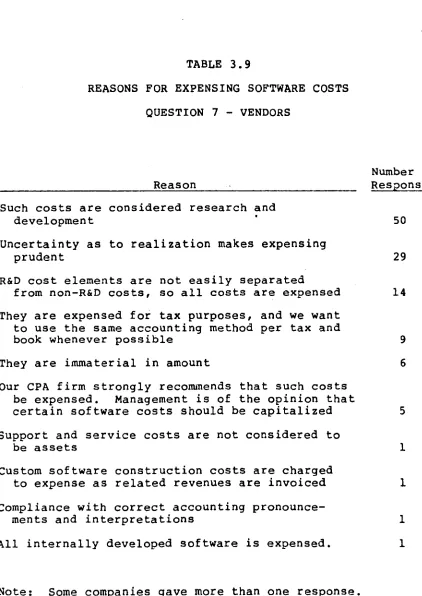
3.9
Reasons for Expensing Software Costs154
3.10
Accounting Policy for Reused Coding156
3.11
Accounting for Shared Development Costs158
3.12
Accounting for Future Maintenance Costs159
3.15
Software
Accounting
Policy and Its Effect on
the Interest
Rate on Borrowed Capital
169
3.16
Software
Accounting
PolICY and Investment
171
3.17
The Effect of Software
Account ing PoI icy on
Stock Price
173
3.18
The Eff ect of Software
Account ing PoI icy on
Long-Term Growth
175
3.19
Purchasing Software
in Order to Place on
BaIance Sheet
177
3.20
Percent Reduction in Net Income Resulting From
Expensing Rather Than CapitalIzing
Software
Costs
179
3.21
Use of R&D Partnerships
and Other Off Balance
Sheet Arrangements
181
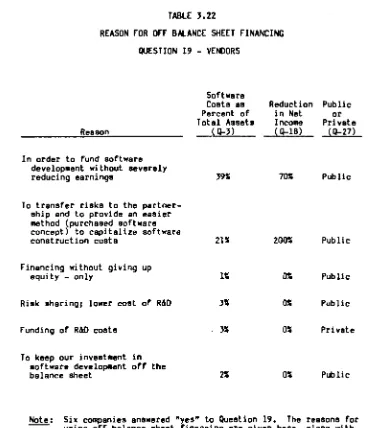
3.22
Reason For Off Balance Sheet Financing
182
3.23
Categories
of Software
Costs Upon WhIch Tax
Credits Are Taken
184
3.24
Comparison of Tax and Financial Statement
Treatment
of Software
Costs
187
3.25
Reasons for Differing
Book and Tax Treatment
188
3.26
Comparison of Arnortizat ion Method and TIme
Period for Financial
Statement
and Tax Purposes 190
3.27
Classificat
ion of Software
for Tax Purposes
191
3.28
Litigation
Involving
Sales Taxabillty
of Software
193
3.29
Public Accounting
Firm
196
3.30
Company SIze - Vendors
198
3.31
Privately
Held and Publicly
Held Companies
199
5.1
Matrix Summary of Software
Accounting
PolIcies
- PubliC Companies - Software
Users
216
5.2
Survey of Software
Accounting
Policies
-Software
User Companies
219
6.1
Amortization
Methods - Software
Users
240
6.2
Amortization
Time Period - Software
Users
241
6.3
Categories
of Capitalized
Costs for Internally
6.4
Account ing Treatment
of Software
That Is
an Integral
Part of the Hardware
246
6.5
Accounting
Treatment
of Software
Maintenance
and Enhancement Costs
249
6.6
Periodic
Financial
Review Policy
251
6.7
Software
Costs Appearing onBalance
Sheet as
a Percentage of Total Assets
252
6.8
Reasons for Capitalization
of Software
Costs
254
6.9
Reasons for Expensing Software
Costs
258
6.10
Balance Sheet Classification
of Capitalized
Software
261
6.11
Accounting
for Leased Software
263
6.12
Accounting
Treatment
of Software
Costs
265
6.13
Investment
Credit and R&D Credit
272
6.14
Classification
of Software
for Tax Purposes
275
6.15
Comparison of Tax and Financial
Statement
Treatment
of Software
Costs
278
6.16
Comparison of Amortization
Method and Tlme
Period for Financial
Statement
and Tax
Purposes
283
6.17
Company Profi le
287
6.18
Type of Company
289
9.IA
Question One Summary
347
9.1B
Question One Summary
349
9.2
Summary of Response to Quest ion No.2
358
9.3
Quest ion Three Summary
360
9.4
Question Five Summary
363
9.5A
Question Six Summary
364
9.5B
Question Six Summary
365
9.6
Question Eight Summary
367
9.7
Banks Approving a Term Loan for Campbell
-Summary of Restrrcttons
372
9.8
Bank Approving a Term Loan for Edwards
-Summary of Restrictions
373
9.12
Mann-Whitney
Test Applied To Table 9.4
403
9.13
Mann-Whitney
Test Applied To Table 956
408
9.14
Mann-Whitney
Test Applied To Table 9.6
413
10.1
Bankers Favoring Campbell and Edwards
418
10.2
Question One Summary
419
10.3A Question Two Summary
420
10.3B Question Two Summary
421
10AA
Quest ion Three Summary
423
10.48
Question Three Summary
424
10.SA Question Four Summary
426
10.58
Question Four Summary
427
10.SC Question Four Summary
428
10.6
Question Five Summary
430
10.7
Question Six Summary
431
10.8A Question Seven Summary
432
10.8B Quest ion Seven Summary
433
10.9
Question Eight Summary
434
10.1OAQuestion Nine Summary
442
10.10B8ank Preference By Size
443
10.11
Question Ten Summary
444
10.12
Question Eleven Summary
445
10.13
Question Twelve Summary
446
10.14
Comparison of Chapter 9 and Chapter 10 Responses 447
10.15
Wi lcoxon Matched-Pairs
Signed-Ranks Test
Applied To Table 10.48 Data
467
11.1
Percentage of $30,000 Allocated
to Campbell
and Edwards
483
11.2
Question Two Summary
485
11.3
Questions Three and Four Summary
487
l1A
Question Five Summary
489
11.5
Question Seven Summary
498
A. 1
Comserv Corporat ion: Software
Construct ion
as a Percentage of Revenue
746
A.2
Diagram of FAS8 Literature
Pertaining
to
A.3
Comserv
overview
Product Plannlng
and Construct ion Process
A4
Product Construction Activity
Flow
SUMMARY
This thesis represents the first
major research to be completed
either in the United Kingdom or the United States on the subject of
accounting for software.
Part I concentrates on the financial aspects
of software accounting, and consisted of in-person interviews
with a
number of individuals
from software' vendor and user companies who
are knowledgeable about software
accounting. The interviews
were
followed by two mai I Questionnaires, one each to software
vending
company executives
and software
user company executives.
The
NAARSdatabase was also used to determine how software accounting
policies
are disclosed
for
these two types of company.
It was
concluded that
more than one policy
exists
in practice.
While
approximately
90% of the companies surveyed expense internally
constructed
software,
about
two-thirds
capital
tze
the cost
of
purchased software.
Reasons given for
individual
company policy
seem to be based on expediency rather than good accounting theory.
The interviews
and Questionnaire responses in Part I seemed to
indicate that software
vendor companies that
cao:
tal ize software
find it easier to raise debt and equity capital
than do companies
which expense software
costs. Part II presents the results
of two
Questionnaires that were mailed to bank lending officers
and one
questionnaire that was mailed to financial analysts for the purpose of
obtaining
more information
on this point.
It was concluded that
companies that capitalize
software
costs find it significantly
easier
to obtain bank loans than do companies that expense software costs.
The effect
on stock
price
was
less
clear
cut,
although
the
Questionnaire
responses did
indicate
that
a company's software
accounting policy does influence the value a financial analyst places
on a company's stock.
CHAPTER ONE
BACKGROUND
In the decade following World War II, companies began to
use computers to solve business problems and process data to
an
ever
increasing
extent.
At
this
early
stage
in
the
development
of
the
computer
industry, .the
companies
that
manufactured
computer
hardware
also
produced
the
software
that was used with the machines.
These manufacturers
gener-ally sold the systems software as part of the hardware
with-out
breaking down
the purchase
price
into its hardware and
software
components.
The
companies
that
used
the
hardware
hired
employees
to
construct
whatever
"custom"
(individualized)
software
that
might
be needed.
Very
few
companies
constructed
systems
or
applications
software
for
sale apart from sales that were "bundled" with hardware.
As
the
use
of
computers
became
more
prevalent
in
the
1960s,
the demand
for custom
programming
increased and
led
to the development of a new industry that would supply these
software
users with
the programs
they needed.
However,
it
was
still
not
a
common
practice
to
purchase
application
programs
because
these were
supplied
free of charge by the
hardware manufacturer.
to state the cost of the software and hardware separately.l
This policy resulted in the creation of a new industry, the
software
industry, whose
members
began to produce
software
for
sale
to
users
of
hardware.
Companies
that
formerly
wrote
their
own
software
now
had
an
option
--
they
could
purchase
it.
This
option
became
very
attractive,
as
the
cost
of
developing
a
program
might
run
into
six or
seven
figures, whereas a comparable program could be purchased for
$50,000
or
less.
This
cost
relationship
led
to
a
rapid
increase
in
the
number
of
firms
that manufacture
software
for
sale,
as
a
program
that
might
cost
$1
million
to
construct
could
be
sold
to
a
multitude
of
customers
for
$50,000 each.
A software
firm would
be able to break even
after
only
twenty
sales.
Any
additional
sales
would
be
almost
pure profit,
as
the cost of delivering a program
is
basically equal to the cost of the medium used
(tape, disk,
etc.) plus selling expenses.
The Beginning of the Problem -- How to Account for Software
In the
same year
IBM decided
to unbundle, the Internal
Revenue Service
issued a pronouncement
addressing the
soft-ware issue.2
(See Appendix
0for full text)
This Revenue
Procedure
provided
tax
accounting
guidelines
in connection
associated with
the development
of software could either be
expensed as
incurred or capitalized and amortized over five
years or less.
Thus, software development costs were to be
accorded
the
same
treatment
as
research
and
development
costs3 for federal tax purposes.
Purchased
software
could
be capitalized
along wi th
the
hardware
if
bundled.
Software
having
a
separately
stated
price could be amortized
if treated as an intangible asset.
Leased
software
is
accorded
the
same
treatment
as
rentals
under regulation 1.162-11.
Two
years
after
that
pronouncement
was
issued,
the
Internal
Revenue
Service
issued
a
second
pronouncement
dealing with
software.4
(See Appendix D)
That ruling held
that
for
depreciation
and
investment
tax
credit
purposes,
the
cost
of
a
new
computer
includes
software
costs
not
separately
stated
but
capitalized
in
accordance
with
the
taxpayer's
consistent
practice.
Another
pronouncementS
issued that same year
(see Appendix D) held that the
capi-talization
of software costs with respect to a new computer
where such costs had previously been expensed is a change in
method of accounting requiring the Commissioner's consent.
What is Software?
accounting purposes, because it was accounted for as part of
the hardware. The few programs that were developed
inter-nally constituted such a small percentage of total
expen-ditures for most companies that a formal software accounting
policy was not needed.
However, as software expenditures continued to increase
and become more material, companies began establishing
spe-cific policies for software accounting. It was then that
the definition of software became important. Unfortunately,
there is no single readily accepted definition of software.
The broadest definition would be that software includes
everything that is not hardware.6 The definition of software
promulgated by the National Bureau of Standards
7
and adoptedby the U. S. Bureau of Standards 8 is: "Computer programs,
procedures, rules, and possibly associated documentation
concerned with the operation of a data processing system."
The Internal Revenue Service defines computer software
as:
" ...all programs or routines used to cause a
com-puter to perform a desired task or set of tasks,
and the documentation required to describe and
systems, monitors, compilers and translators,
assembly routines, and utility programs as well as
application programs are included. 'Computer
soft-ware' does not include procedures which are
exter-nal to computer ,operations, such as instructions to
transcription operators an~ external control
proce-dures.n9
Several courts and State legislatures have also defined
software. Some have even made distinctions between systems
software and applications software. (The argument could be
made that systems software is really part of the hardware,
whereas applications software is separate and distinct from
the hardware.> The Supreme Court of TennesseelO has defined
a systems (operational) program as one that is fundamental
to the functioning of the hardware, or software that
controls the hardware and makes it run.
Bryant and Matherll state that systems software consists
of:
1. compilers, which are used to translate
sym-bolic code into machine language, and which are
also capable of replacing a series of instructions
with subroutines:
2. sorts, which assemble and file items of data
3.
utility routines, which perform functions such
as
transferring
data
from
one
magnetic
tape
to
another.
The Tangibility Issue
Another problem that grew out of unbundling is the issue
of
tangibility.
The
Internal
Revenue
Service treats
soft-ware
as
intangible
and,
therefore,
not
eligible
for
the
investment tax credit unless bundled with hardware,12 but at
least
one
court
has
ruled
that
software
is
tangible
and
qualifies
for
the
investment
tax
credit.13
For
state
14
15
16 t
"the
.
.t
f
sales,
use,
and property
ax purposes,
maJorl y
0courts have held that software is intangible and, therefore,
not subject to the tax.
However, two recent cases have held
th
.
17
o
erWlse.
For
Uniform
Commercial
Code18 and
replevin19
purposes, software is tangible, but not for collapsible
cor-20
poration purposes.
(Replevin is a personal action brought
to
recover
possession
of
goods
unlawfully
taken.
A
collapsible
corporation
is
a
corporation
that
is
formed
for
the
purpose
of
converting
what
would
otherwise
be
ordinary
income
into
capital
gain. )
The
sale
of
a
prewritten
program
is
currently
taxable
in thirty-three
states
and
exempt
in
thirteen,
with
a
few
states
not
yet
Financial Accounting Rules
The present financial accounting rules pertaining to
computer software are far from clear. The Financial
Accounting Standards Board has issued several pronouncements
that deal wi th software to a limited extent. One
pronoun-cement21 requires that research and development costs must be
expensed as incurred unless an alternative future use
exists. (An example of al ternati ve future use would be
where an aircraft manufacturer constructs a wind tunnel to
test an experimental aircraft. If the company does not
intend to use the tunnel to test other types of aircraft,
the costs of constructing the wind tunnel would be expensed
as research and development. If the company intends to use
the tunnel for other projects, the cost of constructing the
tunnel would be capitalized rather than expensed.) Another
22
pronouncement states that not all software costs are to be
considered research and development costs. A third
23
pronouncement asserts that software costs not qualifying
as research and development expenditures are not necessarily
inventor iable or deferralbe. None of the FASB
pronounce-ments give clear guidance regarding when computer software
qualifies for capitalization treatment, and whether the
software costs should be included in the balance sheet
Interpreta-tion
No.6,
paragraph 8, footnote 2 seems to indicate that
software should be classified as intangible.24
The Accounting
Principles Board, the predecessor of the
Financial
Accounting
Standards
Board,
issued
a
pronounce-ment25
requiring
intangibles
acquired
from
others
to
be
recorded
as
assets
and
amortized
using
the
straight-line
method
unless
some other method
was more
appropriate.
The
Opinion went on to state that the cost of developing
intang-ibles
that
are
not
specifically
identifiable
should
be
expensed as incurred.
The issue of how to account for
iden-tifiable
internally developed
intangibles is not addressed,
and
it is questionable
whether
computer
software should
be
classified as intangible in any event, since the courts seem
unable to agree on the tangibility of software.
On
August
31,
1984,
the Financial Accounting
Standards
Board issued an Exposure Draft, entitled "Accounting for the
Costs
of Computer
Software to be Sold, Leased, or Otherwise
Marketed" ,
but
this
Exposure
Draft
does
not
address
the
issue
of
how
to
account
for
software
that
is intended for
internal use.
Furthermore, the Exposure Draft, in its
pre-sent form, has drawn much opposition from the accounting and
software manufacturing communities.
(See Note at the end of
typing, the Financial Accounting Standards Board issued
Statement No. 86, entitled "Accounting for the Costs of
Computer Software to Be Sold, Leased, or Otherwise Marketed"
(August, 1985). This final Statement differs only in minor
detail from the Exposure Draft.
The Stages of Software Development
Software development goes through a ser ies of stages.
The initial stage is the feasibility stage, the stage at
which it is determined whether going forward wi th further
developments is likely to be worthwhile. A certain amount
of conceptual design also occurs at this stage. If the "go
forward" decision is made, the next step in the software
product life cycle is detail design, which takes product
function, feature and technical requirements to their most
detailed, logical form. Some coding (program writing> might
occur at this stage as well, but most coding takes place
after a substantial portion fo the detail design phase has
been completed, at least in draft stage. Coding involves
writing a series of detailed instructions that will carry
out the requirements outlined in the detail program design.
The next stage is testing, which determines whether the
After
testing
has
been
successfully
completed
the
pro-duct is ready to use or market to others.
For some software
products,
additional
phases
lie
in the
future.
Much
soft-ware
goes
through
a
more
or
less
continuous
maintenance
phase,
in which
changes, additions and corrections are made
to the software,
either
to correct errors or to update the
software.
Enhancements
are
much
like
maintenance
except
improvements
to
existing
that
enhancements
are
substantial
products which tend to extend the product's life or
signifi-cantly
improve
its
marketabil ity.
Enhancements
generally
involve an alteration in the product's design.
Present
accounting
rules
(FASB
No.2)
require
that
research and development costs (R&D) be expensed as incurred,
and this pronouncement has drawn much attention, because the
exact
cut-off
point
between
R&D
and
post-R&D
expenditures
cannot
be
agreed
upon
by
the
accounting
profess ion or
the
software industry.
Some view the R&D expenditures as
encom-passing
feasibility,
conceptual
design
and
detail
design
costs.
Others view
the R&D expenditures as including only
feasibility
and
conceptual
design,
with
the
result
that
DEFICIENCIES IN CURRENT PRONOUNCEMENTS
FASB Statement No.2
FASB's
Statement on research and development26 provides
as much
ambiguity
as
it does guidance.
Paragraph SCa)
de-fines research as:
"••.planned
search or critical
investigation aimed
at
discovery
of
new
knowledge
with
the
hope
that
such
knowledge will
be useful
in developing
a new
product or service or a new process or technique or
in
bringing
about
a
significant
improvement to an
existing product or process."
Research
is an activity that occurs early in the
soft-ware construction process, and although FASB Statement No.2
requires that research expenditures be charged to expense as
incurred,
there
is little guidance
regarding which
activi-ties
should
be classified
as
research, and which
should be
classified as development.
Paragraph SCb) defines development as
" ••.the
translation
of
research
findings
or
other
knowledge
into a plan
or design
for a new product
existing product or process whether intended for
sale or use. It includes the conceptual
formula-tion, design, and testing of product alternatives,
construction of prototypes, and operation of pilot
plants. It does not include routine or periodic
alterations to existing products, production lines,
manufacturing processes, and other on-going
opera-tions even though those alterations may represent
improvements and it does not include market
research or market testing activities."
This def ini tion of development can be appl ied to
soft-ware accounting in two different ways. It could be
inter-preted to mean that the development phase does not end until
software construction is essentially complete, because
suc-cessful completion is uncertain until the development
pro-cess is nearly complete. For the development phase to end
it is necessary to have a working prototype. Lastly, the
fact that design modifications are needed throughout the
construction phase is evidence that development occurs
through that phase.
Another interpretation could be that the development
phase has essentially been completed before the construction
development phase. The formUlation, design and product
testing activities occur prior to the construction phase.
In fact, there must be a single product design before
con-struction can commence, and although testing occurs during
the construction phase, the testing at that stage involves
the product's operation rathe~'than the testing of
alterna-tive products. Furthermore, the software construction
pro-cess does not culminate in the production of a prototype or
the operation of a pilot plant, so these guidelines are
irrelevant for purposes of determining when the development
phase ends and the production phase begins. The key point
for determining when development has ended should be the
establishment of technological feasibility instead.
paragraph 31 states:
" •••Computer software is developed for many and
diverse uses. Accordingly, in each case the nature
of the activity for which the software is being
developed should be considered in relation to the
guidelines in paragraphs 8-10 to determine whether
software costs should be included or excluded. For
example, efforts to develop a new or higher level
of computer software capability intended for sale
(but not under a contractual arrangement) would be
The term "new or higher level of computer software
capa-b i1 ity" can be interpreted in several ways. If" new" is
interpreted in the technological sense, most software would
be exc 1uded,
rather than
as most software is developed
new technology. ", "New" could
using
also
existing
refer to
whether the product is new in the company sense, even though
developed wi th existing technology. "New" could also be
interpreted to mean new in the market sense. For example,
the first company to develop and market a payroll program
incurs development costs, but companies that later on develop
a similar product do not incur development costs.
The term "efforts to develop" could also be interpreted
in at least two ways. It could be interpreted to include
the whole construct ion process, which would place all
con-struction expenditures in the development phase. Or it
could be interpreted to mean that "efforts to develop" cease
prior to the construction phase. These two interpretations
lead to opposite results, as construction expenditures would
be classified as development costs calling for expense
treatment in the first instance, and such expenditures would
be nonresearch and development costs in the second instance,
Paragraph 9 of FASB Statement No.2 provides several
examples of activities that could be considered research and
development expenditures. These are:
(a) Laboratory research aimed at discovery of new
knowledge.
(b) Searching for applications of new research
findings or other knowledge.
(c) Conceptual formulation and design of possible
product or process alternatives.
(d) Testing in search for or evaluation of product
or process alternatives.
(e) Modification of the formulation or design of a
product or process.
(f) Design, construction, and testing of
pre-production prototypes and models.
( g) Design of tools, jigs, molds, and dies
involving new technology.
(h) Design, construction, and operation of a pilot
plant that is not of a scale economically
feasible to the enterprise for commercial
(i) Engineering activity required to advance the
design of a product to the point that it meets
specific functional and economic requirements
and is ready for manufacture.
The first four activities generally occur prior to the
construction phase. The fifth example, "modification of the
formulation or design of a product or process," can occur
throughout the process, but occurs only to a minimal degree
once the construction process begins. As was previously
mentioned, design modifications can be viewed as either
occurring as part of the development phase or as part of the
construction phase after development is completed.
Examples
(f)
through (h) are viewed by some as not beingapplicable to software accounting. The end product is not a
prototype, but ra ther is the product itsel f. Others view
the prototype as being the end product itself in the case of
software, which would place the entire software construction
process within the definition of research and development
and, therefore, subject to expense treatment.
The last example relates to engineering activity. One
view holds that manufacturing is merely the duplication of
the program once the program is ready to market, and that
development. others view all engineering activity as
occurring prior to construction.
Paragraph 10 lists examples of activities that typically
would be excluded from research and development. These
activities include:
(a) Eng ineering follow-through in an early phase
of commercial production.
(b) Qual ity control during commercial product ion
including routine testing of products.
(c) Trouble-shooting in connection with
break-downs during commercial production.
(d) Routine, on-going efforts to refine, enrich,
or otherwise improve upon the qualities of an
existing product.
(e) Adaptation of an existing capability to a
par-ticular requirement or customer's need as part
of a continuing commercial activity.
(f) Seasonal or· other per iod ic des ign changes to
existing products.
(h) Activity, including
engineering, related
des ign and
to the
construction
construction,
relocat ion, rearrangement, or start-up of
facilities or equipment other than (1) pilot
whose sole use is
(2) facilities or equipment
foz' a particular research
plants
. .
.
andand development project •
. .
.
(i) Legal work in connection with patent
applica-tions or litigation, and the sale or licensing
of patents.
The first three examples are subject to several
inter-pretations. These activities could be viewed as occurring
only after sales have commenced, and that similar activities
that occur during construction are part of development.
Another view is that these activities constitute
construc-tion and post construction activities, which is a further
indication that construction costs should not be considered
part of development.
FASB Interpretation No.6
Another PASB pronouncement states that:
" •••costs, including those incurred for programming
costs when incurred in the search for or the
eval-uation of product or process alternatives or in the
design of a pre-production model."27
The phrase "search for or the evaluation of product or
process alternatives" is subject to varying interpretations,
as was prev ious ly men t ioned, depend ing on whether deve
lop-ment is regarded as being virtually complete at the
begin-ning of construction or at the end. The term "preproduction
model" is not defined and its meaning is not clear as applied
to sof tware. The preproduction model could be interpreted
to mean the same thing' as a prototype, and all costs
incurred prior to the completion of the prototype could be
viewed as research and development costs. Another view is
that preproduction models are not made for software, although
systems makeups or product simulators are sometimes made
prior to construction.
This pronouncement also states that:
" •••costs for programming and testing are not
research and development costs when incurred, for
example, in routine or other on-going efforts to
improve an existing product or adapt a product to a
This statement could be interpreted to mean that
pro-gramming and testing costs are not research and development
expenditures only when they are incurred to improve an
existing product or adapt a product to a particular
require-ment or customer's need. Or it could be interpreted less
restrictively to exclude programming and testing costs from
class if icat ion as research and development for acti v ities
other than those given in the example. Furthermore, it
could be argued that zeroing in on the costs associated with
product improvement or adaptation misses the point entirely,
and that the issue to be addressed should be accounting for
construction costs. Lastly, one could conclude by a literal
reading of the Interpretation that all enhancement costs
should be class if ied as nonresearch and development.
How-ever, it could be argued that such a view is not reasonable.
The process involved in producing enhancements to an
existing product is essentially the same as that for a new
product, and some of the costs involved in the construction
of a new product are research and development costs.
Technical Bulletin No. 79-2
This pronouncement states that:
" •••all costs incurred in producing a given
and development costs. However, a determination
that software production costs are not research and
development costs does not necessarily mean that
they would be inventoriable or deferrable to future
operations. Those decisions can only be made in
light of all of the facts and circumstances
sur-rounding the particular situation.H29
From reading this pronouncement one can quickly conclude
that very little guidance, if any, is being provided. The
issue of which costs should be classified as research and
development is not addressed. Although there is a hint that
certain costs may be deferrable or inventoriable under
cer-tain circumstances, there is no suggestion elaborating on
when such circumstances might arise.
RELATED PRONOUNCEMENTS
Another approach might lie through a consideration of
generally accepted accounting practicesin industries which
in their technology or structure might seem not dissimilar
to the computer software industry. Such practices, together
with their supporting institutional or legal pronouncements,
might offer a framework within which detailed
recommen-dations for software accounting could be developed.
-22-The Record and Music Industry
The argument can be made that the cost of producing a
record master is similar to the cost of producing a computer
program. In both cases:
1. the majori ty of the product's value is the
result of the labor that is expended rather
than the material that is used:
2. logical patterns must be developed (coding or
music, either in written or nonwritten form)
and transferred onto a physical medium such as
a record, tape or disk (although this is not
necessarily
which may
computer) :
the case for a computer program,
be input directly into the
3. the value of the finished product far exceeds
the value of the material upon which the
coding or music is recorded:
4. both records and computer programs developed
for sale have estimated economic lives and
projected income streams that are difficult
The National Commission on New Technological Uses of
Copyrighted Works stated that:
"Both recorded music and computer programs are sets
of information in a form which, when passed over a
magnet ized head, cause minute currents to flow in
such a way that
accomplished."30
desired physical work is
On the other hand, it can also be argued that records
are of a different nature than computer programs that are
recorded on disks or tapes.3l For example, when information
is transferred from a tape into the computer, the tape is no
longer of any value to the user. In many cases, the tape is
not even retained by the user. It may be discarded or
returned. The information on the tape, unlike a phonograph
record, is not complete and ready to be used at the time of
its purchase. It must be translated into a language that is
understood by the computer.
Secondly, a computer tape or disk is not necessary to
transmit information. Such information can also be sent
over telephone wires or by satellite, or may even be
In late 1981, the Financial Accounting Standards Board
issued a Sta tement 'that permi ts the capital izat ion of a
record master in instances where past performance and
current popularity of the artist provides a sound basis for
estimating that the cost will be recovered from future
sales.
"The portion of the cost of a record master borne
by the record company shall be reported as an asset
if the past performance and current populari ty of
the artist provides a sound basis for estimating
that the cost will be recovered from future sales.
otherwise, that cost shall be charged to expense.
The amount recognized as an asset shall be
amor-tized over the estimated life of the recorded
per-formance using a method that reasonably relates the
amount to the net revenue expected to be
real-. d "32
lze •
That same statement yoes on to define record master as:
"The master tape resulting from the performance of
the artist. It is used to produce molds for
in mak ing cartr idges, cassettes, and reel tapes.
The costs of producing a record master include (a)
the cost of the musical talent (musicians, vocal
background, and arrangements): (b) the cost of the
techn ical ta lent for eng ineer ing, direct ing , and
mixing: (c) costs for the 'use of the equipment to
record and produce the master: and (d) studio
faci-l't1 Y c arges.h • •"33
In its comment letter to the Exposure Draft that
even-tually became statement No. 50, Coopers & Lybrand suggested
tha t the language of the Sta temen t be changed to spec if
i-, 1 d ' b Li h 34 " 1 '
cally lnc u e mUS1C pu 1S ers. Slml ar suggestlons were
made by other respondents,35 and to also include record
pro-ducers and songwriters.36
Motion Picture Films
Another Statement that might be related to computer
software costs is FASB Statement No. 53, "Financial
Report-ing by Producers and Distributors of Motion Picture Films,"3?
which allows the capitalization of film production costs.
This Statement requires that film production costs be cap
i-talized as film cost inventory and be amortized using the
individual-film-forecast-computation method38 or the
individual-film-forecast-computation method amortizes costs in the ratio of current
gross revenues to ant ic ipa ted total gross revenues, wi th
adjustment for periodic changes in estimate.40 The
periodic-table-computation method amortizes film costs using the
historic revenue patterns of a large group of films.41
The analogy of motion picture films to software has also
been made in several court cases, and several court cases
deal ing wi th sales, use, property or federal taxat ion of
motion picture films or master negatives have been cited by
heari ft' 42
courts earlng so tware ax lssues.
Preliminary Conclusions and Relevance
Although software has many similarities and differences
with both film-making and the record industry, it appears
that the similarities substantively outweigh the differences.
In all cases, the value of the finished product is primarily
attributable to the labor that was expended to bring the
product into existence rather than the amount of material
that went into the manufacture of the product. It is the
recorded logical patterns that have value, not the material
that contains those patterns. All three products have
pro-jected economic lives and income streams that could
conceiv-ably exceed one accounting period, which would seem to make
the program is stored (disk, tape, etc ,) may be discarded
may be offered as further evidence that the value is in the
information rather than the physical medium being used to
store the information.
Because the manufacture of computer software has so much
in common with the manufacture of records and films, it
would seem logical that the accounting treatment for all
three items should be similar in the interest of consistency.
In fact, justifying a different treatment for software than
for mov ies and records would seem to be di ff icul t indeed.
Record and film masters perform the same funct ion as the
software product that is coded, tested and debugged. Each
is used to produce copies for sale or use. But the issue is
more complex than this, as we shall see below.
Research and Development Arrangements
Another FASB statement43 addresses the topic of research
and development arrangements. During the course of several
interviews conducted as part of this research project, it
was pointed out that some software vending companies enter
into research and development arrangements so that they can
treat costs that would otherwise be expensed as assets
instead. These arrangements may be structured so that a
that would otherwise be constructed internally, and then
sells the finished software product to the arranging firm,
which then promptly records the software as an asset. Had
the software been constructed internally instead, there
would be pressure to expense the construction cost as
research and development. The survey that was rnailed to
software vendors bore this theory out to a limited extent,
although the responses revealed that a very small percentage
of software vendors participate in research and development
arrangements, and those that do have valid business reasons
for doing so apart from the benef ic ial f inanc ial statement
effect.44
SOFTWARE
COSTS:
SHOULD
THEY
BE CAPITALIZED
OR EXPENSED?
Prior to June, 1969, when IBM unbundled, this question
was a non-issue. Software costs were included in the price
of the hardware and were amortized over the useful life of
the hardware. After IBM began stating their software prices
separately from their hardware prices, and as firms began to
develop their own software, this question began to be raised
with increasing frequency. Over the past two decades,
soft-ware costs have become an increasingly important expenditure
in most corporate budgets. While it was easy to expense
materiality, it has become increasingly difficult to state
"emphatically that software expenditures are immaterial when
they continue to increase every year.45
FASB Concepts Statement No.3, defines assets as:
" •••probable future economic benefits obtained or
controlled by a particular entity as a result of
past transactions or events."
The Statement goes on to say that:
"An asset has three essential characteristics: (a)
it embodies a probable future benefit that involves
a capacity, singly or in combination with other
assets, to contribute directly or indirectly to
future net cash inflows, (b) a particular
enter-prise can obtain the benef it and control others'
access to it, and (c) the transact ion or other
event giving rise to the enterprise's right to or
control of the benefit has already occurred."
Expenses, on the other hand, have doubtful future
econo-mic benefit (to carry the FASB reasoning one step further).
that has probable future economic benefit should be recorded
as an asset and amortized over its estimated economic life.
Software having doubtful future economic benefit should be
expensed. Unfortunately, the answer is not quite that
, 1 t t f '1" 46
simp e. Some accoun an s argue or cap rta 1za tion while
others continue to argue for expense treatment.47 Several
48
articles have addressed the topic in recent years, and it
appears that the issue will continue to be in the news for
the next few years. The AICPA has formed a task force to
study the issue, 49 and the Securi ties and Exchange
Commis-sion has imposed a moratorium on the capitalization of
cer-tain software costs.50
The Controversy
The controversy, simply stated, is deciding whether
software costs should be classified as assets or expenses.
However, the question is more than just philosophical. The
choice chosen can affect a company's earnings and its
abil-ity to raise capital. There are at least 4,000 companies in
the United States that construct software for sale. For all
of these companies, software expenditures are a significant
percentage of net income, and choosing to classify software
expenditures as assets or expenses can make the difference