UNIVERSITY OF TWENTE
Master Thesis
Self-Directed Learning at the Workplace:
the Role of Others
Lin Longquan Dr. Maaike Endedijk
Drs. Maria Hendriks
8/22/2012
1
Table of Contents
Contents
1 Preface ... 3
2 Introduction ... 4
2.1 Background ... 4
2.2 SDL ... 4
2.3 Advantages of SDL ... 5
2.4 SDL Activities ... 6
2.5 The Roles of Self and Other in SDL ... 7
2.6 Objects of Regulation ... 8
2.7 Overview of the Study and Research Question ... 8
3 Literature review ... 9
3.1 Literature Review Method ... 9
3.2 Findings of Literature Review ... 9
3.2.1 Task-oriented SDL ... 9
3.2.2 Interest-oriented SDL ... 12
3.2.3 Job-oriented SDL ... 15
3.2.4 Career-oriented SDL ... 18
3.3 Conclusion of the Literature Review ... 23
3.3.1 Task-oriented SDL’s Phases /Important Activities ... 23
3.3.2 Interest-oriented SDL’s Phases /Important Activities ... 24
3.3.3 Job-oriented SDL’s Phases /Important Activities ... 24
3.3.4 Career-oriented SDL’s Phases /Important Activities ... 25
4 Empirical Questions ... 26
5 Method... 28
5.1 Reliability and Validity of the Instrument ... 28
5.2 Participants and Procedure ... 30
5.3 Data Analysis ... 30
6 Result... 31
6.1 Descriptive Analyses of Passiveness of Regulation, Retrospectiveness of Regulation, Support Amount, and SDL Quality ... 31
6.2 The Relation between Support Sources and Support Types ... 34
6.3 The Relation between Other’s Support and Measurement Moments ... 36
6.4 The Relation of Other’s Support and SDL Quality ... 39
6.5 The Relations between Other’s Support and Regulation Activities ... 43
6.5.1 The Relations between Support Amount and Regulation Activities ... 43
6.5.2 The Relations between Support Sources and Regulation Activities ... 45
6.5.3 The Relations between Support Types and Regulation Activities ... 46
2
6.6.1 What Support Amount and SDL Quality did Pre-service Teachers Get? ... 49
6.6.2 What are the Relationships between Support Sources and Support Types? .. 49
6.6.3 How does Other’s Support Vary through the Program? ... 49
6.6.4 What are the Relationships between Other’s Support and the Quality of Pre-service Teachers’ SDL? ... 50
6.6.5 What are the Relationships between Other’s Support and different Regulation Activities? ... 50
7 Discussion ... 52
8 References ... 55
9 Appendix 1 ... 60
10 Appendix 2 ... 75
3
1
Preface
4
Self-Directed Learning at the Workplace:
The Role of Others
2
Introduction
2.1
Background
The knowledge economy brings both opportunities and challenges to organizations and employees in the twenty-first century. Firstly, knowledge economy expects organizations to keep improving and learning in order to stay competitive and transform information, knowledge, and opportunities into financial profit and organizational sustainability (Cho & Kwon, 2005). Secondly, knowledge economy also changes the traditional relationship between employees and employers (Raemdonck, 2006). Furthermore, knowledge economy requires employees to take more responsibility to improve their competence and also direct their own career paths (Raemdonck). Thus, in the knowledge economy, the importance of knowledge is self-evident (Ulbrich, Scheir, Lindstaedt, & Gortz, 2006).
Both employees and organizations shall take responsibility for the continuous-development of knowledge. If organizations want to stay competitive in the knowledge economy, their employees’ success to self-direct their learning at work is supposed to be one important key (Cho & Kwon, 2005). SDL (self-directed learning) constantly enhances employees’ competence while they are still working on their jobs (Ulbrich et al., 2006). This is a challenging but necessary process. Most of the time, employees learn by themselves in their daily work setting or some less informal environments (Campbell, 1991). But, employees should not be just left alone in SDL and organizations shall facilitate employees with supportive organizational settings, resources and opportunities (Confessore & Kops, 1998).
2.2
SDL
There are various definitions for the concept of SDL. Most definitions have tried to describe either its process or SDL employees’ characteristics. Among those definitions, Knowles’ work, which has been often cited in the process-perspective studies, defined SDL as “the process in which individuals take the initiative, with or without the help of others, in diagnosing their regulation needs, formulating learning goals, identifying human and material resources for regulation, choosing and implementing appropriate regulation strategies and evaluating regulation outcomes” (Knowles, 1975, p. 15). During the SDL process, employees themselves shall have the ability to design, organize, and monitor their SDL activities (Willams, 2010).
5
evaluate their regulation experiences (Willams, 2010). Employees who conduct SDL are often very proactive and self-motivated to initiate and regulate learning activities in their work, which also helps them to solve work-related problems (Gijbels, Raemdonck, & Vervecken, 2010). Taking self-initiative implies that employees themselves shall set their own goals and take control in the regulation process (Gijbels et al.). Employees often have an increasing self-concept and direction when they have more useful experience and resources for their SDL (Raemdonck, 2006).
SDL is a popular topic and there are many other perspectives on the concept. Sometimes researchers use SRL (self-regulated learning) as a synonym of SDL (Loyens, Magda, & Rikers, 2008). On one hand, SRL and SDL share many similar components. Both concepts require employees to follow a goal-guided planning and keep proactive in the regulation process (Loyens et al., 2008). Employees’ intrinsic motivation is a crucial element in both SRL and SDL (Loyens et al.). On the other hand, SRL and SDL have some differences in their regulation focuses (e.g., which one focuses on the long-term goals), regulation control (e.g., which one offers employees more control over the regulation process), design of regulation process (e.g., which one gives employees more freedom to design their regulation process), strategy application (e.g., whose strategies can be used directly in other situations) and influences from the regulation environment (e.g., which one encourages employees to create a new learning environment) (Evensen, Salisbury-Glennon, & Glenn, 2001; Hout-Wolters, Simons, & Volet, 2002; Jossberger, Brand-Gruwel, Boshuisen, & van de Wiel, 2010; Loyens et al.). SRL usually takes place in domain-specific situations where strategies employees have used could not be applied to other situations directly (Evensen et al.). SRL is more individual-oriented and SDL is more collective-oriented (Volet, Summers, & Thurman, 2009). For some studies, internal factors (e.g., employees’ characteristics) are described as an important component in SRL while external factors (e.g., regulation environment) have more influences in SDL (Loyens et al.). SDL came from the field of adult learning. This study chooses to use SDL instead of SRL because SRL originated from the traditional school setting, while employees’ learning at the workplace happens in an informal setting most of times (Jossberger et al., 2010).
2.3
Advantages of SDL
6
goals” (Cho, 2002, p. 467).
Compared to traditional ways of employees’ professional development such as formally structured trainings and workshops, SDL can save much time and money for organizations (Cho & Kwon, 2005). With a focus of continuality, SDL does not require employees to invest an intense effort or time within a short period because it is embedded into their daily work (Sitzmann & Ely, 2011). Also, SDL could avoid the disadvantage of knowledge transferring discrepancy which has been often criticized in classroom-based training programs (Sitzmann & Ely). Furthermore, SDL has a bigger possibility to satisfy employees’ diverse learning needs and job demand, which shall help to increase the organizational effectiveness in return (Manz & Manz, 1991). In SDL, employees themselves shall always play a very important part by taking different ways such as “self-generation, self-monitoring, self-reflection, and self-assessment” (Loyens et al., 2008, p. 424). Many SDL activities are similar to activities in employee development. “Employee development typically refers to a broader set of activities that have both learning and career development goals, such as talent development, job rotation, degree programs, special courses, and mentoring relationships, to achieve individual and organizational goals” (Y. Park & Jacobs, 2011, p. 438).
2.4
SDL Activities
SDL process usually has three phases: orientation, performance, and reflection (Confessore & Kops, 1998). Employees identify regulation opportunities, analyze information and environmental conditions, select and adjust strategies, and evaluate their regulation experiences (Confessore & Kops). Employees themselves can design SDL activities. Sometimes these activities can differ variously (Loyens et al., 2008). For example, one study focused on identifying regulation needs and goals in the orientation phase (Boekaerts, 1999). But one other study paid more attention to analyzing resources and selecting strategies in the orientation phase (Cho & Kwon, 2005). One study used 8 regulation activities to summarize general SDL elements (Endedijk, 2010).
The orientation phase consists of self-efficacy, goal orientation, and strategic planning (Endedijk, 2010). Firstly, self-efficacy refers to how much confidence employees believe themselves have the capability to successfully carry out SDL activities (Loyens et al., 2008; Schunk, 2005). Secondly, goal orientation is among the reasons why employees themselves want to carry out those SDL activities (Schunk; Zimmerman, 2002). Goal orientation and self-efficacy are also part of SDL.
Goal-orientation and self-efficacy can predict employees’ motivation and possible regulation outcomes (Jossberger et al., 2010). Thirdly, strategic planning expects employees to make clear smaller goals, list and choose suitable strategies, construct possible procedures, and anticipate possible problems (Ertmer & Newby, 1996).
7
take actions for their SDL (Ertmer & Newby).
The performance phase consists of monitoring of the learning process, and
regulation strategy control (Endedijk, 2010). Firstly, monitoring of the learning process is the real process in which employees have self-awareness and abilities to actually control and manage regulation activities (Loyens et al., 2008). Secondly,
regulation strategy control means that employees themselves process and analyze information of their regulation tasks. Regulation strategy control helps employees to understand their regulation results and to discover deeper meanings or principles (Loyens et al.).
The reflection phase consists of self-reflection on the regulation outcomes, self-evaluation of the regulation experience, and inferences of subsequent regulation experience (Endedijk, 2010). Firstly, in the self-reflection on the regulation outcomes, employees carry out attribution (attributing successful or unsuccessful regulation outcomes to causal reasons) and self-reaction (whether they are satisfied with the regulation outcomes). Secondly, self-evaluation of the regulation experience is to evaluate employees’ regulation performance with their initial planning and targeted standards (Ertmer & Newby, 1996). Thirdly, inferences for subsequent regulation experiences are sometime called as forethought. It can be understood as that, by analyzing future regulation tasks and assessing self-motivation, employees connect current regulation experiences to possible future regulation experiences (Zimmerman, 2002).
2.5
The Roles of Self and Other in SDL
So far, I have discussed the general background of SDL, its definition, advantages and regulation activities. There is still one missing component of SDL we need to know about—people, employees who carry out these activities and other stakeholders who are involved in the SDL process.
The importance of the learner himself in self-directed learning is obvious. Employees themselves have most control and responsibility for their regulation. The regulation process and regulation results of SDL could be influenced by many of their personal factors. In SDL, internal factors are important determinants of their regulation outcomes. Internal factors include task values, goal expectation, perceptions of task, regulation difficulty, and self-efficacy (Jossberger et al., 2010). However, sometimes different persons who have almost same backgrounds and abilities in the same organizations have totally different regulation processes and outcome in their SDL (Latham & Locke, 1991). Thus, this study also raised this common phenomenon and indicated that employees’ SDL difference could be much influenced by others (Latham & Locke).
8
involve others. Some studies explored how SDL will be influenced by other people. For example, managers or supervisors also share responsibility in employees’ SDL (Campbell, 1991). Managers could have several influences in SDL: first, they shall propose challenging but achievable tasks or projects, in which employees can find regulation opportunities; second, they help to create a supporting and friendly working environment; third, they can give feedback, appraisal or rewards if employees manage to make a big progress in work performance and learning (Campbell). Employees shall have responsibility and control about the regulation activities, content, and strategies, but they also need other people’s support (Loyens et al., 2008). “Adult learners can and do seek a variety of ways to gain assistance from others in order to become more self-directed learners” (Cho, 2002, p. 467). Other’s support can be measured by support amount, support sources, and source types. Support amount refers to how much support they get during SDL process; support sources refer to whom or what has given them support (e.g., colleagues); support types refer to what support they have received (e.g., direct or indirect feedback). Other’s support usually has much variation during the SDL process (Grow, 1991). For example, some employees need a larger amount of support in the beginning of their regulation process than the support amount they need in the later period of their SDL process (Unger, Keith, Hilling, Gielnik, & Frese, 2009).
2.6
Objects of Regulation
In workplace learning, employees improve their work-related information, knowledge and skills (Park & Jacob, 2011). Employees can regulate their job satisfaction, organizational commitment, and work motivation (Park & Jacob). In the past, researchers often regarded SDL as a way for employees’ personal development; nowadays, it is increasingly recognized as an effective way to both enhance work performance and personal development (Cho, 2002). Employees can regulate “practical skills, intrapersonal skills, interpersonal skills” (Cofer, 2000, p.3). These skills will improve their work performance. In different situations with different regulation focuses, employees shall regulate their strategies. Employees shall regulate interpersonal skills because sometimes SDL opportunities come from their communication and cooperation with other people. Employees can also regulate their environment. Employees shall consider whether it is necessary to create a new regulation environment in order to conduct an effective application of regulation strategies (Cho). One study summarized some general objects for employees in SDL: reinforce their lifelong learning, problem-solving ability, cooperating and communicating skills, information selection and transformation, discover themselves (Costa & Kallick, 2004).
2.7
Overview of the Study and Research Question
9
and different perspectives of the subject in order to understand problems better (Swanson & Holton, 2005).
First, we will conduct a literature review as the qualitative method to explore more about employees’ SDL at the workplace. More detailed questions of literature review will be discussed in the following paragraph.
SDL has been introduced in the previous paragraphs. Its advantages and importance to employees and organizations in the knowledge economy cannot be neglected. Both employees and others play a role in the regulation. SDL is quite a broad concept. It seems that there might be different definitions, regulation focuses, various activities or objects of SDL. However, we don’t know yet how to define different perspectives of SDL at the workplace and what regulation activities they have. Without such a general overview, it is quite difficult for us to have a well understanding about what SDL means to employees at the workplace. So we hope we can answer this with findings from the literature review. Our main question is whether there are different perspectives of SDL at the workplace. It can be split into two sub-questions:
What are definitions fitting for different perspectives of SDL? What are regulation activities in different perspectives of SDL?
3
Literature review
3.1
Literature Review Method
Search terms were formulated by combining “Self-regulated learning OR self-directed learning OR SDL OR SRL OR self-regulation” AND “company* OR business* OR work* OR workplace* OR job* OR organization*”. These terms were searched in two sources: databases (ERIC with 40 hits, Web of Science with 54 hits, Scopus with 28 hits), and SAGE Journals with 18 hits (including Human Resource Development Review, Advances in Developing Human Resources, Human Resource Development International, Human Resource Development Quarterly). All articles from databases had been peer-reviewed. The relevance of an article is decided by reading its key words, research question and findings in its abstract. Low relevant articles were excluded after reading abstracts of all 140 hits. Then, most articles found in Google Scholar were overlapping with databases and SAGE Journals. Finally, 6 articles were added after consulting a subject expert. In total, 64 articles were included in two rounds of selection.
3.2
Findings of Literature Review
3.2.1
Task-oriented SDL
10
(Jossberger et al., 2010; Pintrich, 2004; Schunk, 2005; Torrano & Gonzelez, 2004; Wolters, Pintrich, & Karabenick, 2005; Zimmerman, 2002). Employees and supervisors anticipate results of targeted tasks, gather facilitating conditions, design and implement their planning (Kremer-Hayon & Tillema, 1999). Employees’ SDL on this level is at an unconscious state because they pay more attention to their task achievement process (Nieuwenhuis & Van Woerkom, 2007). In task-oriented SDL, employees do not come up with tasks or set goals themselves. In essence, they are not in control of their task-oriented SDL (Schunk).
One study summarized several underlying assumptions when employees conducted the task-oriented SDL: first, employees did not design their tasks, but they had much control of key activities in their task performance process; second, they were able and willing to regulate their knowledge and behaviors during this process; third, task goals were very important and necessary for them to evaluate their task performance and to regulate SDL if they were also aware of SDL; four, besides personal and organizational factors, their SDL quality would also influence their task performance (Schunk, 2005).
A three-phased SRL process is activated after they receive a clear task. The orientation phase covers task goal setting (or receiving), planning, analyzing self and task; the performance phase is about monitoring, controlling and regulating their task performance; the reflection phase focuses on their reaction toward the task result, and their reflection on the process and themselves (Pintrich, 2004). These three stages follow a chronological order as employees conduct their tasks (Wolters et al., 2005).
3.2.1.1
Sub-phases/Regulation Activities
3.2.1.1.1
Orientation
In the orientation phase of task-oriented SDL, employees analyze the task, receive goals, anticipate possible results, formulate an appropriate plan and select suitable strategies for the task (Jossberger et al., 2010). During this preparation process, employees also analyze task requirements and their individual resources in order to predict potential problems (Jossberger et al.).
11
et al., 2010). Thirdly, another important activity is goal-setting. In their planning, employees could set up different levels of goals, among which most of them are performance goals while one or none of these goals might emphasize their learning during the task accomplishment (Torrano & Gonzelez). Often, learning goals are weighed after task performance goals in task-oriented SDL (Zimmerman, 2002). These goals or standards will be used in the monitoring activities during the performance phase (Pintrich, 1999). Some research results showed that, in most cases, task-oriented SDL could be understood as unconscious or even unexpected learning process since employees were unaware of also being learners when they were focusing on performing tasks (Van Eekelen, Boshuizen, & Vermunt, 2005).
3.2.1.1.2
Performance
In the performance phase of task-oriented SDL, employees implement their plans, monitor, adjust behavior to accomplish goals, observe themselves and manage learning process. Among these activities, monitoring is very important because it helps individuals to constantly compare their current performance with their pre-made planning and update things they still need to do in order to achieve task goals (Jossberger et al., 2010). Behavior adjustment usually happens when their pre-made planning is not working as well as they have planned (Jossberger et al.). Behavior adjustment includes re-allocating their effort and time when their task conditions have changed (Schunk, 2005). Employees can evaluate the effectiveness of their selected strategies by conducting self-control and self-observation (Jossberger et al.). These activities help employees to be conscious about the ongoing situation of their tasks, cognition, and motivation (Torrano & Gonzelez, 2004).
Among the activities mentioned in the last paragraph, an explanation of self-control and self-observation is necessary in order to avoid confusion. Self-control applies the chosen strategies from the preparation phase and self-observation records the effect of these strategies (Zimmerman, 2002). “Self-control includes task strategies, imagery, self-instruction, time management, environmental structuring, and help seeking, whereas self-observation includes self-monitoring and self-recording” (Jossberger et al., p. 12). However, in the real practice, it is really difficult for people to differentiate self-control and self-observation during their regulation process (Torrano & Gonzelez, 2004).
3.2.1.1.3
Reflection
12
evaluate regulation outcomes (Ertmer & Newby, 1996; Jossberger et al., 2010; Torrano & Gonzelez, 2004; Wolters et al., 2005; Zimmerman, 2008). Activities during the reflection stage usually could provide much feedback about their performance and SDL. Reflection activities are very important if employees want to maintain a follow-up SDL process because these activities can help employees to connect their previous learning experience with the task-performance experience, which could create post-task opportunities for them to learn from practical experience and for possible future task-accomplishment (Jossberger et al.). Among these activities, three frequently-used ones are self-reaction, self-evaluation, and attribution. They will be explained in following three paragraphs.
Firstly, employees will have self-reaction in most cases. Self-reaction can be understood as employees’ motivational, behavioral reaction about their task performance and regulation progress (Schunk, 2005). Motivational reaction refers to whether they like the result or not, while behavioral reaction refers to cognitions about their behaviors such as the efficiency of their time (Schunk).
Secondly, employees usually have self-evaluation after self-reaction. Evaluation activities of task performance could be conducted by comparing either to standards from employees and supervisors, or to performance of other employees, even to comparable task which they have done before (Torrano & Gonzelez, 2004; Zimmerman, 2008). Environmental evaluation encourages employees to judge whether the organizational setting is supporting their learning and task performance. If the organizational setting is not supporting, they shall consider whether it needs to be improved for their future regulation experience (Schunk, 2005). Evaluation activities in the reflection phase have a close correlation with self-monitoring activities in the performance phase because they all compare performance with goals and standards from the planning (Pintrich, 1999).
Then, another activity in the reflection phase is attribution. Attribution enables employees themselves to ask questions such as how well their performance is, how good the planning quality is, how many problems has been predicted beforehand, whether their selected strategies are efficient or not, what helps them to accomplish the task, what new knowledge and learning experience they go through. These questions help employees to think about reasons why they have success or failure (Torrano & Gonzelez, 2004).
3.2.2
Interest-oriented SDL
13
them to apply and control strategies to attain targeted task performance and also SDL regulation results (Straka). Interest will decide the extent to which employees can connect themselves with their tasks (Loyens et al., 2008).
In interest-oriented SDL, employees try to transform assigned tasks and organizational goals into personal goals and learning interests. Employees themselves want to learn and these learning goals are a manifestation of their psychological needs, which may be possible to express in some tasks and impossible to be fulfilled in some other tasks (Boekaerts, 1999). Their self-knowledge, motivation, and affect will also influence how employees value the outcome and guide their own behavior (Straka, 2010). Employees believe that more effort will lead to good learning and performance results, and they value this regulation process (Schunk, 1990). Since they receive assigned task and design learning goals themselves, goal-setting is also an important construct in this level of SDL (Straka). One another study used two directions to describe the goals of employees’ interested-oriented SDL, “either to support work performance for personal goals, or to result in innovation, creativity and enhanced capabilities for organizational goals” (Clardy, 2000, p. 116). While the emphasis has been their performance goals in the task-oriented SDL, employees could pay more attention to their learning goals in this interest-oriented SDL (Van Eekelen et al., 2005). Another relevant construct is employees’ self-efficacy, which portrays their own perceived personal abilities for learning and performance goals (Schunk).
3.2.2.1
Sub-phases/Regulation Activities
3.2.2.1.1
Orientation
Firstly, before they really start regulation behaviors, employees have to identify their regulation needs. Employees specify regulation needs with consideration of both personal (or organizational) interests and environmental conditions. In interest-oriented SDL, employees’ learning needs do not emerge automatically; rather they are triggered by the occurrence of multiple tasks (Boekaerts, 1999). From this perspective, it is initiated by expectation or demand of employees’ supervisors or other employees (Boekaerts). Employees have a high self-awareness to discover learning opportunities among tasks (Willams, 2010). Employees’ motivation level towards learning is not always the same. By transforming assigned tasks into structured learning goals, their motivation can be activated from an unclear level to a clear level (Bedny & Karwowski, 2006).
14
employees still receive tasks, but also analyze information and make choices about what and how they want to learn from these tasks (Van Eekelen et al., 2005).
Then, employees choose their own goals after making a sequence of multiple tasks (Boekaerts, 1999). Goal or task difficulty does not really need to be employees’ first criteria to determine their goal structure since employees can build more skill, knowledge, confidence in the solving and performance process than they could imagine in this planning phase (Schunk, 1990). Sometimes difficult but attainable goals can even push employees to spend effort (Schunk). Another characteristic of the goal-setting in the interest-oriented SDL is short-termed while some researches refer to proximal goals, both performance and learning goals (Van Eekelen et al., 2005). Thus, time requirement and deadlines for each task have a bigger influence on employees’ structuring of goals (Boekaerts). In the goal-setting process, it is important for them to critically judge importance and urgency of each task (Kremer-Hayon & Tillema, 1999). Goal-setting shall also include setting performance standards because this can stimulate employees’ self-efficacy and satisfaction level in the task performance and regulation process (Schunk). Concrete and clear goals and standards have a higher possibility to positively influence their SDL than general, vague goals and standards (Schunk).
In both task-oriented SDL and interest-oriented SDL, task performance is a crucial element; but, they have different regulation focuses (Van Eekelen et al., 2005). In task-oriented SDL, performance goals have a priority; while the interest-oriented SDL has more focus on employees’ learning interests and needs (Van Eekelen et al., 2005). In the interest-oriented SDL, learning goals are pursued with “a purposively and consciously controlled planned process” (Van Eekelen et al., p. 450). Employees will spend more effort and commitment as self-made learning goals are interesting for them to learn (Boekaerts, 1999). In the interest-oriented SDL, employees could plan sub-processes for each learning goals and tasks, and employees are active learners who are conscious and aware of their regulation goals and have a proactive will to control the regulation process (Van Eekelen et al.).
3.2.2.1.2
Performance
15
learn how to find a balance in their different tasks and goals in order to avoid goal conflicts in the task solving process (Boekaerts, 1999). A working environment can influentially stimulate or hinder employees’ interest-oriented SDL, however, employees can also take up some responsibility to change accordingly and not just passively receive influence from it, namely, by restructuring (Boekaerts). These activities above could be categorized into three constructs in the control phase: sequencing, restructuring, resource management (Straka, 2010). Self-observation, self-judgment and self-reaction help employees constantly make weighing of their needs (Straka).
3.2.2.1.3
Reflection
Firstly, they diagnose problems that has occurred in the learning process and analyze causes in the reflection phase of interest-oriented SDL (Boekaerts, 1999; Schunk, 1990; Straka, 2010; Van Eekelen et al., 2005). “Diagnosis refers to the concluding subjective assessment of the learning result as the difference between the consciously anticipated goal and the actually achieved learning result” (Straka, p. 248).
Secondly, they will have attribution. Their ability and autonomy influence their learning interests and how they design their regulation. In return, employees attribute more of their success or failure of regulation outcome to personal factors in the end (Straka, 2010).
In addition to problem diagnosis and attribution, employees also have self-reaction in the reflection phase. Self-reaction gives them reasons why or why not to reward themselves such as a longer work break (Schunk, 1990).
3.2.3
Job-oriented SDL
Job-oriented SDL refers to employees keep developing their abilities and competences to fulfill job expectations (Guglielmino, Guglielmino, & Long, 1987). Job-oriented SDL has several characteristics: employees themselves will initiate SDL in their jobs; the desired outcomes of SDL fit well with their job requirements; employees take most of the control and responsibility in the regulation (Grow, 1991). In either task-oriented SDL or interest-oriented SDL, their regulation is initiated by tasks. Job-oriented SDL is different because employees themselves could initiate and design their own regulation tasks and goals, identify and choose strategies, implement and evaluate their regulation results (Willams, 2010). The fundamental purpose of job-oriented SDL is to constantly develop their abilities and enhance job-related competence (J. Park & Kwon, 2004).
16
passive, high-strain, and low-strain (Gijbels et al., 2010). In general, active jobs can provide most job-oriented SDL opportunities among these four types of jobs (Gijbels et al.; J. Park & Kwon, 2004).
As job-holders, employees have much interaction with other people and their working environment in the job-oriented SDL (Dechant, 1999). Employees, environment, and jobs could be seen as three separated stake-holders during the SDL process: in the environment, there are other employees, supervisors, customers who employees are working together during their daily work life; in their jobs, there are always tasks, assignments, and projects that are waiting for them to accomplish every day. It is by interacting with the external environment that employees learn how to perform their jobs. This study also shows that, for some employees, their supervisors have much control over their regulation by giving specific guidance, assignment direction, goal explanation, skill requirement, strategy advices. Thus, these novice employees gradually become SDL learners along with the process they transform into experienced job-holders (Dechant). Employees are supposed to be qualified for their jobs in the end of job-oriented SDL.
One study provides a description about four types of employees in job-oriented SDL: dependent employees, who act as apprentices to get information, carry out plans and receive feedback from their coaches; autonomous employees, who are motivated to set goals and select strategies to solve their tasks; motivated employees, who design their learning plans and supervisors facilitate the learning process; mature employees, who can learn independently and only consult supervisors when it is necessary (Grow, 1991). Although this differs from the process perspective of this paper, we may understand this as different employees have different levels of awareness and abilities to manage their job-oriented SDL. By job-oriented SDL, employees are supposed to grow from an apprentice who is incompetent and not willing to regulate and grow into an independent worker who is competent and willing to learn (Lindstaedt, Aehnelt, & de Hoog, 2009). Three phases of job-oriented SDL (orientation, performance, and reflection) do not necessarily follow a chronological manner; instead, they are interrelated phases, with which employees’ job-oriented SDL keep evolving forwards. Throughout these phases, employees have a growing independence in learning.
3.2.3.1
Sub-phases/Regulation Activities
3.2.3.1.1
Orientation
17
coaching and mentoring. At the orientation phase, employees receive many learning-by-doing opportunities from their coach or supervisors.
Another component in this phase is employee orientation, in which they get to know more about their jobs and people in their workplace (Brown, 2001). Employees try to learn basic responsibilities and functions which are required by their job descriptions (Nieuwenhuis & Van Woerkom, 2007). Sometimes job changes (e.g., job rotation, job enrichment) can stimulate employees’ job-oriented SDL, which could also happen to experienced employees who have a new assigned job in the same organization (Clardy, 2000).
Employees have many experiential learning opportunities to quickly enhance their competence, but most of the real fit between employees and their jobs or job success will largely depend on their own proactivity and awareness to improve their competence from the next phase, and also their ability of learning to regulate (Brown, 2001). This study suggested that organizations shall be patient and facilitate new employees with more SDL before evaluating an employee’s job competence, which was usually conducted shortly after new employees entered their organizations (Brown).
Another research’s results showed that some employees’ job-oriented SDL was often triggered by the gap between working performance and job expectation. “The employee is confronted with the need to learn more but without mandate, guidance, or formal training resources support. As a result, the employee is on his or her own in deciding about learning activities” (Clardy, 2000, p. 110). In this case, we may understand their job-oriented SDL as reactive, instead of proactive.
So we conclude these two different opinions as that job-oriented SDL should be mostly self-initiated and self-managed by employees themselves (Baskett, 1993).
One research found out the success of their orientation phase of job-oriented SDL will be partially caused by employee’s previous education or training, which is not really connected with the concept of SDL in this context (Unger et al., 2009).
3.2.3.1.2
Performance
In the performance phase of job-oriented SDL, employee do not just simply follow job instruction from their coaches or mentors any more (Dechant, 1999). They have more regulation autonomy and motivation by interacting frequently and questioning for more explanation from their coach or mentor. Compared to the previous phase, a main difference is the shift from one-way communication to two way communication between employees and coaches. In this way, employees have a clearer self-understanding about target learning results, and more appreciation of direction and help from their coach (Grow, 1991). Sometimes employees will also conduct an evaluation about the quality of their learning environment at this moment (Ellinger, 2004).
18
SDL (Grow, 1991). Results showed that most employees have confidence, autonomy, ability and knowledge to lead the SDL in their jobs. This research also indicated that employees would increase the value of surrounding working environment. During their interaction or cooperation, they could critically reflect what they could learn from co-workers in their working teams. A close personal relationship between coach and employees plays an important role in SDL, especially providing their support and encouragement (Brown, 2001). Employees will re-define their roles in the interaction with their coaches and they are more self-responsible for their learning, while their supervisors or coaches act as facilitators and will help and motivate them to solve problems (Grow). Their proactive mindset in this phase could be expressed with “identify learning opportunities, show learning initiative, undertake learning activities, and persevere in overcoming barriers to learn” (Gijbels et al., 2010, p. 243).
3.2.3.1.3
Reflection
One research’s results showed that employees may reflect their relationships with their colleagues or supervisors in the reflection phase of job-oriented SDL. “The individual takes the initiative and does the planning, but the autonomy to choose how, when, why, what, and where to learn is still basically determined as a result of being an employees and as a result of such other factors as the task to be achieved, deadlines, available time and resources, and relationships with other employees” (Baskett, 1993, p. 7).
Clear regulation goals are supposed to help employees to consciously monitor their learning process and actively ask feedback from others (Unger et al., 2009). In the reflection phase of job-oriented SDL, employees can evaluate their regulation goals, for which they can consult their coaches if they feel necessary (Grow, 1991). This research gave an example: some employees may still have appointments with their coaches or supervisors from time to time to talk about their SDL and working progress and their difficulties if necessary. By doing this, employees could get social support or motivation for their coaches or mentors. Compared to the orientation and performance phases, responsibility and control have been delegated from supervisors to employees. This research also provided research results indicating that at this moment employees should be able to take total responsibility for their job-oriented SDL and working results (Grow).
3.2.4
Career-oriented SDL
19
to make advancement for their career development (Clardy, 2000). It contains not only effort-costing individual regulation activities but also a socially collaboration process (Brown, 2001). Some other study also pointed out the importance of collaboration in career-oriented SDL. “Although the primary purpose of SDL has been recognized as personal growth, interaction and collaboration with others can play a very important role in the process” (Cho, 2002, p. 468).
Personal networks and abilities help employees to find opportunities and get projects. Job expectation will help them to make performance goals, while their self-efficacy will direct their personal regulation goals. Employees use career plans to guide individual learning goals and performance goals but their supervisor does not offer regular help, support or guidance in this level of SDL (Gasevic et al., 2004). Their regulation is much influences by their social environment. “Just as people are social beings who are deeply connected to the group, organization, and community to which they belong, so a variety of learning activities are also affected by the social environment—family, community, and workplace” (Cho, 2002, p. 467).
Career-oriented SDL has several underlying assumptions: firstly, employees shall have self-awareness to design and manage their regulation; secondly, employees gather experience and knowledge from their working life, which are important for their SDL; thirdly, their regulation needs are always changing because they have different roles in different times; then, both personal and organizational factors can encourage them to have SDL (Merriam, 2001).
3.2.4.1
Sub-phases/Regulation Activities
3.2.4.1.1
Orientation
20
(Nieuwenhuis & Van Woerkom, 2007, p. 68). Employees need to embed their career-oriented SDL in a context, and a supporting organizational environment is important here because it could help employees to identify personal and organizational learning goals such as advices from peer employees (Gasevic et al., 2004).
Goal-setting is an important activity in the orientation phase of career-oriented SDL. There are learning goals, performance goals, social goals, career goals, and organizational goals. Firstly, employees’ career plan can be specified with learning goals and performance goals, (Gasevic et al., 2004). Learning and performance goals can help to explain activities in career-based SDL. Employees are more persistent, adaptive, self-efficacious, enthusiastic towards challenging learning goals, which help them to enhance their competence and pay more attention to the learning process; and performance goals help them to fulfill self and other’s expectation, very often done by comparing with other employees (Radosevich et al., 2004). Their learning and performance goals could be one significant reason when they attribute their performance success or failure because their energy, motivation and value will be influenced by their goals during their performance process (Latham & Locke, 1991). Secondly, another different kind of goals in career-oriented SDL refer to employee’s social goals during their networking process, which could be defined as “desires to achieve a particular social outcome and influence achievement in their own right, as well as together with learning goals” (Gasevic et al., p. 507). For achieving their social goals, employees need to share information and knowledge, cooperate with other employees or management, and hold a positive view of the interaction process (Gasevic et al.; Radosevich et al., 2004). Thirdly, employee’s commitment to regulate will be influenced by the match between their personal goals and organizational goals. For this, employee and employer shall negotiate an appropriate career development plan together. Employer shall be open-minded and they will understand that employee’s career development and learning are actually beneficial and very important to the organizational performance (Neault, 2000). According to one research, employee’s career-oriented SDL is important for organizations to maintain competitiveness and flexibility in the knowledge economy and it is already very rare to see organizations offering life-time contracts for their employees, thus, how shall employee plan and develop their career remains as a challenge (Neault). For this study, collaborative relationship differs from the traditional way of contacting both psychologically and legitimately. Collaboration between employee and employer is proposed in the literature. Employer shall provide resources and tools, but employees should be responsible for their careers (Neault). To summarize, in the career-oriented SDL, goal-setting will be all self-designed by employees. In this case, employees have full control over their learning.
21
Schmidt, & Hall, 2010, p. 551). Almost all employees (both new employees and senior employees) will try to construct their future career identity (either short-term or long-term) in career-oriented SDL. Identity construction starts from the very beginning of their working life. Employees consider the economic value and competitiveness that they can make in the long run of their career life (Nieuwenhuis & Van Woerkom, 2007).
Only finding career identity is not enough for career-oriented SDL. It is also necessary for employees to have self-directness for career-oriented SDL. The motivation and initiative shall really come from employees themselves (Clardy, 2000). One study points out that employee’s self-directness is a fundamental construct in career-oriented SDL (Raemdonck, 2006). According to this, self-directedness in career-oriented SDL can be defined as adaptive reaction towards changing labor market and intentional implementation of career plans. Its several characteristics have been described as: being unsteady, proactive, interactive with requirements from organization and labor markets, future-oriented, and continuous. Self-directedness can be influenced by both personal factors (e.g., gender, age, ethnicity, desire of mobility, formal education, previous working experience, career plans) and organizational factors (e.g., job challenge, job conditions, HR policies, learning opportunities, organizational support, work environment) (Raemdonck).
In career-oriented SDL, employees shall have a good ability of decision-making with the availability of a large number of regulation opportunities, which may give them an overloaded amount of information. Employees are free and autonomous to make decisions in the career-oriented SDL. They often want to make a maximum regulation result by giving up some of their sub-goals and opportunities. For doing this, it is important for them to clearly understand what they really want in their SDL. In principle, their long-term learning goals and career plans shall have a priority than short-term goals and opportunities (J. Park & Kwon, 2004).
3.2.4.1.2
Performance
In the performance stage of career-oriented SDL, employees will develop knowledge, skill and network to fulfill their goals, especially know more information about key persons who they think are important to develop their career plans right now; carry out the specified strategies (Raemdonck, 2006).
Both the process and results are important in the concept of career-oriented SDL. In the process, employees independently and autonomously direct their regulation with plans, goals and criteria; for the result, they need to show whether they really reach their performance goals, learning goals, and social goals (Margaryan et al., 2009).
22
build a collaborative learning environment, which they analyze and place themselves into a certain position (Ellinger, 2004). “People learn at work by participating in various working practices, collaborating with colleagues and clients and meeting new challenges” (Tynjala, 2008, p. 150). Employees begin to value the quality of collaboration with others and they are more concerned about how others can help them with useful knowledge, skills, information, and potential career opportunities. “They introduce new knowledge into the environment through collaborative informal learning, communities of practice enable individuals engaging in SDL to enhance group Knowledge” (Confessore & Kops, 1998, p. 371).
Collaboration can be understood as an important element in employees’ career-oriented SDL. “While internal networks (neural structures within individuals’ minds) are necessary in creating understanding, it is the external networks that allow an individual to tap into the collective in order to continually find, generate, create, filter and connect new knowledge” (Littlejohn et al., 2009, p. 209). Collaboration could be in the individual-level or in the group-level. “Although the primary purpose of SDL has been recognized as personal growth, interaction and collaboration with others can play a very important role in the process” (Cho, 2002, p. 468). Firstly, individual level of collaboration is very common. When employees are competent to perform their own jobs, they shall all have certain individual expertise. If they can collaborate with each other, employees could form a helpful social network which could give them new knowledge to develop their careers (Littlejohn et al.). Collaboration with others helps employees to get more subjective feedback and they can discover more learning needs or opportunities in the collaborative process (Dechant, 1999). This is another level of help-seeking, which is not problem-oriented but future-oriented because they are more conscious to connect their work plans and future career goals with other people (Margaryan et al.). Secondly, sometimes regulation is embedded in their group-level collaboration activities with other employees or supervisors (Willams, 2010). SDL begins to shift from the personal-oriented regulation to group-oriented regulation (Margaryan et al., 2009). “It should be understood as a mode of learning in which an individual identifies his/her own learning needs, looks for proper learning resources, manages the learning process and evaluates the results without regard to place or distance” (J. Park & Kwon, 2004, p. 334). Employees and employer should support each other to create a friendly working environment.
23
mid-aged employees. Common practice could be promotions, more flexible working time, changing job requirements, more communicative meetings, clear and timing feedback and evaluation in order to give them commitment, motivation, time, or resources for their SDL (Neault). In some research results, one purpose of the performance phase in career-oriented SDL was to find more opportunities and people who can offer information, cooperation or help for their regulation (Margaryan et al., 2009).
3.2.4.1.3
Reflection
Reflection activities are an important component in career-oriented SDL. Employee’s reflective ability is determined by “personality type, learning style preference, cognitive style, past experiences” (Jennings, 2007, p. 521). There are two types of reflective activities: reflection-during-performance and reflection-after-performance (Jennings). A large number of researchers are focusing on the first one because of four reasons. Firstly, employees tend to ignore their mistakes or problems in reflection-after-performance; secondly, career-oriented SDL requires employees be responsible of both the process and its result; thirdly, reflection-after-performance might lower employee’s efficiency to reflect because some employees set very long-term goals which may take years of time (Jennings); last but not least, evaluation and reflection could be rich sources to motivate employees (Karoly, 1993).
In career-oriented SDL, employees are assumed to have maximum autonomy and freedom to decide their regulation content, time and strategy. In the reflection phase, employees need to question themselves that whether they have been really autonomous to do so during the process (Baskett, 1993).
Employees can also evaluate whether these people give useful feedback or suggestions because career-oriented SDL is really embedded into their social interaction with their teammates or other organizational members (Confessore & Kops, 1998).
In the reflection phase of career-oriented SDL, employees will evaluate how they respond in the performing process, what they like and dislike in this process, reflect their motivation and satisfaction changes, and change their overall career goals if this is necessary (Gasevic et al., 2004; Karoly, 1993; Klein, 1989; Latham & Locke, 1991; Littlejohn et al., 2009; Radosevich et al., 2004). However, reflection activities in career-oriented SDL do not necessarily follow a pre-made sequence, rather its various activities are often interconnected (Margaryan et al., 2009).
3.3
Conclusion of the Literature Review
3.3.1
Task-oriented SDL’s Phases /Important Activities
24
orientation phase, task strategies include metacognitive, motivational, behavioral, and cognitive strategies (Jossberger et al., 2010). Task knowledge could be categorized intro three types: task-specific knowledge is about what they know about their tasks, procedural knowledge is about how they can carry out their strategies, conditional knowledge is about when they can use these strategies (Schunk, 2005). In the orientation phase, they analyze tasks, set (receive) goals and standards. They have both performance goals and learning goals. Compared to learning goals, performance goals have a priority to them in this level of SDL (Torrano & Gonzelez, 2004; Zimmerman, 2002). Main activities in the performance phase include self-controlling, monitoring, observing, and recording (Jossberger et al.; Schunk; Torrano & Gonzelez; Zimmerman). In the reflection, employees could evaluate their task performance, learning process and environment (Schunk; Torrano & Gonzelez; Zimmerman).
3.3.2
Interest-oriented SDL’s Phases /Important Activities
In interest-oriented SDL, employees focus on interest discoveries. In the orientation phase, employees sequence multiple tasks considering time requirement or deadlines, and choose their own goals (Boekaerts, 1999). Their motivation is activated from an unclear level to a clear level by transforming assigned tasks into structured learning goals (Bedny & Karwowski, 2006). Concrete, clear goals and standards have a higher possibility to positively influence their self-directed learning than general, vague goals and standards (Schunk, 1990). In the performance phase, they make an order for various learning needs, modify their working environment for these needs if this is necessary, manage time efficiently, allocate resource and adjust strategies, have self-observation, self-judgment and self-reaction (Van Eekelen et al., 2005). Restructuring and resource management help to create a learning environment (Straka, 2010). Self-observation, self-judgment and self-reaction help employees constantly make weighing of their needs (Straka). In the reflection phase, they diagnose problems occurring in the learning process and analyze causes (Boekaerts; Schunk; Straka; Van Eekelen et al.). The reflection phase also includes attribution and self-reaction, which give reasons why or why not to reward themselves such as a longer work break (Schunk).
3.3.3
Job-oriented SDL’s Phases /Important Activities
25
autonomous and motivated, thus, they interact more frequently and question more explanation from their supervisor, coach or mentor (Dechant, 1999). In the reflection phase, clear learning goals and process (either self-made or jointly designed with supervisors earlier), are now evaluated and this will help employees to consciously monitor their follow-up learning processes and actively ask feedback from others (Unger et al., 2009).
3.3.4
Career-oriented SDL’s Phases /Important Activities
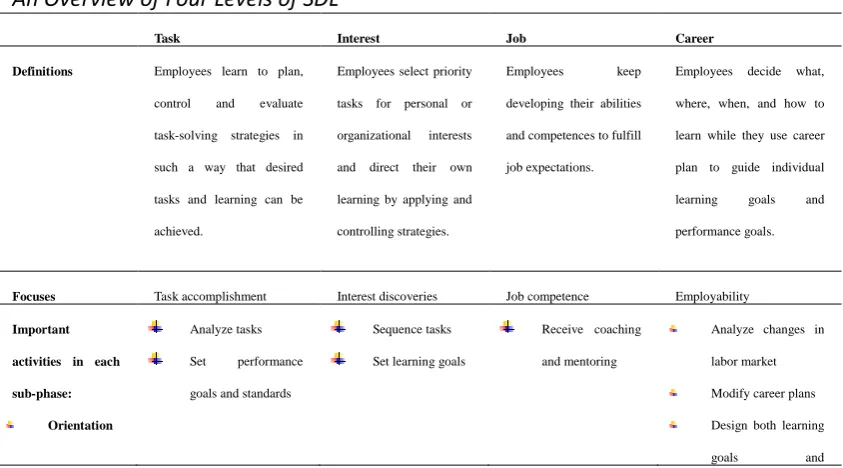
[image:26.595.87.509.513.747.2]In career-oriented SDL, employees focus on their employability. In the orientation phase, main regulation activities include goal setting, social networking, information gathering, analyzing changes in labor market, finding potential career opportunities, career planning modification, regulation strategy specification (Latham & Locke, 1991; Littlejohn et al., 2009; Margaryan et al., 2009; Neault, 2000; Radosevich et al., 2004; Raemdonck, 2006; Scott, 2006). In the performance stage, employees will develop knowledge, skill and network to fulfill their goals, carry out the specified strategies (Raemdonck). Employees build a collaborative learning environment (Ellinger, 2004). Employees get more subjective feedback and discover more learning needs or opportunities in the collaborative process (Dechant, 1999). The performance phase may also include reflection-during-performance activities (Jennings, 2007). In the reflection phase, reflection-after-performance activities include evaluating how they respond in the performing process, what they like and dislike, reflect their motivation and satisfaction changes, and change their overall career goals if this is necessary (Gasevic et al., 2004; Karoly, 1993; Klein, 1989; Latham & Locke; Littlejohn et al.; Radosevich et al.). An overview of four levels of SDL is given below (See Table 1).
Table 1
An Overview of Four Levels of SDL
Task Interest Job Career
Definitions Employees learn to plan, control and evaluate
task-solving strategies in
such a way that desired
tasks and learning can be
achieved.
Employees select priority
tasks for personal or
organizational interests
and direct their own
learning by applying and
controlling strategies.
Employees keep
developing their abilities
and competences to fulfill
job expectations.
Employees decide what,
where, when, and how to
learn while they use career
plan to guide individual
learning goals and
performance goals.
Focuses Task accomplishment Interest discoveries Job competence Employability
Important activities in each sub-phase:
Orientation
Analyze tasks
Set performance
goals and standards
Sequence tasks
Set learning goals
Receive coaching
and mentoring
Analyze changes in
labor market
Modify career plans
Design both learning
26
performance goals
Performance Self-regulation of performance
behaviors
Self-controlling,
monitoring,
observing
Adjust learning
needs
Restructure
environment
Manage resource
Interact with
supervisors
Require
information
Collaborate with
others
Network for possible
opportunities
Carry out career
plans
Reflection Performance evaluation
Diagnose
problems
Attribute causes
Evaluate learning
goals and process
Ask feedback for
follow-up learning
Evaluate
performance process
Reflect personal
changes in career
development
We wanted to know whether there are different levels of SDL at the workplace and how shall we define them, and what activities employees use to regulate their SDL. Literature review findings have given a positive answer to the main question: there are different levels of SDL at the workplace. There are indeed four levels of SDL existing at the workplace: task-oriented SDL, interest-oriented SDL, job-oriented SDL, and career-oriented SDL. Findings provide definitions and regulation activities help us to understand these four levels. We found that SDL is not just an internal learning process employees have individually. Both personal regulation activities and social embedded regulation activities have been found. Each level of SDL has a different regulation focus: task competence, interest discoveries, job competence, and employability. With a process-perspective, we have structured and discussed these four levels. Four levels of SDL at the workplace have three phases: orientation, performance, and reflection. There are different kinds of goals existing in employees’ SDL: performance goals, learning goals, organizational goals, and social goals. In the first two levels, performance goals and tasks have more priority; in the other two levels, learning goals and development have more priority. However, information about the role of others in SDL is still missing, although it has been confirmed by literatures findings that employees have quite much interaction and collaboration with others in SDL, especially in job-oriented SDL and career-oriented SDL. It is worthwhile for the empirical research to find more information about this.
4
Empirical Questions
27
However, we don’t have much information about the role of others in SDL. Nowadays many organizations begin to have much investment in employees’ SDL. Organizational performance and employees’ working performance would closely relate to employees’ SDL quality. It is necessary to improve the quality of employees’ SDL. If we know more about the role of others, we can facilitate employees’ SDL better in the future. We want a sample of employees who have very intense regulation activities and contain most SDL elements. Also, this sample shall fit with our research time. A very nice example would be pre-service teachers, who have a transitional education program which prepares them for teaching later on. An explanation of pre-service teacher’s SDL is necessary here. Pre-service teacher is sometimes used inter-changeably with student teacher or beginning teacher. Pre-service teacher usually refers to students who are taking education programs, training and teaching practices, in order to prepare their future teaching profession (Rampai & Sopeerak, 2011). Also, pre-service teacher includes new teachers who do not have much teaching experience, “a beginning teacher is a teacher with fewer than three years’ teaching experience since graduation from their teacher education programs” (Pendergast, Garvis, & Keogh, 2011, p. 45). Learning, practicing and reflecting are the three most important elements in pre-service teacher’s SDL (Chen, 2012). The data of this research was collected from pre-service teachers in a dual program, in which they conducted SDL through practical teaching and university learning (Endedijk, 2010).
The quality of SDL in pre-service teachers can be analyzed with two dimensions of regulation experiences: passive verse active; and retrospective verse prospective. Passive regulation means that someone else, instead of pre-service teachers themselves, are controlling the regulation content, process (active, vice versa); retrospective regulation means that pre-service teachers have few panning or goal-setting activities and pay more attention to monitoring, evaluation and reflection activities (Endedijk, 2010).
With this way of division, SDL experiences could be categorized into four kinds: passive prospective regulation, active prospective regulation, passive retrospective regulation, and active retrospective regulation. In passive prospective regulation, someone else makes most of choices for the regulation while pre-service teachers do not participate in the planning. Their regulation focuses on the beginning phase. In active prospective regulation, pre-service teachers control their regulation process. The beginning phase still attracts most of their focus while the reflection phase does not. In active retrospective regulation, pre-service teachers spend much effort on the planning, but they are very active in evaluation and reflection activities. In passive retrospective regulation, pre-service teachers usually do not plan their SDL regulation and SDL achievement is dependent on intuitive realization instead of deliberate evaluation or reflection (Endedijk, 2010).
28
interaction and collaboration with others during their SDL process, especially in the job-oriented SDL and career-oriented SDL. It is safe to conclude that others shall also play a role and support employees’ SDL. Many researchers have studied how do employees’ personal factors influence their SDL, but there is not much research about influence of other’s support in SDL quality. Thus, it is worthwhile for the empirical research to focus on how other’s support influence employees’ SDL. Other’s support refers to the support amount, support sources, and support types that pre-service teacher received. Support amount refers to how much support they get during SDL process; support sources refer to whom or what has given them support; support types refer to what support they have received. This study will research on the relationships among other’s support, regulation activities, and SDL quality. To research SDL in pre-service teachers, the empirical research question can be formulated as: how do pre-service teachers involve others in the SDL? It can be split into seven sub-questions:
How much support do pre-service teachers get?
What sources of support do pre-service teachers use? What types of support do pre-service teachers get?
What are the relationships between different sources of support and types of support?
How does other’s support vary through pre-service teachers’ dual program? What are the relationships between other’s support and different regulation activities?
What are the relationships between other’s support and the quality of pre-service teachers’ SDL?
5
Method
5.1
Reliability and Validity of the Instrument
This instrument is developed by Dr. Endedijk in her dissertation (Endedijk,
2010). The following two paragraphs summarize its development process.
Firstly, Open Question Learning Report collects qualitative data and it serves as the preliminary version of instrument. 28 participants, who are students from a Dutch dual teacher education program, provide 133 learning experiences with Open Question Learning Report. This instrument’s reliability, internal consistency and construct validity are checked. The reliability of this instrument is checked for the categorization of the qualitative data and the internal consistency of the instrument. For this, inter-rater reliability and Cronbach’s alpha are calculated. Construct validity is checked by comparing data structure with similar studies. With satisfactory results, Open Question Learning Report can be used to develop the Structured Learning Report (Endedijk, 2010).