University of Warwick institutional repository:
http://go.warwick.ac.uk/wrap
A Thesis Submitted for the Degree of PhD at the University of Warwick
http://go.warwick.ac.uk/wrap/72805
This thesis is made available online and is protected by original copyright.
Please scroll down to view the document itself.
THE STUDY OF ELECTRON CORRELATION
bytt
DIFFERENT ORBITALS FOR DIFFERENT SPINS" . METHODS.
f
A thesis submitted to the University '~f Warwick in support of an application for admission to the degree of Doctor of Philosophy.
Department of Molecular Sciences, University of Warwick.
his help and advice during the past four years.
Some of the work presented here has been previously published.
Hirst,D.M. and Lininpion,M.E., Theoret. chim. Acta,(Berl.),
n,(1971),3 1 5.
"The method of non-pi:ired spatial orbitals - Naphthalene and Azulene."
Hirst,D.H. and Lininf!ton,M.E., Theoret. chim. Acta,(Berl.),
26,(1972),176.
"The method of non-paired spatial orbitals - pa~t
II,
the Benzyl radical."Hirst,D.~I. and Linington,M.E.,J. Chern. Soc.,(London),
Farad. Trans.
II,
~,(1972),1988. "The method of non-paired spatial orbitals - partIII,
Anthracene and Phenanthrene."
Hirst,n.~I. and Linin~ton,M.E~, J. Chern. Soc.,(London),
Farad.Trans.
II,
~,(1972),2200. "The ret.hod of non-paired spatial orbitals - partIV,
>.
Abstract
; .I. Introduction.
1.1 Schr8dinger l'lave Equation
1.2 Electron Correlation
a) Fermi holes
b) Coulomb holes
1.3 Including Electron Correlation in the
Wave function
a) Spin correlation
b) Space correlation
,"
1.4 Hethods of Including Spin Correlation
in the Wave function
i) Correlated wavefunction
ii) Configuration interaction
• .1
•
.3-•
.4-• .4
• .5
• .5
· .5
• .7
• .7
• .8iii) Different orbitals for different spins ••
9
II. Hartree - Pock Theory.
11.1 Introduction
1I.2Hartree - Fock Equations
11.3 Hartree - Fock for Molecules
II.4 Hartree - Fock for Open Shell Systems
i)Spin proper-ties of the wavefunction
ii)
O~enshell SCF theory
• ;11
• .13
• .14
• .14
• .15
iii) HF t.heory extended to a DODS system
•• 16
iv) Spin extended UF theory
•• 18
11.5
Other l\tavefunctious
III. lhe Non-Paired Spatial Orbital Method.
111.1 Introduction •• 21
111.2 LinneLt's Theory •• 21
111.3 1he Formation of the NPSO Wave function •• 28 111.4 Calculation of the Ground State Energy •• 36
i) Introduction .• 36
ii) Calcula t,ion of
J
lI.
H
OJ
ct.
s (:
iii) Calculation ofS~,
H
Os
\}i"
S'
111.5 Energy Calculationsi) tinprojected NPSO ii) annihilated:NPSO
iii) projected and unprojected NPSO iv) projected and annihilated NPSO
IV. Azulene.
• .37
.. 44 • .45 • .45 • .45 • .46· .47
IV.l Introduction •• 48
IV.2 The Alternant Molecular Orbital Method •• 48 IV.3 The Non-Paired Spatial Orbital Method •• 50
IV.4 Calculations •• 52
IV.5Results •• 58
V. Anthracene and Phenanthrene. V.l Introduction
V.2 The NPSO Wavefunction i) Anthracene
ii) Phenanthrene
V.3 Calculations and Results i) Ant,hriieene
ii) Phenanthrene V.4 Discussion
i i
..6~
· .61
.. 61 .. 65• .69
· .69
VI.1 Introduction
VI.2 The NPSO Wavefunction
VI.3 Calculations
Methods of calculation: i) NPSO
.if)r-iO,.
VI.4 Results and Discussion
VI.5 Further UHF Calculations
iii) SCF-MO
'·i:~)
AMO
VI.6 Further Integral .Approximations
i) Goeppert-Mayer and Sklar
ii) After Karp1us and Shavitt
iii)
Accu~atethree centre integrals
· .89
• .89
• .95
· .95
• .98
•• 98
•• 98
•• 99
• .114
• .120
• .120
•• 120
• .125
i v) Goeppert-Mayer Sklar with the lvlu11iken •• 125
approximation
v) Results and discussion
VI.7 Spin Densities
i) Int.roduction
ii) Calculations
iii) Results
iv) Two parameter NPSO wavefunctions
v) . Discu$sion
VII. Further Applications of the NPSO Method.
VII.1 Introduction .
VII.2 The Pentadieny1 Radical
VII.3 Butadiene Negative Ions
a) The trans butadiene ion
b) The cis butd.die.ne ion
VII.4 The Naphthalene Negative Ion
VII.5 The Azu1ene Negative Ian
VIII. The Fully Spin Projected hPSO Wavefunction
'.
VIII.l Introduction
ViII.2 D~nsity Vairix Theory
VIII.3 Density Matrix Calcu1~tions
(
VIII.4 Natural Orbitals
VIII.5. Fully Spin Projected NPSO Calculations VIII.6. Applications of the Fully Spin
Projected NPSO Method
i) Anthracene and Phenanthrene ii)Azu1ene
iii) The Benzyl Radical i v) Semi-'empiri cal data v) Two Variable Parameters vi) Excited States of Azu1ene
IX. Conclusion
Appendix
I.
Appendix II. References.
iv
· .178
· .179
· .183 • .187· .191
• .194
• .!-9
4-• .199
• .202
•• 202
• .206
• .208
Table.
IV-I
IV-Z
IV-3
IV-4
V-I
V-ZV-3
V-4
V-5
V-6
Title.Integr'~l values for the azulene molecule.
Eigenvectors of the complete overlap matrix for azulene.
SCF-LCAO molecular orbitals for azulene.
,
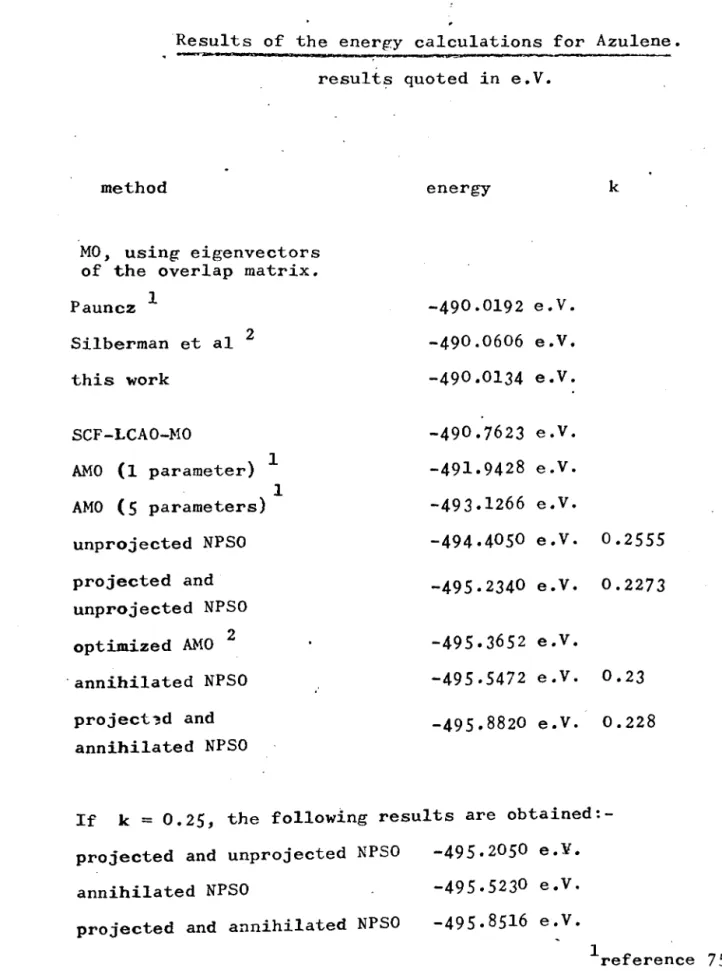
Results of the energy calculativns for azulene.
Integral values for anthracene, calculated using Ruedenberg's approximation.
Eigenvectors of the overlap matrix for anth~acene.
Energy results for anthracene.
SCF-LCAO molecular orbitals for anthracene. Integral values for anthracene, Parker and Memory.
Energy results ,for anthracene, Parker and Memory data.
V-7 Integral values for phen~nt~rene,Ruedenberg
data.
V-8
V-9
V-IOV-II
V-IZ
'"Eigenvectors of the overlap matrix for phenanthrene.
SCF-LCAO molecular orbitals for phenanthrene. Energy results for phenanthrene, Ru~denberg
data.
Integral values for phenanthrene,Parker and :t-1emory.
Energy results for phenanthrene; Parker and Memory dat~a"
List of tables,conti~ued.
VI:"1 Integral values for the benzyl radical, Ruedenberg.
. .
,VI-2 Eigenvectors of the overlap matrix for the
VI-3 VI-4 VI-5 VI-6 VI-7
VI-B
Vo
-9
VI-IO VI-II VI-12 VI-13
VI-1.4·
VI-15 VI-16, benzyl, radical.RHF-SCF-LCAO molecular orbitals. UHF-SCF-LCAO molecular orbitals.
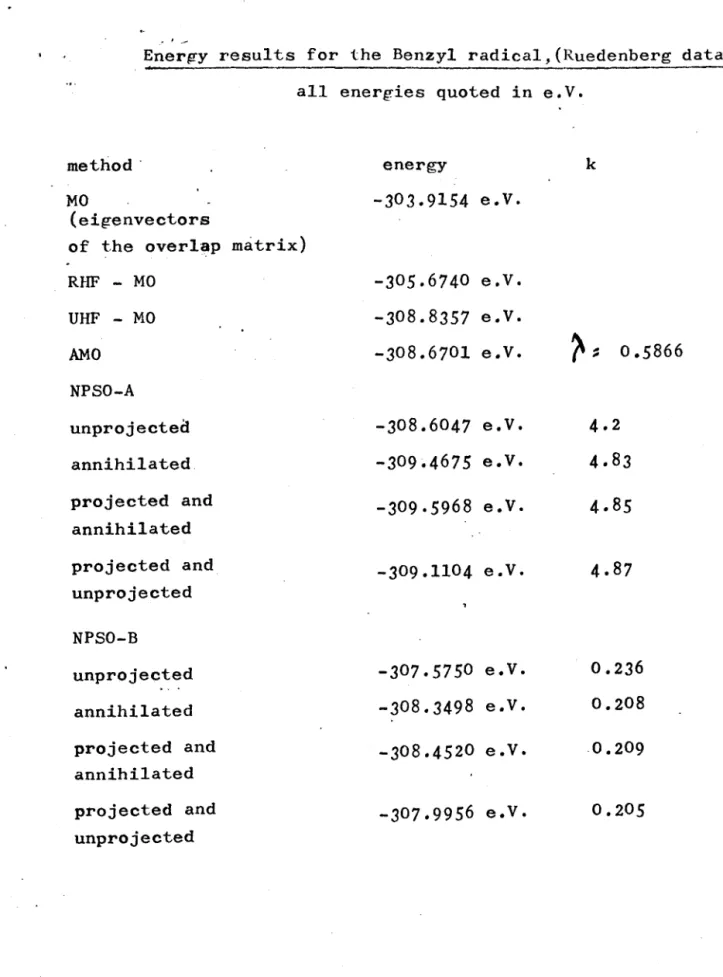
Energy.results for the Benzyl radical, Ruedenberg data.
Pariser, Parr and Polpe data for the benzyl rOadical.
Energy results for the benzyl radical, (PPP data~.
Molecular orbitals for the benzyl radical. Integral values for the benzyl radical, Goeppert-Mayer and Sklar data.
Karplus andShavitt data.
Integral values for the benzyl radical; for Karplus and Shavitt data, and accurate three centre integrals.
Integral values for the benzyl radical, accurate
'\'
Three centre integrals.
Energy results for the benzyl radical.
Results of the spin density calculations for the benzyl radical.
Energy calculations for the benzyl radical -using NPSO wavefunctions with two variable parameters.
Spin density results for the benzyl radical, using NPSO wavefunctions with two variable pRramet.ers.
• •• continued.
VII-I~ VII-Ib VII-Ie VII-2a VII-2b VII-2c VII-2d VII-2e VII-2f VII-3a VII-3b VII-3c VII-4a VII-4b
Integral values for the pentadienyl radical. Energy results for the pentadienyl radical.
Spin density result for the pentadienyl radical. Integral values for. the trans butadiene
negative ion.
The results of the ener~~ calculation for the trans butadiene negative ion.
Results of the spin density calculation for the trans butadiene negative ion.
Integral values for the cis butadiene
..
negative ion.Results of the 'energy calculations for the cis butadiene negative ion.
Results of the spin density calculations for the cis butadiene negative ion.
Integral values for naphthalene negative ion. Results of the energy calculation for the
naphthalene.negative ion:
..
Results of the spin density calculations for the naphthalene negative ion.
Results of the energy calculation·for the azulene negative ion.
Results of the spin density calculation for the azulene negative ion.
List of tables, continued.
VIII-I'"
~VIII-2
VIII-3
VIII-4
VIII-S
VIII-6
VIII-7
VIII-B
VIII-9
VIII-IO
VIII-II
VIII-12
VIII-13
VIII-14
. VIII-IS
VIII-16
First. order density matrix for Azulene. First order density matrix for Anthracene. First order density matrix for Phenanthrene.
Results of the enerr-Y calculations 'for-Anthracene. Result of the ener~y calculations for Phenanthrene. First ord.r dens-i;ty matrix for _ Anthpacene.
First order density matrix for Phenanthrene. Results of the energy calculations for Azulene. First order density"matrix for Azulene.
Results of the energy calculations for Benzyl radical. Spin density results for the Benzyl radical.
Beveridge and Hinze data for t.he Benzyl radical. Results of the energy calculations for the various states of the Azulene:molecule.
Calculated transition energies for Azulene. Beveridge and Hinze data for Azulene •
Results of the energy calculations for the various
'f
states of Azulene, using Beveridge and Hinze data.
/
111-4 111-B 111-C 111-D 111-E 111-F
V-A
..
V-B
V-C
V-D
V1-A
VI-B
V1-C
V1-D
V1-EV1-F
V1-G
,
The electron spin arrangement of the benzene molecule. The electron spin arrangement of the ben~ene molecule. The electron spin arrangement of the benzene
molecule-Different Orbitals for molecule-Different Spins.
The electron-spin arrangement of the benzene molecule. The electron spin arrangement of the benzene
molecule-under C
2 symmetry.
The electron spin arrangement of the benzene molecule-under i symmetry.
r
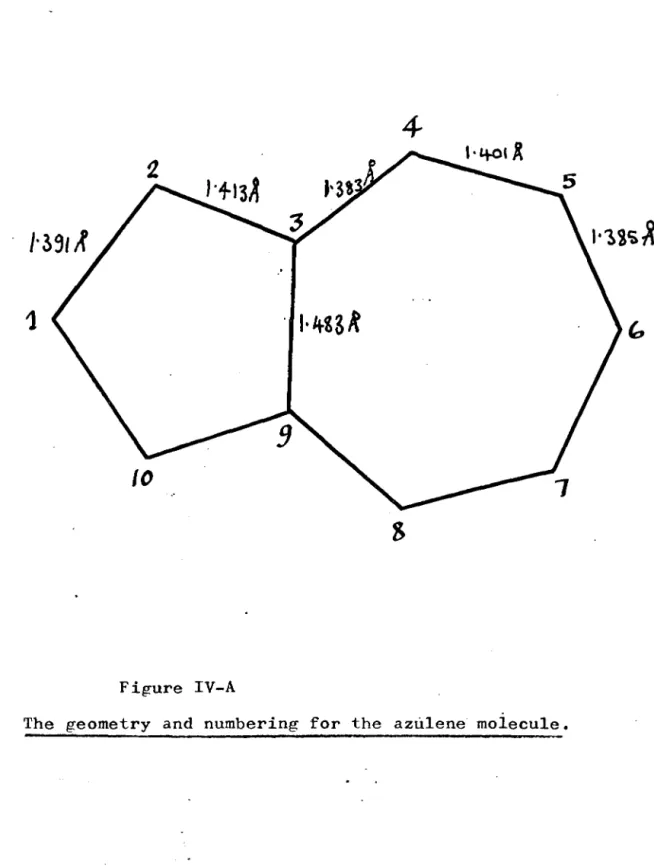
'The geometry and numbering of the azulene molecule.
The numbering and geome,try of anthracene
-)The arrangement of fI,. and
f>
spin e'lectrons~n
the one-'J electron orbitals, for anthracene.The numbering and geometry for phenanthrene.
The arrangement of
rJ.
andP
spin electrons in the one-electron orbitals, for phenanthrene.The
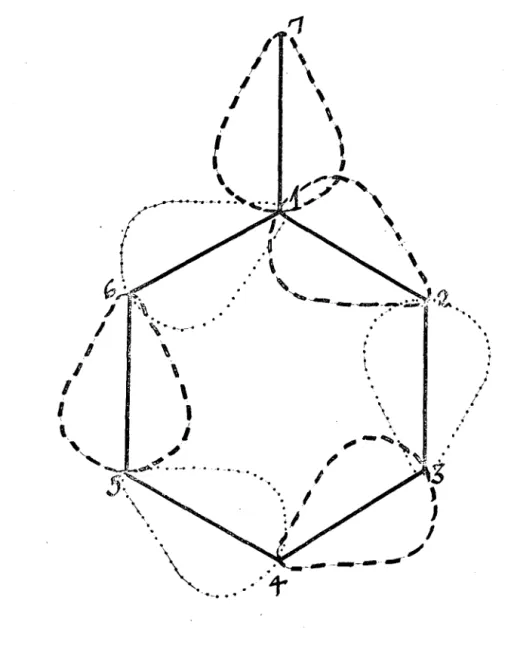
n~ering
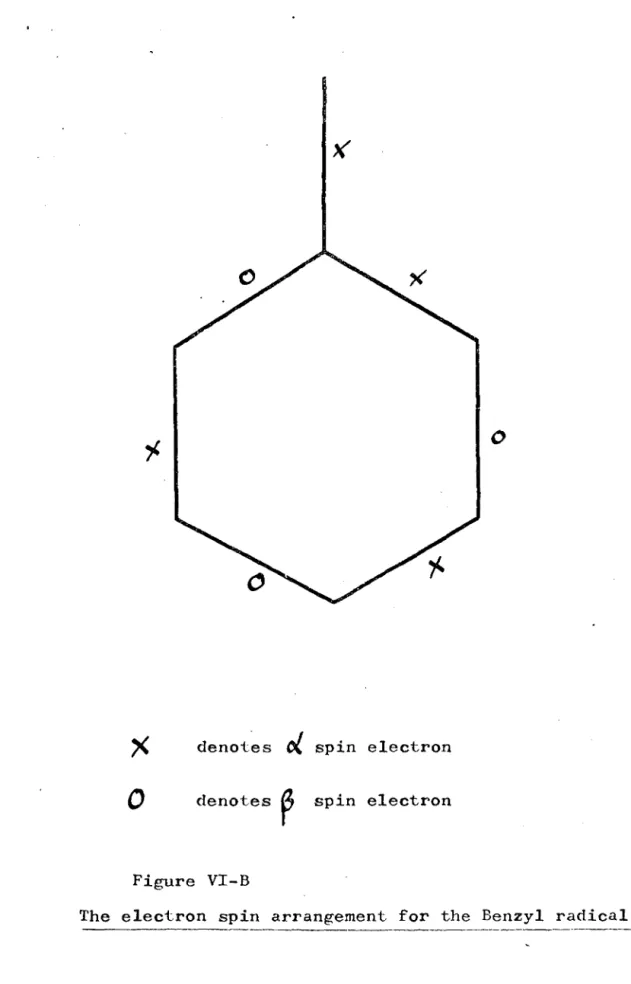
of atoms for the benzyl radical.The electron spin arrangement for the benzyl radical. The electron spin arrangement for the benzyl 1
The electron spin arrangement for the benzyl radical. 'The representation of an NPSO-A wavefunction,
The representation of an N~SO-A wavefunction, with, k") 1.
The representation of an NijSO-B wavefunction,
,.
/
List of figures, continued. VI-H VII-A VII-B VII-C VII-D VII-E VII-F
The representation of an NPSO-B wavefunction,
,.
The numberin~ scheme for the pentadienyl radical.
The numberiny scheme for the trans butadiene negative ion.
The representation of the NPSO wavefunction for the trans butadiene ion.
The representation of the NPSO-variation A- for the trans butadiene ion. ,
The representation of the symmetric NPSO wavefunction, for the trans butadiene ion.
The geometry and numbering scheme for thePcis
butadi~ne negative ion.
VII-G . V,>'The geometry' and numbering scheme for the t
VII-H VII-.1 VII-K Graphs: VI-l VI-2
naphthalene negative ion.
I
The arrangemen~. of the
-0/..
and ~ spin electrons in the one-electron orbitals for the naphthalene negative ion.The numbering and geometry of the azulene negative ion. The arrangement of the
oJ
and ~ spin electrons in theazulene negative ion.
Annihilated NPSO energy v. k, the variable parameter, for the function, KPSO-A, for the.benzyl radical. Annihilated NPSO energy v.
k,
the variable parameter, for the function NPSO-B, for the benzyl radical.ABSTRACT.
The bulk of th~s thesis is concerned with the calculation bf molecular wavefunctions - calculated within a
Different Orbitals for Different Spins framework. Initially other important methods of constructing molecular wavefunctions are considered, and the DODS method is discussed in relation to them. Two different DODS methods are considered in detail, namely the
Alternant Molecular Orbital method and the Non-Paired Spatial Orbital me-thod. Other workers have previously
used these methods and obtained satisfactory wavefunctions. Both methods make ~ood allowance for electron correlation, but for benzene, and several other hydrocarbons, the
NPSO method proves superior. Pauncz has stated that,(~~ because the NPSO calculations are cwnbersome,"one
cannot expect to c.pply this method to larger systems." In this thesis ths NPSO method is extended to larger molecules, namely azulene, anthracene and phenanthrene. In all cases the NPSO method proves superior to the .M10 method • With azulene, for example, a better ground
state energy is obtained using a one-parameter NPSO
~avefunction, than with a five-parameter optimised AMO wavefunction.
Having found satisfactory ground state wavefunctions for these molecules, and observed that most endorse the sug~cst~on that k .~ 0.25 , the NPSO method was
mln
2 radical are more satisfactory than for other open shell systems. ~he spin density distribution of the benzyl radical was calculated by various approximations, but with limited success. In this context we developed a
fully spin projected NPSO method.
I. INTRODUCTION
1.1: Solution of the Schrgdinger Wave Equation.
The study of the electronic structure of molecules is based on the search for a solution of the Schr~dinger wave equation (1), since the electronic structure and properties any molecule can be derived from the wave function.
where, for n electrons, the
..
H~ [(I'~
t?l-
t
~e')
• 1
1~
;.
(,'j
\." ~
• .1-1 Hamiltonian operator is
"
+L
.
,
• .1-2
"J
This form of the Hamiltonian already assumes that:-1) only stationary states are being considered;
,
2) spin-orbit interactions are neglected; and
3) the Born-Oppenheimer approximation (2) holds.
The expectation value of the Hamiltonian operator,~H7
. ~
is given by
(H7 •
f.~ H~lf
St
• .1-3
and is regarded as the total electronic energy, E.
For a many electron system, the exact solution of the equation (I-I) is not possible, but there are useful /
r
approximate methods. Hartree (3} assumed that each electron moves independently of, but under an average potential due to the other electrons, in an orbital
~~ (~~)
,
..
of one electron orbitals
This form of the wave function would be valid if there were
I
no electron repulsion terms of the form~' in H, but
~
the Hartree method does include the average potential due to the other electrons.
The electronic energy, E, is now the sum of the energies of the individual electrons.
I.2: Electron correlation (5)
Since electron repulsion terms are neglected in the Hartree method, there is, in theory, a finite probability of two electrons having the same position co-ordinates. In fact there is no correlation between the motions of the individual electrons.
There are two types of electron ~orrelation:-a)Fermi Holes (6)
b) Coulomb ,Holes (8)
For electrons of the same spin there will be a Fermi hole; but for electrons of-opposite spin there will be no Fermi hole. _Thus there is a finite probability of two electrons occupying the same part of space. However there will be a
,.
charge interaction between two electrons of -
~,
, i frtJ
they are a distance
r0
apart. As(d
tends to zero, as the electrons approach each other, this interaction will become infinite. Thus i t is not possible for two electrons to approach each other closer than a fixed distance, and a Coulomb hole results.A Fermi hole is due to spin interactions, but a Coulomb hole is due to charge interactions. A Coulomb hole imposes the restriction that no two electrons, irrespective of spin, can occupy the same part of space.
1-3: Including correlation in the wavefunction. a) Spin correlation.
The Hartree wavefunction, equation 1-4, is unsatisfactory for two reasons: (i) i t ignores the spins of the electrons, and (ii) i t does not treat them as indistinguishable particles
The wavefunction can be written as
~i.
,each consisting of a spacea product of spin orbital orbi tal
Wi
(Xi)
and aspin factor . Each space orbital can occur twice; once with a spin factor of and once with factor
•
Thus:-.. 1-5
, , ,It is more convenient to define a set of spin orbitals, 6
and
-
•• I-6~,(L) ~
tYi
(~l)
f3
(,,-i)
and
thus:--
•• I-7
To make allowance for the indistinguishability of the electrons we must include all permutations of the electrons in the spin orbitals:
P
denotes permuta-tions,and
at
is anumeric~l
coefficient.The Pauli principle requires that interchange of two electrons changes the sign of the wavefunction, giving
~
, Z
(:1)P
P
¢,(t)
f.b) ...
p
where, for an odd number of interchanges
(-!)P
%-I
and
t
J
for an even number. This can be\\'rittenas:--
-A
!
~,(.) ~,
(2) ." ,
where
A
is the antisymmetriser,A
=
E
c..-I)
"P .
p
~~ (~-l) ~~(~)
J
:t. ;l.. •• I-IO
Equation
1-9
is in fact the expansion of a determinant. Thus
the wavefunction can be written in terms of a Slater
determinant
(9);all possible permutations of electrons
are included, and since the determinant vanishes if any
two rows or columns are the same, Fermi holes are included also.
b) Space correlation •
.
Although the Hartree- Fock (HF) method (10) takes into
account spin correlation - through the use of a' Slater
determinant, i t makes no allowance for space correlation. It
finds the wavefunction for each electron in the presence of
an average potential due to the remaining electrons, and
hence it negle'cts the "instantaneous" repulsions between
pairs of electrons. There will thus be a difference between
the energy calculated from the exact solution of the
"
Schrodinger wave equation, arid the HF energy. This difference
is known as the correlation energy
(2.3).1.4: Methods 'of including
J~Ucorrelation in the wavefunction.
Several methods (14,13,12) have been developed to try
to include some space correlation in the wavefunction.
(i)Correlated Wavefunction. (11)
One possitle method of introducing a coulomb hole into
the wavefunction is to include the interelectronic distance,
(~
,.explicitly. Hylleraas (14), James and Coolidge
(15)deve19ped this method. It works well for two electron systems,
such as Helium or Hydrogen, but its application to systems
with larger numbers of electrons is difficult, because the
8
mathematics becomes unmanagable. The problem is the evaluatj of the expectation value of the Hamiltonian, when theintegrals involved contain more than one interelectronic distance.
Sz~sz
(16) has recently performed more calculation in an effort to extend the range of applicability of this method.Sinano'lu (12) proposed another method of incorporating into the wavefunction - the many electron theory. He showed that, in HF theory, the long range potentials are taken into account. H~ing expressed the wave function in terms of the HF wavefunction, and a correction term, he
expanded the correction term as two, three, four, •••• electrc excitations. Since the potentials neglected by HF theory, short range potentials, are due to the spin pairing of the
e~ectrons, he neglected all but the two electron terms in
the~e?pansiQ~ and so reduced the correction to a soluble two electron problem.
(ii) Configuration Interaction.
(17)
The configuration interaction (CI) method - or superpositio: of configurations method - was first considered by
Hylleraas
(18). A
better approximation to the ground statew~vefunction can be formed by allowing for interactions between the HF ground
state,~o
' and the excited state configurations. Since every normalisable antisymmetric wavefunction"can be expressed as a linear combination ofSlater determinants' built up from a complete-basis set of one electron functions .( 19) we can expand the total wave function as
The coefficients,Ck;. , that will give the best solution to equation I-I can be found by the variation principle (20).
A set of linear equations lS formed,
•• 1-12
which may be solved if
Jtt
[Ukl -
rSk~J
IS0
•• 1-13where
Uu
, J
q"
H
tVl
St,
The theory of the method is simple; the practical
application is frought with difficulties. Using a compl~te basis set means the size of the secular determinant is huge. Despite the reduction in the number of configurations that need to be included, through considering spin and
symmetry restrictions, the task is still mammo.th. To
worsen the situation, convergence is slow. By varying the basis orbitals at the same time as varying the coefficients we can improve the situation. This is multiconfigurational Self-consistent Field (SCF) CI. (21 )
(iii) Different Orbitals for Different Suins, DODS. (22) We have already noted, that, for closed shell systems, the same space orbital is used twice, in a determinantal
Thus:-f
~
r
It:
(I),{(,)
~tu.)
J(z,)
/
.If'~
(Jul)
~(~I)
."
., , •
~t\(H)~(I1)
If'1.>1
{lit
l
f
(2" )
I
•• I-14
10
II. HARTREE-FOCK THEORY.(IO)
II.I:Introduction.
In order to find the best wavefunction,
yv ,
of a particular form, the variation principle (25) is applied and the expect~tion value of the Hamiltonian, H, is minimised. This expectation value is the energy, E,E?
f
qA
H
Y'~
Sit
S\{I'
~
St
•
•• 2-1
The energy can be calculated using an initial approximate wavefunction which can be varied with respect to the
starting orbitals and the variation set equal to zero. Solving the resul-ting problemJ , by the method of Lagrangian
multipliers(24), gives a set of coupled integro-differential equations. The solution of these coupled equations
gives the best wavefunction consistent with the initial approximation.
If a simple product of one electron orbitals is used as the initial wavefunction the Hartree equa-tions ( 3) are obtained. If a Slater determinant (9 ) is used the Hartree- Fock equations are formed,(IO).
11.2: Hartree-Fock Equations.
For a determinantal wavefunction for a closed shell system
-
•• 2-2the energy is given by
"(1
£=2ir~
· .2-3
t~
,
where
:.-i)
•. 2-4a
""""'ft
(1)
is the one electron z,.part ofequation~
1';"2,. " C"
h"
ri,l, -7.-,"
J
the Ham1l ton1an, ~Ht VI, A.,..-~
.")
r~
11 _
JIj ::
ff
\f'{tI)
1ft,;
0)
{1,.
If'j
(1.)
l/J
u)
St;
S1;.
• .2-4bis a coulomb integral, account1ng for repulsions between the electrons in orbitals
~~
"I')
ltJ '
and iii)
KU
~ J]4'i~C"
lYj (.)
f:1.
~~.,f.(t) lfj(~)
sr,
S~
•• 2-4c is an exchange integral.From this the HF equations are obtained as, assuming, real orbitals,
O~Wlt
(,'
+
f
C1Jj" ) -
!:j
('!J
(h,
C. ) '"
Gi-
LIi
CI}
where
JjO)
,,~~ ~
(.)
are defined fromtv ·
f
~iV)
KJ(')
~iV)
SC,
,: f
~J
Ct.)
It\p-)
o/j~) sr~
-and
J~
·
S
~.:
C.)
Jj")
~
i
(0)
be
I~
f
~j
(1-)
Ji(~) ~j(J,) hC~
• .2-
5
• .2-6a
that is:
.• 2-7
In order to solve these equations an iterative procedure is used. The initial orbitals are guessed, used to
calculate and ~j
,
which are in turn used to solve equation 2-7 for a better approximate wavefunction. This procedure is repeated until there is no variation in either the orbitals or the energy; that is until self consistency results.II.j:Hartree-Fock for Molecules.(26).
For atoms we can solve the HF equations. For molecules, because of the lack of spherical symmetry, the linear combination of atomic orbitals - LCAO - approximation should be used.
For closed shell molecules HF calculations are usually performed by the Roothaan method (24) in which the
molecular wavefunctions
tt~
can be expanded in terms of -the atomic orbitals~i
'
as~ Ci~
rr
•• 2-8
,
Substituting equation 2-8 into equation 1-1 and applying the variation principle results in an equation analogous to equation 2-7,
14
whereFrs
~
J1-,..C.)
he,)
'fs(t)
S't.,.
E
r
tl.
G.Jf~(,
)"'ft;(i
»).
~
r.)
1,.{
z.)
~r
ISC
1l;"
~
U
r,
1. I""r
•• 2-10
JJ
")C,.(')
~i2.)J,:;2.
1..(.)
~
(z)
fr,
SrI.
J
is defined as14ft
the bond order matrix, ( 27).
Ph ;: (
t+t.
I
•• 2-11
The energy, E, is given by
•. 2-12
Again an iterative SCF method is used to solve the equations.
II.4:Hartre9-Fgck theory for Open Sh~~~stemS1 (28). HF theory seeks the best single determinant wave function with doubly filled orbitals. However i t can be extended to open shell systems; but firstly some of the spin properties of the wavefunction will be considered.
Spin properties of the wavefunction:
In writing the Hamiltonian operator as equation 1-2, spin-orbit coupling was ignored, -thus H is spin free. In this case the Hamiltonian operator, (29,3ri),must
2
commute with both the t,otal spin operator,
S '
and the z-component,Sz .
That is:and
Thus the' wavefunction,tt, an eigen-function of H, must
C'9
52.
also be an eigen-function of the operators
~ZandAlthough the.formation of a wavefunction, in terms of
a product of one-electron orbitals, that is an
eigen-function of
Sz
is easy, it is considerably more
difficult to make such a wavefunction an eigen-function
of
S1 .
A Slater
determi~ant
of the type so far considered
(equation 1-7) will automatically be an eigen-function of
" both th'e
Sz.
and
sz.
operators, since it consists of
doubly filled orbitals. For an open shell system the
situation is different.
-.
-lJ'
~ ~
I
~I
f,.
~~ ~~
" . '
In gene;al, if a determinantal wavefunction for an
open shell system, (equation2-14), has
nd}
c:4
spin
electro~s.
and
(l~
I{3
spin electrons,
t1~
"?
"(3
,
i t will not be an eigen-func"t::ion of
S~
unless the
number of doubly occupied orbitals is
t\~, (30 ) •Open shell.SCF Hartree-Fock theory:
-.
..Roothaan (28) and Huzinaga (31) extended SCF theory
to open shell systems, such as radicals and excited
states, using a wavefunction of the form of
~quation.
2-14 •
-.~
Equation 2-9 still holds, but now the' Fock operator,
/
I
~: ~ ~~
Ii,.,
dJ.,. -k-1) -
(u
Jo -
J3
14)
I
'($
>
16. . .,. P:
(5"1"14
8.ts
.r
Sts
By
If]
.f
f
P
tu
CSr ..
&t.s
.f
S.f;s
S" ..
1
where
11
~.
S" ..
JII -.
~f
'
t" .,..
k'" •
~
o(I'*'_f)
, A
and [; are and~::
( , - .,)/(1
~
f )
numerical constants, depending on the system, (28).
:f
= fractional occupation number of open shells,•• 2-15
= number of occupied spin orbtials divided by the number of available spin orbitals.
and
and
dlStJ
S~Uj
~
l
~14
Ctt
•• 2-16
~
and
,,~ S~.ttu
P~
•
~
UI>
CI(,t
andHere contains an open shell and a closed shell term. The energy is still given by equation 2-12.
different spins to occupy different spatial orbitals.
. -, if
~
A
,I
~,
(,)"(6)
~% (z-)~)
-- -
~
...
(OK)
.,({~)
-
~It\
.. ,("HI)
~(_)
." -
~
(,,)
fC ... )
I·
.2-17 The energy is now"
..
..
I
f
~
f..v
\"
1-1,. ",
H,1.
~"
~[,
5,,'
v
.
~'., J
~,.
"
Applying the variation principle to this in the LeAD
. .,
approximation leads to two pseudo-eigenvalue problems, for
~
'and , electrons separatelt;F "
ct
~
£;,
i~
S
C~",
fP U" : G,'
S
C~~
• .2-19where
d
F~'
It ....
1 -
Jl
and• .2-20
r~ ~
ff
-t
J -
k P
Fr.s
I- andFr.!
are now defined asf:~ ~ "'~~[(P~ "P~)"r51~'
-
P~
(rsiKnJ
• .2-21
<rs
1
tLA
I:
j
r.(,c.)
f.s
(1.) {
u.
,J,r
The energy is now
fI. ~
E'!
~~
fl'rs"
(11"
+-f./Jj
r
6
1
8
18
...
~ ~ ~.
[ rr/'
(H"s .,.
Fj'S") )
•• 2-23where
'"
P.,
tl :;
~
Cri
Cji
,
IJ . '"
'rs ::
~
Cri C$i
The wavefunction used in this method - originally and
•• 2-24
sugges~ed
byPop~e
and Nesbet, (34) - is, by previous considerations, not necessarily an eigen-function of~t
,
V
(30). Further work has been done in order to try to form such an eigen-function, (35)'Spin Extended Hartree-Fock Theory:
The application of a spin projection operator, (36 ),
Os
to a wavefunction can give a wavefunction which is an eigen-function ofS
'J. •..
~S
:r
Os
q,
•• 2-25The energy is calculated, using the spin eigen-function wavefunction as
f
lfS
H
lJtS
s-c
J
If'S
(}S S
1:
•• 2- 26
The calculation of this energy is difficult, (37), and so an alternative method has been·proposed, (38), where the energy is calculated using the unprojected
•• 2-1
:: Os
E
•• 2-27"
The validity of this method has been questioned, since the resulting energy is not necessarily a -minimum, (39). Marshall found that in certain
cases the spin extended HF wave function gave a smaller energy lowering from the HF energy than the unrestricted energy.
Another suggestion to try to ove'rcome the difficulties involved in the calculation of
fS
by equation 2-26is that, instead of the complete projection,
"S'
an annihilator (4 0 ),As
is used, (41). This annihilation operator removes the major contaminating spin state 'from the mixtures of states in the wavefunction,~
•The UHF wavefunction can be expanded in terms of wavefunctions that are eigen-functions of
52. ,
where
5'
t
(net
-tl
J3)
As m increases the value of the coefficients
decreases,
(48),
thus the major contaminat~ng spin component is (s+
1),(4
0 ).20 After annihilation the wave function is
"
:#
....
ASfI
~
C
s
lts
~
C
S
-f'K1
4'
St~
•• 2-29M~1
This method has been applied successfully by Amos and Snyder (42,4J; Qut it, too, has been crit.icised (43),
since the physical quantities whose operators commute with the annihilation operator are not much changed by its application, (47).
II:5: Other Wavq.functions.
We shall now proceed to consider other wavefunctions, which, we hope will be as good, if not better than, the projected or annihilated HF ones.
Throughout this work we shall consider conjugated
hydrocarbons. We shall construct molecular wavefunctions using only the pi-electrons of the molecule; the
sigma-core,assumed constant, will be included in the Hamiltonian through the term
~~((i).
(For aIII. THE NON-P"AIRED SPATIAL ORBITAL METHOD.
III.I:1ntroduction
··It has been suggested th?t a wavefunction which makes
some allowance tor electron correlation riould be
'formed by putting electrons of different spin into
different spatial orbitals. The
Non-Paired Spatial
Orbital (NPSO) wavefunction is one type of DODS
wavefunction, . resulting from Linnett's work,
(49).
The NPSO method starts from a valence bond (50)
picture; but forms the molecular wavefunction from
semi-localised two centre (nuclei) unsymmetrical bond
orbitals, instead of from atomic orbitals.
NPSO calculations have been performed on, for example,
the allyl radical, cation and anion, (51), benzene, (52),
the nitrite ion,
(53),
and naphthalene, (54). This
thesis is con.cerned with the extension of its application
to a non-alternant hydrocarbon - azulene, large
hydrocarbons - phenanthrene and anthracene, and open
shell Eystems, such as' the benzyl radical.
111.2: Linnett's TheorYt(S6).
Linnett suggested that the octet of electrons
discussed by Lewis,
(55),
consisted of, not four groups
of two electrons, but two groups of four electrons.
His considerations of charge and spin effects lead
him to this conclusion
to think of the particles (electrons) in two sets, -one set being made up of particles of one spin, and
22
"the other of the other spin. The most probable disposition of the particles is that in which the particles
of each set ~dopt the most fayourable disposition for that set, (opposite for two, equilateral triangle for three). If there are equal numbers of particles in each set, then the most probable configuration is that in which the particles are placed as pairs~ If there are unequal numbers in each set, then the
probability is independant of the mutual dispositions of the two sets."
In any many electron system, charge and spin effects must balance each other, since they have opposite
effects. Electrons all have the same charge, therefore they repel each other. Fqr two electrons of the same spin, which tend to keep apart due to spin effects, the charge correlation will be additive. But for two electrons of opposite spin, the spin pairing effect will cause them to interact, whereas charge
considerations would cause them to repel each other. Consider a group of eight electrons, four ofe< spin, and four of
@
spin. The charge effects within the set of~
spin electrons will cause the electrons to arrange themselves so as to reduce inter-elect~onic repulsions. Thus they will be at t,he corners of a tetrahedron.The four
P
electrons will arrange themselvessimilarly. We now need to consider the relative positions of the two 'tetrahedra, since they will interact, to
/
In neon, for example, the filled shell contains 'eight electrons. Here the interaction between the
.
. , two tetrahedra is probably quite weak; since there are no bonds the electrons will be positioned so as to minimise both charge. and spin interactions.In methane, CH
4
,
however, there are four directionalbonds. Thus i t is suggested that the two tetrahdra will interact quite strongly, due to spin pairing. Here i t is immaterial whether the eight electrons
.
.
are re~arded as four pairs.or two quartets.
As an extension ·of this method to a pi-electron system, we chose the theoretical chemists' favourite molecule, benzene. This molecule has been closely studied by many workers, (e.g. 57,5~,59),
and has been considered in depth by Linnett and his
co-workers'~2). Here the treatment is brief.
The six pi-electrons of benzene can be considered as two sets of three electrons, one set of
~
spin, the other of~
spin. For the charge repulsion within the sets to be lowered the elect~ons will be spaced around a circle at 120°. (i.e. at the corners of an equilateral triangle.)Now we must consider the relative correlations of the two sets.
Spin interactions suggest pairing - to give bonds, as in figure III-A.
"
o
~ denotes a one-electron bond containing a
d
spin electroro
denotes a one-electron bond containing a~
spin electron.Figure III-A
"
"
o
denotes a one-electron bond containing a . '" spin electron. denotes a one-electron bond contdining a
~spin electron.
-.. ~ Figure III-B
I
+
~ denotes a one-electron bond containing a
d
spin electron. " denotes a one-electron bond con~nga
p
spin electron.Fig-ure III-C
The electron spin drran~ement of the
bE:n~E:ne molecu~.e"'_ ,,-' _d_l_f r~_I'_e_n_t ~~r?_:_i !_~l_~_. f_~:
different spins.
However charge correlation suggests that the
'arrangement of the two set will be as in figure III-C.
If spin interactions are more important than charge
effects the wavefunctionfrom arrangements III-A and
III-B will give a lower ehergy, than that from III-C;
whereas if charge interactions are stronger than those
of spin the wavefunction from arrangement III-C would
give a lower energy.
Empedocles and Linnett (52) performed extensive
calculations, on various models; their results led
them to suggest that the best chemical formula for
representing the electronic structure of benzene is
as in figure III-C. This structure represents a
situation in which electrons of different spins
occupy different parts of space.
This NPsol method has been applied to many systems.
In all cases the wavefunctions so formed lower the
ground state energy sufficiently to suggest that; (62)
" there is no particular and special energy effect
involved
inthe 'pairing of electrons'. Therefore
if there are two electrons and two bond regions,
the best description of the system
isas two one-electron
bonds."
III.3:~ormation of the NPSO Wa~efunction •
.;t)
The major objective of the NPSO method is to form a molecular wave function in which electrons of opposite spin are separated as much as.possible but at the same time maximising the bonding. Electrons are assigned to semi-localised bonding orbitals. From
28
these a Slater determinant is formed such that adjacent one -electron bonds contain electrons of opposite spin.
The use of semi-localised orbitals was first suggested by Muller and Eyring (60) and Coulson and Fischer (61). Both replaced the atomic orbitals (1-4 and
'1
b )in the molecular orbital wavefunction for hydrogen with orbitals of the
type:-~,
::1--,.
....
~16
1*'1
-
-
~
}'"
+
1~
•• 3-1
Their calculations led them to conclude that ionic and covalent resonance can be equally well described by the introduction of asymmetrical orbitals,( 61) •
b)
As
an example, the NPSO wavefunction for benzene is considered..The NPSO wavefunction is constructed from two centre semi-localised orbitals, that span the bonding region of the molecule. The semi-localised orbitals are
formed by combining adjacent 2p-pi atomic orbitals. For benzene, such a one-electron bond will
be:-where k is a variable parameter •
/
If an, electron of '" spin is assigned to this . semi-localised orbital, in ord~r that correct
"separation of electron spins is achieved, the semi-localised orbitals
(11
"'''1,)
and
(1."
f
k.1
1'
must contain electrons of
p,
spin.The complete wavefunction will be a Slater determinant of the form
~
" A/
(1,
Hid(,)
J. (,)
( 13"'1t.
1' ..
)(1.)
J{
2)
(~>
.f
~
1" )
(3)
J.(
3 )
(~14'k.1-J)(+)
P(1)
('(-If+
K~f)es-)P(~)
(7'~" JC~,)M
f
C'"
I
From the geometrical consider,ations, i t may seem that for benzene, k would be equal to 1.0; 'but a rather inflexible wavefunction would result.
Now we have a wavefunction, equation
3-3,
in which electrons of different spin occupy different spatial orbitals. However, i t fails to satisfy the basic requi rements of an. acceptable wavefunction.• . 3-3
/
30
c) Requirements for
a..
satisfactorywavefunction:-i)
A satisfactory wave function must transform as one of the irred~cible representations of the point group of the molecule.
By applying a symmetry projection operator,
n,
!J '
(63),
i t is possible to meet this requirement. The symmetry ,projection operator is defined as. ,
~
=
?
l
[19)(K)
J~ l'~
'"
• • 3-4
where
,
labels the irreducible representation
is the dimensionality of the representation
is the order of the group and
1~'
)(R)
is the character of the group operator,~
, f
~
for theJ
th. representation.Effectively one needs to consider the results of applying
.1 t of the
..
,
.
/
Benzene has point group D
6h, with sy~netry elements
E, C2 , C3 , i, S3' S6' O"'h' (iv'
rd.
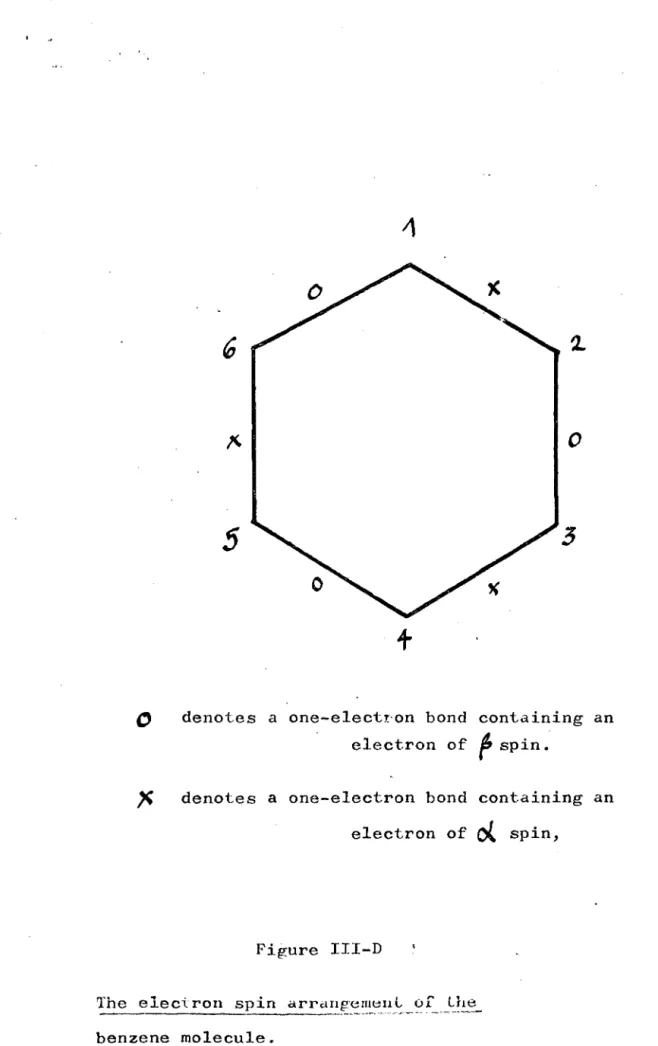
Consider figure III~D. Under C
2' symmetry.this gives figure III-E, and
lfl
(equation, 3-3 ) becomesA
r
(i,
f
l!.
7'6)
(I)
~(,) (tff"~
tf)
(L)
ct6.)
(?'J
~
K
7'
2)
(3)
~(3)
(-(..3
I-"7',)
(If)
P(+)
(1',
~
It.
~5
')
(5)
r(5)
(7',/-
f-
/['](3) ((,
)P(b)
J
;(~
11-
.
The application of the other symmetry elements to
~
will result in either~E
, o r~
or with spins interchanged. For example: applying igives figure III-F, and a wavefunction,
fjj,
where~
~
A
lt111-
f'(7')
)(.)rJ.(.)
(ICh'"
IL
f--.
)(~)
J.(2)
-(~tlL~
j(3)
ol(~)
C,cstlClf,,)
(4)
P(4)
(')C.
+
IQ(L)Cfo)
~5) (~;
...
(eXit) (,)
P[')
I
which is
~1
(equation3-~)
withcJ..
andP
spins interchanged.Defining
tt'li
aslJI,
with.[ andP
spins interchanged means the total wave function~1
is nowI
II
'1'1
- ' f n / ., f.l-.
I . . .-•• 3- 5
32
o
s
3
+
"
denotes a one-electr.·on bond containing anelectron of
f
spin."
denotes a one-electron bond containing an electron of0{
spin,Figure III-D
The electron spin drrdIlgeIlleul .--.. of Lhe
~ .. >---- -,- '--.-.-."---~ . - ---
"
"
3
5
t
o
denotes a one-electron bond containing an~ electron of
r;
spin.~ denotes a one-electron bond containing an electron of
ol
spin.Fi~ure 11I.E,
---.---.-.2
1
() denotes a one-electron bond containing an
electron of ~ spin.
)<
denotes a one-electron bondcontainin~
an electron ofof
spin.Fi~ure III-F
The electron spin arra.n~ement of the benzene molecule under i symmetry.
Requirements for a satisfactory
wavefunction:-.
{:The wavefunction
~
must be an eigen-function
of the spin operators,
sz.
and
Sr. .
i.e.
• .3-8
By previous considerations, the NPSO wavefunction,
(equation
3-7)
is not necessarily an eigen-function
.
t-of
S .
To make the wavefunction a pure spin state,
singlet. for
b~nzeneground state, we must apply a
spin pt:'ojection operator,
~
I(19).
From equation 3-8 we get
'l'hus
(52. -
S
(s ... ) )
will remove from the
wavefunction,
W,
the term with spin component .
S •
If
S
=0, the singlet term ,dll be annihilated; if
~
=
1 the triplet. By repeated application of
~Os •
(s'L -
S
(Sot') )
•• 3-9
,
··3-10
we can remove all terms except a
specified one; say
.s
=
k. Thus
•• 3-11
/
36
Thus we must apply
"0
(k=O) to the NPSO wavefunction for benzene to obtain the sing~et ground state.0,,:,
11
51
-JU+')
j;:::
1-
J' _
j
(j .... )
• ·3-12
'"
The resulting wavefunction is:
lJ'
.=.
0
0~-r
·.3-13or
. £f:
Oc
(lf
1
~
lit,)
·.3-14
Here~~and ~Eare
included in the final wavefunction by the action of0
0 an
tit
and'i'.F,
sinceV1ff
isobtained from
~JlbY
three interchanges. That is~ (~~~ 1~.lJ)
: -
\}'l£(olaLd
I
Pfr)
where
(~P
F
I
J.~J
)
denotes that the first three semi-localised orbitals in the determinanta1 wavefunction contain
~
spin electrons, and the last three,c(
spin electrons. This can be written more compactly asIII.4~Ca1cu1ation of the Ground State Energy.
i)
Substituting equation 3-13 into equation 1-3, the ground state energy, E, isf
0" (lit
~
'hi)
Ii
0" (
(h ."
lhi )
~r,
•• 3-15
•• 3-16
Using the properties of projection operators,(19),
" ,
, idempotency and commutation with the Hamiltonian operator, this reduces to
f
~
fClYI.flh;)
H
Ob
(~£ -I-~ii)
S-c
•• 3-18
J(lf'I"'o/il)
O,,'(ttI.f
If'i)
S--r,"
The energy calculation now reduces to two problems; calculation of integrals of the type
flit
H
0"
W.r
St:
and of the typef
ll' '(
H
0"
lI',
S-c ,
and the-corresponding'overlap integrals,
"J
lI' ..
.,
OD
li',
$('
,
•• 3-19
andJ
4'1
0"
'fff.
SC
ii) Calculation of
llfJ
H 0.5
{t, "
Since the operation of
0.1
on the wavefunctionl\'L
,
produces a new wavefuncti'on that is a linear combination of Slater,
determinants~e
calculation ofJ
tY!
H
Os
If!
~r:,
is complex.The value of the energy of a projected single determinant can be calculated more easily if the
orbital~ can be transformed to either the
"corresponding orbitals" of Amos and Hall, (64),or the "paired orbitals"of L8wdin,(6s). Consider two sets of orbitals: ui of
«
spin and vi ofF
spin, If the sets u l ' u 2 ' •••••• unlinearly independent there exists a non-singular transformation, which will transform them into orthogonal orbitals, u 1 ',
•••••• v ' . , n
(4,:
~
Z
such that
"
U
2' , ••••••
u '
n andare
/
--
•• 3-21
.
.- .A detertninantalwavefunct-ion formed from the orbitals u i ' differ from that formed by the initial orbitals
.ui ' by a factor det
I
U ,. The same type of transformation holds for the set v .•~
[. "l
V~
"
J
V/
'JI
St :
Thus i t is possible to form an orthonormal set of
• ·3-22
•• 3-23
orbitals from any linearly independent set of orbitals, without essentially changing the HF wavefunction.
Now we 'must consider the relationships between the two sets, u.' and l/.f. If we could construct the sets
~ ~
such that
J
I
I
u,~
\j
St
~
..
~.I
that is such that the -overlap matrix contains only diagonal and pseudo-dia~onal terms, the number of non-vanishing integrals in the energy calculation
J
lf'
H
as
q,r~
would be considerably reduced. This1
...
.·3-24
"pairing theorem" was formulated by Amos and Hall, (64) and L8wdin, (65).
The overlap matrix between the two sets can be
formed • I
J)ii
::L
\A.i,
/Vj "
•• 3-25
....
,
,
equi valent to (( / .
,,!
~
• (66 )[Ui
1'5
"7
is.
J
v"'\t Y fTwo transforms are now required
.Iti :
~
Uk
A
ki
&j
sz,
Vi
By
•• 3-26
.(.. such that
i
Qi,
t
bj
>
-
-
~i ~~i
• ·3-27
t~
AI;
, I
I6,y
k
S~·
t~
4
U:"
VI.'
-
-
•• 3-28
"
.t
i.e.
¥
A
B])
= /\,
/\
diagonal.Multiplying by
1\' ,
the adjoint of/\,
·.3-29
gives
•• 3-30
But
B
BAA
=.E ,
the unit matrix.Thus
•• 3-31
Thus
f\
can be found by considering the diagonalisation of(j)j)*),
which is Hermitian. Thus, generally, we. .
can require the following orthogonality conditions of any two sets of
orbitals:-LUi
I~'
:7L
V~
J
Vj'
,=:<
It,,
I
Vj
i' .::
We can now go on to calculate the values of the
integrals
J
\fJ
H
OJ
'fr
Sf
a~d
J
Ifl
0
5
t/'
J.
St:
,
.. by",ell-documented methods, (67,68
). We chose to
follow that of Pauncz,(67) for closed shell molecules,
·and that of Harris, (68)·for open shell systems.
By
considering the effects of the antisymmetriser
/
on the space and spin parts of the l1avefunction,
Pauncz wrote the matrix elements of H, and the
overlap
matr~x,as:
'.l/'~
II-'
I '"
t
7
~
'f'" IlVt
7
:r
'ift)P
U
(p)
(,t
(p
)to(,
p
=
E
(-I)'
J
(p)
(A
(,,)~(,
p
where
:r
~
1"
J
p~
'it
>
· L'" ,,.,
J
P"
f:>
~
L
f
'P"
4,
j
denotes spin function,
d"P
denotes permutation of spin function
p"
denotes permutation of space function.
Now projacting the spin function gives,
Llt
f.,11/
llJ'l':
Zk9f'
H(r)
Gcs,'\I )
p
Lf ...
llI'.t' ..
~(:I)P
f(p)
(,{$,tj,)
p
•• 3-33
•• 3-34
lVhere
-@"
of
1",
and whereand and
are projections of products spin functions,
~~
and-e-.c, .
- Os
6
1"
:: C
((S,i)
1i
•. 3-36
and q
is
the characteristic number. All functions with the sameT.,
thatis,
all those functionlwhich1.
have i
P
-functions amongst the first ncI-
functions will have the same characteristic nwnber, q.From these equations and the orthogonality
relationships between paired orbitals, equation
3-27,
we can write the overlap as,
•• ,3-37
where are the symmetric sums, such that
, , ,
and