6th International Conference on Earthquake Geotechnical Engineering 1-4 November 2015
Christchurch, New Zealand
Case Study - Undisturbed Sampling, Cyclic Testing and Numerical
Modelling of a Low Plasticity Silt
H.J. Bowen1, G.L. Ashby2 and M.E. Stringer3
ABSTRACT
A potential development site in Central Otago, New Zealand, is situated on alluvial sediments that comprise very soft to soft low plasticity silts. Liquefaction prediction methods using CPT, SPT and conventional laboratory testing indicate that liquefaction would be expected to occur in moderate earthquakes. Given the sloping nature of the site this indicated potentially significant lateral spreading displacements, which is inconsistent with the observed landforms in the vicinity. Therefore, a more detailed assessment of liquefaction was carried out using advanced undisturbed sampling, cyclic triaxial testing and slope stability analysis using a dynamic effective stress finite element model. The purpose of the paper is to demonstrate the applicability of these advanced techniques to geotechnical engineering practice in New Zealand. The cyclic laboratory testing showed a cyclic mobility type soil response. Dynamic effective stress finite element modelling, using parameters derived from the cyclic laboratory testing, was able to demonstrate that a catastrophic flow failure type response was not expected at the site. This suggests that while moderate horizontal and vertical displacements may occur in large earthquakes, they are expected to build up gradually throughout the earthquake rather than occur suddenly during a large scale slope failure. Deep ground improvements to ‘hold the slope back’ were not considered necessary and robust shallow foundations with shallow ground improvement should provide acceptable building performance.
Introduction
This paper describes a detailed liquefaction assessment and seismic response analysis undertaken for a potential development site in Central Otago, New Zealand. Conventional liquefaction assessment techniques predict widespread liquefaction and lateral spreading to occur in moderate earthquakes. However, the soils at this site are different to the sand-like soils that the conventional analysis methods are based on. It was also recognised that this site is likely to have experienced many moderate earthquakes in the past yet no signs of the large scale land damage described above can be observed in the terraced landscape.
Previous research (Sanin and Wijewickreme 2006) suggests similar soils in British Columbia, Canada, exhibit a cyclic mobility response during cyclic loading characterized by a gradual buildup of pore water pressure as shear strains increase, without strain-softening. In contrast, ‘true’ liquefaction is characterized by continuous strain softening, leading to possible rapid flow failure.
1
Geotechnical Engineer, Tonkin & Taylor Ltd, Christchurch, New Zealand, [email protected]
2
Senior Geotechnical Engineer, Tonkin & Taylor Ltd, Christchurch, New Zealand, [email protected]
3
Dept. Civil and Nat. Resources Engineering, University of Canterbury, Christchurch, New Zealand,
Further work was therefore undertaken to determine the liquefaction and lateral spreading risk at the site. This work comprised the following main tasks:
1. Characterisation of the cyclic behaviour of the soils using laboratory cyclic triaxial testing of undisturbed samples.
2. Site specific seismic hazard analysis.
3. Seismic stability modelling of the site using a dynamic finite element analysis with advanced constitutive models to incorporate the outcomes of the two tasks above. 4. Evaluation of potential liquefaction mitigation measures.
Soil Conditions and Initial Liquefaction Assessment
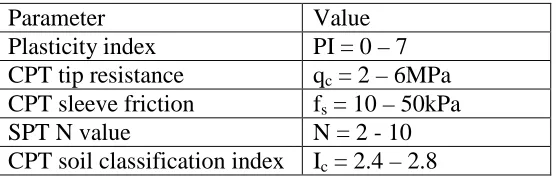
The site is located on alluvial materials deposited during aggradation of a river delta overlying glacial lake deposited sediments. Local topography is characterized by distinct terraces interpreted to have formed by the downcutting of the nearby river. The sediments primarily comprise non-plastic, grey, micaceous, soft sandy silt. Despite classification into distinct layers such as river sediments and lake sediments the particle size distributions, in-situ testing and cyclic response of samples from various soil layers were very similar. Investigations confirm that the sediments continue to beyond a depth of 70m across the site while geological maps (Turnbull 2000) for the area suggest that they may be 100 to -200m deep. Typical properties of the silty soils underling the site are provided in Table 1.
Liquefaction assessment techniques typically used in engineering practice, such as liquefaction susceptibility using plasticity testing (Idriss and Boulanger 2006, Bray and Sancio 2006) and liquefaction triggering methods using SPT and CPT tests (Boulanger and Idriss 2014) predict that:
• Widespread liquefaction is expected to occur during in earthquakes larger than a 1/50 year event (M7.5, PGA=0.09g) with ‘Sand-like’ behavior expected.
• Liquefaction causing significant land damage (ground settlements in the order of several hundred millimeters with sand boils and ground cracking)
[image:2.612.169.447.606.696.2]• Liquefaction induced flow failure towards the nearby river resulting in several meters of lateral and vertical displacements that would be expected to result in significant damage to potential buildings and infrastructure.
Table 1: Silt index parameters.
Parameter Value
Plasticity index PI = 0 – 7 CPT tip resistance qc = 2 – 6MPa CPT sleeve friction fs = 10 – 50kPa
SPT N value N = 2 - 10
It was concluded that the initial liquefaction analysis did not capture key features of the cyclic response of the soil, resulting in an over-prediction of land disruption. Hence a more detailed soil sampling and laboratory testing program was undertaken to gain further insight.
Soil Sampling and Laboratory Testing
Soil sampling to collect undisturbed samples for static and cyclic strength testing was carried out using a conventional pitcher sampler as well as a gel-push technique, which was carried out in general accordance with the methodology as described in Taylor & Cubrinovski (2012). A total of 13 samples were tested in the laboratory by the University of Canterbury (Stringer et al.
2014).
After saturation the samples were isotropically consolidated to a stress level that was approximately 10% above the anticipated vertical effective stresses in the field. Cyclic tests were conducted by varying the axial loading using a servo-controlled pneumatic piston to apply sinusoidal loading at a frequency of 0.05Hz under undrained conditions and constant cell pressure (a typical test setup is shown in Figure 1).
A number of samples were tested at different cyclic stress ratios to generate curves of cyclic resistance (i.e. cyclic stress ratio vs. number of cycles to failure). Once a test had started the cyclic loading continued at constant cyclic stress amplitude and frequency until either:
• the sample passed a minimum of 10% peak to peak axial strain, or • the number of cycles exceeded 200.
To investigate the post liquefaction behaviour of the specimens the samples were subjected either to undrained monotonic shear loading, or a post-liquefaction volumetric strain test after stopping the cyclic loading.
The undrained monotonic shearing tests were conducted at a rate of 1mm (approximately 1 % axial strain) per minute in the axial direction. Figure 2 shows a typical stress, pore pressure and strain time history plot. Figure 3 shows a liquefaction resistance curve that plots the cyclic stress ratio versus the number of cycles required to reach 5% peak to peak (double amplitude) strain. The laboratory test results indicated that:
• ‘classical liquefaction’ behaviour, i.e. rapid development of excess pore pressures and consequent loss of shear strength, was not observed in any of the tests;
• ‘cyclic mobility’ behaviour was observed, where shear strains and excess pore pressures increase gradually as the earthquake shaking progresses;
• large strains were still developed under cyclic loading; and
• cyclic mobility was not triggered for cyclic stress ratios less than 0.20, which roughly corresponds to the level of ground shaking expected in a 1/250 year earthquake event.
[image:4.612.85.535.350.652.2]This means that conventional “sand-like” liquefaction type behaviour and the associated significant land disruption described earlier in this paper, is not expected to occur. Instead, cyclic mobility type behaviour is expected, which results in gradually increasing, but significantly less ground deformation.
Figure 3: Liquefaction resistance curve.
Seismic Stability Modeling
The lateral stability of the site during earthquake loading was analysed using the geotechnical finite element software PLAXIS 2D Dynamic. The objective of this model is to estimate the seismic slope displacements and to assess the need for ground improvement.
Soil parameters
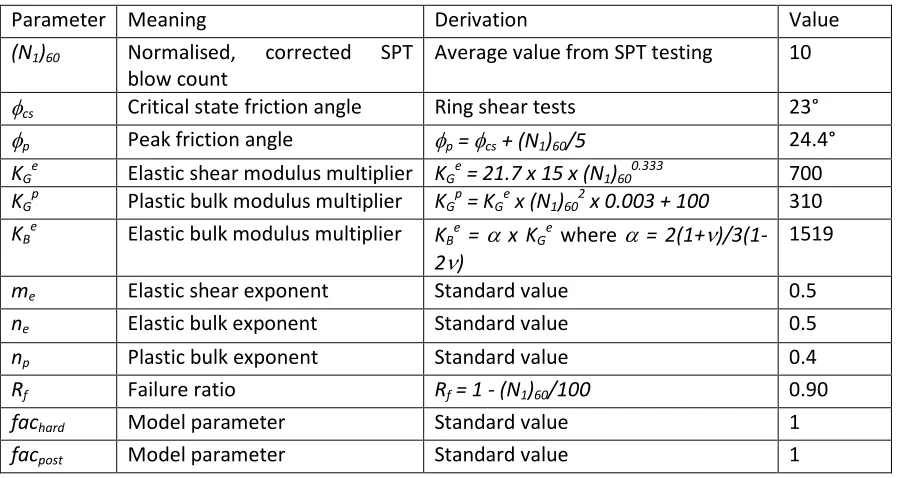
An advanced effective stress constitutive model, UBC Sand, was used to model the development of cyclic mobility as earthquake loading was applied. The parameters for the model were developed using the procedures outlined in Dashti and Bray (2013) and are provided in Table 2.
Ground motion selection
A site specific seismic hazard assessment was carried out at the site (Bradley 2014). The study indicated that an Alpine Fault earthquake event is the greatest contributor to the seismic hazard for medium period structures. Both a median peak ground acceleration (PGA=0.11g) and a median plus one standard deviation peak ground acceleration (PGA=0.18g) were considered in the model.
Model results
[image:6.612.83.533.180.419.2]The stability modelling was able to capture the cyclic mobility type response observed in the laboratory tests, i.e. gradually increasing levels of shear strain, excess pore pressures and ground displacements as the shaking progressed.
Table 2: Soil parameters used in UBC Sand model.
Parameter Meaning Derivation Value
(N1)60 Normalised, corrected SPT
blow count Average value from SPT testing 10
φcs Critical state friction angle Ring shear tests 23° φp Peak friction angle φp = φcs + (N1)60/5 24.4°
KGe Elastic shear modulus multiplier KGe = 21.7 x 15 x (N1)600.333 700
KGp Plastic bulk modulus multiplier KGp = KGe x (N1)602 x 0.003 + 100 310
KBe Elastic bulk modulus multiplier KBe = α x KGe where α = 2(1+ν
)/3(1-2ν) 1519
me Elastic shear exponent Standard value 0.5
ne Elastic bulk exponent Standard value 0.5
np Plastic bulk exponent Standard value 0.4
Rf Failure ratio Rf = 1 - (N1)60/100 0.90
fachard Model parameter Standard value 1
facpost Model parameter Standard value 1
Seismic displacements were assessed for various earthquake scenarios with peak ground accelerations ranging from 0.1g to 0.3g. This modelling indicated that maximum displacements typically occurred at the free edge of the site and at the top and bottom of the major changes in site elevation. Selected indicative displacement patterns for a particular section through the site are shown in Figures 4 and 5.
[image:6.612.74.540.514.648.2]Discussion
[image:7.612.181.435.207.361.2]A critical observation from the stability analysis was that a catastrophic flow failure type response was not predicted. This suggests that while significant horizontal and vertical displacements may occur in large earthquakes, they are expected to build up gradually throughout the earthquake rather than occur suddenly and resulting in a rapid large scale slope failure. This suggests that deep ground improvement to ‘hold the slope back’ may not be necessary.
Figure 5: Time history showing indicative horizontal displacement patterns at Point A in Figure 4for an Alpine Fault scenario with median expected PGA (0.11g) and median plus one standard
deviation PGA (0.18g).
[image:7.612.166.448.503.683.2]An alternative to deep ground improvement was considered where structures are designed to tolerate potential ground displacements using similar principles to buildings located over active faults (Bray 2009). This would comprise robust shallow foundations founded on shallow ground improvement. For example, a concrete mat foundation on top of a geogrid reinforced gravel raft as shown in Figure 6.
Figure 6: Example foundation detail to mitigate structural damage due to co-seismic horizontal ground movements.
0 0.5 1 1.5 2 2.5 3
0 20 40 60 80 100
H
o
ri
zo
n
ta
l d
isp
la
cem
en
t (
m
)
Time (seconds)
Conclusions
This paper demonstrates the useful application of advanced geotechnical sampling, laboratory testing and numerical modelling techniques to a project in Central Otago, New Zealand. This detailed assessment was able to provide a superior understanding of the seismic response of a complex site underlain by low plasticity silts. In addition, this paper adds to the limited international database of cyclic undrained laboratory test results for low plasticity silts.
By undertaking detailed assessment of the site-specific seismic response on undisturbed soil samples it was demonstrated that co-seismic horizontal ground movements are expected to build up gradually in large earthquakes. This removed the need for extensive deep ground improvement to hold back the slope, enabling a cost effective raft foundation plus shallow ground improvement to be considered.
Conventional liquefaction assessment techniques indicated the potential for widespread seismic slope failures which may have precluded development on the site. The work described in this paper has enabled development to proceed on the site and has resulted in a significant reduction in ground improvement costs.
References
Boulanger, R. W., and Idriss, I. M. (2014). CPT and SPT based liquefaction triggering procedures. Report No. UCD/CGM-14/01, Center for Geotechnical Modeling, Department of Civil and Environmental Engineering, University of California, Davis, CA, 134 pp.
Bray, J. D. and Sancio, R. B. (2006) Assessment of the liquefaction susceptibility of fine grained soils, Journal of
Geotechnical and Geoenvironmental Engineering, ASCE, Vol. 132, No. 9, pp. 1165-1177.
Bradley, B. A. (2014) Site Scenario Seismic Hazard Analysis, unpublished project report by Bradley Seismic Limited
Bray (2009) Designing Buildings to Accommodate Earthquake Surface Fault Rupture, ATC & SEI 2009 Conference on Improving the Seismic Performance of Existing Buildings and Other Structures.
Idriss, I. M. and Boulanger, R. W. (2006) Liquefaction susceptibility criteria for silts and clays, Journal of
Geotechnical and Geoenviromental Engineering, ASCE, Vol. 132 No. 11, pp. 1413-1426.
Dashti, S., and Bray, J.D. (2013) Numerical Simulation of Building Response on Liquefiable Sand, Journal of
Geotechnical and Geoenvironmental Engineering, ASCE, 139 (8), 1235-1249.
Stringer, M. E., Cubrinovski, M., Taylor, M. L. (2014) Evaluation of soils by Cyclic Triaxial Testing January 2014, Version: 1.1, unpublished project report prepared by Department of Civil & Natural Resources Engineering, College of Engineering, University of Canterbury.
Sanin, M.V., and Wijewickreme, D. (2006) Cyclic shear response of channel-fill Fraser River Delta silt. Soil
Dynamics and Earthquake Engineering26: 854-869 CrossRef, ISI.
Taylor, M.L. and Cubrinovski, M. (2012). Application of new ‘Gel-push’ sampling procedure to obtain high quality laboratory test data for advanced geotechnical analyses, proceedings of the NZSEE Annual Technical Conference, Christchurch.