41
Does Ability Affect Alignment in Second Language Tutorial Dialogue?
Arabella Sinclair Adam Lopez Christopher G. Lucas University of Edinburgh [email protected] {alopez,clucas2}@inf.ed.ac.uk
Dragan Gasevic Monash University
Abstract
The role of alignment between interlocu-tors in second language learning is dif-ferent to that in fluent conversational di-alogue. Learners gain linguistic skill through increased alignment, yet the ex-tent to which they can align will be con-strained by their ability. Tutors may use alignment to teach and encourage the stu-dent, yet still must push the student and correct their errors, decreasing alignment. To understand how learner ability interacts with alignment, we measure the influence of ability on lexical priming, an indicator of alignment. We find that lexical prim-ing in learner-tutor dialogues differs from that in conversational and task-based di-alogues, and we find evidence that align-ment increases with ability and with word complexity.
1 Introduction
The Interactive Alignment Model (Pickering and Garrod, 2004) suggests that successful dialogue arises from an alignment of representations (in-cluding phonological, lexical, syntactic and se-mantic), and therefore of speakers’ situation mod-els. This model assumes that these aspects of the speakers’ language will align automatically as the dialogue progresses and will greatly simplify both production and comprehension in dialogue.
In a Second Language (L2) learning setting, a learner will have a more limited scope for align-ment due to their situational understanding, and their proficiency will dictate to what extent they are capable of aligning lexically, syntactically and semantically (Pickering and Garrod, 2006). Even once a situational alignment is reached (i.e. the learner understands the context of their
in-terlocutor’s interaction with them) there remains the question of the learners receptive vs. pro-ductivevocabulary knowledge (words they under-stand when others use them vs. words they can use themselves), both of which are active in L2 dia-logues (Takaˇc,2008) and constrain their scope for alignment. Student alignment therefore will also be influenced by the tutor’s strategy; or by how much of the student’s receptive language the tutor produces which facilitates the student productive ability in this context.
We expect that alignment within L2 learner di-alogue will differ from alignment in fluent dia-logues due to the different constraints mentioned above (Costa et al.,2008). We also expect learn-ers to align to their interlocutor to a compara-tively greater degree than found in native dialogue. This is both because of the difficulty of the task leading to a greater need for alignment ( Picker-ing and Garrod,2006), and because we know that an L2 learner’s lexical complexity increases in a dialogue setting due to the shared context words within that dialogue, compared to the level at which they are capable of expressing themselves in monologue (Robinson,2011).
In order to find out whether ability affects align-ment in L2 dialogue, we investigatelexical prim-ingeffects between L2 learner and tutor. Priming
is a mechanism which brings about alignment and entrainment, and when interlocutors use the same words, we say they arelexically entrained ( Bren-nan and Clark, 1996). We compare the effects against two different corpora: task-based ( Ander-son et al.,1991) and conversational (Godfrey et al.,
(Sinclair et al.,2017). We are interested in the dif-ference between tutor-to-student (TS) and student-to-tutor (ST) alignment, as there are various fac-tors which could contribute to both increased and decreased alignment to that existing between two fluent interlocutors (Costa et al.,2008).
1.1 Motivation
By examining alignment differences, we aim to better understand the relationship between tutor adaptation and L2 learner production. This under-standing can inform analysis of “good” tutoring moves, leading to the creation of either an L2 tu-toring language model or more informed L2 dia-logue agent design, which can exploit this knowl-edge of effective tutor alignment strategy to con-tribute to improved automated L2 tutoring. The potential benefits of automated tutoring for L2 di-alogue1 have already been seen through the suc-cess of apps such as Duolingo2 bots which allow the user to engage in instant-messaging style chats with an agent to learn another language. Adap-tion of agent to learner however is an ongoing research task, although outside L2 tutoring, is a well-explored area (Graesser et al.,2005). Align-ment, or“more lexical similarity between student and tutor” has been shown to be more predic-tive of increased student motivation (Ward et al.,
2011), and agent alignment to students’ goals can improve student learning (Ai et al., 2010). We build on previous research by investigating lexi-cal priming effects for each interlocutor in dia-logue both within- and between-speaker, and at
different ability levels in L2 dialogue. This adds the dimension of lexical priming and individual speaker interactions to the work of Reitter and Moore(2006) and the inspection of student to tu-tor, and within-speaker priming to that of Ward and Litman(2007b). By also making comparisons across L2 ability levels, we can now analyse prim-ing effects in terms of L2 acquisition. Similar work in this area outside the scope of this paper includes work analysing alignment ofexpressions
in a task-based dialogue setting (Duplessis et al.,
2017) and the analysis of alignment-capable dia-logue generation (Buschmeier et al.,2009).
In addition to informing dialogue tutoring agent design, this work has potential to augment exist-ing measures of lexist-inguistic sophistication
predic-1
Also know asDialogue-based Computer Assisted Lan-guage Learning (CALL)
2bots.duolingo.com
tion (Vajjala and Meurers, 2016) to better deal with individual speakers within a dialogue, us-ing alignment as a predictor of learner ability as has been suggested byWard and Litman(2007a). Dialogue is inherently sparse, particularly when considering the lexical contribution of a single speaker. Accordingly, alignment could be a use-ful predictor of student receptive and productive knowledge when in combination with lexical com-plexity of the shared vocabulary.
1.2 Research Questions
We present evidence which strengthens our hy-pothesis that tutors take advantage of the natural alignment found in language, in order to better in-troduce, orground3 vocabulary to the student; in other words,scaffolding4 vocabulary from recep-tive to producrecep-tive practice in these dialogues.
Our work investigates the following research questions:
RQ1 How does L2 dialogue differ from task-based and conversational in terms of align-ment?
We find ST alignment has the strongest ef-fect within L2 dialogue.
RQ2 Does alignment correlate with ability in L2 dialogue?
We find priming effects are greater at higher levels of student ability.
RQ3 Does linguistic sophistication of the lan-guage used influence alignment of speakers at different ability levels in L2 dialogue? We find the more complex the word, the greater the likelihood of alignment within L2 dialogue.
2 Corpora
We compare the alignment present within three di-alogue corpora: L2-tutoring, conversational and task-based. A summary of the corpora is pre-sented in Table 1. The Barcelona English Lan-guage Corpus (BELC) (Mu˜noz, 2006) was gath-ered at four different periods over the course of
3Grounding in dialogue consists of the participants estab-lishing a common basis, or ground, on which their communi-cation takes place. This can be viewed as a strategy for man-aging uncertainty and therefore error handling in dialogue (Skantze,2007).
Corpus Type English Dialogues
BELC L2 tutoring non-native (levels 1-4)
118
[image:3.595.73.291.62.115.2]Switchboard conversational fluent 1155 Map Task task-based fluent 128
Table 1: Corpora types and details. Map Taskis referred to in later diagrams as MT, Switchboard
as SB. The levels in BELC indicate increasing learner ability, with 1 indicating the lowest ability level and 4 the highest.
three years, with the students involved receiving approximately one school year of weekly English tuition between sessions. Table 2 shows a short 20-utterance long extract from a dialogue. The Switchboard Corpus is conversational dialogue over telephone between two fluent English speak-ers (A and B), and MapTask is a task-based dia-logue where theinstruction-Giver (G)directs the
instruction-Follower (F)from a shared start point to an end point marked onG’s map but which is unknown to F, who also has access to a similar map, although some features may only be present on one of the interlocutors’ copies.
3 Methods
To address RQ1 and RQ2, section 3.1 discusses how we measure lexical priming so that we can compare priming effects in different situations. Section3.2discusses the measure we use for word complexity in order to addressRQ3, so that we can use this as an additional parameter in our model.
3.1 Lexical Convergence
Lexical priming predicts that a given word (target) occurs more often closely after a potentialprime
of the same word than further away. In order to measure lexical convergence, we count each word used by the speaker being considered as a potential prime. FollowingWard and Litman(2007b), who measure the lexical convergence of student to tutor in physics tutorial dialogues, we only count words as primes if in WordNet (Miller,1995), the word has a non-empty synset5e.g. if there was a choice of potential words and the speaker used the same word as their interlocutor, this can be counted as a prime, since it was not simply used because it was the only choice.
Since the learning content of L2 dialogues is the
5This also has the effect of removing function words from consideration.
Tutor Student
do you have a bedroom for just you ?
yes .
ok .
how many beds are there in your room ?
two .
twobeds .
two beds.
ok one for you...
... and his friend alg´uns amigos. and afriendthat’s good .
hmm what is the room like ?
hmm...
tell me about your room .
myroom?
uhhuh . describe it .
myroomis...
there’stwo beds...
...very big...
uhhuh .
Table 2: Example of lexical alignment in BELC dialogue. room, bedsandfriendare examples of lexical alignment from student to tutor and from tutor to student respectively. Underlinedtext in-dicates within-speaker (TT orSS) alignment, and
bold text indicates between-speaker (TS or ST) alignment (alg´uns amigosmeanssome friends).
language itself, we group the words intoword fam-ilies, which is a common method used to measure L2 student vocabulary (Graves et al., 2012). We do this by lemmatizing6 the words in a text, and counting lemmas used by the speaker as prime. Thus, we count the formswant, wants, wanted & wantingas a single word.
We also distinguish between the speakers when looking at between-speaker, or comprehension-production (CP) priming where the speaker first comprehends the prime (uttered by their inter-locutor) and then produces the target, and within-speaker or production-production (PP) priming, where both the prime and the target are produced by the same speaker. Since we are also interested in tutorT behaviour vs. studentS in these inter-actions we map PP priming toTT andSS respec-tively and CP toTSandST.
Lexical Repetition
In our data, each repetition of an occurrence of a wordWat distancenis counted aspriming7where
W has a non-empty synset, and is of the same
word-familyas its prime (section 3.1). Each case whereW occurs but is not primednunits before-hand in the dialogue, is counted asnon-priming. Our goal is to model p(primeˆ |target, n), that is the sampling probability that a prime is present in the n-th word before target occurs. Without lexical priming’s effect on the dialogue, we would assume that
ˆ
p(prime|target, n) = ˆp(prime|target).
The distance n between stimulus and target is counted in words, as this has the advantage over utterances for capturing within-utterance priming and is less sensitive to differences in average ut-terance length between corpora when comparing priming effects.Wordswere chosen as the closest approximate available totime in secondsas mea-sured in Reitter and Moore (2006). We look for repetitions within windows of 85 words8.
Generalized Linear Mixed Effects Regression
For the purposes of this study, following Reit-ter and Moore(2006), we use a Generalized Lin-ear Mixed Effects Regression Model (GLMM). In all cases, a word instance t is counted as a rep-etition at distance d if at d there is a token in the same word-family ast. To measure speaker-speaker priming effects, we record both the prime and target producers atd. GLMMs with a binary response variable such as ours can be considered a form of logistic regression.We model the number of occurrencesprime= target|d ≤n(where n is window size) of priming being detected9. We model this as binomial, where the success
proba-7The use of
primingis not intended to imply that priming is the only explanation for lexical repetition
8
We chose this window size based onReitter and Moore
(2006) using an utterance window of 25 and a time window of 15 seconds. We calculated the average number of words to occur in the utterance window chosen, and the average num-ber of words which are spoken in the 15 second window and chose the average of the two as our window.
9
For example, if we were only interested in priming within a window size of3words, In table2, for the student’s first use of the wordbedswe would record 3 data points: (window:1, target:bed, role:SS, prime=target:0), (window:2, target:bed, role:ST, prime=target:1), (window:3, target:bed, role:ST, prime=target:0) indicating there is a prime for our targetbedsat distance 2. The number of trials = target words ×window size.
bility depends on the following explanatory vari-ables: Categorical: corpus choice, priming type from speaker role, ability level;andOrdinal: word frequency, as explained in Section3.2. The model will produce coefficientsβi, one for each
explana-tory variable i. βi expresses the contribution of
ito the probability of the outcome event, in our case, successful priming, referred to aspriming ef-fect size in the following sections. For example, theβi estimates allow us to predict the decline of
repetition probability with increasing distance be-tweenprimeandtarget, and the other explanatory variables we are interested in; we refer to this as theprobability estimatesin in subsequent sections. The model outputs a statistical significance score for each coefficient, these are reported under each figure where relevant.
3.2 Complexity Convergence
To capture linguistic complexitywithin the prim-ing words, we use Word Occurrence Frequency (WOF) as a predictor of the relative difficulty of the words used. We uselog(W OF)to normalise the deta before using it as a factor in our model. W OF has been found to predict L2 vocabulary acquisition rates - the higher frequency of a word, the more exposure a student has had to it, the more likely they are to learn it faster (Vermeer,
2001). Word Frequency has also been shown to act as a reasonable indication of word ‘difficulty’ (Chen and Meurers,2017). We therefore expect a negative correlation between learner level and fre-quency of vocabulary used, given a certain prime window. We gathered frequency counts from the Google News Corpus introduced byMikolov et al.
(2013), for its size and diverse language.
4 Results
4.1 Lexical Convergence Cross Corpora
Figure 1: Priming effects of distance across Corpora for different speaker roles. S:Student, T:Tutor, F:Follower, G:Giver, A& B:Speaker A& B. AB indicates alignment of A to B. CP: comprehension-production, or between-speaker priming, PP: production-production, or within-speaker priming. The results are all significant with(p <0.0001)exceptBBwithin Switchboard, with(p <0.01).
Figure 2: Decaying probability estimates for window lengths for different speaker roles across corpora. F ormula:lemma occ∼window+role∗corpus
size for the different roles for all three corpora. This shows the same symmetry and asymmetry of between- and within-speaker repetition decay probability as Figure1.
4.2 Lexical Convergence by Level
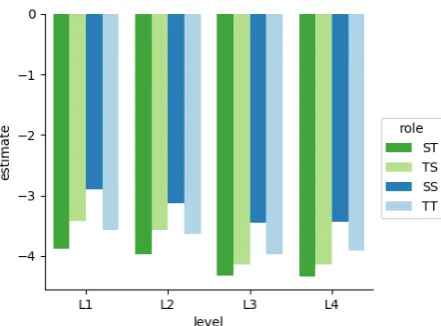
We investigate priming effects within BELC be-tween levels to find whether alignment correlates with ability in L2 dialogue(RQ2). Figure3shows the strong student-tutor priming occurring at each ability level, and the general increase in priming effect size as ability level increases for all prim-ing types. When comparprim-ing both Figure1and3, we see that as ability level increases, BELC prim-ing effect sizes tend towards those seen in Switch-Board, particularly those of ST and TS, the ef-fect size of which also becomes more symmetrical with ability level, although the imbalance between SS and TT priming remains similar to that of Map-Task.
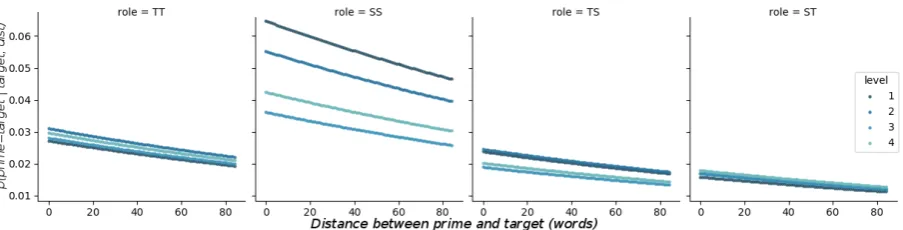
We also examine the model predictions for dif-ferent window sizes for difdif-ferent conditions. Fig-ures4and5describe the relationship between role
and ability level on the probability of seeing a prime word at different window sizes. Figure 4
shows a sharper decay in the probability of tutor to student (TS) priming than in student to tutor (ST) priming. Figure 5 shows that tutor self-priming is more probable at lower ability levels, and that ST alignment at lower levels is less likely than at higher levels of ability.
4.3 Linguistic Complexity Convergence
[image:5.595.77.525.271.395.2]Figure 3: Priming effect sizes under different speaker role situations, across levels in BELC. Ef-fects estimated from separately fitted nested re-gression models for each subset of BELC split by level(1-4). The results are all significant (p < 0.0001).
effect between low and high levels, lowest at the highest ability. Per role, priming effect is gener-ally smaller at higher ability levels than lower.
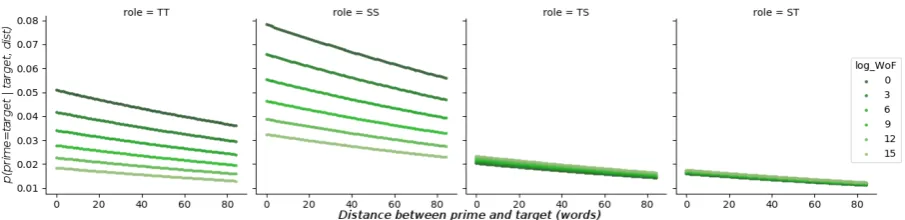
Figures 7 and8 show the effects of W OF on level and role respectively. In Figure 7, lower log(W OF)values are indicative of more complex words. In such cases (see Figure 7, column 1), the repetition probability is higher for high ability students, compared to low ability students. This stands in contrast to higherlog(W OF)values, in-dicative of less complex words, where the repeti-tion probability is now lower for high ability stu-dents compared to low ability stustu-dents (see Fig-ure 7, column 6). Figure8 shows differences in self-priming and within speaker priming, in that for both TS and ST, the probability of repetition is greater for higher frequency words, while forTT
andSS, the probability of repetition is higher for lower frequency words.
5 Discussion
The three spoken dialogue corpora we investigated demonstrate a significant effect of distance be-tween prime and target in lexical repetition, pro-viding evidence of a lexical priming effect onword family use. We also found evidence of priming for each interlocutor in both between-speaker and within-speaker roles.
ST alignment has the strongest effect within L2 dialogue. To find how L2 dialogue differs
from our other two corpora in terms of role(RQ1), we measured the priming effects for Tutors (TT, TS) and Students (SS, ST) and find it asymmet-ric in the same manner as for the task-based di-alogue MT. This is in contrast to the symmetric effects in the conversational dialogue of SB (Fig-ure1). ST alignment also has the greatest prim-ing effect compared to the other roles in BELC, which supports our hypothesis that student-to-tutor alignment is an artefact of both tutor scaf-folding, and students’ productive range benefiting from the shared dialogue context.
When considering within-speaker priming, it is also interesting to note that TT priming has a more marked effect than SS priming, similar to the rela-tionship between GG and FF in Map Task. We in-terpret this similarly toReitter and Moore’s (2006) comparison of Map Task and Switchboard, in that since the task-based or tutoring nature of the di-alogue is harder, the leading speakers use more consistent language in order to reduce the cogni-tive load of the task (tutoring/instruction-giving).
Priming effects are greater at higher levels of student ability. In order to investigate our main hypothesis, that abilitydoesaffect alignment
(RQ2), we measured priming effects in different ability levels of L2 tutorial dialogue (Figure 3), and found that priming effects are greater at higher levels of student ability, which provides evidence that as ability increases, dialogues have more in common with conversational dialogue. We also measured how role influences these priming ef-fects (Figures 4 and 5) and hypothesise that the faster decay of TS repetition probability (Figure5) is an indication that the tutor is using the immedi-ate encouraging backchanneling seen in the repe-tition in Table2. We note (Figure4) that tutor-to-tutor repetition is more probable at lower levels, which supports the above hypothesis. Addition-ally, student-to-tutor repetition probability is more likely at higher levels which is a good indication that student ability is higher, since we argue that they are nowableto align to their interlocutor.
The more complex the word, the greater the likelihood of alignment within L2 dialogue.
[image:6.595.75.296.62.225.2]in-Figure 4: Decaying repetition probability estimates depending on the increasing distance between prime and target, contrasting different speaker roles at different levels.
[image:7.595.75.527.60.175.2]F ormula:lemma occ∼window+role∗categorical level
Figure 5: Decaying repetition probability estimates depending on the increasing distance between prime and target, contrasting different speaker roles at different levels.
F ormula:lemma occ∼window∗role+categorical level
Figure 6: Word Occurrence Frequency Priming ef-fects under different selections of role and level situations in BELC. Each model was separately fitted on the relevant subset of data to show the priming effect sizes for Word Occurrence Fre-quency. (L1:SS, L2:TS and L3:ST are insignifi-cant, all other results are significant with at least p <0.001and most withp <0.0001.
dicate more complex words), repetition probabil-ity is higher in the higher abilprobabil-ity levels compared to the lower levels, and at higherlog(W OF), the repetition probability of the higher ability levels
[image:7.595.74.527.237.352.2] [image:7.595.74.296.424.563.2]Figure 7: Decaying repetition probabilities of differentlog(W OF)values on probability of word occur-rence by level. Lowerlog(W OF)values correspond tolowerfrequency, an indication ofmorecomplex words, andhigherfrequency aslesscomplex words.
F ormula:lemma occ∼window+log(W OF)∗categorical level
Figure 8: Decaying repetition probabilities of differentlog(W OF)values on probability of word occur-rence by role.Higherlog(W OF)indicateseasierwords.
F ormula:lemma occ∼window+log(W OF)∗role
6 Conclusions and Future Work
We see these results as an indication that measur-ing lexical alignment combined with lexical so-phistication of vocabulary has potential as a pre-dictor of student competency. We also hypothe-sise that measurements of‘good tutoring’actions could consist of how and to what extent tutors adapt interactively to individual students’ needs in terms of their conversational ability. Tutor self-priming seems to be an interesting possible feature for measuring this adaption. We want to further in-vestigate different measures of alignment and both lexical and syntactic complexity to inform sys-tems that aim to automate L2 tutoring. We plan to consider which speakerintroducesthe word be-ing aligned to, in order to better understand the relationship between productive and receptive vo-cabulary of the student in dialogue settings. It is also important to separate the effects of priming per se from other factors that can influence lexi-cal convergence, such as differences in vocabulary and topic specificity. As a first step toward that goal, we plan to compare lexical convergence in the original corpus with convergence in matched
baselines of randomly ordered utterances ( Dup-lessis et al.,2017), which will account for vocabu-lary effects and corpus-specific factors. To explore more measures of word complexity in addition to simpleWOF, we will further investigate measures specific to L2 dialogue, such as the English Vo-cabulary Profile (EVP) (Capel,2012), with word lists per CEFR10level, or measures such as counts of word sense per word, or whether a word is con-creteorabstract11, exploiting existing readability features (Vajjala and Meurers,2014).
Acknowledgements
Thanks to Amy Isard, Maria Gorinova, Maria Wolters, Federico Fancellu, Sorcha Gilroy, Clara Vania and Marco Damonte as well as the three anonymous reviewers for their useful comments in relation to this paper. A. Sinclair especially ac-knowledges the help and support of Jon Oberlan-der during the early development of this idea.
10The Common European Framework of Reference (CEFR) defines the 6 levels of english proficiency in ascend-ing order as: A1, A2, B1, B2, C1, C2.
[image:8.595.74.527.252.362.2]References
Hua Ai, Rohit Kumar, Dong Nguyen, Amrut Nagasun-der, and Carolyn P Ros´e. 2010. Exploring the ef-fectiveness of social capabilities and goal alignment
in computer supported collaborative learning. In
In-ternational Conference on Intelligent Tutoring
Sys-tems, pages 134–143. Springer.
Anne H Anderson, Miles Bader, Ellen Gurman Bard, Elizabeth Boyle, Gwyneth Doherty, Simon Garrod, Stephen Isard, Jacqueline Kowtko, Jan McAllister, Jim Miller, et al. 1991. The hcrc map task corpus.
Language and speech, 34(4):351–366.
Susan E Brennan and Herbert H Clark. 1996.
Concep-tual pacts and lexical choice in conversation.
Jour-nal of Experimental Psychology: Learning, Mem-ory, and Cognition, 22(6):1482.
Hendrik Buschmeier, Kirsten Bergmann, and Stefan
Kopp. 2009. An alignment-capable microplanner
for natural language generation. InProceedings of
the 12th European Workshop on Natural Language Generation, pages 82–89. Association for Computa-tional Linguistics.
Annette Capel. 2012. Completing the english
vocabu-lary profile: C1 and c2 vocabuvocabu-lary. English Profile Journal, 3:e1.
Xiaobin Chen and Detmar Meurers. 2017. Word
fre-quency and readability: Predicting the text-level readability with a lexical-level attribute. Journal of Research in Reading, pages n/a–n/a. JRIR-2017-01-0006.R1.
Albert Costa, Martin J Pickering, and Antonella So-race. 2008. Alignment in second language dialogue.
Language and cognitive processes, 23(4):528–556.
Guillaume Dubuisson Duplessis, Chlo´e Clavel, and Fr´ed´eric Landragin. 2017. Automatic measures to characterise verbal alignment in human-agent
inter-action. In18th Annual Meeting of the Special
Inter-est Group on Discourse and Dialogue (SIGDIAL), pages 71–81.
John J Godfrey, Edward C Holliman, and Jane Mc-Daniel. 1992. Switchboard: Telephone speech
cor-pus for research and development. In Acoustics,
Speech, and Signal Processing, 1992. ICASSP-92., 1992 IEEE International Conference on, volume 1, pages 517–520. IEEE.
Arthur C Graesser, Patrick Chipman, Brian C Haynes,
and Andrew Olney. 2005. Autotutor: An
intelli-gent tutoring system with mixed-initiative dialogue.
IEEE Transactions on Education, 48(4):612–618.
Michael F. Graves, Diane August, and Jeannette
Mancilla-Martinez. 2012. Teaching
Vocabu-lary to English Language Learners. TESOL Press/Teachers College Press.
Edward Loper and Steven Bird. 2002. Nltk: The
natu-ral language toolkit. InProceedings of the ACL-02
Workshop on Effective tools and methodologies for teaching natural language processing and computa-tional linguistics-Volume 1, pages 63–70. Associa-tion for ComputaAssocia-tional Linguistics.
Tomas Mikolov, Kai Chen, Greg Corrado, and
Jef-frey Dean. 2013. Efficient estimation of word
representations in vector space. arXiv preprint
arXiv:1301.3781.
George A Miller. 1995. Wordnet: a lexical database for
english. Communications of the ACM, 38(11):39–
41.
Carmen Mu˜noz. 2006. Age and the rate of foreign
lan-guage learning, volume 19. Multilingual Matters.
Martin J Pickering and Simon Garrod. 2004. Toward
a mechanistic psychology of dialogue. Behavioral
and brain sciences, 27(2):169–190.
Martin J Pickering and Simon Garrod. 2006.
Align-ment as the basis for successful communication.
Re-search on Language and Computation, 4(2-3):203– 228.
David Reitter and Johanna D Moore. 2006. Priming of syntactic rules in task-oriented dialogue and
spon-taneous conversation. In Proceedings of the
An-nual Meeting of the Cognitive Science Society, vol-ume 28.
P. Robinson. 2011. Second Language Task
Complex-ity: Researching the Cognition Hypothesis of Lan-guage Learning and Performance. Task-based lan-guage teaching : issues, research and practice. John Benjamins Publishing Company.
Arabella Sinclair, Jon Oberlander, and Dragan Gasevic. 2017. Finding the zone of proximal development: Student-tutor second language dialogue interactions.
SEMDIAL 2017 SaarDial, page 134.
Gabriel Skantze. 2007. Error Handling in Spoken
Di-alogue Systems-Managing Uncertainty, Grounding and Miscommunication. Gabriel Skantze.
Viˇsnja Paviˇci´c Takaˇc. 2008. Vocabulary learning
strategies and foreign language acquisition. Mul-tilingual Matters.
Sowmya Vajjala and Detmar Meurers. 2014. Exploring measures of readability for spoken language: Ana-lyzing linguistic features of subtitles to identify age-specific tv programs.
Sowmya Vajjala and Detmar Meurers. 2016.
Readability-based sentence ranking for
eval-uating text simplification. arXiv preprint
arXiv:1603.06009.
Arthur Ward and Diane Litman. 2007a. Dialog
con-vergence and learning. InProceedings of the 2007
conference on Artificial Intelligence in Education: Building Technology Rich Learning Contexts That
Work, pages 262–269. IOS Press.
Arthur Ward and Diane Litman. 2007b. Measuring
convergence and priming in tutorial dialog.
Univer-sity of Pittsburgh.
Arthur Ward, Diane Litman, and Maxine Eskenazi. 2011. Predicting change in student motivation by measuring cohesion between tutor and student. In
Proceedings of the 6th Workshop on Innovative Use of NLP for Building Educational Applications, pages 136–141. Association for Computational Lin-guistics.
David Wood, Jerome S Bruner, and Gail Ross. 1976.
The role of tutoring in problem solving. Journal of