Proceedings of the Multiling 2019 Workshop, co-located with the RANLP 2019 conference, pages 6–10 Varna, Bulgaria, September 6, 2019.
6
MultiLing 2019: Financial Narrative Summarisation
Mahmoud El-Haj
School of Computing and Communications Lancaster University
United Kingdom
Abstract
The Financial Narrative Summarisation task at MultiLing 2019 aims to demonstrate the value and challenges of applying automatic text summarisation to financial text written in English, usually referred to as financial nar-rative disclosures. The task dataset has been extracted from UK annual reports published in PDF file format. The participants were asked to provide structured summaries, based on real-world, publicly available financial an-nual reports of UK firms by extracting infor-mation from different key sections. Partici-pants were asked to generate summaries that reflects the analysis and assessment of the fi-nancial trend of the business over the past year, as provided by annual reports. The evaluation of the summaries was performed using Au-toSummENG and Rouge automatic metrics. This paper focuses mainly on the data creation process.
1 Introduction
Firms and businesses worldwide use a number of different methods to communicate with their shareholders and investors and to report to the fi-nancial markets. These include annual fifi-nancial reports, quarterly reports, preliminary earnings an-nouncements, conference calls and press releases (El-Haj et al.,2018a).
For the financial narrative summarisation task we focus on annual reports produced by UK firms listed on the London Stock Exchange (LSE). In the UK and elsewhere, annual report structure is much less rigid than those produced in the US, and companies produce glossy brochures with a much looser structure, and this makes automatic summarisation of narratives in UK annual reports a challenging task since the structure of those doc-uments needs to be extracted first in order to sum-marise the narrative sections of the annual reports.
This can happen by detecting narrative sections that usually includes the management disclosures rather than the financial statements of the annual reports.
2 Related Work
The volume of available information is increasing sharply and therefore the study of NLP methods that automatically summarise content has grown rapidly into a major research area. At the con-ceptual level, text summarisation is the process of distilling content of a single document or a set of related documents down to the most important events presented in the correct sequence. Auto-matic text summarisation is therefore the process of producing a condensed version of a text using computerised methods. The aim is for the sum-mary to convey the key contributions of the origi-nal text. Automated text summarisation therefore involves identifying key sentences. The process of defining key sentences is highly dependent on the summarisation method used.
The ongoing MultiLing series1 tailored tasks towards multilingual single and multi-document summarisation aimed towards pushing the state of the art in automatic text summarisation and this year Multiling is introducing the first Fi-nancial Narrative Summarisation task focused to-wards English UK annual reports (Li et al.,2013;
El-Haj et al., 2011; Elhadad et al., 2013; Gian-nakopoulos et al.,2011).
Cardinaels et al. (2018) is the only Account-ing and Finance study of which we are aware that uses statistical and heuristic summarisers to gen-erate summaries of financial disclosures. Results reveal that automatic algorithm-based summaries of earnings releases are generally less positively biased than management summaries, and that
vestors who receive an earnings release accompa-nied by an automatic summary arrive at more con-servative valuation judgements.
de Oliveira et al. (2002) created a summarisa-tion system that uses lexical cohesion2 to sum-marise financial news collected from Reuters’ Website3.
3 Data Description
Before we indulge into describing the summaries dataset we start by a short introduction of what an annual report is. Firms in the UK and world-wide produce an annual document called an ’an-nual report’ which provides a comprehensive re-porting on a company’s activities throughout the preceding year. Annual reports are intended to give shareholders and other interested parties in-formation about the company’s activities and fi-nancial performance. They may be considered as grey literature. It was not until legislation was en-acted after the stock market crash in 1929 that the annual report became a regular component of cor-porate financial reporting. Typically, an annual report will contain the following (El-Haj et al.,
2019b):
• Financial Highlights
• Letter to the Shareholders
• Narrative Text, Graphics and Photos
• Management’s Discussion and Analysis
• Financial Statements
• Notes to Financial Statements
• Auditor’s Report
• Summary Financial Data
• Corporate Information
Annual reports are usually long documents spanning between 60 and up to 300 pages. As the reports are provided in PDF file format, extracting
2
Lexical cohesion refers to the way related words are cho-sen to link elements of a text. There are two forms: repeti-tion and collocarepeti-tion. Repetirepeti-tion uses the same word, or syn-onyms, antsyn-onyms, etc. For example, “Which dress are you going to wear?” - ”I will wear my green frock“ uses the syn-onyms “dress” and “frock” for lexical cohesion. Collocation uses related words that typically go together or tend to repeat the same meaning. An example is the phrase “once upon a time”.
3http://www.reuters.co.uk
[image:2.595.335.499.274.622.2]strcture is a challening task. The work by (El-Haj et al.,2018b,2019b) used the UK annual report’s table of contents to retrieve the textual content (narratives) for each section listed in the table of contents. Section headings presented in the table of contents are used to partition retrieved content into the audited financial statements component of the report and the “front-end” narratives compo-nent, with the latter sub-classified further into a set of generic report elements including the Chair-man’s Statement, CEO Review, the Governance Statement, the Remuneration Report, and report’s Highlights. Figure 1 shows a narrative example extracted from the Chairman’s Statement Section in front-end of an annual report.
Figure 1: Front-End narratives example - Chairman’s Statement
To detect the structure of UK annual reports we used the CFIE-FRSE software to detect structure for around 4000 UK annual reports for firms listed on LSE covering the period between 2002 and 2017 (El-Haj et al., 2014, 2019a,c;El Haj et al.,
Re-port Structure Extractor (FRSE). The tool is able as a desktop application, which is freely avail-able on GitHub4. The tool detects the structure of annual reports by detecting the key sections, their start and end pages in addition to the narrative con-tents.
Using CFIE-FRSE we divided the annual re-ports‘ full text into training, testing and valida-tion. We also provide the sections extracted using CFIE-FRSE and we indicate which sections are the “narrative” sections, thus containing the tex-tual contents of the annual reports (see Section5
below for more details on how we define narrative sections).
For the creation of the financial narrative sum-marisation dataset we used a number of 3,863 an-nual reports. We randomly split the dataset into training (c75%), testing and validation (c25%). Table 1 shows the dataset details. We provided the participants with the training and validation datasets including the full text of each annual re-port along with the extracted sections and gold-standard summaries. At a later stage the partici-pants were given the testing data. On average there are at least 2 gold-standard summaries for each an-nual report. We do not provide the PDF anan-nual re-ports and instead we provide the full text as plain text file.
Table 1: Dataset
Data Type Training Testing Validation Total Report full text 3,000 500 363 3,863 Report sections 60,794 12,089 9,247 82,130 Gold summaries 6,787 1,151 878 8,816
4 Task Description
In this task We introduce a new summarisation task which we call ’Sturece-based Summarisa-tion’. In this task the summary requires extrac-tion from different key secextrac-tions found in the an-nual reports. Those sections are usually referred to as “narrative sections” or “front-end” sections and they usually contain textual information and reviews by the firm’s management and board of directors. Sections containing financial statements in terms of tables and numbers are usually referred to as “back-end” sections and are not supposed to be part of the narrative summaries.
For the purpose of this task we ask the partici-pants to produce one summary for each annual
re-4https://github.com/drelhaj/CFIE-FRSE
port. The summary length should not exceed1000
words. We advise that the summary is generat-ed/extracted based on the narrative sections (see Section5, therefore the participating summarisers need to be trained to detect narrative sections be-fore creating the summaries.
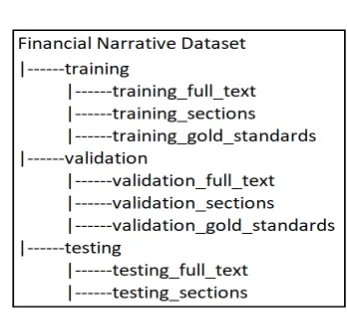
Figure 2 shows the structure of the Financial Narrative Dataset. At the beginning of the shared task we provided the participants with two direc-tories “training” and “validation” each containing the full text of the annual reports (*_full_text), the extracted sections (*_sections) and the gold stan-dard summaries (*_gold_stanstan-dards).
[image:3.595.327.501.269.425.2]5 Data Sample
Figure 2: Dataset Structure
The data is provided in plain text file format in a directory structure as in Figure 2. Each annual report has a unique ID and it is used across in or-der to link annual reports’ full text to their sec-tions and gold-standards. For example: The train-ing directory contains a file called 17.txt where 17 is a unique ID and can be used to locate this report‘s sections in the training_sections di-rectory, as shown in the files 17_896317_3.txt
and 17_896317_4.txt. Also the same ID can be
used to find this report‘s gold standard summaries as in the training_gold_standards as in the files
17_896311_8.txtand17_896313_1.txt.
For the files in the *_sections and *_gold_standards each file name is made of the following: reportID_sectionID_sectionType.txt
as in17_896317_4.txt.
Section type can be used to identify narrative sections, those with any sectionTypebut zero, as follows:
• 2 Chief Executive Officer (CEO) review
• 3 Governance statement
• 4 Remuneration report
• 5 Business review
• 6 Financial review
• 7 Operating review
• 8 Highlights
• 9 Auditors report
• 10 Risk management
• 11 Chairman‘s governance introduction
• 12 Corporate Social Responsibility (CSR) disclosures
Sections with sectionType=0 are considered to be non-narratives and are not expected to appear in the summary. Example: 17_896315_0.txt. To make the task challenging we did not provide sec-tion types in the testing data as that is expected to be the participants task where they are expected to define which sections are narrative sections before summarising the report.
The data is available for free for research pru-poses.5
6 Challenges
This is a challenging task considering a) the size of each annual reports and b) the lack of standardisa-tion in UK annual reports. These challenges shed light on the complexity of financial narratives in general, along with the fact that more robust and up to date machine learning and NLP techniques are required to facilitate the automatic extraction and analysis of financial narratives.
7 Conclusion and Future Work
This paper introduces the first financial narra-tive summarisation dataset at the First MultiL-ing Financial Narrative Summarisation Task, held at MultiLing 2019 Summarisation workshop at RANLP 2019 in Varna, Bulgaria . It shows the need and as well as the challenges of summaris-ing long and unstructured UK annual reports. For
5 http://multiling.iit.demokritos.gr/pages/view/1648/task-financial-narrative-summarization
the future work we will provide a baseline sum-mariser reporting AutoSummENG and Rouge au-tomatic metrics.
References
Eddy Cardinaels, Stephan Hollander, and Brian J White. 2018. Automatic summaries of earnings releases: Attributes and effects on investorsâ judgments. Available at SSRN 2904384.
Mahmoud El-Haj, Paulo Alves, Paul Rayson, Martin Walker, and Steven Young. 2019a. Re-trieving, classifying and analysing narrative commentary in unstructured (glossy) annual re-ports published as pdf files. Accounting and Business Research, pages 1–29.
Mahmoud El-Haj, Udo Kruschwitz, and Chris Fox. 2011. University of essex at the tac 2011 multilingual summarisation pilot.
Mahmoud El-Haj, Paul Rayson, Paulo Alves, Carlos Herrero-Zorita, and Steven Young. 2019b. Multilingual financial narrative process-ing: Analysing annual reports in english, span-ish and portuguese. Multilingual Text Analy-sis: Challenges, Models, And Approaches, page 441.
Mahmoud El-Haj, Paul Rayson, Paulo Alves, Carlos Herrero-Zorita, and Steven Young. 2019c. Multilingual financial narrative process-ing: Analysing annual reports in english, span-ish and portuguese. Multilingual Text Analy-sis: Challenges, Models, And Approaches, page 441.
Mahmoud El-Haj, Paul Rayson, and Andrew Moore. 2018a. The first financial narrative pro-cessing workshop (fnp 2018). LREC 2018.
Mahmoud El-Haj, Paul Rayson, Steven Young, and Martin Walker. 2014. Detecting document structure in a very large corpus of uk financial reports.
Mahmoud El-Haj, Paul Edward Rayson, Paulo Alves, and Steven Eric Young. 2018b. To-wards a multilingual financial narrative process-ing system. LREC 2018.
Michael Elhadad, Sabino Miranda-Jiménez, Josef Steinberger, and George Giannakopoulos. 2013. Multi-document multilingual summarization corpus preparation, part 2: Czech, hebrew and spanish. MultiLing 2013, page 13.
George Giannakopoulos, Mahmoud El-Haj, Benoit Favre, Marina Litvak, Josef Steinberger, and Vasudeva Varma. 2011. Tac 2011 multiling pilot overview.
Lei Li, Corina Forascu, Mahmoud El-Haj, and George Giannakopoulos. 2013. Multi-document multilingual summarization corpus preparation, part 1: Arabic, english, greek, chi-nese, romanian. In Proceedings of the Mul-tiLing 2013 Workshop on Multilingual Multi-document Summarization, pages 1–12.