323
Controlling Contents in Data-to-Document Generation with
Human-Designed Topic Labels
Kasumi Aoki♭♣ Akira Miyazawa♢♡♣ Tatsuya Ishigaki♠♣ Tatsuya Aoki♠♣ Hiroshi Noji♣
Keiichi Goshima♯♣ Ichiro Kobayashi♭♣ Hiroya Takamura♠♣ Yusuke Miyao♮♣
♭Ochanomizu University ♣National Institute of Advanced Industrial Science and Technology ♢The Graduate University for Advanced Studies ♡National Institute of Informatics
♠Tokyo Institute of Technology ♯Waseda University ♮The University of Tokyo
{g1120501, koba}@is.ocha.ac.jp [email protected] {aoki, ishigaki}@lr.pi.titech.ac.jp
[email protected] [email protected] [email protected] [email protected]
Abstract
We propose a data-to-document generator that can easily control the contents of output texts based on a neural language model. Con-ventional data-to-text model is useful when a reader seeks a global summary of data be-cause it has only to describe an important part that has been extracted beforehand. However, since it differs from users to users what they are interested in, it is necessary to develop a method to generate various summaries accord-ing to users’ requests. We develop a model to generate various summaries and to control their contents by providing the explicit targets for a reference to the model as controllable fac-tors. In the experiments, we used five-minute or one-hour charts of 9 indicators (e.g., Nikkei 225), as time-series data, and daily summaries of Nikkei Quick News as textual data. We conducted comparative experiments using two pieces of information: human-designed topic labels indicating the contents of a sentence and automatically extracted keywords as the refer-ential information for generation. Experiments show both models using additional informa-tion of target document achieved higher per-formance in terms of BLEU and human eval-uation. We found that human-designed topic labels are superior to extracted keywords in terms of controllability.
1 Introduction
Data-to-text is one of the challenging tasks in nat-ural language generation, which aims to generate summaries of input data such as statistics from sports games (Robin,1995;Barzilay and Lapata, 2005;Wiseman et al., 2017), financial data ( Mu-rakami et al.,2017;Aoki et al.,2018), and database records (Reiter and Dale,1997;Liang et al.,2009; Mei et al.,2016;Lebret et al.,2016;Novikova et al., 2017;Liu et al.,2018;Wiseman et al.,2017).
Over the past several years, end-to-end neu-ral language generation models have successfully
been applied to versatile data-to-text tasks, because they can generate fluent texts without task-specific knowledge and resources.
However, it has also been pointed out that texts generated by neural models suffer from low diver-sity in expressions (Yang et al.,2019). Especially on the data-to-text tasks, since they are developed under the assumption that the important contents could be uniquely determined, previous methods did not focus on controlling the contents in terms of user’s interests.
However, each user may expect different con-tents in a summary depending on what they are interested in, and thus it is appealing to develop a method to generate various summaries which re-flect user’s interests.
This paper investigates a method for guiding data-to-document generation in the finance do-main, by referring to a sequence of additional infor-mation for input financial data. Generating docu-ments consisting of multiple sentences involves an inherent challenge in content selection and order-ing (Reiter and Dale,1997), because one can pro-duce a large variety of documents for specific input data, depending on a focus, intent, readers’ interest, etc. Therefore, it is essential for document gener-ation systems to have an additional mechanism to select and order the contents to be represented.
We introduce and empirically compare two types of topic labels, both of which are intended to denote clause-level contents and their orders. One is topical keywords automatically extracted from domain texts (Rose et al.,2010), which was applied for the story generation by using as the contents of the story (Yao et al.,2018).
closed set of domain-specific labels by investigat-ing financial news articles. In the experiments on generating daily summaries of financial markets, we will empirically show the effectiveness of topic labels and potential advantages/disadvantages of this approach.
2 Related study
Controllability of text generation has been an in-tensive research focus recently. Examples include suggestive content control such as tense, sentiment, gender, or automatically learned hidden states (Hu et al.,2017;Zhao et al.,2018;Juraska and Walker, 2018;Bau et al., 2019). Another series of work is focused on controlling surface textual features such as length, descriptiveness and politeness (Li et al.,2016;Sennrich et al.,2016;Kikuchi et al., 2016;Ficler and Goldberg,2017;Shen et al.,2017; Prabhumoye et al.,2018). The target of these pre-vious methods is on controlling generic content-independent features of texts. That is, they aim at varying surface strings while preserving main information content. Wiseman et al. (2018) pro-posed a neural model that generates diverse texts by learning templates. They control diversity through templates rather than contents or the order of them. The present work is more closely related to meth-ods for controlling topical content by using auto-matically extracted or human-designed keywords (Wang et al.,2016;Yao et al., 2017,2018;Miao et al., 2018). Our method resembles the idea of using keywords to control topics of sentences and their orders, but it primarily focuses on describing given data and uses topic labels as auxiliary infor-mation. We will empirically attest added effects of introducing topic labels in the data-to-document scenario.
Besides, Gkatzia et al. (2017) and Portet et al. (2009) proposed non-neural language generation models for the data-to-text task with higher con-trollability on the output. They assumed that the important contents and their descriptions are de-termined primarily by experts, and their models do not allow users to select the contents directly.
To the best of our knowledge, no previous re-search tackled a problem with controllability of the content in the data-to-document task.
We believe that the contribution of this pa-per is the followings: First, we propose explic-itly content-controllable data-to-document gener-ator that uses additional clause information.
Ex-periments show the fluency and fidelity of the gen-erated document in terms of BLEU and human-evaluation. Secondly, compared the generated documents between with human-designed labels and automatically extracted keywords, human-designed labels are more useful as the ease of un-derstanding.
3 Generation of Market Comments
Our task is to generate summaries of financial mar-kets. The input is a set of financial time-series data, such as DJI, Nikkei 225, and JPY/USD exchange rate. The output is a sequence of sentences de-scribing movements of the financial data and their relationships.
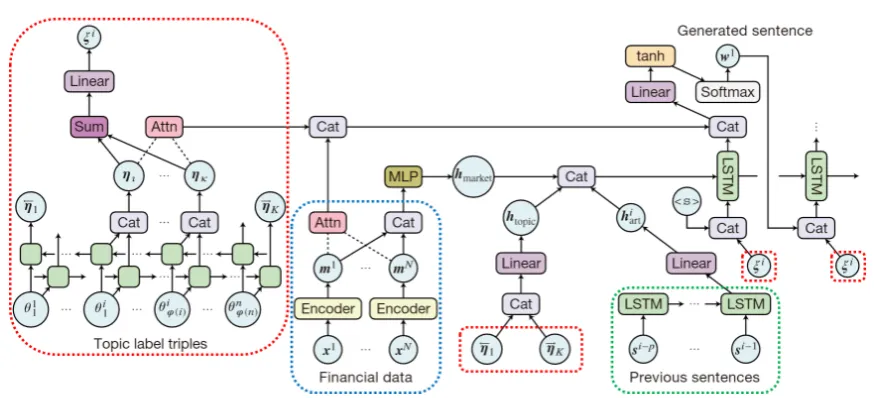
The overview of our model is illustrated in Fig-ure1. In the following, we first describe our design of topic labels, then describe our data-to-text model with topic labels.
3.1 Topic Labels
Topic labelsare defined as clause-level topics for aiming to guide a sequence of contents to be output. We empirically compare two methods to obtain topic labels: automatically extracted keywords and human-designed labels.
Automatically extracted keywords
This is a straightforward strategy to obtain the la-bels as the topic of sentences. We use RAKE (Rose et al., 2010) algorithm, which builds document graphs and weights the importance of each word combining several word-level and graph-level cri-teria to extract the keywords. Using such an auto-matic keywords extraction system has an advantage on the cost of human annotation while the extracted keywords sometimes do not express writers’ intent. For example, RAKE often outputs the word “mar-ket” or “observation” as keywords, but they are not appropriate as the topic labels because of the lack of precise information—a system would be unable to understand which market, e.g., Nikkei or DJI, or what kinds of observations, e.g., the growth rate of stock prices or the trends of investments, when generating a text considering these labels.
Human-designed topic labels
We devised a set of topic labels by observing target sentences in the training data and what they often refer to, especially forNikkei Quick News(NQN).
Figure 1: The neural-network architecture of our model with topic labels. The model generates each sentence st =(w1
t,w2t, . . .)separately with document topic labels Θ= (θ11, . . ., θ i
1, . . .), financial data X = (x
1, . . .,xN)
and also previous sentences si−p to si−1. Topic labels are encoded to capture both of the document-level and
sentence-level information. We denote concatenation asCat, 3-layer MLP asMLP. In addition,Attndenotes the attention with the hidden states of the decoder.
of which indicatestarget, actuals or futures, and trade or movement. The latter two are subcate-gories oftarget; for example,[US Market]-[Actuals]
-[Movement] denotes a topic about the movement of actuals of the US market, while [Nikkei 225]
-[Futures]-[Trade] means the trading activity of the futures market of Nikkei 225. [Others] is given when these subcategories do not apply.
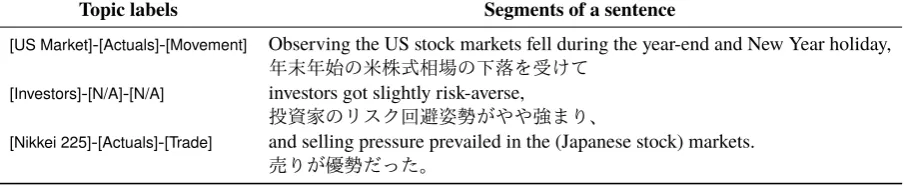
Table 1 shows all atomic labels, and Table 2 illustrates an example of sentence and its topic la-bels. Note that a topic label is given to a clause, which means one sentence may have multiple topic labels. On the annotated data, the average number of labels for each sentence is 2.0.
We designed the topic labels aiming to make it easy for a user to control the contents. News ar-ticles often refer to trends of each market indices and also their relationships focusing on the general market movements. This means that sometimes the generated summary would not contain the contents expected by the user, especially when the markets attended by the user are not common ones. There-fore, we developedtopic labels with the concrete names of market indices. Thetopic labelshelp a user to generate articles which have sufficient con-tent by inputting market names as their interest.
Besides, the granularity of topics is an important factor to design the topic labels. Too rough topics could lead the vagueness of meaning of the topic while too detailed topics would be difficult for some
users and take time to annotate. We designed our topic labels in a hierarchical structure to make them adaptive to different levels of granularity.
Human-designed labels are inferior in terms of construction cost, but expected to be superior to automatically extracted keywords in terms of in-terpretability as discussed later.
3.2 Encoder–Decoder with Topic Labels
Our model is an extended encoder–decoder that conditions on a document topic label sequence and previous sentences, in addition to financial data consisting of multiple numerical sequences. To make learning and generation simpler, our de-coder generates each sentence separately, by en-coding the sentence that was generated last. The entire neural-network architecture of our encoder– decoder model is shown in Figure1.
Assume that we have generatedi−1sentences in an article and generate the nexti-th sentence. Let sj = (wtj)Tt=1(j =1, . . .,n)be the j-th sentence in an article, where eachwtj is a word. We also use
wtj to denote embedding ofwtj. In addition, in the following,W∗andb∗are a weight matrix and bias terms in the model parameters, respectively.
3.2.1 Encoders
Topic Labels
Target: [Nikkei 225], [Individual stock (Japan)], [Narrow-based stock indices (Japan)], [TSE1] (First section
of Tokyo Stock Exchange), [TSE2] (Second section of Tokyo Stock Exchange), [TOPIX], [US Market],
[Individual stock (US)],[Narrow-based stock indices (US)],[DJI](Dow Jones Industrial Average),[Hong Kong Market],[Market (Other countries)],[Individual stock (Other countries)],[Narrow-based stock indices (Other coun-tries)], [JPY],[JPY/USD],[JPY/EUR], [JPY/AUD], [JPY Others], [USD],[AUD], [EUR],[HKD], [JGB](Japanese government bond), [JGB (5–10 years)], [JGB (2–3 years)], [US Treasury securities], [US Treasury Notes (5– 10 years)], [US Treasury Notes (2–3 years)], [TIBOR], [JPY interest rate], [Economic Index], [Events], [Lack of information for making a decision],[Investors],[Buying operation],[Statement of prominent person],[Others]
Actuals or Futures: [Actuals],[Futures],[N/A]
[image:4.595.75.529.262.355.2]Trade or Movement:[Trade],[Movement],[N/A]
Table 1: Full set of human-designed atomic topic labels. Each topic is a tuple of values from three categories.
Topic labels Segments of a sentence
[US Market]-[Actuals]-[Movement] Observing the US stock markets fell during the year-end and New Year holiday,
年末年始の米株式相場の下落を受けて
[Investors]-[N/A]-[N/A] investors got slightly risk-averse,
投資家のリスク回避姿勢がやや強まり、
[Nikkei 225]-[Actuals]-[Trade] and selling pressure prevailed in the (Japanese stock) markets.
売りが優勢だった。
Table 2: Example of a sentence and its topic labels. One sentence may have multiple topic labels as in this example.
encoders we first obtain three vectors,hmarket,hiart,
and htopic, which encode financial data, previous
sentences, and all topic labels on the article, re-spectively. Note thathtopicencodes a sequence of
all topics on the article. We also obtain a vector encoding the topic labels of the current sentence, denoted byξi, from the topic labels encoder.
Financial data encoder
As the encoder of financial data, we follow Mu-rakami et al.(2017). GivenLnumerical sequences
x1, . . .,xL, which are numerical sequences of fi-nancial indicators (e.g., Nikkei stock average and the foreign exchange rate of Japanese yen). We concatenate these vectors and feed it to a 3-layer MLP to obtain a single vectorhmarket:
hmarket=MLP([m1;. . .;mL]).
We use different MLPs to convert numerical se-quences into vectors. Note thatxlconsists ofxshortl
andxllong, which are short-term and long-term
nor-malized data ofxl. xl
short is composed of the
pre-vious prices within one trading day and xllong is composed of the closing prices of the seven
pre-ceding trading days.
ml=Wl([xshortl ;xllong;
MLP(xlshort); MLP(xllong)])+bl. Previous sentences encoder
The hidden state hiart representing previous sen-tences of si is obtained from p preceding sentences, si−p, . . .,si−1. We input embed-dings w1i−p, . . .,w|is−ip−p|, . . .,w
i−1 1 , . . .,w
i−1 |si−1| to
long short-term memory (LSTM) cells and obtain
harti after passing its terminal hidden state to a
lin-ear layer, where|sj|denotes the number of tokens insj.
Topic label encoder
The outputs of this encoder are htopic, which
en-codes the topic sequence of the article, andξi, cor-responding to the embedding of topics assigned to the target (i-th) sentence si. The reason why we encode the document-level topic sequence, rather than sentence topics only, is to make ξi context-sensitive, by which we expect the output sentence, conditioned on ξi, to reflect the position of sen-tence topics on the entire document topics.
topic labels of sentences with a token</s>. Then
htopic is obtained from the outputs of this LSTM,
by concatenating the outputs at the end tokens of both directions. These are denoted by→−ηK and←η−1
in Figure1, whereK = ∑jφ(j), the length of the document-level topic sequence. φ(j) denotes the length of assigned topics forsj, including the last topic label</s>.
We then extract topic embedding corresponding to the topic labels ofsiastopic embeddingξi. We do this by summing all outputs of LSTMs in a span corresponding to the current sentence excluding
</s>. Letθikbe thek-th topic insi. The bi-LSTM introduced above transforms this input into a vector ηt = [←η−t ;→−ηt], by concatenating the outputs of LSTMs of both directions. Then ξi is obtained by summing the outputs in the span, followed by a linear layer:
ξi=W
ξ (∑κ
t=ι ηt
)
+bξ,
in which ιand κare the indices corresponding to θi
1 and θ
i
φ(i)−1, the start and end topic labels for
thei-th sentence. Formally,ι=∑ij−=11φ(j)+1and κ=ι+φ(i) −1.
3.2.2 Decoder
Our decoder is another LSTM conditioned on the outputs of three encoders introduced above. To initialize the decoder, we first concatenate three outputs of encoders and apply a linear layer:
H0i=WH[htopic;hmarket;hiart]+bH. (1) Note that htopic encodes the entire
document-level topics, not the topics for the target sentence only. To make the output sentence more relevant to those target topics, we feedξito the input of the decoder at every step, by concatenating it with the original input vectorwtj.
While this would allow the contents of output sentence to follow the given local topics, the sen-tence should also reflect the information of global topic sequence, e.g., the relative position of the target sentence in the article. A natural way to en-code such context in the deen-coder is the attention mechanism (Luong et al.,2015), which we apply to the outputs of topic label encoderηt, as well as the outputs of financial data encoder ml, to cap-ture the important resources relevant to the current sentence.
We obtain the context vectors cmarket
t and c
topic
t for attending the financial data and topic labels from the output of decoder LSTM, and concatenate them before the softmax layer:
wt ∼softmax(tanh(Wc[ctopict ;cmarkett ;Hti]+bc)).
The context vectorctmarketis obtained by a bilinear attention (Luong et al.,2015):
ctmarket=
L
∑
l=1 αmarket
t (l)ml, αmarket
t (l) ∝exp(Hti ⊤
Wamarketml). cttopicis obtained similarly:
ctopict =
K
∑
k=1 αtopic
t (k)ηk, αtopic
t (k) ∝exp(Hti ⊤
Watopicηk).
4 Experimental Settings
Each example in our dataset is a pair of aligned time-series data and a corresponding document. We obtained documents by retrieving daily sum-maries from NQN, which describes market trends in Japanese, as well as aligned time-series data, from Thomson Reuters DataScope Select1. Divid-ing by periods, we obtained 864, 122, and 124 documents (9,337, 1,215, and 1,237 sentences) for train/valid/test sets, respectively. The vocab-ulary size was 3,025. As topic labels, we used 91 human-designed topic labels and 818 kinds of extracted keywords by the RAKE algorithm. We preprocessed each indicator followingAoki et al. (2018), and used the same parameters for the finan-cial data encoder. Other parameters were tuned by document-level BLEU scores on the validation set. We compared five different documents; a doc-ument written by human writer (Gold), a doc-ument generated by our model without topic la-bels (NoTopicLabel) and three documents respec-tively generated by our models using topic labels:
• HDTag3: Human-designed topic labels.
• HDTag1: Simplified Human-designed topic labels (only target of Table1) to see the im-portance of other factors.
• RAKE: Two keywords extracted by RAKE.
Method BLEU (doc) BLEU (sent)
NoTopicLabel 21.19±1.16 14.69±0.39 HDTag3 29.21±0.29 22.77±0.40 HDTag1 27.92±0.37 21.25±0.57 RAKE 29.53±0.25 23.35±0.40
Table 3: Result of evaluation in terms of BLEU. Scores were averaged over 5 runs. The values after ± are the standard deviations. We report both the averaged BLEU scores over all the documents (BLEU (doc)) and sentences (BLEU (sent)).
We conducted both an automatic evaluation with BLEU score in words and a human-evaluation. The human evaluation focused on the fluency and the fidelity and the correctness of each approach. For human evaluation, we sample 15 instances from the test dataset. For each of the 15 instances, eval-uators are presented with 5 documents that are re-spectively generated by a human writer (Gold), NoTopicLabel, HDTag3, HDTag1, andRAKE. Note thatNoTopicLabeldoes not use topic labels, whileHDTag3,HDTag1, andRAKEuse topic la-bels. The evaluators are asked to rate the docu-ments on a 1–3 scale with respect to fidelity, cor-rectness and fluency. Fidelitymeasures whether each document reflects the given topic labels.
Cor-rectnessmeasures whether each document is
faith-ful to the given financial data. Fluency measures the fluency of each document without regard to input data. Since the evaluation of Correctness
is a complicated process which requires the ref-erence to input numerical data, the evaluators are supposed to evaluate only the sentences that satisfy the following two conditions: (i) the sentence starts with “Nikkei stock average” or “The exchange rate of the Japanese yen”2, (ii) the sentence is labeled with only [Nikkei 225/ Actuals/ Movement] or [JPY//Movement]. Additionally, the evaluators are also asked to conduct sentence-level evaluation of fluency, in which they are presented with 5 sen-tences generated by the 5 methods includingGold. All the evaluations are conducted by two evalua-tors, and we compute the average scores for each approach.
2The original Japanese phrases are “日経平均株価は
(Nikkei stock average)” and “円相場は(The exchange rate of the yen)”.
5 Results
Table 3 shows the BLEU scores of different ap-proaches. The models with label information ( HD-Tag3,HDTag1, andRAKE) achieved higher per-formances in terms of BLEU. RAKE achieved a slightly higher BLEU score thanHDTag3, but the difference was not statistically significant. HD-Tag3achieved a higher BLEU score thanHDTag1. This result suggests that more informative topic la-bels improved the quality of generated text. In other words, careful design of topic labels helps high-quality generation, although it requires more human cost. It is also encouraging thatHDTag3is comparable toRAKE, in spite of the fact that the labels in the latter are extracted from words in the reference.
The results of human-evaluation are shown in Table4. There was no statistically-significant dif-ference among the sentence-level fluency scores of all methods. This means that the neural-network based method has the ability to generate a fluent text at least at the sentence level. The methods with topic-label information showed a better document-level fluency than the one without topic labels.
Meanwhile, there was a significant difference between the document-level fluency scores of gen-erated sentences and human-written sentences. We considered it is caused by not considering relation-ships among topic-labels and also by weak consid-eration of generated sentences. Specifically, our model possibly generates almost the same content repeatedly as the content of previously generated sentences which are not treated as input resource, and moreover our model could generate different movement descriptions about the same indicator within a document. An example is shown in Ta-ble 5, where two sentences describing the same movement of the exchange rate state the contra-dictory things; dropped and rose. To solve the above problems, the implementation of additional memories to keep tracking which topics have been mentioned and how topics have been mentioned is interesting avenue for future work.
Method Fidelity Correctness Fluency (doc) Fluency (sent)
Gold – 2.80 2.90 2.93
NoTopicLabel – 1.70 1.13 2.86
HDTag3 2.70 2.23 1.70 2.90
HDTag1 2.60 1.93 1.86 2.86
RAKE 1.96 2.53 1.76 2.93
Table 4: Result of human-evaluation. Scores range in [1,3]. Fidelitymeasures whether each document reflects the given topic labels. Correctness measures whether each document is faithful to the given financial data.
Fluencymeasures the fluency of each document or sentence without regard to input data. Fluency (doc)is the document-level fluency, whileFluency (sent)is the sentence-level fluency.
Method Topic label Text
Gold . . ., </s>, “The yen exchange rates rose for four days in a row.”, </s>, “There were movements to sell the yen along with the rise of Nikkei 225, but they soon calmed down.”,</s>, “In the afternoon, the yen rose and hit a high of around 108.5 yen against the dollar, which was the highest in about three weeks.”,</s>,. . .
. . .,</s>, “円相場は4日続伸した。”,</s>, “日経平均の上昇と歩
調を合わせて円を売る動きがあったが、勢いは続かなかった。”,
</s>, “午後に1ドル=108円台半ばまで上昇し、約3週間ぶりの 高値を付ける場面があった。”,</s>,. . .
HDTag3 . . .,</s>,[JPY]-[N/A]-[Movement],</s>,
[Nikkei]-[Actual]-[Movement],[JPY]-[N/A]
-[Trade], [JPY]-[N/A]-[Movement], </s>,
[JPY/USD]-[N/A]-[Movement],</s>,. . .
. . .,</s>, “The yen exchange rates dropped.”,</s>, “Observing the steady rise of Nikkei 225, traders started to sell the yen regarding it as a low-risk currency, and it did not rise constantly.”,</s>, “The yen exchange rate rose against the dollar.”,</s>,. . .
. . .,</s>, “円相場は反落。”,</s>, “日経平均株価が堅調に推移
したことで、「低リスク通貨」とされる円を売る動きが出て、円の
上値は重かった。”,</s>, “円は対ドルで上昇した。”,</s>,. . .
Table 5: Sentences generated byHDTag3.
consistent with the result of BLEU scores.
Moreover, both models with human-designed topic labels show higher fidelity, which means the generated documents reflect the given topic labels. We speculate that the lower fidelity of RAKE is caused by the ambiguity of extracted keywords as discussed through examples in the next paragraph.
We then provide a qualitative comparison of RAKE and human-designed topic labels. Table6 shows some output examples. As we mentioned, we found that RAKE keywords are often more ambiguous than the human-designed topic labels. This is mainly because the granularity of keywords is not properly defined. Table6(a) shows an exam-ple, where RAKE keywords contain “high”, which however does not tell which quantity is high, re-sulting in the wrong contents in the generated sen-tence. The human-designed topic labels have a higher interpretability, and the sentences generated with such topic labels are well-controlled.
The quantitative and qualitative evaluations above suggest that human-designed topic labels
contribute to a better controllability backed up by high fidelity and interpretability.
Although our approach has the advantage of the controllability in generating sentences, we also found complication in terms of topic design, in particular, the definition of granularity of the top-ics. We found that the system often generates a wrong description when the topic labels contain a general label, such asOthersandEvents. These labels tend to be used as catch-all labels, resulting in diverse contents. Table6(b) shows an example thatOthersleads to a longer sentence with wrong contents.
(a) Sentences generated byHDTag3andHDTag1,RAKE, for which the topic labels byRAKEare ambiguous.
Method Topic label Text
Gold . . .,</s>, “Then, Nikkei 225 significantly rose, and traders sold the yen expecting investors to get risk-appetite and regarding yen as a ‘low-risk currency’.”,</s>,. . .
. . .,</s>, “その後、日経平均株価が大幅高となり、投資家のリ スク選好意欲が強まるとみた市場参加者が「低リスク通貨」と される円の売りを増やした。”,</s>,. . .
HDTag1 . . ., </s>,[Nikkei 225],[Investors],[JPY], </s>,. . .
. . .,</s>, “A rise of Nikkei 225 improved investor sentiment and prompted traders to buy the yen regarding it as a low-risk currency.”, </s>,. . .
. . .,</s>, “日経平均株価が上昇したことで投資家心理が改善し、 低リスク通貨とされる円を買う動きが優勢だった。”,</s>,. . .
HDTag3 . . ., </s>, [Nikkei 225]-[Actuals]
-[Movement], [Investors]-[N/A]-[N/A],
[JPY]-[N/A]-[Trade],</s>,. . .
. . .,</s>, “A significant rise of Nikkei 225 also improved investor sentiment and prompted traders to buy the yen.”,</s>,. . .
. . .,</s>, “日経平均株価が大幅に上昇したことも投資家心理の 改善につながり、円買いを誘った。”,</s>,. . .
RAKE . . .,</s>,high,preference,</s>,. . . .,</s>, “However, traders bought the yen and sold the dollars to adjust the position in advance of the Fed’s Interest-Rate Announce-ment.”,</s>,. . .
. . .,</s>, “ただ、米連邦公開市場委員会(FOMC)の結果発表を 控え、持ち高調整の円買い・ドル売りが入った。”,</s>,. . .
(b) Sentences generated byHDTag3with[Others].
Method Topic label Text
Gold . . .,</s>, “Speculation that the Bank of Japan purchased exchange-traded funds was positive for the markets.”</s>,. . .
. . .,</s>, “日銀が株価指数連動型上場投資信託(ETF)買いを入 れたとの思惑も相場を支えた。”,</s>,. . .
[image:8.595.73.534.514.710.2]HDTag3 · · ·, </s>, [Others]-[N/A]-[N/A], [In-vestors]-[N/A]-[N/A], [Nikkei 225]-[Actuals]
-[Movement],</s>,· · ·
. . .,</s>, “On alert against the debt problem in Europe, stock prices continued to decline while bonds continued to rise.”</s>,. . .
. . .,</s>, “もっとも、欧州債務問題への警戒感から株安・債券高 が進んだ。”,</s>,. . .
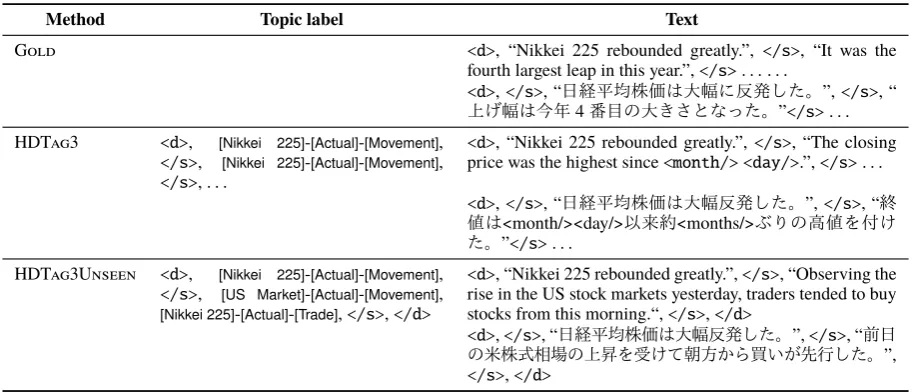
(c) Sentences generated byHDTag3andHDTag3Unseen.
Method Topic label Text
Gold <d>, “Nikkei 225 rebounded greatly.”, </s>, “It was the fourth largest leap in this year.”,</s>. . . .
<d>,</s>, “日経平均株価は大幅に反発した。”,</s>, “
上げ幅は今年4番目の大きさとなった。”</s>. . .
HDTag3 <d>, [Nikkei 225]-[Actual]-[Movement], </s>, [Nikkei 225]-[Actual]-[Movement], </s>, . . .
<d>, “Nikkei 225 rebounded greatly.”, </s>, “The closing price was the highest since<month/> <day/>.”,</s>. . .
<d>,</s>, “日経平均株価は大幅反発した。”,</s>, “終 値は<month/><day/>以来約<months/>ぶりの高値を付け た。”</s>. . .
HDTag3Unseen <d>, [Nikkei 225]-[Actual]-[Movement], </s>, [US Market]-[Actual]-[Movement],
[Nikkei 225]-[Actual]-[Trade],</s>,</d>
<d>, “Nikkei 225 rebounded greatly.”,</s>, “Observing the rise in the US stock markets yesterday, traders tended to buy stocks from this morning.“,</s>,</d>
<d>,</s>, “日経平均株価は大幅反発した。”,</s>, “前日
の米株式相場の上昇を受けて朝方から買いが先行した。”,
</s>,</d>
6 Conclusion
We proposed a data-to-document generator which can be controlled by a sequence of topic la-bels. We compared two topic labels, the human-designed topic label and automatically extracted keywords, and conducted experiments with a fi-nancial dataset. Our experiments empirically showed that the model using topic label infor-mation achieved higher performance in terms of BLEU and human-evaluation. Furthermore, the model using the human-designed topic labels has an advantage on controllability of the output docu-ments without reducing BLEU scores. In addition, experiments showed that the granularity of topic labels influences the generation quality.
As future work, we will employ the network architectures which have additional memories to keep tracking which topics have been mentioned and how topics have been mentioned for high topi-cal coherence in the sentences. In addition, future work should include reducing the inconsistency be-tween a generated text and the actual movement of input financial indicators because even one conflict could be fatal to the reliability of the generated text. Topic labels should also be easy to handle for human users, who actually use the system to gen-erate a document. We also need to evaluate topic labels in terms of the easiness of use.
Acknowledgements
This paper is based on results obtained from a project commissioned by the New Energy and Industrial Technology Development Organization (NEDO).
References
Tatsuya Aoki, Akira Miyazawa, Tatsuya Ishigaki, Kei-ichi Goshima, Kasumi Aoki, Ichiro Kobayashi, Hi-roya Takamura, and Yusuke Miyao. 2018. Generat-ing market comments referrGenerat-ing to external resources. InProc. of INLG 2018, pages 135–139.
Regina Barzilay and Mirella Lapata. 2005. Collec-tive content selection for concept-to-text generation. In Proceedings of the Conference on Human Lan-guage Technology and Empirical Methods in Natu-ral Language Processing, HLT ’05, pages 331–338, Stroudsburg, PA, USA. Association for Computa-tional Linguistics.
Anthony Bau, Yonatan Belinkov, Hassan Sajjad, Nadir Durrani, Fahim Dalvi, and James Glass. 2019. Iden-tifying and controlling important neurons in neural
machine translation. InInternational Conference on Learning Representations.
Jessica Ficler and Yoav Goldberg. 2017. Controlling linguistic style aspects in neural language generation. In Proceedings of the Workshop on Stylistic Varia-tion, pages 94–104. Association for Computational Linguistics.
Dimitra Gkatzia, Oliver Lemon, and Verena Rieser. 2017. Data-to-text generation improves decision-making under uncertainty.IEEE Computational In-telligence Magazine, 12:10–17.
Zhiting Hu, Zichao Yang, Xiaodan Liang, Ruslan Salakhutdinov, and Eric P. Xing. 2017. Toward con-trolled generation of text. InProceedings of the 34th International Conference on Machine Learning, vol-ume 70 of Proceedings of Machine Learning Re-search, pages 1587–1596, International Convention Centre, Sydney, Australia. PMLR.
Juraj Juraska and Marilyn Walker. 2018. Character-izing variation in crowd-sourced data for training neural language generators to produce stylistically varied outputs. InProceedings of the 11th Interna-tional Conference on Natural Language Generation, pages 441–450, Tilburg University, The Netherlands. Association for Computational Linguistics.
Yuta Kikuchi, Graham Neubig, Ryohei Sasano, Hiroya Takamura, and Manabu Okumura. 2016.Controlling output length in neural encoder-decoders. In Pro-ceedings of the 2016 Conference on Empirical Meth-ods in Natural Language Processing, pages 1328– 1338, Austin, Texas. Association for Computational Linguistics.
Rémi Lebret, David Grangier, and Michael Auli. 2016.
Neural text generation from structured data with ap-plication to the biography domain. InProceedings of the 2016 Conference on Empirical Methods in Nat-ural Language Processing, pages 1203–1213. Asso-ciation for Computational Linguistics.
Jiwei Li, Michel Galley, Chris Brockett, Georgios Sp-ithourakis, Jianfeng Gao, and Bill Dolan. 2016. A persona-based neural conversation model. In Pro-ceedings of the 54th Annual Meeting of the Associa-tion for ComputaAssocia-tional Linguistics (Volume 1: Long Papers), pages 994–1003, Berlin, Germany. Associ-ation for ComputAssoci-ational Linguistics.
Percy Liang, Michael Jordan, and Dan Klein. 2009.
Learning semantic correspondences with less super-vision. InProceedings of the Joint Conference of the 47th Annual Meeting of the ACL and the 4th In-ternational Joint Conference on Natural Language Processing of the AFNLP, pages 91–99, Suntec, Sin-gapore. Association for Computational Linguistics. Tianyu Liu, Kexiang Wang, Baobao Chang Lei Sha,
Thang Luong, Hieu Pham, and Christopher D. Man-ning. 2015. Effective approaches to attention-based neural machine translation. InProceedings of Em-pirical Methods in Natural Language Processing (EMNLP), pages 1412–1421.
Hongyuan Mei, Mohit Bansal, and Matthew R. Walter. 2016. What to talk about and how? selective gener-ation using lstms with coarse-to-fine alignment. In
Proceedings of the 2016 Conference of the North American Chapter of the Association for Computa-tional Linguistics: Human Language Technologies, pages 720–730, San Diego, California. Association for Computational Linguistics.
Ning Miao, Hao Zhou, Lili Mou, Rui Yan, and Lei Li. 2018. CGMH: constrained sentence gen-eration by metropolis-hastings sampling. CoRR, abs/1811.10996.
Soichiro Murakami, Akihiko Watanabe, Akira Miyazawa, Keiichi Goshima, Toshihiko Yanase, Hi-roya Takamura, and Yusuke Miyao. 2017. Learning to generate market comments from stock prices. In
Proc. of ACL 2017, pages 1374–1384.
Jekaterina Novikova, Ondřej Dušek, and Verena Rieser. 2017. The e2e dataset: New challenges for end-to-end generation. InProceedings of the 18th An-nual SIGdial Meeting on Discourse and Dialogue, pages 201–206, Saarbrcken, Germany. Association for Computational Linguistics.
Francois Portet, Ehud Reiter, Albert Gatt, Jim Hunter, Somayajulu Sripada, Yvonne Freer, and Cindy Sykes. 2009. Automatic generation of textual sum-maries from neonatal intensive care data. Artificial Intelligence, 173(7-8):789–816.
Shrimai Prabhumoye, Yulia Tsvetkov, Ruslan Salakhut-dinov, and Alan W Black. 2018. Style transfer through back-translation. In Proceedings of the 56th Annual Meeting of the Association for Com-putational Linguistics (Volume 1: Long Papers), pages 866–876, Melbourne, Australia. Association for Computational Linguistics.
Ehud Reiter and Robert Dale. 1997. Building applied natural language generation systems. Nat. Lang. Eng., 3(1):57–87.
Jacques Pierre Robin. 1995. Revision-based Genera-tion of Natural Language Summaries Providing His-torical Background: Corpus-based Analysis, De-sign, Implementation and Evaluation. Ph.D. the-sis, New York, NY, USA. UMI Order No. GAX95-33653.
Stuart Rose, Dave Engel, Nick Cramer, and Wendy Cowley. 2010. Automatic keyword extraction from individual documents. InText Mining. Applications and Theory, pages 1–20.
Rico Sennrich, Barry Haddow, and Alexandra Birch. 2016. Controlling politeness in neural machine translation via side constraints. In Proceedings of
the 2016 Conference of the North American Chap-ter of the Association for Computational Linguistics: Human Language Technologies, pages 35–40. Asso-ciation for Computational Linguistics.
Tianxiao Shen, Tao Lei, Regina Barzilay, and Tommi Jaakkola. 2017.Style transfer from non-parallel text by cross-alignment. In I. Guyon, U. V. Luxburg, S. Bengio, H. Wallach, R. Fergus, S. Vishwanathan, and R. Garnett, editors, Advances in Neural Infor-mation Processing Systems 30, pages 6830–6841. Curran Associates, Inc.
Zhe Wang, Wei He, Hua Wu, Haiyang Wu, Wei Li, Haifeng Wang, and Enhong Chen. 2016. Chinese po-etry generation with planning based neural network. In Proceedings of COLING 2016, the 26th Inter-national Conference on Computational Linguistics: Technical Papers, pages 1051–1060. The COLING 2016 Organizing Committee.
Sam Wiseman, Stuart Shieber, and Alexander Rush. 2017. Challenges in data-to-document generation. In Proceedings of the 2017 Conference on Empiri-cal Methods in Natural Language Processing, pages 2253–2263, Copenhagen, Denmark. Association for Computational Linguistics.
Sam Wiseman, Stuart Shieber, and Alexander Rush. 2018. Learning neural templates for text genera-tion. InProceedings of the 2018 Conference on Em-pirical Methods in Natural Language Processing, pages 3174–3187, Brussels, Belgium. Association for Computational Linguistics.
Pengcheng Yang, Lei Li, Fuli Luo, Tianyu Liu, and Xu Sun. 2019. Knowledgeable writer: Enhanc-ing topic-to-essay generation with external common-sense knowledge. InProc. of ACL 2019.
Lili Yao, Nanyun Peng, Ralph Weischedel, Kevin Knight, Dongyan Zhao, and Rui Yan. 2018. Plan-and-write: Towards better automatic storytelling.
Lili Yao, Yaoyuan Zhang, Yansong Feng, Dongyan Zhao, and Rui Yan. 2017.Towards implicit content-introducing for generative short-text conversation systems. InProceedings of the 2017 Conference on Empirical Methods in Natural Language Processing, pages 2190–2199, Copenhagen, Denmark. Associa-tion for ComputaAssocia-tional Linguistics.