Proceedings of NAACL-HLT 2018: Student Research Workshop, pages 106–111
Metric for Automatic Machine Translation Evaluation
based on Universal Sentence Representations
Hiroki Shimanaka† Tomoyuki Kajiwara†‡
†Graduate School of Systems Design, Tokyo Metropolitan University, Tokyo, Japan [email protected], [email protected]
‡Institute for Datability Science, Osaka University, Osaka, Japan [email protected]
Mamoru Komachi†
Abstract
Sentence representations can capture a wide range of information that cannot be captured by local features based on character or word N-grams. This paper examines the usefulness of universal sentence representations for eval-uating the quality of machine translation. Al-though it is difficult to train sentence represen-tations using small-scale translation datasets with manual evaluation, sentence representa-tions trained from large-scale data in other tasks can improve the automatic evaluation of machine translation. Experimental results of the WMT-2016 dataset show that the proposed method achieves state-of-the-art performance with sentence representation features only.
1 Introduction
This paper describes a segment-level metric for automatic machine translation evaluation (MTE). MTE metrics having a high correlation with hu-man evaluation enable the continuous integration and deployment of a machine translation (MT) system. Various MTE metrics have been pro-posed in the metrics task of the Workshops on Statistical Machine Translation (WMT) that was started in 2008. However, most MTE metrics are obtained by computing the similarity between an MT hypothesis and a reference translation based on character N-grams or word N-grams, such as SentBLEU (Lin and Och, 2004), which is a smoothed version of BLEU (Papineni et al., 2002), Blend (Ma et al.,2017), MEANT 2.0 (Lo, 2017), and chrF++ (Popovi´c, 2017), which achieved excellent results in the WMT-2017 Met-rics task (Bojar et al.,2017). Therefore, they can exploit only limited information for segment-level MTE. In other words, MTE metrics based on char-acter N-grams or word N-grams cannot make full use of sentence representations; they only check for word matches.
We propose a segment-level MTE metric by using universal sentence representations capable of capturing information that cannot be captured by local features based on character or word N-grams. The results of an experiment in segment-level MTE conducted using the datasets for to-English language pairs on WMT-2016 indicated that the proposed regression model using sentence representations achieves the best performance.
The main contributions of the study are summa-rized below:
• We propose a novel supervised regression model for segment-level MTE based on uni-versal sentence representations.
• We achieved state-of-the-art performance on the WMT-2016 dataset for to-English lan-guage pairs without using any complex fea-tures and models.
2 Related Work
DPMFcomb (Yu et al., 2015a) achieved the
best performance in the WMT-2016 Metrics task (Bojar et al., 2016). It incorporates 55 default metrics provided by the Asiya MT evaluation toolkit1 (Gim´enez and M`arquez,
2010), as well as three other metrics, namely, DPMF (Yu et al., 2015b), REDp (Yu et al., 2015a), and ENTFp (Yu et al.,2015a), using rank-ing SVM to train parameters of each metric score. DPMF evaluates the syntactic similarity between an MT hypothesis and a reference translation. REDp evaluates an MT hypothesis based on the dependency tree of the reference translation that comprises both lexical and syntactic information. ENTFp (Yu et al.,2015a) evaluates the fluency of an MT hypothesis.
1http://asiya.lsi.upc.edu/
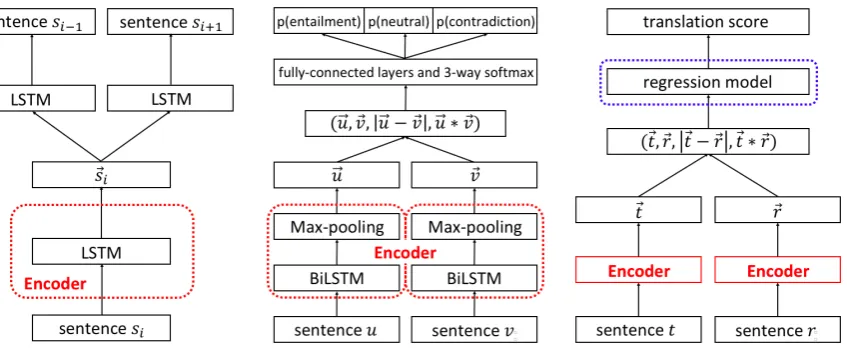
Figure 1: Outline of Skip-Thought. Figure 2: Outline of InferSent. Figure 3: Outline of our metric.
After the success of DPMFcomb,
Blend2 (Ma et al., 2017) achieved the best
performance in the WMT-2017 Metrics task (Bojar et al., 2017). Similar to DPMFcomb,
Blend is essentially an SVR (RBF kernel) model that uses the scores of various metrics as features. It incorporates 25 lexical metrics provided by the Asiya MT evaluation toolkit, as well as four other metrics, namely, BEER (Stanojevi´c and Sima’an, 2015), CharacTER (Wang et al., 2016), DPMF and ENTFp. BEER (Stanojevi´c and Sima’an, 2015) is a linear model based on character N-grams and replacement trees. Charac-TER (Wang et al., 2016) evaluates an MT hypothesis based on character-level edit distance.
DPMFcomb is trained through relative ranking
of human evaluation data in terms of relative rank-ing (RR). The quality of five MT hypotheses of the same source segment are ranked from 1 to 5 via comparison with the reference translation. In contrast, Blend is trained through direct assess-ment (DA) of human evaluation data. DA provides the absolute quality scores of hypotheses, by mea-suring to what extent a hypothesis adequately ex-presses the meaning of the reference translation. The results of the experiments in segment-level MTE conducted using the datasets for to-English language pairs on WMT-2016 showed that Blend achieved a better performance than DPMFcomb
(Table 2). In this study, we use Blend and pro-pose a supervised regression model trained using DA human evaluation data.
Instead of using local and lexical features,
2http://github.com/qingsongma/blend
ReVal3 (Gupta et al., 2015a,b) proposes using
sentence-level features. It is a metric using Tree-LSTM (Tai et al., 2015) for training and captur-ing the holistic information of sentences. It is trained using datasets of pseudo similarity scores, which is generated by translating RR data, and out-domain datasets of similarity scores of SICK4.
However, the training dataset used in this metric consists of approximately 21,000 sentences; thus, the learning of Tree-LSTM is unstable and accu-rate learning is difficult (Table2). The proposed metric uses sentence representations trained using LSTM as sentence information. Further, we ap-ply universal sentence representations to this task; these representations were trained using large-scale data obtained in other tasks. Therefore, the proposed approach avoids the problem of using a small dataset for training sentence representations.
3 Regression Model for MTE Using Universal Sentence Representations The proposed metric evaluates MT results with universal sentence representations trained using large-scale data obtained in other tasks. First, we explain two types of sentence representations used in the proposed metric in Section3.1. Then, we explain the proposed regression model and feature extraction for MTE in Section3.2.
3.1 Universal Sentence Representations Several approaches have been proposed to learn sentence representations. These sentence repre-sentations are learned through large-scale data so
cs-en de-en fi-en ro-en ru-en tr-en WMT-2015 500 500 500 - 500 -WMT-2016 560 560 560 560 560 560
Table 1: Number of DA human evaluation datasets for to-English language pairs8in WMT-2015 (Stanojevi´c et al.,
2015) and WMT-2016 (Bojar et al.,2016).
that they constitute potentially useful features for MTE. These have been proved effective in vari-ous NLP tasks such as document classification and measurement of semantic textual similarity, and we call them universal sentence representations.
First, Skip-Thought5 (Kiros et al.,2015) builds
an unsupervised model of universal sentence rep-resentations trained using three consecutive sen-tences, such assi−1,si, andsi+1. It is an
encoder-decoder model that encodes sentence si and
pre-dicts previous and next sentences si−1 and si+1
from its sentence representations⃗i (Figure1). As
a result of training, this encoder can produce sen-tence representations. Skip-Thought demonstrates high performance, especially when applied to doc-ument classification tasks.
Second, InferSent6 (Conneau et al.,2017)
con-structs a supervised model computing uni-versal sentence representations trained using Stanford Natural Language Inference (SNLI) datasets7 (Bowman et al., 2015). The Natural
Language Inference task is a classification task of sentence pairs with three labels,entailment,
con-tradiction and neutral; thus, InferSent can train
sentence representations that are sensitive to dif-ferences in meaning. This model encodes sen-tence pairsuandvand generates features by
sen-tence representations⃗uand⃗vwith a bi-directional
LSTM architecture with max pooling (Figure 2). InferSent demonstrates high performance across various document classification and semantic tex-tual similarity tasks.
3.2 Regression Model for MTE
In this paper, we propose a segment-level MTE metric for to-English language pairs. This prob-lem can be treated as a regression probprob-lem that es-timates translation quality as a real number from an MT hypothesistand a reference translationr.
Onced-dimensional sentence vectors⃗tand⃗rare
generated, the proposed model applies the
follow-5https://github.com/ryankiros/skip-thoughts 6https://github.com/facebookresearch/InferSent 7https://nlp.stanford.edu/projects/snli/
ing three matching methods to extract relations be-tweentandr(Figure3).
• Concatenation:(⃗t,⃗r)
• Element-wise product:⃗t∗⃗r
• Absolute element-wise difference:|⃗t−⃗r|
Thus, we perform regression using 4d -dimensional features of⃗t,⃗r,⃗t∗⃗rand|⃗t−⃗r|.
4 Experiments of Segment-Level MTE for To-English Language Pairs
We performed experiments using evaluation datasets of the WMT Metrics task to verify the performance of the proposed metric.
4.1 Setups
Datasets. We used datasets for to-English language pairs from the WMT-2016 Metrics task (Bojar et al.,2016) as summarized in Table1. Following Ma et al. (2017), we employed all other to-English DA data as training data (4,800 sen-tences) for testing on each to-English language pair (560 sentences) in WMT-2016.
Features. Publicly available pre-trained sen-tence representations such as Skip-Thought5 and
InferSent6 were used as the features mentioned
in Section 3. Skip-Thought is a collection of 4,800-dimensional sentence representations trained on 74 million sentences of the BookCor-pus dataset (Zhu et al., 2015). InferSent is a col-lection of 4,096-dimensional sentence represen-tations trained on both 560,000 sentences of the SNLI dataset (Bowman et al., 2015) and 433,000 sentences of the MultiNLI dataset (Williams et al., 2017).
Model. Our regression model used SVR with the RBF kernel from scikit-learn9.
Hyper-parameters were determined through 10-fold cross 8en: English, cs: Czech, de: German, fi: Finnish, ro: Ro-manian, ru: Russian, tr: Turkish
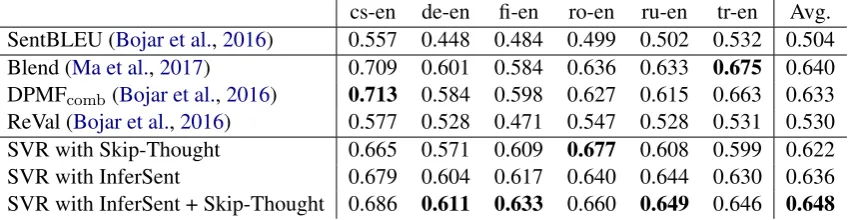
cs-en de-en fi-en ro-en ru-en tr-en Avg. SentBLEU (Bojar et al.,2016) 0.557 0.448 0.484 0.499 0.502 0.532 0.504 Blend (Ma et al.,2017) 0.709 0.601 0.584 0.636 0.633 0.675 0.640 DPMFcomb(Bojar et al.,2016) 0.713 0.584 0.598 0.627 0.615 0.663 0.633
[image:4.595.88.513.63.173.2]ReVal (Bojar et al.,2016) 0.577 0.528 0.471 0.547 0.528 0.531 0.530 SVR with Skip-Thought 0.665 0.571 0.609 0.677 0.608 0.599 0.622 SVR with InferSent 0.679 0.604 0.617 0.640 0.644 0.630 0.636 SVR with InferSent + Skip-Thought 0.686 0.611 0.633 0.660 0.649 0.646 0.648
Table 2: Segment-level Pearson correlation of metric scores and DA human evaluations scores for to-English language pairs in WMT-2016 (newstest2016).
validation using the training data. We examined all combinations of hyper-parameters amongC∈ {0.01,0.1,1.0,10}, ϵ ∈ {0.01,0.1,1.0,10}, and γ ∈ {0.01,0.1,1.0,10}.
There are three comparison methods: Blend (Ma et al., 2017), DPMFcomb (Yu et al., 2015a), and ReVal (Gupta et al., 2015a,b), as described in Section2. Blend and DPMFcombare
MTE metrics that exhibited the best performance in the WMT-2017 Metrics task (Bojar et al.,2017) and WMT-2016 Metrics task, respectively. We compared the Pearson correlation of each metric score and DA human evaluation scores.
4.2 Result
As can be seen in Table 2, the proposed met-ric, which combines InferSent and Skip-Thought representations, surpasses the best performance in three out of six to-English languages pairs and achieves state-of-the-art performance on average.
4.3 Discussion
These results indicate that it is possible to adopt universal sentence representations in MTE by training a regression model using DA human evaluation data. Since Blend is an ensemble method using combinations of various MTE met-rics as features, our results show that universal sentence representations can consider information more abundantly than a complex model. Since ReVal is also based on sentence representations, we conclude that universal sentence representa-tions trained on a large-scale dataset are more effective for MTE tasks than sentence represen-tations trained on a small or limited in-domain dataset.
4.4 Error Analysis
We re-implemented Blend10(Ma et al.,2017) and
compared the evaluation results with the proposed metric.11
We analyzed 20% of the pairs of MT hypothe-ses and reference translations (112 sentence pairs
×6 languages = 672 sentence pairs) in
descend-ing order of DA human score in each language pair. In other words, the top 20% of MT hypothe-ses that were close to the meaning of the reference translations for each language pair were analyzed. Among these, only Blend estimates the translation quality as high for 70 sentence pairs, and only our metric estimates the translation quality as high for 88 sentence pairs.
Surface. Among pairs estimated to have high translation quality by each method, there were 26 pairs in Blend and 42 pairs in the proposed method with a low word surface matching rate between MT hypotheses and reference translations. This result shows that the proposed metric can evaluate a wide range of sentence information that cannot be captured by Blend.
Unknown words. There were 26 MT hypothe-ses consisting of words that were treated as un-known words in Skip-Thought or InferSent that were correctly evaluated in Blend. On the other hand, there were 26 MT hypotheses that were cor-rectly evaluated in the proposed metric. This re-sult shows that the proposed metric is affected by unknown words. However, it is also true that there are some MT hypotheses containing unknown words that can be correctly evaluated.
10http://github.com/qingsongma/blend
Therefore, we analyzed further by focusing on sentence length. There were 17 MT hypotheses consisting of words that were treated as unknown words by either Skip-Thought or InferSent with a short length (15 words or less) that were correctly evaluated in Blend. However, in the proposed met-ric, there were only two MT hypotheses that were correctly evaluated. This result indicates that the shorter the sentence, the more likely is the pro-posed metric to be affected by unknown words.
5 Conclusions
In this study, we tried to apply universal sentence representation to MTE based on the DA of human evaluation data. Our segment-level MTE metric achieved the best performance on the WMT-2016 dataset. We conclude that:
• Universal sentence representations can con-sider information more comprehensively than an ensemble metric using combinations of various MTE metrics based on features of character or word N-grams.
• Universal sentence representations trained on a large-scale dataset are more effective than sentence representations trained on a small or limited in-domain dataset.
• Although a metric based on SVR with uni-versal sentence representations is not good at handling unknown words, it correctly esti-mates the translation quality of MT hypothe-ses with a low word matching rate with refer-ence translations.
Following the success of In-ferSent (Conneau et al., 2017), many works (Wieting and Gimpel, 2017; Cer et al., 2018; Subramanian et al., 2018) on universal sentence representations have been published. Based on the results of our work, we expect that the MTE metric will be further improved using these better universal sentence representations.
References
Ondˇrej Bojar, Yvette Graham, and Amir Kamran. 2017. Results of the WMT17 Metrics Shared Task. In Proceedings of the Second Conference on Ma-chine Translation, pages 489–513.
Ondˇrej Bojar, Yvette Graham, Amir Kamran, and Miloˇs Stanojevi´c. 2016. Results of the WMT16
Metrics Shared Task. In Proceedings of the First Conference on Machine Translation, pages 199– 231.
Samuel R. Bowman, Gabor Angeli, Christopher Potts, and Christopher D. Manning. 2015. A Large An-notated Corpus for Learning Natural Language In-ference. InProceedings of the 2015 Conference on Empirical Methods in Natural Language Process-ing, pages 632–642.
Daniel Cer, Yinfei Yang, Sheng yi Kong, Nan Hua, Nicole Limtiaco, Rhomni St. John, Noah Constant, Mario Guajardo-Cespedes, Steve Yuan, Chris Tar, Yun-Hsuan Sung, Brian Strope, and Ray Kurzweil. 2018. Universal Sentence Encoder. arXiv preprint arXiv:1803.11175.
Alexis Conneau, Douwe Kiela, Holger Schwenk, Lo¨ıc Barrault, and Antoine Bordes. 2017. Supervised Learning of Universal Sentence Representations from Natural Language Inference Data. In Proceed-ings of the 2017 Conference on Empirical Methods in Natural Language Processing, pages 670–680. Jes´us Gim´enez and Llu´ıs M`arquez. 2010. Asiya: An
Open Toolkit for Automatic Machine Translation (Meta-) Evaluation. The Prague Bulletin of Math-ematical Linguistics, (94):77–86.
Rohit Gupta, Constantin Orasan, and Josef van Gen-abith. 2015a. ReVal: A Simple and Effective Ma-chine Translation Evaluation Metric Based on Re-current Neural Networks. In Proceedings of the 2015 Conference on Empirical Methods in Natural Language Processing, pages 1066–1072.
Rohit Gupta, Constantin Orasan, and Josef van Gen-abith. 2015b. Machine Translation Evaluation using Recurrent Neural Networks. In Proceedings of the Tenth Workshop on Statistical Machine Translation, pages 380–384.
Ryan Kiros, Yukun Zhu, Ruslan R Salakhutdinov, Richard Zemel, Raquel Urtasun, Antonio Torralba, and Sanja Fidler. 2015. Skip-Thought Vectors. In
Advances in Neural Information Processing Systems 28, pages 3294–3302.
Chin-Yew Lin and Franz Josef Och. 2004. OR-ANGE: a Method for Evaluating Automatic Evalu-ation Metrics for Machine TranslEvalu-ation. In Proceed-ings of the 20th International Conference on Com-putational Linguistics, pages 501–507.
Chi-Kiu Lo. 2017. MEANT 2.0: Accurate semantic MT evaluation for any output language. In Proceed-ings of the Second Conference on Machine Transla-tion, pages 589–597.
Qingsong Ma, Yvette Graham, Shugen Wang, and Qun Liu. 2017. Blend: a Novel Combined MT Metric Based on Direct Assessment―CASICT-DCU
Kishore Papineni, Salim Roukos, Todd Ward, and Wei-Jing Zhu. 2002. BLEU: a Method for Automatic Evaluation of Machine Translation. InProceedings of 40th Annual Meeting of the Association for Com-putational Linguistics, pages 311–318.
Maja Popovi´c. 2017. chrF++: words helping character n-grams. InProceedings of the Second Conference on Machine Translation, pages 612–618.
Miloˇs Stanojevi´c, Philipp Koehn, and Ondˇrej Bojar. 2015. Results of the WMT15 Metrics Shared Task. InProceedings of the Tenth Workshop on Statistical Machine Translation, pages 256–273.
Miloˇs Stanojevi´c and Khalil Sima’an. 2015. BEER 1.1: ILLC UvA submission to metrics and tuning task. In Proceedings of the Tenth Workshop on Statistical Machine Translation, pages 396–401.
Sandeep Subramanian, Adam Trischler, Yoshua Ben-gio, and Christopher J Pal. 2018. Learning Gen-eral Purpose Distributed Sentence Representations via Large Scale Multi-task Learning. In Proceed-ings of the 6th International Conference on Learn-ing Representations, pages 1–16.
Weiyue Wang, Jan-Thorsten Peter, Hendrik Rosendahl, and Hermann Ney. 2016. CharacTER: Translation Edit Rate on Character Level. In Proceedings of the First Conference on Machine Translation, pages 505–510.
John Wieting and Kevin Gimpel. 2017. Pushing the Limits of Paraphrastic Sentence Embeddings with Millions of Machine Translations. arXiv preprint arXiv:1711.05732.
Adina Williams, Nikita Nangia, and Samuel R. Bow-man. 2017. A Broad-Coverage Challenge Cor-pus for Sentence Understanding through Inference.
arXiv preprint arXiv:1704.05426.
Hui Yu, Qingsong Ma, Xiaofeng Wu, and Qun Liu. 2015a. CASICT-DCU Participation in WMT2015 Metrics Task. InProceedings of the Tenth Workshop on Statistical Machine Translation, pages 417–421. Hui Yu, Xiaofeng Wu, Wenbin Jiang, Qun Liu, and
Shouxun Lin. 2015b. An Automatic Machine Trans-lation Evaluation Metric Based on Dependency Parsing Model. arXiv preprint arXiv:1508.01996.