Proceedings of the 3rd Workshop on Evaluating Vector Space Representations for NLP, pages 95–101 95
Multi-Context Term Embeddings:
the Use Case of Corpus-based Term Set Expansion
Jonathan Mamou,1 Oren Pereg,1 Moshe Wasserblat,1 Ido Dagan2
1Intel AI Lab, Israel
2Department of Computer Science, Bar-Ilan University, Ramat Gan, Israel
1{jonathan.mamou,oren.pereg,moshe.wasserblat}@intel.com 2[email protected]
Abstract
In this paper, we present a novel algorithm that combines multi-context term embeddings using a neural classifier and we test this ap-proach on the use case of corpus-based term set expansion. In addition, we present a novel and unique dataset for intrinsic evaluation of corpus-based term set expansion algorithms. We show that, over this dataset, our algorithm provides up to 5 mean average precision points over the best baseline.
1 Introduction
Term set expansion is the task of expanding a given seed set of terms into a more complete set of terms that belong to the same semantic class. For example, given a seed of personal assistant application terms like ‘Siri’ and ‘Cortana’, the ex-panded set is expected to include additional terms such as ‘Amazon Echo’ and ‘Google Now’.
Most prior work on corpus-based term set ex-pansion is based on distributional similarity, where early work is primarily based on using sparse vec-tors while recent work is based on word embed-dings. The prototypical term set expansion meth-ods utilize corpus-based semantic similarity be-tween seed terms and candidate expansion terms. To the best of our knowledge, each of the prior methods used a single context type for embedding generation, and there are no reported comparisons of the effectiveness of embedding different context types. Moreover, the lack of a publicly available dataset hinders the replicability of previous work and method comparison.
In this paper, we investigate the research ques-tion of whether embeddings of different context types can complement each other and enhance the performance of computational semantics tasks like term set expansion. To address this question, we propose an approach that combines term
embed-dings over multiple contexts for capturing differ-ent aspects of semantic similarity. The algorithm uses 5 different context types, 3 of which were pre-viously proposed for term set expansion and addi-tional two context types that were borrowed from the general distributional similarity literature. We show that combining the different context types yields improved results on term set expansion. In addition to the algorithm, we developed a dataset for intrinsic evaluation of corpus-based set expan-sion algorithms, which we propose as a basis for future comparisons.
Code, demonstration system, dataset and term embeddings pre-trained models are distributed as part of NLP Architect by Intel AI Lab.1
2 Related Work
Several works have addressed the term set ex-pansion problem. We focus on corpus-based ap-proaches based on the distributional similarity hypothesis (Harris, 1954). State-of-the-art tech-niques return the k nearest neighbors around the seed terms as the expanded set, where terms are represented by their co-occurrence or embedding vectors in a training corpus according to different context types, such as linear window context ( Pan-tel et al.,2009;Shi et al.,2010;Rong et al.,2016;
Zaheer et al., 2017; Gyllensten and Sahlgren,
2018; Zhao et al., 2018), explicit lists (Roark and Charniak, 1998; Sarmento et al., 2007; He and Xin,2011), coordinational patterns (Sarmento et al.,2007) and unary patterns (Rong et al.,2016;
Shen et al., 2017). In this work, we generalize coordinational patterns, look at additional context types and combine multiple context-type embed-dings.
We did not find any suitable publicly available
1http://nlp_architect.nervanasys.com/term_
dataset to train and evaluate our set expansion al-gorithm. The INEX Entity Ranking track ( De-martini et al.,2009) released a dataset for the list completion task. However, it addresses a some-what different task: in addition to seed terms, an explicit description of the semantic class is sup-plied as input to the algorithm and is used to de-fine the ground truth expanded set. Some works like (Pantel et al., 2009) provide an evaluation dataset that does not include any training corpus, which is required for comparing corpus-based ap-proaches.Sarmento et al.(2007) use Wikipedia as training corpus, but exploit meta-information like hyperlinks to identify terms; in our work, we opted for a dataset that matches real-life scenarios where terms have to be automatically identified.
Systems based on our approach are described by (Mamou et al.,2018a,b).
3 Term Representation
Our approach is based on representing any term in a (unlabeled) training corpus by its word embed-dings in order to estimate the similarity between seed terms and candidate expansion terms. Differ-ent techniques for term extraction are described in detail by Moreno and Redondo (2016). We fol-lowKageura and Umino(1996) who approximate terms by noun phrases (NPs),2extracting them us-ing an NP chunker. We useterm to refer to such extracted NP chunk and unit to refer to either a term or a word.
As preprocessing, term variations, such as aliases, acronyms and synonyms, which refer to the same entity, are grouped together.3 Next, we use term groups as input elements for embedding training (the remaining corpus words are left in-tact); this enables obtaining more contextual infor-mation compared to using individual terms, thus enhancing embedding model robustness. In the remainder of this paper, by language abuse,term
will be used instead of term group.
While word2vec originally uses a linear win-dow context around thefocus word, the literature describes other possible context types. For each
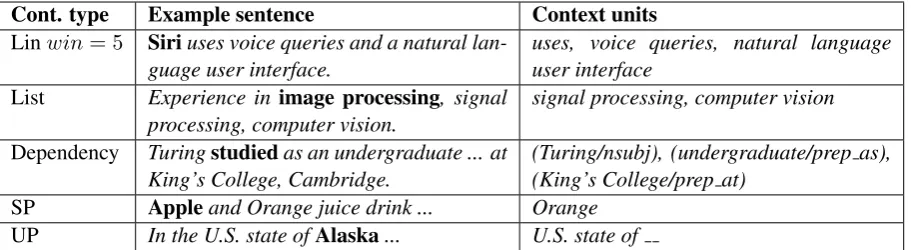
focus unit, we extract context units of different types, as follows (see a typical example for each
2Our algorithm can be used for terms with other
part-of-speech or with other term extraction methods.
3For that, we use a heuristic algorithm based on text
normalization, abbreviation web resources, edit distance and word2vec similarity. For example,New York, New-York, NY, NYCandNew York Cityare grouped.
type in Table14).
3.1 Linear Context (Lin)
This context is defined by neighboring context units within a fixed length window of context units, denoted by win, around the focus unit. word2vec(Mikolov et al.,2013),GloVe( Pen-nington et al.,2014) andfastText(Joulin et al.,
2016) are state-of-the-art implementations.
3.2 Explicit Lists
Context units consist of terms co-occurring with the focus term in textual lists such as comma sep-arated lists and bullet lists (Roark and Charniak,
1998;Sarmento et al.,2007).
3.3 Syntactic Dependency Context (Dep)
This context is defined by the syntactic depen-dency relations in which the focus unit partici-pates (Levy and Goldberg,2014;MacAvaney and Zeldes, 2018). The context unit is concatenated with the type and the direction of the dependency relation.5 This context type has not yet been used for set expansion. However, Levy and Goldberg
(2014) showed that it yields more functional simi-larities of a co-hyponym nature than linear context and thus may be relevant to set expansion.
3.4 Symmetric Patterns (SP)
Context units consist of terms co-occurring with the focus term in symmetric patterns (Schwartz et al.,2015). We followDavidov and Rappoport
(2006) for automatic extraction of SPs from the textual corpus.6 For example, the symmetric pat-tern ‘X rather than Y’ captures certain semantic relatedness between the terms X and Y. This con-text type generalizes coordinational patterns (‘X and Y’, ‘X or Y’), which have been used for set expansion.
3.5 Unary Patterns (UP)
This context is defined by the unary patterns in which the focus term occurs. Context units
con-4
We preferred showing in the example the strength of each context type with a good example, rather than providing a common example sentence across all the context types.
5Given a focus unittwith modifiersm
iand a headh, the
context oftconsists of the pairs(mi/li), whereliis the type
of the dependency relation between the headhand the modi-fiermi; the context stores also(h/l−i1)wherel
−1
i marks the
inverse-relation betweentandh.
6SPs are automatically extracted using the dr06
Cont. type Example sentence Context units
Linwin= 5 Siriuses voice queries and a natural lan-guage user interface.
uses, voice queries, natural language user interface
List Experience in image processing, signal processing, computer vision.
signal processing, computer vision
Dependency Turingstudiedas an undergraduate ... at King’s College, Cambridge.
(Turing/nsubj), (undergraduate/prep as), (King’s College/prep at)
SP Appleand Orange juice drink ... Orange
[image:3.595.73.529.62.187.2]UP In the U.S. state ofAlaska... U.S. state of
Table 1: Examples of extracted context units per context type. Focus units appear in bold.
sist of n-grams of terms and other words, where the focus term occurs; ‘ ’ denotes the placeholder of the focus term in Table1. FollowingRong et al.
(2016), we extract sixn-grams per focus term.7
We show in Section 7 that different context types complement each other by capturing dif-ferent types of semantic relations. As explained in Section 2, to the best of our knowledge, sev-eral of these context types have been used for set expansion, except for syntactic dependency con-text and symmetric patterns. We train a separate term embedding model for each of the 5 context types and thus, for each term, we obtain 5 dif-ferent vector representations. When training for a certain context type, for each focus unit in the cor-pus, corresponding<focus unit, context unit> pairs are extracted from the corpus and are then fed to the word2vecf toolkit that can train embeddings on arbitrary contexts, except for linear context for which we use the word2vec toolkit. Only terms representations are stored in the embedding models while other word represen-tations are pruned.
4 Multi-Context Seed-Candidate Similarity
For a given context type embedding and a seed term list, we compute two similarity scores be-tween the seed terms and each candidate term, based on cosine similarity. 8 First, we apply the
7Given a sentence fragmentc−
3 c−2 c−1 t c1 c2 c3 wheretis the focus term andci are the context units, the
following n-grams are extracted: (c−3 c−2 c−1 t c1),
(c−2 c−1 t c1 c2), (c−2 c−1 t c1), (c−1 t c1 c2 c3),
(c−1t c1c2),(c−1t c1).
8
Sarmento et al.(2007) andPantel et al.(2009) use first-order semantic similarities for explicit list and coordinational pattern context types, respectively. However,Schwartz et al.
(2015) showed that for the symmetric patterns context type, word embeddings similarity (second-order) performs
gener-centroid scoring method (cent), commonly used for set expansion (Pantel et al., 2009). The cen-troid of the seed is represented by the average of the term embedding vectors of the seed terms. Candidate terms become the k terms9 that are the most similar, by cosine similarity, to the cen-troid of the seed. Second, theCombSUMscoring method (csum) is commonly used in Information Retrieval (Shaw et al., 1994). We first produce a candidate term set for each individual seed term: candidate terms become thek0 terms9 that are the most similar, according to the term embedding co-sine similarity, to the seed term. The CombSUM method scores the similarity of a candidate term to the seed terms by averaging over all the seed terms the normalized pairwise cosine similarities10 be-tween the candidate term and the seed term.
To combine multi-context embeddings, we fol-low the general idea ofBerant et al. (2012) who train an SVM to combine different similarity score features to learn textual entailment relations. Sim-ilarly, we train a Multilayer Perceptron (MLP) bi-nary classifier that predicts whether a candidate term should be part of the expanded set based on 10 similarity scores (considered as input features), using the above 2 different scoring methods for each of the 5 context types. Note that our MLP classifier polynomially combines different seman-tic similarity estimations and performs better than their linear combination. We also tried to concate-nate the multi-context term embeddings in order to obtain a single vector representing all the context
ally better. We opted for term embeddings similarity (second-order) for all the context types.
9Optimal values fork andk0
are tuned on the training term list. Other terms are assigned a similarity score of 0 for normalization and combination purpose.
10For any seed term, cosine similarities are normalized
types. We trained an MLP classifier with concate-nated vectors of candidate and seed terms as input features, but it performed worst (see Section7).
5 Dataset
Given the lack of suitable standard dataset for training and testing term set expansion models, we used Wikipedia to develop a standard dataset. Our motivation for using Wikipedia is two-fold. First, Wikipedia contains human-generated lists of terms (‘List of’ pages) that cover many domains; these lists can be used for supervised training (MLP training in our approach) and for evaluating set expansion algorithms. Second, it contains tex-tual data that can be used for unsupervised training of corpus-based approaches (multi-context term embedding training in our approach). We thus ex-tracted from an English Wikipedia dump a set of term lists and a textual corpus for term embedding training.
5.1 Term Lists
A Wikipedia ‘List of’ page contains terms be-longing to a specific class, where a term is de-fined to be the title of a Wikipedia article. We selected term lists among ‘List of’ pages contain-ing between fifty and eight hundred terms in order to cover both specific and more common classes (e.g., list of chemical elements vs. list of coun-tries). Moreover, we selected term lists that de-fine purely a semantic class, with no additional constraints (e.g., skipping list of biblical names starting with N’). Since there can be some prob-lems with some Wikipedia ‘List of’ pages, 28 term lists have been validated manually and are used as ground truth in the evaluation. Here are some few examples of term lists: Australian cities, chem-ical elements, countries, diplomatic missions of the United Kingdom, English cities in the United Kingdom, English-language poets, Formula One drivers, French artists, Greek mythological fig-ures, islands of Greece, male tennis players, Mex-ican singers, oil exploration and production com-panies.
Terms having a frequency lower than 10 in the training corpus are pruned from the lists since their embeddings cannot be learned properly; note that these terms are generally less interesting in most of real case applications. Term variations are grouped according to Wikipedia redirect informa-tion.
On average, a term list contains 328 terms, of which 3% are not recognized by the noun phrase chunker; the average frequency of the terms in the corpus is 2475.
The set of term lists is split into train, develop-ment (dev) and test sets with respectively 5, 5 and 18 lists for MLP training, hyperparameters tuning and evaluation. Each term list is randomly split intoseedandexpandedterm sets, where we are in-terested in getting enough samples of seed and ex-panded term sets. Thus, given a term list, we ran-domly generate 15 seed sets (5 seed sets for each seed size of 2, 5 and 10 terms) where seed terms are sampled among the top 30 most frequent terms within the list. For the train set, the non-seed terms (expanded term set) provide the positive samples; we randomly select candidate terms that occur in the corpus but not in the list as negative samples; positive and negative classes are balanced.
5.2 Textual Corpus
The corpus contains all the textual parts of Wikipedia articles except ‘List of’ pages. 11 It is used for training the multi-context embedding models. 3% of the terms appearing in the term lists are not recognized by our NP chunker in the corpus. It contains 2.2 billion words, and 12 mil-lion unique terms are automatically extracted.
5.3 Public Release
We useenwiki-20171201English Wikipedia dump12to develop the dataset. Full dataset will be released upon publication and it will include train, dev and test sets including the split into seed and expanded terms, and negative samples for the train set; the textual corpus along with NP chunks and grouped term variations; term embedding model for each context type.
6 Implementation Details
Code is distributed under the Apache license as part of NLP Architect by Intel AI Lab13, an open-source Python library for exploring state-of-the-art deep learning topologies and techniques for natu-ral language processing and natunatu-ral language un-derstanding.
11
Note that the corpus does not contain any Wikipedia meta information.
12
enwiki-20171201-pages-articles-multistream. xml.bz2
We used the following tools for the implemen-tation and for the development of the dataset: spaCy 14 for tokenization, noun phrase chunk-ing and dependency parschunk-ing;textacy15for text normalization; word2vec16andfastText17 to model term embeddings of linear context type; word2vecf 18 to model term embeddings of other context types; WikiExtractor 19 to ex-tract textual part of Wikipedia dump;Keras20to implement the MLP classifier.
Similarity scores are softmax-normalized over all the candidate terms per context type and per scoring method, in order to combine them with the MLP classifier. Our MLP network consists of one hidden layer. The input and hidden layers have respectively ten and four neurons.
7 Experiments
Following previous work (Sarmento et al.,2007), we report the Mean Average Precision at several topnvalues (MAP@n) to evaluate ranked candi-date lists returned by the algorithm. When com-puting MAP, a candidate term is considered as matching a gold term if they both appear in the same term variations group. We first compare the different context types; then, we report results on their combination.
7.1 Context Type Analysis
We provide a comparison of the different context types in Table2. These context types are baselines and we compare them to the linear context that is more standard. Note that the dependency context type is affected by the performance of the depen-dency parser.21 Linear context with centroid scor-ing yields consistently best performance of at least 19 MAP@10 points and is consistently more sta-ble looking at standard deviation. However, other context types achieve better performance than lin-ear context type for 55% of the term lists, suggest-ing that the different context types complement each other by capturing better different types of
14https://spacy.io 15
https://github.com/chartbeat-labs/textacy
16
https://code.google.com/archive/p/word2vec
17https://github.com/facebookresearch/fastText 18
https://bitbucket.org/yoavgo/word2vecf
19
https://github.com/attardi/wikiextractor
20
https://github.com/keras-team/keras
21We used spaCyfor dependency parsing; it achieves
92.6% accuracy on the OntoNotes 5 corpus (Choi et al.,
2015).
Context Scor. MAP@10 stdev best %
Lin cent .78 .22
List csum .59 .30 20
Dep cent .53 .31 15
SP csum .48 .32 10
[image:5.595.308.526.61.144.2]UP csum .47 .36 10
Table 2: Comparison of the different context types. For each context type, we report the scoring method with higher MAP@10 on dev set, MAP@10 with 5 seed terms, its standard deviation among the different test term lists, the percentage of the test term lists where the context type achieves best performance.
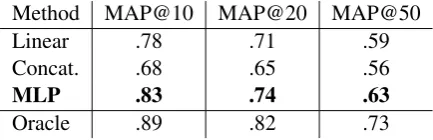
Method MAP@10 MAP@20 MAP@50
Linear .78 .71 .59
Concat. .68 .65 .56
MLP .83 .74 .63
Oracle .89 .82 .73
Table 3: MAP@nperformance evaluation of the linear context, concatenation, MLP binary classification and oracle, with 5 seed terms.
semantic relations and that their combination may improve the quality of the expanded set.
In addition, performance consistently increases with the number of seed terms e.g., MAP@10, MAP@20 and MAP@50 of the linear context are respectively .66, .58 and .51 with 2 seed terms.
7.2 Context Combination
[image:5.595.308.525.243.313.2]8 Conclusion
We proposed a novel approach to combine differ-ent context embedding types and we showed that it achieved improved results for the corpus-based term set expansion use case. In addition, we pub-lish a dataset and a companion corpus that en-able comparability and replicability of work in this field.
For future work, we plan to run similar ex-periments using recently introduced contextual embeddings, (e.g., ELMo (Peters et al., 2018), BERT (Devlin et al.,2018), OpenAI GPT-2 ( Rad-ford et al.,2019)), which are expected to implicitly capture more syntax than context-free embeddings used in the current paper. We plan also to investi-gate the contribution of multi-context term embed-dings to other tasks in computational semantics.
References
J. Berant, I. Dagan, and J. Goldberger. 2012. Learning entailment relations by global graph structure opti-mization. Computational Linguistics, 38:73–111.
Jinho D Choi, Joel Tetreault, and Amanda Stent. 2015. It depends: Dependency parser comparison using a web-based evaluation tool. In Proceedings of the 53rd Annual Meeting of the Association for Compu-tational Linguistics and the 7th International Joint Conference on Natural Language Processing (Vol-ume 1: Long Papers), vol(Vol-ume 1, pages 387–396.
Dmitry Davidov and Ari Rappoport. 2006. Efficient unsupervised discovery of word categories using symmetric patterns and high frequency words. In Proceedings of the 21st International Conference on Computational Linguistics and the 44th annual meeting of the Association for Computational Lin-guistics, pages 297–304. Association for Computa-tional Linguistics.
Gianluca Demartini, Tereza Iofciu, and Arjen P De Vries. 2009. Overview of the inex 2009 entity ranking track. InInternational Workshop of the Ini-tiative for the Evaluation of XML Retrieval, pages 254–264. Springer.
Jacob Devlin, Ming-Wei Chang, Kenton Lee, and Kristina Toutanova. 2018. Bert: Pre-training of deep bidirectional transformers for language understand-ing. arXiv preprint arXiv:1810.04805.
Amaru Cuba Gyllensten and Magnus Sahlgren. 2018. Distributional term set expansion. arXiv preprint arXiv:1802.05014.
Zellig S Harris. 1954. Distributional structure. Word, 10(2-3):146–162.
Yeye He and Dong Xin. 2011. Seisa: set expansion by iterative similarity aggregation. InProceedings of the 20th international conference on World wide web, pages 427–436. ACM.
Armand Joulin, Edouard Grave, Piotr Bojanowski, Matthijs Douze, H´erve J´egou, and Tomas Mikolov. 2016. Fasttext.zip: Compressing text classification models. arXiv preprint arXiv:1612.03651.
Kyo Kageura and Bin Umino. 1996. Methods of au-tomatic term recognition: A review. Terminology. International Journal of Theoretical and Applied Is-sues in Specialized Communication, 3(2):259–289.
Omer Levy and Yoav Goldberg. 2014. Dependency-based word embeddings. InProceedings of the 52nd Annual Meeting of the Association for Computa-tional Linguistics (Volume 2: Short Papers), vol-ume 2, pages 302–308.
Sean MacAvaney and Amir Zeldes. 2018. A deeper look into dependency-based word embeddings. arXiv preprint arXiv:1804.05972.
Jonathan Mamou, Oren Pereg, Moshe Wasserblat, Ido Dagan, Yoav Goldberg, Alon Eirew, Yael Green, Shira Guskin, Peter Izsak, and Daniel Korat. 2018a. Term Set Expansion based on Multi-Context Term Embeddings: an End-to-end Workflow. In Proceed-ings of the 27th International Conference on Com-putational Linguistics: System Demonstrations.
Jonathan Mamou, Oren Pereg, Moshe Wasserblat, Alon Eirew, Yael Green, Shira Guskin, Peter Izsak, and Daniel Korat. 2018b. Term Set Expansion based NLP Architect by Intel AI Lab. In Proceedings of the Conference on Empirical Methods in Natural Language Processing: System Demonstrations.
Tomas Mikolov, Ilya Sutskever, Kai Chen, Greg S Cor-rado, and Jeff Dean. 2013. Distributed representa-tions of words and phrases and their compositional-ity. InAdvances in neural information processing systems, pages 3111–3119.
Antonio Moreno and Te´ofilo Redondo. 2016. Text an-alytics: the convergence of big data and artificial in-telligence.IJIMAI, 3(6):57–64.
Patrick Pantel, Eric Crestan, Arkady Borkovsky, Ana-Maria Popescu, and Vishnu Vyas. 2009. Web-scale distributional similarity and entity set expansion. In Proceedings of the 2009 Conference on Empirical Methods in Natural Language Processing: Volume 2-Volume 2, pages 938–947. Association for Com-putational Linguistics.
Matthew E Peters, Mark Neumann, Mohit Iyyer, Matt Gardner, Christopher Clark, Kenton Lee, and Luke Zettlemoyer. 2018. Deep contextualized word rep-resentations. arXiv preprint arXiv:1802.05365.
Alec Radford, Jeff Wu, Rewon Child, David Luan, Dario Amodei, and Ilya Sutskever. 2019. Language models are unsupervised multitask learners.
Brian Roark and Eugene Charniak. 1998. Noun-phrase co-occurrence statistics for semiautomatic semantic lexicon construction. InProceedings of the 36th An-nual Meeting of the Association for Computational Linguistics and 17th International Conference on Computational Linguistics-Volume 2, pages 1110– 1116. Association for Computational Linguistics.
Xin Rong, Zhe Chen, Qiaozhu Mei, and Eytan Adar. 2016. Egoset: Exploiting word ego-networks and user-generated ontology for multifaceted set expan-sion. InProceedings of the Ninth ACM International Conference on Web Search and Data Mining, pages 645–654. ACM.
Luis Sarmento, Valentin Jijkuon, Maarten de Rijke, and Eugenio Oliveira. 2007. More like these: growing entity classes from seeds. InProceedings of the six-teenth ACM conference on Conference on informa-tion and knowledge management, pages 959–962. ACM.
Roy Schwartz, Roi Reichart, and Ari Rappoport. 2015. Symmetric pattern based word embeddings for im-proved word similarity prediction. In Proceed-ings of the Nineteenth Conference on Computational Natural Language Learning, pages 258–267.
Joseph A. Shaw, Edward A. Fox, Joseph A. Shaw, and Edward A. Fox. 1994. Combination of multiple searches. InThe Second Text REtrieval Conference (TREC-2, pages 243–252.
Jiaming Shen, Zeqiu Wu, Dongming Lei, Jingbo Shang, Xiang Ren, and Jiawei Han. 2017. Setexpan: Corpus-based set expansion via context feature se-lection and rank ensemble. InJoint European Con-ference on Machine Learning and Knowledge Dis-covery in Databases, pages 288–304. Springer.
Shuming Shi, Huibin Zhang, Xiaojie Yuan, and Ji-Rong Wen. 2010. Corpus-based semantic class min-ing: distributional vs. pattern-based approaches. In Proceedings of the 23rd International Conference on Computational Linguistics, pages 993–1001. Asso-ciation for Computational Linguistics.
Shengli Wu, Fabio Crestani, and Yaxin Bi. 2006. Eval-uating score normalization methods in data fusion. In Asia Information Retrieval Symposium, pages 642–648. Springer.
Manzil Zaheer, Satwik Kottur, Siamak Ravanbakhsh, Barnabas Poczos, Ruslan R Salakhutdinov, and Alexander J Smola. 2017. Deep sets. InAdvances in Neural Information Processing Systems, pages 3394–3404.