Functionalized Carbon Nanotubes
Altynbek Murat,
†Ivan Rungger,
‡Chengjun Jin,
†Stefano Sanvito,
‡and Udo
Schwingenschlögl
∗,†PSE Division, KAUST, Thuwal 23955-6900, Kingdom of Saudi Arabia, and School of Physics and
CRANN, Trinity College, Dublin 2, Ireland
E-mail: [email protected],+966(0)544700080
Abstract
The microscopic origin of the p-type character of AuCl3 functionalized carbon nanotubes
(CNTs) is investigated using first-principles self-interaction corrected density functional
the-ory (DFT). Recent DFT calculations suggest that the p-type character of AuCl3functionalized
CNTs is due to the Cl atoms adsorbed on the CNTs. We test this hypothesis and show that
adsorbed Cl atoms only lead to a p-type character for very specific concentrations and
ar-rangements of the Cl atoms, which furthermore are not the lowest energy configurations. We
therefore investigate alternative mechanisms and conclude that the p-type character is due to
the adsorption of AuCl4 molecules. The unraveling of the exact nature of the p-doping
ad-sorbates is a key step for further development of AuCl3 functionalized CNTs in water sensor
applications.
Keywords: p-type doping, CNT, sensor, chemical functionalization
Introduction
Carbon nanotubes (CNTs) have a wide range of applications in transistors, spintronics, sensors,
and solar cells.1–7 Due to their “quantum nature” and high surface-to-volume ratio, they are
con-sidered as promising candidates for extremely sensitive gas sensors.3,8–10However, the gas sensing
response of pristine CNTs is weak due to the strong sp2bonds of the carbon network, characterized
by a low chemical reactivity. Thus, functionalization of the CNT surface is necessary to obtain a
gas sensor with high sensitivity and selectivity.
Recently, AuCl3functionalized semiconducting CNTs have been experimentally investigated.11,12
It has been found that the system exhibits a selective H2O adsorption and is insensitive to O2and
N2gases. This is advantageous for designing selective water sensors. Moreover, a p-type character
of the semi-conducting CNTs is observed when functionalized with AuCl3,11,13 where the Fermi
energy is found to lie just below the top of the valence band maximum and no defect states appear
inside the CNT band gap,13 which is of general importance for fabricating nanoscale devices.
The crystal structure of AuCl3 consists of stacked planar Au2Cl6 molecules.14 Au2Cl6exists
as a chloride-bridged Au dimer at low temperatures where each Au center is surrounded by four Cl
atoms in a square planar configuration. When dissolved, AuCl3can have different ionic
conforma-tions depending on the coordinating agent. In the experiments in Refs. 11 and 12 nitromethane is
used as solvent, in which AuCl3can be dissolved into single atoms, Au3+and Cl−, and at the same
time AuCl−4 molecular ions can be formed.15,16It has been suggested, both experimentally11,12and
theoretically17 that the Cl anions are the origin of the observed p-type behavior of AuCl3 doped
CNTs and that the Au cations and AuCl4 molecules do not play a significant role. This scenario
has been examined by density functional theory (DFT) calculations17 and it was found that the
CNT-Cl system shows p-type behavior due to a shift of the Fermi level towards the valence band.
In this work we perform DFT calculations with the aim to compare possible reasons for the
p-type character observed in AuCl3functionalized CNTs. We study the formation and adsorption of
the different conformations of AuCl3in nitromethane. In addition to doping with isolated atoms,
elec-tronic band structures and densities of states obtained for the different configurations are compared
to available experimental data, which points to an alternative explanation of the experimentally
achieved p-type doping not based on individual Cl atom adsorption.
Methods
In our calculations we use a (10,0) semiconducting CNT corresponding to that of Ref. 17. One
primitive unit cell contains 40 atoms. We use a supercell containing 80 carbon atoms with a
cell size of 30×30×17 Å3. Electronic structure calculations are performed using theSIESTA
im-plementation of the first-principles DFT formalism.20 A double-ζ polarized atomic orbital basis
set for C, Au, and Cl is used together with the Troullier-Martins scheme for constructing
norm-conserving pseudopotentials.21 A plane wave cutoff of 250 Ry is chosen for the real space grid
and the Brillouin zone is sampled with a 1×1×4 Monkhorst-Packk-point grid. Periodic boundary
conditions are applied and sufficient vacuum is used in all calculations to avoid interaction between
periodic images. In the structural relaxations all atoms in the unit cell are allowed to move until
the atomic forces are less than 0.03 eV/Å. Both the generalized gradient approximation (GGA)22
and local-density approximation (LDA) are used to optimize the above structures and to obtain the
electronic structures. We find that the GGA and LDA essentially give the same results. However,
it is known that the LDA overestimates the electron delocalization, especially for dilute doping.24
Therefore, the LDA alone can be misleading for describing the localized defect band in the doped
system. Different advanced techniques can be used to improve the description of electron-electron
interactions. Here we use the atomic self-interaction correction (ASIC),25 which also corrects for
the overestimated delocalization of the LDA and generally improves the band alignment in
de-fective systems.26,27 To investigate the effect of the ASIC, we use different values for the scaling
parameterα, which controls the amount of ASIC added and can go from 0.0 (pure LDA) to 1.0
(full ASIC). The general trend is that with increasingα the occupied defect states move down in
withα=0.5, which is typically appropriate for defects in extended semiconducting systems, but it
is mentioned whenever LDA and full ASIC differ significantly.
Results and Discussion
Role and formation of single Cl atoms
First, we investigate the electronic structure of Cl doped CNTs. In particular, we study the effect
of different concentrations of Cl atoms attached on top of the C atoms as well as the dependence
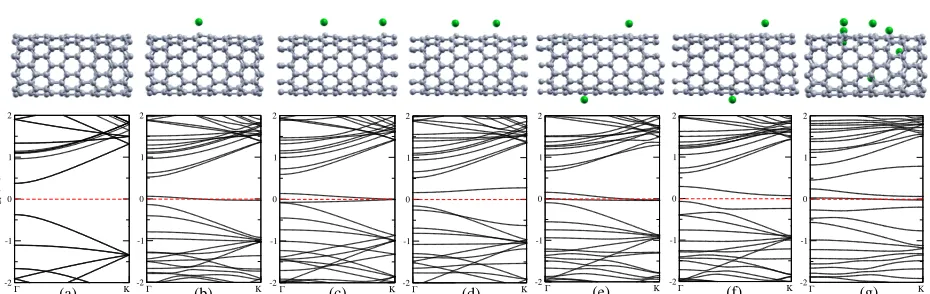
of the results on the relative positions of the Cl atoms. Figure Figure 1 presents the electronic band
structures of pristine and Cl doped CNTs for different concentrations and configurations (ASIC,
α=0.5). Figure Figure 1a shows for the pristine CNT a band gap of 0.8 eV with the Fermi energy
in the middle of the band gap, in good agreement with previous DFT calculations.18,19
Γ Κ
-2 -1 0 1 2
Γ Κ
-2 -1 0 1 2
Γ Κ
-2 -1 0 1 2
Γ Κ
-2 -1 0 1 2
Γ Κ
-2 -1 0 1 2
Γ Κ
-2 -1 0 1 2
Γ Κ
-2 -1 0 1 2 Energy (eV) (g) (f) (e) (d) (c) (b) (a)
Figure 1: (Color online) Electronic band structure of CNTs: (a) pristine, (b) one Cl doped, (c) two equidistant Cl doped, (d) two non-equidistant Cl doped, (e, f) two Cl doped on different sides with different distances, and (g) seven Cl doped.
When the CNT is doped with a low concentration of one Cl atom per cell the band structure
shows a distinct band around the Fermi energy, see Figure Figure 1b. This can be interpreted as a
p-type system. Figure Figure 1c shows the band structure for two Cl atoms with a specific
arrange-ment, where a cell of half the size with one Cl atom is doubled along the CNT axis. The smaller
[image:4.612.76.541.367.514.2]agree-ment with the results in Ref. 17 and does indicate a p-type character for this Cl concentration. Note
that the calculations addressed in Figure Figure 1 are performed without spin-polarization. Due
to the high DOS at the Fermi energy, spin-polarized calculations results in a small spin-splitting,
where an increasing α leads to an increasing spin-polarization due to the enhanced localization
of the states. However, another and more effective way for the system to reduce the DOS at the
Fermi energy, and thereby the total energy, is a Peierls-type distortion, where the two neighboring
Cl atoms undergo small shifts so that the periodicity is broken. Peierls-type distortions in
semicon-ducting and metallic CNTs have been extensively studied,28–31while we only consider Peierls-type
distortions of the Cl adatoms. This situation is realized in Figure Figure 1d. It can be seen that
due to the broken periodicity a gap opens at the Fermi energy and we obtain occupied bonding
states and empty antibonding states. Therefore, no p-type behavior is encountered for the same
Cl concentration as in Figure Figure 1c. Importantly, the total energy of this second system is by
about 0.6 eV lower than for the perfectly periodic system, reflecting the Peierls-type instability. As
a further example of an equidistant arrangement, in Figure Figure 1e the two Cl atoms are placed
on opposite sides of the CNT (but still equidistant along the CNT axis). Therefore the interaction
between them is minimized. The resulting band structure is similar to Figure Figure 1c. When
we again slightly shift one of the Cl atoms along the CNT axis a band gap opens at the Fermi
energy, see Figure Figure 1f, accompanied by a reduction of the total energy by 1.7 eV. Overall,
the system in Figure Figure 1d has the lowest energy of the considered two-Cl configurations, with
the energy of the system in Figure Figure 1f being only marginally higher by 0.2 eV. Note that in
all the cases there is only a minimal charge transfer between Cl and the CNT, with the Cl atoms
remaining essentially charge neutral. Our results show that the recent conclusion that Cl atoms are
the origin of the p-type doping11,12,17is only valid for very specific high-energy configurations and
concentrations. For random or generally low-energy Cl configurations we obtain filled and empty
defect states rather than a shift of the Fermi energy below the CNT valence band maximum, which
contradicts experimental evidence.13,17
where seven Cl atoms have been adsorbed on the upper side of the CNT. At this concentration
and for this specific configuration the number of defect bands is so large that they essentially close
the CNT band gap and make the system metallic. A substantial reduction of the gap is already
observed for the cells with two Cl atoms, especially for the low energy asymmetric arrangements,
see Figure Figure 1d and Figure Figure 1f. Such a gap closure contradicts the experimental
preser-vation of the band gap for AuCl3functionalized CNTs and further corroborates our conclusion that
individual Cl atoms are not responsible for the observed p-type character.
Electronic properties for Au
2Cl
6and AuCl
4adsorption
Having established that individual Cl atoms cannot explain the p-type character, we investigate
other possible sources. Using x-ray photoelectron spectroscopy, the different species attached to
the CNT after immersion in AuCl3 solution and subsequent drying have been determined in Ref.
12. It has been found that at room temperature there are both neutral Au atoms on the CNT as
well as Au3+ions, in approximately the same amount. Visual characterization proves the presence
of Au clusters, which allows us to conclude that the neutral Au atoms are mostly combined to
larger clusters. To be in a 3+state the Au atoms need to be coordinated by negatively charged Cl
ions, which indicates that charged Au is most likely found in the presence of Au2Cl6and/or AuCl4
molecules, since AuCl3is much less stable.14,15 With increasing temperature the amount of Au3+
is found to decrease, whereas the amount of neutral Au increases. At the same time, the size and
number of Au clusters is found to increase with temperature, whereas the Cl signal decreases with
temperature.12These results indicate that the energy added to the system by the temperature leads
to a breaking of the molecules into their constituents. The individual Au atoms do not desorb from
the CNT but move along it until they merge with an Au cluster, which increases the cluster size.
The Cl atoms on the other hand can form Cl2molecules and desorb.
the CNT. The formation energy is defined as
Eform,Cl = ECNT+Cl−ECNT−1/2ECl2, (1)
Eform,Au = ECNT+Au−ECNT−EAu,bulk. (2)
Here,ECNTis the energy of the isolated CNT,ECNT+Cl(ECNT+Au) is the energy of the CNT with the
adsorbed Cl (Au) atom,ECl2 is the total energy of a Cl2molecule, andEAu,bulkis the energy of bulk
Au per atom. We obtain Eform,Cl=0.4 eV andEform,Au=3.3 eV. These positive values indicate
that for Cl it is more favorable to form Cl2molecules rather than being attached as individual atoms
to the CNT and that for Au it is favorable to form clusters. We also evaluate the energy for Au
atoms to migrate along the CNT using the nudged elastic band method and find an energy barrier of
75 meV, which is easily activated by thermal energy at the experimental conditions. The migration
path is along the zigzag direction of the C bond and the adsorption position is on top of a C atom,
with a bond length of 2.2 Å. These results are consistent with the experimental observation of Au
cluster formation and Cl2desorption with increasing temperature.12
Interestingly, experimentally also the conductance is found to decrease with increasing
tem-perature,12 implying that the conductance of the AuCl3–doped CNT is proportional to the Au3+
and Cl concentrations. It also excludes Au clusters playing a significant role, since those are found
also at high temperature. Combined with the results from the previous section, namely that also
individual Cl atoms cannot be responsible for the observed p-type character and preserved band
gap, the most likely candidates are Au2Cl6and AuCl4molecules adsorbed on the CNT.
Before analyzing their electronic structure, we first estimate the binding energies of the molecules
to the CNT. The binding energy is defined as
Eb=ECNT+mol−ECNT−Emol, (3)
where ECNT and Emol are the energies of the isolated CNT and molecules, respectively, and
bind-ing energies of−1.6 eV and −0.6 eV, respectively. These rather large negative values show that
the molecules bind strongly to the CNT, especially AuCl4. We find that both Au2Cl6and AuCl4
physically adsorb on the CNT without any significant structural distortion, at a binding distance
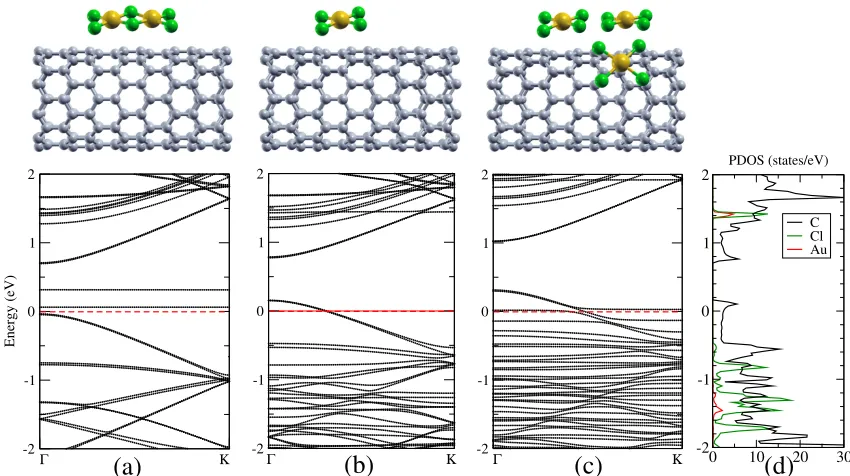
of 3 Å. Our calculated band structure of a single Au2Cl6 molecule attached to the CNT is shown
in Figure Figure 2a. The CNT bands are essentially unperturbed by the molecule, compare
Fig-ure FigFig-ure 1a, and the Au2Cl6bands show almost no dispersion, indicating that they are localized
on the molecule and do not hybridize with the C states. No p-type behavior is found but rather
localized gap states at different energies, which depend on the Au2Cl6concentration.
Γ Κ
-2 -1 0 1 2
Γ Κ
-2 -1 0 1 2
Γ Κ
-2 -1 0 1 2 Energy (eV)
0 10 20 30 -2 -1 0 1 2 C Cl Au PDOS (states/eV)
(d)
(c)
(b)
(a)
Figure 2: (Color online) Electronic band structure of CNTs doped with different molecules as calculated with ASIC α =0.5: (a) Au2Cl6, (b) one AuCl4, (c) three AuCl4, and (d) density of
states for case (b).
The band structure of a single AuCl4 molecule attached to the CNT is shown in Figure
Fig-ure 2b. It indicates a p-type behavior, where the Fermi energy is shifted below the valence band
maximum of the CNT due to charge transfer of a full electron to the AuCl4. To compare the effect
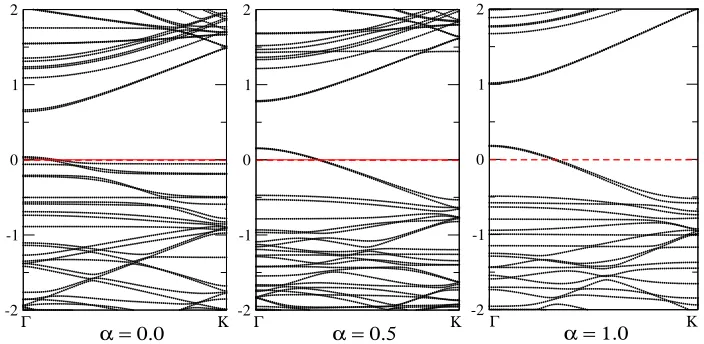
of ASIC, Figure Figure 3 presents the electronic band structure of the CNTs doped with one AuCl4
molecule, calculated withα=0 (pure LDA),α=0.5, andα=1 (full ASIC). Indeed, as expected,
[image:8.612.92.517.266.504.2]Γ Κ
-2 -1 0 1 2
α = 0.0
Γ Κ -2
-1 0 1 2
α = 0.5 Γ Κ
-2 -1 0 1 2
α = 1.0
Figure 3: (Color online) Electronic band structures of CNTs doped with one AuCl4 molecule,
calculated withα=0 (pure LDA),α =0.5, andα =1 (full ASIC).
respect to the CNT states. ASIC withα =0.5 increases the band gap of the pure LDA by 0.1 eV
andα =1 increases it by further 0.3 eV. Long-range corrected functionals as investigated in Ref.
23 are expected not to modify our conclusions, because already the ASIC does not result in
qualita-tive changes as compared to the LDA. The occupied molecular states are resonant with the valence
band of the pristine CNT and show little dispersion, indicating rather localized states. This is
fur-ther confirmed by the projected density of states, see Figure Figure 2d, where it is seen that the Cl
states are all occupied, whereas the C states are partly empty at the valence band maximum. These
findings are in good agreement with experiment. We thus conclude that the AuCl4molecules are
responsible for the observed p-type character and associated conductance properties.11,12 We plot
the HOMO and LUMO wave functions for the CNT doped with one AuCl4molecule as calculated
withα =0.5 at theΓpoint in Figure Figure 4. The LUMO+1, LUMO, HOMO, and HOMO-1 are
localized on the CNT whereas, the HOMO-2 is localized on the molecule. Only the HOMO shows
slight hybridization with the molecule. The LDA HOMO is the ASICα =0.5 HOMO-2 which
is consistent with the increased localization due to the self-interaction reduction. As expected the
states associated with p-type doping in Figure Figure 1 are mostly localized on the CNTs.
More-over, a Mulliken population analysis shows that the net charge transfer between the CNT and the
[image:9.612.130.482.71.243.2]LUMO+1 LUMO HOMO HOMO−1 HOMO−2
Figure 4: (Color online) HOMO and LUMO wave function isosurfaces of the CNT doped with one AuCl4molecule, calculated withα =0.5.
cases with two doped Cl atoms, Figure Figure 1c. We further investigate the effect of increasing
the AuCl4 concentration on the band structure. As presented in Figure Figure 2c, we find that
when more AuCl4molecules are attached to the CNT in close proximity, specifically three closely
spaced molecules, the p-type behavior is preserved. The band gap is also preserved, in contrast
to what happens for higher concentrations of isolated Cl atoms, see Figure Figure 1g. For high
concentrations the CNT, however, cannot provide one full electron for each molecule, so that the
highest molecular states are now located around the Fermi energy, but well below the CNT valence
band maximum.
Conclusions
In conclusion, we have investigated the origin of the experimentally observed p-type character
of AuCl3 functionalized CNTs. We have shown that individual Cl atoms cannot account for the
p-type doping, contrary to previous claims in the literature, and therefore propose an alternative
explanation. In particular, we have studied the possible formation of different conformations of
AuCl3 as well as the effect of different adsorbate concentrations. We find that especially AuCl4
molecules bind strongly to the CNT and that they lead to an electron transfer from the CNT to the
molecules and thus a shift of the Fermi energy below the valence band maximum. We conclude
that the origin of the p-type doping in AuCl3 functionalized CNT is AuCl4 adsorption, which is
key in understanding the mechanisms behind the resistivity changes in water vapor sensors based
[image:10.612.75.541.75.159.2]Acknowledgement
Financial support and computational resources have been provided by King Abdullah University
of Science and Technology (ACRAB project). Calculations have been performed on the Shaheen
supercomputer and Noor Linux cluster.
Γ Κ
-2 -1 0 1 2
References
(1) Tans, S. J.; Verschueren, A. R. M.; Dekker, C. Room-Temperature Transistor Based on a
Single Carbon Nanotube.Nature1998,393, 49–52.
(2) Zhou, C.; Kong, J.; Yenilmez, E.; Dai, H. Modulated Chemical Doping of Individual Carbon
Nanotubes.Science2000,290, 1552–1555.
(3) Goldoni, A.; Petaccia, L.; Lizzit, S.; Larciprete, R. Sensing Gases with Carbon Nanotubes: a
Review of the Actual Situation.J. Phys.: Condens. Matter2010,22, 013001.
(4) Kuemmeth, F.; Churchill, H.; Herring, P.; Marcus, C. Carbon Nanotubes for Coherent
Spin-tronics.Materials Today2010,13, 18–26.
(5) Lee, J. M.; Kwon, B. H.; Park, H.; Kim, H.; Kim, M. G.; Park, J. S.; Kim, E. S.; Yoo, S.;
Jean, D. Y.; Kim, S. O. Exciton Dissociation and Charge-Transport Enhancement in Organic
Solar Cells with Quantum-Dot/N-Doped CNT Hybrid Nanomaterials.Advanced Materials
2013,25, 2011–2017.
Role of N-Doped Multiwall Carbon Nanotubes in Achieving Highly Efficient Polymer Bulk
Heterojunction Solar Cells.Nano Letters2013,13, 2365–2369.
(7) Lee, J. M.; Park, J. S.; Lee, S. H.; Kim, H.; Yoo, S.; Kim, S. O. Selective Electron- or
Hole-Transport Enhancement in Bulk-Heterojunction Organic Solar Cells with N- or B-Doped
Carbon Nanotubes.Advanced Materials2011,23, 629–633.
(8) Zhang, T.; Mubeen, S.; Myung, N. V.; Deshusses, M. A. Recent Progress in Carbon
Nanotube-Based Gas Sensors.Nanotechnology2008,19, 332001.
(9) Peng, S.; Cho, K. Ab Initio Study of Doped Carbon Nanotube Sensors.Nano Lett. 2003, 3,
513–517.
(10) Zanolli, Z.; Leghrib, R.; Felten, A.; Pireaux, J.-J.; Llobet, E.; Charlier, J.-C. Gas Sensing with
Au-Decorated Carbon Nanotubes.ACS Nano2011,5, 4592–4599.
(11) Lee, I. H.; Kim, U. J.; Son, H. B.; Yoon, S. M.; Yao, F.; Yu, W. J.; Duong, D. L.; Choi, J.
Y.; Kim, J. M.; Lee, E. H. et al. Hygroscopic Effects on AuCl3-Doped Carbon Nanotubes.J.
Phys. Chem. C2010,114, 11618–11622.
(12) Kim, S. M.; Kim, K. K.; Jo, Y. W.; Park, M. H.; Chae, S. J.; Duong, D. L.; Yang, C. W.;
Kong, J.; Lee, Y. H. Role of Anions in the AuCl3-Doping of Carbon Nanotubes. ACS Nano
2011,5, 1236–1242.
(13) Kim, K. K.; Bae, J. J.; Park, H. K.; Kim, S. M.; Geng, H. Z.; Park, K. A.; Shin, H. J.;
Yoon, S. M.; Benayad, A.; Choi, J. Y. et al. Fermi Level Engineering of Single-Walled Carbon
Nanotubes by AuCl3Doping.JACS2008,130, 12757–12761.
(14) Clark, E. S.; Templeton, D. H.; MacGillavry, C. H. The Crystal Structure of Gold(III)
Chlo-ride.Acta Crystallographica1958,11, 284–288.
Enhanced Stability of the Electronically Conducting State and Electroless Deposition of Au0.
Synth. Met.1993,60, 93–96.
(16) Kim, K. K.; Yoon, S. M.; Park, H. K.; Shin, H. J.; Kim, S. M.; Bae, J. J.; Cui, Y.; Kim, J. M.;
Choi, J. Y.; Lee, Y. H. Doping Strategy of Carbon Nanotubes with Redox Chemistry.New J.
Chem.2010,34, 2183–2188.
(17) Duong, D. L.; Lee, I. H.; Kim, K. K.; Kong, J.; Lee, S. M.; Lee, Y. H. Carbon Nanotube
Doping Mechanism in a Salt Solution and Hygroscopic Effect: Density Functional Theory.
ACS Nano2010,4, 5430–5436.
(18) Reich, S.; Thomsen, C.; Ordejón, P. Electronic Band Structure of Isolated and Bundled
Car-bon Nanotubes.Phys. Rev. B2002,65, 155411.
(19) Chen, C. W.; Lee, M. H.; Clark, S. J. Band Gap Modification of Single-Walled Carbon
Nan-otube and Boron Nitride NanNan-otube Under a Transverse Electric Field.Nanotechnology2004,
15, 1837–1843.
(20) Soler, J.; Artacho, E.; Gale, J.; García, A.; Junquera, J.; Ordejón, P.; Sánchez-Portal, D.
The SIESTA Method for Ab Initio Order-N Materials Simulation.J. Phys.: Condens. Matter
2002,14, 2745–2779.
(21) Delley, B. An All-Electron Numerical Method for Solving the Local Density Functional for
Polyatomic Molecules.J. Chem. Phys.1990,92, 508.
(22) Perdew, J.; Burke, K.; Ernzerhof, M. Generalized Gradient Approximation Made Simple.
Phys. Rev. Lett.1996,77, 3865.
(23) Ramirez, J.; Mayo, M. L.; Kilina, S.; Tretiak, S. Electronic Structure and Optical Spectra of
Semiconducting Carbon Nanotubes Functionalized by Diazonium Salts .Chem. Phys. 2013,
(24) Kohanoff, J. inElectronic Structure Calculations for Solids and Molecules: Theory and
Com-putational Methods; Cambridge University Press, 2006; pp 75–120.
(25) Pemmaraju, C.; Archer, T.; Sanchez-Portal, D.; Sanvito, S. Atomic-Orbital-Based
Approxi-mate Self-Interaction Correction Scheme for Molecules and Solids.Phys. Rev. B 2007, 75,
045101.
(26) Droghetti, A.; Pemmaraju, C. D.; Sanvito, S. Predicting d0Magnetism: Self-Interaction
Cor-rection Scheme.Phys. Rev. B2008,78, 140404(R).
(27) Pemmaraju, C. D.; Hanafin, R.; Archer, T.; Braun, H. B.; Sanvito, S. Impurity-Ion Pair
In-duced High-Temperature Ferromagnetism in Co-Doped ZnO.Phys. Rev. B2008,78, 054428.
(28) Torres, L. E. F. F.; Roche, S. Inelastic Quantum Transport and Peierls-Like Mechanism in
Carbon Nanotubes.Phys. Rev. Lett.2006,97, 076804.
(29) Rafailov, P. M.; Janina, M.; Christian, T.; Hiromichi, K. Electrochemical Switching of the
Peierls-Like Transition in Metallic Single-Walled Carbon Nanotubes.Phys. Rev. B2006,72,
045411.
(30) Connétable, D.; Rignanese, G. M.; Charlier, J. C.; Blase, X. Room Temperature Peierls
Dis-tortion in Small Diameter Nanotubes.Phys. Rev. Lett.2005,94, 015503.
(31) Bohnen, K. P.; Heid, R.; Liu, H. J.; Chan, C. T. Lattice Dynamics and Electron-Phonon