A Polynomial-Time Dynamic Programming Algorithm for Phrase-Based
Decoding with a Fixed Distortion Limit
Yin-Wen Chang Google Research, New York
Michael Collins∗ Google Research, New York [email protected]
Abstract
Decoding of phrase-based translation mod-els in the general case is known to be NP-complete, by a reduction from the traveling salesman problem (Knight, 1999). In practice, phrase-based systems often impose a hard distortion limit that limits the movement of phrases during translation. However, the im-pact on complexity after imposing such a con-straint is not well studied. In this paper, we describe a dynamic programming algorithm for phrase-based decoding with a fixed dis-tortion limit. The runtime of the algorithm is
O(nd!lhd+1)wherenis the sentence length, dis the distortion limit, l is a bound on the number of phrases starting at any position in the sentence, andhis related to the maximum number of target language translations for any source word. The algorithm makes use of a novel representation that gives a new perspec-tive on decoding of phrase-based models.
1 Introduction
Phrase-based translation models (Koehn et al., 2003; Och and Ney, 2004) are widely used in statisti-cal machine translation. The decoding problem for phrase-based translation models is known to be dif-ficult: the results from Knight (1999) imply that in the general case decoding of phrase-based transla-tion models is NP-complete.
The complexity of phrase-based decoding comes from reordering of phrases. In practice, however, various constraints on reordering are often imposed in phrase-based translation systems. A common constraint is a “distortion limit”, which places a hard constraint on how far phrases can move. The com-plexity of decoding with such a distortion limit is an open question: the NP-hardness result from Knight
∗On leave from Columbia University.
(1999) applies to a phrase-based model with no dis-tortion limit.
This paper describes an algorithm for phrase-based decoding with a fixed distortion limit whose runtime is linear in the length of the sentence, and for a fixed distortion limit is polynomial in other fac-tors. More specifically, for a hard distortion limitd, and sentence lengthn, the runtime isO(nd!lhd+1),
wherel is a bound on the number of phrases start-ing at any point in the sentence, andh is related to the maximum number of translations for any word in the source language sentence.
The algorithm builds on the insight that de-coding with a hard distortion limit is related to the bandwidth-limited traveling salesman problem (BTSP) (Lawler et al., 1985). The algorithm is eas-ily amenable to beam search. It is quite different from previous methods for decoding of phrase-based models, potentially opening up a very different way of thinking about decoding algorithms for phrase-based models, or more generally for models in sta-tistical NLP that involve reordering.
2 Related Work
Knight (1999) proves that decoding of word-to-word translation models is NP-complete, assuming that there is no hard limit on distortion, through a reduc-tion from the traveling salesman problem. Phrase-based models are more general than word-to-word models, hence this result implies that phrase-based decoding with unlimited distortion is NP-complete.
Phrase-based systems can make use of both re-ordering constraints, which give a hard “distortion limit” on how far phrases can move, and reorder-ing models, which give scores for reordering steps, often penalizing phrases that move long distances. Moses (Koehn et al., 2007b) makes use of a distor-tion limit, and a decoding algorithm that makes use
59
of bit-strings representing which words have been translated. We show in Section 5.2 of this paper that this can lead to at least2n/4 bit-strings for an input
sentence of lengthn, hence an exhaustive version of this algorithm has worst-case runtime that is expo-nential in the sentence length. The current paper is concerned with decoding phrase-based models with a hard distortion limit.
Various other reordering constraints have been considered. Zens and Ney (2003) and Zens et al. (2004) consider two types of hard constraints: the IBM constraints, and the ITG (inversion transduc-tion grammar) constraints from the model of Wu (1997). They give polynomial time dynamic pro-gramming algorithms for both of these cases. It is important to note that the IBM and ITG constraints are different from the distortion limit constraint con-sidered in the current paper. Decoding algorithms with ITG constraints are further studied by Feng et al. (2010) and Cherry et al. (2012).
Kumar and Byrne (2005) describe a class of re-ordering constraints and models that can be encoded in finite state transducers. Lopez (2009) shows that several translation models can be represented as weighted deduction problems and analyzes their complexities.1 Koehn et al. (2003) describe a
beam-search algorithm for phrase-based decoding that is in widespread use; see Section 5 for discussion.
A number of reordering models have been pro-posed, see for example Tillmann (2004), Koehn et al. (2007a) and Galley and Manning (2008).
DeNero and Klein (2008) consider the phrase alignment problem, that is, the problem of find-ing an optimal phrase-based alignment for a source-language/target-language sentence pair. They show that in the general case, the phrase alignment prob-lem is NP-hard. It may be possible to extend the techniques in the current paper to the phrase-alignment problem with a hard distortion limit.
Various methods for exact decoding of phrase-based translation models have been proposed. Za-slavskiy et al. (2009) describe the use of
travel-1An earlier version of this paper states the complexity of de-coding with a distortion limit asO(I32d)wheredis the
distor-tion limit andIis the number of words in the sentence; however (personal communication from Adam Lopez) this runtime is an error, and should beO(2I)i.e., exponential time in the length
of the sentence. A corrected version of the paper corrects this.
ing salesman algorithms for phrase-based decod-ing. Chang and Collins (2011) describe an exact method based on Lagrangian relaxation. Aziz et al. (2014) describe a coarse-to-fine approach. These al-gorithms all have exponential time runtime (in the length of the sentence) in the worst case.
Galley and Manning (2010) describe a decoding algorithm for phrase-based systems where phrases can have discontinuities in both the source and tar-get languages. The algorithm has some similarities to the algorithm we propose: in particular, it makes use of a state representation that contains a list of disconnected phrases. However, the algorithms dif-fer in several important ways: Galley and Manning (2010) make use of bit string coverage vectors, giv-ing an exponential number of possible states; in con-trast to our approach, the translations are not formed in strictly left-to-right ordering on the source side.
3 Background: The Traveling Salesman Problem on Bandwidth-Limited Graphs
This section first defines the bandwidth-limited trav-eling salesman problem, then describes a polyno-mial time dynamic programming algorithm for the traveling salesman path problemon bandwidth lim-ited graphs. This algorithm is the algorithm pro-posed by Lawler et al. (1985)2with small
modifica-tions to make the goal apathinstead of acycle, and to consider directed rather than undirected graphs.
3.1 Bandwidth-Limited TSPPs
The input to the problem is a directed graph G = (V, E), whereV is a set of vertices andEis a set of directed edges. We assume thatV ={1,2, . . . , n}. A directed edge is a pair(i, j)wherei, j ∈ V, and i 6= j. Each edge (i, j) ∈ E has an associated weight wi,j. Given an integer k ≥ 1, a graph is
bandwidth-limitedwith bandwidthkif
∀(i, j)∈E, |i−j| ≤k
The traveling salesman path problem(TSPP) on the graphGis defined as follows. We will assume that vertex 1is the “source” vertex and vertexnis the “sink” vertex. The TSPP is to find the minimum cost directed path from vertex1to vertexn, which passes through each vertex exactly once.
3.2 An Algorithm for Bandwidth-Limited TSPPs
The key idea of the dynamic-programming algo-rithm for TSPPs is the definition of equivalence classes corresponding to dynamic programming states, and an argument that the number of equiv-alence classes depends only on the bandwidthk.
The input to our algorithm will be a directed graph G= (V, E), with weightswi,j, and with bandwidth k. We define a 1-n path to be any path from the source vertex1to the sink vertexnthat visits each vertex in the graph exactly once. A 1-n path is a
subgraph(V0, E0)ofG, whereV0=V andE0 ⊆E. We will make use of the following definition:
Definition 1. For any 1-npathH, define Hj to be the subgraph thatH induces on vertices1,2, . . . j, where1≤j ≤n.
That is,Hj contains the vertices1,2, . . . jand the edges inHbetween these vertices.
For a given value forj, we divide the verticesV into three setsAj,Bj andCj:
• Aj ={1,2, . . . ,(j−k)} (Aj is the empty set ifj ≤k).
• Bj ={1. . . j} \Aj.3
• Cj ={j+ 1, j+ 2, . . . , n} (Cjis the empty set ifj=n).
Note that the vertices in subgraphHj are the union of the setsAj andBj. Aj is the empty set ifj≤k, butBj is always non-empty.
The following Lemma then applies:
Lemma 1. For any 1-n path H in a graph with bandwidthk, for any1 ≤j ≤ n, the subgraphHj has the following properties:
1. If vertex 1 is inAj, then vertex 1 has degree one.
2. For any vertexv∈Ajwithv≥2, vertexvhas degree two.
3. Hj contains no cycles.
Proof. The first and second properties are true be-cause of the bandwidth limit. Under the constraint of bandwidth k, any edge (u, v) in H such that
3For setsXandY we use the notationX
\Y to refer to the set difference: i.e.,X\Y ={x|x∈X and x /∈Y}.
u ∈ Aj, must havev ∈ Aj ∪Bj = Hj. This fol-lows because if v ∈ Cj = {j + 1, j + 2, . . . n} andu ∈ Aj = {1,2, . . . j−k}, then|u−v|> k. Similarly any edge (u, v) ∈ H such that v ∈ Aj must haveu ∈ Aj ∪Bj = Hj. It follows that for any vertex u ∈ Aj, with u > 1, there are edges
(u, v) ∈ Hj and(v0, u) ∈ Hj, hence vertex uhas
degree 2. For vertexu ∈ Aj with u = 1, there is an edge(u, v) ∈ Hj, hence vertex uhas degree 1. The third property (no cycles) is true becauseHj is a subgraph ofH, which has no cycles.
It follows that each connected component of Hj is a directed path, that the start points of these paths are in the set{1} ∪Bj, and that the end points of these paths are in the setBj.
We now define an equivalence relation on sub-graphs. Two subgraphsHj andHj0 are in the same equivalence class if the following conditions hold (taken from Lawler et al. (1985)):
1. For any vertexv ∈ Bj, the degree ofv inHj andHj0 is the same.
2. For each path (connected component) in Hj there is a path in Hj0 with the same start and end points, and conversely.
The significance of this definition is as follows. Assume thatH∗is an optimal1-npath in the graph,
and that it induces the subgraph Hj on vertices
1. . . j. Assume that Hj0 is another subgraph over vertices 1. . . j, which is in the same equivalence
class asHj. For any subgraphHj, definec(Hj)to
be the sum of edge weights inHj:
c(Hj) = X
(u,v)∈Hj wu,v
Then it must be the case thatc(Hj0) ≥c(Hj). Oth-erwise, we could simply replaceHj by Hj0 inH∗, thereby deriving a new1-npath with a lower cost,
implying thatH∗is not optimal.
Next, define∆to be a set of0, 1or2edges be-tween vertex(j+ 1)and the vertices inBj. For any subgraphHj+1of a1-npath, there is some∆, sim-ply found by recording the edges incident to vertex
(j+ 1). For anyHj, define τ(σ(Hj),∆)to be the equivalence class resulting from adding the edges in
∆to the data structureσ(Hj). If adding the edges in∆toσ(Hj)results in an ill-formed subgraph—for example, a subgraph that has one or more cycles— then τ(σ(Hj),∆) is undefined. The following re-currence then defines the dynamic program (see Eq. 20 of Lawler et al. (1985)):
α(j+ 1, S) = min
∆,S0:τ(S0,∆)=S α(j, S
0) +c(∆)
Here S is an equivalence class over vertices
{1. . .(j+1)}, andα(S, j+1)is the minimum score
for any subgraph in equivalence classS. Theminis
taken over all equivalence classes S0 over vertices
{1. . . j}, together with all possible values for∆.
4 A Dynamic Programming Algorithm for Phrase-Based Decoding
We now describe the dynamic programming algo-rithm for phrase-based decoding with a fixed distor-tion limit. We first give basic definidistor-tions for phrase-based decoding, and then describe the algorithm.
4.1 Basic Definitions
Consider decoding an input sentence consisting of wordsx1. . . xnfor some integern. We assume that x1 = <s> andxn = </s>where<s> and</s> are the sentence start and end symbols respectively. A phrase-based lexicon specifies a set of possible translations in the form of phrases p = (s, t, e), wheresandtare integers such that1≤s≤t≤n, andeis a sequence ofm≥1target-language words
e1. . . em. This signifies that wordsxs. . . xt in the source language have a translation ase1. . . emin the target language. We uses(p),t(p)ande(p)to refer
to the three components of a phrasep= (s, t, e), and e1(p). . . em(p) to refer to the words in the target-language string e(p). We assume that (1,1,<s>)
and(n, n,</s>)are the only translation entries with s(p)≤1andt(p)≥nrespectively.
Aderivationis then defined as follows:
Definition 2 (Derivations). A derivation is a se-quence of phrasesp1. . . pLsuch that
• p1 = (1,1,<s>)andpL= (n, n,</s>).
• Each source word is translated exactly once. • The distortion limit is satisfied for each pair of
phrasespi−1, pi, that is:
|t(pi−1) + 1−s(pi)| ≤d ∀i= 2. . . L.
where d is an integer specifying the distortion limit in the model.
Given a derivation p1. . . pL, a target-language translation can be obtained by concatenating the target-language stringse(p1). . . e(pL).
The scoring function is defined as follows:
f(p1. . . pL) = λ(e(p1). . . e(pL)) + L
X
i=1 κ(pi)
+
L
X
i=2
η× |t(pi−1) + 1−s(pi)| (1)
For each phrasep, κ(p) is the translation score for
the phrase. The parameterηis the distortion penalty, which is typically a negative constant.λ(e)is a
lan-guage model score for the stringe. We will assume a bigram language model:
λ(e1. . . em) = m
X
i=2
λ(ei|ei−1).
The generalization of our algorithm to higher-order n-gram language models is straightforward.
The goal of phrase-based decoding is to findy∗= arg maxy∈Yf(y)whereY is the set of valid deriva-tions for the input sentence.
H1=hπ1i= 1,1,<s>
H3=hπ1i= 1,1,<s> 2,3,we must
H4=hπ1i= 1,1,<s> 2,3,we must 4,4,also
H6=hπ1, π2i= 1,1,<s> 2,3,we must 4,4,also, 5,6,these criticisms H7=hπ1, π2i=
1,1,<s> 2,3,we must 4,4,also, 5,6,these criticisms 7,7,seriously H8=hπ1i= 1,1,<s> 2,3,we must 4,4,also 8,8,take 5,6,these criticisms 7,7,seriously
H9=hπ1i= 1,1,<s> 2,3,we must 4,4,also 8,8,take 5,6,these criticisms 7,7,seriously 9,9,</s>
Figure 1: Sub-derivations Hj for j ∈ {1,3,4,6,7,8,9} induced by the full derivation H =
(1,1,<s>)(2,3,we must)(4,4,also)(8,8,take)(5,6,these criticisms)(7,7,seriously)(9,9</s>). Note that Hj includes the phrases that cover spans ending before or at positionj. Sub-derivationHjis extended to another sub-derivationHj+iby incorporating a phrase of lengthi.
4.2 The Algorithm
We now describe the dynamic programming algo-rithm. Intuitively the algorithm builds a deriva-tion by processing thesource-language sentencein strictly left-to-right order. This is in contrast with the algorithm of Koehn et al. (2007b), where the target-language sentenceis constructed from left to right.
Throughout this section we will useπ, or πi for some integeri, to refer to a sequence of phrases:
π=p1. . . pl
where each phrasepi = (s(pi), t(pi), e(pi)), as
de-fined in the previous section.
We overload the s, t and e operators, so that if π = p1. . . pl
, we have s(π) = s(p1), t(π) =
t(pl), ande(π) =e(p1)·e(p2). . .·e(pl), wherex·y is the concatenation of stringsxandy.
A derivation H consists of a single phrase se-quenceπ =p1. . . pL
:
H =π=p1. . . pL
where the sequence p1. . . pL satisfies the con-straints in definition 2.
We now give a definition ofsub-derivations and complement sub-derivations:
Definition 3(derivations and Complement Sub--derivations). For any H = p1. . . pL, for any j ∈ {1. . . n}such that∃i ∈ {1. . . L}s.t.t(pi) = j, the sub-derivationHj and the complement sub-derivationHj¯ are defined as
Hj =hπ1. . . πri, H¯j =hπ¯1. . .π¯ri
where the following properties hold: • ris an integer withr≥1.
• Each πi for i = 1. . . r is a sequence of one or more phrases, where each phrasep ∈ πi has t(p)≤j.
• Eachπ¯ifori= 1. . .(r−1)is a sequence of one or more phrases, where each phrasep ∈ πi¯ has
s(p)> j.
• πr¯ is a sequence of zero or more phrases, where
each phrasep ∈ π¯r hass(p) > j. We have zero phrases inπ¯r iffj = n wheren is the length of the sentence.
• Finally, π1·¯π1·π2·¯π2. . . πr·πr¯ = p1. . . pL where x·y denotes the concatenation of phrase sequencesxandy.
Note that for any j ∈ {1. . . n} such that @i ∈
{1. . . L} such that t(pi) = j, the sub-derivation Hjand the complement sub-derivationH¯jis not de-fined.
Thus for each integerjsuch that there is a phrase inH ending at point j, we can divide the phrases inH into two sets: phrases p with t(p) ≤ j, and
phrasespwiths(p)> j. The sub-derivationHjlists all maximal sub-sequences of phrases witht(p)≤j. The complement sub-derivationH¯jlists all maximal
sub-sequences of phrases withs(p)> j.
Figure 1 gives all sub-derivations Hj for the derivation
H=p1. . . p7
=(1,1,<s>)(2,3,we must)(4,4,also) (8,8,take)(5,6,these criticisms) (7,7,seriously)(9,9,</s>)
As one example, the sub-derivation H7 =
hπ1, π2iinduced byHhas two phrase sequences:
π1 =
(1,1,<s>)(2,3,we must)(4,4,also)
π2 =
(5,6,these criticisms)(7,7,seriously)
are two disjoint phrase sequences because in the full derivationH, the phrasep = (8,8,take), with
t(p) = 8 > 7, is used to form a longer sequence of
phrasesπ1p π2.
For the above example, the complement sub-derivationH¯7is as follows:
¯
π1 =
(8,8,take) ¯
π2 =(9,9,</s>)
It can be verified thatπ1·π¯1·π2·π¯2 =Has required by the definition of sub-derivations and complement sub-derivations.
We now state the following Lemma:
Lemma 2. For any derivation H = p1. . . pL, for any j such that ∃i such that t(pi) = j, the sub-derivation Hj = hπ1. . . πrisatisfies the following properties:
1. s(π1) = 1ande1(π1) =<s>.
2. For all positions i ∈ {1. . . j}, there exists a phrasep ∈ π, for some phrase sequenceπ ∈
Hj, such thats(p)≤i≤t(p).
3. For alli= 2. . . r,s(πi)∈ {(j−d+ 2). . . j} 4. For alli= 1. . . r,t(πi)∈ {(j−d). . . j} Heredis again the distortion limit.
This lemma is a close analogy of Lemma 1. The proof is as follows:
Proof of Property 1: For all values ofj, the phrase p1 = (1,1,<s>)hast(p1)≤j, hence we must have π1 = p1. . . pk for some k ∈ {1. . . L}. It follows thats(π1) = 1ande1(π1) =<s>.
Proof of Property 2: For any positioni∈ {1. . . j}, define the phrase(s, t, e)in the derivationH to be the phrase that covers wordi; i.e., the phrase such that s ≤ i ≤ t. We must have s ∈ {1. . . j}, because s ≤ i and i ≤ j. We must also have t∈ {1. . . j}, because otherwise we haves≤j < t, which contradicts the assumption that there is some i∈ {1. . . L}such thatt(pi) =j. It follows that the phrase(s, t, e)hast≤j, and from the definition of sub-derivations it follows that the phrase is in one of the phrase sequencesπ1. . . πr.
Proof of Property 3: This follows from the distor-tion limit. Consider the complement sub-derivadistor-tion
¯
Hj =hπ¯1. . .π¯ri. For the distortion limit to be sat-isfied, for alli∈ {2. . . r}, we must have
|t(¯πi−1) + 1−s(πi)| ≤d
We must also have t(¯πi−1) > j, and s(πi) ≤ j, by the definition of sub-derivations. It follows that s(πi)∈ {(j−d+ 2). . . j}.
Proof of Property 4:This follows from the distortion limit. First consider the case whereπ¯ris non-empty. For the distortion limit to be satisfied, for all i ∈
{1. . . r}, we must have
|t(πi) + 1−s(¯πi)| ≤d
We must also havet(πi) ≤j, ands(¯πi)> j, by the definition of sub-derivations. It follows thatt(πi)∈
{(j−d). . . j}.
Next consider the case whereπ¯r is empty. In this case we must havej=n. For the distortion limit to
be satisfied, for alli∈ {1. . .(r−1)}, we must have
|t(πi) + 1−s(¯πi)| ≤d
We must also havet(πi) ≤j, ands(¯πi)> j, by the definition of sub-derivations. It follows thatt(πi)∈
{(j−d). . . j}fori∈ {1. . .(r−1)}. Fori=r, we
must havet(πi) = n, from which it again follows thatt(πr) =n∈ {(j−d). . . j}.
We now define an equivalence relation between sub-derivations, which will be central to the dy-namic programming algorithm. We define a func-tionσthat maps a phrase sequenceπto itssignature. The signature is a four-tuple:
σ(π) = (s, ws, t, wt).
wheresis the start position,wsis the start word,tis the end position andwtis the end word of the phrase sequence. We will uses(σ),ws(σ),t(σ), andwt(σ) to refer to each component of a signatureσ.
For example, given a phrase sequence
π =(1, 1,<s>) (2, 2, we) (4, 4, also),
its signature isσ(π) =(1,<s>, 4, also).
The signature of a sub-derivation Hj =
hπ1. . . πriis defined to be
σ(Hj) =hσ(π1). . . σ(πr)i.
For example, withH7as defined above, we have
σ(H7) = 1,<s>,4,also, 5,these,7,seriously
Two partial derivationsHjandHj0are in the same equivalence class iffσ(Hj) =σ(Hj0).
Lemma 3. Define H∗ to be the optimal deriva-tion for some input sentence, and Hj∗ to be a sub-derivation of H∗. Suppose Hj0 is another sub-derivation withjwords, such thatσ(Hj0) =σ(Hj∗). Then it must be the case that f(Hj∗) ≥ f(Hj0), wheref is the function defined in Section 4.1. Proof. Define the sub-derivation and complement sub-derivation ofH∗ as
Hj∗ =hπ1. . . πri H¯j∗ =hπ¯1. . .π¯ri
We then have
f(H∗) =f(Hj∗) +f( ¯Hj∗) +γ (2)
wheref(. . .)is as defined in Eq. 1, andγ takes into account the bigram language modeling scores and the distortion scores for the transitions π1 → π¯1,
¯
π1 →π2,π2→π¯2, etc.
The proof is by contradiction. Define
Hj0 =π01. . . π0r
and assume thatf(Hj∗)< f(Hj0). Now consider
H0 =π01¯π1π20π¯2. . . π0rπ¯r
This is a valid derivation because the transitions π10 → π¯1, π¯1 → π20,π02 → π¯2 have the same dis-tortion distances asπ1 → ¯π1,π¯1 → π2,π2 → π¯2, hence they must satisfy the distortion limit.
We have
f(H0) =f(Hj0) +f( ¯Hj∗) +γ (3)
where γ has the same value as in Eq. 2. This fol-lows because the scores for the transitionsπ10 →π¯1,
¯
π1 →π20,π20 →π2¯ are identical to the scores for the
transitionsπ1 → π¯1, π¯1 → π2, π2 → π¯2, because σ(Hj∗) =σ(Hj0).
It follows from Eq. 2 and Eq. 3 that iff(Hj0) > f(Hj∗), thenf(H0) > f(H∗). But this contradicts
the assumption thatH∗ is optimal. It follows that we must havef(Hj0)≤f(Hj∗).
This lemma leads to a dynamic programming al-gorithm. Each dynamic programming state consists of an integerj ∈ {1. . . n}and a set ofrsignatures:
T = (j,{σ1. . . σr})
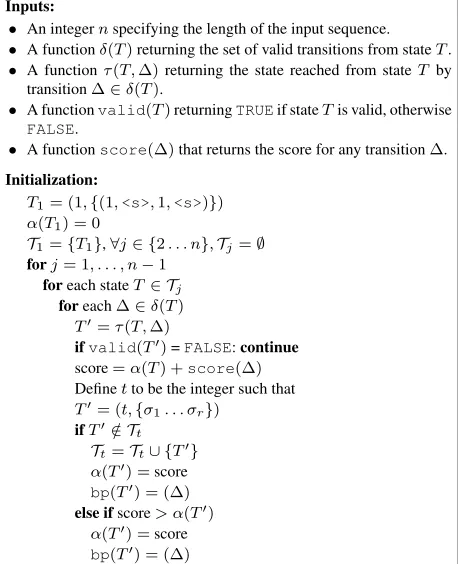
Figure 2 shows the dynamic programming algo-rithm. It relies on the following functions:
Inputs:
• An integernspecifying the length of the input sequence.
• A functionδ(T)returning the set of valid transitions from stateT.
• A functionτ(T,∆)returning the state reached from stateT by transition∆∈δ(T).
• A functionvalid(T)returningTRUEif stateTis valid, otherwise FALSE.
• A functionscore(∆)that returns the score for any transition∆. Initialization:
T1= (1,{(1,<s>,1,<s>)})
α(T1) = 0
T1={T1},∀j∈ {2. . . n},Tj=∅
forj= 1, . . . , n−1
foreach stateT ∈ Tj
foreach∆∈δ(T) T0=τ(T,∆)
ifvalid(T0)=FALSE:continue
score=α(T) +score(∆)
Definetto be the integer such that
T0= (t,{σ1. . . σr})
ifT0∈ T/ t Tt=Tt∪ {T0} α(T0) =score
bp(T0) = (∆)
else ifscore> α(T0)
α(T0) =score
bp(T0) = (∆)
Return: the score of the state(n,{(1,<s>, n,</s>)})inTn, and
[image:7.612.314.543.58.340.2]backpointersbpdefining the transitions leading to this state. Figure 2: The phrase-based decoding algorithm. α(T)
is the score for stateT. Thebp(T)variables are
back-pointers used in recovering the highest scoring sequence of transitions.
• For any stateT,δ(T)is the set of outgoing tran-sitions from stateT.
• For any state T, for any transition ∆ ∈ δ(T),
τ(T,∆)is the state reached by transition∆from
stateT.
• For any stateT, valid(T)checks if a resulting
state is valid.
• For any transition∆,score(∆)is the score for the transition.
We next give full definitions of these functions.
4.2.1 Definitions ofδ(T)andτ(T,∆)
Recall that for any state T, δ(T) returns the set
of possible transitions from state T. In addition τ(T,∆)returns the state reached when taking
tran-sition∆∈δ(T).
• pis a phrase such thats(p) =j+ 1.
• ψ1∈ {σ1. . . σr} ∪ {φ}. Ifψ1 6=φ, it must be the
case that|t(ψ1) + 1−s(p)| ≤dandt(ψ1)6=n.
• ψ2∈ {σ1. . . σr} ∪ {φ}. Ifψ2 6=φ, it must be the case that|t(p) + 1−s(ψ2)| ≤dands(ψ2)6= 1.
• Ifψ16=φandψ2 6=φ, thenψ16=ψ2.
Thus there are four possible types of transition from a stateT = (j,{σ1. . . σr}):
Case 1: ∆ = φ p φ. In this case the phrase p is incorporated as a stand-alone phrase. The new state T0 is equal to(j0,{σ10 . . . σr+10 }) where j0 =
t(p), whereσ0i = σi for i = 1. . . r, and σr+10 =
(s(p), e1(p), t(p), em(p)).
Case 2: ∆ = σip φ for someσi ∈ {σ1. . . σr}. In this case the phrase p is appended to the
signa-tureσi. The new stateT0 = τ(T,∆)is of the form
(j0, σ01. . . σ0r), wherej0 =t(p), whereσiis replaced by(s(σi), ws(σi), t(p), em(p)), and whereσ0i0 =σi0
for alli0 6=i.
Case 3: ∆ = φ p σi for someσi ∈ {σ1. . . σr}. In this case the phrasep is prepended to the
signa-tureσi. The new stateT0 = τ(T,∆)is of the form
(j0, σ01. . . σ0r), wherej0 =t(p), whereσiis replaced by(s(p), e1(p), t(σi), wt(σi)), and whereσi00 = σi0
for alli0 6=i.
Case 4: ∆ = σip σi0 for some σi, σi0 ∈ {σ1. . . σr}, with i0 6= i. In this case phrase p is appended to signature σi, and prepended to signature σi0, effectively joining the two
signa-tures together. In this case the new state T0 =
τ(T,∆) is of the form(j0, σ01. . . σ0r−1), where
sig-natures σi andσi0 are replaced by a new signature (s(σi), ws(σi), t(σi0), wt(σi0)), and all other
signa-tures are copied across fromT toT0.
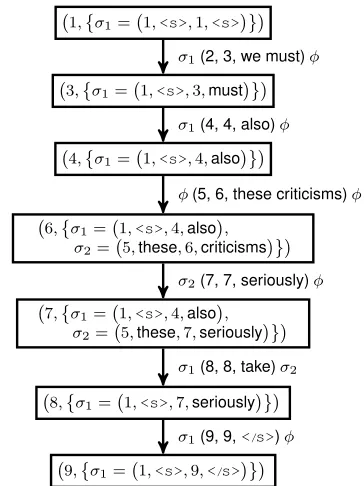
Figure 3 gives the dynamic programming states and transitions for the derivationHin Figure 1. For example, the sub-derivation
H7 =
D
(1,1,<s>)(2,3,we must)(4,4,also),
(5,6,these criticisms)(7,7,seriously)E
will be mapped to a state
T = 7, σ(H7)
= 7,(1,<s>,4,also),(5,these,7,seriously)
1,σ1= 1,<s>,1,<s>
3,σ1= 1,<s>,3,must
4,σ1= 1,<s>,4,also
6,σ1= 1,<s>,4,also,
σ2= 5,these,6,criticisms
7,σ1= 1,<s>,4,also,
σ2= 5,these,7,seriously
8,σ1= 1,<s>,7,seriously
9,σ1= 1,<s>,9,</s>
σ1(2, 3, we must)φ
σ1(4, 4, also)φ
φ(5, 6, these criticisms)φ
σ2(7, 7, seriously)φ
σ1(8, 8, take)σ2
[image:8.612.332.514.52.295.2]σ1(9, 9,</s>)φ
Figure 3: Dynamic programming states and the transi-tions from one state to another, using the same example as in Figure 1. Note thatσi =σ(πi)for allπi∈Hj.
The transitionσ1(8, 8, take)σ2from this state leads to a new state,
T0 = 8,σ1 = (1,<s>,7,seriously)
4.3 Definition ofscore(∆)
Figure 4 gives the definition of score(∆), which incorporates the language model, phrase scores, and distortion penalty implied by the transition∆.
4.4 Definition ofvalid(T)
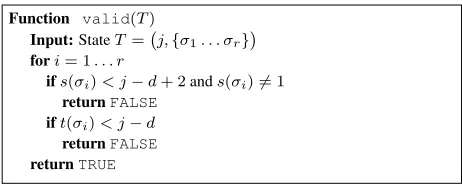
Figure 5 gives the definition of valid(T). This
function checks that the start and end points of each signature are in the set of allowed start and end points given in Lemma 2.
4.5 A Bound on the Runtime of the Algorithm
We now give a bound on the algorithm’s run time. This will be the product of termsN andM, where N is an upper bound on the number of states in the dynamic program, andM is an upper bound on the number of outgoing transitions from any state.
For anyj ∈ {1. . . n}, definefirst(j)to be the
∆ Resulting phrase sequence score(∆)
φ p φ (s, e1, t, em) w(p)ˆ
σip φ (s(σi), ws(σi), t, em) w(p) +ˆ λ(e1|wt(σi)) +η× |t(σi) + 1−s|
φ p σi (s, e1, t(σi), wt(σi)) w(p) +ˆ λ(ws(σi)|em)
+η× |t+ 1−s(σi)|
σip σi0 (s(σi), ws(σi), t(σi0), wt(σi0)) ˆw(p) +λ(e1|wt(σi)) +η× |t(σi) + 1−s|
+λ(ws(σi0)|em)
[image:9.612.73.300.54.182.2]+η× |t+ 1−s(σi0)|
Figure 4: Four operations that can extend a state
T = (j,{σ1. . . σr})by a phrase p = (s, t, e1. . . em), and the scores incurred. We define w(p) =ˆ κ(p) + Pm
i=2λ(ei(p)|ei−1(p)). The functionw(p)ˆ includes the
phrase translation modelκand the language model scores
that can be computed usingpalone. The weightηis the
distortion penalty.
Function valid(T)
Input:StateT = j,{σ1. . . σr}
fori= 1. . . r
ifs(σi)< j−d+ 2ands(σi)6= 1
returnFALSE ift(σi)< j−d
returnFALSE returnTRUE
Figure 5:Thevalidfunction.
words that can end at positionj.
first(j) ={w: ∃p= (s, t, e)s.t. s=j, e1=w}
last(j) ={w: ∃p= (s, t, e)s.t. t=j, em =w}
In addition, define singles(j) to be the set of phrases that translate the single word at positionj:
singles(j) ={p:s(p) =j andt(p) =j}
Next, define h to be the smallest integer such that for all j, |first(j)| ≤ h, |last(j)| ≤ h, and
|singles(j)| ≤ h. Thus h is a measure of the maximal ambiguity of any wordxj in the input.
Finally, for any positionj, definestart(j)to be
the set of phrases starting at positionj:
start(j) ={p:s(p) =j}
and definelto be the smallest integer such that for all j, |start(j)| ≤ l. Given these definitions we
can state the following result:
Theorem 1. The time complexity of the algorithm is O(nd!lhd+1).
To prove this we need the following definition:
Definition 4(p-structures). For any finite set Aof integers with|A|=k, a p-structure is a set ofr or-dered pairs{(si, ti)}ri=1 that satisfies the following properties: 1)0 ≤r ≤k; 2) for eachi∈ {1. . . r}, si ∈ Aandti ∈ A(bothsi = ti andsi 6= ti are allowed); 3) for eachj ∈ A, there is at most one indexi∈ {1. . . r}such that(si =j)or(ti =j)or
(si =jandti =j).
We use g(k) to denote the number of unique p-structures for a setAwith|A|=k.
We then have the following Lemmas:
Lemma 4. The function g(k) satisfies g(0) = 0,
g(1) = 2, and the following recurrence fork≥2:
g(k) = 2g(k−1) + 2(n−1)g(k−2)
Proof. The proof is in Appendix A.
Lemma 5. Consider the functionh(k) =k2×g(k).
h(k)is inO((k−2)!).
Proof. The proof is in Appendix B. We can now prove the theorem:
Proof of Theorem 1: First consider the num-ber of states in the dynamic program. Each state is of the form (j,{σ1. . . σr}) where the set
{(s(σi), t(σi))}ri=1is a p-structure over the set{1}∪
{(j − d). . . d}. The number of possible values for {(s(σi), e(σi))}ri=1 is at most g(d+ 2). For a fixed choice of {(s(σi), t(σi))}ri=1 we will ar-gue that there are at mosthd+1 possible values for
{(ws(σi), wt(σi))}ri=1. This follows because for each k ∈ {(j−d). . . j} there are at most h pos-sible choices: if there is someisuch thats(σi) =k, andt(σi) 6= k, then the associated wordws(σi) is in the setfirst(k); alternatively if there is some
[image:9.612.71.302.268.360.2]nchoices of the variablej, implies that there are at mostng(d+ 2)hd+1states in the dynamic program. Now consider the number of transitions from any state. A transition is of the formψ1pψ2 as defined in Section 4.2.1. For a given state there are at most
(d+ 2)choices forψ1 andψ2, andlchoices forp, giving at most(d+ 2)2lchoices in total.
Multiplying the upper bounds on the number of states and number of transitions for each state gives an upper bound on the runtime of the algorithm as O(ng(d+ 2)hd+1(d+ 2)2l). Hence by Lemma 5
the runtime isO(nd!lhd+1)time.
The boundg(d+ 2)over the number of possible
values for{(s(σi), e(σi))}ri=1is somewhat loose, as the set of p-structures over{1} ∪ {(j−d). . . d} in-cludes impossible values{(si, ti)}r
i=1where for ex-ample there is noisuch thats(σi) = 1. However the bound is tight enough to give theO(d!)runtime.
5 Discussion
We conclude the paper with discussion of some is-sues. First we describe how the dynamic program-ming structures we have described can be used in conjunction with beam search. Second, we give more analysis of the complexity of the widely-used decoding algorithm of Koehn et al. (2003).
5.1 Beam Search
Beam search is widely used in phrase-based decod-ing; it can also be applied to our dynamic program-ming construction. We can replace the line
foreach stateT ∈ Tj
in the algorithm in Figure 2 with
foreach stateT ∈beam(Tj)
wherebeamis a function that returns a subset ofTj, most often the highest scoring elements of Tj un-der some scoring criterion. A key question concerns the choice of scoring function γ(T) used to rank states. One proposal is to define γ(T) = α(T) +
β(T) whereα(T) is the score used in the dynamic
program, andβ(T) = Pi:ws(σi)6=<s>λu(ws(σi)). Hereλu(w)is the score of wordwunder a unigram language model. The β(T) scores allow different
states in Tj, which have different words ws(σi) at
the start of signatures, to be comparable: for exam-ple it compensates for the case wherews(σi)is a rare word, which will incur a low probability when the bigramhw ws(σi)ifor some wordwis constructed during search.
The β(T) values play a similar role to “future
scores” in the algorithm of Koehn et al. (2003). However in the Koehn et al. (2003) algorithm, dif-ferent items in the same beam can translate differ-ent subsets of the input sdiffer-entence, making future-score estimation more involved. In our case all items inTj translate all words x1. . . xj inclusive, which may make comparison of different hypotheses more straightforward.
5.2 Complexity of Decoding with Bit-string Representations
A common method for decoding phrase-based mod-els, as described in Koehn et al. (2003), is to use beam search in conjunction with a search algorithm that 1) creates the target language string in strictly left-to-right order; 2) uses a bit string with bits bi∈ {0,1}fori= 1. . . nrepresenting at each point whether wordiin the input has been translated. A natural question is whether the number of possible bit strings for a model with a fixed distortion limitd can grow exponentially quickly with respect to the length of the input sentence. This section gives an example that shows that this is indeed the case.
Assume that our sentence length n is such that
(n−2)/4is an integer. Assume as beforex1=<s> andxn =</s>. For eachk∈ {0. . .((n−2)/4−
1)}, assume we have the following phrases for the wordsx4k+2. . . x4k+5:
(4k+ 2,4k+ 2, uk) (4k+ 3,4k+ 3, vk)
(4k+ 4,4k+ 4, wk) (4k+ 5,4k+ 5, zk)
(4k+ 4,4k+ 5, yk)
Note that the only source of ambiguity is for each k whether we useyk to translate the entire phrase x4k+4x4k+5, or whether we usewkandzk to trans-latex4k+4andx4k+5separately.
With a distortion limitd≥5, the number of pos-sible bit strings in this example is at least2(n−2)/4.
there is a valid derivationp1. . . pLsuch that the pre-fixp1. . . plwherel = 1 + (n−2)/4gives this bit string. Simply choosep1 = (1,1,<s>)and forl0 ∈
{0. . .(n−2)/4−1}choosepl0+2 = (4l0+ 4,4l0+
5, yi) if b4k+4 = 1, pl0+2 = (4l0 + 5,4l0 + 5, zi)
otherwise. It can be verified thatp1. . . pl is a valid prefix (there is a valid way to give a complete deriva-tion from this prefix). As one example, forn= 10,
andb4= 1andb8= 0, a valid derivation is
(1,1,<s>)(4,5, y1)(9,9, z2)(7,7, v2)(3,3, v1)
(2,2, u1)(6,6, u2)(8,8, w2)(10,10,</s>)
In this case the prefix(1,1,<s>)(4,5, y1)(9,9, z2) givesb4 = 1andb8 = 0. Other values forb4andb8 can be given by using(5,5, z1)in place of(4,5, y1), and(8,9, y2)in place of(9,9, z2), with the follow-ing phrases modified appropriately.
6 Conclusion
We have given a polynomial-time dynamic program-ming algorithm for phrase-based decoding with a fixed distortion limit. The algorithm uses a quite dif-ferent representation of states from previous decod-ing algorithms, is easily amenable to beam search, and leads to a new perspective on phrase-based de-coding. Future work should investigate the effec-tiveness of the algorithm in practice.
A Proof of Lemma 4
Without loss of generality assume A =
{1,2,3, . . . k}. We have g(1) = 2, because in
this case the valid p-structures are {(1,1)} and ∅.
To calculateg(k)we can sum over four possibilities:
Case 1: There areg(k−1)p-structures withsi= ti = 1for somei∈ {1. . . r}. This follows because once si = ti = 1 for some i, there are g(k−1) possible p-structures for the integers{2,3,4. . . k}.
Case 2: There areg(k−1)p-structures such that
si 6= 1andti 6= 1for all i ∈ {1. . . r}. This fol-lows because oncesi 6= 1andti 6= 1for alli, there are g(k−1) possible p-structures for the integers
{2,3,4. . . k}.
Case 3: There are(k−1)×g(k−2)p-structures
such that there is some i ∈ {1. . . r} with si = 1 andti 6= 1. This follows because for theisuch that
si = 1, there are(k−1)choices for the value forti, and there are theng(k−2)possible p-structures for
the remaining integers in the set{1. . . k}/{1, ti}.
Case 4: There are(k−1)×g(k−2)p-structures
such that there is some i ∈ {1. . . r} with ti = 1 andsi 6= 1. This follows because for theisuch that ti= 1, there are(k−1)choices for the value forsi, and there are theng(k−2)possible p-structures for the remaining integers in the set{1. . . k}/{1, si}.
Summing over these possibilities gives the fol-lowing recurrence:
g(k) = 2g(k−1) + 2(k−1)×g(k−2)
B Proof of Lemma 5
Recall thath(k) =f(k)×g(k)wheref(k) =k2. Definek0 to be the smallest integer such that for allk≥k0,
2f(k)
f(k−1)+
2f(k)
f(k−2)·
k−1
k−3 ≤k−2 (4)
Forf(k) =k2we havek0 = 9.
Now choose a constant c such that for all k ∈
{1. . .(k0 −1)}, h(k) ≤ c× (k−2)!. We will
prove by induction that under these definitions ofk0 andc we haveh(k) ≤ c(k−2)!for all integersk,
henceh(k)is inO((k−2)!).
For valuesk≥k0, we have
h(k) =f(k)g(k)
= 2f(k)g(k−1) + 2f(k)(k−1)g(k−2) (5)
= 2f(k)
f(k−1)h(k−1) +
2f(k)
f(k−2)(k−1)h(k−2)
≤
2cf(k)
f(k−1)+
2cf(k)
f(k−2)·
k−1
k−3
(k−3)! (6)
≤c(k−2)! (7)
Eq. 5 follows fromg(k) = 2g(k−1)+2(k−1)g(k−
2). Eq. 6 follows by the inductive hypothesis that
h(k−1) ≤ c(k−3)!andh(k−2) ≤ c(k−4)!.
Eq 7 follows because Eq. 4 holds for allk≥k0.
References
Yin-Wen Chang and Michael Collins. 2011. Exact de-coding of phrase-based translation models through La-grangian relaxation. InProceedings of the Conference on Empirical Methods in Natural Language Process-ing, pages 26–37. Association for Computational Lin-guistics.
Colin Cherry, Robert C Moore, and Chris Quirk. 2012. On hierarchical re-ordering and permutation parsing for phrase-based decoding. In Proceedings of the Seventh Workshop on Statistical Machine Translation, pages 200–209. Association for Computational Lin-guistics.
John DeNero and Dan Klein. 2008. The complexity of phrase alignment problems. InProceedings of the 46th Annual Meeting of the Association for Computational Linguistics on Human Language Technologies: Short Papers, pages 25–28. Association for Computational Linguistics.
Yang Feng, Haitao Mi, Yang Liu, and Qun Liu. 2010. An efficient shift-reduce decoding algorithm for phrased-based machine translation. InProceedings of the 23rd International Conference on Computational Linguis-tics: Posters, pages 285–293. Association for Compu-tational Linguistics.
Michel Galley and Christopher D Manning. 2008. A simple and effective hierarchical phrase reordering model. InProceedings of the Conference on Empir-ical Methods in Natural Language Processing, pages 848–856. Association for Computational Linguistics. Michel Galley and Christopher D Manning. 2010.
Accu-rate non-hierarchical phrase-based translation. In Hu-man Language Technologies: The 2010 Annual Con-ference of the North American Chapter of the Associ-ation for ComputAssoci-ational Linguistics, pages 966–974. Association for Computational Linguistics.
Kevin Knight. 1999. Decoding complexity in word-replacement translation models. Computational Lin-guistics, 25(4).
Philipp Koehn, Franz Josef Och, and Daniel Marcu. 2003. Statistical phrase-based translation. In Proceed-ings of the 2003 Conference of the North American Chapter of the Association for Computational Linguis-tics on Human Language Technology-Volume 1, pages 48–54. Association for Computational Linguistics. Philipp Koehn, Amittai Axelrod, Chris Callison-Burch,
Miles Osborne, and David Talbot. 2007a. Edinburgh system description for the 2005 IWSLT speech trans-lation evaluation. InProceedings of the Second Work-shop on Statistical Machine Translation, StatMT ’07, pages 224–227, Stroudsburg, PA, USA. Association for Computational Linguistics.
Philipp Koehn, Hieu Hoang, Alexandra Birch, Chris Callison-Burch, Marcello Federico, Nicola Bertoldi, Brooke Cowan, Wade Shen, Christine Moran, Richard
Zens, Chris Dyer, Ondˇrej Bojar, Alexandra Con-stantin, and Evan Herbst. 2007b. Moses: Open source toolkit for statistical machine translation. In Proceed-ings of the 45th annual meeting of the ACL on inter-active poster and demonstration sessions, pages 177– 180. Association for Computational Linguistics. Shankar Kumar and William Byrne. 2005. Local phrase
reordering models for statistical machine translation. InProceedings of the conference on Human Language Technology and Empirical Methods in Natural Lan-guage Processing, pages 161–168. Association for Computational Linguistics.
Eugene Leighton Lawler, Jan Karel Lenstra, Alexander Hendrik George Rinnooy Kan, and David Bernard Shmoys. 1985. The Traveling Salesman Problem. John Wiley & Sons Ltd.
Adam Lopez. 2009. Translation as weighted deduction. InProceedings of the 12th Conference of the European Chapter of the Association for Computational Linguis-tics, pages 532–540. Association for Computational Linguistics.
Burkhard Monien and Ivan Hal Sudborough. 1981. Bandwidth constrained NP-complete problems. In
Proceedings of the thirteenth annual ACM symposium on Theory of computing, pages 207–217. ACM. Franz Josef Och and Hermann Ney. 2004. The
align-ment template approach to statistical machine transla-tion. Computational linguistics, 30(4):417–449. H Donald Ratliff and Arnon S Rosenthal. 1983.
Order-picking in a rectangular warehouse: a solvable case of the traveling salesman problem.Operations Research, 31(3):507–521.
Christoph Tillmann. 2004. A unigram orientation model for statistical machine translation. InProceedings of HLT-NAACL 2004: Short Papers, pages 101–104. As-sociation for Computational Linguistics.
Dekai Wu. 1997. Stochastic inversion transduction grammars and bilingual parsing of parallel corpora.
Computational linguistics, 23(3):377–403.
Mikhail Zaslavskiy, Marc Dymetman, and Nicola Can-cedda. 2009. Phrase-based statistical machine transla-tion as a traveling salesman problem. InProceedings of the Joint Conference of the 47th Annual Meeting of the ACL and the 4th International Joint Conference on Natural Language Processing of the AFNLP: Volume 1-Volume 1, pages 333–341. Association for Compu-tational Linguistics.