Enhancing Automatic ICD-9-CM Code Assignment for
Medical Texts with PubMed
Danchen Zhang1, Daqing He1, Sanqiang Zhao1, Lei Li2 1School of Information Sciences, University of Pittsburgh
2School of Economics and Management, Nanjing University of Science and Technology
{daz45, dah44, saz31}@pitt.edu, [email protected]
Abstract
Assigning a standard ICD-9-CM code to disease symptoms in medical texts is an important task in the medical domain. Au-tomating this process could greatly reduce the costs. However, the effectiveness of an automatic ICD-9-CM code classifier faces a serious problem, which can be triggered by unbalanced training data. Frequent dis-eases often have more training data, which helps its classification to perform better than that of an infrequent disease. How-ever, a diseases frequency does not nec-essarily reflect its importance. To resolve this training data shortage problem, we propose to strategically draw data from PubMed to enrich the training data when there is such need. We validate our method on the CMC dataset, and the evaluation re-sults indicate that our method can signifi-cantly improve the code assignment classi-fiers’ performance at the macro-averaging level.
1 Introduction and Background
The rapid computerization of medical content such as electronic medical records (EMRs), doc-tors notes and death certificates, drives a crucial need to apply automatic techniques to better as-sist medical professionals in creating and manag-ing medical information. A standard procedure in hospital is to assign the International Classifica-tion of Diseases (ICD) codes to diseases appear-ing in medical texts by professional coders. As a result, several recent studies have been devoted to automatically extracting ICD code from medical texts to help manual coders (Crammer et al.,2007;
Farkas and Szarvas, 2008;Aronson et al., 2007;
Kavuluru et al.,2015,2013;Zuccon and Nguyen,
Figure 1: An example radiology report with man-ually labeled ICD-9-CM code from CMC dataset.
2013;Koopman et al.,2015).
In this paper, we focus on ICD-9-CM (the 9th version ICD, Clinical Modification), although our work is portable to ICD-10-CM (the 10th version ICD). The reason to conduct our study on ICD-9-CM is to compare with the state-of-art methods, whose evaluations have mostly conducted on ICD-9-CM code (Aronson et al.,2007;Kavuluru et al.,
2015,2013;Patrick et al., 2007;Ira et al., 2007;
Zhang,2008). ICD-9-CM codes are organized hi-erarchically, and each code corresponds to a tex-tual description, such as ”786.2, cough”. Multi-ple codes can be assigned to a medical text, and a specific ICD-9-CM code is preferred than a more generic one when both are suitable (Pestian et al.,
2007). Figure1shows a code assignment example where a radiology report is labeled with ”786.2, cough”.
Existing methods for automatic ICD-9-CM as-signment have been mostly supervised methods because of the effectiveness the training; how-ever, classification performance heavily relies on the sufficiency of training data (He and Garcia,
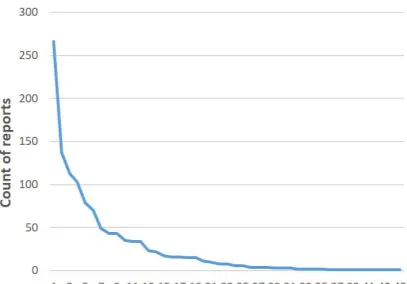
at-Figure 2: The distribution of radiology reports for 45 ICD-9-CM codes in the CMC dataset.
tention to the correctness of the code assignment to each EHR (individual case), which helps to hide the impact of unbalanced training data. How-ever, a useful classification system should perform consistently across all ICD-9-CM codes regard-less of the popularity of the codes (Jackson and Moulinier, 2007). This motivated us to examine the imbalanced training data and its impacts to the classifier. Specifically, we pay more attention to macro-average measures, which helps to examine the consistency across all codes.
Unfortunately, in a real dataset for studying ICD-9-CM code classification, the data available for each code is highly imbalanced. For example, Figure 2 shows the count of available radiology reports for each of the 45 ICD-9-CM codes in the CMC dataset (Pestian et al.,2007). Common dis-eases like ”786.2, cough”, can have 266 reports as the training data, whereas unpopular disease ”758.6, Gonadal dysgenesis” only has one. Sim-ilarly, Kavuluru et al. (2015) found that 874 of 1,231 ICD-9-CM code in their UKLarge dataset have less than 350 supporting data, and only 92 codes have more than 1,430 supporting data. In another example, Koopman et al. (2015) found that 85% of the whole death certificate dataset are related to top 20 common cancers, and only rest 15% is associated with 65 rarer cancers. These long tail supporting data problems are very com-mon, which makes data imbalance an noticeable problem.
Our approach for resolving this problem is to introduce additional information resources. Fur-thermore, due to the privacy concern of medical-related content, this study is particularly interested in obtaining extra relevant training data from
pub-licly available medical datasets. PubMed1, as a vast and broad medical literature dataset, covers a great number of disease related information and imposes few restrictions on data access. There-fore, it is a perfect starting point to explore our approach. The hypothesis is that training data can be obtained from PubMed articles that talk about a disease corresponding to a ICD-9-CM code. With the abundant PubMed articles, we would be able to alleviate the training data imbalance problem.
There are several contributions in our study. Firstly, we examine the data imbalance problem in ICD-9-CM code assignment. Secondly, we pro-pose and compare several methods to resolve the data imbalance problem. Thirdly, we give a com-prehensive discussion on the current classification challenges. Finally, our method can be adapted to ICD-10-CM code assignment task with minor modifications.
The rest of this paper is organized as follows. In Section 2, we will discuss related research. Our methods and experiments will appear in Section 3 and 4. Limitations are discussed in Section 5 and the conclusion is provided in Section 6.
2 Related Work
The existing studies of automating ICD-9 code assignment can be classified into two groups. Through examining how professional coders as-signing ICD codes, the first one used rule-based approaches. Ira et al. (2007) developed a rule-based system considering factors such as uncer-tainty, negation, synonymy, and lexical elements.
Farkas and Szarvas (2008) used Decision Tree (DT) and Maximum Entropy (ME) to automati-cally generate a rule-based coding system. Cram-mer et al.(2007) composed a hybrid system con-sisting of a machine learning system with natural language features, a rule-based system based on the overlap between the reports and code descrip-tions, and an automatic policy system. Their re-sults showed better performance than each single system.
The second group employed supervised ma-chine learning methods for the assignment task, and their performance has been being equivalent or even better than those rule-based systems that need experts manually crafting knowledge. Aron-son et al.(2007) used a stacked model to combine the results of four modules: Support Vector
[image:2.595.78.282.62.204.2]chine (SVM), K-Nearest Neighbors (KNN), Pat-tern Matching (PM) and a hybrid Medical Text Indexer (MTI) system. Patrick et al. (2007) used ME and SVM classifiers, enhanced by a feature-engineering module that explores the best combi-nation of several types of features. Zhang(2008) proposed a hierarchical text categorization method utilizing the ICD-9-CM codes structure. Zuc-con and Nguyen (2013) conducted a comparison study on four classifiers (SVM, Adaboost, DT, and Naive Bayes) and different features on a 5,000 free-text death certificate dataset, and found that SVM with a stemmed unigram feature performed the best.
Along with the introduction of supervised meth-ods, many past studies indicated that data imbal-ance problem can severely affect the classifier’s performance. For example,Kavuluru et al.(2015) found that 874 of 1,231 ICD-9-CM codes in UK-Large dataset have less than 350 supporting data, whereas only 92 codes have more than 1,430 sup-porting data. The former group has macro F1 value of 51.3%, but the latter group only has 16.1%. To resolve data imbalance problem, they used optimal training set (OTS) selection approach to sample negative instance subset that provides best performance on validation set. However, OTS did not work on UKLarge dataset because sev-eral codes have so few training examples that even carefully selecting negative instances could not help. When Koopman et al. (2015) found that 85% of the whole death certificate dataset is asso-ciated with only top 20 common cancers, whereas the other 65 rarer cancers only have the rest 15% of the dataset, they tried to construct the balanced training set by randomly sampling a static num-ber of negative examples for each class. Their re-sults reflected the benefits of having more train-ing data in improvtrain-ing the classifiers’ performance. Since result of original model learned with imbal-anced data is not provided, we cannot know the ac-tual improvement. In addition, to deal with codes that only appear once in the dataset,Patrick et al.
(2007) used a rule-based module to supplement ME and SVM classifiers.
Consistent to the existing works, our approach utilizes supervised methods for automatic ICD-9-CM code assignment, and our focus is on address-ing the trainaddress-ing data imbalance problem. But our work tries to solve the data imbalance problem by adding extra positive instances, which is not
lim-ited to the existing training data distribution or ex-pert’s knowledge. Adding positive instances have been proven to be effective in supervised machine learning in other domains(Caruana,2000;He and Garcia,2009), and we are first to find open source dataset as supplementary data for improving ICD-9-CM assignment performance.
3 Methods
In this section, we will first introduce the dataset on which our methods will be evaluated, then we propose two methods of collecting supplementary training data from PubMed dataset.
3.1 Dataset
We validate our methods on the official dataset of the 2007 Computational Medicine Challenge (CMC dataset), collected by Cincinnati Children’s Hospital Medical Center (Pestian et al., 2007), which is frequently used by researchers working on the ICD-9-CM code assignment task. The CMC dataset consists of training and testing dataset, but only training dataset is accessible for us. Fortunately, most studies publish their system performance on both training and testing dataset, and then we can compare our methods with state-of-art methods. This corpus consists of 978 radi-ological reports taken from real medical records, and each report has been manually labeled with ICD-9-CM codes by professional companies. The example in Figure1 comes from this dataset. In total, there are 45 ICD-9-CM codes appearing in the CMC dataset, and each report is labeled with one or more ICD-9-CM codes. This is a very im-balanced collection, with around half codes having less than 10 training data (see Figure2).
3.2 Method I: Retrieving PubMed articles using ICD-9-CM code official description
whole PubMed dataset as a document collection. For example, based on ICD-9-CM code ”786.2, cough”, we can retrieve PubMed articles with a query ”cough”. Our initial informal testing con-firmed our hypothesis.
To avoid bring back too much noise, we re-stricted the PubMed retrieval to only search on the article title field. Our motivation is that the title generally introduces the main topic of the whole paper. For the same reason, we also only utilized the title and abstract of top returned arti-cles as the supplementary training data. In case of empty retrieval result, certain ICD-9-CM descrip-tion terms that would not appear in PubMed ar-ticle titles, such as ”other”, ”unspecified”, ”spec-ified”, ”NOS”, and ”nonspecific”, are removed from the query. For example, ICD-9-CM code ”599.0”, whose description is ”urinary tract infec-tion, site not specified”, will generate a cleaned query ”urinary tract infection”, and ICD-9-CM code ”596.54”, whose description is ”neurogenic bladder NOS”, will generate a cleaned query ”neu-rogenic bladder”.
3.3 Method II: Retrieving PubMed articles with both official and synonyms
ICD-9-CM code description
Despite great overlap among them, ICD-9-CM code descriptions and the radiology reports in the CMC collection are written by different groups of people with different purposes. Therefore, there could be term mis-match problems between them. When this happens, it is actually better to not use the terms in the ICD-9-CM official description as the query for finding relevant PubMed articles, but actually to use the related terms in the CMC dataset as the query terms instead. This would en-able the model trained on these returned PubMed articles can be more effectively classifying CMC reports. For example, the description ”Anorexia” of code ”783.0” does not appear in CMC dataset. Instead, ”loss of appetite” exists in the radiology reports labeled with ”783.0”, while according to data in ICD9Data.com, ”loss of appetite” is the synonym of ”Anorexia”. Therefore, in this case, it is better to use ”loss of appetite” rather than ”Anorexia” to be the query when search for train-ing data in PubMed.
ICD9Data.com is an online website, providing rich and free ICD-9-CM coding information. It contains code definition, hierarchy structure,
ap-proximate synonyms, etc. We crawled the 45 codes’ synonyms from the website. In method II, besides the queries from the official description, we also conducted PubMed searches with queries based on the synonyms of the descriptions. Each synonym is an individual PubMed query, and only when all its terms appear in CMC dataset, the query is considered. If one ICDcode hasnqueries and totally needsmsupplementary documents for training, only topm/nretrieved PubMed articles from each query are considered.
4 EXPERIMENTS
4.1 Evaluation metrics
Following the past studies (Pestian et al., 2007;
Kavuluru et al.,2015), we evaluate the classifica-tion performance through a micro F1 score (i.e., sum of the individual classification performance and divided by the individual amount) and a macro F1 score (i.e., sum of the classifiers performance and divided by the classifiers amount). We ex-pect that by alleviating the data imbalance prob-lem, macro F1 scores can increase significantly. All experiments in this study have gone through 10-fold cross validation, because it can provide a reliable result when data is limited (Witten et al.,
2016).
4.2 Pre-process and Features
Following the past studies (Crammer et al.,2007;
Aronson et al.,2007;Kavuluru et al.,2015,2013;
Koopman et al., 2015; Patrick et al., 2007; Ira et al.,2007), the CMC dataset is preprocessed with following steps:
• Full name restoration. Medical abbreviation restoration is a hard topic, which is not ex-plored in this study. We manually generate a list of full names for abbreviations appearing in CMC dataset2.
• Word lemmatization. Lemmatization of words are restored with WordNet 3.0 (Miller,
1995).
• Negation detection and removal. Negex (Chapman et al., 2001) is used to detect the negation expression, and negation target terms are removed after detection.
Figure 3: Feature selection on LR and SVM.
• Phrase recognition. MetaMap (Aronson and Lang,2010) is utilized to extract the medical concept phrase appearing in the text, which is appended to the text.
After preprocessing, the example radiology re-port in Figure 1 will be ”ten year old with chest pain x two week. the lung be well expand and clear. there be. the cardiac and mediastinal silhou-ette be normal. there be. chest pain”. Supplemen-tary data collected from PubMed will be prepro-cessed in the same way.
4.3 Baselines
According to the past studies(Farkas and Szarvas,
2008;Aronson et al.,2007;Kavuluru et al.,2015), Support Vector Machine (SVM) and Logistic Re-gression (LR) are the most effective and com-monly used classification models in this task. Therefore, we selected them as the two baselines. Each ICD-9-CM code has one binary classifier implemented using Scikit-Learn(Pedregosa et al.,
2011). We name these two sets of baselines as Baseline LR and Baseline SVM.
Features consist of unigrams and bigrams ap-pearing in preprocessed radiology reports, and the feature vector values are binary, indicating the ap-pearance or absence of the word in text.
We performed feature selection on two base-lines to avoid over-fit and extra computation cost. χ2 based feature selection was employed for
fea-ture selection (Liu and Setiono,1995). As shown in Figure3, We find that 500 features can provide stable micro F1 performance and best macro F1 performance for Baseline LR and Baseline SVM. In all the following experiments, all classifiers are
trained on these 500 selected features.
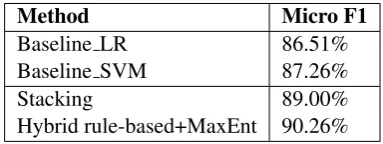
Our baseline performance were compared with the state-of-art methods in Table 1. Stacking is a stacked model combining four classification models (Aronson et al., 2007). Hybrid based+MaxEnt is a hybrid system combining rule-based method with MaxEnt (Aronson et al.,2007). Although Table1shows that their performance is significantly better than our baselines, for the pur-pose of studying the methods for addressing im-balanced training data, we have to use the two current baselines since these advanced and com-plicated systems would hide the effects that we want to observe. In addition, any improvement we achieve in single classifier can be later integrated into these systems, which could be an interesting future work. These methods concentrated on mi-cro averaging performance, while in this study we will explore the macro averaging performance.
Method Micro F1
Baseline LR 86.51%
Baseline SVM 87.26%
Stacking 89.00%
Hybrid rule-based+MaxEnt 90.26%
Table 1: Baseline performance and existing best performed methods from related work.
Figure4shows the individual classification per-formance of 45 classifiers, and we can find an un-stable performance across 45 classifiers. We use Macro F1 score as the split line, and we can find that, for both baseline system, there are 21 classi-fiers having a below-average performance, and all of them have relatively less training data than the classifiers with above-average performance. This indicates that the data imbalance leads to the per-formance instability across all classes.
[image:5.595.320.512.331.403.2]Figure 4: Individual classification performance of 45 classifiers trained with LR and SVM model in Baseline.
4.4 Experiment I: retrieving PubMed articles with ICD code official description
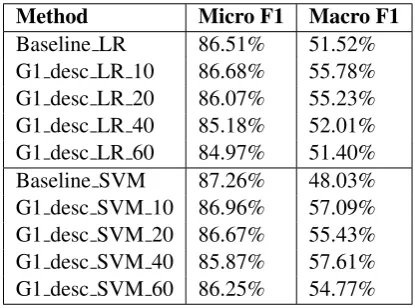
In the first experiment, supplementary data is col-lected based on ICD-9-CM code official descrip-tion, as described in method I. The supplement-ing document size is set to be 10, 20, 40 and 60. Supplementary training data is added to 24 classifiers in Group 1. We name these two new runs as Group 1 Description LR (G1 desc LR) and Group 1 Description SVM (G1 desc SVM), appended with supplementary data size. The re-sults in Table 2also show that supplementing 10 documents can generate best performance, and with more documents added, both macro and mi-cro F1 will decrease.
Method Micro F1 Macro F1 Baseline LR 86.51% 51.52% G1 desc LR 10 86.68% 55.78% G1 desc LR 20 86.07% 55.23% G1 desc LR 40 85.18% 52.01% G1 desc LR 60 84.97% 51.40% Baseline SVM 87.26% 48.03% G1 desc SVM 10 86.96% 57.09% G1 desc SVM 20 86.67% 55.43% G1 desc SVM 40 85.87% 57.61% G1 desc SVM 60 86.25% 54.77%
Table 2: Enhance classifiers in Group 1 with sup-plementary data collected with method I, while the evaluation is performed on all classes.
Through Wilcoxon Signed Ranks test, there is no significant difference between G1 desc LR 10
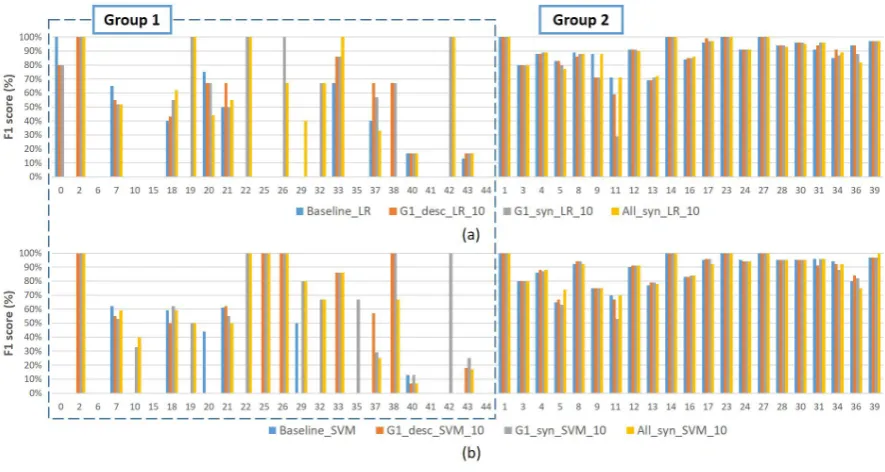
and Baseline LR. Nor does G1 desc SVM 10. Further, we compare both methods against base-line on Group 1 and Group 2 separately. How-ever, there is still no significant difference existing. Take G1 desc SVM 10 for example, from Figure
5, we can see that 11 classes still have F1=0%, while 5 classes’ performance decrease, and only 8 got F1 improved. It indicates that the method I is ineffective.
After exploring the results, we find sometimes the supplementary data does not help training. For example, for ICD-9-CM code ”783.0 Anorexia”, the classification performance stays 0%. The corresponding radiology report doesn’t have term ”Anorexia”, making the supplementary data use-less. It implies we need to collect PubMed arti-cles containing same features with the radiology reports in CMC dataset.
4.5 Experiment II: Retrieving PubMed articles with ICD code official and synonyms descriptions
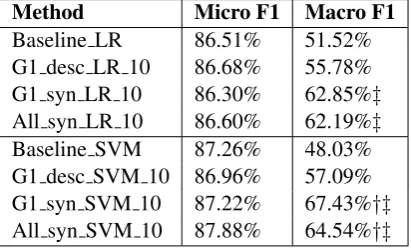
In this second experiment, we collect PubMed data through the ICD-9-CM code’s both of-ficial and synonyms description that appears in CMC dataset. We name these two runs as Group 1 Synonym LR (G1 syn LR) and Group 1 Synonym SVM (G1 syn SVM). Due to the paper size limitation, here we only show the best results with supplementary document size being 10 in Table3.
[image:6.595.77.285.518.672.2]signifi-cant difference compared with G1 desc SVM 10. However, if only classifiers in Group 1 are consid-ered, G1 syn SVM 10 significantly outperforms G1 desc SVM 10 (p − value < 0.01). This indicates that our propose method II can generate effective supplementary training data. On the other hand, G1 syn LR 10 is found to outperform Baseline LR significantly only on Group 1 classes (p−value <0.01).
Method Micro F1 Macro F1 Baseline LR 86.51% 51.52% G1 desc LR 10 86.68% 55.78% G1 syn LR 10 86.30% 62.85%‡
All syn LR 10 86.60% 62.19%‡
Baseline SVM 87.26% 48.03% G1 desc SVM 10 86.96% 57.09% G1 syn SVM 10 87.22% 67.43%†‡
[image:7.595.79.285.197.321.2]All syn SVM 10 87.88% 64.54%†‡
Table 3: Experiment results.†means significantly outperform baseline. ‡means significant outper-form baseline on Group 1.
It shows that on SVM model, PubMed data collected with ICD-9-CM code descriptions syn-onyms works better in solving the data imbalance problem than with the official descriptions. After data supplementation, there are still 6 classifiers with F1 score being 0%, which will be further dis-cussed in Section 5.
4.6 Experiment III: adding supplementary training data to all classifiers
In the third experiment, we add supplemen-tary data to all 45 classifiers to explore whether adding supplementary data to the classifiers that originally have sufficient training data still can gain performance improvement. We name these two runs as All Synonym LR (All syn LR) and All Synonym SVM (All syn SVM). Also, only the best results with supplementary document size being 10 is shown in Table3. Through Wilcoxon Signed Ranks test, All syn SVM 10 significantly outperforms the baseline, and All syn LR 10 sig-nificantly outperforms the baseline only on Group 1 (p−value < 0.01), but both have no signifi-cant difference with G1 syn and G1 desc. These means that adding supplementary training data is effective on solving data imbalance problem, but for the classifiers that originally have sufficient training data, extra training data seems have no
significant effect.
5 Discussion
Experiment results indicates that our proposed supplementing training data method can help the classifiers to reach to a relatively balanced perfor-mance. Such improvement mainly comes from changing the word weight ranking so that im-portant words rank higher. For example, for code ”758.6 turner syndrome”, in the baseline LR (F1=0%), top 3 features with highest weights are ”duplicate left, partially, turner syndrome”. But in G1 syn LR 10 (F1=67%), top 3 features are ”turner, turner syndrome, syndrome”. Supplemen-tary data trains term in ”turner syndrome” a higher weight in LR model, explaining this code’s classi-fication performance increase.
In addition, supplementary data will improve classification through boosting the weight of the features. For example, the top features for code ”786.59, Other chest pain” are basically similar in both baseline LR (F1=0%) and G1 syn LR 10 (F1=40%), including ”tightness, chest tightness, chest pain”. However, the weight differs a lot. For baseline LR, weights are all under 1.5, while in G1 syn LR 10, top 5 features are all above 1.5, in-dicating the classification model have much higher confidence on these features.
Finally, supplementary data mainly support code assignment effectively in Group 1, and we find that classification performance in Group 2 ba-sically has no significant difference across all ex-periments. Meanwhile, 978 reports, dominated by Group 2 classes, also show no significant dif-ference across all experiments. Therefore, extra training data does not improve Group 2’s perfor-mance, and hence supplementary data is not sug-gested for classes having sufficient training data.
Besides, our proposed methods can be directly used in ICD-10-CM classification with little mod-ification. Just update the PubMed query with the ICD-10-CM textual descriptions and synonyms.
Though data imbalance problem has been largely alleviated, there are still a few classifiers in Group 1 have poor performance. After explor-ing, we think there are mainly four reasons:
Figure 5: Individual classification performance of 45 classifiers on Baseline and three experiments.
of imaging techniques, and such word level feature matching cannot help classification.
• ”History of” ICD-9-CM codes. For codes ”V13.02, Personal history, urinary tract in-fection” and ”V13.09 Personal history of other specified urinary system disorders”, adding supplementary data doesn’t help their performance. We find their radiology re-ports are basically classified to ”599.0 urinary tract infection” and ”593.70 vesicoureteral reflux”. ”history of” feature is ignored. Extra training data has no effect on this problem.
• Speculative expression. In prepossessing procedure, negation terms are removed, but speculative expressions are kept. It results in that when doctor is not sure whether a patient may get a disease, but write it down to re-ports, classification results will rely on these speculative terms, and cause false positive. For example, code ”518.0” has a low F1 score because in many reports labeled with other codes, doctors write that the patient may have disease ”atelectasis”, while ”atelectasis” is a very important word to recognize ”518.0”.
• Data missing due to expert disagreement. In CMC dataset, three experts manually assign codes to 978 radiology reports. Only when two or more experts agree, code is approved. However, sometimes the conflict opinions
re-sults in code assignment failure. For exam-ple, reports 99619963 and 99803917 should be labeled with ”741.90 Spina bifida”. How-ever, one expert assigned ”741.90”, another assigned ”741.9”, and the third expert miss this code at all. This led to ”741.90 Spina bi-fida” was not assigned to these two reports. However, with the supplementary data added into the training, our method correctly as-signs ”741.90 Spina bifida” to these two re-ports, but this assignment was counted as wrong since the ground truth does not have this code due to expert disagreements.
6 Conclusion and Future Work
References
Alan R Aronson, Olivier Bodenreider, Dina Demner-Fushman, Kin Wah Fung, Vivian K Lee, James G Mork, Aur´elie N´ev´eol, Lee Peters, and Willie J Rogers. 2007. From indexing the biomedical lit-erature to coding clinical text: experience with mti and machine learning approaches. InProceedings of the Workshop on BioNLP 2007: Biological, Transla-tional, and Clinical Language Processing. Associa-tion for ComputaAssocia-tional Linguistics, pages 105–112.
Alan R Aronson and Franc¸ois-Michel Lang. 2010. An overview of metamap: historical perspective and re-cent advances.Journal of the American Medical In-formatics Association17(3):229–236.
Rich Caruana. 2000. Learning from imbalanced data: Rank metrics and extra tasks. InProc. Am. Assoc. for Artificial Intelligence (AAAI) Conf. pages 51–57.
Wendy W Chapman, Will Bridewell, Paul Hanbury, Gregory F Cooper, and Bruce G Buchanan. 2001. A simple algorithm for identifying negated findings and diseases in discharge summaries. Journal of biomedical informatics34(5):301–310.
Koby Crammer, Mark Dredze, Kuzman Ganchev, Partha Pratim Talukdar, and Steven Carroll. 2007. Automatic code assignment to medical text. In Pro-ceedings of the Workshop on BioNLP 2007: Bio-logical, Translational, and Clinical Language Pro-cessing. Association for Computational Linguistics, pages 129–136.
Rich´ard Farkas and Gy¨orgy Szarvas. 2008. Automatic construction of rule-based icd-9-cm coding systems.
BMC bioinformatics9(3):S10.
Henk Harkema, John N Dowling, Tyler Thornblade, and Wendy W Chapman. 2009. Context: an al-gorithm for determining negation, experiencer, and temporal status from clinical reports. Journal of biomedical informatics42(5):839–851.
Haibo He and Edwardo A Garcia. 2009. Learning from imbalanced data. IEEE Transactions on knowledge and data engineering21(9):1263–1284.
Goldstein Ira, Arzumtsyan Anna, and Uzuner Ozlem. 2007. Three approaches to automatic assignment of icd-9-cm codes to radiology reports .
Peter Jackson and Isabelle Moulinier. 2007. Natural language processing for online applications: Text retrieval, extraction and categorization, volume 5. John Benjamins Publishing.
Ramakanth Kavuluru, Sifei Han, and Daniel Harris. 2013. Unsupervised extraction of diagnosis codes from emrs using knowledge-based and extractive text summarization techniques. InCanadian Con-ference on Artificial Intelligence. Springer, pages 77–88.
Ramakanth Kavuluru, Anthony Rios, and Yuan Lu. 2015. An empirical evaluation of supervised learn-ing approaches in assignlearn-ing diagnosis codes to elec-tronic medical records. Artificial intelligence in medicine65(2):155–166.
Bevan Koopman, Guido Zuccon, Anthony Nguyen, Anton Bergheim, and Narelle Grayson. 2015. Auto-matic icd-10 classification of cancers from free-text death certificates. International journal of medical informatics84(11):956–965.
Huan Liu and Rudy Setiono. 1995. Chi2: Feature se-lection and discretization of numeric attributes. In
Tools with artificial intelligence, 1995. proceedings., seventh international conference on. IEEE, pages 388–391.
George A Miller. 1995. Wordnet: a lexical database for english. Communications of the ACM 38(11):39– 41.
Jon Patrick, Yitao Zhang, and Yefeng Wang. 2007. De-veloping feature types for classifying clinical notes. In Proceedings of the Workshop on BioNLP 2007: Biological, Translational, and Clinical Language Processing. Association for Computational Linguis-tics, pages 191–192.
Fabian Pedregosa, Ga¨el Varoquaux, Alexandre Gram-fort, Vincent Michel, Bertrand Thirion, Olivier Grisel, Mathieu Blondel, Peter Prettenhofer, Ron Weiss, Vincent Dubourg, et al. 2011. Scikit-learn: Machine learning in python. Journal of Machine Learning Research12(Oct):2825–2830.
John P Pestian, Christopher Brew, Paweł Matykiewicz, Dj J Hovermale, Neil Johnson, K Bretonnel Cohen, and Włodzisław Duch. 2007. A shared task involv-ing multi-label classification of clinical free text. In
Proceedings of the Workshop on BioNLP 2007: Bi-ological, Translational, and Clinical Language Pro-cessing. Association for Computational Linguistics, pages 97–104.
Ian H Witten, Eibe Frank, Mark A Hall, and Christo-pher J Pal. 2016. Data Mining: Practical machine learning tools and techniques. Morgan Kaufmann.
Yitao Zhang. 2008. A hierarchical approach to encod-ing medical concepts for clinical notes. In Proceed-ings of the 46th Annual Meeting of the Association for Computational Linguistics on Human Language Technologies: Student Research Workshop. Associ-ation for ComputAssoci-ational Linguistics, pages 67–72.