Review Article
Induced vomiting: a therapeutic option
Dongdong Chai, Hong Jiang, Qifang Li
Department of Anesthesiology and Pain Medicine, Shanghai Ninth People’s Hospital Affiliated to Shanghai Jiao Tong University School of Medicine, Shanghai 200011, P. R. China
Received March 24, 2016; Accepted August 15, 2016; Epub September 15, 2016; Published September 30, 2016
Abstract: Vomiting, the basic protective reflexes against ingested toxins, or result from underlying diseases such as inevitable medication side effect or anatomic obstruction, however, in some situations, induced vomiting may be a therapeutic option as reported in bulimia nervosa as a weight control measure. Besides that, many types of
researches demonstrate that induced vomiting for treating disease does not have serious negative effects. To well
understand the therapeutic effect of induced vomiting, the paper firstly describe the anatomy of brain structures containing the vomiting reflex, including chemoreceptor trigger zone, vomiting center and the specific signal deliver process. Moreover, cardiovascular and respiratory functions changes are essential to the generation of vomiting. Furthermore, the brain-gut connections may play an important role in the vomiting reflex, its bidirectional interaction can be perturbed leading to acute physiological repercussions. In addition to that, vagal afferent activation is also
indispensable. Effect of emesis can achieve via vagal fibers in variable methods. Additionally, induced vomiting can change the gastrointestinal homeostasis as well which lead to a recovery of the stomach’s function. Finally, this work will briefly illustrate the procedure of induced vomiting, as well as the side effects of induced vomiting and the
corresponding control strategies. According to the known acknowledge about the induced vomiting as mentioned
above, we draw a conclusion that induced vomiting may be a therapeutic option.
Keywords: Induced vomiting, brain-gut connections, vagal fibers, gastrointestinal homeostasis, therapeutic option
Introduction
Vomiting, the culminating sign of nausea, is a
primarily protective reflex involving the gastro-intestinal system, respiratory and abdominal
muscles, and changes in posture [1-4]. The
symptom of vomiting may be associated with a myriad of organic causes, including infections,
toxic ingestions, migraine, inevitable
medica-tion or post-operative side effect, pregnancy,
and increased intracranial pressure, however,
vomiting is not always a bad thing existing in
the disease, it was known to be a frequent method of purging in patients with bulimia
ner-vosa as a weight control measure in an early time [5, 6]. Besides, many researches has also
been reported to demonstrate that induced vomiting for treating disease does not have
serious negative effects [7]. Additionally,
in-duced vomiting could also be served as a pos-sible therapeutic option in some diseases. For instance, vomiting can be used to exclude the toxin food, stop migraine attack, or perhaps
protect the embryo and mothers. In this paper,
we mainly proposed a hypothesis relating to the topic: induced vomiting, maybe a therapeu
-tic option. And we analyzed the postulation in detail, including the anatomy and physiology
of vomiting, the possible mechanisms con- taining the gut-brain and vagal activation and so on.
The anatomy and physiology of vomiting
Vomiting is defined as the actual oral expulsion
of gastrointestinal contents from the mouth. At the onset of vomiting, intrinsic contractions occur in both the duodenum and the stomach, the lower esophageal sphincter relaxes, and vomitus moves from the stomach into the
esophagus. Next, the inspiratory and abdomi -nal muscles contract and expel the vomitus into
the mouth [8]. These are basic protective reflex -es against ing-ested toxins, or r-esult from
under-lying disease that affects the gastrointestinal
tract or surrounding structures, metabolic or
Vomiting is associated with activation of a
matrix of brain structures including the amyg
-dala, periaqueductal gray, putamen, and dorsal
pons/locus coeruleus [11]. Among them, the more important are the vomiting center (VC)
and the chemoreceptor trigger zone (CTZ). The
VC, located in the medulla oblongata, was
ini-tially confirmed by Borison and Wang [12]. The
VC is the portion of the brain responsible for collecting emetogenic such as emetics stimuli
from throughout the body and coordinating the
development of nausea and vomiting, which
can be activated directly input from multiple mechanisms, including the pharyngeal, vagal, and midbrain afferents and the limbic system [13, 14]. The VC can also be activated indirectly by certain stimuli that activate the CTZ, which is located in the area postrema (AP) on the floor
of the fourth ventricle. However, this area lacks a true blood-brain barrier and is exposed to
both blood and cerebrospinal fluid. Thus, the CTZ is directly sensitive to stimulation from the
transmitters that carried in the blood such as emetics, serotonin, dopamine, histamine, as well as cholinergic, adrenergic, opiate recep-tors and the substance P [15-18]. Besides, the
CTZ could directly identify the harmful stimula -tion from the stomach and small intestine via
vagal afferents. Then the CTZ integrate these information and convey them to VC, which initi
-ates the vomiting reflex [14].
Changes in cardiovascular and respiratory
fun-ctions are essential for the generation of vomit-ing. Vomiting is associated with the increase in blood pressure and a coordinated contraction
of respiratory muscles. The coordinated activity of respiratory muscles (diaphragm, abdominal,
intercostal) is essential to the production of increased thoracic and abdominal pressures required for vomiting. Unlike normal respira-tion, during emetic-like behavior the diaphragm and abdominal muscles co-contract
accompa-nied by contraction of the external (inspiratory)
intercostal muscles and relaxation of the
inter-nal (expiratory) intercostal muscles [19-21]. When vomiting, some of these coordinated reflex events are a reduction in gastric motility,
retrograde movement of gut contents from the proximal intestine to the stomach, and relax-ation of the gastro-esophageal junction
fol-lowed by expulsion of gastric contents brought about by forceful contractions of the diaphragm
and abdominal muscles, and closure of the
glottis to protect the airways [1, 3, 22].
During the vomiting phase, salivation and swal-lowing increase, gastric tone decreases, and
pallor, diaphoresis, and tachycardia occur. The act of vomiting can produce a transiently ele
-vated heart rate followed by decreased heart rate, and additionally causes continued periph -eral vasoconstriction [23]. This phase is
medi-ated by the vagus nerve and the neurotransmit
-ter acetylcholine [24].
The practical application of induced vomiting
Extensive research has been reported to dem-onstrate that several treatments for disease do not have negative effects, such as nausea and induced vomiting [7]. Induced vomiting has
also been conducted by some patients to be therapeutic. Generally speaking, vomiting was
used as an additional therapeutic schedule for
dealing with an unhealthy meal or dangerous ingested toxins, playing a significant role in sub -sequent levels of defense. Vomiting, along with diarrhea, contributes to ridding the gastrointes-tinal tract of dangerous contents [7]. Additiona-
lly, certain events such as emesis appear to completely abort migraine, such as reported,
patients found that the most striking terminator (because the effects can be almost instanta-neous) is emesis [25]. Then vomiting proved to stop a migraine attack [26]. Further, previous
report also proposed an embryo protection hypothesis, which stated the benefit of vomit -ing were the expulsion of dangerous foodborne chemicals and the subsequent avoidance of these chemical via learned aversions to the food that triggered illness [27].
The possible therapeutic mechanisms of vom-iting
There are obvious instances, such as when it is in response to the ingestion of toxic or irritating substances when vomiting is in the best inter-est of the patient and should be encouraged rather than suppressed. Besides that, as men-tioned above, induced vomiting can also be a treatment for some diseases. Here, we pro-posed some possible mechanisms of induced
vomiting as a therapy option.
Vomiting as an adaptive reaction and, in turn modulating the action
-cal challenge of absorbing nutrients while maintaining a delicate balance between de-fense and tolerance against foreign antigens and pathogens that enter with the food and in maintaining homeostasis [28]. As the stomach
plays a key role in the homeostatic mechanism,
when vomiting, the gastrointestinal homeosta-sis could be changed. Thus, the resultant
emp-tying of the stomach actually leads to the recov
-ery of the stomach’s function. This is consistent with Solomon’ theory which states that a reac
-tion to an event will automatically produce the
opposite reaction [29].
Given our knowledge of gastrointestinal and autonomic function, active rather than passive regulation of homeostasis should not be
sur-prising [30]. In the body, forward and feed-back loops are obligatory components of any homeostasis system, among of them, the nega
-tive feed-back loops are more important. When
diseases occur, internal environment distur-bance would be disturbed. The focus on the treatment is the terminations of pathological reactions, restoration the internal environment homeostasis. Shapiro reported that if the
mechanisms for active termination exist, they may lie within neural networks that also sub
-serve the initiation of emesis [31]. In summary, vomiting may be an adaptive action to maintain
the internal environment homeostasis and inhibit diseases development.
The role of the brain-gut axis in vomiting
An increasing number of experts held that the
gut and the brain are closely connected through
direct and indirect wiring. The transmission of information from the gut to the brain relies on multiple information carriers, including the
vagal and the spinal afferent system, gut hor -mones, and gut-microbiota derived signaling
[32]. While output from the CNS to the gut pri
-marily through a myriad of neural, hormonal
and immunological routes, these include the
sympathoadrenal axis and hypothalamic-pitu
-itary-adrenal (HPA) axis, the two branches of the autonomic nervous system (ANS), and the monoaminergic pathways, which modify dorsal horn excitability and spinal reflexes [33]. The first comprehensive scientific theory of
brain-viscera interactions was formulated in
the 1880s by William James and Carl Lange
and was based on the central concept that
stimuli that induce emotions such as fear,
anger or love initially induce changes in visceral function through autonomic nervous system
output, and that the afferent feedback of these peripheral changes to the brain is essential in
the generation of specific emotional feelings [34]. The symptoms of nausea and vomiting may be considered phenomena emerging from
a complex interaction of the central nervous system (CNS), autonomic nervous system (ANS), and enteric nervous system (ENS), where
vomiting may be a terminal event of these
interactions.
The ENS interfaces closely with our largest body surface (the intestinal surface area, which is approximately 100 times larger than the sur -face area of the skin), with the largest
popula-tion of commensal microorganisms of all body
surfaces (100 trillion microorganisms from 40,000 species with 100 times the number of genes in the human genome) [35], with the
gut-associated immune system (containing two-thirds of the body’s immune cells) and with
thousands of enteroendocrine cells (containing
more than 20 identified hormones). Apart from
this, the gastrointestinal tract has been re-vealed as the largest endocrine organ in the
body. More than 30 different gastric-derived
peptides are secreted from enteroendocrine cells in response to ingested food regulating, in
addition to digestive functions, energy balance [36]. Among the novel gastric systems requiring central integration that directly or indirectly participates in the regulation of energy balance by the brain-stomach connection, the endocan
-nabinoid, ghrelin and nesfatin systems togeth
-er with the intracellular mTOR/S6K1 pathway have become key factors. Based on its size, complexity and similarity in neurotransmitters
and signaling molecules with the brain, even though it is now considered the third branch of
the autonomic nervous system, the ENS has been referred to as the ‘second brain’.
Most experts would probably maintain that the
gut-brain interaction is bidirectional and
changes in the gut to brain signaling that is associated with increased consumption of fat-rich diets and neuroplastic changes in visceral afferent pathways associated with gut inflam-mation [38, 39]. These unparalleled relation-ships between the gastrointestinal tract and the brain, with multiple bidirectional and often
interacting interoceptive communication sys
-tems, emphasize the importance of this system
in the maintenance of homeostasis, which also implicating gut-brain communication regulated under neural and hormonal control, the stom-ach-brain connection has been revealed to be one of the most promising targets for treating disease [40].
Vagal afferents activation during vomiting modulates diseases
Vagal afferents are extensively distributed in
the digestive tract from the esophagus to the
colon. They are involved in the reflex control of
normal gastrointestinal (GI) tract function (e.g.
secretion and motility) as well as reflexes more
characteristic of diseases such as functional
dyspepsia and gastroesophageal reflux dis -ease (e.g. vomiting, disordered lower esopha-geal sphincter relaxation and gastric
accommo-dation). They are also implicated in signaling non-painful sensations (e.g. nausea and early satiety) associated with disease [41].
Substan-tial experiments have demonstrated that
gas-trointestinal vagal afferent fibers play a critical
role in the induction of nausea and the
genera-tion of vomiting [23], and the integrity of the
abdominal vagus is essential for the generation
of emesis. In 1951, Wang and Borison demon
-strated that vagotomy can prevent the emesis
[42] and electrical stimulation of the abdominal vagus was known to induce an emetic response that includes an increase in blood pressure,
increased activity of the abdominal muscles
and an increased intragastric pressure [43]. Furthermore, in ferrets, stimulation of mucosal chemoreceptors in the stomach or the
duode-num results in a long latency but sudden
increase in vagal efferent discharge associated with the prodrome of vomiting, suggesting that activation of vagal afferents is involved in the generation of vomiting [44]. The involvement
and importance of vagal neurocircuitry in the generation of vomiting have been well defined
across several species including humans [7, 22, 23, 41].
The role of vagal afferents stimulation exerts the effect of the vomiting sensation via the
fol-lowing methods. Vomiting can be triggered by
toxic materials within the gastrointestinal lumen which stimulate dorsal brainstem via vagal afferents, absorbed toxins or drugs which
act directly on the dorsal vagal complex, pathol -ogies in the gastrointestinal tract or other vis-ceral organs (e.g. renal or cardiac) which stimu-late vagal afferents, stimuli within the central
nervous system (CNS) including cerebral cortex and limbic system; and disturbance of the ves -tibular nuclei and cerebellum [45, 46].
The specific process is that, the afferent vagus nerve is responsible for relaying a vast amount of sensory information such as acidity, alkalini
-ty, hypertonic fluids, temperature extremes,
and irritants from thoracic and abdominal
organs to the nucleus of the solitary tract (NTS),
which is thought to be the main site for the ter-mination of vagal afferents from the gut and
receives not only inputs from peripheral senso
-ry but have direct or indirect connections with
several other hindbrain, midbrain and forebrain structures responsible for the coordination of
the multiple organ systems. From here, infor -mation is disseminated to autonomic motor nuclei, such as the dorsal motor vagal nucleus
(DMV) and ‘higher’ regions of the brain includ
-ing the parabrachial nucleus, hypothalamus, amygdala and insular cortex. The efferent vagus nerve which output from the DMV relays
the integrated and coordinated output response to several peripheral organs responsible for
emesis [18]. Activity within vagal efferent path
-ways during emetic reflexes results in a large retropulsive wave of intestinal motility accom
-panied by gastric contraction. Together with temporally coordinated relaxation of the antral/ pyloric sphincter and the lower esophageal sphincter accompanied by contraction of the
abdominal and intercostal muscles, this results in expulsion of gastric contents from the
stom-ach and upper intestine [21, 47-49]. The CTZ is also the point of vagal afferent entry. Serotonin
is thought to be the major neurotransmitter involved in vagal stimulation [14]. Serotonin
binds to 5-hydroxy tryptamine (5-HT3) recep
-tors on vagal afferent fibers, and conveys impulses to the CTZ [50]. The CTZ conveys
these impulses to the vomiting center,
-tral pattern generators via nucleus of the
soli-tary tract and moderate the motor and prodro -mal activities which mediate nausea and vomit-ing [22, 51]. Abdominal and other vagal affer-ents might also be involved in the genesis of fatigue associated with cancer and its treat-ment [52].
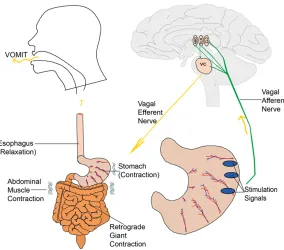
Activation of vagal afferents involved in the pro-cessing of vomiting (Figure 1). Input signals
such as the stimulation of toxin, acidity, alkalin
-ity, hypertonic fluids, or temperature extremes
from the gastrointestinal (GI) tract are
respec-tively transferred to the DMV, NTS, and CTZ
through the afferent vagus nerve. Then, the efferent vagus nerve coordinates GI function based on the processed data in the brainstem. The reaction of GI including intrinsic contrac-tions occurs in both the duodenum and the stomach, the lower esophageal sphincter relax-es, and vomitus moves from the stomach into
the esophagus. Next, the inspiratory and
abdominal muscles contract and expel the vomitus into the mouth.
In addition to the regulation of nervous system, the vomiting could also be triggered by the
release of the neurotransmitter serotonin
(5-HT) from the Enterochromaffin (EC) cells,
which stimulates the vagus nerve via 5-HT3 receptors [41, 53, 54]. The vagus nerve is the
Procedure of induced vomiting
Induced vomiting is achieved most effectively through manual stimulation of the gag reflex
[56]. To induce vomiting, patients need to drink a large number of the emetics, such as mild water, salt water and vinegar water [57], to increase the stomach volume in a short period of time. And then, the materials such as a spoon handle, spatula, chopsticks or a plume would be used to stimulate the posterior
pha-ryngeal wall or tongue root, causing the vomit
-ing reflex. Generally, the total number of opera -tion times is four times. The whole opera-tion process needs about one hour. According to reports, the vomitus consisted of food
rem-nants initially, often changing almost entirely to
saliva, gastric. To get the best effect of induced
vomiting, patients are usually intended to try their best in the vomiting process until they spit out the sticky mucus. If the process of stomach emptying was slow, the intestinal tract could
increase the volume of absorption of water,
which could easily lead to water intoxication.
[image:5.612.94.378.70.320.2]There are some other emetics, for example, tra-ditional medicine, western medicine and other drugs to operate the induced-vomiting proce-dure [57]. The whole operation can force the patients to spit out all of the contents of the stomach, throat, trachea, lots of mucus and Figure 1. Activation of vagal afferents involved in the processing of vomiting.
primary afferent nerve of the
GI tract. Most of the mes-sages from the gut
transmit-ted via the vagus nerve may
involve the neurotransmitter serotonin. In fact, 80% of the
serotonin in the body is
located in EC cells [55]. These cells mediate mes-sages from the brain to the nucleus tractus solitarius (NTS) via the vagus nerve. Messages from the EC cells
can also activate reflexes to
regulate secretion of
diges-tive enzymes and peristalsis
in the gut. Sero-tonin, along
with several tachykinins, can have direct local physiologi -cal effects, such as smooth muscle relaxation, vasodila-tion, and secretion of water
other foreign matter can be emptied. Vomiting
may be accompanied by nausea, sweating, pal -pitation and rapid pulse, which can cause a positive feedback to increase the process of secretion.
The side effects of induced vomiting and con-trol strategies
Induced vomiting would result in diverse side effects. It has been reported that vomitus is
mainly composed of acidic substances and gastrointestinal fluid, and a significant amount
of these contents loss could give rise to
meta-bolic alkalosis, hyponatremia and hypokalemia [58]. And previous study indicated that the gas -tric acid in vomitus will induce esophageal
burns, chronic pharyngitis and teeth decay [59]. Induced vomiting might breaks the dynam -ic equilibrium of gastr-ic mucosal damage and self-healing, and thus leading to severe gastric
mucosal injury and stomach bleeding [60]. Moreover, Chevalier N, et al confirmed that vio -lent vomiting would increase intra-abdominal
pressure, duodenal contents reflux, and further
cause acute pancreatitis [61]. Excessive induced vomiting contributes to the
over-stimu-lation and laxity of esophagus sphincter, which may cause the symptom of nausea, and induce
vomiting during normal stomach contractions, and lead to mild esophagitis and even
gastro-esophageal reflux disease [62, 63]. In addition,
it has been found that induced vomiting could
lead to hoarseness, rough skin and a yellow
face color [64, 65].
Through summarizing the previous studies and
our clinical experiences, we found some effec-tive treatment methods for aforementioned
complications. For the esophageal reflux dis -ease, cessation of vomiting behavior is the best
way to control the heartburn symptoms [66]. And if the symptoms were not eliminated, patients can take the omeprazole correctly
[67]. During or before the induced vomiting, eating some fruits (bananas, oranges, or water-melons) or drinking fruit juice, which are rich in
postassium, can prevent electrolyte imbalance
[68]. According to our clinical experiences, tak-ing some light victuals such as porridge, instead
of food difficult to digest is benefit to protecting the gastric mucosa. Additionally, vitamin B12
could be regarded as adjuvant drug to repair the gastric mucosa. Besides these, the
fre-quency of induced vomiting procure should be strictly controlled.
Conclusion
Vomiting is one of the most frequent co-existing
symptoms in many diseases, yet it has also been reported by some patients to abort or
improve their performance, for instance,
head-ache. Induced vomiting may exert its effects by fulfilling its fundamental goal of connecting the
brain-gut bid-interaction, or, activating vagal nerve, or changing the gastrointestinal homeo-stasis to break the internal environment
distur-bance. Vomiting may exert multiple autonomic,
chemical, and vascular effects to diminish dis-eases. Though induced vomiting might give rise to some serious side effects, we can take effec-tive treatment strategies to prevent these com-plications. Taken together, more studies should
be performed to elucidate the underlying mech -anism of the therapeutic effects of vomiting in future.
Disclosure of conflict of interest
None.
Address correspondence to: Dr. Qifang Li, Depart-
ment of Anesthesiology and Pain Medicine, Shang-hai Ninth People’s Hospital Affiliated to ShangShang-hai Jiao Tong University School of Medicine, Shanghai
200011, P. R. China. Tel: +86-21-23271699; Fax: +86-21-53591385; E-mail: [email protected]
References
[1] McCarthy LE and Borison HL. Respiratory me -chanics of vomiting in decerebrate cats. Am J
Physiol 1974; 226: 738-743.
[2] Miller AD, Lakos SF and Tan LK. Central motor program for relaxation of periesophageal dia-phragm during the expulsive phase of vomit-ing. Brain Res 1988; 456: 367-370.
[3] Umezaki T, Shiba K, Zheng Y and Miller AD. Upper airway motor outputs during vomiting
versus swallowing in the decerebrate cat. Brain Res 1998; 781: 25-36.
[4] Miller AD. Central mechanisms of vomiting. Dig Dis Sci 1999; 44: 39s-43s.
[5] Herzog DB, Keller MB, Lavori PW and Sacks
NR. The course and outcome of bulimia
ner-vosa. J Clin Psychiatry 1991; 52 Suppl: 4-8.
[6] Whitaker AH. An epidemiological study of ano
-rectic and bulimic symptoms in adolescent
girls: implications for pediatricians. Pediatr Ann 1992; 21: 752-759.
[7] Horn CC. Why is the neurobiology of nausea
[8] Becker DE. Nausea, vomiting, and hiccups: a review of mechanisms and treatment. Anesth
Prog 2010; 57: 150-156; quiz 157.
[9] Steele A and Carlson KK. Nausea and
vomit-ing: applying research to bedside practice. AACN Adv Crit Care 2007; 18: 61-73; quiz
74-65.
[10] Camici M. [Vomiting]. Minerva Med 2002; 93: 295-302.
[11] Napadow V, Sheehan JD, Kim J, Lacount LT, Park K, Kaptchuk TJ, Rosen BR and Kuo B. The
brain circuitry underlying the temporal evolu -tion of nausea in humans. Cereb Cortex 2013; 23: 806-813.
[12] Borison HL and Wang SC. Physiology and phar
-macology of vomiting. Pharmacol Rev 1953; 5:
193-230.
[13] Acker ME. Vomiting in children. A comprehen-sive review. Adv Nurse Pract 2002; 10: 51-56, 68.
[14] Munro H. Postoperative nausea and vomiting in children. J Perianesth Nurs 2000; 15: 401-407.
[15] Loprinzi CL, Alberts SR, Christensen BJ, Hanson LJ, Farley DR, Broers JK, Betcher DL, Grady RE, Southorn PA, Johnson TM and Perez EA. History of the development of antiemetic guidelines at Mayo Clinic Rochester. Mayo Clin
Proc 2000; 75: 303-309.
[16] Bleiberg H. A new class of antiemetics: the NK-1 receptor antagonists. Curr Opin Oncol 2000; 12: 284-288.
[17] Welliver M. Nausea and vomiting: mechanisms
and treatment overview. Gastroenterol Nurs 2013; 36: 378-380.
[18] Darmani NA and Ray AP. Evidence for a re-eval -uation of the neurochemical and anatomical
bases of chemotherapy-induced vomiting.
Chem Rev 2009; 109: 3158-3199.
[19] Miller AD, Tan LK and Suzuki I. Control of ab
-dominal and expiratory intercostal muscle ac
-tivity during vomiting: role of ventral respiratory group expiratory neurons. J Neurophysiol
1987; 57: 1854-1866.
[20] Miller AD and Nonaka S. Mechanisms of ab-dominal muscle activation during vomiting. J
Appl Physiol (1985) 1990; 69: 21-25.
[21] Miller AD. Respiratory muscle control during vomiting. Can J Physiol Pharmacol 1990; 68:
237-241.
[22] Hornby PJ. Central neurocircuitry associated
with emesis. Am J Med 2001; 111 Suppl 8A: 106s-112s.
[23] Andrews PL and Horn CC. Signals for nausea and emesis: Implications for models of upper gastrointestinal diseases. Auton Neurosci 2006; 125: 100-115.
[24] Hogan CM and Grant M. Physiologic mecha -nisms of nausea and vomiting in patients with cancer. Oncol Nurs Forum 1997; 24: 8-12.
[25] Saper CB, Fuller PM, Pedersen NP, Lu J and Scammell TE. Sleep state switching. Neuron 2010; 68: 1023-1042.
[26] Chai NC, Shapiro RE and Rapoport AM. Why
does vomiting stop a migraine attack? Curr Pain Headache Rep 2013; 17: 362.
[27] Flaxman SM and Sherman PW. Morning sick -ness: a mechanism for protecting mother and
embryo. Q Rev Biol 2000; 75: 113-148.
[28] Baxt LA and Xavier RJ. Role of Autophagy in the
Maintenance of Intestinal Homeostasis.
Ga-stroenterology 2015; 149: 553-562.
[29] Solomon RL. The opponent-process theory of
acquired motivation: the costs of pleasure and
the benefits of pain. Am Psychol 1980; 35:
691-712.
[30] Ahn AH and Brennan KC. Unanswered ques-tions in headache: how does a migraine attack stop? Headache 2012; 52: 186-187.
[31] Shapiro RE. How do migraine attacks stop? Headache 2012; 52: 191-192.
[32] Van Oudenhove L, Coen SJ and Aziz Q.
Functional brain imaging of gastrointestinal
sensation in health and disease. World J
Gastroenterol 2007; 13: 3438-3445.
[33] Holzer P, Reichmann F and Farzi A. Neuropeptide Y, peptide YY and pancreatic polypeptide in the gut-brain axis. Neuropeptides
2012; 46: 261-274.
[34] Furness JB, Kunze WA, Bertrand PP, Clerc N and Bornstein JC. Intrinsic primary afferent
neurons of the intestine. Prog Neurobiol 1998; 54: 1-18.
[35] Kurokawa K, Itoh T, Kuwahara T, Oshima K, Toh
H, Toyoda A, Takami H, Morita H, Sharma VK, Srivastava TP, Taylor TD, Noguchi H, Mori H, Ogura Y, Ehrlich DS, Itoh K, Takagi T, Sakaki Y, Hayashi T and Hattori M. Comparative metage
-nomics revealed commonly enriched gene
sets in human gut microbiomes. DNA Res 2007; 14: 169-181.
[36] Rehfeld JF. Accurate measurement of
chole-cystokinin in plasma. Clin Chem 1998; 44:
991-1001.
[37] Al Omran Y and Aziz Q. The brain-gut axis in
health and disease. Adv Exp Med Biol 2014; 817: 135-153.
[38] Mawe GM, Strong DS and Sharkey KA. Plasticity of enteric nerve functions in the in
-flamed and postin-flamed gut.
Neurogastro-enterol Motil 2009; 21: 481-491.
[39] Vergnolle N. Postinflammatory visceral sensi
-tivity and pain mechanisms.
Neurogastroen-terol Motil 2008; 20 Suppl 1: 73-80.
[40] Folgueira C, Seoane LM and Casanueva FF. The brain-stomach connection. Front Horm Res 2014; 42: 83-92.
treatment of gastrointestinal dysfunction. Curr
Opin Pharmacol 2002; 2: 650-656.
[42] Wang SC and Borison HL. Copper sulphate em
-esis; a study of afferent pathways from the gastrointestinal tract. Am J Physiol 1951; 164:
520-526.
[43] Moulton EA, Burstein R, Tully S, Hargreaves R, Becerra L and Borsook D. Interictal dysfunc
-tion of a brainstem descending modulatory
center in migraine patients. PLoS One 2008; 3: e3799.
[44] Andrews PL, Davis CJ, Bingham S, Davidson HI, Hawthorn J and Maskell L. The abdominal
vis-ceral innervation and the emetic reflex: path
-ways, pharmacology, and plasticity. Can J Physiol Pharmacol 1990; 68: 325-345.
[45] Sanger GJ and Andrews PL. Treatment of nau-sea and vomiting: gaps in our knowledge. Auton Neurosci 2006; 129: 3-16.
[46] Smith HS, Smith EJ and Smith AR.
Pa-thophysiology of nausea and vomiting in pallia -tive medicine. Ann Palliat Med 2012; 1: 87-93. [47] Stahl SM. The ups and downs of novel anti-emetic drugs, part 1: substance P, 5-HT, and
the neuropharmacology of vomiting. J Clin Psychiatry 2003; 64: 498-499.
[48] Lang IM, Sarna SK and Condon RE. Ga-strointestinal motor correlates of vomiting in
the dog: quantification and characterization as
an independent phenomenon. Gastroentero-
logy 1986; 90: 40-47.
[49] Lang IM, Sarna SK and Dodds WJ. Pharyngeal,
esophageal, and proximal gastric responses
associated with vomiting. Am J Physiol 1993;
265: G963-972.
[50] Lindley C and Blower P. Oral serotonin type
3-receptor antagonists for prevention of
che-motherapy-induced emesis. Am J Health Syst
Pharm 2000; 57: 1685-1697.
[51] Collins SM and Bercik P. The relationship be-tween intestinal microbiota and the central
nervous system in normal gastrointestinal function and disease. Gastroenterology 2009;
136: 2003-2014.
[52] Morrow GR, Andrews PL, Hickok JT, Roscoe JA and Matteson S. Fatigue associated with can-cer and its treatment. Support Care Cancan-cer 2002; 10: 389-398.
[53] Jordan K, Schaffrath J, Jahn F, Mueller-Tidow C
and Jordan B. Neuropharmacology and man
-agement of chemotherapy-induced nausea
and vomiting in patients with breast cancer. Breast Care (Basel) 2014; 9: 246-253. [54] Reynolds J and Swartz L. Professional con
-structions of a ‘lay’ illness: ‘nerves’ in a rural ‘coloured’ community in South Africa. Soc Sci
Med 1993; 36: 657-663.
[55] Veyrat-Follet C, Farinotti R and Palmer JL. Physiology of chemotherapy-induced emesis and antiemetic therapy. Predictive models for
evaluation of new compounds. Drugs 1997; 53: 206-234.
[56] Mendell DA and Logemann JA. Bulimia and swallowing: cause for concern. Int J Eat Disord 2001; 30: 252-258.
[57] Matsha T, Stepien A, Blanco-Blanco E, Brink LT, Lombard CJ, Van Rensburg S and Erasmus RT. Self-induced vomiting -- risk for oesophageal cancer? S Afr Med J 2006; 96: 209-212. [58] Lee JH, Lee J and Han JS. Gitelman’s syndrome
with vomiting manifested by severe metabolic alkalosis and progressive renal insufficiency.
Tohoku J Exp Med 2013; 231: 165-169. [59] Uhlen MM, Tveit AB, Stenhagen KR and Mulic
A. Self-induced vomiting and dental erosion--a
clinical study. BMC Oral Health 2014; 14: 92.
[60] Kent TH, Cannon B, Reynolds JA and Osborne JW. Gastric emptying and small intestinal mu
-cosal injury in rats. Gastroenterology 1975;
69: 1246-1253.
[61] Chevalier N, Anty R, Gilly O, Paul C, Panaia-Ferrari P and Brucker-Davis F. Severe hyper -emesis gravidarum associated with
gestation-al thyrotoxicosis and acute biliary pancreatitis. Eur J Obstet Gynecol Reprod Biol 2015; 187:
74-75.
[62] Mehler PS. Medical complications of bulimia nervosa and their treatments. Int J Eat Disord 2011; 44: 95-104.
[63] Teufel M, Lamprecht G, Zipfel S, Schrauth M,
Rapps N, Martens U and Gross G. Vomiting and feeling fat--coincidence of achalasia and bulimia nervosa. Int J Eat Disord 2009; 42: 90-92.
[64] Rothstein SG. Reflux and vocal disorders in
singers with bulimia. J Voice 1998; 12: 89-90. [65] Strumia R. Eating disorders and the skin. Clin
Dermatol 2013; 31: 80-85.
[66] Brown CA and Mehler PS. Medical complica-tions of self-induced vomiting. Eat Disord 2013; 21: 287-294.
[67] van Pinxteren B, Numans ME, Lau J, de Wit NJ,
Hungin AP and Bonis PA. Short-term treatment
of gastroesophageal reflux disease. J Gen
Intern Med 2003; 18: 755-763.
[68] Kalayanarooj S. Clinical Manifestations and