Noise Reduction Methods for
Distantly Supervised Biomedical Relation Extraction
Gang Li1 Cathy H. Wu1,2 K. Vijay-Shanker1
1Department of Computer Information & Sciences 2Center for Bioinformatics and Computational Biology
University of Delaware Newark, DE 19716, USA
{ligang,wuc,vijay}@udel.edu
Abstract
Distant supervision has been applied to automatically generate labeled data for biomedical relation extraction. Noise ex-ists in both positively and negatively-labeled data and affects the performance of supervised machine learning methods. In this paper, we propose three novel heuris-tics based on the notion of proximity, trig-ger word and confidence of patterns to leverage lexical and syntactic information to reduce the level of noise in the distantly labeled data. Experiments on three dif-ferent tasks, extraction of protein-protein-interaction, miRNA-gene regulation rela-tion and protein-localizarela-tion event, show that the proposed methods can improve the F-score over the baseline by 6, 10 and 14 points for the three tasks, respectively. We also show that when the models are configured to output high-confidence re-sults, high precisions can be obtained us-ing the proposed methods, makus-ing them promising for facilitating manual curation for databases.
1 Introduction
Biomedical relation extraction is a widely studied field that is concerned with the detection of dif-ferent kinds of relations between bio-entities men-tioned in text. With the rapid growth of biomed-ical literature, it has attracted much research in-terest as it makes possible to automatically ex-tract structured information from large amounts of text. Biomedical relation extraction has helped facilitate manual curation of many biomedical databases as well as biological hypothesis gener-ation.
Various tasks have been studied for biomedi-cal relation extraction, e.g., extraction of protein-protein interaction (Airola et al., 2008), drug-drug interaction (Segura-Bedmar et al., 2013) and mutation-disease association (Singhal et al.,
2016). In recent years, community-organized events, such as BioNLP (Kim et al.,2012,2013) and BioCreative (Arighi et al., 2014; Wei et al.,
2015b), provide comprehensive evaluation for ex-traction systems of a wide range of biomedical relations and events. In these tasks, supervised learning methods are commonly used and achieve state-of-the-art results.
When applying supervised learning methods, a training corpus is required to train the extraction model. The creation of a training corpus usu-ally requires curators with domain knowledge, and is a time-consuming and labor-intensive process. Thus, it is one of the main obstacles in the use of supervised learning methods for relation extrac-tion. To address this issue, recently researchers have been using distant supervision to construct training data automatically.
In distant supervision, a heuristic labeling pro-cess is used to label a text corpus using known re-lated entity pairs from a database. Text containing these entity mentions or their different name varia-tions are labeled as positive instances. To illustrate the labeling process, we show two example sen-tences labeled using interacting protein pairs from the database IntAct (Orchard et al.,2014).
• hNgR, p75i:NgRinteracted withp75in lipid rafts
• hMdm2, p53i: As a consequence, N-terminally truncated Mdm2 binds p53 and promotes its stability.
The above sentences are labeled as positive in-stances and express protein-protein interaction
lation between the protein mention pair. When a protein pair mentioned in a sentence is not recorded by IntAct, the sentence is then labeled as a negative instance. The positively and negatively-labeled data generated by this process can poten-tially be used by supervised learning algorithms to train a model. Various existing biological databases and the large amount of Medline ab-stracts and PMC full-length articles can support applying distant supervision for many biomedical relation extraction tasks. However, the main draw-back of distant supervision is that the created data can be very noisy, due to the guideless heuristic labeling process. Wrongly labeled instances ex-ist in both positively and negatively-labeled data. For example, consider the two labeled sentences below for protein-protein interaction.
• hMdm2, p53i: Ribosomal protein S3: A multi-functional protein that interacts with bothp53andMDM2through its KH domain. • hLRAP35a, MYO18Ai: LRAP35abinds
in-dependently toMYO18Aand MRCK. In the first sentence, although the protein pair hMdm2, p53i are interacting with each other ac-cording to IntAct, no explicit description in the sentence expresses such an interaction relation. It is labeled as a positive instance by the heuristic la-beling process, which is a wrong annotation. On the other hand, if a related entity pair has not been recorded in the database, all the sentences con-taining their mentions will be labeled as negative instances, which may also contain wrong annota-tions. As an example, the protein pairhLRAP35a, MYO18Aiin the second sentence is not recorded by IntAct. The sentence is labeled as negative, while it expresses an interaction relation between the two proteins. Thus, it is a wrong annotation in the negatively-labeled data.
In this paper, we propose three novel heuristics that attempt to reduce the noise in the positively-labeled data setPas well as the negatively-labeled data setN. First, noise can be removed fromP us-ing lexical and syntactic information of the entity mention pairs. Next, high-confidence patterns can be discovered using the purifiedP, which can then be used to remove noise fromN. Experiments on three tasks, extraction of protein-protein interac-tion, miRNA-gene regulation relation and protein-localization event, show that our methods can im-prove the F-score by 6, 10 and 14 points over the
baseline for the three tasks, respectively. Further-more, we show that our methods obtain 0.71, 0.95 and 0.77 precision at recall level 0.30 for the three tasks, respectively, making them promising for fa-cilitating database curation.
In the rest of the paper, we first discuss the related work in Section 2. Section 3 describes the three tasks for experiments, as well as the databases and text corpora used in our experiments for applying distant supervision. In Section 4, we describe the details of the proposed methods. Ex-periments results will be reported in Section 5. We conclude with future work in Section 6.
2 Related Work
Distant supervision for relation extraction was first proposed by Craven and Kumlien (1999) to ex-tract protein-localization relation. Mintz et al.
(2009) used Freebase relations to annotate arti-cles in Wikipedia and trained a logistic regression model to extract 102 different types of relations.
Riedel et al.(2010) proposed to use multi-instance learning to tolerate noise in the positively-labeled data. They relaxed the original assumption in dis-tant supervision that all the positively-labeled sen-tences of an entity pair express the relation of in-terest and instead, they assume that at least one of the sentences does. Hoffmann et al. (2011) andSurdeanu et al.(2012) continued to augment the multi-instance model with a multi-label clas-sifier for each entity pair, to exploit correlations and conflicts among different relations to improve performance. In these approaches, researchers fo-cus on developing models that can tolerate noise and improve extraction performance on entity pair level. However, it is important to note that the noise is not explicitly removed from the labeled data, and extraction on sentence level is not opti-mized directly.
used pseudo-relevance feedback to discover high-confidence related entity pairs which do not exist in the database, and removed negatively-labeled instances of these entity pairs. Roller et al.(2015) tried to reduce noise in the negatively-labeled data by inferring new relations of a knowledge graph using a random-walk algorithm.Roth et al.(2013) gave a nice review of some of the above methods. Distant supervision has also been applied to ex-tract biomedical relation.Zheng and Blake(2015) used a heuristic based on dependency path fre-quency to reduce noise in the positively-labeled data for extraction of protein-localization rela-tions. Thomas et al. (2011) used a list of words which are frequently employed to indicate protein interaction to filter out noise for proteprotein in-teraction extraction. Roller and Stevenson(2015) tried to combine existing hand-labeled data with distantly labeled data to improve the performance for drug-condition relations. Multi-instance learn-ing was used byRoller et al.(2015) to extract two subsets of relations in UMLS database with re-duced noise by a path ranking algorithm, and by
Lamurias et al.(2017) to extract miRNA-gene re-lations.
3 Resources
3.1 Task Definition
In this paper, we use three tasks, extraction of protein-protein interaction (PPI), miRNA-gene regulation relation (MIRGENE) and protein-localization event (PLOC), to evaluate our meth-ods. Extraction of PPIs is a well-studied task (Miwa et al., 2009; Peng et al., 2016). We aim to extract interacting protein pairs from text us-ing distant supervision, and evaluate it on one of the public corpora used by previous work. Ex-traction of miRNA-gene regulation relations have attracted much interest recently because of the rapid growth of miRNA-related literature ( Bage-wadi et al.,2014;Li et al.,2015). In a MIRGENE relation, a miRNA regulates gene expression via direct binding to the gene’s 3’ UTR or indirect pathway effect. Extraction of protein-localization event has been a subtask in BioNLP shared task from 2009 to 2013 in the Genia track (Kim et al.,
2013). It describes the event that a protein is lo-calized to a subcellular location. We only con-sider extraction of such events when the sentence mentions the protein and the location, same with
Zheng and Blake(2015). We list an example
sen-tence for each task below.
• PPI: Interaction ofShc withGrb2regulates association of Grb2 with mSOS.
• MIRGENE: MicroRNA-223 regulates FOXO1expression and cell proliferation.
• PLOC: Thecyclin G1protein was localized innucleus.
3.2 Training Data Construction
To construct the training set, we need a database containing related entity pairs and a large amount of text for the heuristic labeling. Table 1 lists the databases, text corpora and numbers of positively/negatively-labeled instances produced by the heuristic labeling process for the three tasks.
Task Database Abstracts Positive / Negative PPI IntAct 14,769 67,099 / 108,016 MIRGENE Tarbase, miRTarBase 30,000 75,632 / 97,118 PLOC UniProt 30,000 28,985 / 82,132
Table 1: Databases, text corpora and distantly la-beled data for the three tasks.
From all the Medline abstracts, we randomly sampled 30,000 abstracts with sentences men-tioning a pair of miRNA and gene for miRNA-gene regulation relation, and 30,000 abstracts with sentences mentioning a pair of protein and subcellular location for protein-localization event. We tried sampling more abstracts but the ex-periment results were not significantly different. For protein-protein interaction, using Medline ab-stracts leads to a skewed labeled data set (1:7.4 positive/negative ratio), we turned to use all the abstracts that are curated by IntAct database as the text corpus. Although this may result in less noise, we will show that our proposed methods are still able to improve performance over the baseline in the experiments.
In the heuristic labeling process, we need to recognize entity mentions in text and map them to their database entry. For gene/protein, we use the output from GenNorm++ (Wei et al., 2015a). We use simple regular expressions to recognize miRNA mentions, and map them to a miRNA en-try in TarBase (Vlachos et al., 2014) or miRTar-Base (Hsu et al., 2014) using the number in the miRNA name. For subcellular location, similar to
UniProt (UniProt Consortium,2014) and perform string matching to find subcellular location men-tions. The entry "secreted" is removed as it is not a specific subcellular location. The dictionary contains name variants for each location, and we normalize a matched variant in text to its standard name.
3.3 Test Data
We evaluate the baselines and proposed methods on a test set directly for the three tasks. Note that in the context of distant supervision, we should ex-pect little or no hand-labeled data. Hence, we can not assume the availability of a development set for the purpose of parameter tuning. Thus, when a method has multiple possible choices for a pa-rameter, we will report the results using different parameter values.
For the test set, we use the AIMed corpus (Bunescu et al., 2005) for PPI extraction, same withBobic et al.(2012). We extend the corpus in our work (Li et al.,2015) to include relation men-tion annotamen-tions, and use the development set to evaluate MIRGENE extraction. For PLOC extrac-tion we use BioNLP 2011 Genia training and de-velopment set, same withZheng and Blake(2015). Gold entity annotations in these corpora are used except for subcellular location, we use the dictio-nary from UniProt to recognize them, as BioNLP Genia corpus only annotates subcellular locations that participate in an event. The characteristics of the three test corpora are listed in Table 2. We ensure that the test sets do not overlap with the training sets. Specifically, all the abstracts used by the test sets are removed from the document pools from where the training sets are sampled.
Task Documents Annotations (P/N)
PPI 225 1,000 / 4,611
MIRGENE 200 464 / 775 PLOC 1,167 125 / 1,783
Table 2: Test sets for the three tasks.
4 Methods
4.1 Model and Feature Set
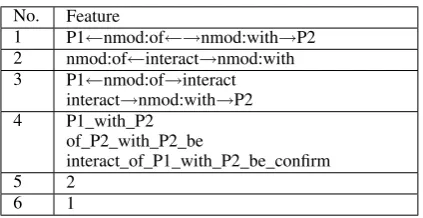
Logistic regression (LR) model is used for all our proposed methods in the experiments. An exam-ple sentence with relevant dependency relations and its extracted features are shown in Fig. 1 and Table 3. E-walk and v-walk features are hedge,
[image:4.595.311.521.141.183.2]stem, edgeiandhstem, edge, stemitriples includ-ing the direction extracted from the shortest de-pendency path. They preserve partial structure in-formation and are more generalizable than the full dependency path.
Figure 1: Example sentence for feature extraction.
No. Feature
1 P1←nmod:of←→nmod:with→P2 2 nmod:of←interact→nmod:with 3 P1←nmod:of→interact
interact→nmod:with→P2 4 P1_with_P2
of_P2_with_P2_be
interact_of_P1_with_P2_be_confirm
5 2
6 1
Table 3: Features extracted from the example sen-tence. P1 and P2 represent the two protein men-tions. 1: unlexicalized shortest dependency path; 2: e-walk features; 3: v-walks features; 4: three stem sequences, 5: number of edges on the short-est dependency path; 6: number of stems on the first stem sequence.
For all the lexical terms, we use their stems pro-duced by Porter’s stemmer (Porter,1980). Char-niak parser (Charniak, 2000;Charniak and John-son,2005) with the biomedical model (Mcclosky,
2010) is used to produce constituency parse for each sentence, which is converted to collapsed dependency parse using Stanford CoreNLP con-verter (Manning et al., 2014) with CCprocessed setting. We remove features that only appear once in the whole training set.
4.2 Baselines
[image:4.595.307.519.228.337.2]for the three tasks, we only report the results for
k = 5 to save space. Note that since different features, text corpus and named entity recognition tool are used, we are not trying to reproduce the exact results reported inZheng and Blake(2015). In addition, we implement a widely-used multi-instance model described inSurdeanu et al.(2012) and train it on unfiltered distantly labeled data.
4.3 Proposed Heuristics
We propose three novel filtering methods to re-move noise from both positively and negatively-labeled data. These methods are applied in a se-quential manner so that each step removes more noise based on the filtered data from the previous step.
The first heuristic is concerned with multiple mentions of an entity in a sentence. If the entity is related to another entity mentioned in the sen-tence, all the binary combinations of their men-tions will be labeled as positive by the default labeling process. This usually introduces noise, since not all combinations are likely to be in the relation. For example, consider the sentence be-low.
Overexpression of miR-193b inhibited the ex-pression ofCCND1, and knock-down ofCCND1 inhibited the proliferation of GC cells, suggesting thatmiR-193bexerted its anti-tumorigenic role in GC cells through targetingCCND1gene.
miR-193b regulates CCND1 according to the database TarBase. The six binary combinations between miR-193b and CCND1 in the sentence will be labeled as positive instances. However, the sentence only expresses miRNA-gene regulation relation for the first and the last combination. The other four are wrongly labeled and hence consti-tute noise in the positively-labeled data.
To remove such noise, we hypothesize that only the closest pair of the entity mentions express the relation. The closest pair is defined as follow-ing: for a positively-labeled entity mention pair he1, e2i, if their shortest dependency path has the smallest length among all the positively-labeled instances that involve either e1 or e2, the pair he1, e2iis considered as a closest pair. When com-puting the dependency path length, we skip the ap-posrelation. The heuristic is described as below.
Heuristic of closest pairs (CP): remove positively-labeled instances that are not closest pair, when multiple mentions of one or both
en-tities are present in the sentence.
For the three tasks and many other biomedical text-mining tasks, the relation or event is often in-dicated by a small set of trigger words (e.g., inter-act/bind for PPI, regulate/target for MIRGENE, andlocalize/translocatefor PLOC). Following the usage in the BioNLP Genia corpus, we can term these words as trigger words. With knowledge of a comprehensive set of trigger words, we can hy-pothesize that sentences without a trigger word are less likely to express the target relation or event. We propose to automatically mine such trigger words from the large distantly-labeled corpus, and use them to remove noise from the positively-labeled data.
Trigger words are usually verbs, or in their nom-inal or adjectival form. Our target is then to iden-tify stems of verb triggers, which can also be used to match nominal or adjectival form of the verb. A simple procedure is used: first, count all the verb stems on the shortest dependency paths of the positively-labeled instances generated by the heuristic labeling process. As we want to choose triggers that are strongly associated with the re-lation, we only use dependency paths that con-tain one token, excluding the two entity mentions. These verb stems are then sorted by frequency and the high-frequency stems are chosen for the trig-ger list. We list the top 10 verb stems for the three tasks in Table 4.
For each positively-labeled instance, we search for trigger stems in the tokens on its shortest dependency path or in the maximum dominat-ing noun phrase. A maximum dominatdominat-ing noun phrase is defined as the maximally-spanning noun phrase that encloses the two entity mentions, with only noun or prepositional phrases as descendants. For example, in the text fragment "interaction be-tween FAK and PP1 regulates a process", the maximum dominating noun phrase is "interaction betweenFAKwithPP1" for this protein mention pair. As sentences without a trigger word are less likely to express the target relation or event, we use the heuristic described below to remove noise. Heuristic of trigger word (TW): remove positively-labeled instances if a trigger stem is not found on the shortest dependency path or in the maximum dominating noun phrase of the entity mention pair.
Task Verb stems Pattern and example sentence PPI interact, bind, associ, phosphoryl, re-cruit, activ, coloc, coimmunoprecipit,
co-immunoprecipit, regul
PROTEIN1←nsubj←interact→nmod:with→PROTEIN2 mGrb10interacts withNedd4.
[image:6.595.73.525.60.148.2]MIRGENE target, regul, inhibit, downregul, suppress,repress, down-regul, correl, induc, promot GENE←dobj←target←advcl←root→nsubj→MIRNAMiR-429play its role in PDAC by targetingTBK1. PLOC local, transloc, express, associ, interact, de-tect, coloc, find, co-loc, target PROTEIN←nmod:of←transloc→amod→LOCATIONImportin beta mediatesnucleartranslocation ofSmad 3.
Table 4: The top 10 verb stems and top pattern and example sentence for the three tasks.
data. Using heuristic CP+TW with 50 trigger stems, 65% of the positively-labeled data can be removed for PPI. For MIRGENE and PLOC, the removal ratio is 38% and 59%, respectively. We hypothesize that the remaining set will still con-tain a large amount of data for training and more importantly, it will be of high quality, and thus it would be possible to discover high-confidence pat-terns from it using pattern occurrence frequency.
Finally, we turn to the last heuristic that we introduce. Recall noisy instances in negatively-labeled data should be negatively-labeled as positive but are negatively labeled because of incompleteness of the database used for distant supervision. We try to mine some high-confidence patterns from the purified positively-labeled set after the application of heuristic CP and TW. We define a pattern as a shortest dependency path lexicalized by a trigger stem between the entity mention pair. The pattern frequencies in the positively-labeled data filtered by heuristic CP and TW are counted. The most frequent pattern and an example sentence for each task are shown in Table 4.
Our hypothesis is that any entity mention pair connected by a high-confidence pattern is likely to be related and hence probably constitute noise in the negatively-labeled data. Therefore, we con-sider the next heuristic described below.
Heuristic of high-confidence patterns (HP): remove negatively-labeled instances which match a high-confidence pattern mined from positively-labeled data.
Note that heuristic DPFreq, CP and TW re-move instances from the positively-labeled data, whereas HP is the only heuristic that removes in-stances from the negatively-labeled data. Heuris-tic TW depends on the number of trigger stems, while heuristic HP depends on both the number of trigger stems and high-confidence patterns, as it needs the trigger stems to lexicalize the shortest dependency path to form a pattern.
5 Results and Discussions
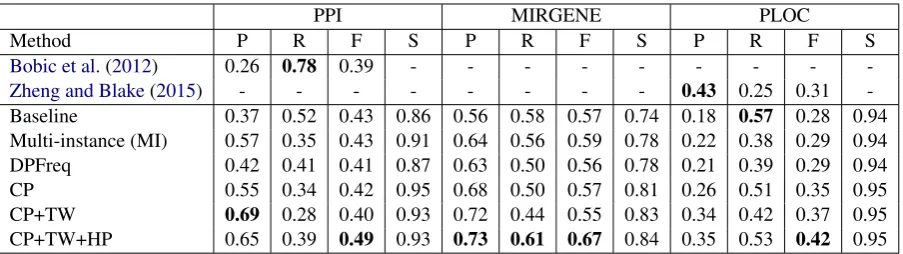
We use precision, recall and F-score to evaluate the baselines and proposed methods. The top 50 trigger stems were used in heuristic TW, while the top 50 trigger stems and the top 100 patterns were used in heuristic HP. The results are presented in Table 5. Specificity is also presented. We will dis-cuss how different numbers of trigger stems and patterns may affect the results later.
Table 5 shows that the multi-instance model and the use of heuristic DPFreq or CP increased precision compared to the baseline for all the three tasks, indicating that they can effectively re-move noise from the positively-labeled data. Us-ing heuristic CP+TW further improved precisions over heuristic CP for the three tasks. However, us-ing heuristic DPFreq, CP or CP+TW did not im-prove the F-score over the baseline for PPI and MIRGENE, due the decreased recall. By remov-ing noise from the negatively-labeled data usremov-ing heuristic HP in addition to CP and TW, the re-calls can be improved with minor or no decrease in precision, resulting in higher F-scores than the baseline, the MI model and other heuristics for all the three tasks. This suggests that the pro-posed heuristics can effectively remove noise from both positively and negatively-labeled data, and to obtain better F-scores, it is important to filter both positive and negative set to improve preci-sion and recall simultaneously. Although PLOC extraction did not obtain a good precision in all the experiments, we will show that high precision can be achieved for high-confidence PLOC extraction later in this section.
By applying heuristic CP+TW+HP, the F-score can be improved by 10 points for PPI extraction compared toBobic et al.(2012), and 11 points for PLOC extraction compared to Zheng and Blake
(2015).
PPI MIRGENE PLOC
Method P R F S P R F S P R F S
Bobic et al.(2012) 0.26 0.78 0.39 - - -
[image:7.595.73.525.61.188.2]-Zheng and Blake(2015) - - - 0.43 0.25 0.31 -Baseline 0.37 0.52 0.43 0.86 0.56 0.58 0.57 0.74 0.18 0.57 0.28 0.94 Multi-instance (MI) 0.57 0.35 0.43 0.91 0.64 0.56 0.59 0.78 0.22 0.38 0.29 0.94 DPFreq 0.42 0.41 0.41 0.87 0.63 0.50 0.56 0.78 0.21 0.39 0.29 0.94 CP 0.55 0.34 0.42 0.95 0.68 0.50 0.57 0.81 0.26 0.51 0.35 0.95 CP+TW 0.69 0.28 0.40 0.93 0.72 0.44 0.55 0.83 0.34 0.42 0.37 0.95 CP+TW+HP 0.65 0.39 0.49 0.93 0.73 0.61 0.67 0.84 0.35 0.53 0.42 0.95
Table 5: Precision, recall, F-score and specificity of all the methods for three extraction tasks.
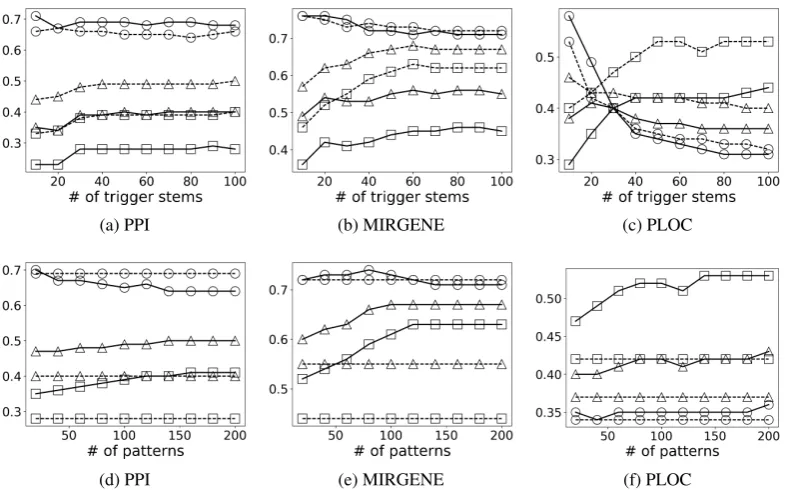
the performance for the three tasks. In Fig. 2 (a)-(c), precisions, recalls and F-scores are shown for applying heuristic CP+TW and CP+TW+HP (using top 100 patterns) with different numbers of trigger stems. PPI and MIRGENE extraction maintained a stable precision with increasing re-call when the number of trigger stem increased. For PLOC extraction precision decreased with in-creased recall when more trigger stems were used, indicating that the quality of the trigger stems can be improved. Using 100 patterns to remove noise resulted in much better recalls and F-scores for all the three tasks across different numbers of trig-ger stems, further confirming that heuristic HP is an effective method to remove noise from the negatively-labeled data.
Different numbers of patterns: we investi-gated how different numbers of patterns used by heuristic HP affect the results. In Fig. 2 (d)-(f), precisions, recalls and F-scores are shown for ap-plying CP+TW+HP (using top 50 trigger stems) with different number of patterns. The perfor-mances using heuristic CP+TW with 50 trigger stems are included for comparison. We can see that recalls can be consistently improved when more patterns were used, with minor or no de-crease in precision. Compared to the results only using heuristic CP+TW, even using small number of patterns can achieve better performance.
A major use case of biomedical relation ex-traction is to help identify high-confidence entity pairs to facilitate manual curation for databases. Thus, a desired property of a relation extractor is to achieve high precision for such high-confidence extractions. Logistic regression model outputs a probability for each test instance, and high proba-bility indicates high confidence to be positive.
To investigate the performance of the proposed methods for the high-confidence extractions, we
draw precision-recall curves using the probability produced by the logistic regression model. By def-inition, logistic regression model predicts an in-stance as positive if the probability is greater than 0.5. By varying the threshold, we can calculate precisions at different recall levels. For example, when the threshold is set to 0.9, the model only predicts an instance with probability greater than 0.9 as positive. Ideally the model should achieve better precision when the threshold is high.
For each task, six curves are drawn in Fig. 3. We can see that using heuristic CP+TW+HP ob-tained higher precisions than the baselines and other heuristics on the left side of the figures, which correspond to the performance for high-confidence extractions. The multi-instance model also obtained better precisions compared to the baseline at lower recall levels. Specifically, by using heuristic CP+TW+HP, PPI, MIRGENE and PLOC extraction can achieve the highest preci-sions among the six curves, which are 0.71, 0.95 and 0.77, respectively, at recall level 0.30.
6 Conclusion
In this paper, we proposed three novel heuristics that use lexical and syntactic information to re-move noise from labeled data generated by dis-tant supervision. Experiments showed that the proposed methods achieved significantly higher F-scores than the baseline and previous works for the three tasks, and high precision can be obtained for high-confidence results. For future work, we plan to improve the trigger stem list by asking cu-rators to remove non-informative stems. Aggre-gating evidences from all the sentences for entity pair level extraction or incorporating direct super-vision (Wallace et al.,2016) are two interesting di-rections.
(a) PPI (b) MIRGENE (c) PLOC
[image:8.595.103.496.59.304.2](d) PPI (e) MIRGENE (f) PLOC
Figure 2: Results of using different numbers of trigger stems (a)-(c) and patterns (d)-(f). Markers: precision (circle), recall (square), F-score (triangle). (a)-(c): CP+TW (solid) and CP+TW+HP (dashed). (d)-(f): CP+TW (dashed) and CP+TW+HP (solid).
(a) PPI (b) MIRGENE (c) PLOC
Figure 3: Precision-recall curves for the three tasks. Y-axis represents precision and X-axis represents recall. Markers: baseline (+), multi-instance (diamond), DPFreq (x), CP (square), CP+TW using 50 trigger stems (triangle), CP+TW+HP using 50 trigger stems and 100 patterns (circle).
of this paper are available at http://biotm. cis.udel.edu/biotm/projects/ds.
Acknowledgments
Research reported in this manuscript was sup-ported by the National Institutes of Health un-der the Grant No. U01GM120953. The funun-ders had no role in study design, data collection and analysis, decision to publish, or preparation of the manuscript.
References
Antti Airola, Sampo Pyysalo, Jari Björne, Tapio Pahikkala, Filip Ginter, and Tapio Salakoski. 2008.
All-paths graph kernel for protein-protein
inter-action extrinter-action with evaluation of cross-corpus learning. BMC Bioinformatics 9 Suppl 11:S2.
https://doi.org/10.1186/1471-2105-9-S11-S2.
Cecilia N Arighi, Cathy H Wu, Kevin B Co-hen, Lynette Hirschman, Martin Krallinger, Alfonso Valencia, Zhiyong Lu, John W Wilbur, and Thomas C Wiegers. 2014.
BioCreative-IV virtual issue. Database 2014.
https://doi.org/10.1093/database/bau039.
Shweta Bagewadi, Tamara Bobi´c, Martin Hofmann-Apitius, Juliane Fluck, and Roman Klinger. 2014. Detecting miRNA mentions and rela-tions in biomedical literature. F1000Res. 3.
https://doi.org/10.12688/f1000research.4591.3.
[image:8.595.106.496.368.470.2]and Semi-Supervised Learning in NLP, Associa-tion for ComputaAssocia-tional Linguistics, chapter Im-proving Distantly Supervised Extraction of Drug-Drug and Protein-Protein Interactions, pages 35–43.
http://aclweb.org/anthology/W12-0705.
Razvan Bunescu, Ruifang Ge, Rohit J Kate, Edward M Marcotte, Raymond J Mooney, Arun K Ramani, and Yuk Wah Wong. 2005. Comparative experiments on learning information extractors for proteins and their interactions. Artif. Intell. Med.33(2):139–155.
https://doi.org/10.1016/j.artmed.2004.07.016.
Eugene Charniak. 2000.A maximum-entropy-inspired parser. In1st Meeting of the North American Chap-ter of the Association for Computational Linguistics.
http://aclweb.org/anthology/A00-2018.
Eugene Charniak and Mark Johnson. 2005. Coarse-to-fine n-best parsing and MaxEnt discriminative reranking. InProceedings of the 43rd Annual
Meet-ing on Association for Computational LMeet-inguistics.
Association for Computational Linguistics, Strouds-burg, PA, USA, volume 1 ofACL ’05, pages 173– 180. http://aclweb.org/anthology/P05-1022.
M Craven and J Kumlien. 1999. Constructing biologi-cal knowledge bases by extracting information from text sources. Proc. Int. Conf. Intell. Syst. Mol. Biol.
pages 77–86.
Raphael Hoffmann, Congle Zhang, Xiao Ling, Luke Zettlemoyer, and S. Daniel Weld. 2011.
Knowledge-based weak supervision for infor-mation extraction of overlapping relations. In
Proceedings of the 49th Annual Meeting of the Association for Computational Linguistics:
Human Language Technologies. Association
for Computational Linguistics, pages 541–550.
http://aclweb.org/anthology/P11-1055.
Sheng-Da Hsu, Ting Tseng, Sirjana Shrestha, Yu-Ling Lin, Anas Khaleel, Chih-Hung Chou, Chao-Fang Chu, Hsi-Yuan Huang, Ching-Min Lin, Shu-Yi Ho, Ting-Yan Jian, Feng-Mao Lin, Tzu-Hao Chang, Shun-Long Weng, Kuang-Wen Liao, I-En Liao, Chun-Chi Liu, and Hsien-Da Huang. 2014.
miRTarBase update 2014: an information resource for experimentally validated miRNA-target interac-tions. Nucleic Acids Res.42(Database issue):D78– 85.https://doi.org/10.1093/nar/gkt1266.
Ander Intxaurrondo, Mihai Surdeanu, Oier Lopez de Lacalle, and Eneko Agirre. 2013. Removing noisy mentions for distant supervision.
Proce-samiento del Lenguaje Natural51(0):41–48.
Jin-Dong Kim, Ngan Nguyen, Yue Wang, Jun’ichi Tsujii, Toshihisa Takagi, and Akinori Yonezawa. 2012. The genia event and protein corefer-ence tasks of the BioNLP shared task 2011.
BMC Bioinformatics 13 Suppl 1(Suppl 11):S1.
https://doi.org/10.1186/1471-2105-13-S11-S1.
Jin-Dong Kim, Yue Wang, and Yamamoto Yasunori. 2013. Proceedings of the BioNLP Shared Task
2013 Workshop, Association for Computational
Linguistics, chapter The Genia Event Extraction Shared Task, 2013 Edition - Overview, pages 8–15.
http://aclweb.org/anthology/W13-2002.
Andre Lamurias, Luka A Clarke, and Francisco M Couto. 2017. Extracting microRNA-gene re-lations from biomedical literature using dis-tant supervision. PLoS One 12(3):e0171929.
https://doi.org/10.1371/journal.pone.0171929. Gang Li, Karen E Ross, Cecilia N Arighi, Yifan Peng,
Cathy H Wu, and K Vijay-Shanker. 2015. miR-Tex: A text mining system for miRNA-Gene relation extraction. PLoS Comput. Biol. 11(9):e1004391.
https://doi.org/10.1371/journal.pcbi.1004391. Christopher Manning, Mihai Surdeanu, John Bauer,
Jenny Finkel, Steven Bethard, and David Mc-Closky. 2014. The stanford corenlp natural lan-guage processing toolkit. In Proceedings of 52nd Annual Meeting of the Association for Computa-tional Linguistics: System Demonstrations. Associ-ation for ComputAssoci-ational Linguistics, pages 55–60.
https://doi.org/10.3115/v1/P14-5010.
David Mcclosky. 2010. Any Domain Parsing: Au-tomatic Domain Adaptation for Natural Language
Parsing. Ph.D. thesis, Brown University,
Provi-dence, RI, USA.
Mike Mintz, Steven Bills, Rion Snow, and Daniel Ju-rafsky. 2009. Distant supervision for relation ex-traction without labeled data. InProceedings of the Joint Conference of the 47th Annual Meeting of the ACL and the 4th International Joint Conference on
Natural Language Processing of the AFNLP.
Asso-ciation for Computational Linguistics, pages 1003– 1011.http://aclweb.org/anthology/P09-1113. Makoto Miwa, Rune Saetre, Yusuke Miyao, and
Jun’ichi Tsujii. 2009. Protein-protein interac-tion extracinterac-tion by leveraging multiple kernels and parsers. Int. J. Med. Inform. 78(12):e39–46.
https://doi.org/10.1016/j.ijmedinf.2009.04.010. Sandra Orchard, Mais Ammari, Bruno Aranda,
Li-onel Breuza, Leonardo Briganti, Fiona Broackes-Carter, Nancy H Campbell, Gayatri Chavali, Carol Chen, Noemi del Toro, Margaret Dues-bury, Marine Dumousseau, Eugenia Galeota, Ur-sula Hinz, Marta Iannuccelli, Sruthi Jagannathan, Rafael Jimenez, Jyoti Khadake, Astrid Lagreid, Luana Licata, Ruth C Lovering, Birgit Mel-dal, Anna N Melidoni, Mila Milagros, Daniele Peluso, Livia Perfetto, Pablo Porras, Arathi Raghu-nath, Sylvie Ricard-Blum, Bernd Roechert, An-dre Stutz, Michael Tognolli, Kim van Roey, Gi-anni Cesareni, and Henning Hermjakob. 2014.
The MIntAct project–IntAct as a common cura-tion platform for 11 molecular interaccura-tion databases.
Nucleic Acids Res. 42(Database issue):D358–63.
Yifan Peng, Cecilia Arighi, Cathy H Wu, and K Vijay-Shanker. 2016. BioC-compatible full-text pas-sage detection for protein-protein interactions us-ing extended dependency graph. Database 2016.
https://doi.org/10.1093/database/baw072.
M F Porter. 1980. An algorithm for suffix stripping.
Programmirovanie14(3):130–137.
Sebastian Riedel, Limin Yao, and Andrew McCallum. 2010.Modeling Relations and Their Mentions with-out Labeled Text, Springer Berlin Heidelberg, vol-ume 6323 of Lecture Notes in Computer Science, page 148–163. https://doi.org/10.1007/978-3-642-15939-8_10.
Roland Roller, Eneko Agirre, Aitor Soroa, and Mark Stevenson. 2015. Improving distant su-pervision using inference learning. In Proceed-ings of the 53rd Annual Meeting of the Associa-tion for ComputaAssocia-tional Linguistics and the 7th In-ternational Joint Conference on Natural Language
Processing (Volume 2: Short Papers).
Associa-tion for ComputaAssocia-tional Linguistics, pages 273–278.
https://doi.org/10.3115/v1/P15-2045.
Roland Roller and Mark Stevenson. 2015.Proceedings
of BioNLP 15, Association for Computational
Lin-guistics, chapter Making the most of limited train-ing data ustrain-ing distant supervision, pages 12–20.
https://doi.org/10.18653/v1/W15-3802.
Benjamin Roth, Tassilo Barth, Michael Wiegand, and Dietrich Klakow. 2013. A survey of noise re-duction methods for distant supervision. In Pro-ceedings of the 2013 workshop on Automated
knowledge base construction. ACM, pages 73–78.
https://doi.org/10.1145/2509558.2509571.
Isabel Segura-Bedmar, Paloma Martınez, and Marıa Herrero-Zazo. 2013. Semeval-2013 task 9: Extrac-tion of drug-drug interacExtrac-tions from biomedical texts (ddiextraction 2013). Proceedings of Semevalpages 341–350.
Ayush Singhal, Michael Simmons, and Zhiy-ong Lu. 2016. Text mining Genotype-Phenotype relationships from biomedical lit-erature for database curation and precision medicine. PLoS Comput. Biol. 12(11):e1005017.
https://doi.org/10.1371/journal.pcbi.1005017.
Mihai Surdeanu, Julie Tibshirani, Ramesh Nallapati, and D. Christopher Manning. 2012. Multi-instance multi-label learning for relation extraction. In Pro-ceedings of the 2012 Joint Conference on Empiri-cal Methods in Natural Language Processing and
Computational Natural Language Learning.
Associ-ation for ComputAssoci-ational Linguistics, pages 455–465.
http://aclweb.org/anthology/D12-1042.
Shingo Takamatsu, Issei Sato, and Hiroshi Nakagawa. 2012. Reducing wrong labels in distant supervi-sion for relation extraction. In Proceedings of the
50th Annual Meeting of the Association for
Compu-tational Linguistics (Volume 1: Long Papers).
As-sociation for Computational Linguistics, pages 721– 729. http://aclweb.org/anthology/P12-1076. Philippe Thomas, Illès Solt, Roman Klinger, and Ulf
Leser. 2011. Proceedings of Workshop on Robust Unsupervised and Semisupervised Methods in
Natu-ral Language Processing, Association for
Computa-tional Linguistics, chapter Learning Protein Protein Interaction Extraction using Distant Supervision, pages 25–32. http://aclweb.org/anthology/W11-3904.
UniProt Consortium. 2014. Activities at the universal protein resource (UniProt).
Nu-cleic Acids Res. 42(Database issue):D191–8.
https://doi.org/10.1093/nar/gkt1140.
Ioannis S Vlachos, Maria D Paraskevopoulou, Dimitra Karagkouni, Georgios Georgakilas, Thana-sis Vergoulis, Ilias Kanellos, Ioannis-Laertis Anastasopoulos, Sofia Maniou, Konstantina Karathanou, Despina Kalfakakou, Athanasios Fevgas, Theodore Dalamagas, and Artemis G Hatzi-georgiou. 2014. DIANA-TarBase v7.0: indexing more than half a million experimentally supported miRNA:mRNA interactions. Nucleic Acids Res. https://doi.org/10.1093/nar/gku1215.
Byron C Wallace, Joël Kuiper, Aakash Sharma, Mingxi Brian Zhu, and Iain J Marshall. 2016. Ex-tracting PICO sentences from clinical trial reports using supervised distant supervision. J. Mach. Learn. Res.17.
Chih-Hsuan Wei, Hung-Yu Kao, and Zhiyong Lu. 2015a. GNormPlus: An integrative approach for tagging genes, gene families, and pro-tein domains. Biomed Res. Int. 2015:918710.
https://doi.org/10.1155/2015/918710.
Chih-Hsuan Wei, Yifan Peng, Robert Leaman, Al-lan Peter Davis, Carolyn J Mattingly, Jiao Li, Thomas C Wiegers, and Zhiyong Lu. 2015b. Overview of the BioCreative V chemical disease relation (CDR) task. In Proceedings of the fifth
BioCreative challenge evaluation workshop. pages
154–166.
Wei Xu, Raphael Hoffmann, Le Zhao, and Ralph Gr-ishman. 2013. Filling knowledge base gaps for dis-tant supervision of relation extraction. In Proceed-ings of the 51st Annual Meeting of the Associa-tion for ComputaAssocia-tional Linguistics (Volume 2: Short Papers). Association for Computational Linguistics, pages 665–670. http://aclweb.org/anthology/P13-2117.