Proceedings of NAACL-HLT 2018, pages 185–195
Natural Answer Generation with Heterogeneous Memory
Yao Fu and Yansong Feng
Institute of Computer Science and Technology, Peking University The MOE Key Laboratory of Computational Linguistics, Peking University
{francis_yao,fengyansong}@pku.edu.cn
Abstract
Memory augmented encoder-decoder frame-work has achieved promising progress for nat-ural language generation tasks. Such frame-works enable a decoder to retrieve from a memory during generation. However, less re-search has been done to take care of the mem-ory contents from different sources, which are often of heterogeneous formats. In this work, we propose a novel attention mechanism to en-courage the decoder to actively interact with the memory by taking its heterogeneity into account. Our solution attends across the gen-erated history and memory to explicitly avoid repetition, and introduce related knowledge to enrich our generated sentences. Experiments on the answer sentence generation task show that our method can effectively explore het-erogeneous memory to produce readable and meaningful answer sentences while maintain-ing high coverage for given answer informa-tion.
1 Introduction
Most previous question answering systems fo-cus on finding candidate words, phrases or sen-tence snippets from many resources, and ranking them for their users (Chu-Carroll et al.,2004;Xu et al.,2016). Typically, candidate answers are col-lected from different resources, such as knowledge base (KB) or textual documents, which are often with heterogeneous formats, e.g., KB triples or semi-structured results from Information Extrac-tion (IE). For factoid quesExtrac-tions, a single answer word or phrase is chosen as the response for users, as shown in Table1(A1).
However, in many real-world scenarios, users may prefer more natural responses rather than a single word. For example, as A2 in Table1,James Cameron directed the Titanic. is more favorable than the single nameJames Cameron. A straight-forward solution to compose an answer sentence is to build a template based model, where the answer
Q Who is the director of the Titanic? A1 James Cameron
A2 James Camerondirectedthe Titanic. A3 James Camerondirectedit.
A4 James Camerondirected it in1999. Table 1: Answer sentences generated by different QA systems
wordJames Cameronand topic word in the ques-tion the Titanic are filled into a pre-defined tem-plate (Chu-Carroll et al.,2004). But such systems intrinsically lack variety, hence hard to generalize to new domains.
To produce more natural answer sentences,
Yin et al. (2015) proposed GenQA, an encoder-decoder based model to select candidate answers from a KB styled memory during decoding to gen-erate an answer sentence. CoreQA (He et al.,
2017b) further extended GenQA with a copy mechanism to learn to copy words from the ques-tion. The application of attention mechanism en-ables those attempts to successfully learn sentence varieties from the memory and training data, such as usage of pronouns (A3 in Table1). However, since they are within the encoder-decoder frame-work, they also encounter the well noticed rep-etition issue: due to loss of temporary decoder state, an RNN based decoder may repeat what has already been said during generation (Tu et al.,
2016a,b).
Both GenQA and CoreQA are designed to work with a structured KB as the memory, while in most real-world scenarios, we require knowledge from different resources, hence of different for-mats. This knowledge may come from structured KBs, documents, or even tables. It is admittedly challenging to leverage a heterogeneous memory in a neural generation framework, and it is not well studied in previous works (Miller et al., 2016). Here in our case, the memory should contain two main formats: KB triples and semi-structured
tities from IE, forming a heterogeneous memory (HM). The former is usually organized in is a subject-predicate-object form, while, the latter is usually extracted from textual documents, in the form of keywords, sometimes associated with cer-tain categories or tags oriented to specific tasks (Bordes and Weston,2016).
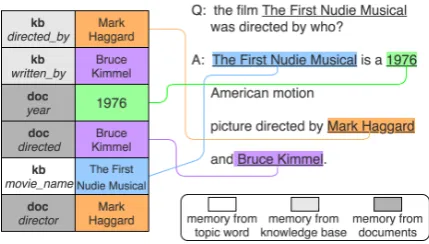
Miller et al.(2016) discuss different knowledge representations for a simple factoid QA task and show that classic structured KBs organized in a Key-Value Memory style work the best. However, dealing with heterogeneous memory is not trivial. Figure1shows an example of generating answer sentences from HM in a Key-Value style, which is indeed more challenging than only using a classic KB memory. Keys and values play different roles during decoding. Adirectorkey indicates this slot contains the answer. Same James Cameron val-ues with different keys indicate duplication. The decoder needs this information to proactively per-form memory addressing. Because keys from doc-uments are not canonicalized, e.g., doc directed and doc director, they may lead to redundancy with the structured KB, e.g., kb directed_by and doc director. A decoder could repetitively output a director twice simply because there are two dif-ferent memory slots hit by the query, both indi-cating the same director. This will make the the repetition issue even worse.
Although many neural generation systems can produce coherent answer sentences, they often fo-cus on how to guarantee the chosen answer words to appear in the output, while ignoring many re-lated or meaningful background information in the memory that can further improve user experiences. In real-world applications like chatbots or personal assistants, users may want to know not only the exact answer word, but also information related to the answers or the questions. This informa-tion is potentially helpful to attract users’ atten-tion, and make the output sentences more natural. For example in Table 1 (A4), the extra 1999not only enriches the answer with the movie’s release year, but also can act as a clue to help distinguish ambiguous candidate answers, e.g.,Titanic (1999) andTitanic (HD, 2016).
In this paper, we propose a sequence to se-quence model tailing for heterogeneous memory. In order to bridge the gap between decoder states and memory heterogeneity, we split decoder states into separate vectors, which can be used to address
Figure 1: An example qa-pair with heterogeneous memory
different memory components explicitly. To avoid redundancy, we propose the Cumulative Atten-tionmechanism, which uses the context of the de-coder history to address the memory, thus reduces repetition at memory addressing time. We conduct experiments on two WikiMovies datasets, and experimental results show that our model is able to generate natural answer sentences composed of extra related facts about the question.
2 Related Work
Natural Answer Generation with Sequence to Sequence Learning: Sequence to sequence mod-els (with attention) have achieved successful re-sults in many NLP tasks (Cho et al., 2014; Bah-danau et al.,2014;Vinyals et al.,2015;See et al.,
2017). Memory is an effective way to equip seq2seq systems with external information ( We-ston et al., 2014;Sukhbaatar et al., 2015;Miller et al., 2016; Kumar et al., 2015). GenQA (Yin et al., 2015) applies a seq2seq model to gener-ate natural answer sentences from a knowledge base, and CoreQA (He et al., 2017b) extends it with copying mechanism (Gu et al., 2016). But they do not consider the heterogeneity of the mem-ory, only tackle questions with one single answer word, and do not study information enrichment. Memory and Attention: There are also increas-ing works focusincreas-ing on different memory repre-sentations and the interaction between the de-coder and memory, i.e., attention. Miller et al.
(2016) propose the Key-Value style memory to ex-plore textual knowledge (both structured and un-structured) from different sources, but they still utilize them separately, without a uniform ad-dressing and attention mechanism. Daniluk et al.
[image:2.595.307.522.62.184.2]performance. Multiple variants of attention mech-anism have also been studied. Sukhbaatar et al.
(2015) introduce multi-hop attention, and extend it to convolutional sequence to sequence learn-ing (Gehring et al., 2017). Kumar et al. (2015) further extend it by using a Gated Recurrent Unit (Chung et al.,2014) between hops. These models show that multiple hops may increase the model’s ability to reason. These multi-hop attention is performed within a single homogeneous memory. Our Cumulative Attention is inspired by them, but we utilize it cross different memory, hence can ex-plicitly reason over different memory components. Conditional Sentence Generation: Controllable sentence generation with external information is wildly studied from different views. From the task perspective,Fan et al.(2017) utilize label informa-tion for generainforma-tion, and tackle informainforma-tion cover-age in a summarization task.He et al.(2017a) use recursive Network to represent knowledge base, and Bordes and Weston (2016) track generation states and provide information enrichment, both are in a dialog setting. In terms of network ar-chitecture,Wen et al.(2015) equip LSTM with a semantic control cell to improve informativeness of generated sentence. Kiddon et al.(2016) pro-pose the neural checklist model to explicitly track what has been mentioned and what left to say by splitting these two into different lists. Our model is related to these models with respect to information representation and challenges from coverage and redundancy. The most closely related one is the checklist model. But it does not explicitly study information redundancy. Also, the information we track is heterogeneous, and we track it in a differ-ent way, i.e. using Cumulative attdiffer-ention.
Due to loss of states across time steps, the de-coder may generate duplicate outputs. Attempts have been made to address this problem. Some ar-chitectures try to utilize History attention records.
See et al. (2017) introduce a coverage mecha-nism, and Paulus et al. (2017) use history atten-tion weights to normalize new attenatten-tion. Others are featured in network modules. Suzuki and Na-gata(2017) estimate the frequency of target words and record the occurrence. Our model shows that simply attending to history decoder states can re-duce redundancy. Then we use the context vector of attention to history decoder states to perform attention to the memory. Doing this enables the decoder to correctly decide what to say at
mem-ory addressing time, rather than decoding time, thus increasing answer coverage and information enrichment.
3 Task Definition
Given a question q and a memory M storing re-lated information, our task is to retrieve all the an-swer words from the memory, generate an anan-swer sentencex, and use the rest information as enrich-ment.
Answer Coverage is the primary objective of our task. Since many answers contain multiple words, the system needs to cover all the target words.
Information Redundancyis one challenge for this task. It is well noticed that the decoder lan-guage model may lose track of its state, thus re-peating itself. Also, the decoder needs to rea-son over the semantic gap between heterogeneous memory slots, figuring out different keys may re-fer to the same value. These two kinds of redun-dancy should both be addressed.
Information Enrichmentis another challenge. It requires the decoder to interact with the mem-ory effectively and use the right word to enrich the answer.
The tradeoff between redundancy and cov-erage/enrichmentis one of our main considera-tions. This is because when the decoder generates a word, it either generates a new word or a men-tioned word. The more answer words and infor-mation enrichment are considered, the more likely the model repeats what it has already generated.
4 Our Model
Our model consists of the question encoder, the heterogeneous memory, and the decoder. The en-coder embeds the question into a vector represen-tation. The decoder reads questions, retrieves the memory, and generates answer sentences.
We use a Long Short Term Memory (LSTM) (Hochreiter and Schmidhuber,1997) for question encoding and encode the question into an embed-ding. It takes every word embedding (q1, q2...qn)
of question words as inputs, and generates hidden statesst =LST Menc(qt, st−1). Thesesare later
used for decoder’s attention. The last hidden state snis used as the vector representation of the
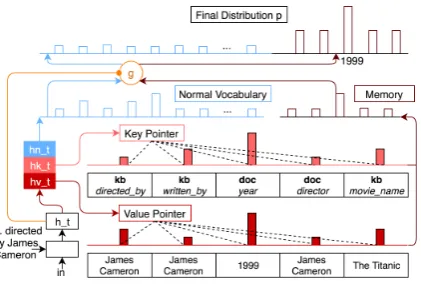
Figure 2: The Decoder with Heterogeneous States
We use a key-value memory M to represent the information heterogeneity. In our experiments, we study information from KB, topic words, and words extracted from documents. The memory is formatted as ((m⟨0K⟩, m⟨0V⟩), (m⟨1K⟩, m⟨1V⟩) ... (m⟨nK⟩, m⟨nV⟩)), wherem⟨iK⟩andm⟨iV⟩are
respec-tively the key embedding and word embedding for the i-th memory slot. The vocabulary for keys Vkey consists of all predicates in the KB, and all tags we use to classify the value words (e.g: di-rector, actor, or release_year). The vocabulary for values Vval consists all related words from web
documents, subjects and objects from the KB. This memory is later used in two ways: 1. the decoder uses its previous hidden state to perform atten-tion and generate context vectors. 2. the decoder uses the updated hidden states as pointers (Vinyals et al.,2015) to retrieve the memory and copy the memory contents into the decoder’s output.
4.1 Decoder with Heterogeneous States As in the standard encoder-decoder architecture with attention, the word embedding of the de-coder’s previous time step xt and context vector
ctis fed as the input of the next time step, and the
hidden statehtis updated then. The initial hidden
state is the question embedding concatenated with average memory key and value:
ht=LST Mdec(xt, ct, ht−1)
h0 = [sn, avg(m⟨K⟩), avg(m⟨V⟩)]
where[·,·]denotes concatenation.
As shown in figure 2, to match the key-value memory representation, we use three linear trans-formations to convert the decoder’s currenthtinto
ht⟨N⟩,ht⟨K⟩, andh⟨tV⟩:
h⟨tN⟩ =Wnht
h⟨tK⟩ =Wkht
h⟨tV⟩ =Wvht
where the Ws are initialized as identity matrix I =diag(1,1...1). h⟨tN⟩ will be projected to nor-mal word vocabulary Vnorm to form a distribu-tion p⟨tN⟩. ht⟨K⟩ and h⟨tV⟩ will be used as point-ers to perform attention to memory keysm⟨K⟩and valuesm⟨V⟩, respectively, and forms two distribu-tions: p⟨tM K⟩ and p⟨tM V⟩. We use the average of the two as distribution over the memory: p⟨tM⟩ = (p⟨tM K⟩+p⟨tM V⟩)/2. By doing this, we bridge the decoder’s semantic space with the memory’s se-mantic space, and explicitly maintains heterogene-ity.
The decoder then uses a gating mechanismg=
sigmoid(Wght+bg)to decide whether the output
xtcomes from the normal vocabulary or the
mem-ory. By mixingp⟨tN⟩ andp⟨tM⟩withg, we get the distribution for the next decoder output:
P(xt|q, M, x0, x1, ...xt−1) = (1)
g×P(Xt=wk|q, M, x0, x1...xt−1) +
(1−g)×P(Xt=mk|q, M, x0, x1...xt−1)
where
P(Xt=wk|q, M, x0, x1...xt−1) =p⟨tN⟩
P(Xt=mk|q, M, x0, x1...xt−1) =p⟨tM⟩
The three hs are then recorded as history states for later decoding time steps to perform the self-attention. We will explain this in the next section. 4.2 Cumulative Attention
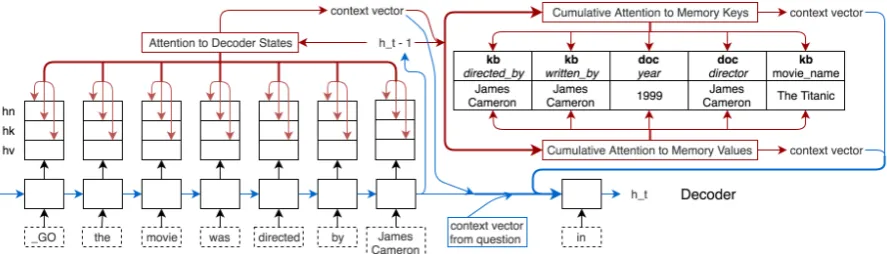
As shown in Figure3, our Cumulative Attention mechanism is exploited similarly to a multi-hop attention (Sukhbaatar et al.,2015). The difference is that the multi-hop attention uses context vector over one single memory at different hops, while our Cumulative Attention utilizes the context vec-tor to query different memories. As shown in the left part of Figure 3, the decoder first performs self-attention to its historyh⟨tN⟩, ht⟨K⟩, and h⟨tV⟩, and generates corresponding context vectorscas:
c⟨tHN⟩ =attn(ht−1, hist(h⟨tN⟩))
c⟨tHK⟩ =attn(ht−1, hist(h⟨tK⟩)
Figure 3: The Cumulative Attention Mechanism
wherec =attn(query, memory)denotes the
at-tention function (Bahdanau et al.,2014), and the decoder’s history states are defined as:
hist(h⟨tN⟩) = (h⟨0N⟩, h⟨1N⟩, ...h⟨t−N1⟩)
hist(h⟨tK⟩) = (h⟨0K⟩, h⟨1K⟩, ...h⟨tK−1⟩)
hist(h⟨tV⟩) = (h⟨0V⟩, h⟨1V⟩, ...h⟨tV−⟩1)
The overall context vector is obtained through concatenation : c⟨tH⟩ = [c⟨tHN⟩, c⟨tHK⟩, c⟨tHV⟩],
which is then used together withh⟨K⟩andh⟨V⟩to perform attention tom⟨K⟩andm⟨V⟩, respectively:
ct⟨M K⟩ =attn([ht⟨−K1⟩, c⟨tH⟩], m⟨K⟩)
ct⟨M V⟩ =attn([ht⟨−V1⟩, c⟨tH⟩], m⟨V⟩)
wherem⟨K⟩= (m⟨0K⟩, m1⟨K⟩...m⟨nK⟩)andm⟨V⟩ = (m⟨0V⟩, m1⟨V⟩...m⟨nV⟩), as shown in the right part of
Figure3.
The decoder also performs attention to the ques-tion to get context vectorc⟨tQ⟩, as in the standard seq2seq attention model.
At time step t, all context vectors are concate-nated:ct= [c⟨tQ⟩, c⟨
H⟩
t , c⟨ M K⟩
t , c⟨ M V⟩
t ]to form the
current input to the decoder. The decoder takes the context vector, the previous output, and the previ-ous state to update its state, then generates a distri-bution for the next token, as shown in Section4.1. We use the greedy decoding approach and choose the word with the highest probability as the current output.
For optimization, we jointly optimize the nega-tive log-probability of the output sentence and the cross entropyHfor gate g. Sinceg is the proba-bility about whether the current output comes from the memory or the vocabulary, we can extract the label forg by matching sentence words with the
memory. The overall loss functionLcan be writ-ten as:
L=− N
∑
t=1
log(P(xt|q, M, x0...xt−1)) +H(g,gˆ)
We optimizeL with gradient descent based opti-mizers.
5 Experiments
Our experiments are designed to answer the fol-lowing questions: (1) whether our model can prop-erly utilize heterogeneous memories to generate readable answer sentences, (2) whether our model can cover all target answers during generation, (3) whether our model can introduce related knowl-edge in the output while avoiding repetition. 5.1 Datasets
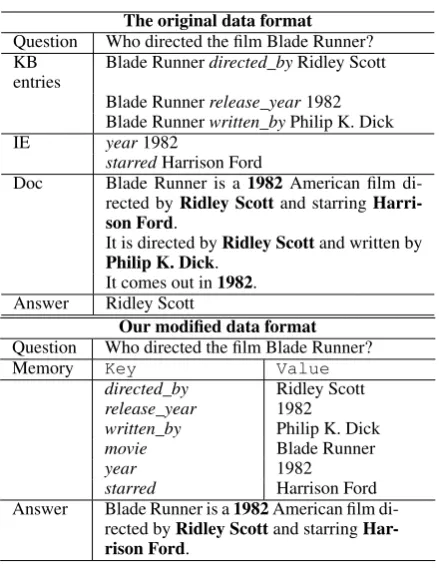
Our task requires a question, and a memory stor-ing all the answer words and related knowledge as input, and produces anatural, readablesentence as the output. Unfortunately, there is no existing dataset that naturally fits to our task. We thus tailor the WikiMovies1 dataset according to our re-quirements. ThisWikiMoviesdataset was orig-inally constructed for answering simple factoid questions, using memory networks with differ-ent knowledge represdiffer-entations, i.e., structured KB (KB entries in Table 2), raw textual documents (Doc), or processed documents obtained through information extraction (IE), respectively. The first is in the classic subject-predicate-object format. The second contains sentences from Wikipedia and also sentences automatically generated from predefined templates. The third is in the subject-verb-object format, collected by applying off-the-shell information extractor to all sentences.
The original data format Question Who directed the film Blade Runner? KB
entries Blade Runnerdirected_byRidley Scott Blade Runnerrelease_year1982 Blade Runnerwritten_byPhilip K. Dick IE year1982
starredHarrison Ford
Doc Blade Runner is a 1982American film di-rected byRidley Scottand starring Harri-son Ford.
It is directed byRidley Scottand written by Philip K. Dick.
It comes out in1982. Answer Ridley Scott
Our modified data format Question Who directed the film Blade Runner?
Memory Key Value
directed_by Ridley Scott release_year 1982
written_by Philip K. Dick
movie Blade Runner
year 1982
starred Harrison Ford Answer Blade Runner is a1982American film
[image:6.595.72.292.57.342.2]di-rected byRidley Scottand starring Har-rison Ford.
Table 2: The data format ofWikiMoviesused in our experiment.
As shown in Table 2, we treat each ques-tion in WikiMovies with its original answer (usually one or more words) as a QA pair, and one of the question’s supportive sentences (ei-ther from Wikipedia or templates) as its gold-standard answer sentence. For each question, the memory will contain all knowledge triples about the question’s topic movie from the KB entries, and also include entities and keywords extracted from its IE portion. For each entry in KB en-tries, we use the predicate as the key and the object as value to construct a new entry in our memory. For those from IE, we keep the tracted tags as the key and entities or other ex-pressions as the value. Given a question, if an en-tity/expression in the memory is not the answer, it will be treated as information enrichment. Ac-cording to whether the supportive sentences are generated by predefined templates or not, we split the dataset intoWikiMovies-Syntheticand
WikiMovies-Wikipedia.
The resultingWikiMovies-Synthetic in-cludes 115 question patterns and 194 answer pat-terns, covering 10 topics, e.g., director, genre, ac-tor, release year, etc. We follow its original data split, i.e., 47,226 QA-pairs for training, 8,895 for validation and 8,910 for testing.
In WikiMovies-Wikipedia, answer sen-tences are extracted from Wikipedia, admittedly noisy in nature. Note that there are more than 10K Wikipedia sentences that cannot be paired with any questions. We thus left their questions as blank and treat it as a pure generation task from a given memory, which can be viewed as a form of data augmentation to improve sentence variety. We splitWikiMovies-Wikipediathe dataset randomly into 47,309 cases for training, 4,093 for testing and 3,954 for validation. We treat normal words occurring less than 10 times asUNK, and, eventually, have 24,850 normal words and 37,898 entity words. We cut the maximum length of an-swer sentences to 20, and the maximum memory size to 10, which covers most cases in both syn-thetic and Wikipedia datasets.
5.2 Metrics
We evaluate our answer sentences in terms of an-swercoverage, informationenrichment, and re-dundancy. For cases with only one answer word, we design Csingle to indicate the percentage of
cases being correctly answered. Cases with more than one answer word are evaluated byCpart, i.e.,
the percentage of answer words covered correctly, andCperf ectis the percentage of cases whose
an-swers are perfectly covered. Here, the definition of coverageis similar in spirit with the conventional recallas both measure how many gold words are included in the output. Specifically, Cpart is
es-sentially the same asrecallwith respect to its own cases. Note that perfect coverage is the most diffi-cult, while single coverage is the easiest one. For Enrich, we measure the number of none-answer memory items included in the output. Regarding Redundancy, we calculate the times of repetition for memory values in the answer sentence. We also compute BLEU scores (Papineni et al.,2002) on the WikiMovies-Wikipedia, as an indi-cator of naturalness, to some extent.
5.3 Comparison Models
Model Redundancy Csingle Cpart Cperf ect Enrich
GenQA 0.1109 91.25% 69.19% 38.92% 0.1535
[image:7.595.152.447.62.134.2]HS-GenQA 0.1218 94.10% 76.47% 50.10% 0.1951 GenQA-AttnHist 0.1280 95.99% 73.44% 44.94% 0.1903 CheckList 0.1176 93.80% 76.32% 50.04% 0.1963 HS-AttnHist 0.1295 97.17% 77.90% 51.55% 0.1996 HS-CumuAttn 0.0983 98.15% 77.28% 50.79% 0.1665
Table 3: Results on theWikiMovies-Syntheticdataset
[image:7.595.163.438.162.207.2]Model BLEU Redundancy Cpart Cperf ect Enrich GenQA 42.50 0.2603 62.80% 18.24% 0.5903 CheckList 43.69 0.2744 63.42% 18.23% 0.6094 HS-CumuAttn 44.97 0.2385 64.06% 19.09% 0.6218
Table 4: Results on theWikiMovies-Wikipediadataset
GenQA-AttnHist, is enhanced with a history at-tention during decoding.
CheckList (Kiddon et al.,2016) is the state-of-the-art model for generating long sentences with large agenda to mention. It keeps words that have been mentioned and words to mention using two separate records, and updates the records dynam-ically during decoding. To adapt to our task, we modify CheckList with a question encoder and a KV memory.
We also compare with one variant of our own model, HS-AttnHist, which does not benefit from the Cumulative Attention.
5.4 Implementation
Our model is implemented with the Tensorflow framework2, version 1.2. We use the Adam
opti-mizer (Kingma and Ba,2014) with its default set-ting. The embedding dimension is set to be 256, as is the LSTM state size. We set the batch size to 128 and train the model up to 80 epochs.
As mentioned, there is a tradeoff between Cov-erage/Enrichment and Redundancy. To set up a more fair comparison for different models, we ask the control group to reach a comparable level ofRedundancy, i.e., approximately 0.11-0.12 on
WikiMovies-Synthetic and 0.26-0.27 on
WikiMovies-Wikipedia. Keeping the Re-dundancyin around the same bucket, we compare their Coverage and Enrichment.
5.5 Results and Discussion
Let us first look at the performance on the
Synthetic set in Table 3. GenQA is origi-nally proposed to read only one single fact dur-ing decoddur-ing, so it is not surprisdur-ing that it has the lowest answer coverage (38.92% Cperf ect)
2www.tensorflow.org
Question the movie Torn Curtain starred who? Memory 0actor Julie Andrews
1starred_actors Julie Andrews 2starred_actors Paul Newman 3movie Torn Curtain
4year 1966
5director Alfred Hitchcock
6actor Paul Newman
GenQA It stared Julie Andrews0 and
Julie Andrews0and and.
CheckList Torn Curtain3 is a 19664
Ameri-can film starring Paul Newman2 and
Julie Andrews0andJulie Andrews1.
HS-CumuAttn Torn Curtainican political thriller film directed3 is a 19664 Amer-by Alfred Hitchcock5, starring
Paul Newman2andJulie Andrews0.
Table 5: Example sentences generated by different models, where an underlined bold phrase is the value of a memory slot selected from the memory by its cor-responding generation model, and its subscript number is the index of this slot in the memory.
and information enrichment (0.1535). After split-ting the decoder state, HS-GenQA obtains sig-nificant improvement in both coverage (50.10% Cperf ect) and enrichment (0.1952). When
con-sidering history for attention, GenQA-AttnHist achieves even better coverage ( +3.% in Cpartand
+5% in Cperf ect). By combining these two
mecha-nisms, HS-AttnHist achieves the best perfect cov-erage, 51.55%. Although CheckList is not origi-nally designed for our task, it still gives a strong performance (50.04% Cperf ectand 0.1963
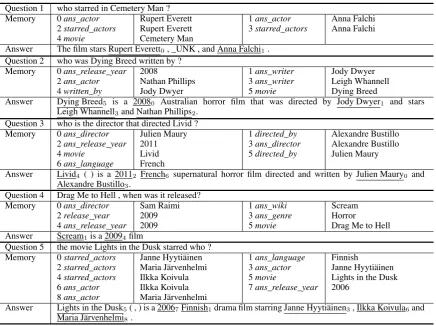
[image:7.595.308.526.242.417.2]Question 1 who starred in Cemetery Man ?
Memory 0ans_actor Rupert Everett 1ans_actor Anna Falchi 2starred_actors Rupert Everett 3starred_actors Anna Falchi 4movie Cemetery Man
Answer The film stars Rupert Everett0, _UNK , and Anna Falchi1.
Question 2 who was Dying Breed written by ?
Memory 0ans_release_year 2008 1ans_writer Jody Dwyer
2ans_actor Nathan Phillips 3ans_writer Leigh Whannell
4written_by Jody Dwyer 5movie Dying Breed
Answer Dying Breed5 is a 20080 Australian horror film that was directed by Jody Dwyer1 and stars
Leigh Whannell3and Nathan Phillips2.
Question 3 who is the director that directed Livid ?
Memory 0ans_director Julien Maury 1directed_by Alexandre Bustillo 2ans_release_year 2011 3ans_director Alexandre Bustillo
4movie Livid 5directed_by Julien Maury
6ans_language French
Answer Livid4 ( ) is a 20112 French6 supernatural horror film directed and written by Julien Maury0 and
Alexandre Bustillo3.
Question 4 Drag Me to Hell , when was it released?
Memory 0ans_director Sam Raimi 1ans_wiki Scream
2release_year 2009 3ans_genre Horror
4ans_release_year 2009 5movie Drag Me to Hell
Answer Scream1is a 20094film
Question 5 the movie Lights in the Dusk starred who ?
Memory 0starred_actors Janne Hyytiäinen 1ans_language Finnish
2starred_actors Maria Järvenhelmi 3ans_actor Janne Hyytiäinen 4starred_actors Ilkka Koivula 5movie Lights in the Dusk 6ans_actor Ilkka Koivula 7ans_release_year 2006
8ans_actor Maria Järvenhelmi
Answer Lights in the Dusk5( , ) is a 20067Finnish1drama film starring Janne Hyytiäinen3, Ilkka Koivula6and
[image:8.595.82.519.60.386.2]Maria Järvenhelmi8.
Table 6: Example answers generated by our model. In an answer sentence, an underlined phrase is the value of a memory slot selected from the memory by our model, and the subscript number is the index of this slot in the memory.
Figure 4: Two methods of using context of history to address the memory
We further break down the contributions from different mechanisms. Compared to vanilla GenQA, HS-GenQA splits the decoder states, thus improves the decoder’s memory addressing pro-cess by performing attention separately, leading to improvements in both coverage and enrichment. Improvements of GenQA-AttnHist are of a differ-ent rationale. Looking at the history enables the decoder to avoid what are already said. Compared with HS-GenQA, GenQA-AttnHist improves En-richment by avoiding repetition when introducing related information, while, HS-GenQA improves Enrichment by better memory addressing to select proper slots. Combining the two mechanisms
to-gether gives HS-AttnHist the best performance in Enrichment. However, HS-AttnHist still suffers from the repetition issue, to certain extent. Be-cause when choosing memory content, there is no explicit mechanism to help the decoder to avoid repetitions according to the history (left of Figure
4). Therefore, a generated word may still be cho-sen again at the memory addressing step, leaving all the burden of avoiding repetition to the genera-tion step. Our Cumulative Attengenera-tion mechanism is designed to utilize the context vector of the history to address the memory, thus helps avoid choosing those already mentioned slots at memory address-ing time (right of Figure4), leading to almost the best coverage with the lowest redundancy.
Now we compare the three main models, GenQA, CheckList and our HS-CumuAttn on WikiMovies-Wikipedia (Table 4), which is admittedly more challenging than
[image:8.595.77.284.446.509.2]CheckList, with a lower redundancy, still out-performs GenQA in almost all metrics, except Cperf ect, since CheckList is originally designed
to perform well with larger agenda/memory and longer sentences. On the other hand, our model, HS-CumuAttn, achieves the best performance in all metrics. Although the BLEU score is not designed to fully reflect the naturalness, it still indicates that our model can output sentences that share more n-gram snippets with reference sentences and are more similar to those composed by humans.
Case Study and Error Analysis Table 5 pro-vides the system outputs from different models for an example question. We can see that GenQA may lose track of the decoder history, and repeat itself (and and), because there is no explicit mechanism to help avoid repetition. Also, it lacks informative-ness and may not utilize other information stored in the memory. CheckList keeps records of what have been said and what are left to mention, thus reaches a good answer coverage. But its decoder is unable to explicitly address separate components within one memory slot, so it may not realize that the two Julie Andrewss are essentially the same person. HS-CumuAttn is able to find all the an-swer words correctly and also include thedirector into the sentence. After generatingPaul Newman, the Cumulative Attention mechanism enables the model to realize that Paul Newman in slot 2 has been said, andPaul Newmanin slot 6 is the same as slot 2, so it should not choose the 6th slot again. Rather it should move toJulie Andrews. Although the decoder may figure out the twoPaul Newman are the same during decoding, the Cumulative At-tention can explicitly help make the clarification during memory addressing. Intuitively, the atten-tion across memory and history induces a stronger signal for the decoder to gather the right informa-tion.
Table6lists more typical imperfect output from our model. In question 1, there is considerable re-dundancy in the memory, but our decoder is still able to avoid repeatedly choosing the same enti-ties from difference sources, though it produces a "_UNK" showing a slight incoherence. We think it comes from the gategas it fails to decide that the current word should come from the memory. In question 2, the model correctly chooses the mem-ory slot, but outputs the word "directed" while the correct word should be "written". This also
shows an word choice inconsistency between the language model and the memory retrieval. Ques-tion 3 makes the same mistake, where it indeed chooses the right answer, but adds an incorrect word "written". We also observe a pair of addi-tional parentheses, which are often used to acco-modatemovie tags, but we do not see any tags in this memory, so it has to be left blank. Question 4 shows an incorrect memory retrieval, where the decoder should have chosen slot 5 as the movie name. Question 5 is generally good enough, ex-cept the same parenthesis error as in question 4.
It is also interesting to see additional de-scriptions like "Australian", "supernatural" and "drama" in question 2, 3, and 5, introduced by the language model, rather than the memory. Al-though our model prevents repetition and obtains general naturalness, it cannot guarantee that the decoder can precisely use the right language to de-scribe the memory information. We see the gen-eral readability of these sentences, yet they are still not as good as human composed ones. It is fairly subtle for the decoder to collaborate with the memory in different levels of semantics. The se-mantic coherency and word choice consistency is still a challenge in natural language generation.
6 Conclusion and Future Work
In this paper, we propose a novel mechanism within an encoder-decoder framework to enable the decoder to actively interact with a memory by taking its heterogeneity into account. Our solu-tion can read multiple memory slots from different sources, attend across the generated history and the memory to explicitly avoid repetition, and en-rich the answer sentences with related information from the memory. In the future, we plan to extend our work through 1) investigating more sophisti-cated structures in the memory such as knowledge graph, 2) solving more complex questions, such as those involving deep reasoning over multiple facts.
Acknowledgments
References
Dzmitry Bahdanau, Kyunghyun Cho, and Yoshua Bengio. 2014. Neural machine translation by jointly learning to align and translate. CoRR
abs/1409.0473.
Antoine Bordes and Jason Weston. 2016. Learn-ing end-to-end goal-oriented dialog. CoRR
abs/1605.07683. http://arxiv.org/abs/ 1605.07683.
Kyunghyun Cho, Bart van Merrienboer, Çaglar Gülçehre, Fethi Bougares, Holger Schwenk, and Yoshua Bengio. 2014. Learning phrase representa-tions using RNN encoder-decoder for statistical ma-chine translation. CoRR abs/1406.1078. http:
//arxiv.org/abs/1406.1078.
Jennifer Chu-Carroll, Krzysztof Czuba, John M. Prager, Abraham Ittycheriah, and Sasha Blair-Goldensohn. 2004. Ibm’s piquant ii in trec 2004. InTREC.
Junyoung Chung, Çaglar Gülçehre, KyungHyun Cho, and Yoshua Bengio. 2014. Empirical evaluation of gated recurrent neural networks on sequence mod-eling. CoRR abs/1412.3555. http://arxiv.
org/abs/1412.3555.
Michal Daniluk, Tim Rocktäschel, Johannes Welbl, and Sebastian Riedel. 2017. Frustratingly short at-tention spans in neural language modeling. CoRR
abs/1702.04521. http://arxiv.org/abs/ 1702.04521.
Angela Fan, David Grangier, and Michael Auli. 2017. Controllable abstractive summarization. CoRR
abs/1711.05217. http://arxiv.org/abs/ 1711.05217.
Jonas Gehring, Michael Auli, David Grangier, De-nis Yarats, and Yann N. Dauphin. 2017. Con-volutional sequence to sequence learning. CoRR
abs/1705.03122. http://arxiv.org/abs/ 1705.03122.
Jiatao Gu, Zhengdong Lu, Hang Li, and Victor O. K. Li. 2016. Incorporating copying mech-anism in sequence-to-sequence learning. CoRR
abs/1603.06393. http://arxiv.org/abs/ 1603.06393.
He He, Anusha Balakrishnan, Mihail Eric, and Percy Liang. 2017a. Learning symmetric collaborative dialogue agents with dynamic knowledge graph embeddings. CoRR abs/1704.07130. http://
arxiv.org/abs/1704.07130.
Shizhu He, Cao Liu, Kang Liu, and Jun Zhao. 2017b. Generating natural answers by incorporating copying and retrieving mechanisms in sequence-to-sequence learning. pages 199–208.
Sepp Hochreiter and Jürgen Schmidhuber. 1997. Long short-term memory. Neural Comput. 9(8):1735– 1780. https://doi.org/10.1162/neco.
1997.9.8.1735.
Chloé Kiddon, Luke S. Zettlemoyer, and Yejin Choi. 2016. Globally coherent text generation with neural checklist models. InEMNLP.
Diederik P. Kingma and Jimmy Ba. 2014. Adam: A method for stochastic optimization. CoRR
abs/1412.6980. http://arxiv.org/abs/
1412.6980.
Ankit Kumar, Ozan Irsoy, Jonathan Su, James Brad-bury, Robert English, Brian Pierce, Peter Ondruska, Ishaan Gulrajani, and Richard Socher. 2015. Ask me anything: Dynamic memory networks for nat-ural language processing. CoRR abs/1506.07285.
http://arxiv.org/abs/1506.07285.
Alexander H. Miller, Adam Fisch, Jesse Dodge, Amir-Hossein Karimi, Antoine Bordes, and Jason We-ston. 2016. Key-value memory networks for di-rectly reading documents. CoRR abs/1606.03126.
http://arxiv.org/abs/1606.03126.
Kishore Papineni, Salim Roukos, Todd Ward, and Wei-Jing Zhu. 2002. Bleu: A method for auto-matic evaluation of machine translation. In Pro-ceedings of the 40th Annual Meeting on Associa-tion for ComputaAssocia-tional Linguistics. Association for Computational Linguistics, Stroudsburg, PA, USA, ACL ’02, pages 311–318. https://doi.org/
10.3115/1073083.1073135.
Romain Paulus, Caiming Xiong, and Richard Socher. 2017. A deep reinforced model for abstractive summarization. CoRR abs/1705.04304. http:
//arxiv.org/abs/1705.04304.
Abigail See, Peter Liu, and Christopher Manning. 2017.Get to the point: Summarization with pointer-generator networks. In Association for Computa-tional Linguistics.https://arxiv.org/abs/ 1704.04368.
Sainbayar Sukhbaatar, Arthur Szlam, Jason We-ston, and Rob Fergus. 2015. End-to-end mem-ory networks. In Proceedings of the 28th International Conference on Neural Information Processing Systems - Volume 2. MIT Press, Cambridge, MA, USA, NIPS’15, pages 2440– 2448. http://dl.acm.org/citation.
cfm?id=2969442.2969512.
Jun Suzuki and Masaaki Nagata. 2017. Cutting-off re-dundant repeating generations for neural abstractive summarization. InEACL.
Zhaopeng Tu, Zhengdong Lu, Yang Liu, Xiaohua Liu, and Hang Li. 2016b. Modeling coverage for neu-ral machine translation. In Proceedings of the 54th Annual Meeting of the Association for Com-putational Linguistics (Volume 1: Long Papers). Association for Computational Linguistics, pages 76–85. https://doi.org/10.18653/v1/ P16-1008.
Oriol Vinyals, Meire Fortunato, and Navdeep Jaitly. 2015. Pointer networks. In Proceedings of the 28th International Conference on Neural Informa-tion Processing Systems - Volume 2. MIT Press, Cambridge, MA, USA, NIPS’15, pages 2692– 2700. http://dl.acm.org/citation.
cfm?id=2969442.2969540.
Tsung-Hsien Wen, Milica Gasic, Nikola Mrkši´c, Pei-Hao Su, David Vandyke, and Steve Young. 2015. Semantically conditioned lstm-based natural lan-guage generation for spoken dialogue systems. In Proceedings of the 2015 Conference on Em-pirical Methods in Natural Language Processing. Association for Computational Linguistics, pages 1711–1721. https://doi.org/10.18653/ v1/D15-1199.
Jason Weston, Sumit Chopra, and Antoine Bordes. 2014. Memory networks. CoRR abs/1410.3916.
http://arxiv.org/abs/1410.3916.
Kun Xu, Yansong Feng, Songfang Huang, and Dongyan Zhao. 2016. Hybrid question answering over knowledge base and free text. InCOLING.
Jun Yin, Xin Jiang, Zhengdong Lu, Lifeng Shang, Hang Li, and Xiaoming Li. 2015. Neural gener-ative question answering. CoRR abs/1512.01337.