Proceedings of NAACL-HLT 2018, pages 1676–1686
Encoding Conversation Context for Neural Keyphrase Extraction
from Microblog Posts
Yingyi Zhang†∗ Jing Li‡ Yan Song‡ Chengzhi Zhang†
†Nanjing University of Science and Technology
{yingyizhang, zhangcz}@njust.edu.cn
‡Tencent AI Lab
{ameliajli,clksong}@tencent.com
Abstract
Existing keyphrase extraction methods suffer from data sparsity problem when they are con-ducted on short and informal texts, especially microblog messages. Enriching context is one way to alleviate this problem. Considering that conversations are formed by reposting and re-plying messages, they provide useful clues for recognizing essential content in target posts and are therefore helpful for keyphrase iden-tification. In this paper, we present a neural keyphrase extraction framework for microblog posts that takes their conversation context into account, where four types of neural encoders, namely, averaged embedding, RNN, attention, and memory networks, are proposed to repre-sent the conversation context. Experimental results on Twitter and Weibo datasets1 show
that our framework with such encoders outper-forms state-of-the-art approaches.
1 Introduction
The increasing popularity of microblogs results in a huge volume of daily-produced user-generated data. As a result, such explosive growth of data far outpaces human beings’ reading and understand-ing capacity. Techniques that can automatically identify critical excerpts from microblog posts are therefore in growing demand. Keyphrase extrac-tion is one of the techniques that can meet this demand, because it is defined to identify salient phrases, generally formed by one or multiple words, for representing key focus and main topics for a given collection (Turney, 2000;Zhao et al., 2011). Particularly for microblogs, keyphrase ex-traction has been proven useful to downstream applications such as information retrieval (Choi
*Work was done during the internship at Tencent AI Lab. 1Our datasets are released at:http://ai.tencent.
com/ailab/Encoding_Conversation_Context_ for_Neural_Keyphrase_Extraction_from_ Microblog_Posts.html
Target post for keyphrase extraction:
”I will curse you in that forum” is the lowest of low. You are an embarrassmentpresident Duterte. Childish! Messages forming a conversation:
[R1]: anyhead of statewill be irked if asked to report toanother head of state
[R2]: Really? DidObamareally askedDuterteto report
to him? LOL
Table 1: An example conversation about “presi-dent Duterte” on Twitter.[Ri]: The i-th message in
conversation ordered by their positing time. pres-ident Duterte: keyphrase to be detected; Italic words: words that are related to the main topic in conversations and can indicate the keyphrase.
et al., 2012), text summarization (Zhao et al., 2011), event tracking (Ribeiro et al.,2017), etc.
To date, most efforts on keyphrase extraction on microblogs treat messages as independent docu-ments or sentences, and then apply ranking-based models (Zhao et al., 2011; Bellaachia and Al-Dhelaan, 2012;Marujo et al., 2015) or sequence tagging models (Zhang et al., 2016) on them. It is arguable that these methods are suboptimal for recognizing salient content from short and infor-mal messages due to the severe data sparsity prob-lem. Considering that microblogs allow users to form conversations on issues of interests by re-posting with comments2andreplying to messages for voicing opinions on previous discussed points, these conversations can enrich context for short messages (Chang et al., 2013; Li et al., 2015), and have been proven useful for identifying topic-related content (Li et al.,2016). For example, Ta-ble1displays a target post with keyphrase “ presi-dent Duterte” and its reposting and replying mes-sages forming a conversation.
Easily identified, critical words are mentioned multiple times in conversations. Such as in[R2], keyword “Duterte” re-occurs in the conversation.
2On Twitter, reposting behavior is named as retweet.
Also, topic-relevant content, e.g., “head of state”, “another head of state”, “Obama”, helps to in-dicate keyphrase “president Duterte”. Such con-textual information embedded in a conversation is nonetheless ignored for keyphrase extraction in existing approaches.
In this paper, we present a neural keyphrase extraction framework that exploits conversation context, which is represented by neural encoders for capturing salient content to help in indicating keyphrases in target posts. Conversation context has been proven useful in many NLP tasks on so-cial media, such as sentiment analysis (Ren et al., 2016), summarization (Chang et al., 2013; Li et al.,2015), and sarcasm detection (Ghosh et al., 2017). We use four context encoders in our model, namely, averaged embedding, RNN ( Pearlmut-ter, 1989), attention (Bahdanau et al., 2014), and memory networks (Weston et al.,2015), which are proven useful in text representation (Cho et al., 2014;Weston et al.,2015;Huang et al.,2016;Nie et al.,2017). Particularly in this task, to the best of our knowledge, we are the first to encode con-versations for detecting keyphrases in microblog posts. Experimental results on Twitter and Sina Weibo datasets demonstrate that, by effectively encoding context in conversations, our proposed approach outperforms existing approaches by a large margin. Quantitative and qualitative analy-sis suggest that our framework performs robustly on keyphrases with various length. Some en-coders such as memory networks can detect salient and topic-related content, whose occurrences are highly indicative of keyphrases. In addition, we test ranking-based models with and without con-sidering conversations. The results also confirm that conversation context can boost keyphrase ex-traction of ranking-based models.
2 Keyphrase Extraction with Conversation Context Encoding
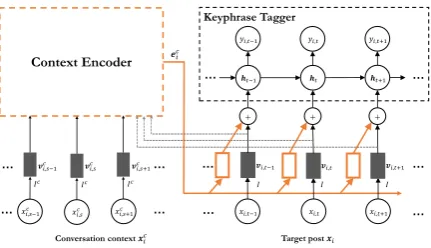
Our keyphrase extraction framework consists of two parts, i.e., a keyphrase tagger and a conversa-tion context encoder. The keyphrase tagger aims to identify keyphrases from a target post, and the context encoders captures the salient content in conversations, which would indicate keyphrases in the target post. The entire framework is learned synchronously with the given target posts and their corresponding conversation context. In prediction, the keyphrase tagger identifies keyphrases in a
𝑥𝑖,𝑡−1 𝑥𝑖,𝑡 𝑥𝑖,𝑡+1 𝒗𝑖,𝑡−1 𝒗𝑖,𝑡 𝒗𝑖,𝑡+1
Context Encoder
𝑦𝑖,𝑡−1 𝑦𝑖,𝑡 𝑦𝑖,𝑡+1 Keyphrase Tagger
𝒉𝑡−1 𝒉𝑡 𝒉𝑡+1
𝐼 𝐼 𝒗𝑖,𝑠−1𝑐 𝒗𝑖,𝑠𝑐 𝒗𝑖,𝑠+1𝑐
𝑥𝑖,𝑠−1𝑐
𝑥𝑖,𝑠𝑐 𝑥𝑖,𝑠+1𝑐
Conversation context 𝒙𝑖𝑐 Target post 𝒙𝑖 𝐼 𝐼𝑐 𝐼𝑐 𝐼𝑐
𝒆𝑖𝑐
+ + +
… …
… …
…
…
…
…
[image:2.595.305.521.61.185.2]… …
Figure 1: The overall structure of our keyphrase extraction framework with context encoder. Grey dotted array refer to the inputs of target posts that are also used in context encoding.
SINGLE xi,tis a one-word keyphrase (keyword).
BEGIN xi,tis the first word of a keyphrase.
MIDDLE xi,tis part of a keyphrase but it is neither
the first nor the last word of the keyphrase. END xi,tis the last word of a keyphrase
NOT xi,tis not a keyword or part of a keyphrase.
Table 2: Definitions of differentyi,t.
post with the help of representations generated by the encoder. Figure1shows the overall structure of our keyphrase extraction framework. In the rest of this section, Section2.1describes the keyphrase taggers used in our framework; Section2.2gives the details of different context encoders.
2.1 Keyphrase Taggers
We followZhang et al. (2016) to cast keyphrase extraction into the sequence tagging task. For-mally, given a target microblog postxiformulated
as word sequence< xi,1, xi,2, ..., xi,|xi| >, where |xi| denotes the length ofxi, we aim to produce
a tag sequence< yi,1, yi,2, ..., yi,|xi| >, whereyi,t
indicates whether xi,t is part of a keyphrase. In
detail,yi,t has five possible values:
yi,t ∈ {SINGLE,BEGIN,MIDDLE,END,NOT}
…
…
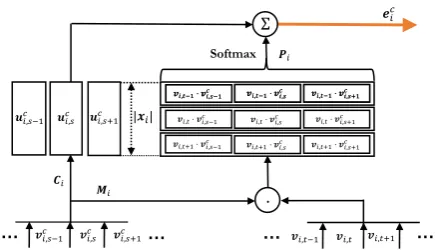
Figure 2: The structure of attention-based conver-sation context encoder.
In addition to one-type output, we also use joint-layer RNN proposed byZhang et al.(2016), which is demonstrated to be the state-of-the-art keyphrase tagger in previous work without modeling conversation context. As a multi-task learner (Collobert and Weston,2008), joint-layer RNN tackles two tasks with two types of outputs,
y1
i,t andy2i,t. y1i,t has a binary tagset, which
indi-cates whether wordxi,t is part of a keyphrase or
not. yi,t2 employs the 5-value tagset defined in
Ta-ble2. Besides the standard RNN version, in imple-mentation, we also build the joint-layer RNN with its GRU, LSTM, and BiLSTM counterparts. To be consistent, taggers with one-type output with the 5-value tagset are named as single-layer taggers.
As shown in Figure 1, our keyphrase tagger is built upon input feature map I(·), which embeds
each word xi,t in target post into a dense vector
format, i.e.,I(xi,t) =νννi,t. We initialize input
fea-ture map by pre-trained embeddings, and update embeddings during training.
2.2 Context Encoders
We aggregate all reposting and replying messages in conversations to form a pseudo-document as context by their posting time, and input context in forms of word sequences into context encoder. Let xc
i denote the context word sequence of the
target postxi, we propose four methods to encode
xci, namely,averaged embedding,RNN,attention, andmemory networks. Similar to keyphrase tag-gers (see Section2.1), each wordxci,sin contextxci takes the form of a vectorνννci,smapped by an input
layerIc(·), which is also initialized by pre-trained
embeddings, and updated in the training process.
2.2.1 Averaged Embedding
As a straightforward sentence representation tech-nique, averaged embedding simply takes the
aver-Softmax 𝑷𝑖
Σ 𝒆𝑖𝑐
𝒗𝑖,𝑠𝑐 𝒗𝑖,𝑠+1𝑐
𝒗𝑖,𝑠−1𝑐 𝒗𝑖,𝑡−1 𝒗𝑖,𝑡 𝒗𝑖,𝑡+1
𝑴𝑖
𝒗𝑖,𝑡−1⋅ 𝒗𝑖,𝑠𝑐 𝒗𝑖,𝑡−1⋅ 𝒗𝑖,𝑠+1𝑐
𝒗𝑖,𝑡−1⋅ 𝒗𝑖,𝑠−1𝑐
𝒗𝑖,𝑡⋅ 𝒗𝑖,𝑠𝑐 𝒗𝑖,𝑡⋅ 𝒗𝑖,𝑠+1𝑐
𝒗𝑖,𝑡⋅ 𝒗𝑖,𝑠−1𝑐
𝒗𝑖,𝑡+1⋅ 𝒗𝑖,𝑠𝑐 𝒗𝑖,𝑡+1⋅ 𝒗𝑖,𝑠+1𝑐
𝒗𝑖,𝑡+1⋅ 𝒗𝑖,𝑠−1𝑐
⋅ 𝑪𝑖
𝒖𝑖,𝑠−1𝑐 𝒖𝑖,𝑠𝑐 𝒖𝑖,𝑠+1𝑐 |𝒙𝑖|
… … … …
𝒗𝑖,𝑡−1⋅ 𝒗𝑖,𝑠𝑐 𝒗𝑖,𝑡−1⋅ 𝒗𝑖,𝑠+1𝑐
[image:3.595.76.288.65.196.2]𝒗𝑖,𝑡−1⋅ 𝒗𝑖,𝑠−1𝑐
Figure 3: The structure of the conversation context encoder based on memory networks.
age embeddings of words in a context, i.e.,νννci,s, as
the encoding of context representation, i.e.,
eci = 1
|xc i|
|xc i| X
s=1
νννci,s (1)
where|xci|is the length ofxci in the context.
2.2.2 RNN
RNN encoders employ the recurrent neural net-work model for the embedded context sequence
< νννci,1, νννci,2, ..., νννci,|xc
i| >, through the recurrent
functions over all the states:
hci,s=δh(W1hhi,sc −1+W2hνννci,s) (2)
where W1h and Wh2 are learnable weight matri-ces, andδh is the component-wise sigmoid
func-tion. The encoder representation is thus given by the hidden units at the last state:
eci =hc|xc
i| (3)
In this paper, RNN-based encoders have four variants, namely, RNN, GRU, LSTM, and BiL-STM. Particularly, as BiLSTM has two opposite directions, its context representation takes the con-catenation of the last states from both directions, which come from two ends of a given context.
2.2.3 Attention
Attention-based encoders put attention mecha-nism (Bahdanau et al., 2014) upon RNN model for “soft-addressing” important words in the con-versation context. In this paper, we use the feed-forward attention (Raffel and Ellis, 2015; SØnderby et al.,2015), as shown in Figure2. The encoder is thus represented as
eci =
|xc i| X
s=1
whereαc
i,sis the attention coefficient obtained for
word xcs, which implicitly reflects its importance for helping keyphrase identification. αci,s is
com-puted via a softmax over the hidden states by
αi,sc =sof tmax(a(hci,s)) (5)
wherea(·)is a learnable function formulated as:
a(hci,s) =tanh(Wahci,s) (6)
which takes input only from onhc
i,s. Wa are
pa-rameters of the functiona(·)to be learned.
2.2.4 Memory Networks
The encoder based on memory networks (MemNN) (Weston et al., 2015) stores and updates the representations of conversation
contexts in a memory module. The updated
representations are used to guide the keyphrase tagger. Figure3illustrates its structure.
Formally, each embedded context sequence Vci =< νννci,1, νννci,2, ..., νννci,|xc
i|>is stored into
mem-oryMi. We then yield the match between
embed-ded target postVi =< νννi,1, νννi,2, ..., νννi,|xi| >and
context memory Mi by their inner product
acti-vated by softmax:
Pi =sof tmax(Vi·Mi) (7)
where Pi,j,j0 captures the similarity between the
j-th word in conversation contextxci and thej0-th
word in target postxi.
To transform context input xci into an aligned form so that it is able to be added with Pi,
we include another embedding matrix Ci =< µµµi,1, ..., µµµi,|xc
i| >. Similar to attention encoder,
the MemNN encoder aims to generate a represen-tation, which addresses the important part in the conversation context that helps tagging keyphrases in target post xi. The sum of Ci and matching
matrixPiserves as the encoded representation for
conversation context:
eci =Pi+Ci (8)
In particular, both attention and MemNN ex-plores salient words in conversations that describe main focus of the conversation, which helps indi-cate keyphrases of a target post. In comparison, MemNN explicitly exploits the affinity of target posts and conversations in matching each other, while attention implicitly highlights certain con-text without taking target posts into account.
Dataset # of an-not. msgs # of msgsin context Contextlength Vocab Twitter
Train 3,976 3.38 49.74 34,412
Dev 497 3.19 46.44 7,186
Test 497 3.30 48.09 8,779
Train 13,816 1.97 55.77 25,259
Dev 1,727 2.01 45.00 9,106
Test 1,727 1.82 51.95 9,305
Table 3: Statistics of two datasets. Train, Dev, and Test denotes training, development, and test set, respectively. # of annot. msgs: number of mes-sages with keyphrase annotation, each containing conversation context. # of msgs in context: av-erage count of message in conversation context. Context length: average count of words in conver-sation context. Vocab: vocabulary size.
3 Experiment Setup
3.1 Datasets
Our experiments are conducted on two datasets collected from Twitter and Weibo3, respectively. The Twitter dataset is constructed based on TREC2011 microblog track4. To recover conver-sations, we used Tweet Search API5to retrieve full information of a tweet with its “in reply to status id” included. Recursively, we searched the “in re-ply to” tweet till the entire conversation is recov-ered. Note that we do not consider retweet rela-tions, i.e., reposting behaviors on Twitter, because retweets provide limited extra textual information for the reason that Twitter did not allow users to add comments in retweets until 2015. To build theWeibo dataset, we tracked real-time trending hashtags6 on Weibo and used the hashtag-search API7 to crawl the posts matching the given hash-tag queries. In the end, a large-scale Weibo corpus is built containing Weibo messages posted during January 2nd to July 31st, 2014.
For keyphrase annotation, we follow Zhang et al. (2016) to use microblog hashtags as
gold-3Weibo is short for Sina Weibo, the biggest microblog
platform in China and shares the similar market penetration as Twitter (Rapoza,2011). Similar to Twitter, it has a length limitation of 140 Chinese characters.
4http://trec.nist.gov/data/tweets/
5http://developer.twitter.com/en/docs/
tweets/search/api-reference/get-saved_ searches-show-id
6http://open.weibo.com/wiki/Trends/
hourly
7http://www.open.weibo.com/wiki/2/
Single-layer Taggers Joint-layer Taggers
RNN GRU LSTM BiLSTM RNN GRU LSTM BiLSTM
No Encoder 44.9±1.4 53.9±4.7 54.9±3.8 60.8±3.6 51.0±3.3 56.1±3.4 55.1±2.6 62.5±0.9
Context Encoder
Avg Emb 50.4±0.9 58.8±2.9 56.0±0.7 62.2±3.0 51.5±1.7 59.0±3.5 58.7±3.7 64.5±0.4
RNN 46.4±1.6 56.4±1.9 55.6±2.5 59.0±2.4 52.2±2.8 54.4±2.8 58.3±1.8 63.7±1.3
GRU 50.3±0.8 53.7±1.0 58.0±0.9 56.8±2.3 50.8±4.8 52.3±3.8 57.0±2.1 63.0±1.3
LSTM 51.6±2.0 56.4±1.4 57.9±2.3 64.0±3.1 50.8±3.1 57.9±2.3 58.3±4.0 64.2±0.6
BiLSTM 49.2±1.7 58.3±1.1 56.0±2.0 62.6±3.2 52.7±3.4 56.8±1.0 56.5±3.6 63.7±2.3
Att (LSTM) 48.7±1.7 58.1±1.7 58.1±3.1 64.0±1.8 51.7±4.8 57.4±2.3 58.0±2.4 63.8±1.5
Att (BiLSTM) 51.7±1.4 58.3±1.5 57.0±3.6 62.8±2.5 52.3±4.3 58.0±1.8 59.0±3.9 64.2±3.4
[image:5.595.86.513.62.185.2]MemNN 53.6±0.3 59.4±3.1 59.5±4.1 62.4±4.8 53.7±3.5 59.4±2.1 62.3±3.3 65.5±1.6
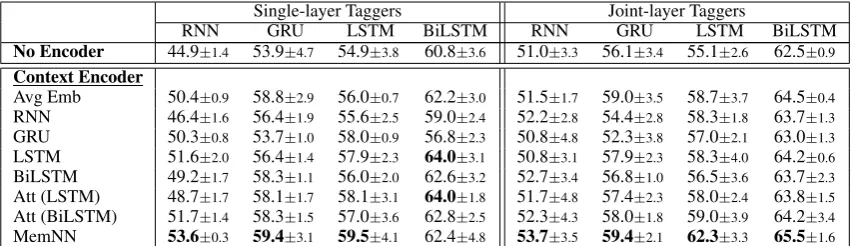
Table 4: Comparisons of the average F1 scores (%) and their standard deviations measured on Twitter over the results of models with5sets of parameters for random initialization. The left half reports results of
single-layer taggers; The right half reports results of joint-layer taggers. Each column: results of the same tagger with different encoders. Each row: results of different taggers with the same encoder. No Encoder: taggers without encoding context. Abbreviations for context encoders: Avg Emb – averaged embedding; Att (LSTM) – attention on LSTM; Att (BiLSTM) – attention on BiLSTM; MemNN – memory networks.
standard keyphrases8 and filtered all microblog posts by two rules: first, there is only one hash-tag per post; second, the hashhash-tag is inside a post, i.e., containing neither the first nor the last word of a post. Then, we removed all the “#” symbols in hashtags before keyphrase extraction. For both Twitter and Weibo dataset, we randomly sample 80% for training, 10% for development, and the rest 10% for test. Table3reports the statistics of the two datasets. The dataset released by Zhang et al.(2016) is not used because it does not con-tain conversation information.
We preprocessed Twitter dataset with Twitter NLP tool9 (Gimpel et al., 2011;Owoputi et al., 2013) for tokenization. For Weibo dataset, we used NLPIR tool10 (Zhang et al.,2003) for Chi-nese word segmentation. In particular, Weibo con-versations have an relatively wide range (from 3 to 8,846 words), e.g., one conversation could contain up to 447 messages. If use the maximum length of all conversations as the input length for en-coders, padding the inputs will lead to a sparse ma-trix. Therefore, for long conversations (with more than 10 messages), we use KLSum (Haghighi and Vanderwende,2009) to produce summaries with a length of 10 messages and then encode the pro-duced summaries. In contrast, we do not sum-marize Twitter conversations because their length range is much narrower (from 4 to 1,035 words).
8Zhang et al. (2016) proves that 90% of the
hashtag-annotated keyphrases match human annotations.
9http://www.cs.cmu.edu/˜ark/TweetNLP/
10https://github.com/NLPIR-team/NLPIR
3.2 Model Settings
For keyphrase taggers based on RNN, GRU, and LSTM, we followZhang et al.(2016) and set their state size to 300. For the BiLSTM tagger, which has two directions, we set the state size for each direction to 150. The joint-layer taggers employ the same hyper-parameters according to Zhang et al.(2016). The state size of context encoders shares the same settings with keyphrase taggers. In training, the entire keyphrase extraction frame-work uses cross-entropy loss and RMSprop opti-mizer (Graves,2013) for parameter updating.
We initialize input feature mapI for target post
and Ic for conversation context by embeddings
pre-trained on large-scale external microblog col-lections from Twitter and Weibo. Twitter embed-dings are trained on 99M tweets with 27B tokens and 4.6M words in the vocabulary. Weibo embed-dings are trained on 467M Weibo messages with 1.7B words and 2.5M words in the vocabulary.
In comparison, we employ neural taggers with-out encoding conversation context, which are based on RNN, GRU, LSTM, and BiLSTM. We also compare our models with the state-of-the-art joint-layer RNN (Zhang et al.,2016) and its GRU, LSTM, and BiLSTM variations.
To further illustrate the effectiveness of lever-aging conversation context for keyphrase extrac-tion, we also evaluate some ranking-based mod-els, namely, TF-IDF (Salton and Buckley,1988), TextRank (Mihalcea and Tarau,2004), and KEA implemented by KEA-3.011 (Witten et al.,1999).
Single-layer Taggers Joint-layer Taggers
RNN GRU LSTM BiLSTM RNN GRU LSTM BiLSTM
No encoder 58.8±1.4 66.2±0.8 67.3±1.6 74.8±0.7 55.5±0.5 64.1±0.7 64.9±0.6 76.8±0.5
Context Encoder
Avg Emb 63.3±0.9 68.2±0.7 69.4±0.4 76.6±0.9 61.1±1.2 69.7±1.3 69.3±0.7 79.8±0.6
RNN 58.2±1.6 64.9±0.6 65.3±0.8 73.1±0.1 60.9±0.5 67.1±0.6 66.7±0.5 71.2±0.7
GRU 56.5±0.8 67.0±0.6 67.4±1.1 73.8±0.7 58.4±1.1 65.5±0.8 67.1±0.4 76.2±0.7
LSTM 59.4±2.0 67.6±0.8 68.1±0.5 75.5±0.2 61.1±1.9 68.4±1.1 69.5±0.7 78.1±1.0
BILSTM 60.8±1.7 68.6±1.0 68.4±0.7 75.9±0.7 61.6±1.8 69.3±1.0 69.6±0.3 78.2±0.8
Att (LSTM) 62.4±1.8 67.6±1.1 69.0±0.7 75.8±1.2 63.1±1.3 70.2±0.8 70.8±1.3 79.3±0.5
Att (BiLSTM) 59.6±1.4 68.6±0.6 70.4±1.0 76.5±0.8 61.5±2.2 70.5±0.6 71.0±0.5 80.5±1.7
[image:6.595.86.513.61.186.2]MemNN 61.1±0.4 69.3±0.5 69.9±0.7 79.1±1.1 61.8±1.4 68.7±0.9 69.3±0.4 79.6±1.4
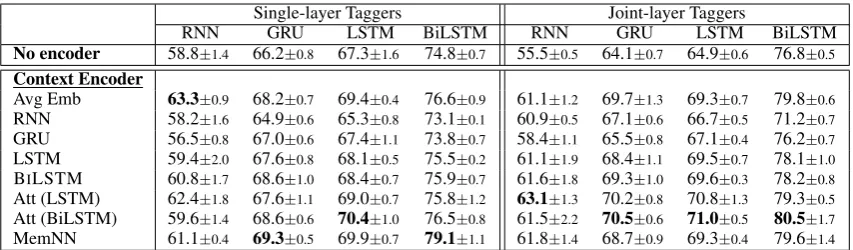
Table 5: Comparisons of F1 scores on Weibo. The abbreviations are defined the same as those in Table4.
We design two experiment settings when running these models: 1) each target post is treated as a document; 2) each conversation (containing the target post) is treated as a document. We select the topN words for each target post by their
ranked-orders and the threshold N is tuned on the de-velopment set. As a result, N ranges from2 to 7 for various methods. Particularly, since
TF-IDF and TextRank extract keywords instead of keyphrases, we aggregate the selected keywords according toBellaachia and Al-Dhelaan(2012).
4 Experimental Results
Section 4.1 to4.5 present quantitative and quali-tative analysis of our neural keyprhase extraction models. Section 4.6 reports the performance of ranking-based models where we test the general applicability of incorporating conversation context to non-neural keyphase extraction methods.
4.1 Overall Comparisons
Table 4 and Table 5 report F1 scores on Twitter and Weibo, respectively.12 We have the following observations.
Conversation context is useful for keyphrase ex-traction. By combining the encoded context in conversations, the F1 scores of all taggers are bet-ter than their basic versions without context en-coders. It confirms that content in conversations helps in indicating keyphrases in target posts.
Selecting the correct context encoder is impor-tant. Encoding context simply by RNN or GRU yields poor results. The reason for RNN is that it suffers from gradient vanishing problem when encoding long conversations (conversions in our
12We also tried BiRNN and BiGRU as keyphrase taggers
and as context encoders. They are outperformed by BiLSTM. We don’t report these results due to the space limitation.
two datasets have over 45 words on average). The reason for GRU is that its forget gates may be not well trained to process important content when the training set is small.
The results of AvgEmb are the worst on Twit-ter while competitive to other encoders on Weibo.
The performance of AvgEmb is competitive to other complex context encoders on Weibo. The reason may be that incorrect word orders generally do not affect the understanding in Chinese, where word order misuse is prevalent in Chinese Weibo messages. As a result, encoding word orders, as is done by the encoders except AvgEmb, might bring noise to keyphrase extraction on Weibo dataset. In contrast, AvgEmb is the worst encoder on Twitter dataset, as word order is crucial in English.
Identifying salient content in context is impor-tant. Four types of context encoders have differ-ent behaviors. Avg Emb considers all words in conversation context are equally important. RNN-variant context encoders, i.e., RNN, GRU, LSTM, and BiLSTM, additionally explore the relations between succeeded words without distinguishing salient and non-salient words. Attention (Att (LSTM) and Att (BiLSTM)) and MemNN can recognize critical content in conversations, which would indicate keyphrases in target posts. There-fore, our keyphrase extraction framework with at-tention or MemNN encoder has generally better F1 scores than those with other encoders.
SL BiLSTM JL BiLSTM Twitter Weibo Twitter Weibo No encoder 60.8 74.8 62.5 76.8
Avg Emb 61.0 75.7 63.3 79.2
RNN 58.8 72.7 63.1 71.1
GRU 56.4 73.1 62.7 76.0
LSTM 61.3 75.2 63.9 77.8
BiLSTM 62.0 75.4 62.3 78.0
Att (LSTM) 62.6 75.6 63.7 79.2 Att (BiLSTM) 62.0 76.5 63.9 79.9
[image:7.595.73.290.61.181.2]MemNN 61.6 77.4 65.1 79.2
Table 6: The F1 scores of BiLSTM taggers mea-sured on test instances without conversation con-text (%). SL BiLSTM and JL BiLSTM denote keyphrase tagger as single-layer and joint-layer BiLSTM, respectively. The other abbreviations are defined the same as those in Table4.
4.2 Test without Conversation Context
[image:7.595.302.508.64.185.2]Although we have shown in the previous section that conversation context is useful for training ef-fective models for keyphrase extraction on mi-croblog posts, it is necessary to consider that con-versation context might be unavailable to some microblog posts, which do not sparking any re-post or reply message. Under this circumstance, the models trained on messages with conver-sation context might be affected in extracting the keyphrases for messages without conversation context. To study whether conversation context is critical in testing process, we assume that the conversations are only available for training data, while all the target posts in the test set have no context to be leveraged. To this end, we apply the models trained for the experiment in Section 4.1 on the test posts without using their conversation context. In prediction, context encoders of the trained models take the target posts instead of con-versation as input. Results are reported in Table6, where models with context encoders yield better F1 scores than their counterparts without such en-coders no matter providing conversation to test data or not. This observation indicates that encod-ing conversations in trainencod-ing data helps in learn-ing effective keyphrase extraction models, which is beneficial to detect keyphrases in a microblog post with or without its conversation context. In addition, by comparing Table6with Table4and5, we find that, for each model with context encoder, higher F1 scores are observed when conversation context is used in testing process. This observa-tion confirms that, conversaobserva-tion context of target posts helps in indicating keyphrases in prediction.
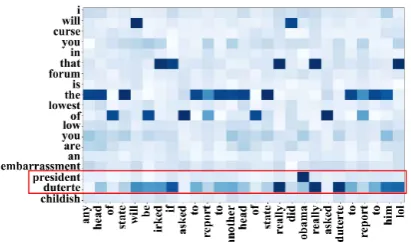
Figure 4: The heatmap of the context representa-tion generated by MemNN (see Eq.8). The hori-zontal axis refers to words in the conversation con-text, while the vertical axis refers to words in the target post. Darker colors indicate higher weights. The red box indicates the keyphrase to be detected.
4.3 Qualitative Analysis
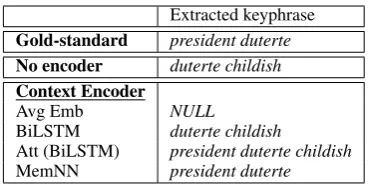
To qualitatively analyze why MemNN encoder generally performs better in comparison, we con-duct a case study on the sample instance in Ta-ble1. Recall that the keyphrase should be “ pres-ident Duterte”. We compare the keyphrases pro-duced by the joint-layer BiLSTM tagger with var-ious context encoders, given in Table 7. Of all models, only the one with MemNN encoder tags correctly. Interestingly, Avg Emb does not ex-tract any keyphrase. The reason might be that it considers each word in conversations independent and equally important. Therefore, when using this encoder, non-topic words like “if” and “LOL” may distract the keyphrase tagger in identifying the key information. Models with BiLSTM, Att (BiLSTM), and the basic model without encoder mistakenly extract the sentiment word “childish” since sentiment words are prominent on Twitter.
We also visualize context representation gen-erated by MemNN for conversation context in
a heatmap shown in Figure 4. It is
ob-served that MemNN highlights different types of words for keyphrases and non-keyphrases. For keyphrases, MemNN highlights topical words such as “Obama”. For non-keyphrases, MemNN highlights non-topic words, e.g., “be”, “to”. Therefore, features learned for keyphrases and non-keyphrases are different, which can thus benefit keyphrase tagger to correctly distinguish keyphrases from non-keyphrases.
4.4 Keyphrases with Various Lengths
Extracted keyphrase Gold-standard president duterte
No encoder duterte childish
Context Encoder
Avg Emb NULL
BiLSTM duterte childish
[image:8.595.89.275.60.152.2]Att (BiLSTM) president duterte childish MemNN president duterte
Table 7: Outputs of joint-layer BiLSTM combined with various context encoders given the example illustrated in Table1. “NULL”: Avg Emb did not produce any keyphrase.
shows the histograms of F1 scores yielded by a single-layer and a joint-layer tagger on Twitter and Weibo when keyphrase lengths are different. Note that we only report the results of BiLSTM taggers because their overall F1 scores are the best accord-ing to Table4and Table5.
In general, the F1 scores of all models decrease when keyphrases becomes longer, which implies that detecting longer keyphrases is harder than short ones. In comparison of different context en-coders, we observe that MemNN obtained the best F1 score in detection of long keyphrases. This is because MemNN highlights salient content in con-versation context by jointly considering its sim-ilarities with keyphrases in target posts. When the keyphrases become longer, there are more words in context highlighted, which hence helps keyphrase tagger. For short keyphrases, MemNN is still competitive with other context encoders. The observation suggests that MemNN is robust in detecting various length of keyphrases.
4.5 Error Analysis
In this section, we briefly discuss the errors found in our experiments. It is observed that one ma-jor incorrect prediction is additionally extracted neighboring words surrounding a gold-standard keyphrase. For example, in the tweet “Hillary Clinton accepted gifts from UAE, Saudi Arabia, Oman and others while SOS. CROOKED Podesta Emails 29 ...”, in addition to the gold-standard “Podesta Emails 29”, our models also extract out “CROOKED”. In general, these additionally ex-tracted words are mostly modifiers of keyphrases. External features for identifying modifiers can be used to filter these auxiliary parts of a keyphrase.
Another main error comes from the words that are not keyphrases in target posts but reflect the topics in conversations. For example, joint-layer
(a) SL BiLSTM on Twitter (b) JL BiLSTM on Twitter
(c) SL BiLSTM on Weibo (d) JL BiLSTM on Weibo Figure 5: Histograms of F1 scores on extract-ing keyphrases with various lengths. SL BiL-STM: tagger based on single-layer BiLSTM. JL BiLSTM: tagger based on joint-layer BiLSTM. Length: count of words in keyphrases. For each length range, histograms from left to right show the results of No encoder, Avg Emb, LSTM, BiL-STM, Att (LSTM), ATT (BiLSTM), and MemNN.
BiLSTM tagger with MemNN encoder mistak-enly extracts “Hillary” as a keyphrase for “ DOU-BLE STANDARD: Obama DOJ Prosecuted Others For Leaking FAR LESS Than Hillary Espionage URL” whose keyphrase should be “Espionage”. Because the corresponding conversation of this post is centered around “Hillary” instead of “ Espi-onage”, such information is captured by the con-text encoder, which leads to incorrect keyphrase prediction. However, this type of error points out the potential of extending our framework to extracting keyphrases from conversations instead of a post, which would be beneficial to gener-ating summary-worthy content for conversations (Fern´andez et al.,2008;Loza et al.,2014).
4.6 Ranking-based Models
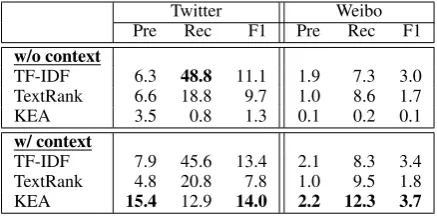
[image:8.595.300.524.60.246.2]Twitter Weibo
Pre Rec F1 Pre Rec F1
w/o context
TF-IDF 6.3 48.8 11.1 1.9 7.3 3.0 TextRank 6.6 18.8 9.7 1.0 8.6 1.7
KEA 3.5 0.8 1.3 0.1 0.2 0.1
w/ context
[image:9.595.72.291.62.172.2]TF-IDF 7.9 45.6 13.4 2.1 8.3 3.4 TextRank 4.8 20.8 7.8 1.0 9.5 1.8 KEA 15.4 12.9 14.0 2.2 12.3 3.7
Table 8: Precision, recall, and F1 scores of ranking-based baselines (%). w/o context: each target post is treated as a document; w/ con-text: each conversation and its corresponding tar-get post is treated as a document.
to capture indicative features. Second, conversa-tion context improves ranking-based models by a large margin. Simply by aggregating conversa-tions to a pseudo-document, the F1 scores of TF-IDF, TextRank, and KEA are generally better than their counterparts that are only performed on tar-get posts. For TF-IDF and TextRank, which are unsupervised, context remarkably improves recall by enriching more topic-related words. While for supervised method KEA, context improves both precision and recall, because supervision helps in identifying good features from conversations.
5 Related Work
Previous work on extracting keyphrases mainly fo-cuses on formal texts like news reports (Wan and Xiao, 2008) and scientific articles (Nguyen and Kan, 2007). Existing keyphrase extraction mod-els can be categorized as ranking-based modmod-els and tagging-based models. Ranking-based meth-ods include models based on graph ranking ( Mi-halcea and Tarau,2004;Wan and Xiao,2008), text clustering (Liu et al.,2009), TF-IDF (Jones,2004; Zhang et al.,2007;Lee and Kim, 2008;Kireyev, 2009; Wu and Giles, 2013), etc. The empirical study provided by Hasan and Ng (2010) shows that TF-IDF has robust performance and can serve as a strong baseline. Tagging models focus on us-ing manually-crafted features for binary classifiers to predict keyphrases (Frank et al., 1999; Tang et al., 2004; Medelyan and Witten, 2006). Our models are in the line of tagging approaches, and provide an alternative choice that incorporates ad-ditionally knowledge from conversations.
Recently, keyphrase extraction methods have been extended to social media texts (Zhao et al., 2011; Bellaachia and Al-Dhelaan, 2012; Marujo
et al.,2015;Zhang et al.,2016). These work suf-fers from the data sparsity issue because social media texts are normally short. Also, they only use internal information in the input text and ig-nore external knowledge in conversation context. Thus our work provides an improved approach that compensates their limitations.
6 Conclusion
This work presents a keyphrase extraction frame-work for microblog posts with considering conver-sation context to alleviate the data sparsity in short and colloquial messages. The posts to be tagged are enriched by conversation context through four types of encoders based on averaged embedding, RNN, attention, and memory networks, which are effective in capturing salient content in conversa-tions that is indicative for keyphrase identification. Experimental results on Twitter and Weibo dataset have shown that by effectively encoding conversa-tion context, our proposed models outperform ex-isting approaches by a large margin. Qualitative analysis confirm that our context encoders capture critical content in conversations.
Acknowledgments
We thank Shuming Shi, Haisong Zhang, Jialong Han, and three anonymous reviewers for their valuable suggestions on different aspects of this work. Chengzhi Zhang was supported by National Social Science Fund of China 17ZDA291.
References
Dzmitry Bahdanau, Kyunghyun Cho, and Yoshua Ben-gio. 2014. Neural machine translation by jointly learning to align and translate. arXiv pre-print arXiv/1409.0473.
Abdelghani Bellaachia and Mohammed Al-Dhelaan. 2012. NE-Rank: A novel graph-based keyphrase extraction in Twitter. In Proceedings of the IEEE/WIC/ACM International Conferences on Web Intelligence, WI. pages 372–379.
Yi Chang, Xuanhui Wang, Qiaozhu Mei, and Yan Liu. 2013. Towards Twitter context summarization with user influence models. InProceedings of the Sixth ACM International Conference on Web Search and Data Mining, WSDM. pages 527–536.
Jaeho Choi, W. Bruce Croft, and Jinyoung Kim. 2012. Quality models for microblog retrieval. In Proceed-ings of the 21st ACM International Conference on Information and Knowledge Management, CIKM. pages 1834–1838.
Junyoung Chung, C¸aglar G¨ulc¸ehre, KyungHyun Cho, and Yoshua Bengio. 2014. Empirical evaluation of gated recurrent neural networks on sequence model-ing. arXiv pre-printarXiv/1412.3555.
Ronan Collobert and Jason Weston. 2008. A unified architecture for natural language processing: deep neural networks with multitask learning. In Pro-ceedings of the Twenty-Fifth International Confer-ence Machine Learning, ICML. pages 160–167.
Raquel Fern´andez, Matthew Frampton, John Dowd-ing, Anish Adukuzhiyil, Patrick Ehlen, and Stan-ley Peters. 2008. Identifying relevant phrases to summarize decisions in spoken meetings. In Pro-ceedings of 9th Annual Conference of the Interna-tional Speech Communication Association, INTER-SPEECH. pages 78–81.
Eibe Frank, Gordon W. Paynter, Ian H. Witten, Carl Gutwin, and Craig G. Nevill-manning. 1999. Domain-specific keyphrase extraction. In Proceed-ings of the Sixteenth International Joint Conference on Artificial Intelligence, IJCAI. pages 668–673. Debanjan Ghosh, Alexander Richard Fabbri, and
Smaranda Muresan. 2017. The role of conversation context for sarcasm detection in online interactions. InProceedings of the 18th Annual SIGdial Meeting on Discourse and Dialogue. pages 186–196. Kevin Gimpel, Nathan Schneider, Brendan O’Connor,
Dipanjan Das, Daniel Mills, Jacob Eisenstein, Michael Heilman, Dani Yogatama, Jeffrey Flanigan, and Noah A. Smith. 2011. Part-of-speech tagging for Twitter: annotation, features, and experiments. In Proceedings of the 49th Annual Meeting of the Association for Computational Linguistics: Human Language Technologies. pages 42–47.
Alex Graves. 2013. Generating sequences with recurrent neural networks. arXiv pre-print arXiv/1308.0850.
Alex Graves and J¨urgen Schmidhuber. 2005. Frame-wise phoneme classification with bidirectional LSTM and other neural network architectures. Neu-ral Networks18(5-6):602–610.
Aria Haghighi and Lucy Vanderwende. 2009. Explor-ing content models for multi-document summariza-tion. InProceedings of the Conference of the North American Chapter of the Association of Computa-tional Linguistics, NAACL. pages 362–370.
Kazi Saidul Hasan and Vincent Ng. 2010. Conun-drums in unsupervised keyphrase extraction: mak-ing sense of the state-of-the-Art. In Proceedings of the 23rd International Conference on Computa-tional Linguistics, COLING. pages 365–373.
Sepp Hochreiter and J¨urgen Schmidhuber. 1997. Long short-term memory. Neural Computation 9(8):1735–1780.
Haoran Huang, Qi Zhang, Yeyun Gong, and Xuanjing Huang. 2016. Hashtag recommendation using end-to-end memory networks with hierarchical attention. InProceedings of the 26th International Conference on Computational Linguistics, COLING. pages 943– 952.
Karen Sp¨arck Jones. 2004. A statistical interpretation of term specificity and its application in retrieval. Journal of Documentation60(5):493–502.
Kirill Kireyev. 2009. Semantic-based estimation of term informativeness. InProceedings of the Human Language Technologies: Conference of the North American Chapter of the Association of Computa-tional Linguistics, NAACL. pages 530–538.
Sungjick Lee and Han-Joon Kim. 2008. News key-word extraction for topic tracking. In Proceed-ings of the Fourth International Conference on Net-worked Computing and Advanced Information Man-agement, NCM. pages 554–559.
Jing Li, Wei Gao, Zhongyu Wei, Baolin Peng, and Kam-Fai Wong. 2015. Using content-level struc-tures for summarizing microblog repost trees. In Proceedings of the 2015 Conference on Empirical Methods in Natural Language Processing, EMNLP. pages 2168–2178.
Jing Li, Ming Liao, Wei Gao, Yulan He, and Kam-Fai Wong. 2016. Topic extraction from microblog posts using conversation structures. InProceedings of the 54th Annual Meeting of the Association for Compu-tational Linguistics, ACL. pages 2114–2123.
Zhiyuan Liu, Peng Li, Yabin Zheng, and Maosong Sun. 2009. Clustering to find exemplar terms for keyphrase extraction. In Proceedings of the 2009 Conference on Empirical Methods in Natural Lan-guage Processing, EMNLP, August, A meeting of SIGDAT, a Special Interest Group of the ACL. pages 257–266.
Vanessa Loza, Shibamouli Lahiri, Rada Mihalcea, and Po-Hsiang Lai. 2014. Building a dataset for sum-marization and keyword extraction from emails. In Proceedings of the Ninth International Conference on Language Resources and Evaluation, LREC. pages 2441–2446.
Olena Medelyan and Ian H. Witten. 2006. Thesaurus based automatic keyphrase indexing. In Proceed-ings of the ACM/IEEE Joint Conference on Digital Libraries, JCDL. pages 296–297.
Rada Mihalcea and Paul Tarau. 2004. TextRank: Bringing order into text. InProceedings of the 2004 Conference on Empirical Methods in Natural Lan-guage Processing , EMNLP, A meeting of SIGDAT, a Special Interest Group of the ACL, held in con-junction with ACL. pages 404–411.
Thuy Dung Nguyen and Min-Yen Kan. 2007. Keyphrase extraction in scientific publications. In Proceedings of the Asian Digital Libraries. Looking Back 10 Years and Forging New Frontiers, 10th In-ternational Conference on Asian Digital Libraries, ICADL. pages 317–326.
Yuanping Nie, Yi Han, Jiuming Huang, Bo Jiao, and Aiping Li. 2017. Attention-based encoder-decoder model for answer selection in question answering. Frontiers of IT & EE18(4):535–544.
Olutobi Owoputi, Brendan O’Connor, Chris Dyer, Kevin Gimpel, Nathan Schneider, and Noah A. Smith. 2013. Improved part-of-speech tagging for online conversational text with word clusters. In Proceedings of the Human Language Technologies: Conference of the North American Chapter of the Association of Computational Linguistics, NAACL. pages 380–390.
Barak A. Pearlmutter. 1989. Learning state space tra-jectories in recurrent neural networks. Neural Com-putation1(2):263–269.
Colin Raffel and Daniel P. W. Ellis. 2015. Feed-forward networks with attention Can solve some long-term memory problems. arXiv pre-print arXiv/1512.08756.
Kenneth Rapoza. 2011. China’s Weibos vs US’s Twit-ter: And the winner is? Forbes.
Yafeng Ren, Yue Zhang, Meishan Zhang, and Donghong Ji. 2016. Context-sensitive Twitter sen-timent classification using neural network. In Pro-ceedings of the Thirtieth AAAI Conference on Artifi-cial Intelligence. pages 215–221.
Ricardo Ribeiro, Anatole Gershman, David Martins de Matos, Jo˜ao Paulo Neto, and Jaime G. Car-bonell. 2017. Event-based summarization using a centrality-as-relevance model. Knowledge & Infor-mation Systems50(3):945–968.
Gerard Salton and Chris Buckley. 1988. Term-weighting approaches in automatic text retrieval. In-formation Processing & Management 24(5):513– 523.
SØren Kaae SØnderby, Casper Kaae SØnderby, Hen-rik Nielsen, and Ole Winther. 2015. Convolutional LSTM networks for subcellular localization of pro-teins. In Proceedings of the Second International
Conference on Algorithms for Computational Biol-ogy. pages 68–80.
Jie Tang, Juan-Zi Li, Kehong Wang, and Yue-Ru Cai. 2004. Loss minimization based keyword distilla-tion. InProceedings of the Advanced Web Technolo-gies and Applications, 6th Asia-Pacific Web Confer-ence, APWeb. pages 572–577.
Peter D. Turney. 2000. Learning algorithms for keyphrase extraction. Information Retrieval 2(4):303–336.
Xiaojun Wan and Jianguo Xiao. 2008. Single doc-ument keyphrase extraction using neighborhood knowledge. In Proceedings of the Twenty-Third AAAI Conference on Artificial Intelligence, AAAI. pages 855–860.
Jason Weston, Sumit Chopra, and Antoine Bordes. 2015. Memory networks. In Proceedings of the International Conference on Learning Representa-tions, ICLR.
Ian H. Witten, Gordon W. Paynter, Eibe Frank, Carl Gutwin, and Craig G. Nevill-Manning. 1999. KEA: Practical automatic keyphrase extraction. In Pro-ceedings of the Fourth ACM conference on Digital Libraries. pages 254–255.
Zhaohui Wu and C. Lee Giles. 2013. Measuring term informativeness in context. In Proceedings of the Human Language Technologies: Conference of the North American Chapter of the Association of Com-putational Linguistics, NAACL. pages 259–269.
Hua-Ping Zhang, Hong-Kui Yu, De-Yi Xiong, and Qun Liu. 2003. HHMM-based chinese lexical analyzer ICTCLAS. InProceedings of the Second SIGHAN Workshop on Chinese Language Processing. pages 184–187.
Qi Zhang, Yang Wang, Yeyun Gong, and Xuanjing Huang. 2016. Keyphrase extraction using deep re-current neural networks on Twitter. InProceedings of the 2016 Conference on Empirical Methods in Natural Language Processing, EMNLP. pages 836– 845.
Yongzheng Zhang, Evangelos E. Milios, and A. Nur Zincir-Heywood. 2007. A comparative study on key phrase extraction methods in automatic web site summarization. Journal of Digital Information Management5(5):323–332.