Proceedings of NAACL-HLT 2018, pages 303–308
Modeling Semantic Plausibility by Injecting World Knowledge
Su Wang1,2 Greg Durrett3 Katrin Erk11Department of Linguistics
2Department of Statistics and Data Science
3Department of Computer Science
The University of Texas at Austin
[email protected] [email protected] [email protected]
Abstract
Distributional data tells us that a man can swal-low candy, but not that a man can swalswal-low a paintball, since this is never attested. How-ever both are physically plausible events. This paper introduces the task of semantic plau-sibility: recognizing plausible but possibly novel events. We present a new crowdsourced dataset of semantic plausibility judgments of single events such asman swallow paintball. Simple models based on distributional repre-sentations perform poorly on this task, despite doing well on selection preference, but inject-ing manually elicited knowledge about entity properties provides a substantial performance boost. Our error analysis shows that our new dataset is a great testbed for semantic plausi-bility models: more sophisticated knowledge representation and propagation could address many of the remaining errors.
1 Introduction
Intuitively, a mancan swallowa candy or paint-ballbut not adesk. Equally so, one cannot plausi-blyeatacakeand thenholdit. What kinds of se-mantic knowledge are necessary for distinguishing a physically plausible event (or event sequence) from an implausible one? Semantic plausibility
stands in stark contrast to the familiarselectional preference (Erk and Pad´o, 2010; Van de Cruys,
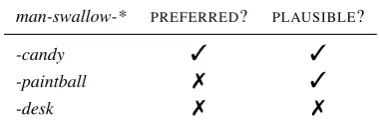
2014) which is concerned with the typicality of events (Table 1). For example,candy is a typical entity forman-swallow-*butpaintballis not, even though both events are plausible physically. Also, some events are physically plausible but are never stated because humans avoid stating the obvious. Critically, semantic plausibility is sensitive to cer-tain properties such as relative object size that are not explicitly encoded by selectional preferences (Bagherinezhad et al.,2016). Therefore, it is cru-cial that we learn to model these dimensions in ad-dition to using classical distributional signals.
man-swallow-* PREFERRED? PLAUSIBLE?
-candy 3 3
-paintball 7 3
[image:1.595.321.511.207.270.2]-desk 7 7
Table 1: Distinguishingsemantic plausibilityfrom se-lectional preference. candyis selectionally preferred because it is distributionally common patient in the event man-swallow-*, as opposed to the bizarre and rarely seen (if at all) patient paintball. However both are semantically plausible according to our world knowledge: they are small-sized objects that are swal-lowable by a man.deskis both distributionally unlikely and implausible (i.e. oversized for swallowing).
Semantic plausibility is pertinent and crucial in a multitude of interesting NLP tasks put forth previously, such as narrative schema (Chambers,
2013), narrative interpolation (Bowman et al.,
2016), story understanding (Mostafazadeh et al.,
2016), and paragraph reconstruction (Li and Ju-rafsky, 2017). Existing methods for these tasks, however, draw predominantly (if not only) on dis-tributional data and produce rather weak perfor-mance. Semantic plausibility over subject-verb-objecttriples, while simpler than these other tasks, is a key building block that requires many of the same signals and encapsulates complex world knowledge in a binary prediction problem.
In this work, we show that world knowledge in-jection is necessary and effective for the seman-tic plausibility task, for which we create a ro-bust, high-agreement dataset (details in section 3). Employing methods inspired by the recent work on world knowledge propagation through distribu-tional context (Forbes and Choi,2017;Wang et al.,
2017), we accomplish the goal with minimal effort in manual annotation. Finally, we perform an in-depth error analysis to point to future directions of work on semantic plausibility.
2 Related Work
Simple events (i.e. S-V-O) have seen
thor-ough investigation from the angle of selectional preference. While early works are resource-based (Resnik, 1996; Clark and Weir, 2001), later work shows that unsupervised learning with distributional data yields strong performance (O’Seaghdha, 2010;Erk and Pad´o,2010), which has recently been further improved upon with neu-ral approaches (Van de Cruys, 2014; Tilk et al.,
2016). Distribution-only models however, as will be shown, fail on the semantic plausibility task we propose.
Physical world knowledge modeling appears frequently in more closely related work. Bagher-inezhad et al.(2016) combine computer vision and text-based information extraction to learn the rel-ative sizes of objects; Forbes and Choi (2017) crowdsource physical knowledge along specified dimensions and employ belief propagation to learn relative physical attributes of object pairs. Wang et al. (2017) propose a multimodal LDA to learn the definitional properties (e.g. animal, four-legged) of entities. Zhang et al. (2017) study the role of common-sense knowledge in natural language inference, which is inherently between-events rather than single-event focused. Prior work does not specifically handles the (single-event) semantic plausibility task and related ef-forts do not necessarily adapt well to this task, as we will show, suggesting that new approaches are needed.
3 Data
To study the semantic plausibility ofS-V-Oevents,
specificallyphysicalsemantic plausibility, we cre-ate a dataset1 through Amazon Mechanical Turk
with the following criteria in mind: (i) Robust-ness: Strong inter-annotator agreement; (ii) Di-versity: A wide range of typical/atypical, plau-sible/implausible events; (iii) Balanced: Equal number of plausible and implausible events.
In creating physical events, we work with a fixed vocabulary of 150 concrete verbs and 450 concrete nouns from Brysbaert et al. (2014)’s word list, with a concreteness threshold of 4.95 (scale: 0-5). We take the following steps:
1Link: https://github.com/suwangcompling/
Modeling-Semantic-Plausibility-NAACL18/ tree/master/data.
(a) Have Turkers write down plausible or im-plausibleS-VandV-Oselections;
(b) Randomly generate S-V-O triples from
col-lectedS-VandV-Opairs;
(c) Send resultingS-V-Otriples to Turkers to
fil-ter for ones with high agreement (by majority vote).
(a) ensures diversity and the cleanness of data (compared with noisy selectional preference data collected unsupervised from free text): the Turk-ers are instructed (with examples) to (i) consider both typical and atypical selections (e.g. man-swallow-*withcandyorpaintball); (ii) disregard metaphorical uses (e.g. feel-blue or fish-idea). 2,000 pairs are collected in the step, balancing typ-ical and atyptyp-ical pairs. In (b), we manually fil-ter error submissions in triple generation. For (c), 5 Turkers provide labels, and we only keep the ones that have≥ 3majority votes, resulting with
3,062 triples (of 4,000 annotated triples, plausible-implausible balanced), with 100% ≥ 3
agree-ment, 95%≥ 4 agreement, and 90%5
agree-ment.
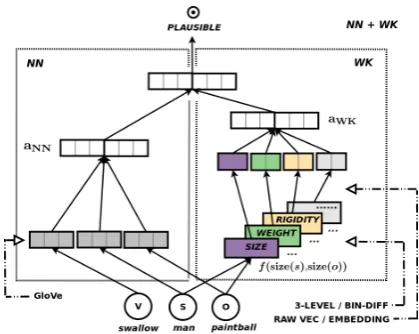
To empirically show the failure of distribution-only methods, we runVan de Cruys(2014)’s neu-ral net classifier (hereforth NN), which is one of the strongest models designed for selectional pref-erence (Figure 1, left-box). Letxbe the
concate-nation of the embeddings of the three words in an
S-V-O triple. The predictionP(y|x)is computed
as follows:
P(y= 1|x) =σ2(W2σ1(W1x)) (1)
whereσis a nonlinearity,W are weights, and we use 300D pretrained GloVe vectors (Pennington et al.,2014). The model achieves an accuracy of 68% (logistic regression baseline: 64%) after fine-tuning, verifying the intuition that distributional data alone cannot satisfactorily capture the seman-tics of physical plausibility.
4 World Knowledge Features
Recognizing that a distribution-alone method lacks necessary information, we collect a set of world knowledge features. The feature types de-rive from inspecting the high agreement event triples for knowledge missing in distributional selection (e.g. relative sizes in man-swallow-paintball/desk). Previously, Forbes and Choi
(2017) proposed a three level (3-LEVEL)
values for, e.g. relative size:{−1,0,1}(i.e. lesser, similar, greater). This method, however, does not explain many cases we observed. For instance,
man-hug-cat/ant, manis larger than bothcat and
ant, but the latter event is implausible. 3-LEVELis
also inefficient:kobjects incurO(k2)elicitations.
We thus propose a binning-by-landmark method, which is sufficiently fine-grained while still being efficient and easy for the annotator: given an entity n, the Turker decides to which of the landmarksn is closest to. E.g., forSIZE, we have the landmarks {watch, book, cat, person, jeep, stadium}, in as-cending sizes. Ifn =dog, the Turker may put n in the bin corresponding tocat. The features2are
listed with their landmarks as follows: • SENTIENCE:rock, tree, ant, cat, chimp, man.
• MASS-COUNT:milk, sand, pebbles, car.
• PHASE:smoke, milk, wood.
• SIZE:watch, book, cat, person, jeep, stadium.
• WEIGHT:watch, book, dumbbell, man, jeep, stadium.
• RIGIDITY:water, skin, leather, wood, metal.
5 Turkers provide annotations for all 450 nouns, and we obtained93%≥3agreement, 85%≥4
agreement, and 79% 5 agreement.
Our binning is sufficiently granular, which is crucial for semantic plausibility of an event in many cases. E.g. forman-hug-cat/ant, man, cat
and ant fall in the 4th,3rd and 1st bin, which
suffices to explain why man-hug-cat is plausible whileman-hug-antis not. Compared to past work (Forbes and Choi,2017), it is efficient. Each entity only needs one assignment in comparison to the landmarks to be located in a “global scale” (e.g. from the smallest to the largest objects), and even for extreme granularity, it only takes O(klogk)
comparisons. It is also intuitive: differences in bins capture the intuition that one canhugsmaller objects as long as those objects are not too small.
5 Models
We answer two questions: (i) Does world knowl-edge improve the accuracy of semantic plausibil-ity classification? (ii) Can we minimize effort in knowledge feature annotation by learning from a
2We experimented with numerous feature types, e.g. size,
[image:3.595.312.522.60.227.2]temperature, shape, etc. and kept the subset that contributes most substantially to semantic plausibility classification. More details on the feature types in supplementary ma-terial (https://github.com/suwangcompling/ Modeling-Semantic-Plausibility-NAACL18/ tree/master/supplementary).
Figure 1: Model architecture (example input: man-swallow-paintball). Left box: Van de Cruys (2014)’s neural net (NN, embeddings only); Right box: world
knowledge feature net WK with different modeling
choices (Section 5). Only SIZE, WEIGHT, RIGIDITY are shown; the rest receive the same treatment. NN+ WK: embedding and world knowledge combined.
small amount of training data?
For question (i), we experiment with various methods to incorporate the features on top of the embedding-onlyNN(Section3). Our architecture3
is outlined in Figure 1, where we ensemble the
NN(left-box) and another feedforward net for fea-tures (WK, right-box) to produce the final predic-tion. For the feature net, the relative physical at-tributes of the subject-object pair can be encoded in3-LEVEL(Section4) or the bin difference (BIN -DIFF) scheme.4 For BIN-DIFF, given the two
en-tities in an S-V-O event (i.e. S, O) ant andman,
which are in the bins of the landmarkwatch(i.e. the1st) and that ofperson (i.e. the4th), the pair
ant-mangets aBIN-DIFFvalue of1−4 =−3. Ex-emplifying the featurization functionf(s, o)with
SIZE:
f3-L(SIZE(s),SIZE(o))∈ {−1,0,1} (2) fBIN(SIZE(s),SIZE(o)) =BIN(s)−BIN(o) (3)
Then, given a featurization scheme, we may feed raw feature values (RAW VEC, for 3-LEVEL, e.g.
concatenation of -1, 0 or 1 of all feature types, in that order, and in one-hot format), or feature embeddings (EMBEDDING, e.g. concatenation of embeddings looked up with feature values).
Fi-3More configuration details in supplementary material. 4We also tried usingbin numbersdirectly, however it does
not produce ideal results (classification accuracy between
MODELS 5% 20% Label Spreading (Zhu et al.,2004) 0.56 0.59 Factor Graph (Forbes and Choi,2017) 0.69 0.71 Multi-LDA (Wang et al.,2017) 0.64 0.72 Logistic Regression 0.72 0.83 Factor Graph (initialized with our LR) 0.72 0.84
Ordinal-LR 0.76 0.88
MODELS 5% 20% 3-L BIN 3-L BIN Logistic Regression 0.61 0.21 0.68 0.26 Ordinal-LR 0.66 0.32 0.76 0.40
Table 2: Feature Propagation. Top-table: results
on Forbes and Choi (2017)’s 2.5k object pair data;
Bottom-table: results on our 10k object pair data.
nally, let aNN,aWK be the penultimate-layer
vec-tors ofNNandWK(see Figure 1), we affine
trans-form their concatenation to predict label yˆ with
argmax on the final softmax layer:
ˆ
y =argmax
y softmax(σ(W[aNN;aWK] +b)) (4)
whereσis a ReLU nonlinearity. We will only re-port the results from the best-performing model configuration, which has BIN-DIFF + EMBED -DING. The model will be listed below as NN
+ WK-GOLD (i.e. with GOLD, Turker-annotated
WorldKnowledge features).
For question (ii), we select a data-efficient fea-ture learning model. Following Forbes and Choi
(2017) we evaluate the models with 5% or 20% of training data. We experiment with several pre-viously proposed techniques: (a)label spreading; (b) factor graph; (c) multi-LDA. As a baseline we employ a simple but well-tuned logistic re-gressor (LR). We also initialize the factor graph with this LR, on account of its unexpectedly strong performance.5 Finally, observing that the feature
types are inherently ordinal (e.g. SIZEfrom small
to large), we also run ordinal logistic regression
(Adeleke and Adepoju,2010). For model selec-tion we first evaluate the object-pair attribute data collected by Forbes and Choi (2017), 2.5k pairs labeled in the 3-LEVEL scheme. We then
com-pared the the LR and Ordinal-LR (our strongest models6in this experiment) on 10k randomly
gen-erated object-pairs from our annotated nouns. The results are summarized in Table 2, where we see
5We verified our setup with the authors and they attributed the
higher performance of our LR to hyperparameter choices.
6Because the factor graph + LR gives very slight
improve-ment, for simplicity we choose LR instead.
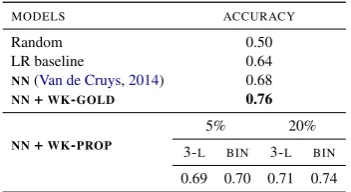
MODELS ACCURACY
Random 0.50
LR baseline 0.64
NN(Van de Cruys,2014) 0.68
NN+WK-GOLD 0.76
NN+WK-PROP
5% 20%
[image:4.595.75.289.61.193.2]3-L BIN 3-L BIN 0.69 0.70 0.71 0.74
Table 3: Semantic Plausibility (binary) Classification. The average of 10-fold CV (splitting on the total 3,062 entries). The neural classifier injected with full an-notation of world knowledge (i.e. NN + WK-GOLD) performs substantially better, and the performance re-tainment is rather strong with propagated features (by Ordinal-LR) from small fractions of gold annotation (i.e. inNN+WK-PROP).
(i) 3-LEVEL propagation is much easier; (ii) our
object-pairs are more challenging, likely due to sparsity with larger vocabulary size; (iii) ordinal-ity information contributes substantially to perfor-mance. The model that uses propagated features (w/ Ordinal-LR) will be listed asNN+WK-PROP.
6 Semantic Plausibility Results
We evaluate the models on the task of classifying our 3,062 S-V-O triples by semantic plausibility
(10-fold CV, taking the average over 20 runs with the same random seed). We compare our three models in the 3-LEVEL and BIN-DIFF schemes,
with NN + WK-PROP evaluated in 5% and 20%
training conditions. The results are outlined in Ta-ble 3. Summarizing our findings: (i) world knowl-edge undoubtedly leads to a strong performance boost (∼8%); (ii) BIN-DIFF scheme works much
better than 3-LEVEL— it manages to outperform
the latter even with much weaker propagation ac-curacy; (iii) the accuracy loss with propagated fea-tures seems rather mild with 20% labeled training and the best scheme.
7 Error Analysis
To understand what challenges remain in this task, we run the models above 200 times (10-fold CV, random shuffle at each run), and inspect the top 200 most frequently misclassified cases. The pcentage statistics below are from counting the er-ror cases.
In the cases where NN misclassifies while NN
+ WK-GOLD correctly classifies, 60% relates to
[image:4.595.330.506.62.158.2](bad) ordog-pull-paper(good)). PHASEtakes up
18% (e.g. missing monkey-puff-smoke (good)). This validates the intuition that distributional con-texts do not encode these types of world knowl-edge.
For cases often misclassified byallthe models, we observe two main types of errors: (i) data sparsity; (ii) highly-specific attributes.
Data sparsity (32%). man-choke-ant, e.g., is a singleton big-object-choke-small-object instance, and there are no distributionally similar verbs that can help (e.g. suffocate); Forsun-heat-water, be-cause the majority of the actions in the data are limited to solid objects, the models tend to predict implausible for whenever a gas/liquid appears as the object.
Highly-specific attributes (68%). “long-tailed” physical attributes which are absent from our fea-ture set are required. To exemplify a few:7
• edibility (21%). *-fry-egg (plausible) and
*-fry-cup (implausible) are hard to distin-guish because egg and cup are similar in
SIZE/WEIGHT/..., however introducing large
free-text data to help learn edibility mis-guides our model to mind selectional prefer-ence, causing mislabeling of other events. • natural vs. artificial (18%). Turkers
of-ten think creating natural objects like moon
or mountain is implausible but creating an equally big (but artificial) object like
skyscraperis plausible.
• hollow objects (15%). plane-contain-shell
and purse-contain-scissors are plausible, but the hollow-object-can-contain-things at-tribute is failed to be captured.
• forefoot dexterity (5%). horse-hug-man is implausible but bear-hug-man is plausible; For *-snatch-watch, girl is a plausible sub-ject, but notpig. Obviously the dexterity of the forefoot of the agent matters here. The analysis shows that the task and the dataset highlights the necessity for more sophisticated knowledge featurization and cleverer learning techniques (e.g. features from computer vision, propagation methods with stronger capacity to generalize) to reduce the cost of manual annota-tion.
7Percentages calculated with the 68% as the denominator.
Full list in supplementary material.
8 Conclusion
We present the novel task of semantic plausibil-ity, which forms the foundation of various inter-esting and complex NLP tasks in event seman-tics (Bowman et al., 2016; Mostafazadeh et al.,
2016; Li and Jurafsky, 2017). We collected a high-quality dedicated dataset, showed empiri-cally that the conventional, distribution data only model fails on the task, and that clever world knowledge injection can help substantially with little annotation cost, which lends initial empiri-cal support for the sempiri-calability of our approach in practical applications, i.e. labeling little but prop-agating well approximates performance with full annotation. Granted that annotation-based injec-tion method does not cover the full spectrum of leverageable world knowledge information (alter-native/complementary sources being images and videos, e.g. Bagherinezhad et al. 2016), it is in-deed irreplaceable in some cases (e.g. features such asWEIGHTorRIGIDITYare not easily
learn-able through visual modality), and in other cases presents a low-cost and effective option. Finally, we also discovered the limitation of existing meth-ods through a detailed error analysis, and thereby invite cross-area effort (e.g. multimodal knowl-edge features) in the future exploration in auto-mated methods for semantic plausibility learning.
Acknowledgments
This research was supported by NSF grant IIS 1523637. Further, this material is based on re-search sponsored by DARPA under agreement number FA8750-18- 2-0017. The U.S. Govern-ment is authorized to reproduce and distribute reprints for Governmental purposes notwithstand-ing any copyright notation thereon. We acknowl-edge the Texas Advanced Computing Center for providing grid resources that contributed to these results. We would also like to thank our reviewers for their insightful comments.
References
K.A. Adeleke and A.A. Adepoju. 2010. Ordinal Logis-tic Regression Model: An Application to Pregnancy Outcomes. Journal of Mathematics and Statistics
6(3):279–285.
Than Butterflies? Reasoning about Sizes of Objects. InProceedings of AAAI.
Samuel R. Bowman, Luke Vilnis, Oriol Vinyals, An-drew M. Dai, Rafal Jozefowicz, and Samy Ben-gio. 2016. Generating Sentences from a Continuous Space. InProceedings of CoNLL.
M Brysbaert, A.B. Warriner, and V. Kuperman. 2014. Concreteness Ratings for 40 Thousand Generally Known English Word Lemmas. Behavior Research Methods46:904–911.
Nathanael Chambers. 2013. Event schema induction with a probabilistic entity-driven model. In Pro-ceedings of EMNLP.
Stephen Clark and David Weir. 2001. Class-based probability estimation using a semantic hierarchy. InProceedings of NAACL.
Katrin Erk and Sebastian Pad´o. 2010. Exemplar-Based Models for Word Meaning in Context. In Proceed-ings of ACL.
Maxwell Forbes and Yejin Choi. 2017. VERB PHYSICS: Relative Physical Knowledge of Actions and Objects. InProceedings of ACL.
Jiwei Li and Daniel Jurafsky. 2017. Neural Net Models of Open-domain Discourse Coherence. In Proceed-ings of EMNLP.
Nasrin Mostafazadeh, Nathanael Chambers, Xiaodong He, Devi Parikh, Dhruv Batra, Lucy Vanderwende, Pushmeet Kohli, and James Allen. 2016. A Corpus and Cloze Evaluation for Deeper Understanding of Commonsense Stories. InProceedings of NAACL.
Diarmiuid O’Seaghdha. 2010. Latent variable models of selectional preference. InProceedings of ACL.
Jeffrey Pennington, Richard Socher, and Christo-pher D. Manning. 2014. GloVe: Global Vectors for Word Embeddings. InProceedings of EMNLP.
Philip Resnik. 1996. Selectional Constraints: An Information-Theoretic Model and Its Computational Realization. Cognition61:127–159.
Ottokar Tilk, Vera Demberg, Asad Sayeed, Dietrich Klakow, and Stefan Thater. 2016. Event Participant Modeling with Neural Networks. InProceedings of EMNLP.
Tim Van de Cruys. 2014. A Neural Network Approach to Selectional Preference Acquisition. In Proceed-ings of EMNLP.
Su Wang, Stephen Roller, and Katrin Erk. 2017. Distri-butional Modeling on a Diet: Learning Word Prop-erties from Text Only. InProceedings of IJCNLP.
Sheng Zhang, Rachel Rudinger, Kevin Duh, and Ben-jamin Van Durme. 2017. Ordinal Common-sense Inference. TACL5:379–395.
Dengyong Zhu, Olivier Bousquet, Thomas Navin Lal, Jason Weston, and Bernhard Sch¨olkopf. 2004. Learning with Local and Global Consistency. In