Improvement of a Naive Bayes Sentiment Classifier Using MRS-Based
Features
Jared Kramer
University of Washington Seattle, WA [email protected]
Clara Gordon
University of Washington Seattle, WA [email protected]
Abstract
This study explores the potential of us-ing deep semantic features to improve bi-nary sentiment classification of paragraph-length movie reviews from the IMBD website. Using a Naive Bayes classifier as a baseline, we show that features extracted from Minimal Recursion Semantics repsentations in conjunction with back-off re-placement of sentiment terms is effective in obtaining moderate increases in accu-racy over the baseline’s n-gram features. Although our results are mixed, our most successful feature combination achieves an accuracy of 89.09%, which represents an increase of 0.76% over the baseline per-formance and a 6.48% reduction in error.
1 Introduction
Text-based sentiment analysis offers valuable in-sight into the opinions of large communities of re-viewers, commenters and customers. In their sur-vey of the field, Pang and Lee (2008) highlight the importance of sentiment analysis across a range of industries, including review aggregation web-sites, business intelligence, and reputation man-agement. Detection and classification of sentiment can improve downstream performance in applica-tions sensitive to user opinions, such as question-answering, automatic product recommendations, and social network analysis (ibid., p. 12).
While previous research in sentiment analysis has investigated the extraction of features from syntactic dependency trees, semantic representa-tions appear to be underused as a resource for modeling opinion in text. Indeed, to our knowl-edge, there has been no research using seman-tic dependencies created by a precision grammar for sentiment analysis. The goal of the present research is to address this gap by augmenting a
baseline classifier with features based on Min-imal Resursion Semantics (MRS; Copestake et al., 2005), a formal semantic representation pro-vided by the English Resource Grammar (ERG; Flickinger, 2000). An MRS is a connected graph in which semantic entities may be linked directly through shared arguments or indirectly through handle or qeq constraints, which denote equal-ity modulo quantifier insertion (Copestake et al., 2005). This schema allows for underspecification of quantifier scope.
Using Narayanan et al.’s (2013) Naive Bayes sentiment classifier as a baseline, we test the effec-tiveness of eight feature types derived from MRS. Our feature pipeline crawls various links in the MRS representations of sentences in our corpus of paragraph-length movie reviews and outputs simple, human-readable features based on various types of semantic relationships. This improved system achieves modest increases in binary senti-ment classification accuracy for several of the fea-ture combinations tested.1
In the following sections, we summarize previ-ous research in MRS feature extraction and senti-ment classification, describe the baseline system and our modifications to it, and outline our ap-proach to parsing our data, constructing features, and integrating them into the existing system. Fi-nally, we report our findings, examine in more detail where our improved system succeeded and failed in relation to the baseline, and suggest av-enues for further research in sentiment analysis with MRS-based features.
2 Context and Related Work
Current approaches to sentiment analysis tasks typically use supervised machine learning
meth-1Because this task consists of binary classification on an evenly split dataset and every test document is assigned a class, simple accuracy is the most appropriate measure of per-formance.
ods with bag-of-words features as a baseline, and for classification of longer documents like the ones in our dataset, such features remain a powerful tool of analysis. Wang and Manning (2012) com-pare the performance of several machine learning algorithms using uni- and bigram features from a variety of common sentiment datasets, including the IMDB set used in this project. They report that that SVM classifiers generally perform better sen-timent classification on paragraph-length reviews, while Native Bayes classifiers produce better re-sults for “snippets,” or short phrases (ibid., p. 91). For our dataset, they obtain the highest accuracies using a hybrid approach, SVM with Naive Bayes features, which results in 91.22% accuracy (ibid., p. 93). This appears to be the best test result to date on this dataset. Although we use a Naive Bayes classifier in our project, alternative machine learning algorithms are a promising topic of fur-ther future investigation (see§6).
Two existing areas of research have direct rele-vance to this project: MRS feature extraction, and sentiment analysis using features based on deep linguistic representations of data. In their work on machine translation, Oepen et al. (2007) define a type of MRS triple based on elementary dependen-cies, a simplified “variable-free” representation of predicate-argument relations in MRS (p. 5). Fu-jita et al. (2007) and Pozen (2013) develop simi-lar features for HPSG parse selection, and Pozen experiments with replacing segments of predicate values in triple features with WordNet sense, POS, and lemma information (2013, p. 32).
While there has not yet been any research on us-ing MRS features in sentiment analysis, there has been work on extracting features from deep repre-sentations of data for sentiment analysis. In work-ing with deep representations such as MRSes or dependency parses, there are myriad sub-graphs that can be used as features. However these fea-tures are often quite sparse and do not general-ize well. Joshi & Rose (2009) improve perfor-mance of a sentiment classifier by incorporating triples consisting of words and grammatical rela-tions extracted from dependency parses. To in-crease the generalizability of these triples, they perform back-off by replacing words with part-of-speech tags. Similarly, Arora et al. (2010) extract features from dependency parses by using senti-ment back-off to identify potentially meaningful portions of the dependency graph. Given this
suc-cess combining back-off with sub-graph features, we design several feature types following a similar methodology.
2.1 The IMBD Dataset
We use a dataset of 50,000 movie reviews crawled from the IMDB website, originally developed by Maas et al. (2011). The dataset is split equally between training and test sets. Both training and test sets contain equal numbers of positive and negative reviews, which are defined according to the number of stars assigned by the author on the IMBD website: one to four stars for nega-tive reviews, and seven to ten stars for posinega-tive reivews. The reviews vary in length but gener-ally contain between five and fifteen sentences. The Natural Language ToolKit’s (NLTK; Loper and Bird, 2002) sentence tokenizer distinguishes 616,995 sentences in the dataset.
Unlike previous research over this dataset, we divide the 25,000 reviews of the test set into two development sets and a final test set. As such, our results are not directly comparable to those of Wang & Manning (2012).
2.2 The Baseline System
The system we use as a baseline, created by Narayanan et al. (2013), implements several small but innovative improvements to a simple Naive Bayes classifier. In the training phase, the base-line performs simple scope of negation annota-tion on the surface string tokens. Any word con-taining the charactersnot,n’t ornotriggers a “negated” state, in which all following n-grams are prepended withnot . This continues until either a punctuation delimiter (?.,!:;) or another negation trigger is encountered.
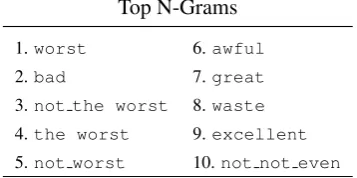
informa-Top N-Grams 1.worst 6.awful
2.bad 7.great
3.not the worst 8.waste
4.the worst 9.excellent
[image:3.595.92.271.66.155.2]5.not worst 10.not not even
Table 1: Top MI-ranked baseline n-gram Features.
tion score, out of the 12.1 million n-gram features generated by our baseline.
Before modifying the baseline system’s code, we reproduced their reported accuracy figure of 88.80% over the entire 25,000 review test set. However, it appears the baseline system used the test data as development data. In order to address this, we split the data as into development sets as described above. When we ran the baseline sys-tem over our final test set, we obtained accuracies of 88.34% pre-feature filtering and 88.29% post-feature filtering; our division of the original test set into development and test sets accounts for this discrepancy.
3 Methodology
Our approach to this task consisted of three gen-eral stages: obtaining MRSes for the dataset, implementing a feature pipeline to process the MRSes, and integrating the new features into the classifier. In this section we will describe each of these processes in turn.
3.1 Parsing with the ERG
Because most of the reviews in our data set ap-pear to be written in Standard English, we per-form minimal pre-processing before parsing the dataset with the ERG. We use NLTK’s sentence tokenization function in our pipeline, along with their HTML-cleaning function to remove some stray HTML-style tags we encountered in the data. To obtain MRS parses of the data, we use ACE version 0.9.17, an “efficient processor for DELPH-IN HPSG grammars.”2 ACE’s
sim-ple command line interface allows the parsing pipeline to output MRS data in a single line to a separate directory of MRS data files. We used the 1212 ERG grammar image3and specified root
2Available at http://sweaglesw.org/linguistics/ace/. Ac-cessed January 15, 2014.
3Available at http://www.delph-in.net/erg/. Accessed
Jan-conditions that would allow for parses of the infor-mal and fragmented sentences sometimes found in our dataset: namely, the root informal,
root frag and root inffrag ERG root
nodes.
Parsing with these conditions resulted in 81.11% coverage over the entire dataset. After manual inspection of sentences that failed to parse, we found that irregularities in spelling and punc-tuation accounted for the majority of these failures and further cleaning of the data would yield higher coverage.
3.2 Feature Design
Our main focus in feature design is capturing rel-evant semantic relationships between sentiment terms that extend beyond the trigram boundary. Our entry point into the MRS is the elementary predication (EP), and our pipeline algorithm ex-plores the three main EP components: arguments and associated variables, label, and predicate sym-bol. We also use the set of handle constraints in crawling the links between EPs.
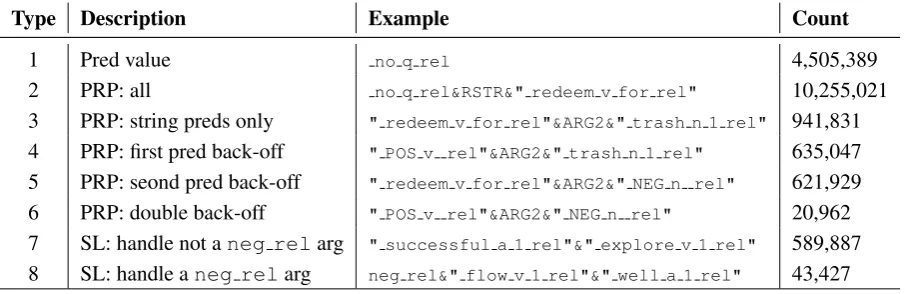
We use two main categories of crawled MRS features: Predicate-Relation-Predicate (PRP) triples, a term borrowed from (Pozen, 2013), and Shared-Label (SL) features. Our feature template consists of eight feature subtypes, including plain EP symbols (type 1), five PRP features (types 2 through 6) and two SL features (types 7 and 8). Table 2 gives examples of each type, along with the unpruned counts of distinct features gathered from our training data. The examples for types 1 through 6 are taken from the abridged MRS example in Figure 1. Note that an & character separates predicate and argument components in the feature strings. The type 7 and 8 examples are taken from MRS of sentences featuring the phrasessuccessfully exploresanddidn’t flow well, respectively.
In our feature extraction pipeline, we use Good-man’s pyDelphin4 tool, a Python module that
al-lows for easy manipulation and querying of MRS constituents. This tool allows our pipeline to quickly process the ERG output files, obtain argu-ment and handle constraint information, and out-put the features for each MRS into a feature file to be read by our classifier. If the grammar has not returned an analysis for a particular sentence, the uary 15, 2014.
There is nothing redeeming about this trash. [LTOP: h0
INDEX:e2 [e SF:prop TENSE:pres MOOD:indicative PROG:- PERF:-]
<[be v there rel<6:8> LBL:h1 ARG0:e2 ARG1:x4] [thing rel<9:16> LBL:h5 ARG0:x4] [no q rel<9:16> LBL:h6 ARG0:x4 RSTR:h7 BODY:h8] [" redeem v for rel"<17:26> LBL:h5 ARG0:e9 ARG1:x4 ARG2:x10]
[" about x deg rel"<27:32> LBL:h11 ARG0:e12 ARG1:u13] [this q dem rel<33:37> LBL:h11 ARG0:x10 RSTR:h14 BODY:h15] [" trash n 1 rel"<38:44> LBL:h16 ARG0:x10]>
[image:4.595.75.528.217.364.2]HCONS: <h0 qeq h1 h7 qeq h5 h14 qeq h16>]
Figure 1: Sample abridged MRS, with mood, tense, and other morphosemantic features removed. Each EP is enclosed in square brackets, bold type denotes predicate values.
Type Description Example Count
1 Pred value no q rel 4,505,389
2 PRP: all no q rel&RSTR&" redeem v for rel" 10,255,021
3 PRP: string preds only " redeem v for rel"&ARG2&" trash n 1 rel" 941,831
4 PRP: first pred back-off " POS v rel"&ARG2&" trash n 1 rel" 635,047
5 PRP: seond pred back-off " redeem v for rel"&ARG2&" NEG n rel" 621,929
6 PRP: double back-off " POS v rel"&ARG2&" NEG n rel" 20,962 7 SL: handle not aneg relarg " successful a 1 rel"&" explore v 1 rel" 589,887 8 SL: handle aneg relarg neg rel&" flow v 1 rel"&" well a 1 rel" 43,427
Table 2: Sample features (Note: Types 1 - 6 are taken from the MRS in Figure 1)
pipeline simply does not output any features for that sentence.
3.2.1 MRS Crawling
In their revisiting of the 2012 SEM scope of nega-tion shared task, Packard et al. (2014) improve on the previous best performance using a relatively simple set of MRS crawling techniques. We make use of two of these techniques, “argument crawl-ing” and “label crawlcrawl-ing” in extracting our PRP and SL features (ibid., p. 3). Both include select-ing an “active EP” and addselect-ing to its scope all EPs that conform to certain specifications. Argument crawling selects all EPs whose distinguished vari-able or label is an argument of the active EP, while label crawling adds EPs that share a label with the active EP (ibid., p. 3).
Our features are constructed in a similar fash-ion; for every EP in an MRS, the pipeline se-lects all EPs linked to the current EP and con-structs features from this group of “in-scope” EPs. PRP and SL features are obtained through one “layer” of argument and label crawling, re-spectively. After observing a number of noisy and uninformative features in our preliminary feature vectors, we excluded a small number
of EPs from being considered as the “active EP” in our pipeline algorithm: udef q rel, proper q rel, named rel, pron rel, and pronoun q rel. More information about what exactly these EPs represent can be found in Copes-take et al. (2005).
3.2.2 PRP Features
These feature types are a version of the depen-dency triple features used in Oepen et al. (2007) and Fujita et al. (2007). We define the linking re-lation as one in which the value of any argument of the first EP matches the distinguished variable or label of the second EP. For handle variables, we count any targets of a qeq constraint headed by that variable as equivalent. We use the same set of EP arguments as Pozen (2013) to link predicates in our PRP features: ARG, ARG1-N,L-INDEX, R-INDEX,L-HANDL,R-HANDL, andRESTR(p. 31).
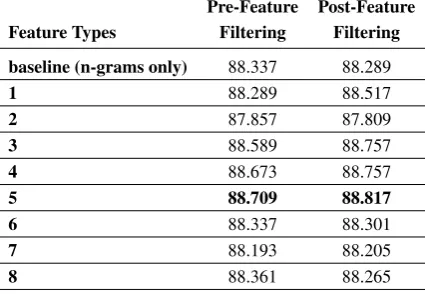
Pre-Feature Post-Feature Feature Types Filtering Filtering baseline (n-grams only) 88.337 88.289
1 88.289 88.517
2 87.857 87.809
3 88.589 88.757
4 88.673 88.757
5 88.709 88.817
6 88.337 88.301
7 88.193 88.205
[image:5.595.308.521.65.226.2]8 88.361 88.265
Table 3: Individual MRS feature trial results
matches any of the entries in the lexicon, the pipeline produces a back-off predicate value by re-placing that portion with NEG or POS and strip-ping the sense category marker. These replace-ments appear in various positions in feature types 4, 5, and 6 (see Table 2).
3.2.3 SL Features
To further explore the relationships in the MRS, we include this second feature category in our fea-ture template, which links together EPs that share a handle variable. We limit SL features to groups of EPs linked by a handle variable that is also an argument of another EP, or the target of a qeq con-straint of such a variable. Our pipeline is therefore able to extract both PRP and SL features in a sin-gle pass through the arguments of each EP. Feature type 7 consists of shared-label groupings of two or more EPs, where the handle is not the ARG1 of aneg relEP. Type 8 includes groups of one or more EPs where the handle is aneg rel ar-gument, with neg relprepended to the feature string.
Features of type 7 tend to capture relationships between modifiers, such as adverbs and adjectives, and modified entities. Features of type 8 were intended to provide some negation information, though our goals of more fully analyzing scope of negation in our dataset remain unrealized at this point. We reasoned that the lemmatization of string predicate values might provide some useful back-off for the semantic entities involved in nega-tion and modificanega-tion.
4 Evaluation
To test our MRS features, we adapted our base-line to treat them much like the n-gram features.
Pre-Feature Post-Feature Feature Types Filtering Filtering baseline (n-grams only) 88.337 88.289 n-grams with back-off 87.293 87.503 MRS only (all types) 88.253 87.977
n-grams,4,5 88.709 88.781
n-grams,3,4,5, 7, 8 88.961 88.853 n-grams, 1,4,5 88.637 88.865 n-grams,3,4,58 88.853 88.961 n-grams,3,4,5, 7 88.889 88.973 n-grams, 1,3,4,5 88.793 89.021 n-grams,3,4,5 88.865 89.093
Table 4: Combination feature results
As with n-grams, each MRS feature is counted to-ward the probability of the class of its source doc-ument, and a negated version of that feature, with not prepended, is counted toward the opposite class. We ran our feature filtering trials using the first development set, then obtained preliminary accuracy figures from our second development set. We began with each feature type in isolation and used these results to inform later experiments us-ing combinations of feature types. The numbers reported here are the results over the final, held-out test set.
Our final test accuracies indicate that three fea-ture types produce the best gains in accuracy: back-off PRPs with first- and second-predicate re-placement (types 4 and 5), and PRPs with string predicates only (type 3). Table 3 displays isolated feature test results, while Table 4 ranks the top seven feature combinations in ascending order by post-feature filtering accuracies. The bolded fea-ture types show that all of the best combination runs include one or more of the top three features mentioned above. Notable also are the accura-cies for MRS-based features alone, which fall very close to the baseline. The best accuracies for pre-and post-feature filtering tests appear in bold.
[image:5.595.75.288.67.214.2]a 6.48% reduction in error.
Most Informative MRS Features
not " NEG a rel"&ARG1& the q rel " NEG a rel"&ARG1& the q rel " POS a rel"&ARG1& the q rel not " POS a rel"&ARG1& the q rel " POS a rel"&ARG1& a q rel not " POS a rel"&ARG1& a q rel
not " NEG a rel"&ARG1&" movie n of rel" " NEG a rel"&ARG1&" movie n of rel"
a q rel&RSTR&" POS a rel" not a q rel&RSTR&" POS a rel" not " NEG a rel"&ARG1&udef q rel " NEG a rel"&ARG1&udef q rel superl rel&ARG1&" POS a rel" not superl rel&ARG1&" POS a rel"
[image:6.595.78.290.102.308.2]and c rel&LHNDL&" POS a rel"
Table 5: Most informative MRS features
5 Discussion
5.1 The Most Successful Experiments
The test accuracies indicate that our back-off re-placement method, in combination with the simple predicate-argument relationships captured in PRP triples, is the most successful aspect of feature de-sign in this project. However, as our error analysis indicates, back-off is the likely source of many of our system’s errors (see§5.2). Table 5 lists the 15 most informative MRS features from our best run based on mutual information score, all of which are of feature type 4 or 5. Note that the not prepended to some features is a function of way our classifier reads in binary features (as described in §2.2), not an indication of grammatical nega-tion. The success of these partial back-off fea-tures confirms our intuition that the semantic rela-tionships between sentiment-laden terms and other entities in the sentence offer a reliable indicator of author sentiment. When we performed back-off replacement directly on the surface strings and ran our classifier with n-grams only, we ob-tained accuracies of 87.29% pre-feature filtering and 87.50% post-feature filtering, a small decrease from the baseline performance (see Table 4). This lends additional support to the idea that the com-bination of sentiment back-off and semantic de-pendencies is significant. These results also fit with the findings of of Joshi and Rose (2009), who
determined that back-off triple features provide “more generalizable and useful patterns” in sen-timent data than lexical dependency features alone (p. 316).
Despite these promising results, we found that the separate EP values (type 1), PRP triples with-out replacement (type 2), PRPs with double re-placement (type 6) and SL features (types 7 and 8) have very little effect on accuracy by them-selves. For type 1, we suspect that EP values alone don’t contribute enough information beyond ba-sic n-gram features. We had hypothesized that the lemmatization in these values might provide some helpful back-off. However, this effect is likely drowned out by the lack of any scope of negation handling in the MRS features.
We attribute the failure of the SL features to the fact that they often capture EPs originating in ad-jacent tokens in the surface string, which does not improve on the n-gram features. Lastly, we be-lieve the relative sparsity of double back-off fea-tures was the primary reason they did not produce meaningful results.
These results also call into question the use-fulness of the feature filtering trials in our base-line. By design, these trials produce performance increases on the dataset on which they are run. However, filtering produces small and inconsistent gains for the final held-out test set.
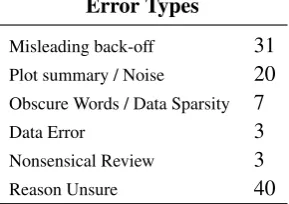
Error Types
Misleading back-off 31 Plot summary / Noise 20 Obscure Words / Data Sparsity 7
Data Error 3
Nonsensical Review 3
Reason Unsure 40
Table 6: Error types from top MRS experiment
5.2 Error Analysis
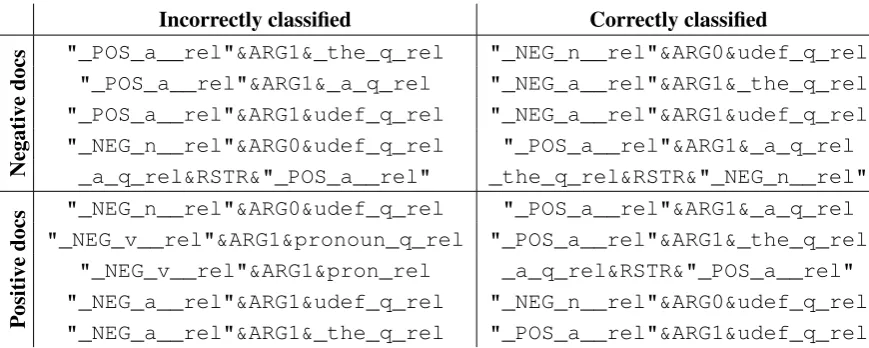
[image:6.595.345.490.474.576.2]sum-Incorrectly classified Correctly classified
Negati
ve
docs
"_POS_a__rel"&ARG1&_the_q_rel "_NEG_n__rel"&ARG0&udef_q_rel "_POS_a__rel"&ARG1&_a_q_rel "_NEG_a__rel"&ARG1&_the_q_rel "_POS_a__rel"&ARG1&udef_q_rel "_NEG_a__rel"&ARG1&udef_q_rel "_NEG_n__rel"&ARG0&udef_q_rel "_POS_a__rel"&ARG1&_a_q_rel
_a_q_rel&RSTR&"_POS_a__rel" _the_q_rel&RSTR&"_NEG_n__rel"
Positi
ve
docs
"_NEG_n__rel"&ARG0&udef_q_rel "_POS_a__rel"&ARG1&_a_q_rel "_NEG_v__rel"&ARG1&pronoun_q_rel "_POS_a__rel"&ARG1&_the_q_rel
[image:7.595.79.514.61.235.2]"_NEG_v__rel"&ARG1&pron_rel _a_q_rel&RSTR&"_POS_a__rel" "_NEG_a__rel"&ARG1&udef_q_rel "_NEG_n__rel"&ARG0&udef_q_rel "_NEG_a__rel"&ARG1&_the_q_rel "_POS_a__rel"&ARG1&udef_q_rel
Table 7: Most frequent features in test data by polarity and classification result
mary or off-topic language; use of obscure words not likely to occur frequently in the data; miscat-egorization in the dataset; and confusing or non-sensical language. The counts for these categories appear in Table 6.
The prevalence of errors in the first category is revealing, and relates to certain subcategories of review that confound our sentiment back-off features. For horror films in particular, words that would generally convey negative sentiment (creepy,horrible,gruesome) are instead used pos-itively. This presents an obvious problem for senti-ment back-off, which relies on the assumption that words are generally used with the same intent.
To explore this further, we collected counts of the most frequent features in these 104 reviews, and compared them to feature counts for correctly classified documents of the same class. The stark contrast between the back-off polarities of the fea-tures extracted and the polarity of the documents suggests that these feature types are overgener-alizing and misleading the classifier (see Table 7). While the course-grained polarity of sentiment terms is often a good indicator of overall review polarity, our system has difficulty with cases in which many sentiment terms do not align with the review sentiment. Our back-off PRP features do not include scope of negation handling, so even if these terms are negated, our classifier in its current form is unable to take advantage of that informa-tion.
Further manual observation of the feature vec-tors from these documents suggests that the senti-ment lexicon contains elesenti-ments that are not suited to the movie review domain; plot, for example is
classified as a negative term. These results point to the need for a more domain-specific sentiment lexicon, and perhaps additional features that look at the combination of sentiment terms present in a review. LDA models could provide some guidance in capturing and analyzing co-occurring groups of sentiment terms.
6 Conclusions and Future Work
Our attempt to improve binary sentiment classifi-cation with MRS-based features is motivated by a desire to move beyond shallow approaches and ex-plore the potential for features based on semantic dependencies. Our preliminary results are promis-ing, if modest, and point to back-off replacement as a useful tool in combination with the relation-ships captured by predicate triples.
There are a number of potential areas for im-provement and further development of our ap-proach. In light of Wang and Manning’s (2012) re-sults using an SVM classifier on the same dataset, one obvious direction would be to experiment with this and other machine learning algorithms. Addi-tionally, the ability to account for negation in the MRS features types as in Packard et al. (2014) would likely mitigate some of the errors caused by the back-off PRP features
effects of various sub-components. Given their success with syntactic dependencies, and the re-search presented here, we believe semantic de-pendencies will be a fruitful avenue for future re-search in sentiment analysis. This project has been an exciting first step into uncharted territory, and suggests the potential to further exploit the MRS in sentiment analysis applications. Nonetheless, the performance gains we were able to observe demonstrate the power of using semantic repre-sentations produced by a linguistically motivated, broad-coverage parser as an information source in a semantically sensitive task such as sentiment analysis.
Acknowledgments
Thanks to our professor, Emily Bender, for pro-viding her expertise and guidance at all stages of this project.
We’re grateful to Michael Goodman for making his pyDelphin module freely available, guiding us in using it, and providing timely troubleshoot-ing and support via email for the duration of this project. Thanks to Woodley Packard, who pro-vided helpful advice on getting the best use out of ACE.
References
S. Arora, E. Mayfield, C Penstein-Ros´e, and E Nyberg. 2010. Sentiment Classification using Automatically
Extracted Subgraph Features. InProceedings of the
NAACL HLT 2010 Workshop on Computational Ap-proaches to Analysis and Generation of Emotion in Text,pp. 131 - 139. Los Angeles, CA.
A. Copestake, D. Flickinger, C. Pollard, and I. A. Sag. 2005. Minimal Recursion Semantics: An
Introduc-tion. Research on Natural Language and
Computa-tion, 3(4), pp. 281 - 332.
D. Flickinger. 2000. On building a more efficient
grammar by exploiting types. Natural Language
Engineering,, 6(1), pp. 15 - 28.
S. Fujita, F. Bond, S. Oepen, T. Tanaka. 2010. Exploit-ing semantic information for HPSG parse selection.
Research on Language and Computation. 8(1): 1-22 M. Hu and B. Liu. 2004. Mining and
Summariz-ing Customer Reviews. InProceedings of the ACM
SIGKDD International Conference on Knowledge Discovery and Data Mining (KDD-2004). Seattle, WA.
M. Joshi and C Penstein Ros´e. 2009. Generalizing
Dependency Features for Opinion Mining. In
Pro-ceedings of the ACL-IJCNLP 2009 Conference Short Papers,pp. 313 - 316. Suntec, Singapore.
E. Loper, and S., Bird. 2002. NLTK: The Natu-ral Language Toolkit. In Proceedings of the ACL Workshop on Effective Tools and Methodologies for Teaching Natural Language Processing and Compu-tational Linguistics. Philadelphia: Association for Computational Linguistics
L. Jia, C. Yu, and W. Meng. 2009. The effect of nega-tion on sentiment analysis and retrieval
effective-ness. In Proceedings of the 18th ACM conference
on Information and knowledge management (CIKM ’09), pp. 1827 - 1830. Hong Kong, China.
A. L. Maas, R. E. Daly, Peter T. Pham, Dan Huang, Andrew Y. Ng, and C. Potts. 2011. Learning word vectors for sentiment analysis. InProceedings of the 49th Annual Meeting of the Association for Com-putational Linguistics: Human Language Technolo-gies, pp. 142 - 150. Portland, Oregon.
V. Narayanan, I. Arora, and A. Bhatia. 2013. Fast and accurate sentiment classification using an enhanced
Naive Bayes’model. Intelligent Data Engineering
and Automated Learning IDEAL function Lecture Notes in Computer Science, 8206:194 - 201. S. Oepen, E. Velldal, J. Lonning, P. Meurer, V. Rosn,
and D. Flickinger. 2007. Towards Hybrid
Qual-ity Oriented Machine Translation. InProceedings
of the 11th International Conference on Theoretical and Methodological Issues in Machine Translation.
W. Packard, E. M. Bender, J. Read, S. Oepen and R. Dridan. 2014. Simple Negation Scope Resolution Through Deep Parsing: A Semantic Solution to a
Semantic Problem. InProceedings of the 52nd
An-nual Meeting of the Association for Computational Linguistics. Baltimore, MD.
B. Pang and L. Lee. 2008. Opinion Mining and
Senti-ment Analysis.Foundations and Trends in
Informa-tion Retrieval, 2(1-2):1 - 135.
Z. Pozen. 2013. Using Lexical and Compositional
Se-mantics to Improve HPSG Parse Selection. Master’s
Thesis, University of Washington.
R. Socher, A. Perelygin, J. Wu, J. Chuang. C. Man-ning, A. Ng, and C. Potts 2013. Recursive Deep Models for Semantic Compositionality Over a
Sen-timent Treebank InProceedings of the 2013
Con-ference on Empirical Methods in Natural Language Processing,pp. 1631-1642. Seattle, WA.
S. Wang and C. D. Manning. 2012. Baselines and Bi-grams: Simple, Good Sentiment and Topic
Classica-tion. InProceedings of the 50th Annual Meeting of
the Association for Computational Linguistics, pp. 90 94. Jeju, Republic of Korea.