Apples to Oranges: Evaluating Image Annotations from Natural Language
Processing Systems
Rebecca Mason and Eugene Charniak
Brown Laboratory for Linguistic Information Processing (BLLIP) Brown University, Providence, RI 02912
{rebecca,ec}@cs.brown.edu
Abstract
We examine evaluation methods for systems that automatically annotate images using co-occurring text. We compare previous datasets for this task using a series of baseline mea-sures inspired by those used in information re-trieval, computer vision, and extractive sum-marization. Some of our baselines match or exceed the best published scores for those datasets. These results illuminate incorrect as-sumptions and improper practices regarding preprocessing, evaluation metrics, and the col-lection of gold image annotations. We con-clude with a list of recommended practices for future research combining language and vi-sion processing techniques.
1 Introduction
Automatic image annotation is an important area with many applications such as tagging, generat-ing captions, and indexgenerat-ing and retrieval on the web. Given an input image, the goal is to generate rel-evant descriptive keywords that describe the visual content of the image. The Computer Vision (CV) literature contains countless approaches to this task, using a wide range of learning techniques and visual features to identify aspects such as objects, people, scenes, and events.
Text processing is computationally less expensive than image processing and easily provides informa-tion that is difficult to learn visually. For this reason, most commerical image search websites identify the semantic content of images using co-occurring text exclusively. But co-occurring text is also a noisy
source for candidate annotations, since not all of the text is visually relevant. Techniques from Natural Language Processing help align descriptive words and images. Some examples of previous research use named-entity recognition to identify people in images (Deschacht and Moens, 2007); term associa-tion to estimate the “visualness” of candidate anno-tations (Boiy et al., 2008; Leong et al., 2010); and topic models to annotate images given both visual and textual features (Feng and Lapata, 2010b).
Image annotation using NLP is still an emerging area with many different tasks, datasets, and eval-uation methods, making it impossible to compare many recent systems to each other. Although there is some effort being made towards establishing shared tasks1, it is not yet clear which kinds of tasks and datasets will provide interesting research questions and practical applications in the long term. Until then, establishing general “best practices” for NLP image annotation will help advance and legitimitize this work. In this paper, we propose some good prac-tices and demonstrate why they are important.
2 Image Annotation Evaluation in CV and NLP
In this section, we first review related work in im-age annotation evaluation in computer vision, spe-cific challenges, and proposed solutions. We then relate these challenges to the NLP image annotation task and some of the specific problems we propose to address.
1http://imageclef.org/
2.1 Related Work in Computer Vision
The work of M¨uller et al. (2002) is one of the first to address the issue of evaluation for image annota-tion systems. While using the exact same annotaannota-tion system, dataset, and evaluation metric, they dramati-cally improve the apparent performance of their sys-tem by using dataset pruning heuristics.
Others have criticized commonly-used CV datasets for being too “easy” — images with the same keywords are extremely similar in low-level features such as orientation, lighting, and color; while differences between images with different keywords are very clear (Westerveld and de Vries, 2003; Ponce et al., 2006; Herv´e and Boujemaa, 2007; Tang and Lewis, 2007). These features are unwittingly exploited by certain algorithms and obscure the benefits of using more complex tech-niques (Ponce et al., 2006). The problem is further exacerbated by evaluation metrics which essentially prefer precision over recall and are biased towards certain keywords. Annotations in test data might not include all of the “correct” keywords, and evaluation metrics need to account for the fact that frequent keywords in the corpus are safer guesses than keywords that appear less frequently (Monay and Gatica-Perez, 2003).
New baseline techniques, evaluation metrics, and datasets for image annotation have been developed in response to these problems. Makadia et al. (2008; 2010) define a basic set of low-level features, and propose new baselines for more complex systems to evaluate against. Barnard et al. (2003) present a nor-malized loss function to address the preference to-wards precision in evaluation metrics. New datasets are larger and provide more diverse images, and it is now easy to obtain multiple human-annotations per image thanks to distributed services such as Ama-zon’s Mechanical Turk, and the ESP game (von Ahn and Dabbish, 2004). Hanbury (2008) provides an overview of popular CV annotation datasets and methods used for building them.
2.2 Image Annotation using Natural Language Processing
Many of the problems from CV image annotation are also applicable to NLP image annotation, and bringing NLP to the task brings new challenges as
well. One of these challenges is whether to allow infrequent words to be pruned. In CV annotation it is typical to remove infrequent terms from both the keyword vocabulary and the evaluation data because CV algorithms typically need a large number of ex-amples to train on. However, using NLP systems and baselines one can correctly annotate using key-words that did not appear in the training set. Remov-ing “unlearnable” keywords from evaluation data, as done in (Boiy et al., 2008; Feng and Lapata, 2010b), artificially inflates performance against simple base-lines such as term frequency.
Nearly all NLP annotation datasets use naturally-occurring sources of images and text. A particu-larly popular source is news images alongside cap-tions or articles, which are collected online from sources such as Yahoo! News (Berg et al., 2004; De-schacht and Moens, 2007). There are also domain-specific databases with images and descriptions such as the art, antiques, and flowers corpora used in Boiy et al. (2008). Wikipedia has also been used as a source of images and associated text (Tsikrika et al., 2011). These sources typically offer well-written and cleanly formatted text but introduce the problem of converting text into annotations, and the annota-tions may not meet the requirements of the new task (as shown in Section 3.1). Obtaining data via image search engines is a common practice in CV (Fei-Fei et al., 2004; Berg and Forsyth, 2006) and can also be used to provide more challenging and diverse in-stances of images and co-occurring text. The addi-tional challenge for NLP is that text content on many websites is written to improve their rank in search engines, using techniques such as listing dozens of popular keywords. Co-occurring text for retrieved images on popular queries may not be representative of the task to be performed.
3 Datasets
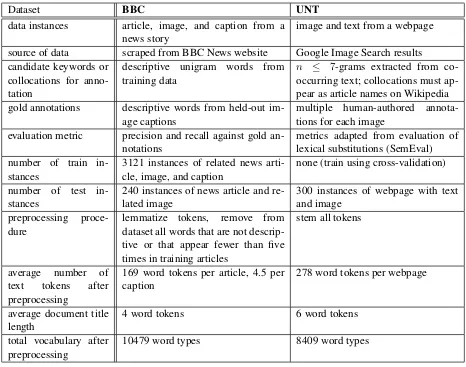
differ-Dataset BBC UNT
data instances article, image, and caption from a news story
image and text from a webpage
source of data scraped from BBC News website Google Image Search results candidate keywords or
collocations for anno-tation
descriptive unigram words from training data
n ≤ 7-grams extracted from co-occurring text; collocations must ap-pear as article names on Wikipedia gold annotations descriptive words from held-out
im-age captions
multiple human-authored annota-tions for each image
evaluation metric precision and recall against gold an-notations
metrics adapted from evaluation of lexical substitutions (SemEval) number of train
in-stances
3121 instances of related news arti-cle, image, and caption
none (train using cross-validation)
number of test in-stances
240 instances of news article and re-lated image
300 instances of webpage with text and image
preprocessing proce-dure
lemmatize tokens, remove from dataset all words that are not descrip-tive or that appear fewer than five times in training articles
stem all tokens
average number of text tokens after preprocessing
169 word tokens per article, 4.5 per caption
278 word tokens per webpage
average document title length
4 word tokens 6 word tokens
total vocabulary after preprocessing
[image:3.612.73.539.55.422.2]10479 word types 8409 word types
Table 1: Comparison of the BBC and UNT image annotation datasets.
ent domains, different sources of gold image anno-tations, different preprocessing procedures, and dif-ferent evaluation measures.
Table 1 provides an overview of the datasets; while this section covers the source of the datsets and their gold annotations in more detail.
3.1 BBC
The BBC Dataset (Feng and Lapata, 2008)2contains news articles, image captions, and images taken from the BBC News website. Training instances consist of a news article, image, and image caption from the same news story. Test instances are just the image and the article, and hold-out the caption as a source of gold image annotations.
Using news image captions as annotations has
2Downloaded from http://homepages.inuf.ed. ac.uk/s0677528/data.html
the disadvantage that captions often describe back-ground information or relate the photo to the story, rather than listing important entities in the image. It also fails to capture variation in how humans de-scribe images, since it is limited to one caption per image.3 However, captions are a cheap source of data; BBC has ten times as many images as UNT.
To address the problem of converting natural lan-guage into annotations, a large amount of prepro-cessing is performed. The established preproprepro-cessing procedure for this dataset is to lemmatize and POS-tag using TreeTagger (Schmid, 1994) then remove all but the “descriptive” words (defined as nouns, ad-jectives, and certain classes of verbs). This leaves a total text vocabulary of about 32K words, which
3
[image:3.612.74.538.56.422.2]is further reduced by removing words that appear fewer than five times in the training set articles. Ta-ble 1 shows the number of word tokens and types after performing these steps.4
3.2 UNT
The UNT Dataset (Leong et al., 2010)5 consists of images and co-occurring text from webpages. The webpages are found by querying Google Image Search with frequent English words, and randomly selecting from the results.
Each image in UNT is annotated by five people via Mechanical Turk. In order to make human and system results comparable, human annotators are re-quired to only select words and collocations that are directly extracted from the text, and the gold anno-tations are the count of how many times each key-word or collocation is selected. The human annota-tors write keywords into a text box; while the col-locations are presented as a list of candidates and annotators mark which ones are relevant. Human annotators tend to select subsets of collocations in addition to the entire collocation. For example, the gold annotation for one image has “university of texas”, “university of texas at dallas”, “the univer-sity of texas”, and “the univeruniver-sity of texas at dal-las”, each selected by at least four of the five an-notators. Additionally, annotators can select mul-tiple forms of the same word (such as “tank” and “tanks”). Gold annotations are stemmed after they are collected, and keywords with the same stem have their counts merged. For this reason, many key-words have a higher count than the number of an-notators.
4 We are unable to reproduce work from Feng & Lapata (2008; 2010a; 2010b) and Feng (2011). Specifically, our vocab-ulary counts after preprocessing (as in Table 1) are much higher than reported counts, although the number of tokens per arti-cle/caption they report is higher than ours. We have contacted the authors, who confirmed that they took additional steps to re-duce the size of the vocabulary, but were unable to tell us exactly what those steps are. Therefore, all system and baseline scores presented on their dataset are of our own implementation, and do not match those reported in previous publications.
5Downloaded from http://lit.csci.unt.edu/ index.php?P=research/downloads
4 Baselines
We run several baselines on the datasets. Term fre-quency, tf*idf, and corpus frequency are features that are often used in annotation systems, so it is im-portant to test them on their own. Document Title and tf*idf are both baselines that were used in the original papers where these datasets came from.
Sentence extraction is a new baseline that we pro-pose specifically for the BBC dataset, in order see if we can exploit certain properties of the gold annota-tions, which are also derived from sentences.
4.1 Term Frequency
Term frequency has been shown to be a power-ful feature in summarization (Nenkova and Vander-wende, 2005). Words that appear frequently are considered more meaningful than infrequent words. Term frequency is the number of times a term (ex-cluding function words) appears in a document, di-vided by the total number of terms in that document. On the UNT dataset we use the stopword list in-cluded with the MALLET6 toolkit, while the BBC dataset doesn’t matter because the function words have already been removed.
4.2 tf*idf
While term frequency baseline requires the use of an
ad hocfunction word list, tf*idf adjusts the weights of different words depending on how important they are in the corpus. It is a standard baseline used for information retrieval tasks, based on the intuition that a word that appears in a smaller number of doc-uments is more likely to be meaningful than a word that appears in many documents.
tf*idf is the product of term frequency and inverse document frequency –idf(ti) = logniN whereN is the number of documents in the corpus, and ni is the number of documents that contain the term ti. For the BBC Dataset, we base the idf weights on the document frequency of the training articles. For UNT, we use the reported tf*idf score which uses the British National Corpus to calculate the idf scores.7
6
mallet.cs.umass.edu 7
4.3 Corpus Frequency
Image annotations in both NLP and CV tend to be distributed with a relatively small number of fre-quently occuring keywords, and a long tail of key-words that only appear a few times. For UNT, we use the total keyword frequency of all the gold an-notations, except for the one document that we are currently scoring. For BBC, we only measure the frequency of keywords in the training set captions, since we are specifically interested in the frequency of terms in captions.
4.4 Document Title
For BBC, the news article headline, and for UNT, the title of the webpage.
4.5 Sentence Extraction
Our baseline extracts the most central sentence from the co-occurring text and uses descriptive words from that sentence as the image annotation. Un-like sentence extraction techniques from Feng and Lapata (2010a), we determine which sentence to ex-tract using the term frequency distribution directly. We extract the sentence with the minimum KL-divergence to the entire document.8
5 BBC Dataset Experiments
5.1 System Comparison
In addition to the baselines, we compare against the Mix LDA system from Feng and Lapata (2010b). In Mix LDA, each instance is represented as a bag of textual features (unigrams) and visual features (SIFT features quantized to discrete “image words” using k-means). A Latent Dirichlet Allocation topic model is trained on articles, images, and captions from the training set. Keywords are generated for an unseen image and article pair by estimating the distribution of topics that generates the test instance, then multi-plying them with the word distributions in each topic to find the probability of textual keywords for the image. Text LDA is is the same model but only us-ing words and not image features.
8
One could also think of this as a version of the KLSum summarization system (Haghighi and Vanderwende, 2009) that stops after one sentence.
5.2 Evaluation
The evaluation metric and the source of gold anno-tations is described in Table 1. For the baselines 4.1, 4.2, 4.3 and the Mix LDA system, the generated an-notation for each test image is its ten most likely keywords. We also run all baselines and the Mix LDA system on an unpruned version of the dataset, where infrequent terms are not removed from train-ing data, test data, or the gold annotations. The pur-pose of this evaluation is to see if candidate key-words deemd “unlearnable” by the Mix LDA system can be learned by the baselines.
5.3 Results
The evaluation results for the BBC Dataset are shown in Table 2. Clearly, term frequency is a stronger baseline than tf*idf by a large margin. The reason for this is simple: since nearly all of BBC’s function words are removed during preprocessing, the only words downweighted by the idf score are common – but meaningful – words such aspoliceor
government. This is worth pointing out because, in
many cases, the choice of using a term frequency or tf*idf baseline is made based on what was used in previous work. As we show here and in Section 6.3, the choice of frequency baseline should be based on the data and processing techniques being used.
We use the corpus frequency baseline to illus-trate the difference between standard and
include-infrequent evaluations. Since including infrequent
base-Standard Include-infrequent
Precision Recall F1 Precision Recall F1
Term Frequency 13.13 27.84 17.84 13.62 25.71 17.81
tf * idf 9.21 19.97 12.61 7.25 13.52 9.44
Doc Title 17.23 13.70 15.26 15.91 11.86 13.59 Corpus Frequency 3.17 6.52 4.26 3.17 6.02 4.15 Sentence Extraction 16.67 15.61 16.13 18.62 16.83 17.68
Mix LDA 7.30 16.16 10.06 7.50 13.98 9.76
[image:6.612.120.492.56.185.2]Text LDA 8.38 17.46 11.32 7.79 14.52 10.14
Table 2: Image annotation results for previous systems and our proposed baselines on the BBC Dataset.
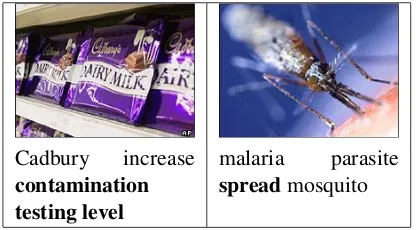
Cadbury increase
contamination testing level
malaria parasite
spreadmosquito
Table 3: Examples of gold annotations from the test sec-tion of the BBC Dataset. The bolded words are the ones that appear five or more times in the training set; the un-bolded words appear fewer than five times and would be removed from both the candidate and gold keywords in the standard BBC evaluation.
lines with the best precision are the Doc Title and Sentence Extraction baselines, which do not need to generate ten keywords for every image.
While sentence extraction has a lower recall than term frequency, it is the only baseline or system that has improved recall when including infrequent words. This is unexpected because our baseline se-lects a sentence based on the term frequency of the document, and the recall for term frequency fell. One possible explanation is that extraction implic-itly uses correlations between keywords. Probabili-ties of objects appearing together in an image are not independent; and the accuracy of annotations can be improved by generating annotation keywords as a set (Moran and Lavrenko, 2011). Recent works in image captioning also use these correlations: explic-itly, using graphical models (Kulkarni et al., 2011; Yang et al., 2011); and implicitly, using language models (Feng and Lapata, 2010a). In comparison,
sentence extraction is very implicit.
Unsurprisingly, the Text LDA and Mix LDA sys-tems do worse on the include-infrequent evaluation than they do on the standard, because words that do not appear in the training set will not have high probability in the trained topic models. We were un-able to reproduce the reported scores for Mix LDA from Feng and Lapata (2010b) where Mix LDA’s scores were double the scores of Text LDA (see Footnote 4). We were also unable to reproduce re-ported scores for tf*idf and Doc Title (Feng and Lap-ata, 2008). However, we have three reasons why we believe our results are correct. First, BBC has more keywords, and fewer images, than typically seen in CV datasets. The BBC dataset is simply not suited for learning from visual data. Second, a single SIFT descriptor describes which way edges are oriented at a certain point in an image (Lowe, 1999). While certain types of edges may correlate to visual objects also described in the text, we do not expect SIFT fea-tures to be as informative as textual feafea-tures for this task. Third, we refer to the best system scores re-ported by Leong et al. (2010), who evaluate their text mining system (see section 6.1) on the standard BBC dataset.9 While their f1 score is slightly worse than our term frequency baseline, they do 4.86% better than tf*idf. But, using the baselines reported in Feng and Lapata (2008), their improvement over tf*idf is 12.06%. Next, we compare their system against fre-quency baselines using the 10 keyword generation task on the UNT dataset (theoot normal scores in table 5). Their best system performs 4.45% better
9
[image:6.612.82.290.227.342.2]than term frequency, and 0.55% worse than tf*idf.10 Although it is difficult to compare different datasets and evaluation metrics, our baselines for BBC seem more reasonable than the reported baselines, given their relative performance to Leong et al’s system.
6 UNT Dataset Experiments
6.1 System Comparison
We evaluate against the text mining system from (Leong et al., 2010). Their system generates image keywords by extracting text from the co-occurring text of an image. It uses three features for select-ing keywords.Flickr Picturabilityqueries the Flickr API with words from the text in order to find re-lated image tags. Retrieved tags that appear as sur-face forms in the text are rewarded proportional to their frequency in the text. Wikipedia Salience as-signs scores to words based on a graph-based mea-sure of importance that considers each term’s docu-ment frequency in Wikipedia. Pachinko Allocation Modelis a topic model that captures correlations be-tween topics (Li and McCallum, 2006). PAM infers subtopics and supertopics for the text, then retrieves top words from the top topics as annotations. There is also a combined model of these features using an SVM with 10-fold cross-validation.
6.2 Evaluation
Evaluation on UNT uses a framework originally de-veloped for the SemEval lexical substitution task (McCarthy and Navigli, 2007). This framework accounts for disagreement between annotators by weighting each generated keyword by the number of human annotators who also selected that keyword. The scoring framework consists of four evaluation measures: best normal, best mode,oot (out-of-ten)
normal, andoot mode.11
The two best evaluations find the accuracy of a single “best” keyword generated by the system12.
10And as we stated earlier, the relative performance of term frequency vs tf*idf is different from dataset to dataset.
11
Both the original framework and its adaptation by Leong et al. (2010) give precision and recall for each of the evaluation measures. However, precision and recall are identical for all baselines and systems, and only slightly different on the upper bound (human) scores. To preserve space, we only present the metric and scores for precision.
12
In contrast to the original SemEval task, where systems can
Best normalmeasures the accuracy for each system
annotationaj as the number of timesaj appears in theRj, the multi-set union of human tags, and aver-ages over all the test imaver-ages.
Bestnormal=
P ij∈I
|aj∈Rj| |Rj|
|I|
Inoot normal, up to ten unordered guesses can be made without penalty.
ootnormal=
P ij∈I
P
aj∈Aj|aj∈Rj|
|Rj|
|I|
where Aj is the set of ten system annotations for imageij.
Thebest modeandoot modemetrics are the same
as thenormalmetrics except they only evaluate sys-tem annotations for images whereRjcontains a sin-gle most frequent tag. We use the scoring software provided by SemEval13with the gold annotation file provided in the UNT Dataset.
6.3 Results
The results of the lexical substitution evaluation on the UNT Dataset are shown in Table 5. The results from the normal show support for our earlier idea that the relative performance of term frequency vs tf*idf depends on the dataset. Although the term fre-quency baseline uses a stopword list, there are other words that appear frequently enough to suggest they are not meaningful to the document – such as copy-right disclaimers.
Recall that themodeevaluation is only measured on data instances where the gold annotations have a single most frequent keyword. While running the evaluation script on the gold annotation file that came with the UNT dataset, we discover that Se-mEval only identifies 28 of the 300 instances as hav-ing a shav-ingle mode annotation, and that for 21 of those 28 instances, the mode keyword is “cartoon”. Those 21/28 images correspond to the 75% best modescore obtained by Corpus Frequency baseline. Given the small number of instances that actually
make from zero to many “best” guesses, penalized by the total number of guesses made.
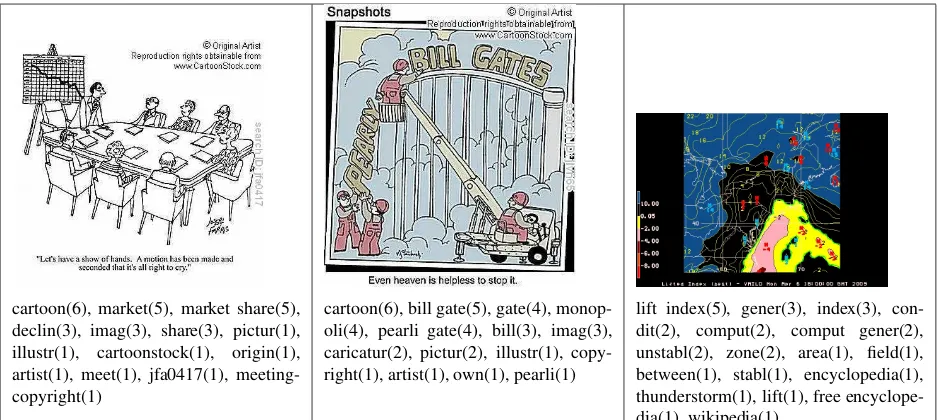
cartoon(6), market(5), market share(5), declin(3), imag(3), share(3), pictur(1), illustr(1), cartoonstock(1), origin(1), artist(1), meet(1), jfa0417(1), meeting-copyright(1)
cartoon(6), bill gate(5), gate(4), monop-oli(4), pearli gate(4), bill(3), imag(3), caricatur(2), pictur(2), illustr(1), copy-right(1), artist(1), own(1), pearli(1)
lift index(5), gener(3), index(3), con-dit(2), comput(2), comput gener(2), unstabl(2), zone(2), area(1), field(1), between(1), stabl(1), encyclopedia(1), thunderstorm(1), lift(1), free encyclope-dia(1), wikipedia(1)
Table 4: Examples of gold annotations from the UNT Dataset.
Best Out-of-ten (oot)
Normal Mode Normal Mode
Term Frequency 5.67 14.29 33.40 89.29
tf * idf 5.94 14.29 38.40 78.57
Doc Title 6.40 7.14 35.19 92.86
[image:8.612.72.541.56.266.2]Corpus Frequency 2.54 75.00 8.22 82.14 Flickr Picturability 6.32 78.57 35.61 92.86 Wikipedia Salience 6.40 7.14 35.19 92.86 Topic Model (PAM) 5.99 42.86 37.13 85.71 Combined (SVM) 6.87 67.49 37.85 100.00
Table 5: Image annotation results for our proposed baselines, the text mining systems from (Leong et al., 2010)
count towards these metrics, we conclude thatmode
evaluation is not a meaningful way to compare im-age annotation systems on the UNT dataset.
That said, the number of cartoons in the dataset does seem to be strikingly high. Looking at the source of the images, we find that 45 of the 300 images were collected from a single online cartoon library. Predictably, we find that the co-occurring text to these images contains a long list of keywords, and little other text that is relevant to the image. We looked at a small sample of the rest of the dataset and found that many of the other text documents in UNT also have keyword lists.
Including this types of text in a general web cor-pus is not necessarily a problem, but it’s difficult to
measure the benefits of using complex techniques like topic modeling and graph similarily to find and extract annotations when in so many cases the anno-tations have already been found and extracted. This is shown in thenormalevaluation results, where the combined system is only slightly better at selecting the single best keyword, and no better than tf*idf for theout-of-tenmeasure.
7 Conclusion
Get to know your data. The ability to quickly and cheaply collect very large – but very noisy – col-lections of data from the internet is a great advance for both NLP and CV research. However, there still needs to be an appopriate match betwen the task be-ing performed, the system bebe-ing proposed, and the dataset being used; and large noisy datasets can hide unintended features or incorrect assumptions about the data.
Use relevant gold annotations. Do not convert other sources of data into annotations. When collect-ing human annotations, avoid postprocesscollect-ing steps such as merging or deleting keywords that change the annotators’ original intent. Keep an open di-alogue with annotators about issues that they find confusing, since that is a sign of an ill-formed task.
Preprocessing should be simple and reprodu-cable. The use of different preprocessing proce-dures affects the apparent performance of systems and sometimes has unintended consequences.
Use strong baselinesand compare to other work only when appropriate. Systems developed for dif-ferent tasks or datasets can make for misleading comparisons if they don’t use all features available. Strong baselines explicitly exploit low-level features that are implicitly exploited by proposed systems, as well as low-level features of the dataset.
Don’t remove keywords from gold annotations.
Just because keywords are impossible for one sys-tem to learn, does not mean they are impossible for all systems to learn. Removing evaluation data arti-ficially inflates system scores and limits comparison to related work.
If a proposed system is to learn associations be-tween visual and textual features, then it is neces-sary to use larger datasets. In general, global an-notations, such as scenes, is easiest; identifying spe-cific objects is more difficult; and identification of events, activities, and other abstract qualities has a very low success rate (Fluhr et al., 2006). Alter-nately,use simpler image features that are known to have a high sucess rate. For example, Deschacht and Moens (2007) used a face detector to determine the number of faces in an image, and then used NLP to determine the names of those people from associ-ated text.
References
K. Barnard, P. Duygulu, D. Forsyth, N. De Freitas, D.M. Blei, and M.I. Jordan. 2003. Matching words and pictures. The Journal of Machine Learning Research, 3:1107–1135.
Tamara L. Berg and David A. Forsyth. 2006. Animals on the web. InProceedings of the 2006 IEEE Computer Society Conference on Computer Vision and Pattern Recognition - Volume 2, CVPR ’06, pages 1463–1470, Washington, DC, USA. IEEE Computer Society. T.L. Berg, A.C. Berg, J. Edwards, M. Maire, R. White,
Yee-Whye Teh, E. Learned-Miller, and D.A. Forsyth. 2004. Names and faces in the news. InComputer Vi-sion and Pattern Recognition, 2004. CVPR 2004. Pro-ceedings of the 2004 IEEE Computer Society Confer-ence on, volume 2, pages II–848 – II–854 Vol.2, june-2 july.
E. Boiy, K. Deschacht, and M.-F. Moens. 2008. Learn-ing visual entities and their visual attributes from text corpora. In Database and Expert Systems Applica-tion, 2008. DEXA ’08. 19th International Workshop on, pages 48 –53, sept.
Koen Deschacht and Marie-Francine Moens. 2007. Text analysis for automatic image annotation. InACL, vol-ume 45, page 1000.
Li Fei-Fei, Rob Fergus, and Pietro Perona. 2004. Learn-ing generative visual models from few trainLearn-ing ex-amples: An incremental bayesian approach tested on 101 object categories. In Proceedings of the 2004 Conference on Computer Vision and Pattern Recog-nition Workshop (CVPRW’04) Volume 12 - Volume 12, CVPRW ’04, pages 178–, Washington, DC, USA. IEEE Computer Society.
Yansong Feng and Mirella Lapata. 2008. Automatic im-age annotation using auxiliary text information. Pro-ceedings of ACL-08: HLT, pages 272–280.
Yansong Feng and Mirella Lapata. 2010a. How many words is a picture worth? automatic caption gener-ation for news images. In Proceedings of the 48th Annual Meeting of the Association for Computational Linguistics, ACL ’10, pages 1239–1249, Stroudsburg, PA, USA. Association for Computational Linguistics. Yansong Feng and Mirella Lapata. 2010b. Topic
mod-els for image annotation and text illustration. In HLT-NAACL, pages 831–839.
Yansong Feng. 2011. Automatic caption generation for news images. Ph.D. thesis, University of Edinburgh. Christian Fluhr, Pierre-Alain Mollic, and Patrick Hde.
Aria Haghighi and Lucy Vanderwende. 2009. Exploring content models for multi-document summarization. In Proceedings of Human Language Technologies: The 2009 Annual Conference of the North American Chap-ter of the Association for Computational Linguistics, pages 362–370, Boulder, Colorado, June. Association for Computational Linguistics.
Allan Hanbury. 2008. A survey of methods for image annotation. J. Vis. Lang. Comput., 19:617–627, Octo-ber.
Nicolas Herv´e and Nozha Boujemaa. 2007. Image an-notation: which approach for realistic databases? In Proceedings of the 6th ACM international conference on Image and video retrieval, CIVR ’07, pages 170– 177, New York, NY, USA. ACM.
Girish Kulkarni, Visruth Premraj, Sagnik Dhar, Siming Li, Yejin Choi, Alexander C. Berg, and Tamara L. Berg. 2011. Baby talk: Understanding and generat-ing simple image descriptions. InCVPR, pages 1601– 1608.
Chee Wee Leong, Rada Mihalcea, and Samer Hassan. 2010. Text mining for automatic image tagging. In COLING, pages 647–655.
Wei Li and Andrew McCallum. 2006. Pachinko alloca-tion: Dag-structured mixture models of topic correla-tions. InProceedings of the 23rd international confer-ence on Machine learning, ICML ’06, pages 577–584, New York, NY, USA. ACM.
D.G. Lowe. 1999. Object recognition from local scale-invariant features. InComputer Vision, 1999. The Pro-ceedings of the Seventh IEEE International Confer-ence on, volume 2, pages 1150 –1157 vol.2.
Ameesh Makadia, Vladimir Pavlovic, and Sanjiv Kumar. 2008. A new baseline for image annotation. In Pro-ceedings of the 10th European Conference on Com-puter Vision: Part III, ECCV ’08, pages 316–329, Berlin, Heidelberg. Springer-Verlag.
A. Makadia, V. Pavlovic, and S. Kumar. 2010. Baselines for image annotation. International Journal of Com-puter Vision, 90(1):88–105.
D. McCarthy and R. Navigli. 2007. Semeval-2007 task 10: English lexical substitution task. InProceedings of the 4th International Workshop on Semantic Evalu-ations (SemEval-2007), pages 48–53.
Florent Monay and Daniel Gatica-Perez. 2003. On im-age auto-annotation with latent space models. In Pro-ceedings of the eleventh ACM international conference on Multimedia, Multimedia ’03, pages 275–278, New York, NY, USA. ACM.
S. Moran and V. Lavrenko. 2011. Optimal tag sets for automatic image.
Henning M¨uller, St´ephane Marchand-Maillet, and Thierry Pun. 2002. The truth about corel - evaluation
in image retrieval. InProceedings of the International Conference on Image and Video Retrieval, CIVR ’02, pages 38–49, London, UK, UK. Springer-Verlag. Ani Nenkova and Lucy Vanderwende. 2005. The
im-pact of frequency on summarization. Technical report, Microsoft Research.
J. Ponce, T. Berg, M. Everingham, D. Forsyth, M. Hebert, S. Lazebnik, M. Marszalek, C. Schmid, B. Russell, A. Torralba, C. Williams, J. Zhang, and A. Zisser-man. 2006. Dataset issues in object recognition. In Jean Ponce, Martial Hebert, Cordelia Schmid, and Andrew Zisserman, editors, Toward Category-Level Object Recognition, volume 4170 of Lecture Notes in Computer Science, pages 29–48. Springer Berlin / Heidelberg. 10.1007/11957959 2.
H. Schmid. 1994. Probabilistic part-of-speech tagging using decision trees. In Proceedings of international conference on new methods in language processing, volume 12, pages 44–49. Manchester, UK.
Jiayu Tang and Paul Lewis. 2007. A study of quality issues for image auto-annotation with the corel data-set. IEEE Transactions on Circuits and Systems for Video Technology, Vol. 1(NO. 3):384–389, March. T. Tsikrika, A. Popescu, and J. Kludas. 2011. Overview
of the wikipedia image retrieval task at imageclef 2011. InCLEF (Notebook Papers/LABs/Workshops): CLEF.
Luis von Ahn and Laura Dabbish. 2004. Labeling im-ages with a computer game. In Proceedings of the SIGCHI conference on Human factors in computing systems, CHI ’04, pages 319–326, New York, NY, USA. ACM.
Thijs Westerveld and Arjen P. de Vries. 2003. Ex-perimental evaluation of a generative probabilistic im-age retrieval model on ’easy’ data. InIn Proceedings of the SIGIR Multimedia Information Retrieval Work-shop 2003, Aug.