Proceedings of the Workshop on Multilingual and Cross-lingual Methods in NLP, pages 45–54,
Leveraging Data-Driven Methods in Word-Level Language Identification for
a Multilingual Alpine Heritage Corpus
Ada Wan University of Zurich [email protected]
Abstract
This paper presents a data-driven, simple cluster-and-label approach using optimized count-based methods for word-level language identification for a large domain-specific mul-tilingual diachronic corpus of periodicals pub-lished at least yearly between 1864 and 2014 in Switzerland. Our system requires no an-notated data or training, only minimal hu-man effort in evaluating and labeling 50 clus-ters for a corpus of almost 40 million tokens. Despite being unsupervised, our results show an accuracy that is comparable to the cor-pus annotations which result from an exist-ing code switchexist-ing algorithm and the com-bined usage of two supervised systems using character and byte n-gram models (Volk and Clematide, 2014).
1 Introduction
Language identification (LID) is important in NLP so long as the applications and tools designed and used are language-specific. Many tokenizers, POS-taggers, lemmatization and NER systems suffer in performance when met with sporadic sequences of foreign/unknown elements – this is especially the case when the languages in question are lesser known, the domain is more specific, and/or the train-ing material is scarce. The view that LID is a "solved task" is unfortunately a misconception that is based on the success of work that dealt with document-level LID in a small number of languages (Lui, 2014). Real world data, esp. those with much code switching (CS), the phenomenon that occurs when speakers/writers switch back and forth between at
least two languages in communication, on smaller spans of texts or with mixed genres, continue to pose challenges.
In this paper, we present our initial LID effort for a large, domain-specific, yet very diverse in themes and styles, multilingual diachronic corpus of peri-odicals published by theSwiss Alpine Club (SAC) abound with intrasentential CS instances. CS in this corpus has previously been addressed in Volk and Clematide (2014) who use a set of heuristics to iden-tify code-switching candidates and label these using langid.py1(Lui and Baldwin, 2012), an off-the-shelf
Python package providing a supervised multinomial Naive Bayes classifier that has been trained over a mixture of byte n-grams (1≤n≤4) on 97 languages. In contrast, we attempt to tackle this task through a simple cluster-and-label approach with unsuper-vised word vectors. Our system – requiring only minimal human intervention when labeling the in-duced clusters – achieves comparable performance to the existing CS annotations, demonstrating the feasibility of unsupervised word clustering for LID for our corpus.
2 Related Work
In the first shared task on LID on code-switched data from 2014, system architectures ranged from a rule-based system to ones leveraging word embeddings, extended Markov Models, and CRF autoencoders (Solorio et al., 2014). While most teams focused on multilingual LID systems for the shared task, there are approaches that deal with classification on bilin-gual code-switched texts specifically – for example, Jhamtani et al. (2014) build a system that makes use of several heuristic features, including a special edit distance between Hindi and English that fits their use case for "Hinglish" texts.
On the other hand, unsupervised approaches to word-level language identification have not been as popular. A cluster-and-label approach similar to ours has recently been applied to unsupervised "Translationese" detection for machine translation by Rabinovich and Wintner (2015), but only for text passages of 2000 tokens each. Another character-istic that sets apart their approach from ours is the cluster labeling approach. Their automatic label-ing approach builds "representative" language mod-els for the class labmod-els and then assigns them to the unsupervised clusters by comparing them to the em-pirical distributions in the clusters. Since their ap-proach is not applicable in our case and labeling clusters for our task requires rather little effort, we resorted to manual labeling.
3 Data: SAC Yearbooks from Text+Berg (TB)
Text+Berg digital2 is an ongoing text digitization
and annotation project for alpine texts. The year-books published by the SAC form a substantial part of the corpus. They contain "reports and essays on all aspects of alpinism as well as alpine na-ture and culna-ture" and cover a good range of sub-genres: from more literary essays and anecdotal narratives on mountain expeditions, book reviews and poems, to practical travel tips such as hotel re-views and cabin directories, to more scientific stud-ies of living organisms, glacier and climate obser-vations, geo-historical descriptions on cols, moun-tains, and parks, and on the flora and fauna of the Alps and other mountain regions, to more technical accident and security reports and financial reports
2http://textberg.ch
from protocols of the annual club gatherings (Volk and Clematide, 2014).
From the first edition of the yearbook in 1864 to 1923, the publication appeared yearly under the ti-tleJahrbuch des SAC, and from 1925 until present, Die Alpen. Les Alpes. Le Alpi. Although it has been published monthly since 1996, the issues have been archived yearly as the yearbooks therebefore by TB – one XML file per year, and are referred to here as the yearbooks. Before 1957, these yearbooks are written without translation in mixed languages – German, French, Italian, and Romansch (as far as we know). That is, an article or a sentence in one language may contain passages or word(s) in one or many other language(s) without translation. Since 1957 there have been parallel versions of these year-books in German and in French, with the addition of Italian since 2012. But despite the emergence of these parallel versions, the occurrences of CS re-mains rather consistent throughout the years. Each of these parallel versions is archived as one XML file per year. For these 150 years between 1864 and 2014, there are 209 XML files (there was no publi-cation in years 1870, 1915, and 1924), with roughly 39 million tokens in total after conversion into plain text, which we used as data for our study. The year-books from 1864 to 2000 were scanned and con-verted into text with commercial OCR software by TB digital. Through a crowdsourcing initiative, se-lected yearbooks have been manually inspected and almost all OCR errors from these books were cor-rected. The texts from 2001 to 2009 were extracted from PDFs. From 2010 on,TB digitalhas been di-rectly receiving the publication in XML format from the SAC and converting these into the XML files with linguistic annotations available for download for research purposes.
Up to and including the latest release of the year-books (release 151v01, from April 11, 2015), all TB corpora have been LIDed on the sentence-level for all sentences with more than 40 characters us-ing Lingua-Ident3 by Michael Piotrowski, a
statis-tical language identifier based on character n-gram frequencies. (Results for shorter sentences and for Romansch (RM) were found to be unreliable and
these were hence assigned language tag of the previ-ous sentence or that of the article). Lingua-Identis able to recognize sentences in German (DE), French (FR), Italian (IT), and English (EN) thus far. Swiss-German (CH-DE) requires additional processing. While it is safe to narrow the number of dominant languages of the corpus down to 6 – the four of-ficial languages of Switzerland (DE, FR, IT, RM), in addition to EN and CH-DE – automatically de-termining exhaustively what other languages it con-tains will remain a hard problem. In our manual evaluation phase for the present experiment, we no-tice Latin (LA) and Spanish (ES) elements in the corpus, which confirm the observation by Volk and Clematide (2014), but we also found texts in Dan-ish (DA) and Tibetan (BO) (in Roman script), for instance. As described in the following section, we approach our LID task as a closed-class classifica-tion problem (with 8 classes/labels) after clustering our word vectors.
4 Method
We adopt an unsupervised data-driven approach in clustering word vectors, optimized with lessons learned from Levy et al. (2015) by combining a PPMI (positive pointwise mutual information) ma-trix with a constant-sized weighted context window, after extracting plain text from each of the XML files for the SAC yearbooks. Our goal is to assign a label (i.e. a language class) to each word type in our data.
4.1 Word Vector Representation: PPMI matrix with weighted context window
We take as vocabularyV all word types vthat nei-ther are punctuations nor numbers, nor do they con-tain any. That is, tokens such as1erwere excluded, regardless of whether it could be a permissible se-quence in a language or an OCR error. We take as context words all elements of V that occur at least 100 times (for reasons of scalability), and refer to the set of these context words as C. We represent our data by constructing a high dimensional |V| × |C|
matrix M with one row for each word type v and with one column for each context wordc. This re-sults in a 785,266 x 23,263 matrix.
We collect co-occurrence counts for every pair
(v, c) using a context window of 5. Concretely,
we treat each yearbook file as a sequence of to-kens, w1, . . . , wN, where N is the total number of these "eligible" (non-punctuation, non-numeric) to-kens. For each wi such that wi ∈V, we give a weighted count to each of the surrounding words, provided that they are inC: 15 forwi−5andwi+5, 25 forwi−4andwi+4, 35 forwi−3andwi+3, 45 forwi−2 andwi+2, and 1 (i.e. 55) forwi−1 andwi+1. (Note that the context window is fixed, e.g. if only one of the surrounding words is inC, or if there is only one surrounding word, only one count will be lected, the window does not expand in order to col-lect counts 5 times.) We sum up these counts from all yearbooks.
The value of each matrix cellMjkis the weighted co-occurrence count of (vj, ck) transformed into a normalized association measure, PPMI, where
P P MI(v, c) = max(P MI(v, c),0) (1)
P MI(v, c) = logP(v, c)
P(v)P(c) (2)
and P(v, c), P(v), and P(c) are estimated using maximum likelihood from the co-occurrence counts. Pointwise mutual information (PMI), defined in eq. 2, is an association metric for measuring word association norms based on the information theo-retic concept of mutual information. PMI compares the joint probability of two events with the product of their marginal probabilities.
Proposed by Church and Hanks (1990), the PMI of two eventsx,yis interpreted as follows:
PMI(x, y)0means that there is a gen-uine association between xandy, as P(x,y) will be much larger than P(x)P(y)
PMI(x, y) ≈ 0 implies that there is no interesting relationship betweenx and y, as P(x,y)≈P(x)P(y)
PMI(x, y)0means thatxandyare in complementary distribution, as P(x,y) will be much less than P(x)P(y).
4.2 Dimensionality Reduction: Truncated Singular Value Decomposition (TSVD)
SVD factorizes a matrixMinto the product of three matricesU ·Σ·VT, whereU andV are orthonor-mal andΣis a diagonal matrix of eigenvalues in de-creasing order. When this factorized matrix is trun-cated, only the largest/topddiagonal elements ofΣ
are "kept". In other words, TSVD compresses the major associative patterns in the data into a lower dimensional matrix by ignoring the smaller, less im-portant influences (Deerwester et al., 1990).
As mentioned in Section 4.1, our PPMI matrix has 23,263 columns, and despite its sparsity, the origi-nal word vector file is 37 GB in size. To facilitate our clustering experiments in the subsequent step, we reduce the dimensions of these word vectors to 100 using TSVD4, resulting in a new file size of 1.21
GB (a reduction of nearly 97%).
4.3 Clustering: K-means
TSVD only gives us a matrix of reduced dimensions. But the number of words we have to cluster is still fairly high (785,266). K-means, as a flat, as opposed to hierarchical, clustering algorithm, is an efficient solution for our task. The objective of K-means is to minimize the average squared Euclidean distance of word vectors from their cluster centers where a cluster center is defined as the mean or centroid~µ
of the word vectors in a clusterω (Manning et al., 2008):
~µ(ω) = |ω|1 X
~v∈ω
~v (3)
KinK-meansrefers to the number of clusters pre-specified by the user. To obtain 50 clusters from our data, we first initialize 50 points (i.e. means) to ran-dom values, seeding the ranran-dom generator with a random seed. The algorithm comprises two steps: the assignment step, in which each data point is as-signed to the nearest centroid, giving rise to 50 clus-ters with one centroid for each cluster, and the up-date step, in which the centroids are then adjusted 4via the implementation in scikit-learn (Pedregosa et al., 2011): http://scikit-learn.org/stable/modules/ generated/sklearn.decomposition.
TruncatedSVD.html
such that they represent the mean values of all the data points in the clusters formed in the assignment step. This is repeated until the cluster assignments converge.
In order to find a set of clusters that is most rep-resentative of our data, we run several clustering experiments varying the number of clusters. Ide-ally, we would get vocabulary items of a language to cluster together such that we get one cluster per language. As may be expected, the situation is a bit more complicated – e.g. if we divide up our data into 5 clusters, we get 1 mixed, 1 IT and 1 FR clus-ter, and 2 DE clusters. This tendency remains rather stable irrespective of the clustering algorithm used. In contrast, the number of clusters considerably im-pacts cluster quality. If too few clusters are used, only the strongest tendency of the data can be cap-tured and minority languages such as RM and EN would be lumped together with the majority lan-guages DE/FR/IT or contribute to mixed clusters. As we increase the number of clusters, purer clusters emerge and mixed classes become smaller. How-ever, beyond a certain point, these improvements seem to level off – 100 clusters are not necessarily purer than 50 clusters. In earlier experiments, we compared both the scikit-learn implementation of a non-parametric Dirichlet Process Gaussian Mixture Model (DPGMM) which automatically determines the appropriate number of clusters from the data5
and a parametric approach using K-means with 50 clusters. The non-parametric model found, depend-ing on the choice of a spherical, diagonal, or full covariance matrix, 194, 201, and 4 clusters respec-tively. While we knew that 4 clusters would be too few, we measured performance of the other two against K-means (see Table 1) and decided to go with K-means for clustering as more clusters do not necessarily entail purer clusters or better results.
We found a set of 50 clusters (which are formed using the vectors we have been describing – these vectors differ from those in earlier experiments only in some minor variation in symbols filtered out in the process of vector building) we produced using K-means yields fairly reasonable language
tsvd_dpgmm_diag (201 clusters) tsvd_dpgmm_spherical (194 clusters) tsvd_kmeans (50 clusters)
strict 88.78 88.60 88.88
lenient 89.39 89.30 89.55
Table 1:Accuracy scores (rounded to 2 digits) from non-parametric (Dirichlet Process Gaussian Mixture Model) vs. parametric models (K-means), using vectors built in earlier experiments
ings, as even minority languages such as RM and EN could be represented as classes of their own. We hence use it for evaluation of our TBLID system in this paper.
4.4 Evaluating and Labeling of Clusters
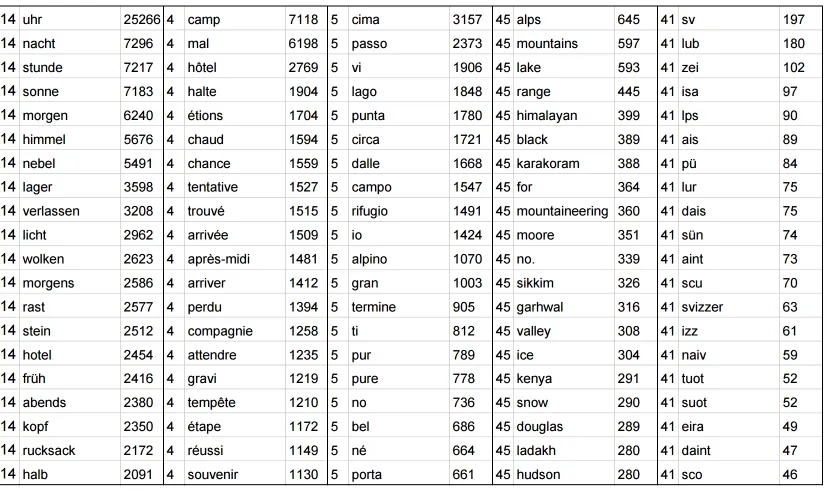
We evaluate the clusters manually and assign labels (language classes) in a majority rule fashion. If the first 20 most frequent words in a cluster look to be from one language, that language is assigned as one of the class labels: DE, EN, FR, IT, RM, CH-DE, NE (named entity), or MIXED (if words are not in any of the aforementioned classes). (See Figure 1 for examples of clusters that were labeled DE, FR, IT, EN, and RM.) Most of the time, there is a major-ity class in a cluster. In cases where it was difficult to make a call based on the top 20 words, the remainder of the cluster will be looked at and evaluated.
The need for a separate class for NEs is based on cluster results6. Although certain NEs have
vari-ants in different languages, e.g. the Swiss city of Basel isBaselin DE,Bâlein FR,Basileain IT, and these words could fall into their respective language classes, results of various clustering experiments show that, especially when the number of classes are well above the number of language classes, some NEs do tend to cluster together.
5 Evaluation of TBLID and Results
5.1 Evaluation Setup
With one language class label assigned for each vo-cabulary item, our experiment to evaluate our LID system (henceforth: TBLID) begins by randomly se-lecting sentences that are indicated to contain CS segments based on the annotations that are about 6but this also concurs with the annotation guide-lines for the shared task in EMNLP 2014 Work-shop on Computational Approaches to Code Switching: http://emnlp2014.org/workshops/
CodeSwitch/guideline/word_annotations _en_es_CF.pdf
to be included in the upcoming release of the year-books provided byTB digital. These annotations re-sult from the implementation of the CS detection al-gorithm from Volk and Clematide (2014) (hereafter: VCCS) which uses a combination of four factors (the presence of quotation marks, at least 2 tokens being outside of these quotation marks, lemma tags
hunknowni, and minimum CS segment length of 15 characters) as cues to identify CS instances. Accord-ing to these criteria, 194 of the 209 yearbook files contain at least one CS sentence. We randomly se-lect one CS sentence from each of these 194 files to evaluate TBLID based on word-level language label accuracy and to compare our labels to the TB an-notations which are output oflangid.pyfor the intra-sentential CS segments andLingua-Identon the sen-tence level. (Classifying words one by one using langid.py alone for these 194 sentences yielded an overall accuracy of approximately 36%, hence it will not be used for comparison in this study.)
Word-level language identification accuracy is the percentage of the correctly labeled word tokens (i.e. tokens containing no numeric element or punctu-ation except for hyphen(s), apostrophe(s), and pe-riod(s)) from all sentences with CS. 2 of these 194 sentences are disqualified for evaluation due to inde-cipherability as they consist exclusively of numeric elements and abbreviations, most of which are po-tential OCR errors. This leaves us with a total of 5,073 word tokens.
We illustrate scoring here with the following sen-tence from the 1925 yearbook:
[1]Je n’ en sais rien , mais l’ énergie de son « Oel per oel e daint per daint » résonne encore à mon oreille .
The 22 word tokens here should be identified with the following languages (labels indicated here with preceding underscores, CS segment boldfaced):
Figure 1: Examples of clusters labeled DE, FR, IT, EN, and RM (from left to right). The leftmost column of the three columns for each language (i.e. inside each frame) indicates the cluster number, the middle column the word token, the rightmost the term frequency.
Oel_rm per_rm oel_rm e_rm daint_rm per_rm daint_rm » résonne_fr encore_fr à_fr mon_fr oreille_fr .
Annotations byTB digital(punctuation marks are also classified by their system, but excluded from evaluation for this paper) have 15 of these correctly identified as FR and 7 RM words incorrectly identi-fied as OC (Occitan):
[1b]TB (Lingua-Ident + langid): Je_fr n’_fr en_fr sais_fr rien_fr ,_fr mais_fr l’_fr én-ergie_fr de_fr son_fr «_oc Oel_oc per_oc oel_oc e_oc daint_oc per_oc daint_oc »_oc résonne_fr encore_fr à_fr mon_fr oreille_fr ._fr
TBLID has 17 correctly identified word tokens and makes 5 mistakes (non-word tokens were ex-cluded as mentioned, and given_unktags):
[1c]TBLID: Je_fr n’_fr en_fr sais_fr rien_fr ,_unk mais_fr l’_fr énergie_fr de_fr son_fr «_unk Oel_mixed per_it oel_mixed e_it daint_rm per_it daint_rm »_unk résonne_fr encore_fr à_fr mon_fr oreille_fr ._unk
If oel were a word in a language not available in the set of language classes in TBLID, classifying it as MIXED would be acceptable and expected, but since RM is a possible label, each occurrence ofoel, for example, is counted as 1 incorrect instance.
All word tokens are evaluated in context, in the particular instance, not for their potentiality to take on a certain label. E.g. the two word tokens par an meaning yearly in a FR segment should both be labeled FR, even thoughparcan be DE/EN/FR/IT/RM, andancan be an EN, FR, DE, as well as a RM word, if evaluated independently. We will return to the issue of multilingual homographs in our discussion in Section 6.1 below.
5.2 NE Classification and Two Annotation Schemes
LID task, we define organizations, person names, lo-cations (which include mountain and cabin names), and month names as NEs.
Since NE is not an available category in TB an-notations, we consider an NE correct if an LID sys-tem gives it an NE or a correct language label. But this notion of "correct language" can be an intricate matter with such an inherently code-switched cor-pus. We may understand that, for example, within a DE segment, if the wordBâlewas used when there is a valid DE variantBasel available, there is valid reason to consider this as a CS element. But how about in cases where the form of the name is identi-cal across the languages in question, such asBonn? The usage ofBonn in midst of a FR segment may not be considered CS in that case. But the line here, if there is one, can be blurry. Consider the following sentence from the 1975 German yearbook:
[2] Indessen gibt dann der Guide bleu von 1962 einige Details über die Bedingungen für eine Besteigung bekannt , indem er von der al-ten Ausgabe die Erwähnung warmer Kleidung , guter Schuhe und Schutzbrillen übernimmt , aber alles in Verbindung mit «Grand Hotel Ätna , mehreren Restaurants bei der Casa Can-toniera , Schutzhütte Sapienza , Hütte Menza des CAI , Wintersport etc . »
If annotated with the above rationale (sentence trun-cated to highlight only the more relevant parts):
[2a] GOLD-strict: Indessen_de gibt_de dann_de der_de Guide_de bleu_de von_de 1962_unk einige_de Details_de über_de die_de Bedingungen_de für_de eine_de Besteigung_de bekannt_de , . . .
, mehreren_de Restaurants_de bei_de der_de Casa_de_ne Cantoniera_de_ne , Schutzhütte_ne_de Sapienza_ne_de , Hütte_de_ne Menza_de_ne des_de CAI_ne_de, Wintersport_de etc_de . »
ClassifyingGuide bleu,Casa Cantoniera,Sapienza, Menza, andCAI(which stands forClub alpino Ital-iano) as DE may not be uncontested, perhaps even a bit unintuitive for some. We hence devised two evaluation schemes – strict and lenient. The anno-tations as exemplified in [2a] are considered strict. The lenient annotations are illustrated in [2b] below:
Lingua-Ident + langid.py TBLID
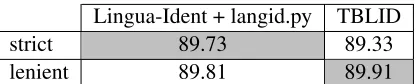
strict 89.73 89.33
[image:7.612.324.533.70.112.2]lenient 89.81 89.91
Table 2:Final accuracy scores (rounded to 2 digits), based on 5073 words
[2b] GOLD-lenient: Indessen_de gibt_de dann_de der_de Guide_de_fr bleu_de_fr von_de 1962_unk einige_de Details_de über_de die_de Bedingungen_de für_de eine_de Besteigung_de bekannt_de , . . . , mehreren_de Restaurants_de bei_de der_de Casa_de_ne_it Cantoniera_de_ne_it , Schutzhütte_ne_de Sapienza_ne_de_it , Hütte_de_ne Menza_de_ne_it des_de CAI_ne_de_it, Wintersport_de etc_de . »
There can be more than one permissible language for each word. For the wordCasahere, for example, a label is considered correct if it is DE, NE, or IT. The strict annotations for a word are a subset of the lenient annotations.
5.3 Results
Despite being a very weakly supervised system (manual "supervision" took place only in the label-ing of 50 clusters), the combination of the two fully supervised systems and TBLID performed neck and neck. As expected, the strict annotation standard fa-vors the combination ofLingua-Identandlangid.py, which assumes the notion of a base language for each chunk of texts within a sentence. TBLID is word-level and allows for more flexible switching and more variation in languages within a sentence, hence agrees more with the lenient annotation stan-dard. In the strict evaluation, TB annotations have 4552 out of 5073 word tokens correct, with an accu-racy score of 89.73%, while TBLID has 4532 cor-rect, at 89.33%. In the lenient evaluation, TBLID has 4561 correct, i.e. accuracy of 89.91%, whereas TB annotations only have 4556 correct, at 89.81% (all scores are rounded to 2 decimal places), as sum-marized in Table 2.
6 Error Analysis and Future Directions
6.1 Multilingual Homographs
and the system of assigning one label per word. Generally, a homograph (within one language) is a word form that expresses two or more different meanings, e.g. bass in EN can refer to a fish and a musical instrument. In our study, we use MH to refer to a word form that exists in two or more lan-guages. TBLID assigns one label to each word type, that is, word type of a multilingual corpus. This im-mediately poses a problem, above all, to the scores of stopwords that the few Indo-European languages in this corpus have in common. Word forms such as la,il,le,de,da,des,d’,an,in,on,per,si,non,et,i, was,a,jeas well asaller,va,est,qua,be,god7,ni,
sur,at,mal,termineare eligible word forms in more than one of the languages relevant in our LID task. Close to about 100 instances where TBLID "mis-labeled" in this evaluation were of errors related to MHs. For example, the TBLID label for the word des(meaning: "of the" in FR and DE) is FR. Hence wheneverdesin DE appears, our current "one label per word type"-design suffers an inevitable defeat (and a frequent one too asdesoccurs not at all sel-dom in DE). We tried to remedy this situation by at-tempting to assign multiple labels via soft clustering with EM (Expectation Maximization) and TSVD via scikit-learn. But the distribution of these MHs are so skewed that it was difficult to even pick a thresh-old above which the word should be classified as be-longing to a certain cluster. Most of these popular MHs, despite their multiple identities, (oddly) show a strong preference for one cluster with a probability of almost 1.
Since it is less likely for function words to be an independent CS element, modeling context through a sequential model such as HMM and CRF as in King and Abney (2013) after our clustering effort could be helpful. Instances such as the one in Sec-tion 6.2 below are good test cases for these future experiments. They serve as vivid reminders that re-lying on the LID of a larger stretch of text for a base language can also be prone to missing many cases of CS and correct LID.
7meaning "forest" or "wood" in RM, as perhttp:// www.pledari.ch/mypledari/index.php
6.2 CS Detection Heuristic: Quotation Marks
One frequent error pattern for TB annotations is the assumption of quotation marks playing a role in CS. The following sentence from the 1997 FR yearbook contains a long stretch of pairs of words in the form "FR / DE" with figures reporting the financial gains, losses, and interests of the SAC fund. The sentence was extracted as a CS candidate for evaluation due to the « and » towards the end of the sentence:
[3] Franz Werthmüller , chef des finances . . . Zins / Intérêts . . . Material Rettungswe-sen / Matériel de sauvetage . . . Veränderung Clubvermögen / Variation de la fortune du club . . . Zunahme / Augmentation . . . Ab-nahme / Diminution Zu- und Abgänge Fond-sAttributions et débits des fonds Verzinsung der Fonds / Intérêts des fonds Zunahme All-gemeine Reserven / Augmentation Réserves générales . . . Details siehe Tabelle « Verän-derung der Fonds » / Détails :
VCCS assumes elements outside of quotation marks to be in one (base/default) language, merely that identified on the sentence-level by Lingua-Ident. According to this, all word tokens of this sentence were predicted to be FR, except for the 3 inside the « and » , whichlangid.pyclassified cor-rectly as DE (sentence accuracy: 50/78). TBLID, on the other hand, identified more words correctly – getting DE forZinsand FR forIntérêtsas "interest" for the two respective languages. It had 65 out of 78 correct and even recognizedFranzandWerthmüller as NEs.
Another motivation that calls for a refinement of VCCS (from 1877 yearbook):
[4]GOLD-lenient: in_de Vissoye_de_ne_fr erfuhr_de ich_de von_de einem_de Thalkundigen_de , sie_de hätten_de « mauvaises_fr femmes_fr » zum_de Schlupfwinkel_de gedient_de , und_de da_de ich_de weiter_de forschte_de , was_de denn_de diese_de « mauvaises_fr femmes_fr » verübt_de , erhielt_de ich_de die_de zögernde_de Erklärung_de , es_de seien_de « sorcières_fr » gewesen_de .
But VCCS does not handle the segment «sorcières», as it is shorter than 15 characters in length, letting it default into the base language of the sentence (DE). TBLID was able to tag the wordsorcièreswith FR. Here we see the feasibility of a word-level LID sys-tem. (Score information: both systems get 33 out of 34 correct – TB annotations miss on the word sorcières, while TBLID recognizesThalkundigen(a DE compound noun meaning "those who are knowl-edgeable about the valley") as an NE.)
6.3 OCR errors
Despite the crowdsourcing effort to rectify OCR er-rors for some yearbooks, OCR erer-rors are still boun-tiful in the corpus, some of them even form clus-ters of their own. Our approach could be refined through iterating the clustering procedure, mirror-ing the two-phase setup in Rabinovich and Wintner (2015)) in which the unsupervised clustering algo-rithm was run twice – separating genre in the first, and Translationese and Original in the second run. This staged approach might help clean up some of our mixed clusters if we, for example, remove the purer clusters (including these "OCR clusters") from the sample first and then re-cluster the remaining words.
6.4 Contextual Accuracy: Diachronic Corpus
Consider the following sentence snippet from the 1874 yearbook:
[5] TBLID: . . . von_de Bünden_de an_de den_de Wiener_de Congress_en und_de nach_de Mailand_de . . .
EN is a minority language in this corpus. Misla-beled EN words are plentiful in our study as EN data is sparse. The system was, however, clever enough to classifyCongressas EN, which would have been correct were it not for the fact that the word here is the DE wordKongresswith an archaic spelling.
7 Conclusion
We have presented a data-driven, self-sufficient, cluster-and-label, simple count distributional ap-proach that identifies the language of word types of a multilingual domain-specific corpus of almost 40 million tokens. We report an accuracy of 89.91%
based on about 5,000 word tokens evaluated and the only "supervision" required was the labor to manu-ally label 50 clusters. We noted some fundamental issues in the definition of gold standard in LID and devised two annotation standards. Different argu-ments speak for and against various possibilities to optimize the system – the assignment of multiple la-bels (esp. for multilingual homographs), a more ex-plicit but smart modeling of surrounding context (for example, through combining clustering with HMM model after clustering, or staging clustering itself), and the refinement of the code switching detection algorithm proposed by Volk and Clematide (2014). Through our comparison with off-the-shelf alterna-tives, we learned that LID of small(er) segments is far from a solved task. Future directions may also include investigating whether incorporating super-vised methods would improve performance and test-ing this method on other datasets.
Acknowledgments
We would like to thankText+Berg digitalfor sharing their existing code-switching annotations and help-ful suggestions. We would also like to thank the three anonymous reviewers for their valuable com-ments.
References
Kenneth Ward Church and Patrick Hanks. 1990. Word association norms, mutual information, and lexicogra-phy. Computational Linguistics, 16(1):22–29. Scott C. Deerwester, Susan T. Dumais, Thomas K.
Lan-dauer, George W. Furnas, and Richard A. Harshman. 1990. Indexing by latent semantic analysis. JASIS, 41(6):391–407.
Harsh Jhamtani, Suleep Kumar Bhogi, and Vaskar Ray-choudhury. 2014. Word-level language identification in bi-lingual code-switched texts. In Wirote Aroon-manakun, Prachya Boonkwan, and Thepchai Supnithi, editors, Proceedings of the 28th Pacific Asia Con-ference on Language, Information and Computation, PACLIC 28, Cape Panwa Hotel, Phuket, Thailand, December 12-14, 2014, pages 348–357. The PACLIC 28 Organizing Committee and PACLIC Steering Com-mittee / ACL / Department of Linguistics, Faculty of Arts, Chulalongkorn University.
Vander-wende, Hal Daumé III, and Katrin Kirchhoff, editors, Human Language Technologies: Conference of the North American Chapter of the Association of Com-putational Linguistics, Proceedings, June 9-14, 2013, Westin Peachtree Plaza Hotel, Atlanta, Georgia, USA, pages 1110–1119. The Association for Computational Linguistics.
Omer Levy, Yoav Goldberg, and Ido Dagan. 2015. Im-proving distributional similarity with lessons learned from word embeddings. TACL, 3:211–225.
Marco Lui and Timothy Baldwin. 2012. langid.py: An off-the-shelf language identification tool. In The 50th Annual Meeting of the Association for Computa-tional Linguistics, Proceedings of the System Demon-strations, July 10, 2012, Jeju Island, Korea, pages 25– 30. The Association for Computer Linguistics. Marco Lui. 2014. Generalized language identification.
PhD thesis, The University of Melbourne.
Christopher D. Manning, Prabhakar Raghavan, and Hin-rich Schütze. 2008. Introduction to information re-trieval. Cambridge University Press.
Fabian Pedregosa, Gaël Varoquaux, Alexandre Gram-fort, Vincent Michel, Bertrand Thirion, Olivier Grisel, Mathieu Blondel, Peter Prettenhofer, Ron Weiss, Vin-cent Dubourg, Jake VanderPlas, Alexandre Passos, David Cournapeau, Matthieu Brucher, Matthieu Per-rot, and Edouard Duchesnay. 2011. Scikit-learn: Ma-chine learning in python. Journal of Machine Learn-ing Research, 12:2825–2830.
Ella Rabinovich and Shuly Wintner. 2015. Unsupervised identification of translationese.TACL, 3:419–432. Thamar Solorio, Elizabeth Blair, Suraj Maharjan, Steven
Bethard, Mona Diab, Mahmoud Ghoneim, Abdelati Hawwari, Fahad AlGhamdi, Julia Hirschberg, Alison Chang, and Pascale Fung. 2014. Overview for the first shared task on language identification in code-switched data. In Proceedings of the First Work-shop on Computational Approaches to Code Switch-ing, pages 62–72, Doha, Qatar, October. Association for Computational Linguistics.