A Joint Model for Word Embedding and Word Morphology
Kris Cao and Marek Rei Computer Lab University of Cambridge
United Kingdom
Abstract
This paper presents a joint model for performing unsupervised morphologi-cal analysis on words, and learning a character-level composition function from morphemes to word embeddings. Our model splits individual words into segments, and weights each segment according to its ability to predict context words. Our morphological analysis is comparable to dedicated morphological analyzers at the task of morpheme bound-ary recovery, and also performs better than word-based embedding models at the task of syntactic analogy answering. Finally, we show that incorporating morphology explicitly into character-level models helps them produce embeddings for unseen words which correlate better with human judgments.
1 Introduction
Word embedding models associate each word in a corpus with a vector in a semantic space. These vectors can either be learnt to optimize perfor-mance in a downstream task (Bengio et al., 2003; Collobert et al., 2011) or learnt via the distri-butional hypothesis: words with similar contexts have similar meanings (Harris, 1954; Mikolov et al., 2013a). Current word embedding models treat words as atomic. However, words follow a power law distribution (Zipf, 1935), and word embed-ding models suffer from the problem of sparsity: a word like ‘unbelievableness’ does not appear at all in the first 17 million words of Wikipedia, even though it is derived from common morphemes. This leads to three problems:
1. word representations decline in quality for
rarely observed words (Bullinaria and Levy, 2007).
2. word embedding models handle out-of-vocabulary words badly, typically as a single ‘OOV’ token.
3. the word distribution has a long tail, and many parameters are needed to capture all of the words in a corpus (for an embedding size of 300 with a vocabulary of 10k words, 3 mil-lion parameters are needed)
One approach to smooth word distributions is to operate on the smallest meaningful semantic unit, the morpheme (Lazaridou et al., 2013; Botha and Blunsom, 2014). However, previous work on the morpheme level has all used external morpho-logical analyzers. These require a separate pre-processing step, and cannot be adapted to suit the problem at hand.
Another is to operate on the smallest ortho-graphic unit, the character (Ling et al., 2015; Kim et al., 2016). However, the link between shape and meaning is often complicated (de Saussure, 1916), as alphabetic characters carry no inherent semantic meaning. To account for this, the model has to learn complicated dependencies between strings of characters to accurately capture word meaning. We hypothesize that explicitly introduc-ing morphology into character-level models can help them learn morphological features, and hence word meaning.
In this paper, we introduce a word embedding model that jointly learns word morphology and word embeddings. To the best of our knowledge, this is the first word embedding model that learns morphology as part of the model. Our guiding in-tuition is that the words with the same stem have similar contexts. Thus, when considering word segments in terms of context-predictive power, the
segment corresponding to the stem will have the most weight.
Our model ‘reads’ the word and outputs a se-quence of word segments. We weight each seg-ment, and then combine the segments to obtain the final word representation. These represen-tations are trained to predict context words, as this has been shown to give word representations which capture word semantics well (Mikolov et al., 2013b). As the root morpheme has the most context-predictive power, we expect our model to assign high weight to this segment, thereby learn-ing to separate root+affix structures.
One exciting feature of character-level models is their ability to represent open-vocabulary words. After training, they can predict a vector for any word, not just words that they have seen before. Our model has an advantage in that it can split unknown words into known and unknown compo-nents. Hence, it can potentially generalise better over seen morphemes and words and apply exist-ing knowledge to new cases.
To evaluate our model, we evaluate its use as a morphological analyzer (§4.1), test how well it learns word semantics, including for unseen words (§4.2), and examine the structure of the embedding space (§4.3).
2 Related Work
While words are often treated as the fundamental unit of language, they are in fact themselves com-positional. The smallest unit of semantics is the morpheme, while the smallest unit of orthography is the grapheme, or character. Both have been used as a method to go beyond word-level models.
2.1 Morphemic analysis and semantics As word semantics is compositional, one might ask whether it is possible to learn morpheme representations, and compose them to obtain good word representations. Lazaridou et al. (2013) demonstrated precisely this: one can de-rive good representations of morphemes distribu-tionally, and apply tools from compositional dis-tributional semantics to obtain good word repre-sentations. Luong et al. (2013) also trained a morphological composition model based on recur-sive neural networks. Botha and Blunsom (2014) built a language model incorporating morphemes, and demonstrated improvements in language mod-elling and in machine translation. All of these
approaches incorporated external morphological knowledge, either in the form of gold standard morphological analyses such as CELEX (Baayen et al., 1995) or an external morphological analyzer such as Morfessor (Creutz and Lagus, 2007).
Unsupervised morphology induction aims to decide whether two words are morphologically re-lated or to generate a morphological analysis for a word (Goldwater et al., 2005; Goldsmith, 2001). While they may use semantic insights to perform the morphological analysis (Soricut and Ochs, 2015), they typically are not concerned with ob-taining a semantic representation for morphemes, nor of the resulting word.
2.2 Character-level models
Another approach to go beyond words is based on on character-level neural network models. Both recurrent and convolutional architectures for de-riving word representations from characters have been used, and results in downstream tasks such as language modelling and POS tagging have been promising, with reductions in word perplexity for language modelling and state-of-the-art English POS tagging accuracy (Ling et al., 2015; Kim et al., 2016). Ballesteros et al. (2015) train a character-level model for parsing. Zhang et al. (2015) do away with words completely, and train a convolutional neural network to do text classifi-cation directly from characters.
Excitingly, character-level models seem to cap-ture morphological effects. Examining nearest neighbours of morphologically complex words in character-aware models often shows other words with the same morphology (Ling et al., 2015; Kim et al., 2016). Furthermore, morphosyntactic fea-tures such as capitalization and suffix information have long been used in tasks such as POS tagging (Xu et al., 2015; Toutanova et al., 2003). By ex-plicitly modelling these features, one might expect good performance gains in many NLP tasks.
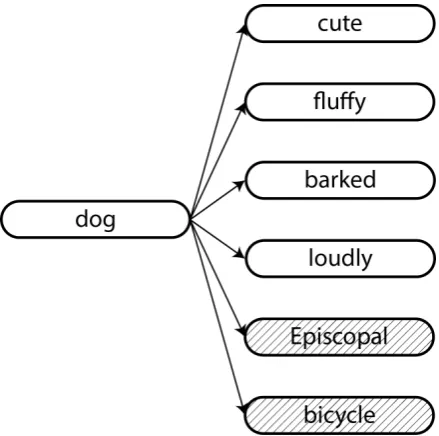
Figure 1: A graphical illustration of SGNS. The target vector for ‘dog’ is learned to have high inner product with the context vectors for words seen in the context of ‘dog’ (no shading), while having low inner product with random negatively sampled words (shaded)
of character-level models against human annota-tors.
3 The Char2Vec model
We hypothesize that by incorporating morpho-logical knowledge directly into a character-level model, one can improve the ability of character-level models to learn compositional word seman-tics. In addition, we hypothesize that incorporat-ing morphological knowledge helps structure the embedding space in such a way that affixation cor-responds to a regular shift in the embedding space. We test both hypotheses directly in§4.2 and§4.3 respectively.
The starting point for our model is the skip-gram with negative sampling (SGNS) objective of Mikolov et al. (2013b). For a vocabulary V of size|V|and embedding sizeN, SGNS learns two embedding tablesW, C ∈ RN×|V|, the target and
context vectors. Every time a word wis seen in the corpus with a context word c, the tables are updated to maximize
logσ(w·c) +Xk
i=1
Ec˜i∼P(w)[logσ(−w·˜ci)] (1)
whereP(w)is a noise distribution from which we draw k negative samples. In the end, the target
[image:3.595.72.292.61.279.2]vector for a wordwshould have high inner prod-uct with context vectors for words with which it is typically seen, and low inner products with con-text vectors for words it is not typically seen with. Figure 1 illustrates this for a particular example. In Mikolov et al. (2013b), the noise distribution
P(w)is proportional to the unigram probability of a word raised to the 3/4th power (Mikolov et al., 2013b).
Our innovation is to replaceW with a trainable function f that accepts a sequence of characters and returns a vector of lengthN (i.e. f :A<ω → RN, where Ais the alphabet we are considering
andA<ω denotes the finite length strings over the
alphabet A). We still keep the table of context embeddingsC, and our model objective is still to minimize
logσ(f(w)·c) +Xk
i=1
E˜ci∼P(w)[logσ(−f(w)·c˜i)]
(2) where we now treatwas a sequence of characters. After training, f can be used to produce an em-bedding for any sequence of characters, even if it was not previously seen in training.
The process of calculating f on a word is il-lustrated in Figure 2. We first pad the word with beginning and end of word tokens, and then pass the characters of the word into a character lookup table. As the link between characters and mor-phemes is non-compositional and requires essen-tially memorizing a sequence of characters, we use LSTMs (Hochreiter and Schmidhuber, 1997) to encode the letters in the word, as they have been shown to capture non-local and non-linear dependencies. We run a forward and a backward LSTM over the character embeddings. The for-ward LSTM reads the beginning of word symbol, but not the end of word symbol, and the backward LSTM reads the end of word symbol but not the beginning of word symbol. This is necessary to align the resulting embeddings, so that the LSTM hidden states taken together correspond to a parti-tion of the word into two without overlap.
The LSTMs output two sequences of vectors
hf0, . . . , hfn andhbn, . . . , hb0. We then concatenate
the resulir ofting vectors, and pass them through a shared feed-forward layer to obtain a final se-quence of vectors hi. Each vector corresponds
to two half-words: one half read by the forward LSTM, and the other by the backward LSTM.
hid-Figure 2: An illustration of Char2Vec. A bidirec-tional LSTM reads the word (start and end of word symbols represented by ˆ and $ respectively), out-putting a sequence of hidden states. These are then passed through a feed-forward layer (not shown), weighted by an attention model (the square box in the diagram) and summed to obtain the final word representation.
den states: given a hidden state hi, we calculate
a weight αi = a(hi) such that Pαi = 1, and
then calculate the resulting vector for the wordw
as f(w) = Pαihi. Following Bahdanau et al.
(2014), we calculateaas
a(hi) = exp(v
T tanh(W h i))
P
jexp(vTtanh(W hj)) (3)
i.e. a softmax over the hidden states.
[image:4.595.306.526.59.363.2]3.1 Capturing morphology via attention Previous work on bidirectional LSTM character-level models used both LSTMs to read the entire word (Ling et al., 2015; Ballesteros et al., 2015). This can lead to redundancy, as both LSTMs are used to capture the full word. In contrast, our model is capable of splitting the words and op-timizing the two LSTMs for modelling different halves. This means one of the LSTMs can spe-cialize on word prefixes and roots, while the other memorizes possible suffixes. In addition, when dealing with an unknown word, it can be split into
Figure 3: An illustration of the attention model (start and end of word symbols omitted). The root morpheme contributes the most to predicting the context, and is upweighted. In contrast, another potential split is inaccurate, and predicts the wrong context words. This is downweighted.
known and unknown components. The model can then use the semantic knowledge it has learnt for a known component to predict a representation for the unknown word as a whole.
We hypothesize that the natural place to split words is on morpheme boundaries, as morphemes are the smallest unit of language which carry se-mantic meaning. We test the splitting capabilities of our model in§4.1.
4 Experiments
We evaluate our model on three tasks: morpho-logical analysis (§4.1), semantic similarity (§4.2), and analogy retrieval (§4.3). We trained all of the models once, and then use the same trained model for all three tasks – we do not perform hyperpa-rameter tuning to optimize performance on each task.
[image:4.595.75.296.60.325.2]cleaned-up dump of Wikipedia1. We only trained on words which appeared more than 5 times in our corpus. We used a context window size of 3 words either side of the target word, and took 11 nega-tive samples per posinega-tive sample, using the same smoothed unigram distribution as word2vec. The model was trained for 3 epochs using the Adam optimizer (Kingma and Ba, 2015). All ex-periments were carried out using Keras (Chollet, 2015) and Theano (Bergstra et al., 2010; Bastien et al., 2012). We initialized the context lookup table usingword2vec2, and kept it fixed during training. 3 In all character-level models, the char-acter embeddings have dimensiondC = 64, while
the forward and backward LSTMs have dimension
dLST M = 256. The concatenation of both
there-fore has dimensionality d = 512. The concate-nated LSTM hidden states are then compressed down todword = 256by a feed-forward layer.
As baselines, we trained a SGNS model on the same dataset with the same parameters. To test how much the attention model helps the character-level model to generalize, we also trained the Char2Vec model without the attention layer, but with the same parameters. In this model, the word embeddings are just the concatenation of the fi-nal forward and backward states, passed through a feedforward layer. We refer to this model as C2V-NO-ATT. We also constructed count-based vec-tors using SVD on PPMI-weighted co-occurence counts, with a window size of 3. We kept the top 256 principal components in the SVD decomposi-tion, to obtain embeddings with the same size as our other models.
4.1 Morphological awareness
The main innovation of our Char2Vec model com-pared to existing recurrent character-level models is the capability to split words and model each half independently. Here we test whether our model segmentations correspond to gold-standard mor-phological analyses.
We obtained morphological analyses for all the words in our training vocabulary which were in the English Lexicon Project (Balota et al., 2007). We then converted these into surface-level
segmenta-1available atmattmahoney.net/dc/text8 2We use the Gensim implementation:
https://radimrehurek.com/gensim/
3We experimented with updating the initialized context lookup tables, and with randomly initialized context lookups, but found they were influenced too much by orthographic similarity from the character encoder.
tions using heuristic affix-matching, and used this as a gold-standard morphemic analysis. We ended up with 14682 words, of which 7867 have at least two morphemes and 1138 have at least three.
Evaluating morphological segmentation is a long-debated issue (Cotterell et al., 2016). Tra-ditional hard morphological analyzers are nor-mally evaluated on borderF1 – that is, how many
morpheme borders are recovered. However, our model does not actually posit any hard morpheme borders. Instead, it just associates each charac-ter boundary with a weight. Therefore, we treat the problem of recovering intra-word morpheme boundaries as a ranking problem. We rank each inter-character boundary of a word according to our model weights, and then evaluate whether our model ranks morpheme boundaries above non-morpheme boundaries.
We use mean average precision (MAP) as our evaluation metric. We first calculate precision at
N for each word, until all the gold standard mor-pheme boundaries have been recovered. Then, we average over N to obtain the average precision (AP) for that word. We then calculate the mean of the APs across all words to obtain the MAP for the model.
We report results of a random baseline as a point of comparison, which randomly places morpheme boundaries inside the word. We also report the results of the Porter stemmer4, where we place a morpheme boundary at the end of the stem, then randomly thereafter.
Finally, we trained Morfessor 2.05 (Creutz and Lagus, 2007) on our corpus, using an initial ran-dom split value of 0.9, and stopping training when the difference in loss between successive epochs is less than 0.1% of the total loss. While Morfessor is no longer state-of-the-art in morpheme recovery (see, e.g. Narasimhan et al. (2015) for more re-cent work), it has previously been as a component in pipelines to build compositional word represen-tations (Luong et al., 2013; Botha and Blunsom, 2014). We then used our trained Morfessor model to predict morpheme boundaries6, and randomly permuted the predicted morpheme boundaries and ranked them ahead of randomly permuted non-morpheme boundaries to calculate MAP.
4We used the NLTK implementation 5We used the Python implementation
Model All word MAP Rich-morphology MAP Random 0.233 0.261 Porter Stemmer 0.705 0.446 Morfessor 0.631 0.500 Char2Vec 0.593 0.586
Table 1: Results at retrieving intra-word mor-pheme boundaries.
Word Model analysis Gold-standard analysis carrying carry|ing carry|ing leninism lenin|ism lenin|ism lesbianism lesbia|nism lesbian|ism
buses buse|s bus|es government gove|rnment govern|ment unrepentant un|repent|ant un|repent|ant weaknesses weak|nes|ses weak|ness|es
Table 2: Morphological analyses for sample words from the corpus. We take the topN model predic-tions as the split points, whereN is the number of gold-standard morphemes in the word.
As the test set is dominated by words with sim-ple morphology, we also extracted all the morpho-logically rich words with 3 or more morphemes, and created a separate evaluation on this subsec-tion. We report the results in Table 1.
As the results show, our model performs the best out of all the methods at analysing morpho-logically rich words with multiple morphemes. On these words, our model even outperforms Morfes-sor, which is explicitly designed as a morpholog-ical analyzer. This shows that our model learns splits which correspond well to human logical analysis, even though we build no morpho-logical knowledge into our model. However, when evaluating on all words, the Porter stemmer has a great advantage, as it is rule-based and able to give just the stem of words with great precision, which is effectively giving a canonical segmentation for words with just 2 morphemes.
We show some model analyses against the gold standard in Table 2.
4.2 Capturing semantic similarity
Next, we tested our model similarity scores against human similarity judgments. For these datasets, human annotators are asked to judge how similar two words are on a fixed scale. Model word vectors are evaluated based on ranking the word pairs according to their cosine similarity, and then measuring the correlation (using Spearman’s
Model WordSim353 MEN Test RW PPMI-SVD 0.607 0.601 0.293
SGNS 0.667 0.557 0.388
[image:6.595.309.524.64.132.2]C2V-NO-ATT 0.361 0.298 0.317 CHAR2VEC 0.345 0.322 0.282
Table 3: Similarity correlations of in-vocabulary word pairs between the models and human anno-tators.
Model WordSim353 MEN Test RW RW OOV C2V-NO-ATT 0.358 0.292 0.273 0.233 CHAR2VEC 0.340 0.318 0.264 0.243
Table 4: Similarity correlations of all word pairs between the character-level models and human an-notators. RW OOV indicates results specifically on pairs in the RW dataset with at least one word not seen in the training corpus.
ρ) between model judgments and human judg-ments (Levy et al., 2015).
We use the WordSim353 dataset (Finkelstein et al., 2002), the test split of the MEN dataset (Bruni et al., 2014), and the Rare Word (RW) dataset (Lu-ong et al., 2013). The word pairs in the Word-Sim353 and MEN datasets are typically simple, commonly occurring words denoting basic con-cepts, whereas the RW dataset contains many mor-phologically derived words which have low corpus frequencies. This is reflected by how many of the test pairs in each dataset contain out of vocabu-lary (OOV) items: 3/353 and 6/1000 of the word pairs in WordSim353 and MEN, compared with 1083/2034 for the RW dataset.
We report results for in-corpus word pairs in Ta-ble 3, and for all word pairs for those models aTa-ble to predict vectors for unseen words in Table 4.
[image:6.595.75.290.179.278.2]In-vocabulary Out-of-Vocabulary germany football bible foulness definately
Char2Vec unfiltered
germaine footballer bibles illness definitely germanies footballing testament seriousness indefinitely
germain footballing librarianship sickness enthusiastically germano foosball literature loudness emphatically germaniae footballers librarian cuteness consistently
Char2Vec filtered
poland footballer testament illness definitely german basketball literature blindness consistently
spain tennis hebrew consciousness drastically germans rugby judaism hardness theoretically
[image:7.595.78.518.64.250.2]france baseball biblical weakness infinitely
Table 5: Filtered and unfiltered model nearest neighbours for some in-vocabulary and out-of-vocabulary words
full Char2Vec model outperforms the C2V model without morphology. This suggests that character-based embedding models are learning to morpho-logically analyse complex word forms, even on unseen words, and that giving the model the capa-bility to learn word segments independently helps this process.
We also present some word nearest neighbours for our Char2Vec model in Table 5, both on the whole vocabulary and then filtering the nearest neighbours to only include words which appear 100 times or more in our corpus. This corresponds to keeping the top 10k words, which is common among language models (Ling et al., 2015; Kim et al., 2016). We note that nearest neighbour pre-dictions include words that are orthographically distant but semantically similar, showing that our model has the capability to learn to compose char-acters into word meanings.
We also note that word nearest neighbours seem to be more semantically coherent when rarely-observed words are filtered out of the vocabulary, and more based on orthographic overlap when the entire vocabulary is included. This suggests that for rarely-observed words, the model is basing its predictions on orthographic analysis, whereas for more commonly observed words it can ‘memo-rize’ the mapping between the orthography and word semantics.
4.3 Capturing syntactic and semantic regularity
Finally, we evaluate the structure of the embed-ding space of our various models. In particular,
Model All Acc Sem. Acc Syn. Acc PPMI-SVD 0.365 0.444 0.341
SGNS 0.436 0.339 0.513
C2V-NO-ATT 0.316 0.016 0.472 CHAR2VEC 0.355 0.025 0.525
Table 6: Results on the Google analogy task
we test whether affixation corresponds to regular linear shifts in the embedding space.
To do this, we use the Google analogy dataset (Mikolov et al., 2013a). This consists of 19544 questions of the form “A is to B as C is to X”. We split this collection into semantic and syntactic sections, based on whether the analogies between the words are driven by morphological changes or deeper semantic shifts. Example semantic ques-tions are on capital-country relaques-tionships (“Paris is to France as Berlin is to X”) and currency-country relationships (“pound is toGreat Britain as dollar is to X”). Example syntactic questions are adjective-adverb relationships (“amazingis to amazingly as apparent is to X”) and opposites formed by prefixing a negation particle (“ accept-able is to unacceptable as aware is to X”). This results in 5537 semantic analogies and 10411 syn-tactic analogies.
We use the method of Mikolov et al. (2013a) to answer these questions. We first`2-normalize all
wwhich satisfies
w= argmax
w∈V−{a,b,c}cos(w, b−a+c) (4)
wherea, b, care the word vectors for the wordsA, BandCrespectively.
We report the results in Table 6. The most in-triguing result is that character-level models are competitive with word-level models for syntactic analogy, with our Char2Vec model holding the best result for syntactic analogy answering. This suggests that incorporating morphological knowl-edge explicitly rather than latently helps the model learn morphological features. However, on the se-mantic analogies, the character-based models do much worse than the word-based models. This is perhaps unsurprising in light of the previous sec-tion, where we demonstrate that character-based models do worse at the semantic similarity task than word-level models.
5 Discussion
We only report results for English. However, En-glish is a morphologically impoverished language, with little inflection and relatively few productive patterns of derivation. Our morphology test set re-flects this, with over half the words consisting of a simple morpheme, and over 90% having at most 2 morphemes.
This is unfortunate for our model, as it performs better on words with richer morphology. It gives consistently more accurate morphological analy-ses for these words compared to standard base-lines, and matches word-level models for seman-tic similarity on rare words with rich morphol-ogy. In addition, it seems to learn morphosyntactic features to help solve the syntactic analogy task. Most of all, it is language-agnostic, and easy to port across different languages. We thus expect our model to perform even better for languages with a richer morphology than English, such as Turkish and German.
6 Conclusion
In this paper, we present a model which learns morphology and word embeddings jointly. Given a word, it splits the word in to segments and ranks the segments based on their context-predictive power. Our model can segment words into mor-phemes, and also embed the word into a represen-tation space.
We show that our model is competitive at the task of morpheme boundary recovery compared to a dedicated morphological analyzer, beating dedi-cated analyzers on words with a rich morphology. We also show that in the representation space word affixation corresponds to linear shifts, demonstrat-ing that our model can learn morphological fea-tures.
Finally, we show that character-level models, while outperformed by word-level models gener-ally at the task of semantic similarity, are com-petitive at representing rare morphologically rich words. In addition, the character-level models can predict good quality representations for unseen words, with the morphologically aware character-level model doing slightly better.
References
Harald R. Baayen, Richard Piepenbrock, and Leon Gu-likers. 1995. The CELEX Lexical Database.
Re-lease 2 (CD-ROM). Linguistic Data Consortium,
University of Pennsylvania, Philadelphia, Pennsyl-vania.
Dzmitry Bahdanau, Kyunghyun Cho, and Yoshua Ben-gio. 2014. Neural machine translation by jointly learning to align and translate. ICLR.
Miguel Ballesteros, Chris Dyer, and Noah A Smith. 2015. Improved transition-based parsing by mod-eling characters instead of words with LSTMs.
EMNLP.
David A. Balota, Melvin J. Yap, Keith A. Hutchi-son, Michael J. Cortese, Brett Kessler, Bjorn Loftis, James H. Neely, Douglas L. Nelson, Greg B. Simp-son, and Rebecca Treiman. 2007. The english lexi-con project.Behavior Research Methods.
Fr´ed´eric Bastien, Pascal Lamblin, Razvan Pascanu, James Bergstra, Ian J. Goodfellow, Arnaud Berg-eron, Nicolas Bouchard, and Yoshua Bengio. 2012. Theano: new features and speed improvements. Deep Learning and Unsupervised Feature Learning NIPS 2012 Workshop.
Yoshua Bengio, R´ejean Ducharme, Pascal Vincent, and Christian Janvin. 2003. A neural probabilistic lan-guage model. J. Mach. Learn. Res., 3:1137–1155, March.
Jan A. Botha and Phil Blunsom. 2014. Composi-tional Morphology for Word Representations and Language Modelling. InICML, Beijing, China, jun. *Award for best application paper*.
Elia Bruni, Nam Khanh Tran, and Marco Baroni. 2014. Multimodal distributional semantics. J. Artif. Int. Res.
John A. Bullinaria and Joseph P. Levy. 2007. Ex-tracting semantic representations from word co-occurrence statistics: A computational study.
Be-havior Research Methods.
Franois Chollet. 2015. Keras. https://github.
com/fchollet/keras.
Ronan Collobert, Jason Weston, L´eon Bottou, Michael Karlen, Koray Kavukcuoglu, and Pavel Kuksa. 2011. Natural language processing (almost) from scratch. JMLR, 12:2493–2537, November.
Ryan Cotterell, Tim Vieira, and Hinrich Sch¨utze. 2016. A joint model of orthography and word segmenta-tion. InNAACL.
Mathias Creutz and Krista Lagus. 2007. Unsupervised models for morpheme segmentation and morphol-ogy learning. ACM Trans. Speech Lang. Process., 4(1):3:1–3:34, February.
Ferdinand de Saussure. 1916. Course in General Lin-guistics.
Lev Finkelstein, Evgeniy Gabrilovich, Yossi Matias, Ehud Rivlin, Zach Solan, Gadi Wolfman, and Ey-tan Ruppin. 2002. Placing search in context: The concept revisited. ACM Trans. Inf. Syst.
John Goldsmith. 2001. Unsupervised learning of the morphology of a natural language. Computational Linguistics, 27(2):153–198, June.
Sharon Goldwater, Mark Johnson, and Thomas L. Grif-fiths. 2005. Interpolating between types and tokens by estimating power-law generators. In Y. Weiss, B. Schlkopf, and J. Platt, editors,NIPS, pages 459– 466. MIT Press, Cambridge, MA.
Zelig S. Harris. 1954. Distributional structure.Word. Sepp Hochreiter and J¨urgen Schmidhuber. 1997.
Long short-term memory. Neural Computation, 9(8):1735–1780, November.
Yoon Kim, Yacine Jernite, David Sontag, and Alexan-der M. Rush. 2016. Character-aware neural lan-guage models. AAAI.
Diederik P. Kingma and Jimmy Ba. 2015. Adam: A method for stochastic optimization.ICLR.
Angeliki Lazaridou, Marco Marelli, Roberto Zampar-elli, and Marco Baroni. 2013. Compositional-ly derived representations of morphologically complex words in distributional semantics. ACL.
Omer Levy, Yoav Goldberg, and Ido Dagan. 2015. Im-proving distributional similarity with lessons learned from word embeddings. Transactions of the Associ-ation for ComputAssoci-ational Linguistics, 3:211–225. Wang Ling, Tiago Lu´ıs, Lu´ıs Marujo, Ram´on
Fernan-dez Astudillo, Silvio Amir, Chris Dyer, Alan W. Black, and Isabel Trancoso. 2015. Finding function in form: Compositional character models for open vocabulary word representation. EMNLP.
Minh-Thang Luong, Richard Socher, and Christo-pher D. Manning. 2013. Better word representa-tions with recursive neural networks for morphol-ogy. InCoNLL.
Tomas Mikolov, Kai Chen, Greg Corrado, and Jeffrey Dean. 2013a. Efficient estimation of word represen-tations in vector space.ICLR Workshop.
Tomas Mikolov, Ilya Sutskever, Kai Chen, Greg Cor-rado, and Jeffrey Dean. 2013b. Distributed repre-sentations of words and phrases and their composi-tionality.NIPS.
Andriy Mnih and Koray Kavukcuoglu. 2013. Learning word embeddings efficiently with noise-contrastive estimation. In C. J. C. Burges, L. Bottou, M. Welling, Z. Ghahramani, and K. Q. Weinberger, editors,Advances in Neural Information Processing
Systems 26, pages 2265–2273. Curran Associates,
Inc.
Karthik Narasimhan, Regina Barzilay, and Tommi S. Jaakkola. 2015. An unsupervised method for un-covering morphological chains. TACL.
Radu Soricut and Franz Ochs. 2015. Unsuper-vised morphology induction using word embed-dings. NAACL.
Kristina Toutanova, Dan Klein, Christopher D. Man-ning, and Yoram Singer. 2003. Feature-rich part-of-speech tagging with a cyclic dependency network. InIn Proceedings of NAACL.
Wenduan Xu, Michael Auli, and Stephen Clark. 2015. CCG supertagging with a recurrent neural network.
ACL.
Xiang Zhang, Junbo Zhao, and Yann LeCun. 2015. Character-level convolutional networks for text clas-sification.NIPS.