Building a Cross-document Event-Event Relation Corpus
Yu Hong1,2, Tongtao Zhang1, Tim O’Gorman3, Sharone Horowit-Hendler4, Heng Ji1, Martha Palmer3
1Computer Science Department, Rensselaer Polytechnic Institute 2Department of Computer Science, Soochow University 3Department of Linguistics, University of Colorado at Boulder
4Institute of Reading Development
Abstract
We propose a new task of extracting event-event relations across documents. We present our efforts at designing an anno-tation schema and building a corpus for this task. Our schema includes five main types of relations: Inheritance, Expan-sion, Contingency, Comparison and Tem-porality, along with 21 subtypes. We also lay out the main challenges based on de-tailed intannotator disagreement and er-ror analysis. We hope these resources can serve as a benchmark to encourage re-search on this new problem.
1 Introduction
The ultimate goal of Information Extraction (IE) is to construct “Information Networks” (Li et al., 2014) from unstructured texts. Most previous IE work focused on constructing entity-centric Infor-mation Networks where each node represents an entity and each edge represents a relation. We pro-pose a novel task to construct a new layer of event-centric Information Networksacross multiple doc-uments, where each node is an event and the edges capture the relations between two events. This task can provide building blocks for many impor-tant applications such as event knowledge base population and temporal event tracking (Do et al., 2012). The nodes can be extracted by existing fine-grained event extraction approaches (Ji and Grishman, 2008; Liao and Grishman, 2010; Hong et al., 2011; Li et al., 2013; Li et al., 2014). How-ever, little previous work can be directly exploited to construct the edges.
In this paper we define a comprehensive schema that includes multiple fine-grained event-event re-lation types. Some types are similar to those in discourse parsing (Soricut and Marcu, 2003).
However, event-event relations are fundamentally different from discourse relations: (1) The input consists of structured events instead of unstruc-tured sentences. (2) For cross-document event pairs, there are neither explicit textual clues nor implicit information about the ordering of clauses that might indicate the relation. Following this schema, we annotated a cross-document event-event relation corpus built on top of the Auto-matic Content Extraction (ACE2005)1 event
an-notations. We will define the task (Section 2), describe the annotation schema (Section 3) and present corpus statistics and annotation challenges (Section 4).
2 Task Definition
In an event-event relation schema, events form a crucial foundation because they serve as nodes and are indispensable in event-centric information net-works. We follow the definition of events in the ACE guideline2:
Event trigger: the main word which most clearly expresses an event occurrence.
Event arguments: the entities, time expressions and values that are involved in an event.
Event mention: a phrase or sentence within which an event is described, including a trigger and a set of arguments.
Event: a set of coreferential event mentions within one document.
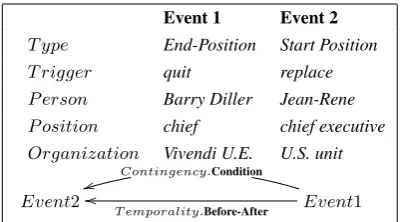
We define the event-event relation task as the annotation of all applicable logical relations be-tween two events. For example, as illustrated in Figure 1, the following events are connected by
ConditionandTemporalityrelations:
Event 1: Media tycoon Barry Diller on Wednes-day quit as chief of Vivendi Universal
Entertain-1http://projects.ldc.upenn.edu/ace
2https://www.ldc.upenn.edu/sites/www.ldc.upenn.edu/ files/english-events-guidelines-v5.4.3.pdf
Event 1 Event 2 T ype End-Position Start Position T rigger quit replace P erson Barry Diller Jean-Rene P osition chief chief executive Organization Vivendi U.E. U.S. unit
Event2 Event1
Contingency.Condition
t
t
T emporality.Before-After
o
[image:2.595.81.282.61.172.2]o
Figure 1: Examples of input and output
ment.
Event 2: Parent company chairman Jean-Rene Fourtou will replace Diller as chief executive of US unit.
This example reveals the fact that a successor takes the place onlyafter the time when (Tempo-rality) and under the condition that (Condition)
the predecessor makes room for the successor.
3 Event-Event Relation Schema
Our event-event relation schema includes 5 main
Types – Inheritance, Expansion, Contingency,
ComparisonandTemporality– along with 21
Sub-typesas shown in Table 1. Table 1 also
demon-strates Roles. Events involved in a relation play certain roles. For example, anAttackevent and an
Injure event in aContingency.Causality will play
CauseandResultroles respectively. In the follow-ing we will present a detailed definition of each subtype.
3.1 Inheritance and Expansion
Inheritance relations include both traditional
Coreference relations as well as Subevent that marks aggregation-to-component relations.
Reemergence connects recurrent events while
Variationsummarizes the prototype of an event.
Expansion relations include Confirmation,
which encodes a concept-to-instance or “subset” relation, andConjunctionandDisjunction, which relate two subevents within a larger event, and mark two subevents as playing similar ( Conjunc-tion) or dissimilar (Disjunction) roles within the larger event. This kind of relation is useful, since a larger event is often not explicitly mentioned.
The combination of these two kinds of relations allow one to build hierarchical representations of parts of an event network, as shown in Figure 2.
e4 e5 e6
e3 e2
e1
bombings marathon
Boston Marathon Bombings
o
o
Conjunction// ooConjunction// Sub-event
O
O
Sub-event 55 ii Sub-event
.
.
Sub-event
o
o Conjunction // Sub-event
O
O
Confirmation
O
O
ConfirmationOO
o
o Conjunction // Sub-event 77 gg Sub-event
————————————————-e1 : 117th annual Boston Marathon; e2 :winner crossed the finish line; e3 :explosion near bystanders; e4 : 1stexplosion;
e5 : 2ndexplosion;
[image:2.595.307.520.65.216.2]e6 :the second bomb was placed at the finish line Figure 2: A hierarchical event network
3.2 Contingency and Comparison
AContingency relation indicates either an event
leading to the emergence (Causality) or serving as a triggering condition (Conditional) of another event.
Comparison relations indicate deeper logical
contrasts between relations. Oppositionindicates a relation in which two events are mutually con-tradictory, and unlikely to be both true. This has some similarity toContrast.Oppositionin the Penn Discourse Treebank (Miltsakaki et al., 2004) or specific annotations of opposition (Feltracco et al., 2015; Takabatake et al., 2015). Negation indi-cates that while two events could both be true, one shows that the other is no longer true.Competition
shows that two events are contrasting versions of the same underlying “event” (e.g., retreat versus
escape in disorder).
3.3 Temporality
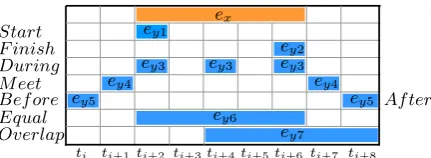
Last but not least, we also define subtypes of Tem-porality, which represents the temporal order of events. Temporality has been an active research topic for a long time. We arrange all categories and normalize the subtype names from the pre-vious work to constitute ourTemporalityschema. Figure 3 illustrates the temporal relation subtypes.
In this work, we elaborate the subtypes Tem-poralityin comparison with conventional work by introducingMeet,StartandFinish, which empha-sizes the existence of time intervals among events. The correct subtype of the Temporality rela-tion has a great impact on the decision of whether the Start-Position and End-Position events have a
Types Inheritance Expansion Contingency Contingency Temporality
Subtypes Reemergence Confirmation Comparison Condition Before-After Start
Roles Reference Generalization Superior Condition Before Included-Start Resurgence Instantiation Inferior Emergence After Includes
Subtypes Sub-event Conjunction Concession Causality Vagueness Overlap
Roles Constituent Homology-1 Not-Achieved Cause Vague-1 Partially-Before Synthesis Homology-2 Achieved Result Vague-2 Partially-After
Subtypes Variation Disjunction Negation Meet Equality
Roles Variance Heterology-1 Negator Before Contemporary-1
Semina Heterology-2 Initiator After Contemporary-2
Subtypes Coreference Opposite During Finish
Roles Occurrence Opponent-1 Includes Includes
[image:3.595.74.533.64.248.2]Paraphrasing Opponent-2 Included-In Included-Finish
Table 1: Fine-grained event-event relations and roles.
ex
ey1 Start
ey2 F inish
ey3 ey3 ey3 During
ey4 ey4
Meet
ey5 ey5
Before After
ey6 Equal
ey7 Overlap
ti ti+1ti+2 ti+3ti+4ti+5ti+6ti+7 ti+8
Figure 3: Various temporal relation subtypes be-tween eventexand eventey∗(tis a time interval).
relation, and vice versa. 4 Corpus Annotation
Annotating event-event relations requires an anno-tator to gain a global view of the overall scenario or topic (e.g., MH17) before exhaustively annotat-ing each event pair. In addition, our relation types are more fine-grained than previous work such as the Richer Event Descriptions (RED) (Ikuta et al., 2014). There are no existing annotation tools to meet these needs, so we developed a new annota-tion tool to visualize trigger words, arguments and contexts for each event pair to ensure that annota-tors fully understand documents, background and storyline.
We created an event-event relation corpus based on gold standard events in ACE2005 newswire documents and some additional news documents about Malaysian Airline 17 (denoted as MH17). Table 2 shows the detailed data statistics. Three annotators (A1&A2: graduate students,A3: a lin-guist) annotate the documents independently. The annotation results fromA1andA2are assessed by
A3 and disagreement among the three annotators is carefully evaluated andA3determined the final
#Topics #Documents #Events #Pairs
Vivendi 3 22 231
Anwar 3 39 741
SARS 2 9 36
MH17 50 196 19,698
Single 67 597 4,904
[image:3.595.70.286.291.370.2]Total 125 863 25,610
Table 2: Corpus statistics. Single denotes top-ics that only contain one document, and cross-document annotation is not available in those top-ics. Pairindicates the number of pairs consisting of two events from the same topic.
results.
Table 3 and 4 indicate that this is a very chal-lenging task for annotators. We can see that the major challenge for annotators is the determina-tion of the existence of reladetermina-tions. Causality and
Condition stand as the most challenging types, which require annotators to figure out the story-line of documents and exploit background knowl-edge. For example, the following two events are from the same document but there are no explicit connectives to indicate the conditional relation be-tween them:
Event 1:Edward Snowden claimed he was trained as a secret agent.
Event 2: The certification would also have given him some of the skills he needed to escape scrutiny.
[image:3.595.312.522.296.427.2]Sub-Annotators κValue A1 and A2 0.1558 A2 and A3 0.1987 A1 and A3 0.1628
Table 3: Stats of Cohen’s kappa coefficient.
Transition of Correction # of Occurrences
unrelated→Condition 142
unrelated→Causality 72
Coreference→unrelated 55
Conjunction→unrelated 48
Causality→unrelated 44
Table 4: Top 5 Error corrections.
eventasCoreference. Such mistakes happen when the arguments from one event appear as more spe-cific and detailed entities (e.g.,an attack in Bagh-dad vs. an attack in Iraq). However, when the event network becomes larger and more compli-cated, errors can be propagated across types, e.g., incorrectly labeledSub-event pairs will also trig-gerConjunctionerrors.
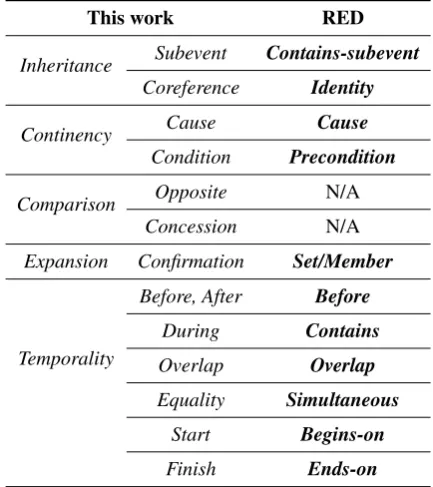
Moreover, we have attempted to align the inven-tory here with other ongoing efforts to annotate within-document event-event relations. Table 5 shows a mapping between a subset of the relations proposed here and those used in the Richer Event Descriptions (RED) (Ikuta et al., 2014). Other similar resources – such as Penn Discourse Tree-bank (Miltsakaki et al., 2004) – could also be used.
5 Related Work
The proposed schema covers event-event relation types that have been widely studied: (Styler IV et al., 2014; Bethard, 2013; Allen, 1983; Miller et al., 2013; Pustejovsky and Stubbs, 2011; Pustejovsky et al., 2005; UzZaman et al., 2013) also focused on the relation types which are related to Tempo-rality. Methods about extracting Coreference re-lations have also been discussed and proposed in (Chen and Ji, 2009; Chen et al., 2009; Bejan and Harabagiu, 2010; Lee et al., 2012; Zhang et al., 2015). (Do et al., 2011; Riaz and Girju, 2013; Mirza and Tonelli, 2014) work on Causality re-lation.
Similar event-event relation schema such as
This work RED
Inheritance Subevent Contains-subevent Coreference Identity
Continency Cause Cause Condition Precondition
Comparison Opposite N/A Concession N/A
Expansion Confirmation Set/Member
Temporality
Before, After Before
During Contains
Overlap Overlap
Equality Simultaneous
Start Begins-on
[image:4.595.309.523.65.307.2]Finish Ends-on
Table 5: Mappings to RED (Ikuta et al., 2014) RED(Ikuta et al., 2014) is in general more coarse-grained and has fewer types and subtypes.
Event-event relations differ from textual en-tailment (Dagan et al., 2013) or discourse rela-tions (Soricut and Marcu, 2003; Miltsakaki et al., 2004; Radev, 2000), which focus on the related-ness between two sentences, by tackling a full document or multiple documents. We adopted some terminology (e.g.,CausalityandExpansion) from the taxonomy of discourse relations (Milt-sakaki et al., 2004). We focus on a wider scope of cross-document events with richer and more fine-grained structured event representations.
If we consider each event-event relation in-stance as a frame (e.g., a contingency/causality event-event relation is similar to the frame cau-sation), the architecture of the Event Networks is also similar to FrameNet (Baker and Sato, 2003) and thus the ontological analysis and constraints in (Ovchinnikova et al., 2010) are also applicable to our task.
6 Conclusions and Future Work
Our work will expand the research venue of IE from entity-centric to event-centric. In the future we will further expand the corpus3, and compare
and integrate with other within-document event-event relation schemas such as RED. We also plan to develop a pilot system using these resources.
3The annotated corpus is available at http://nlp.
[image:4.595.71.290.186.289.2]Acknowledgements
This work was supported by the U.S. ARL NS-CTA No. W911NF-09-2-0053, DARPA DEFT No. FA8750-13-2-0041 and NSF IIS-1523198. The views and conclusions contained in this doc-ument are those of the authors and should not be interpreted as representing the official policies, ei-ther expressed or implied, of the U.S. Govern-ment. The U.S. Government is authorized to re-produce and distribute reprints for Government purposes notwithstanding any copyright notation here on.
References
James F Allen. 1983. Maintaining knowledge about temporal intervals. Communications of the ACM, 26(11):832–843.
Collin F. Baker and Hiroaki Sato. 2003. The framenet data and software. In Proceedings of the Annual Meeting of the Association for Computational Lin-guistics.
Cosmin Adrian Bejan and Sanda Harabagiu. 2010. Unsupervised event coreference resolution with rich linguistic features. In Proceedings of the Annual Meeting of the Association for Computational Lin-guistics.
Steven Bethard. 2013. Cleartk-timeml: A minimalist approach to tempeval 2013. InProceedings of Joint Conference on Lexical and Computational Seman-tics, volume 2, pages 10–14.
Zheng Chen and Heng Ji. 2009. Graph-based event coreference resolution. In Proceedings of Work-shop on Graph-based Methods for Natural Lan-guage Processing.
Zheng Chen, Heng Ji, and Robert Haralick. 2009. A pairwise event coreference model, feature impact and evaluation for event coreference resolution. In Proceedings of the Workshop on Events in Emerging Text Types, pages 17–22. Association for Computa-tional Linguistics.
Ido Dagan, Dan Roth, Mark Sammons, and Fabio Mas-simo Zanzotto. 2013. Recognizing textual entail-ment: Models and applications. Synthesis Lectures on Human Language Technologies, 6(4):1–220. Quang Do, Yee Seng Chan, and Dan Roth. 2011.
Min-imally supervised event causality identification. In Proceedings of Conference on Empirical Methods in Natural Language Processing.
Quang Xuan Do, Wei Lu, and Dan Roth. 2012. Joint inference for event timeline construction. In Pro-ceedings of the Joint Conference on Empirical Meth-ods in Natural Language Processing and Computa-tional Natural Language Learning, pages 677–687.
Anna Feltracco, Elisabetta Jezek, and Bernardo Magnini. 2015. Opposition relations among verb frames. InProceedings of the Workshop on EVENTS at the Conference of the North American Chapter of the Association for Computational Linguistics on Human Language.
Yu Hong, Jianfeng Zhang, Bin Ma, Jian-Min Yao, Guodong Zhou, and Qiaoming Zhu. 2011. Using cross-entity inference to improve event extraction. In Proceedings of the Annual Meeting of the Asso-ciation for Computational Linguistics, pages 1127– 1136, Portland, OR, USA.
Rei Ikuta, William F Styler IV, Mariah Hamang, Tim OGorman, and Martha Palmer. 2014. Challenges of adding causation to richer event descriptions. Pro-ceedings of the Annual Meeting of the Association for Computational Linguistics.
Heng Ji and Ralph Grishman. 2008. Refining event extraction through cross-document inference. In Proceedings of the Annual Meeting of the Asso-ciation for Computational Linguistics, Columbus, Ohio, USA.
Heeyoung Lee, Marta Recasens, Angel Chang, Mihai Surdeanu, and Dan Jurafsky. 2012. Joint entity and event coreference resolution across documents. In Proceedings of Conference on Empirical Methods in Natural Language Processing.
Qi Li, Heng Ji, and Liang Huang. 2013. Joint event extraction via structured prediction with global fea-tures. InProceedings of the Annual Meeting of the Association for Computational Linguistics, pages 73–82, Sofia, Bulgaria.
Qi Li, Heng Ji, Yu Hong, and Sujian Li. 2014. Constructing information networks using one single model. InProceedings of the Conference on Empir-ical Methods on Natural Language Processing.
Shasha Liao and Ralph Grishman. 2010. Using doc-ument level cross-event inference to improve event extraction. In Proceedings of the Annual Meeting of the Association for Computational Linguistics, pages 789–797, Uppsala, Sweden.
Timothy Miller, Steven Bethard, Dmitriy Dligach, Sameer Pradhan, Chen Lin, and Guergana Savova. 2013. Discovering temporal narrative containers in clinical text. InProceedings of the 2013 Workshop on Biomedical Natural Langua ge Processing.
Eleni Miltsakaki, Rashmi Prasad, Aravind K Joshi, and Bonnie L Webber. 2004. The penn discourse tree-bank. InProceedings of the International Confer-ence on Language Resources and Evaluation.
Ekaterina Ovchinnikova, Laure Vieu, Alessandro Oltramari, Stefano Borgo, and Theodore Alexan-drov. 2010. Data-driven and ontological analysis of framenet for natural language reasoning. In Pro-ceedings of the International Conference on Lan-guage Resources and Evaluation.
James Pustejovsky and Amber Stubbs. 2011. Increas-ing informativeness in temporal annotation. In Pro-ceedings of the 5th Linguistic Annotation Workshop. James Pustejovsky, Robert Knippen, Jessica Littman, and Roser Saur´ı. 2005. Temporal and event infor-mation in natural language text. Language resources and evaluation, 39(2-3):123–164.
Dragomir Radev. 2000. A common theory of infor-mation fusion from multiple text sources, step one: Cross-document structure. InProceedings of Spe-cial Interest Group on Discourse and Dialogue. Mehwish Riaz and Roxana Girju. 2013. Toward
a better understanding of causality between verbal events: Extraction and analysis of the causal power of verb-verb associations. InProceedings of Special Interest Group on Discourse and Dialogue.
Radu Soricut and Daniel Marcu. 2003. Sentence level discourse parsing using syntactic and lexi-cal information. InProceedings of the Conference of the North American Chapter of the Association for Computational Linguistics on Human Language, pages 149–156. Association for Computational Lin-guistics.
William F Styler IV, Steven Bethard, Sean Finan, Martha Palmer, Sameer Pradhan, Piet C de Groen, Brad Erickson, Timothy Miller, Chen Lin, Guergana Savova, et al. 2014. Temporal annotation in the clinical domain. Transactions of the Association for Computational Linguistics, 2:143–154.
Yu Takabatake, Hajime Morita, Daisuke Kawahara, Sadao Kurohashi, Ryuichiro Higashinaka, and Yoshihiro Matsuo. 2015. Classification and acquisi-tion of contradictory event pairs using crowdsourc-ing. In Proceedings of the Workshop on EVENTS at the Conference of the North American Chapter of the Association for Computational Linguistics on Human Language.
Naushad UzZaman, Hector Llorens, Leon Derczynski, Marc Verhagen, James F. Allen, and James Puste-jovsky. 2013. SemEval-2013 Task 1: TempEval-3: Evaluating Time Expressions, Events, and Tempo-ral Relations. In Proceedings of the International Workshop on Semantic Evaluation, pages 1–9. Tongtao Zhang, Hongzhi Li, Heng Ji, and Shih-Fu