N
ASARI: a Novel Approach to a Semantically-Aware
Representation of Items
Jos´e Camacho-Collados, Mohammad Taher Pilehvar and Roberto Navigli Department of Computer Science
Sapienza University of Rome
{collados,pilehvar,navigli}@di.uniroma1.it
Abstract
The semantic representation of individual word senses and concepts is of fundamental importance to several applications in Natu-ral Language Processing. To date, concept modeling techniques have in the main based their representation either on lexicographic re-sources, such as WordNet, or on encyclope-dic resources, such as Wikipedia. We pro-pose a vector representation technique that combines the complementary knowledge of both these types of resource. Thanks to its use of explicit semantics combined with a novel cluster-based dimensionality reduction and an effective weighting scheme, our repre-sentation attains state-of-the-art performance on multiple datasets in two standard bench-marks: word similarity and sense clustering. We are releasing our vector representations at http://lcl.uniroma1.it/nasari/.
1 Introduction
Obtaining accurate semantic representations of indi-vidual word senses or concepts is vital for several applications in Natural Language Processing (NLP) such as, for example, Word Sense Disambigua-tion (Navigli, 2009; Navigli, 2012), Entity Linking (Bunescu and Pas¸ca, 2006; Rao et al., 2013), seman-tic similarity (Budanitsky and Hirst, 2006), Informa-tion ExtracInforma-tion (Banko et al., 2007), and resource linking and integration (Pilehvar and Navigli, 2014). One prominent semantic representation approach is the distributional semantic model, which represents lexical items as vectors in a semantic space. The weights in these vectors were traditionally computed
on the basis of co-occurrence statistics (Salton et al., 1975; Turney and Pantel, 2010; Dinu and Lapata, 2010; Lappin and Fox, 2014), whereas for the more recent generation of distributional models weight computation is viewed as a context prediction prob-lem, often to be solved by using neural networks (Collobert and Weston, 2008; Turian et al., 2010; Mikolov et al., 2013). Unfortunately, unless they are provided with large amounts of sense-annotated data these corpus-based techniques cannot capture polysemy in their representations, as they conflate different meanings of a word into a single vector. Therefore, most sense modeling techniques tend to base their computation on the knowledge obtained from various lexical resources. However, these tech-niques mainly utilize the knowledge derived from either WordNet (Banerjee and Pedersen, 2002; Bu-danitsky and Hirst, 2006; Pilehvar et al., 2013) or Wikipedia (Medelyan et al., 2009; Mihalcea, 2007; Dandala et al., 2013; Gabrilovich and Markovitch, 2007; Strube and Ponzetto, 2006), which are, re-spectively, the most widely-used lexicographic and encyclopedic resources in lexical semantics (Hovy et al., 2013). This restriction to a single resource brings about two main limitations: (1) the sense modeling does not benefit from the complementary knowledge of different resources, and (2) the ob-tained representations are resource-specific and can-not be used across settings.
In this paper we put forward a novel concept rep-resentation technique, called NASARI, which ex-ploits the knowledge available in both types of re-source in order to obtain effective representations of arbitrary concepts. The contributions of this paper are threefold. First, we propose a novel technique
for rich semantic representation of arbitrary Word-Net synsets or Wikipedia pages. Second, we provide improvements over the conventional tf-idf weight-ing scheme by applyweight-ing lexical specificity (Lafon, 1980), a statistical measure mainly used for term extraction, to the task of computing vector weights in a vector representation. Third, we propose a semantically-aware dimensionality reduction tech-nique that transforms a lexical item’s representation from a semantic space of words to one of Word-Net synsets, simultaneously providing an implicit disambiguation and a distribution smoothing. We demonstrate that our representation achieves state-of-the-art performance on two different tasks: (1) word similarity on multiple standard datasets: MC-30, RG-65, and WordSim-353 similarity, and (2) Wikipedia sense clustering, in which our unsuper-vised system surpasses the performance of a state-of-the-art supervised technique that exploits knowl-edge available in Wikipedia in several languages.
2 Semantic Representation of Concepts
Lexical resources and concepts. The gist of our approach lies in its combination of knowledge from two different lexical resources: (1) the expert-based lexicographic WordNet, whose basic con-stituents are synsets, i.e., concepts expressed by sets of synonymous words (Miller et al., 1990), and (2) the collaboratively-constructed encyclopedic Wikipedia, whose articles can be considered as indi-vidual concepts. Throughout the paper, by a concept we mean a tupleb = (p, s) wherepis a Wikipedia page and s is the corresponding WordNet synset. As a bridge between the two resources we use the synset-to-article mappings provided by BabelNet1 (Navigli and Ponzetto, 2012), a high coverage mul-tilingual encyclopedic dictionary and semantic net-work that merges, among other resources, Wikipedia and WordNet. Note that the conceptbcan also con-tain a Wikipedia page or a WordNet synset only, if a mapping is not provided by BabelNet.
Semantic representation: NASARI. Our concept modeling approach consists of two phases. First, for a given concept, we collect a set of relevant Wikipedia pages by leveraging the structural infor-mation in Wikipedia and WordNet (Section 2.1).
[image:2.612.318.534.59.239.2]1http://www.babelnet.org/
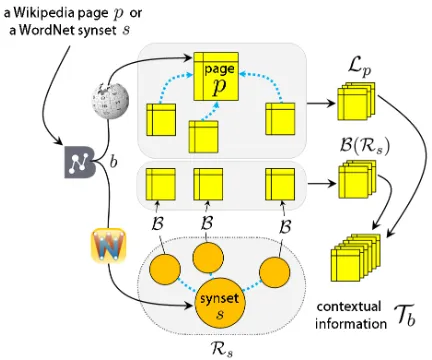
Figure 1: The process of obtaining contextual informa-tion for a WordNet synset or a Wikipedia article.
Then, we analyze the obtained contextual informa-tion and construct two vector representainforma-tions of the concept (Section 2.2).
2.1 Collecting contextual information
Figure 1 illustrates the process of obtaining a set of relevant Wikipedia pagesTb as contextual
informa-tion for a given conceptb = (p, s). LetLp be the
set containing p and all the Wikipedia pages hav-ing an outgohav-ing link to p, and Rs be the set
con-sisting of sand all other synsets that are in its di-rect neighbourhood. We further enrich Rs by
in-cluding the coordinate synsets ofs and the related synsets from its disambiguated gloss2. Let B be a function mapping each WordNet synsets0to its cor-responding Wikipedia pagep, if such mapping ex-ists in BabelNet, and to the empty set otherwise. Hence, B(Rs) = ∪s0∈RsB(s0). Then, our
con-textual information is the set of Wikipedia pages Tb = Lp∪ B(Rs). In the case eitherp orsis not
present in the conceptb, we take the contextual in-formation asTb =B(Rs)orTb =Lp, respectively.
2.2 Vector construction
By processing the collected contextual information Tb, NASARI represents the concept b as two
vec-tors in two semantic spaces: (1) word-based and (2) synset-based. LetWb be the bag of words of all the
word removal. We use lexical specificity in order to extract the most representative words (Section 2.2.1) and synsets (Section 2.2.2) ofWb.
Lexical specificity. Lexical specificity (Lafon, 1980) is a statistical measure that has been used in a wide range of NLP applications, such as ttual data analysis (Lebart et al., 1998), term ex-traction (Drouin, 2003), and domain disambigua-tion (Camacho Collados et al., 2014). However, to our knowledge, it has never heretofore been used to calculate weights in a vector-based representa-tion (Turney and Pantel, 2010). Lexical specificity is based on the hypergeometric distribution over word frequencies. This statistical measure is partic-ularly suitable for extracting an accurate set of rep-resentative terms for a given subcorpus of a refer-ence corpus (Lafon, 1980). Unlike the conventional term frequency-inverse document frequency weight-ing scheme (Jones, 1972, tf-idf), lexical specificity is not especially sensitive to different text lengths.
Assume a reference corpus of T words and a t -words subcorpus of that corpus. The goal is to find a set of terms that are peculiar to the subcorpus, but not to the whole reference corpus. Formally, given a word w that occurs f and k times in the corpus and subcorpus, respectively, positive speci-ficity computes the relevance ofwto the subcorpus asP(X ≥k)ifk≥ ftT, whereXis a random vari-able following a hypergeometric distribution with parametersf,tandT, and ftT is the expected value ofX. In our setting we are only interested in the pos-itive specificity, i.e., the set of most relevant words appearing in the contextual information. We ap-ply the standard procedure of apap-plying log10 and
then inverting the sign of the specificity probabili-ties in order to re-scale them to the real line, which is more easily interpretable (Drouin, 2003; Cama-cho Collados et al., 2014). We only retain words with specificity greater than two, which is equal to −log10(0.01). This threshold leads to a set of
repre-sentative words that are relevant to the context with a confidence of at least 99%, i.e.,P(X ≥k)≤0.01 (Billami et al., 2014).
2.2.1 Word-based representation
This word-based representation models the con-cept b in a conventional semantic space whose di-mensions are individual words. We leverage lexical
specificity to compute a weighted set of most repre-sentative words forWbwith respect to the reference
corpus, i.e., the whole Wikipedia. As an example, the obtained word-based vector for theedge of wa-tersense ofshorehaswater,ocean,lake,beachand seaamong its most relevant dimensions.
2.2.2 Synset-based representation
Given that the amount of contextual informa-tion gathered for a concept can be small, the re-sulting word-based vector can be sparse and as a consequence prone to noise, especially in the case of less frequent concepts. Therefore, we put for-ward a method that tackles the issue, providing rich semantically-aware representations. To this end, we group - and thereby generalize - similar dimen-sions in the obtained word-based vector, to produce a smaller vector in which dimensions are WordNet synsets and weights are computed on the basis of the combined information of the individual words in the group. The generalization procedure can be summa-rized in two main steps.
First, for each word w in Wb, we obtain from
WordNet the set Hw of all the direct hypernyms
of all the synsets containing w. For each synset
h ∈ Hw we check whether there exists another
word w0 from the contextual information that is a hyponym of h, i.e., h ∈ Hw ∩ Hw0. When such
is the case, lettingYh be the set of all words in the
hyponym synsets of h, we combine w, w0 and all the other words inYhinto a single dimension
repre-sented by their common hypernymh. Thus for our earlier example, the three wordsocean,lake, andsea are grouped into a single dimension represented by their hypernym, i.e., the synset containing thebody of watersense ofwater(water2
nin WordNet 3.0)3.
Then, we compute the weight associated with the new dimension by calculating the lexical specificity of the word cluster. Formally, we calculate the lex-ical specificity ofhby setting the parameterskand
fas the total number of times the words inYhoccur
inWb and the whole Wikipedia, respectively. The
values oftandT remain unchanged.
Our generalization procedure is similar to the di-mensionality reduction that is performed using sin-gular value decomposition in Latent Semantic Anal-ysis (Landauer and Dumais, 1997, LSA). However,
LSA is not applicable to our setting because, due to the usage of lexical specificity, our vectors are relatively small in size and different vectors usually have few overlapping dimensions. Moreover, unlike LSA, in which the size-reduced vectors have opaque conflations of multiple words as their dimensions, our new semantic space has human- and machine-readable synsets as its dimensions. Our general-ization procedure produces three advantages: (1) it maps the vectors from a word-based semantic space to a lower-dimensional space of synsets, (2) while merging multiple words into a single synset an im-plicit disambiguation of context words takes place, providing better means for sense distinction, and (3) the dimensionality reduction tackles the potential noise and sparsity, resulting in smoother vectors.
3 NASARIfor Semantic Similarity
So far we have explained how NASARI constructs two types of representations, i.e., word-based and synset-based, for arbitrary WordNet synsets and Wikipedia pages. In this section we provide a method that leverages NASARI representations for effective measurement of concept and word simi-larity. Semantic similarity between a pair of lexi-cal items (e.g., words or concepts) lies at the core of many applications in NLP and hence it has re-ceived a considerable amount of research interest, leading to a wide range of semantic similarity mea-sures (Mohammad and Hirst, 2012).
3.1 Concept similarity
Given a pair of concepts, we first use the procedure described in Section 2 to obtain for each concept the two corresponding vector representations, i.e., word-based and synset-based. For each representa-tion type, we then compute the similarity of the two concepts by comparing their corresponding vectors. This results in two similarity scores, one for each representation type. The final similarity is computed as the average of the two similarity scores. We use Weighted Overlap for comparing vectors.
Weighted Overlap. Proposed by Pilehvar et al. (2013), Weighted Overlap (WO) first sorts the el-ements of each vector vi and then harmonically
Algorithm 1NASARI-based word similarity
Input: wordsw1andw2 Output: Sim, similarity score
1: for eachsynonym setH ∈ S 2: ifw1∈H&w2∈Hthen
3: return Sim= 1 4: for eachwordwi ∈ {w1, w2}
5: Cwi← ∅, set of concepts associated withwi
6: ifwi∈WordNet&winotNamed Entitythen
7: for eachsenses∈WordNet senses(wi)
8: Cwi← Cwi∪ {s}
9: else
10: for eachpagep∈piped links(wi)
11: Cwi← Cwi∪ {p}
12: Vi← ∅, set of representations for concepts inCwi
13: for eachconceptc∈ Cwi
14: vwrd←NASARIword-based rep. ofc
15: vsyn ←NASARIsynset-based rep. ofc
16: v←(vwrd, vsyn)
17: Vi←Vi∪ {v}
18: Sim←maxv∈V1,v0∈V2
WO(vwrd,v0wrd)+WO(vsyn,v0syn) 2
19: return Sim
weights the overlaps between the two vectors:
W O(v1, v2) = P
q∈O(rq1+rq2)−1
P|O|
i=1(2i)−1
(1)
where O is the set of overlapping dimensions be-tween the two vectors andrqj is the rank of
dimen-sion q in the vector vj. Given that our vectors are significantly smaller than those in the original set-ting of WO, the overlaps are also generally smaller in size. Hence, we apply a square root operation to the computed value in order to obtain a more uniformly-distributed range of scores across the sim-ilarity scale, i.e., [0, 1]. In our experiments we show the advantage we gain by using WO in comparison to the conventional cosine measure.
3.2 Word similarity
Algorithm 1 shows the procedure we devised for measuring semantic similarity between two words. There are three main steps:
1. Given a pair of wordsw1 andw2the algorithm
the algorithm returns the maximum similarity score of one (lines 1-3).
2. If the words are not defined as synonyms, we proceed by obtaining, for each wordwi, its set
of possible senses (Cwi, lines 5-11). We
accord-ingly obtain the set of their respective NASARI vector representations (Vi, lines 13-17), two
(word-based and synset-based) for each con-cept inCwi. Section 3.2.2 describes the concept
extraction process.
3. Finally, the algorithm returns the similarity scoreSim(line 19), calculated as the similarity of the closest senses ofw1 andw2. In our
de-fault setting, we linearly combine our two vec-tor representations by averaging them (line 18).
3.2.1 Wiktionary synonymsS
Wiktionary is a rich collaboratively-constructed lexical resource that provides a considerable amount of multilingual lexical information for a large num-ber of words. We use this resource in order to ob-tain sets of synonymous wordsS. To this end, we first extract all the pre-specified synonymy relations in the English Wiktionary. This results in 17K sets with an average size of 2.8 synonyms.
In order to enrich the set we introduce a method that exploits the multilinguality of Wiktionary to extract synonymous words. Our approach utilizes translations of words in other languages as bridges between synonymous words in English. Specifi-cally, for each sensesof wordwin Wiktionary, we first get all the available translations. Assume that the sense sofw translates into the wordtl in
lan-guagel. If there is another word senses0of another wordw0in Wiktionary that is also translated tot
lin
language l, we hypothesize thatw andw0 are syn-onyms. In order to avoid ambiguity, astl we only
consider words that are monosemous according to languagel.
This procedure results in around 9K additional synonymous sets with an average size of 2.1. For in-stance, the Finnish nounammatti, which is monose-mous according to Wiktionary, links seven English words into a single set of synonyms: career, busi-ness,profession,occupation,trade,calling, and vo-cation. The final synonym set collectionS contains 25K sets, each having, on average, 2.6 words.
3.2.2 Concept extraction
If the two input wordsw1andw2are not found in
the same synonym set inS, we proceed by obtain-ing their sets of senses Cw1 and Cw2, respectively. Depending on the type ofwi, we use two different
resources for obtainingCwi: the WordNet sense
in-ventory and Wikipedia.
WordNet words. When the wordwi is defined in the WordNet sense inventory and is not a named entity (line 6 in Algorithm 1), we set Cwi as all
the WordNet synsets that contain wi, i.e., Cwi =
{synset s ∈ WordNet : wi ∈ s}. We use
Stan-ford Named Entity Recognizer (Finkel et al., 2005) in our experiments.
WordNet OOV and named entities. For named entities and words that do not exist in WordNet’s vocabulary (OOV) we construct the setCwi by
ex-ploiting Wikipedia’s piped links (line 10 in Algo-rithm 1). To this end, we take as elements of Cwi
the Wikipedia pages of the hyperlinks which have
wi as their surface form, i.e., piped-links(wi). If
|Cwi|>5, we pruneCwi to its top-5 pages in terms
of their number of ingoing links. Our choice of Wikipedia as a source for named entities is due to its higher coverage in comparison to WordNet.
4 Experiments
We evaluated NASARI on two different tasks that require the computation of semantic similarity be-tween words or concepts: word similarity (Section 4.1) and sense clustering (Section 4.2).
4.1 Word similarity 4.1.1 Datasets
WordSim-353 (WS-Sim) as test bed for our evalua-tions. The subset comprises 203 word pairs.
4.1.2 Experimental setup
In this task, we assess the performance of dif-ferent systems in terms of Pearson correlation. We compare our system against six similarity measures that have reported best performance on the three datasets. Lin (Lin, 1998) and ADW (Pilehvar et al., 2013) are WordNet-based approaches that leverage the structural information of WordNet for the com-putation of semantic similarity. Most similar to our work are Explicit Semantic Analysis (Gabrilovich and Markovitch, 2007, ESA), which represents a word in a high-dimensional space of Wikipedia arti-cles, and Salient Semantic Analysis (Hassan and Mi-halcea, 2011, SSA), which leverages the linking of concepts within Wikipedia articles for generating se-mantic profilesof words. Word2Vec (Mikolov et al., 2013) and PMI-SVD are the best predictive and co-occurrence models obtained by Baroni et al. (2014) on a 2.8 billion-token corpus that also includes the English Wikipedia.4 Word2Vec is based on neu-ral network context prediction models (Mikolov et al., 2013), whereas PMI-SVD is a traditional co-occurrence based vector wherein weights are cal-culated by means of Pointwise Mutual Information (PMI) and the vector’s dimension is reduced to 500 by singular value decomposition (SVD). We use the DKProSimilarity (B¨ar et al., 2013) implementation of Lin and ESA in order to evaluate these measures on the WS-Sim dataset.
4.1.3 Results
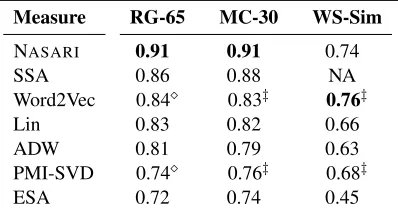
Table 1 shows the Pearson correlation of the dif-ferent similarity measures on the three datasets con-sidered. NASARI proves to be highly reliable on the task of word similarity, providing state-of-the-art performance on RG-65 and MC-30, and compet-itive results on WS-Sim. Importantly, the improve-ment we attain over measures that utilize as their knowledge base either WordNet (i.e., ADW, Lin) or Wikipedia (i.e., ESA and SSA) shows that our usage of the complementary information of the two types of resource has been helpful. We note that our Wik-tionary module detects four additional synonymous pairs (i.e., similarity = 1.0) in MC-30 (13%), eight in RG-65 (12%), and thirteen in WS-Sim (6%) that are
4clic.cimec.unitn.it/composes/semantic-vectors.html
Measure RG-65 MC-30 WS-Sim
NASARI 0.91 0.91 0.74
SSA 0.86 0.88 NA
Word2Vec 0.84 0.83‡ 0.76‡
Lin 0.83 0.82 0.66
ADW 0.81 0.79 0.63
PMI-SVD 0.74 0.76‡ 0.68‡
[image:6.612.329.528.61.168.2]ESA 0.72 0.74 0.45
Table 1: Pearson correlation of different similarity mea-sures on RG-65, MC-30, and WordSim-353 similarity (WS-Sim) datasets. Results for Lin and ESA on RG-65 and MC-30 are taken from (Hassan and Mihalcea, 2011). We show the best performance obtained by Baroni et al. (2014) out of 48 configurations specifically tested on RG-65 (highlighted by) and across different datasets includ-ing WS-Sim (highlighted by‡).
not defined as synonyms in WordNet. We also ob-tain competitive results according to the Spearman correlation (a setting in which the absolute similarity scores do not play a role and it is solely their ranking that matters) on all the three datasets: MC-30 (0.89), RG-65 (0.88), and WS-Sim (0.73).
WS-Sim is the only dataset on which we do not report state-of-the-art performance. An analysis of the outputs of our system on the WS-Sim dataset re-vealed that there are pairs in this subset of WordSim-353 that are not assigned proper scores according to the similarity scale. Hill et al. (2014) had previ-ously pointed out this deficiency of WS-Sim, mainly due to its original relatedness-based scoring scale. For instance, word pairs that are barely related (e.g., street-children) or antonyms (e.g., profit-loss and smart-stupid) are assigned relatively high similar-ity values (respectively, 4.9 for the former and 7.3 and 5.8 for the latter case, in the 0-10 scale). In all these cases our system produces more appropri-ate judgements according to the similarity scale. On the other hand, there are highly similar pairs in the dataset with relatively low gold scores. Examples in-cludeschool-center5andterm-life6with the respec-tive gold similarity scores of 3.4 and 4.5, whereas
5Schoolandcenterhave a pair of highly similar senses in
WordNet 3.0: center3
n: “a building dedicated to a particular
activity”andschool2
n: “a building where young people receive
education.”
6Termandlifeare in coordinate synsets (withtime periodas
Measure System type 500-pair SemEval
NASARI unsupervised 84.6% 88.4% Dan-mono supervised 77.4% 83.5% Dan-multi supervised 84.4% 85.5%
Baseline - 71.4% 82.5%
Table 2: Accuracy of different systems on two manually-annotated English datasets for sense clustering in Wikipedia. Dan-mono and Dan-multi are the monolin-gual and multilinmonolin-gual systems of Dandala et al. (2013).
NASARIcomputes their similarities as 8.4 and 9.6.
4.2 Sense clustering
Our second set of experiments focuses on sense clus-tering of the Wikipedia sense inventory. Wikipedia can be considered as a sense inventory wherein the different meanings of a word are denoted by the arti-cles listed in its disambiguation page (Mihalcea and Csomai, 2007). Given the high granularity of this inventory, clustering of senses can be highly bene-ficial to tasks that take this encyclopedic resource as their sense inventory (Hovy et al., 2013), such as Wikipedia-based Word Sense Disambiguation (Mi-halcea, 2007; Dandala et al., 2013).
4.2.1 Datasets
For the sense clustering task, we take as our benchmark the two datasets created by Dandala et al. (2013). In these datasets, clustering has been viewed as a binary classification problem in which all possible pairings of senses of a word are anno-tated whether they ought to be clustered or not. The first dataset contains 500 pairs, 357 of which are set to clustered and the remaining 143 to not clus-tered. The second dataset, referred to as the Se-mEval dataset, is based on a set of highly ambigu-ous words taken from SemEval evaluations (Mihal-cea, 2007) and consists of 925 pairs, 162 of which are positively labeled, i.e., clustered.
4.2.2 Experimental setup
In this task we use the procedure explained in Sec-tion 3.1 for measuring the similarity of concepts. A pair of pages is set to belong to the same cluster if their similarity exceeds the middle point in our similarity scale, i.e., 0.5 in the scale of [0, 1]. We compare our results with the state-of-the-art systems of Dandala et al. (2013) that perform clustering by
exploiting the structure and content of an English page (monolingual variant), or several pages in dif-ferent languages (multilingual variant that uses En-glish, German, Spanish and Italian pages). These systems are essentially multi-feature Support Vec-tor Machine classifiers that use an automatically-labeled dataset for their training.
4.2.3 Results
Table 2 lists the results of NASARIas well as the state-of-the-art systems of Dandala et al. (2013). We also report the results for a baseline system that sets all pairs asnot clustered. As can be seen from the ta-ble, our system proves to be highly robust and com-petitive by outperforming, in an unsupervised set-ting, the supervised monolingual and multilingual systems of Dandala et al. (2013) on both datasets. As regards the F1, we obtain 72.0% and 64.2% on the 500-pair and SemEval datasets, respectively, a measure that is not reported by Dandala et al. (2013).
4.3 Analysis
Recall from Section 2 that our system has two vec-tor representations, for each of which we compute vectors based on lexical specificity. We also men-tioned in Section 3 that we opt for Weighted Overlap as our vector comparison method. In order to ana-lyze the impact of each of these elements, we carried out a series of experiments with the conventional logarithmically-scaledtf-idf weighting scheme and the cosine vector comparison technique. For a word
w, we calculate the tf-idf by taking tf as the fre-quency ofwin the corresponding contextual infor-mation, andidf = log(|D|/|{p ∈ D : w ∈ p}|), whereDis the set of all pages in Wikipedia.
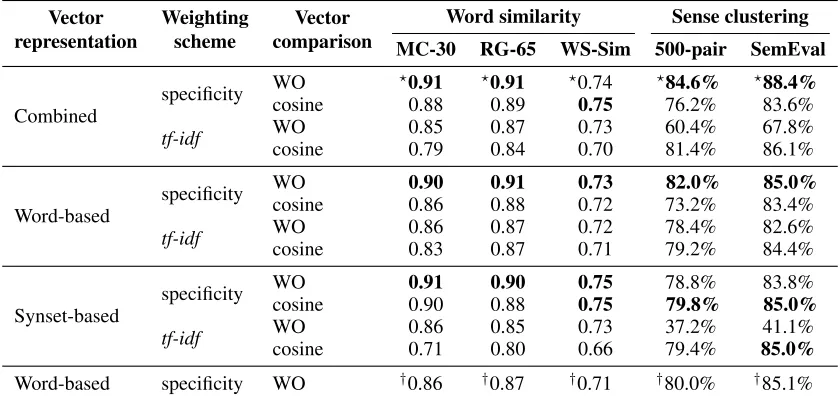
Table 3 shows the performance of the NASARI -based similarity system and its individual vector representations for different weight computation schemes, i.e., lexical specificity and tf-idf, and for different vector comparison techniques, i.e., cosine and WO, on word similarity and sense clustering datasets. As can be seen from the Table, the perfor-mance of the word-based representation consistently improves on both tasks when combined with the ad-ditional information from the synset-based vectors, demonstrating that the sense distinctions offered by the generalization process have been beneficial.
vec-Vector
representation Weightingscheme comparisonVector MC-30 RG-65 WS-Sim 500-pair SemEvalWord similarity Sense clustering
Combined specificity
WO ?0.91 ?0.91 ?0.74 ?84.6% ?88.4%
cosine 0.88 0.89 0.75 76.2% 83.6%
tf-idf WOcosine 0.850.79 0.870.84 0.730.70 60.4%81.4% 67.8%86.1%
Word-based specificity
WO 0.90 0.91 0.73 82.0% 85.0%
cosine 0.86 0.88 0.72 73.2% 83.4%
tf-idf WOcosine 0.860.83 0.870.87 0.720.71 78.4%79.2% 82.6%84.4%
Synset-based specificity
WO 0.91 0.90 0.75 78.8% 83.8%
cosine 0.90 0.88 0.75 79.8% 85.0%
tf-idf WOcosine 0.860.71 0.850.80 0.730.66 37.2%79.4% 85.0%41.1%
[image:8.612.96.516.61.261.2]Word-based specificity WO †0.86 †0.87 †0.71 †80.0% †85.1%
Table 3: Performance of NASARIand its individual vector representations for different weight computation schemes, i.e., lexical specificity andtf-idf, and for different vector comparison techniques, i.e., cosine and Weighted Overlap (WO), in terms of Pearson correlation (word similarity) and accuracy (sense clustering). The scores highlighted by?
are the ones obtained using our default NASARIsetting, and the ones highlighted by†correspond to the setting of our system using Wikipedia as its only knowledge source.
tors by outperforming cosine in most cases. The reason behind the lower performance of WO for the synset-based vectors on the task of sense clustering can be explained by the nature of the corresponding datasets. Since the synset-based vectors and their overlapping dimensions are small, their cosine sim-ilarity scores also tend to be relatively low, unlike WO whose range of values is not affected by the number of overlapping dimensions. Given that in the experiments the threshold is fixed to the mid-dle point of the scale (cf. Section 4.2.2), gener-ally low similarity values lead to a high-precision, low-recall system, which is rewarded by higher ac-curacy performance in datasets in which a large por-tion of instances are negative. In fact, for the synset-based vector representation weighted using speci-ficity, the F1 performance of the cosine is signifi-cantly lower than WO. On the SemEval dataset the F1 performance of WO is 60.1%, whereas cosine at-tains 37.1%. Similarly, on the 500-pair dataset, WO leads cosine by 16.8%: 68.5% vs. 51.7%.
As far as the weighting scheme is concerned, lex-ical specificity outperformstf-idf on both tasks, ir-respective of the vector comparison technique and representation. We attribute the better performance of lexical specificity to the probabilistic nature of
weights in its vectors. Thetf-idf weighting scheme, in contrast, suffers from insensitivity to the relative size of the contextual information. Thus, subse-quently, specificity-based vectors provide the advan-tage of accurately reducing the vectors’ dimension, unlike thetf-idf scheme in which the size-insensitive weights are not comparable across vectors. As a re-sult, the specificity-based vectors are substantially smaller in size, bringing about better space utiliza-tion and faster running time. In our experiments the vectors obtained by using lexical specificity were, on average, almost nine times (2505 vs. 21825) and four times (335 vs. 1311) smaller than the tf-idf -based vectors for the word--based and synset--based vector representations, respectively.
improvement across tasks and datasets, with the av-erage improvement being 5%.
5 Related Work
Given that in this work we focused mainly on simi-larity for the evaluation of our semantic representa-tion, in addition to concept representarepresenta-tion, we also briefly discuss related works for semantic similarity.
Concept representation. Distributional semantic models are usually the first choice for represent-ing textual items such as words or sentences (Tur-ney and Pantel, 2010). These models have attracted considerable research interest, resulting in various co-occurrence based representations (Salton et al., 1975; Evert, 2005; Pado and Lapata, 2007; Erk and Pad´o, 2008) or predictive models (Collobert and Weston, 2008; Turian et al., 2010; Mikolov et al., 2013; Baroni et al., 2014). Although there have been approaches proposed in the literature for learn-ing sense-specific embeddlearn-ings (Weston et al., 2013; Huang et al., 2012; Neelakantan et al., 2014), their coverage is limited only to those senses that are cov-ered in the underlying corpus. Moreover, the ob-tained sense representations are usually not linked to any sense inventory, and therefore such linking has to be carried out, either manually, or with the help of sense-annotated data. Hence, unless they are provided with large amounts of sense-annotated data, these techniques cannot furnish an effective representation of word senses in an existing standard sense inventory.
Consequently, most sense modeling techniques have based their representation on the knowledge derived from resources such as WordNet (Mihal-cea and Moldovan, 1999; Agirre and Lopez, 2003; Agirre and de Lacalle, 2004; Pilehvar et al., 2013), or Wikipedia (Gabrilovich and Markovitch, 2007; Mihalcea, 2007). None of these techniques, how-ever, combine knowledge from multiple types of resource, making their representations resource-specific and also prone to sparsity. In contrast, our method is based on the complementary knowl-edge of two different resources and their interlink-ing, leading to richer semantic representations that are also applicable across resources. Most similar to our combination of complementary knowledge is the work of Franco-Salvador et al. (2014) for cross-lingual document retrieval.
Concept similarity. Concept similarity tech-niques are mainly limited to the knowledge that their underlying lexical resources provide. For instance, methods designed for measuring semantic similarity of WordNet synsets (Banerjee and Peder-sen, 2002; Budanitsky and Hirst, 2006; Pilehvar et al., 2013) usually leverage lexicographic or struc-tural information in this lexical resource. Similarly, Wikipedia-based approaches (Hassan and Mihalcea, 2011; Strube and Ponzetto, 2006; Milne and Witten, 2008) do not usually benefit from the expert-based lexico-semantic knowledge provided in WordNet. In contrast, our approach combines knowledge from both resources, providing two advantages: (1) more effective measurement of similarity based on rich semantic representations, and (2) the possibility of measuring cross-resource semantic similarity, i.e., between Wikipedia pages and WordNet synsets.
6 Conclusions
In this paper we presented a novel semantic approach, called NASARI, for effective vector representation of arbitrary WordNet synsets and Wikipedia pages. The strength of our approach lies in its combination of complementary knowl-edge from different types of resource, while at the same time it also benefits from an effective vec-tor representation with two novel features: lexi-cal specificity for the lexi-calculation of vector weights and a semantically-aware dimensionality reduc-tion. NASARI attains state-of-the-art performance on multiple standard benchmarks in word similarity as well as Wikipedia sense clustering. We release the representations obtained for all the Wikipedia pages and WordNet synsets in http://lcl.uniroma1.it/ nasari/. As future work we plan to integrate NASARI into BabelNet and apply our representation to a mul-tilingual setting, enabling the comparison of pairs of concepts across languages. We also intend to use our approach on the task of multilingual Word Sense Disambiguation.
Acknowledgments
References
Eneko Agirre and Oier Lopez de Lacalle. 2004. Pub-licly available topic signatures for all WordNet nom-inal senses. In Proceedings of LREC, pages 1123– 1126, Lisbon, Portugal.
Eneko Agirre and Oier Lopez. 2003. Clustering Word-Net word senses. In Proceedings of RANLP, pages 121–130, Borovets, Bulgaria.
Eneko Agirre, Enrique Alfonseca, Keith Hall, Jana Kravalova, Marius Pas¸ca, and Aitor Soroa. 2009. A study on similarity and relatedness using distributional and WordNet-based approaches. In Proceedings of
NAACL-HLT, pages 19–27, Boulder, Colorado.
Satanjeev Banerjee and Ted Pedersen. 2002. An adapted Lesk algorithm for Word Sense Disambiguation using WordNet. InProceedings of CICLing, pages 136–145, Mexico City, Mexico.
Michele Banko, Michael J. Cafarella, Stephen Soderland, Matt Broadhead, and Oren Etzioni. 2007. Open infor-mation extraction from the Web. In Proceedings of
IJCAI, pages 2670–2676, New York, NY, USA.
Daniel B¨ar, Torsten Zesch, and Iryna Gurevych. 2013. DKPro similarity: An open source framework for text similarity. InProceedings of ACL: System Demonstra-tions, pages 121–126, Sofia, Bulgaria, August. Marco Baroni, Georgiana Dinu, and Germ´an Kruszewski.
2014. Don’t count, predict! a systematic compari-son of context-counting vs. context-predicting seman-tic vectors. In Proceedings of ACL, pages 238–247, Baltimore, Maryland.
Mokhtar-Boumeyden Billami, Jos´e Camacho-Collados, Evelyne Jacquey, and Laurence Kister. 2014. Seman-tic annotation and terminology validation in full scien-tific articles in social sciences and humanities (annota-tion s´emantique et valida(annota-tion terminologique en texte int´egral en shs) [in french]. InProceedings of TALN 2014, pages 363–376, Marseille, France.
Alexander Budanitsky and Graeme Hirst. 2006. Eval-uating WordNet-based measures of Lexical Semantic Relatedness. Computational Linguistics, 32(1):13–47. Razvan Bunescu and Marius Pas¸ca. 2006. Using ency-clopedic knowledge for named entity disambiguation. InProceedings of EACL, pages 9–16, Trento, Italy. Jose Camacho Collados, Mokhtar Billami, Evelyne
Jacquey, and Laurence Kister. 2014. Approche statis-tique pour le filtrage terminologique des occurrences de candidats termes en texte intgral. In Journ´ees
internationales d0Analyse statistique des Donn´ees
Textuelles, pages 121–133, Paris, France.
Ronan Collobert and Jason Weston. 2008. A unified ar-chitecture for natural language processing: Deep neu-ral networks with multitask learning. InProceedings of ICML, pages 160–167, Helsinki, Finland.
Bharath Dandala, Chris Hokamp, Rada Mihalcea, and Razvan C. Bunescu. 2013. Sense clustering using Wikipedia. InProceedings of RANLP, pages 164–171, Hissar, Bulgaria.
Georgiana Dinu and Mirella Lapata. 2010. Measuring distributional similarity in context. InProceedings of
EMNLP, pages 1162–1172, Massachusetts, USA.
Patrick Drouin. 2003. Term extraction using non-technical corpora as a point of leverage. Terminology, 9(1):99–115.
Katrin Erk and Sebastian Pad´o. 2008. A structured vec-tor space model for word meaning in context. In
Pro-ceedings of EMNLP, pages 897–906, Edinburgh, UK.
Stefan Evert. 2005. The statistics of word
cooccur-rences: word pairs and collocations. Ph.D. thesis,
Universitt Stuttgart.
Jenny Rose Finkel, Trond Grenager, and Christopher Manning. 2005. Incorporating non-local information into information extraction systems by gibbs sampling.
In Proceedings of ACL, pages 363–370, Ann Arbor,
Michigan.
Lev Finkelstein, Gabrilovich Evgeniy, Matias Yossi, Rivlin Ehud, Solan Zach, Wolfman Gadi, and Ruppin Eytan. 2002. Placing search in context: The concept revisited. ACM Transactions on Information Systems, 20(1):116–131.
Marc Franco-Salvador, Paolo Rosso, and Roberto Nav-igli. 2014. A knowledge-based representation for cross-language document retrieval and categorization.
In Proceedings of the 14thConference on European
chapter of the Association for Computational
Linguis-tics (EACL), Gothenburg, Sweden.
Evgeniy Gabrilovich and Shaul Markovitch. 2007. Com-puting semantic relatedness using Wikipedia-based explicit semantic analysis. InProceedings of IJCAI, pages 1606–1611, Hyderabad, India.
Samer Hassan and Rada Mihalcea. 2011. Semantic relat-edness using salient semantic analysis. InProceedings
of AAAI, pages 884,889, San Francisco, USA.
Felix Hill, Roi Reichart, and Anna Korhonen. 2014. Simlex-999: Evaluating semantic models with (gen-uine) similarity estimation. arXiv:1408.3456.
Eduard H. Hovy, Roberto Navigli, and Simone Paolo Ponzetto. 2013. Collaboratively built semi-structured content and Artificial Intelligence: The story so far.
Artificial Intelligence, 194:2–27.
Eric H. Huang, Richard Socher, Christopher D. Manning, and Andrew Y. Ng. 2012. Improving word representa-tions via global context and multiple word prototypes.
In Proceedings of ACL, pages 873–882, Jeju Island,
Korea.
Pierre Lafon. 1980. Sur la variabilit´e de la fr´equence des formes dans un corpus.Mots, 1:127–165.
Thomas K. Landauer and Susan T. Dumais. 1997. A so-lution to Plato’s problem: The latent semantic analysis theory of acquisition, induction, and representation of knowledge. Psychological Review, 104(2):211. Shalom Lappin and Chris Fox, editors. 2014. Handbook
of Contemporary Semantics – second edition.
Wiley-Blackwell, Malden, MA.
Ludovic Lebart, Andre Salem, and Lisette Berry. 1998.
Exploring textual data. Kluwer Academic Publishers. Dekang Lin. 1998. An information-theoretic definition of similarity. InProceedings of ICML, pages 296–304, San Francisco, CA.
Olena Medelyan, David Milne, Catherine Legg, and Ian H. Witten. 2009. Mining meaning from Wikipedia. International Journal of
Human-Computer Studies, 67(9):716–754.
Rada Mihalcea and Andras Csomai. 2007. Wikify! Linking documents to encyclopedic knowledge. In
Proceedings of ACM on Information and Knowledge
management, pages 233–242, Lisbon, Portugal.
Rada Mihalcea and Dan Moldovan. 1999. An automatic method for generating sense tagged corpora. In
Pro-ceedings of AAAI, pages 461–466, Orlando, Florida,
USA.
Rada Mihalcea. 2007. Using Wikipedia for auto-matic Word Sense Disambiguation. InProceedings of
NAACL-HLT-07, pages 196–203, Rochester, NY.
Tomas Mikolov, Kai Chen, Greg Corrado, and Jeffrey Dean. 2013. Efficient estimation of word represen-tations in vector space. InWorkshop at International
Conference on Learning Representations, Scottsdale,
Arizona.
George A. Miller and Walter G. Charles. 1991. Contex-tual correlates of semantic similarity. Language and Cognitive Processes, 6(1):1–28.
George A. Miller, R.T. Beckwith, Christiane D. Fell-baum, D. Gross, and K. Miller. 1990. WordNet: an online lexical database. International Journal of
Lexi-cography, 3(4):235–244.
David Milne and Ian H. Witten. 2008. An effective, low-cost measure of semantic relatedness obtained from Wikipedia links. In Proceedings of the Workshop on Wikipedia and Artificial Intelligence: An Evolving
Synergy at AAAI-08, pages 25–30, Chicago, IL.
Saif Mohammad and Graeme Hirst. 2012. Distributional measures of semantic distance: A survey. CoRR, abs/1203.1858.
Roberto Navigli and Simone Paolo Ponzetto. 2012. Ba-belNet: The automatic construction, evaluation and application of a wide-coverage multilingual semantic network.Artificial Intelligence, 193:217–250.
Roberto Navigli. 2009. Word Sense Disambiguation: A survey. ACM Computing Surveys, 41(2):1–69. Roberto Navigli. 2012. A quick tour of Word Sense
Disambiguation, induction and related approaches. In
SOFSEM 2012: Theory and practice of computer sci-ence, pages 115–129. Springer.
Arvind Neelakantan, Jeevan Shankar, Alexandre Pas-sos, and Andrew McCallum. 2014. Efficient non-parametric estimation of multiple embeddings per word in vector space. In Proceedings of EMNLP, pages 1059–1069, Doha, Qatar.
Sebastian Pado and Mirella Lapata. 2007. Dependency-based construction of semantic space models. Compu-tational Linguistics, 33(2):161–199.
Mohammad Taher Pilehvar and Roberto Navigli. 2014. A robust approach to aligning heterogeneous lexical resources. In Proceedings of ACL, pages 468–478, Baltimore, USA.
Mohammad Taher Pilehvar, David Jurgens, and Roberto Navigli. 2013. Align, Disambiguate and Walk: a Unified Approach for Measuring Semantic Similarity.
InProceedings of ACL, pages 1341–1351, Sofia,
Bul-garia.
Delip Rao, Paul McNamee, and Mark Dredze. 2013. En-tity linking: Finding extracted entities in a knowledge base. In Multi-source, Multilingual Information
Ex-traction and Summarization, pages 93–115.
Herbert Rubenstein and John B. Goodenough. 1965. Contextual correlates of synonymy. Communications
of the ACM, 8(10):627–633.
Gerard Salton, A. Wong, and C. S. Yang. 1975. A vector space model for automatic indexing. Communications
of the ACM, 18(11):613–620.
Michael Strube and Simone Paolo Ponzetto. 2006. WikiRelate! computing semantic relatedness using wikipedia. InProceedings of the 21st National Con-ference on Artificial Intelligence, pages 1419–1424, Boston, Massachusetts.
Joseph Turian, Lev Ratinov, and Yoshua Bengio. 2010. Word representations: A simple and general method for semi-supervised learning. InProceedings of ACL, pages 384–394, Uppsala, Sweden.
Peter D. Turney and Patrick Pantel. 2010. From fre-quency to meaning: Vector space models of semantics.
Journal of Artificial Intelligence Research, 37:141– 188.