A Latent Variable Recurrent Neural Network
for Discourse Relation Language Models
Yangfeng Ji
Georgia Institute of Technology Atlanta, GA 30308, USA
Gholamreza Haffari
Monash University Clayton, VIC, Australia
gholamreza.haffari @monash.edu
Jacob Eisenstein
Georgia Institute of Technology Atlanta, GA 30308, USA
Abstract
This paper presents a novel latent variable re-current neural network architecture for jointly modeling sequences of words and (possibly latent) discourse relations between adjacent sentences. A recurrent neural network gen-erates individual words, thus reaping the ben-efits of discriminatively-trained vector repre-sentations. The discourse relations are rep-resented with a latent variable, which can be predicted or marginalized, depending on the task. The resulting model can therefore em-ploy a training objective that includes not only discourse relation classification, but also word prediction. As a result, it outperforms state-of-the-art alternatives for two tasks: implicit dis-course relation classification in the Penn Dis-course Treebank, and dialog act classification in the Switchboard corpus. Furthermore, by marginalizing over latent discourse relations at test time, we obtain a discourse informed language model, which improves over a strong LSTM baseline.
1 Introduction
Natural language processing (NLP) has recently ex-perienced a neural network “tsunami” (Manning, 2016). A key advantage of these neural architec-tures is that they employ discriminatively-trained distributed representations, which can capture the meaning of linguistic phenomena ranging from in-dividual words (Turian et al., 2010) to longer-range linguistic contexts at the sentence level (Socher et al., 2013) and beyond (Le and Mikolov, 2014). Be-cause they are discriminatively trained, these
meth-ods can learn representations that yield very accurate predictive models (e.g., Dyer et al, 2015).
However, in comparison with the probabilistic graphical models that were previously the dominant machine learning approach for NLP, neural archi-tectures lack flexibility. By treating linguistic an-notations as random variables, probabilistic graphi-cal models can marginalize over annotations that are unavailable at test or training time, elegantly model-ing multiple lmodel-inguistic phenomena in a joint frame-work (Finkel et al., 2006). But because these graph-ical models represent uncertainty for every element in the model, adding too many layers of latent vari-ables makes them difficult to train.
In this paper, we present a hybrid architecture that combines a recurrent neural network language model with a latent variable model over shallow discourse structure. In this way, the model learns a discriminatively-trained distributed representation of the local contextual features that drive word choice at the intra-sentence level, using techniques that are now state-of-the-art in language model-ing (Mikolov et al., 2010). However, the model treats shallow discourse structure — specifically, the relationships between pairs of adjacent sentences — as a latent variable. As a result, the model can act as both a discourse relation classifier and a language model. Specifically:
• If trained to maximize the conditional like-lihood of the discourse relations, it outper-forms state-of-the-art methods for both im-plicit discourse relation classification in the Penn Discourse Treebank (Rutherford and Xue, 2015) and dialog act classification in
board (Kalchbrenner and Blunsom, 2013). The model learns from both the discourse annota-tions as well as the language modeling objec-tive, unlike previous recursive neural architec-tures that learn only from annotated discourse relations (Ji and Eisenstein, 2015).
• If the model is trained to maximize the joint likelihood of the discourse relations and the text, it is possible to marginalize over discourse relations at test time, outperforming language models that do not account for discourse struc-ture.
In contrast to recent work on continuous latent variables in recurrent neural networks (Chung et al., 2015), which require complex variational autoen-coders to represent uncertainty over the latent vari-ables, our model is simple to implement and train, requiring only minimal modifications to existing re-current neural network architectures that are imple-mented in commonly-used toolkits such as Theano, Torch, and CNN.
We focus on a class of shallow discourse rela-tions, which hold between pairs of adjacent sen-tences (or utterances). These relations describe how the adjacent sentences are related: for example, they may be inCONTRAST, or the latter sentence may of-fer an answer to a question posed by the previous sentence. Shallow relations do not capture the full range of discourse phenomena (Webber et al., 2012), but they account for two well-known problems: im-plicit discourse relation classification in the Penn Discourse Treebank, which was the 2015 CoNLL shared task (Xue et al., 2015); and dialog act clas-sification, which characterizes the structure of in-terpersonal communication in the Switchboard cor-pus (Stolcke et al., 2000), and is a key component of contemporary dialog systems (Williams and Young, 2007). Our model outperforms state-of-the-art alter-natives for implicit discourse relation classification in the Penn Discourse Treebank, and for dialog act classification in the Switchboard corpus.
2 Background
Our model scaffolds on recurrent neural network (RNN) language models (Mikolov et al., 2010), and recent variants that exploit multiple levels of linguis-tic detail (Ji et al., 2015; Lin et al., 2015).
RNN Language Models Let us denote tokennin a sentence tby yt,n ∈ {1. . . V}, and write yt =
{yt,n}n∈{1...Nt}to indicate the sequence of words in sentencet. In an RNN language model, the proba-bility of the sentence is decomposed as,
p(yt) = Nt Y
n
p(yt,n |yt,<n), (1)
where the probability of each word yt,n is
condi-tioned on the entire preceding sequence of words yt,<nthrough the summary vectorht,n−1. This vec-tor is computed recurrently from ht,n−2 and from theembeddingof the current word,Xyt,n−1, where
X∈RK×V andKis the dimensionality of the word
embeddings. The language model can then be sum-marized as,
ht,n=f(Xyt,n,ht,n−1) (2)
p(yt,n |yt,<n) =softmax(Woht,n−1+bo), (3)
where the matrixWo ∈ RV×K defines theoutput
embeddings, andbo ∈RV is an offset. The function
f(·)is a deterministic non-linear transition function. It typically takes an element-wise non-linear trans-formation (e.g.,tanh) of a vector resulting from the sum of the word embedding and a linear transforma-tion of the previous hidden state.
The model as described thus far is identical to the recurrent neural network language model (RNNLM) of Mikolov et al. (2010). In this paper, we replace the above simple hidden state units with the more complex Long Short-Term Memory units (Hochre-iter and Schmidhuber, 1997), which have consis-tently been shown to yield much stronger perfor-mance in language modeling (Pham et al., 2014). For simplicity, we still use the term RNNLM in re-ferring to this model.
Document Context Language Model One draw-back of the RNNLM is that it cannot propagate long-range information between the sentences. Even if we remove sentence boundaries, long-range infor-mation will be attenuated by repeated application of the non-linear transition function. Ji et al. (2015) propose the Document Context Language Model (DCLM) to address this issue. The core idea is to represent context withtwovectors: ht,n,
represent-ing intra-sentence word-level context, and ct,
yt−1,N
t−1−2 yt−1,Nt−1−1 yt−1,Nt−1 yt ,1 yt ,2 zt
[image:3.612.87.523.61.114.2]yt ,3
Figure 1:A fragment of our model with latent variablezt, which only illustrates discourse information flow from sentence(t−1) tot. The information from sentence(t−1)affects the distribution ofztand then the words prediction within sentencet.
p(yt,n+1|zt, yt,<n, yt−1) =g
W(zt)
o ht,n
| {z } relation-specific intra-sentential context
+ W(zt)
c ct−1
| {z } relation-specific inter-sentential context
+ b(zt)
o
|{z} relation-specific
bias
(4)
Figure 2:Per-token generative probabilities in the discourse relation language model
are then linearly combined in the generation func-tion for wordyt,n,
p(yt,n|yt,<n,y<t)
=softmax(Woht,n−1+Wcct−1+bo), (5)
wherect−1 is set to the last hidden state of the pre-vious sentence. Ji et al. (2015) show that this model can improve language model perplexity.
3 Discourse Relation Language Models
We now present a probabilistic neural model over sequences of words and shallow discourse relations. Discourse relationsztare treated as latent variables,
which are linked with a recurrent neural network over words in alatent variable recurrent neural net-work(Chung et al., 2015).
3.1 The Model
Our model (see Figure 1) is formulated as a two-step generative story. In the first step, context informa-tion from the sentence(t−1)is used to generate the discourse relation between sentences(t−1)andt,
p(zt|yt−1) =softmax(Uct−1+b), (6)
where zt is a random variable capturing the
dis-course relation between the two sentences, andct−1 is a vector summary of the contextual information from sentence(t−1), just as in the DCLM (Equa-tion 5). The model maintains a default context vec-torc0for the first sentences of documents, and treats it as a parameter learned with other model parame-ters during training.
In the second step, the sentenceyt is generated,
conditioning on the preceding sentenceyt−1and the discourse relationzt:
p(yt|zt,yt−1) =
Nt
Y
n
p(yt,n|yt,<n,yt−1, zt), (7)
The generative probability for the sentence yt
de-composes across tokens as usual (Equation 7). The per-token probabilities are shown in Equation 4, in Figure 2. Discourse relations are incorporated by pa-rameterizing the output matricesW(zt)
o andW(czt);
depending on the discourse relation that holds be-tween (t−1) andt, these matrices will favor dif-ferent parts of the embedding space. The bias term b(zt)
o is also parametrized by the discourse relation,
so that each relation can favor specific words. Overall, the joint probability of the text and dis-course relations is,
p(y1:T,z1:T) = T Y
t
p(zt|yt−1)×p(yt|zt,yt−1).
(8)
If the discourse relationsztare not observed, then
hidden dimension and the size of vocabulary in lan-guage modeling. The size of each prediction matrix Wo(z)andW(cz)isV×H; there are two such
matri-ces for each possible discourse relation. We reduce the number of parameters by factoring each of these matrices into two components:
W(oz)=Wo·V(z), W(cz)=Wc·M(z), (9)
where V(z) and M(z) are relation-specific compo-nents for intra-sentential and inter-sentential con-texts; the size of these matrices is H ×H, with
H V. The larger V ×H matricesWo andWc
are shared across all relations. 3.2 Inference
There are two possible inference scenarios: in-ference over discourse relations, conditioning on words; and inference over words, marginalizing over discourse relations.
Inference over Discourse Relations The prob-ability of discourse relations given the sentences
p(z1:T | y1:T) is decomposed into the product of
probabilities of individual discourse relations condi-tioned on the adjacent sentencesQtp(zt|yt,yt−1). These probabilities are computed by Bayes’ rule:
p(zt|yt,yt−1) =Pp(yt|zt,yt−1)×p(zt|yt−1)
z0p(yt|z0,yt−1)×p(z0|yt−1).
(10)
The terms in each product are given in Equations 6 and 7. Normalizing involves only a sum over a small finite number of discourse relations. Note that infer-ence is easy in our case because all words are ob-served and there is no probabilistic coupling of the discourse relations.
Inference over Words In discourse-informed lan-guage modeling, we marginalize over discourse re-lations to compute the probability of a sequence of sentencey1:T, which can be written as,
p(y1:T) = T
Y
t
X
zt
p(zt|yt−1)×p(yt|zt,yt−1), (11) because the word sequences are observed, decou-pling each zt from its neighbors zt+1 and zt−1. This decoupling ensures that we can compute the
overall marginal likelihood as a product over local marginals.
3.3 Learning
The model can be trained in two ways: to maximize the joint probability p(y1:T,z1:T), or to maximize
the conditional probabilityp(z1:T |y1:T). The joint
training objective is more suitable for language mod-eling scenarios, and the conditional objective is bet-ter for discourse relation prediction. We now de-scribe each objective in detail.
Joint likelihood objective The joint likelihood objective function is directly adopted from the joint probability defined in Equation 8. The objective function for a single document withT sentences or utterances is,
`(θ) = T X
t
logp(zt|yt−1)
+ Nt X
n
logp(yt,n |yt,<n,yt−1, zt), (12)
whereθ represents the collection of all model pa-rameters, including the parameters in the LSTM units and the word embeddings.
Maximizing the objective function `(θ) will jointly optimize the model on both language lan-guage and discourse relation prediction. As such, it can be viewed as a form of multi-task learn-ing (Caruana, 1997), where we learn a shared rep-resentation that works well for discourse relation prediction and for language modeling. However, in practice, the large vocabulary size and number of to-kens means that the language modeling part of the objective function tends to dominate.
Conditional objective This training objective is specific to the discourse relation prediction task, and based on Equation 10 can be written as:
`r(θ) = T X
t
logp(zt|yt−1) + logp(yt|zt,yt−1)
−logX z0
p(z0|y
t−1)×p(yt|z0,yt−1)
possible values ofzt. This forces the objective
func-tion to attend specifically to the problem of maxi-mizing the conditional likelihood of the discourse relations and treat language modeling as an auxil-iary task (Collobert et al., 2011).
3.4 Modeling limitations
The discourse relation language model is carefully designed to decouple the discourse relations from each other, after conditioning on the words. It is clear that text documents and spoken dialogues have sequential discourse structures, and it seems likely that modeling this structure could improve performance. In a traditional hidden Markov model (HMM) generative approach (Stolcke et al., 2000), modeling sequential dependencies is not difficult, because training reduces to relative frequency es-timation. However, in the hybrid probabilistic-neural architecture proposed here, training is al-ready expensive, due to the large number of param-eters that must be estimated. Adding probabilis-tic couplings between adjacent discourse relations hzt−1, zti would require the use of dynamic
pro-gramming for both training and inference, increas-ing time complexity by a factor that is quadratic in the number of discourse relations. We did not at-tempt this in this paper; we do compare against a conventional HMM on the dialogue act prediction task in§5.
Ji et al. (2015) propose an alternative form of the document context language model, in which the contextual information ct impacts the hidden state
ht+1, rather than going directly to the outputsyt+1. They obtain slightly better perplexity with this ap-proach, which has fewer trainable parameters. How-ever, this model would coupleztwithallsubsequent
sentencesy>t, making prediction and
marginaliza-tion of discourse relamarginaliza-tions considerably more chal-lenging. Sequential Monte Carlo algorithms offer a possible solution (de Freitas et al., ; Gu et al., 2015), which may be considered in future work.
4 Data and Implementation
We evaluate our model on two benchmark datasets: (1) the Penn Discourse Treebank (Prasad et al., 2008, PDTB), which is annotated on a corpus of Wall Street Journal acticles; (2) the Switchboard
di-alogue act corpus (Stolcke et al., 2000, SWDA), which is annotated on a collections of phone con-versations. Both corpora contain annotations of dis-course relations and dialogue relations that hold be-tween adjacent spans of text.
The Penn Discourse Treebank (PDTB) provides a low-level discourse annotation on written texts. In the PDTB, each discourse relation is annotated be-tween two argument spans,Arg1andArg2. There are two types of relations: explicit and implicit. Explicit relations are signalled by discourse mark-ers (e.g., “however”, “moreover”), and the span of
Arg1is almost totally unconstrained: it can range from a single clause to an entire paragraph, and need not be adjacent to either Arg2 nor the dis-course marker. However, automatically classifying these relations is considered to be relatively easy, due to the constraints from the discourse marker it-self (Pitler et al., 2008). In addition, explicit rela-tions are difficult to incorporate into language mod-els which must generate each word exactly once. On the contrary, implicit discourse relations are anno-tated only between adjacent sentences, based on a semantic understanding of the discourse arguments. Automatically classifying these discourse relations is a challenging task (Lin et al., 2009; Pitler et al., 2009; Rutherford and Xue, 2015; Ji and Eisenstein, 2015). We therefore focus on implicit discourse re-lations, leaving to the future work the question of how to apply our modeling framework to explicit discourse relations. During training, we collapse all relation types other than implicit (explicit, ENTREL, and NOREL) into a single dummy relation type, which holds between all adjacent sentence pairs that do not share an implicit relation.
there are an equal number of instances with and without each relation type (Park and Cardie, ; Biran and McKeown, 2013; Rutherford and Xue, 2014). In this paper, we target the more challenging multi-way classification problem, so this strategy is not ap-plicable; in any case, since our method deals with entire documents, it is not possible to balance the training set in this way.
The Switchboard Dialog Act Corpus (SWDA) is annotated on the Switchboard Corpus of human-human conversational telephone speech (Godfrey et al., 1992). The annotations label each utterance with one of 42 possible speech acts, such asAGREE, HEDGE, andWH-QUESTION. Because these speech acts form the structure of the dialogue, most of them pertain to both the preceding and succeeding utter-ances (e.g., AGREE). The SWDA corpus includes 1155 five-minute conversations. We adopted the standard split from Stolcke et al. (2000), using 1,115 conversations for training and nineteen conversa-tions for test. For parameter tuning, we randomly select nineteen conversations from the training set as the development set. After parameter tuning, we train the model on the full training set with the se-lected configuration. We use the same preprocessing techniques here as in the PDTB.
4.1 Implementation
We use a single-layer LSTM to build the recur-rent architecture of our models, which we im-plement in the CNN package.1 Our implemen-tation is available on https://github.com/
jiyfeng/drlm. Some additional details follow.
Initialization Following prior work on RNN ini-tialization (Bengio, 2012), all parameters except the relation prediction parametersU andbare ini-tialized with random values drawn from the range
[−p6/(d1+d2),p6/(d1+d2)], whered1andd2 are the input and output dimensions of the parame-ter matrix respectively. The matrixU is initialized with random numbers from[−10−5,10−5]andbis initialized to0.
Learning Online learning was performed using AdaGrad (Duchi et al., 2011) with initial learning
1https://github.com/clab/cnn
rateλ= 0.1. To avoid the exploding gradient prob-lem, we used norm clipping trick with a threshold of
τ = 5.0(Pascanu et al., 2012). In addition, we used value dropout (Srivastava et al., 2014) with rate0.5, on the inputX, context vectorcand hidden stateh, similar to the architecture proposed by Pham et al. (2014). The training procedure is monitored by the performance on the development set. In our experi-ments, 4 to 5 epochs were enough.
Hyper-parameters Our model includes two tun-able hyper-parameters: the dimension of word rep-resentationK, the hidden dimension of LSTM unit
H. We consider the values{32,48,64,96,128}for bothK andH. For each corpus in experiments, the best combination of K and H is selected via grid search on the development set.
5 Experiments
Our main evaluation is discourse relation prediction, using the PDTB and SWDA corpora. We also eval-uate on language modeling, to determine whether incorporating discourse annotations at training time and then marginalizing them at test time can im-prove performance.
5.1 Implicit discourse relation prediction on the PDTB
We first evaluate our model with implicit discourse relation prediction on the PDTB dataset. Most of the prior work on first-level discourse relation predic-tion focuses on the “one-versus-all” binary classifi-cation setting, but we attack the more general four-way classification problem, as performed by Ruther-ford and Xue (2015). We compare against the fol-lowing methods:
Model Accuracy MacroF1
Baseline
1. Most common class 54.7 —
Prior work
2. (Rutherford and Xue, 2015) 55.0 38.4 3. (Rutherford and Xue, 2015) 57.1 40.5
with extra training data
4. (Ji and Eisenstein, 2015) 56.4 40.0
Our work -DRLM
5. Joint training 57.1 40.5
6. Conditional training 59.5∗ 42.3
[image:7.612.319.536.62.211.2]∗significantly better than lines 2 and 4 withp <0.05
Table 1: Multiclass relation identification on the first-level PDTB relations.
Results As shown in Table 1, the conditionally-trained discourse relation language models (DRLM) outperforms all alternatives, on both metrics. While the jointly-trained DRLM is at the same level as the previous state-of-the-art, conditional training on the same model provides a significant additional advan-tage, indicated by a binomial test.
5.2 Dialogue Act tagging
Dialogue act tagging has been widely studied in both NLP and speech communities. We follow the setup used by Stolcke et al. (2000) to conduct experiments, and adopt the following systems for comparison:
Stolcke et al. (2000) employ a hidden Markov model, with each HMM state corresponding to a dialogue act.
Kalchbrenner and Blunsom (2013) employ a complex neural architecture, with a convolutional network at each utterance and a recurrent net-work over the length of the dialog. To our knowl-edge, this model attains state-of-the-art accuracy on this task, outperforming other prior work such as (Webb et al., 2005; Milajevs and Purver, 2014).
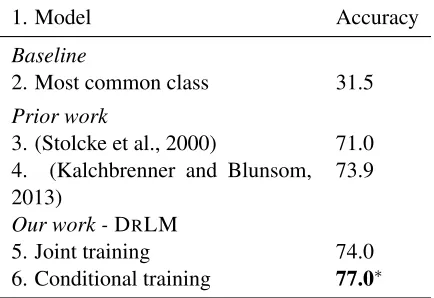
Results As shown in Table 2, the conditionally-trained discourse relation language model (DRLM) outperforms all competitive systems on this task. A binomial test shows the result in line 6 is signifi-cantly better than the previous state-of-the-art (line 4). All comparisons are against published results, and Macro-F1 scores are not available. Accuracy
1. Model Accuracy
Baseline
2. Most common class 31.5 Prior work
3. (Stolcke et al., 2000) 71.0 4. (Kalchbrenner and Blunsom,
2013) 73.9
Our work -DRLM
5. Joint training 74.0
6. Conditional training 77.0∗
∗significantly better than line 4 withp <0.01
Table 2:The results of dialogue act tagging.
is more reliable on this evaluation, since no single class dominates, unlike the PDTB task.
5.3 Discourse-aware language modeling
As a joint model for discourse and language model-ing, DRLM can also function as a language model, assigning probabilities to sequences of words while marginalizing over discourse relations. To deter-mine whether discourse-aware language modeling can improve performance, we compare against the following systems:
RNNLM+LSTM This is the same basic architec-ture as the RNNLM proposed by (Mikolov et al., 2010), which was shown to outperform a Kneser-Ney smoothed 5-gram model on modeling Wall Street Journal text. Following Pham et al. (2014), we replace the Sigmoid nonlinearity with a long short-term memory (LSTM).
DCLM We compare against the Document Context Language Model (DCLM) of Ji et al. (2015). We use the “context-to-output” variant, which is iden-tical to the current modeling approach, except that it is not parametrized by discourse relations. This model achieves strong results on language model-ing for small and medium-sized corpora, outper-forming RNNLM+LSTM.
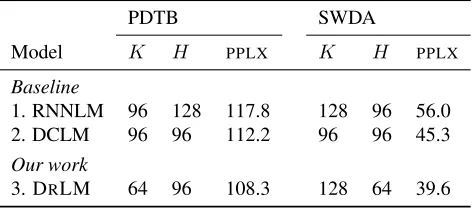
PDTB SWDA
Model K H PPLX K H PPLX
Baseline
1. RNNLM 96 128 117.8 128 96 56.0
2. DCLM 96 96 112.2 96 96 45.3
Our work
[image:8.612.62.298.61.165.2]3. DRLM 64 96 108.3 128 64 39.6
Table 3: Language model perplexities (PPLX), lower is better. The model dimensionsKandHthat gave best performance on the dev set are also shown.
yields further improvements for both datasets. We emphasize that discourse relations in the test doc-uments are marginalized out, so no annotations are required for the test set; the improvements are due to the disambiguating power of discourse relations in the training set.
Because our training procedure requires discourse annotations, this approach does not scale to the large datasets typically used in language modeling. As a consequence, the results obtained here are somewhat academic, from the perspective of practical language modeling. Nonetheless, the positive results here mo-tivate the investigation of training procedures that are also capable of marginalizing over discourse re-lations at training time.
6 Related Work
This paper draws on previous work in both discourse modeling and language modeling.
Discourse and dialog modeling Early work on discourse relation classification utilizes rich, hand-crafted feature sets (Joty et al., 2012; Lin et al., 2009; Sagae, 2009). Recent representation learn-ing approaches attempt to learn good representations jointly with discourse relation classifiers and dis-course parsers (Ji and Eisenstein, 2014; Li et al., 2014). Of particular relevance are applications of neural architectures to PDTB implicit discourse re-lation classification (Ji and Eisenstein, 2015; Zhang et al., 2015; Braud and Denis, 2015). All of these approaches are essentially classifiers, and take su-pervision only from the 16,000 annotated discourse relations in the PDTB training set. In contrast, our approach is a probabilistic model over the entire text. Probabilistic models are frequently used in
dia-log act tagging, where hidden Markov models have been a dominant approach (Stolcke et al., 2000). In this work, the emission distribution is an n-gram language model for each dialogue act; we use a conditionally-trained recurrent neural network lan-guage model. An alternative neural approach for di-alogue act tagging is the combined convolutional-recurrent architecture of Kalchbrenner and Blunsom (2013). Our modeling framework is simpler, rely-ing on a latent variable parametrization of a purely recurrent architecture.
Language modeling There are an increasing number of attempts to incorporate document-level context information into language modeling. For ex-ample, Mikolov and Zweig (2012) introduce LDA-style topics into RNN based language modeling. Sordoni et al. (2015) use a convolutional structure to summarize the context from previous two utter-ances as context vector for RNN based language modeling. Our models in this paper provide a uni-fied framework to model the context and current sen-tence. Wang and Cho (2015) and Lin et al. (2015) construct bag-of-words representations of previous sentences, which are then used to inform the RNN language model that generates the current sentence. The most relevant work is the Document Context Language Model (Ji et al., 2015, DCLM); we de-scribe the connection to this model in§2. By adding discourse information as a latent variable, we attain better perplexity on held-out data.
7 Conclusion
We have presented a probabilistic neural model over sequences of words and shallow discourse re-lations between adjacent sequences. This model combines positive aspects of neural network ar-chitectures with probabilistic graphical models: it can learn discriminatively-trained vector tions, while maintaining a probabilistic representa-tion of the targeted linguistic element: in this case, shallow discourse relations. This method outper-forms state-of-the-art systems in two discourse rela-tion detecrela-tion tasks, and can also be applied as a lan-guage model, marginalizing over discourse relations on the test data. Future work will investigate the possibility of learning from partially-labeled train-ing data, which would have at least two potential ad-vantages. First, it would enable the model to scale up to the large datasets needed for competitive language modeling. Second, by training on more data, the resulting vector representations might support even more accurate discourse relation prediction.
Acknowledgments
Thanks to Trevor Cohn, Chris Dyer, Lingpeng Kong, and Quoc V. Le for helpful discussions, and to the anonymous reviewers for their feedback. This work was supported by a Google Faculty Research award to the third author. It was partially performed dur-ing the 2015 Jelinek Memorial Summer Workshop on Speech and Language Technologies at the Uni-versity of Washington, Seattle, and was supported by Johns Hopkins University via NSF Grant No IIS 1005411, DARPA LORELEI Contract No HR0011-15-2-0027, and gifts from Google, Microsoft Re-search, Amazon and Mitsubishi Electric Research Laboratory.
References
Yoshua Bengio. 2012. Practical recommendations for gradient-based training of deep architectures. In Neu-ral Networks: Tricks of the Trade, pages 437–478. Springer.
Or Biran and Kathleen McKeown. 2013. In Proceed-ings of the Association for Computational Linguistics (ACL), pages 69–73, Sophia, Bulgaria.
Chlo´e Braud and Pascal Denis. 2015. Comparing word representations for implicit discourse relation
classi-fication. In Proceedings of Empirical Methods for Natural Language Processing (EMNLP), pages 2201– 2211, Lisbon, September.
Yuri Burda, Roger Grosse, and Ruslan Salakhutdinov. 2016. Importance weighted autoencoders. In Pro-ceedings of the International Conference on Learning Representations (ICLR).
Rich Caruana. 1997. Multitask learning.Machine learn-ing, 28(1):41–75.
Junyoung Chung, Kyle Kastner, Laurent Dinh, Kratarth Goel, Aaron Courville, and Yoshua Bengio. 2015. A recurrent latent variable model for sequential data. In Neural Information Processing Systems (NIPS), Montr´eal.
R. Collobert, J. Weston, L. Bottou, M. Karlen, K. Kavukcuoglu, and P. Kuksa. 2011. Natural lan-guage processing (almost) from scratch. Journal of Machine Learning Research, 12:2493–2537.
Jo˜ao FG de Freitas, Mahesan Niranjan, Andrew H. Gee, and Arnaud Doucet. Sequential monte carlo methods to train neural network models. Neural computation, 12(4):955–993.
John Duchi, Elad Hazan, and Yoram Singer. 2011. Adaptive subgradient methods for online learning and stochastic optimization. The Journal of Machine Learning Research, 12:2121–2159.
Chris Dyer, Miguel Ballesteros, Wang Ling, Austin Matthews, and Noah A. Smith. 2015. Transition-based dependency parsing with stack long short-term memory. InProceedings of the Association for Com-putational Linguistics (ACL), pages 334–343, Beijing, China.
Jenny Rose Finkel, Christopher D Manning, and An-drew Y Ng. 2006. Solving the problem of cascading errors: Approximate bayesian inference for linguis-tic annotation pipelines. InProceedings of Empirical Methods for Natural Language Processing (EMNLP), pages 618–626.
John J Godfrey, Edward C Holliman, and Jane McDaniel. 1992. Switchboard: Telephone speech corpus for re-search and development. InICASSP, volume 1, pages 517–520. IEEE.
Shixiang Gu, Zoubin Ghahramani, and Richard E Turner. 2015. Neural adaptive sequential monte carlo. In Neu-ral Information Processing Systems (NIPS), Montr´eal. Sepp Hochreiter and J¨urgen Schmidhuber. 1997. Long short-term memory. Neural computation, 9(8):1735– 1780.
Yangfeng Ji and Jacob Eisenstein. 2015. One vector is not enough: Entity-augmented distributional seman-tics for discourse relations. Transactions of the Asso-ciation for Computational Linguistics (TACL), June. Yangfeng Ji, Trevor Cohn, Lingpeng Kong, Chris Dyer,
and Jacob Eisenstein. 2015. Document con-text language models. In International Conference on Learning Representations, Poster Paper, volume abs/1511.03962.
Shafiq Joty, Giuseppe Carenini, and Raymond Ng. 2012. A novel discriminative framework for sentence-level discourse analysis. InProceedings of Empirical Meth-ods for Natural Language Processing (EMNLP). Nal Kalchbrenner and Phil Blunsom. 2013. Recurrent
convolutional neural networks for discourse composi-tionality. InProceedings of the Workshop on Continu-ous Vector Space Models and their Compositionality, pages 119–126, Sofia, Bulgaria, August. Association for Computational Linguistics.
Diederik P Kingma and Max Welling. 2014. Auto-encoding variational bayes. InProceedings of the In-ternational Conference on Learning Representations (ICLR).
Quoc Le and Tomas Mikolov. 2014. Distributed rep-resentations of sentences and documents. In Pro-ceedings of the International Conference on Machine Learning (ICML).
Jiwei Li, Rumeng Li, and Eduard Hovy. 2014. Recursive deep models for discourse parsing. InProceedings of Empirical Methods for Natural Language Processing (EMNLP).
Ziheng Lin, Min-Yen Kan, and Hwee Tou Ng. 2009. Recognizing implicit discourse relations in the penn discourse treebank. In Proceedings of Empirical Methods for Natural Language Processing (EMNLP), pages 343–351, Singapore.
Rui Lin, Shujie Liu, Muyun Yang, Mu Li, Ming Zhou, and Sheng Li. 2015. Hierarchical recurrent neural network for document modeling. In Proceedings of Empirical Methods for Natural Language Processing (EMNLP), pages 899–907, Lisbon, September. Christopher D. Manning. 2016. Computational
linguis-tics and deep learning. Computational Linguistics, 41(4).
Tomas Mikolov and Geoffrey Zweig. 2012. Context de-pendent recurrent neural network language model. In Proceedings of Spoken Language Technology (SLT), pages 234–239.
Tomas Mikolov, Martin Karafi´at, Lukas Burget, Jan Cer-nock`y, and Sanjeev Khudanpur. 2010. Recurrent neural network based language model. In INTER-SPEECH, pages 1045–1048.
Dmitrijs Milajevs and Matthew Purver. 2014. Investi-gating the contribution of distributional semantic in-formation for dialogue act classification. In Proceed-ings of the 2nd Workshop on Continuous Vector Space Models and their Compositionality (CVSC), pages 40– 47.
Joonsuk Park and Claire Cardie. Improving implicit dis-course relation recognition through feature set opti-mization. InProceedings of the 13th Annual Meeting of the Special Interest Group on Discourse and Dia-logue, pages 108–112, Seoul, South Korea, July. As-sociation for Computational Linguistics.
Razvan Pascanu, Tomas Mikolov, and Yoshua Bengio. 2012. On the difficulty of training recurrent neural networks. arXiv preprint arXiv:1211.5063.
Vu Pham, Th´eodore Bluche, Christopher Kermorvant, and J´erˆome Louradour. 2014. Dropout improves re-current neural networks for handwriting recognition. In Frontiers in Handwriting Recognition (ICFHR), 2014 14th International Conference on, pages 285– 290. IEEE.
Emily Pitler, Mridhula Raghupathy, Hena Mehta, Ani Nenkova, Alan Lee, and Aravind Joshi. 2008. Eas-ily identifiable discourse relations. InProceedings of the International Conference on Computational Lin-guistics (COLING), pages 87–90, Manchester, UK. Emily Pitler, Annie Louis, and Ani Nenkova. 2009.
Au-tomatic sense prediction for implicit discourse rela-tions in text. In Proceedings of the Association for Computational Linguistics (ACL), Suntec, Singapore. Rashmi Prasad, Nikhil Dinesh, Alan Lee, Eleni
Milt-sakaki, Livio Robaldo, Aravind Joshi, and Bonnie Webber. 2008. The Penn Discourse Treebank 2.0. In Proceedings of LREC.
Attapol T Rutherford and Nianwen Xue. 2014. Discov-ering implicit discourse relations through brown clus-ter pair representation and coreference patclus-terns. In Proceedings of the European Chapter of the Associ-ation for ComputAssoci-ational Linguistics (EACL).
Attapol Rutherford and Nianwen Xue. 2015. Improving the inference of implicit discourse relations via classi-fying explicit discourse connectives. pages 799–808, May–June.
Kenji Sagae. 2009. Analysis of discourse structure with syntactic dependencies and data-driven shift-reduce parsing. InProceedings of the 11th International Con-ference on Parsing Technologies (IWPT’09), pages 81–84, Paris, France, October. Association for Com-putational Linguistics.
InProceedings of Empirical Methods for Natural Lan-guage Processing (EMNLP), Seattle, WA.
Alessandro Sordoni, Michel Galley, Michael Auli, Chris Brockett, Yangfeng Ji, Meg Mitchell, Jian-Yun Nie, Jianfeng Gao, and Bill Dolan. 2015. A neural network approach to context-sensitive generation of conversa-tional responses. InProceedings of the North Ameri-can Chapter of the Association for Computational Lin-guistics (NAACL), Denver, CO, May.
Nitish Srivastava, Geoffrey Hinton, Alex Krizhevsky, Ilya Sutskever, and Ruslan Salakhutdinov. 2014. Dropout: A simple way to prevent neural networks from overfitting. The Journal of Machine Learning Research, 15(1):1929–1958.
Andreas Stolcke, Klaus Ries, Noah Coccaro, Eliza-beth Shriberg, Rebecca Bates, Daniel Jurafsky, Paul Taylor, Rachel Martin, Carol Van Ess-Dykema, and Marie Meteer. 2000. Dialogue act modeling for automatic tagging and recognition of conversational speech. Computational linguistics, 26(3):339–373. Joseph Turian, Lev Ratinov, and Yoshua Bengio. 2010.
Word representations: A simple and general method for semi-supervised learning. pages 384–394.
Tian Wang and Kyunghyun Cho. 2015.
Larger-context language modelling. arXiv preprint arXiv:1511.03729.
Nick Webb, Mark Hepple, and Yorick Wilks. 2005. Di-alogue act classification based on intra-utterance fea-tures. InProceedings of the AAAI Workshop on Spo-ken Language Understanding.
Bonnie Webber, Markus Egg, and Valia Kordoni. 2012. Discourse structure and language technology. Journal of Natural Language Engineering, 1.
Jason D Williams and Steve Young. 2007. Partially ob-servable markov decision processes for spoken dialog systems. Computer Speech & Language, 21(2):393– 422.
Nianwen Xue, Hwee Tou Ng, Sameer Pradhan, Rashmi Prasad, Christopher Bryant, and Attapol T Rutherford. 2015. The CoNLL-2015 shared task on shallow dis-course parsing. InProceedings of the Conference on Natural Language Learning (CoNLL).