Right-truncatable Neural Word Embeddings
Jun Suzuki and Masaaki Nagata
NTT Communication Science Laboratories, NTT Corporation 2-4 Hikaridai, Seika-cho, Soraku-gun, Kyoto, 619-0237 Japan
{suzuki.jun, nagata.masaaki}@lab.ntt.co.jp
Abstract
This paper proposes an incremental learning strategy for neural word embedding methods, such as SkipGrams and Global Vectors. Since our method iteratively generates embedding vectors one dimension at a time, obtained vec-tors equip a unique property. Namely, any right-truncated vector matches the solution of the corresponding lower-dimensional embed-ding. Therefore, a single embedding vector can manage a wide range of dimensional re-quirements imposed by many different uses and applications.
1 Introduction
Word embedding vectors obtained from ‘neural word embedding methods’, such as SkipGram, continuous bag-of-words (CBoW) and the fam-ily of vector log-bilinear (vLBL) models (Mnih and Kavukcuoglu, 2013; Mikolov et al., 2013a; Mikolov et al., 2013c; Mikolov et al., 2013b) have now become an important fundamental resource for tackling many natural language processing (NLP) tasks. These NLP tasks include part-of-speech tag-ging (Tsuboi, 2014; Ling et al., 2015), dependency parsing (Chen and Manning, 2014; Dyer et al., 2015; Alberti et al., 2015), semantic role labeling (Zhou and Xu, 2015; Woodsend and Lapata, 2015), ma-chine translation (Sutskever et al., 2014), sentiment analysis (Kim et al., 2015), and question answer-ing (Wang and Nyberg, 2015).
The main purpose of this paper is to further en-hance the ‘usability’ of obtained embedding vectors in actual use. To briefly explain our motivation, we first introduce the following concept:
Definition 1 (D0-right-truncated vector1). Let w0 andw00 be vectors, whose dimensions are D0 and
D00, respectively. Namely, w0 = (w0
1, . . . , wD0 0)
and w00 = (w00
1, . . . , wD0000). Suppose w matches
the concatenation of w0 and w00, that is, w =
(w0
1, . . . , w0D0, w001, . . . , w00D00). Then, we definew0as
aD0-right-truncated vector ofw.
This paper focuses on the fact that the appropriate dimension of embedding vectors strongly depends on applications and uses, and is basically determined based on the performance and memory space (or calculation speed) trade-off. Indeed, the actual mensions of the previous studies listed above are di-verse; often around 50, and at most 1000. It is worth noting here that each dimension of embedding vec-tors obtained by conventional methods has no inter-pretable meaning. Thus, we basically need to re-trainD0-dimensional embedding vectors even if we
already have a well-trained D-dimensional vector. In addition, we cannot take full advantage of freely available high-quality pre-trained embedding vec-tors2 since their dimensions are already given and fixed,i.e.,D=300.
To reduce the additional computational cost of the retraining, and to improve the ‘usability’ of embed-ding vectors, we propose a framework for incremen-tally determining embeddings one dimension at a time from 1 toD. As a result, our method always offers the relation that ‘anyD0-right-truncated em-1The term truncated’ is originally taken from ‘right-truncatable prime’
2i.e., ‘GoogleNews-vectors-negative300’ ob-tained from https://code.google.com/archive/p/word2vec/, and ‘glove.840B.300d’ obtained from http://nlp.stanford.edu/projects/glove/
bedding vector is the solution for D0-dimensional embeddings of our method’. Therefore, in actual use, we only need to construct a relatively higher-dimensional embedding vector ‘just once’,i.e.,D= 1000, and then truncate it to an appropriate dimen-sion for the application.
2 Neural Word Embedding Methods LetU andV be two sets of predefined vocabularies of possible inputs and outputs. Let |U|and |V| be the number of words inU andV, respectively. Then, neural word embedding methods generally assign a D-dimensional vector to each word inU andV. We denoteei as representing the i-th input vector, and
ojfor thej-th output vector. In the rest of this paper,
for convenience the notation ‘i’ is always used as the index of input vectors, and ‘j’ as the index of output vectors, where1≤i≤ |U|and1≤j ≤ |V|.
We introduce E and O that represent lists of all input and output vectors, respectively. Namely,
E = (e1,· · ·,e|U|) and O = (o1,· · · ,o|V|). X
represents training data. Then, embedding vectors are obtained by solving the following form of a min-imization problem defined in each neural word em-bedding method:
(ˆE,O) = arg minˆ E,O
Ψ(E,O| X) , (1)
where Ψ represents the objective function, and Eˆ
andOˆ are lists of solution embedding vectors. Hereafter, we use Ψ as an abbreviation of
Ψ(E,O| X). For example, the objective functionΨ
of ‘SkipGram with negative sampling (SGNS)’ can be written in the following form3:
Ψ =X
(i,j)
ci,jL(xi,j) +c0i,jL(−xi,j)
, (2)
wherexi,j =ei·oj, andL(x)represents a logistic
loss function, namely, L(x) = log(1 + exp(−x)). Moreover, ci,j and c0i,j represent co-occurrences of
thei-th input andj-th output words in training data and negative sampling data, respectively.
Another example, the objective functionΨof the ‘Global Vector (GloVe)’ can be written in the
fol-3We can obtain this form by a simple reformulation from the original objective of SGNS (Mikolov et al., 2013b).
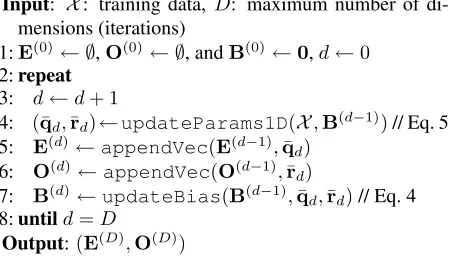
Input: X: training data,D: maximum number of di-mensions (iterations)
1:E(0)← ∅,O(0) ← ∅, andB(0)←0,d←0
2:repeat
3: d←d+ 1
4: (¯qd,¯rd)←updateParams1D(X,B(d−1))// Eq. 5
5: E(d)←appendVec(E(d−1),q¯ d)
6: O(d)←appendVec(O(d−1),¯r d)
7: B(d)←updateBias(B(d−1),q¯d,¯rd)// Eq. 4
8:untild=D
[image:2.612.315.542.61.189.2]Output:(E(D),O(D))
Figure 1:An algorithm for solving an iterative additional coor-dinate optimization formulation for obtaining embedding vec-tors.
lowing form (Pennington et al., 2014):
Ψ = 1
2 X
(i,j)
βi,j(xi,j−mi,j)2, (3)
wheremi,j andβi,j represent certain co-occurrence
and weighting factors of the i-th input and the j-th output words, respectively. For example, βi,j =
min(1,(ci,j/xmax)γ), andmi,j = log(ci,j)are used
in (Pennington et al., 2014), wherexmax andγ are
tunable hyper-parameters.
3 Incremental Construction of Embedding This section explains our proposed method. The ba-sic idea is very simple and clear: we convert the minimization problem shown in Eq. 1 to a series of minimization problems, each of whose individ-ual problem determines one additional dimension of each embedding vector. We refer to this formulation of embedding problems as ‘ITerative Additional Co-ordinate Optimization (ITACO)’ formulation. Fig. 1 shows our entire optimization algorithm for this for-mulation.
3.1 Bias terms and optimization variables
Supposedrepresents a discrete time step, whered∈ {1, . . . , D}. LetB(d) be a matrix representation of
bias terms at thed-th time step, andb(i,jd) denote the
(i, j)-factor ofB(d). Then, we define thatb(d) i,j for all
(i, j)anddhave the following recursive relation:
b(i,jd) =
d
X
k=1
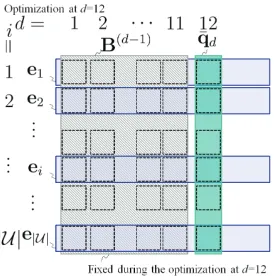
Figure 2:Relation ofeiandq¯dused to represent input vectors
in this paper.
where we define b(0)i,j = 0 for all(i, j). This rela-tion implies that the solurela-tions of former optimiza-tions are used as bias terms in latter optimizaoptimiza-tions.
Next, we defineq¯dand¯rdas the vector
represen-tations of the concatenation of all the input and out-put parameters at thed-th step, respectively, that is,
¯
qd = (e1,d, . . . , e|U|,d)and¯rd = (o1,d, . . . , o|V|,d).
Note that ei used in the former part of this paper
is a D-dimensional vector while¯qdand¯rddefined
here are|U|-dimensional and |V|-dimensional vec-tors, respectively. Moreover, there are relations that ei,dis thed-th factor ofei, and, at the same time, the
i-th factor ofq¯d.
Fig. 2 illustrates the relation of ei andq¯d in this
paper. We omit to explicitly show the relation ofoj
and¯rd, which are used to represent output vectors
because of the space reason. However obviously, they also have the same relation aseiandq¯d.
3.2 Individual optimization problem
Then, we define the d-th optimization problem in our ITACO formulation as follows:
(¯qd,¯rd) = arg min ¯ q,¯r
¯Ψ ¯
q,¯r|X,B(d−1)
subject to: |U||V|||q¯||p =||¯r||p,
(5)
where|| · ||p represents theLp-norm. We generally
assume thatp ={1,2,∞}, and often selectp = 2. Note thatq¯dis optimization parameters in the d-th
optimization problem whileB(d−1) is the constant.
Fig. 3 illustrates the relation ofB(d−1)andq¯ d.
[image:3.612.358.495.59.199.2]We assume that the objective function ¯Ψtakes an identical form as used in one of the conventional methods such as SGNS and GloVe as shown by
Figure 3: Relation ofB(d−1)and¯q
d, which are the constant
and optimization parameters in thed-th optimization problems, respectively.
Eqs. 2 and 3. The difference appears in the vari-ables; our ITACO formulation usesxi,j=eioj+bi,j
rather thanxi,j=ei·oj as described in Sec. 2.
3.3 Improving stability of embeddings
The additional norm constraint in Eq. 5 is introduced to improve stability. The optimization problems of neural word embedding methods including SGNS and GloVe can be categorized as a bi-convex op-timization problem (Gorski et al., 2007); they are convex with respect to the parameters E if the pa-rameters O are assumed to be constants, and vice versa. One well-known drawback of unconstrained bi-convex optimization is that the optimization pa-rameters can possibly diverge to ±∞ (See Exam-ple 4.3 in (Gorski et al., 2007)). This is because the objective function only cares about the inner prod-uct value of two vectors. Therefore, each parameter can easily have a much larger value,i.e.,o1 = 109,
if e1 is smaller and approaches a zero value i.e.,
e1 = 10−10. This is mainly caused by inconsistent
scale problem. Thus, our norm constraint in Eq. 5 can eliminate this problem by maintaining the scale of¯qand¯rat the same level.
3.4 Optimization algorithm
al-ternatively updates one parameter set, i.e., q¯, while the other distinct parameter set is fixed, i.e., ¯r. In our case, ACO solves the following two optimiza-tion problems iteratively and alternately:
¯
qd= arg min ¯ q
¯Ψ(¯
q,¯r| X,B(d−1)) (6)
¯rd= arg min ¯ r
¯Ψ(¯q,¯r| X,B(d−1)) . (7)
There are at least two advantages of using ACO; (1) Eqs. 6 and 7 both become convex optimization prob-lems. Therefore, the global optimum solution can be obtained when∂ei¯Ψ = 0for alliand∂oj¯Ψ = 0for
allj, respectively. (2) ACO guarantees to converge to a stationary point (one of the local minima)4.
For example, by a simple reformulation of∂ei¯Ψ= 0, we obtain the closed form solution of Eq. 6 with the GloVe objective, that is,
ei=
P
jβPi,j(mi,j−bi,j)oj
jβi,j(oj)2 ∀i. (8)
Similarly, the closed form solution of Eq. 7 is:
oj=
P
iβPi,j(mi,j−bi,j)ei
iβi,j(ei)2 ∀j. (9)
Thus, we can solve Eqs. 6 and 7 without performing iterative estimation. Next, we obtain the following equation by a simple reformulation of∂ei¯Ψ = 0for
the SGNS objective:
X
j
ci,joj=
X
j
(ci,j+c0i,j)σ(eioj +bi,j)oj, (10)
where σ(x) represents a sigmoid function, that is, σ(x) = 1
1+exp(−x). Similarly, we also obtain the
following form of the equation for Eq. 7:
X
i
ci,jei=
X
i
(ci,j+c0i,j)σ(eioj +bi,j)ei. (11)
These equations are efficiently solvable by a sim-ple binary search procedure since each equation only has a single parameter, that is,eioroj,
During the optimization, there is no guarantee that the constraint |V||U|||q¯||p =||¯r||palways holds.
Fortu-nately, the following transformations always satisfy
4We somehow prevent the divergence of optimization pa-rameters (Gorski et al., 2007)
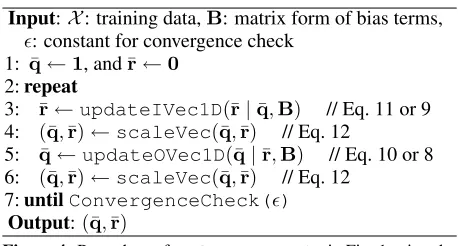
Input:X: training data,B: matrix form of bias terms, : constant for convergence check
1: ¯q←1, and¯r←0 2:repeat
3: ¯r←updateIVec1D(¯r|q¯,B) // Eq. 11 or 9 4: (¯q,¯r)←scaleVec(¯q,¯r) // Eq. 12
5: q¯←updateOVec1D(¯q|¯r,B) // Eq. 10 or 8 6: (¯q,¯r)←scaleVec(¯q,¯r) // Eq. 12
[image:4.612.312.541.54.177.2]7:untilConvergenceCheck() Output:(¯q,¯r)
Figure 4:Procedure ofupdateParams1Din Fig. 1 using the ACO-based algorithm.
this norm constraint:
˜
ei=|U||V|||q¯ei|| p
|V|
|U|||q¯||p||¯r||p
1 2
∀i
˜
oj=||¯ro||j p
|V|
|U|||¯q||p||¯r||p
1 2
∀j, (12)
which also maintaine˜io˜j = eioj, and the objective
value. Thus, we can safely apply them at any time during the optimization.
Finally, Fig. 4 shows the optimization procedure when using the ACO framework.
4 Experiments
As in previously reported neural word embedding papers, our training data was taken from a Wikipedia dump (Aug. 2014). We usedhyperwords tool5 for our data preparation (Levy et al., 2015).
We compared our method, ITACO, with the widely used conventional methods, SGNS and
GloVe. We used the word2vec implementa-tion6 to obtain word embeddings of SGNS, and
gloveimplementation7 for GloVe. Many tunable hyper-parameters were selected based on the rec-ommended default values of each implementation, or suggestion explained in (Levy et al., 2015). For ITACO, we selected the Glove objective to solve Eqs. 6 and 7 since it requires a lower calculation cost than the SGNS objective.
We prepared three types of linguistic benchmark tasks, namely word similarity estimation ( Similar-ity), word analogy estimation (Analogy), and sen-tence completion (SentComp) tasks. We gathered
5https://bitbucket.org/omerlevy/hyperwords
6https://code.google.com/p/word2vec/ (We made a modifi-cation to save the context vector as well as the word vector.)
Analogy
Methods D=10 50 100 300 500 1000
ITACO (trunc) ∗2.6 38.0 51.5 63.5 65.4 ∗65.6
SGNS (trunc) 0.0 11.8 34.6 57.4 61.9 63.2 GloVe (trunc) 0.1 20.1 42.3 60.7 63.2 ∗65.6
SGNS (retrain) 1.7 37.7 51.8 62.3 64.0 – GloVe (retrain) ∗2.6∗42.6∗57.0∗65.6∗66.4 –
Similarity
Methods D=10 50 100 300 500 1000
ITACO (trunc) 41.6 55.2 58.5 61.4 62.2 62.9 SGNS (trunc) 29.0 46.1 52.5 60.7 61.8 ∗64.5
GloVe (trunc) 29.3 46.2 50.6 56.8 58.5 59.9 SGNS (retrain) ∗46.4∗58.2∗61.3∗63.9∗64.2 –
GloVe (retrain) 38.7 51.4 54.2 56.8 58.1 – SentComp
Methods D=10 50 100 300 500 1000
ITACO (trunc) ∗29.2∗32.3 32.1∗34.3∗35.4 ∗36.6
SGNS (trunc) 24.2 26.2 29.9 32.1 32.3 36.1 GloVe (trunc) 22.8 24.3 26.7 26.7 28.2 27.7 SGNS (retrain) 24.8 29.7∗33.0 32.7 33.9 –
[image:5.612.72.299.53.330.2]GloVe (retrain) 26.3 27.3 27.1 28.1 28.1 –
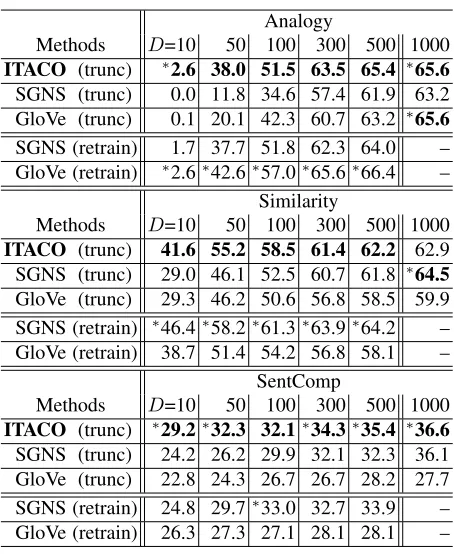
Table 1:Results of right-truncated embedding vectors (trunc), and standard embedding vectors (retrain). ‘∗’ represents the best results in the corresponding column.
nine datasets for Similarity (Rubenstein and Goode-nough, 1965; Miller and Charles, 1991; Agirre et al., 2009; Agirre et al., 2009; Bruni et al., 2014; Radin-sky et al., 2011; Huang et al., 2012; Luong et al., 2013; Hill et al., 2014), three for Analogy (Mikolov et al., 2013a; Mikolov et al., 2013c) , and one for SentComp (Mikolov et al., 2013a).
Table 1 shows all the results of our experiments8. The rows labeled ‘(trunc)’ show the performance of D-right-truncated embedding vectors, whose origi-nal vector of dimension is D= 1000. Thus, they were obtained from a single set of embedding vec-tors withD= 1000for each corresponding method. Next, the rows labeled ‘(retrain)’ show the perfor-mance provided by SGNS or GloVe that were in-dependently constructed with using a standard set-ting and corresponding D. Note that the results of ‘ITACO (retrain)’ are identical to those of ‘ITACO (trunc)’. Moreover, ‘GloVe (trunc)’ and ‘GloVe (re-train)’ in D = 1000 are equivalent, as are ‘SGNS (trunc)’ and ‘SGNS (retrain)’. Thus, these results
8Results for SGNS and GloVe are the average performance of ten runs as suggested in (Suzuki and Nagata, 2015)
were omitted from the table.
First, comparing ‘(retrain)’ and ‘(trunc)’ in SGNS and GloVe, our experimental results first explicitly revealed that SGNS and GloVe with the simple trun-cation approach ‘(trunc)’ cannot provide effective lower-dimensional embedding vectors. This obser-vation strongly supports the significance of exis-tence of our proposed method, ITACO.
Second, in most cases ITACO successfully pro-vided almost the same performance level as the best SGNS and GloVe (retrain) results. We emphasize that ITACO constructed embedding vectors ‘just once’, while SGNS and GloVe required us to retrain embedding vectors in the corresponding times. In addition, single run of ITACO for D= 1000 took approximately 12,000 seconds in our machine envi-ronment, which was almost equivalent to run 4 itera-tions of SGNS and 8 iteraitera-tions of GloVe. The results of SGNS and GloVe in Table 1 were obtained by 10 iterations and 20 iterations, respectively, which are one of the standard settings to run SGNS and GloVe9. This fact verified that ITACO can run effi-ciently as in the same level as SGNS and GloVe.
5 Conclusion
This paper proposed a method for generating in-teresting right-truncatable word embedding vectors. Our experiments revealed that the embedding vec-tors obtained with our method, ITACO, in any lower dimensions work as well as those obtained by SGNS and Glove. In addition, ITACO can also be a good alternative of SGNS and GloVe in terms of the exe-cution speed of a single run. Now, we are free from retraining different dimensions of embedding vec-tors by using ITACO. Our method significantly re-duces the total calculation cost and storage, which improves the ‘usability’ of embedding vectors10.
Acknowledgment
We thank three anonymous reviewers for their help-ful comments.
9The performance of 4 iterations of SGNS and 8 iterations of GloVe were much lower than those of 10 iterations and 20 iterations of SGNS and GloVe shown in Table 1, respectively.
References
Eneko Agirre, Enrique Alfonseca, Keith Hall, Jana Kravalova, Marius Pas¸ca, and Aitor Soroa. 2009. A Study on Similarity and Relatedness Using Distribu-tional and WordNet-based Approaches. In Proceed-ings of Human Language Technologies: The 2009 An-nual Conference of the North American Chapter of the Association for Computational Linguistics, NAACL ’09, pages 19–27, Stroudsburg, PA, USA. Association for Computational Linguistics.
Chris Alberti, David Weiss, Greg Coppola, and Slav Petrov. 2015. Improved Transition-Based Parsing and Tagging with Neural Networks. InProceedings of the 2015 Conference on Empirical Methods in Natural Language Processing, pages 1354–1359, Lisbon, Por-tugal, September. Association for Computational Lin-guistics.
Elia Bruni, Nam Khanh Tran, and Marco Baroni. 2014. Multimodal Distributional Semantics. J. Artif. Int. Res., 49(1):1–47, January.
Danqi Chen and Christopher Manning. 2014. A Fast and Accurate Dependency Parser using Neural Networks. In Proceedings of the 2014 Conference on Empirical Methods in Natural Language Processing (EMNLP), pages 740–750, Doha, Qatar, October. Association for Computational Linguistics.
Chris Dyer, Miguel Ballesteros, Wang Ling, Austin Matthews, and Noah A. Smith. 2015. Transition-Based Dependency Parsing with Stack Long Short-Term Memory. In Proceedings of the 53rd Annual Meeting of the Association for Computational Linguis-tics and the 7th International Joint Conference on Nat-ural Language Processing (Volume 1: Long Papers), pages 334–343, Beijing, China, July. Association for Computational Linguistics.
Yoav Goldberg and Omer Levy. 2014. word2vec Ex-plained: Deriving Mikolov et al.’s Negative-sampling Word-embedding Method. CoRR, abs/1402.3722. Jochen Gorski, Frank Pfeuffer, and Kathrin Klamroth.
2007. Biconvex Sets and Optimization with Biconvex Functions: a Survey and Extensions. Math. Meth. of OR, 66(3):373–407.
Felix Hill, Roi Reichart, and Anna Korhonen. 2014. SimLex-999: Evaluating Semantic Models with (Gen-uine) Similarity Estimation. ArXiv e-prints, August. Eric H. Huang, Richard Socher, Christopher D. Manning,
and Andrew Y. Ng. 2012. Improving Word Represen-tations via Global Context and Multiple Word Proto-types. InProceedings of the 50th Annual Meeting of the Association for Computational Linguistics: Long Papers - Volume 1, pages 873–882. Association for Computational Linguistics.
Jingu Kim, Yunlong He, and Haesun Park. 2014. Al-gorithms for Nonnegative Matrix and Tensor Factor-izations: a Unified View Based on Block Coordinate Descent Framework. Journal of Global Optimization, 58(2):285–319.
Jonghoon Kim, Francois Rousseau, and Michalis Vazir-giannis. 2015. Convolutional Sentence Kernel from Word Embeddings for Short Text Categorization. In
Proceedings of the 2015 Conference on Empirical Methods in Natural Language Processing, pages 775– 780, Lisbon, Portugal, September. Association for Computational Linguistics.
Omer Levy and Yoav Goldberg. 2014. Neural Word Embedding as Implicit Matrix Factorization. In Z. Ghahramani, M. Welling, C. Cortes, N.D. Lawrence, and K.Q. Weinberger, editors, Advances in Neural Information Processing Systems 27, pages 2177–2185. Curran Associates, Inc.
Omer Levy, Yoav Goldberg, and Ido Dagan. 2015. Improving Distributional Similarity with Lessons Learned from Word Embeddings. Transactions of the Association for Computational Linguistics, 3.
Wang Ling, Chris Dyer, Alan W Black, Isabel Trancoso, Ramon Fermandez, Silvio Amir, Luis Marujo, and Tiago Luis. 2015. Finding Function in Form: Compo-sitional Character Models for Open Vocabulary Word Representation. InProceedings of the 2015 Confer-ence on Empirical Methods in Natural Language Pro-cessing, pages 1520–1530, Lisbon, Portugal, Septem-ber. Association for Computational Linguistics. Thang Luong, Richard Socher, and Christopher Manning.
2013. Better Word Representations with Recursive Neural Networks for Morphology. InProceedings of the Seventeenth Conference on Computational Natural Language Learning, pages 104–113, Sofia, Bulgaria, August. Association for Computational Linguistics. Tomas Mikolov, Kai Chen, Greg Corrado, and Jeffrey
Dean. 2013a. Efficient Estimation of Word Repre-sentations in Vector Space. CoRR, abs/1301.3781. Tomas Mikolov, Ilya Sutskever, Kai Chen, Greg S
Cor-rado, and Jeff Dean. 2013b. Distributed Representa-tions of Words and Phrases and their Compositionality. In C.J.C. Burges, L. Bottou, M. Welling, Z. Ghahra-mani, and K.Q. Weinberger, editors,Advances in Neu-ral Information Processing Systems 26, pages 3111– 3119. Curran Associates, Inc.
George A. Miller and Walter G. Charles. 1991. Contex-tual Correlates of Semantic Similarity. Language & Cognitive Processes, 6(1):1–28.
Andriy Mnih and Koray Kavukcuoglu. 2013. Learning Word Embeddings Efficiently With Noise-contrastive Estimation. In C.J.C. Burges, L. Bottou, M. Welling, Z. Ghahramani, and K.Q. Weinberger, editors, Ad-vances in Neural Information Processing Systems 26, pages 2265–2273. Curran Associates, Inc.
Jeffrey Pennington, Richard Socher, and Christopher Manning. 2014. Glove: Global Vectors for Word Represqentation. In Proceedings of the 2014 Con-ference on Empirical Methods in Natural Language Processing (EMNLP), pages 1532–1543, Doha, Qatar, October. Association for Computational Linguistics. Kira Radinsky, Eugene Agichtein, Evgeniy Gabrilovich,
and Shaul Markovitch. 2011. A Word at a Time: Computing Word Relatedness Using Temporal Se-mantic Analysis. In Proceedings of the 20th Inter-national Conference on World Wide Web, WWW ’11, pages 337–346, New York, NY, USA. ACM.
Herbert Rubenstein and John B. Goodenough. 1965. Contextual Correlates of Synonymy. Commun. ACM, 8(10):627–633, October.
Ilya Sutskever, Oriol Vinyals, and Quoc V Le. 2014. Se-quence to SeSe-quence Learning with Neural Networks. In Z. Ghahramani, M. Welling, C. Cortes, N. D. Lawrence, and K. Q. Weinberger, editors, Advances in Neural Information Processing Systems 27, pages 3104–3112. Curran Associates, Inc.
Jun Suzuki and Masaaki Nagata. 2015. A Unified Learn-ing Framework of Skip-Grams and Global Vectors. In
Proceedings of the 53rd Annual Meeting of the As-sociation for Computational Linguistics and the 7th International Joint Conference on Natural Language Processing (Volume 2: Short Papers), pages 186–191, Beijing, China, July. Association for Computational Linguistics.
Yuta Tsuboi. 2014. Neural Networks Leverage Corpus-wide Information for Part-of-speech Tagging. In Pro-ceedings of the 2014 Conference on Empirical Meth-ods in Natural Language Processing (EMNLP), pages 938–950, Doha, Qatar, October. Association for Com-putational Linguistics.
Di Wang and Eric Nyberg. 2015. A Long Short-Term Memory Model for Answer Sentence Selection in Question Answering. In Proceedings of the 53rd Annual Meeting of the Association for Computational Linguistics and the 7th International Joint Conference on Natural Language Processing (Volume 2: Short Pa-pers), pages 707–712, Beijing, China, July. Associa-tion for ComputaAssocia-tional Linguistics.
Kristian Woodsend and Mirella Lapata. 2015. Dis-tributed Representations for Unsupervised Semantic
Role Labeling. InProceedings of the 2015 Conference on Empirical Methods in Natural Language Process-ing, pages 2482–2491, Lisbon, Portugal, September. Association for Computational Linguistics.
Jie Zhou and Wei Xu. 2015. End-to-end Learning of Semantic Role Labeling using Recurrent Neural Net-works. In Proceedings of the 53rd Annual Meet-ing of the Association for Computational LMeet-inguistics and the 7th International Joint Conference on Natu-ral Language Processing (Volume 1: Long Papers), pages 1127–1137, Beijing, China, July. Association for Computational Linguistics.