I
LLINOISM
ATHS
OLVER: Math Reasoning on the Web
Subhro Roy and Dan Roth
University of Illinois, Urbana Champaign {sroy9, danr}@illinois.edu
Abstract
There has been a recent interest in understand-ing text to perform mathematical reasonunderstand-ing. In particular, most of these efforts have fo-cussed on automatically solving school level math word problems. In order to make ad-vancements in this area accessible to people, as well as to facilitate this line of research, we release the ILLINOIS MATH SOLVER, a web based tool that supports performing math-ematical reasoning. ILLINOISMATHSOLVER can answer a wide range of mathematics ques-tions, ranging from compositional operation questions like “What is the result when 6 is divided by the sum of 7 and 5 ?” to el-ementary school level math word problems, like “I bought 6 apples. I ate 3 of them. How many do I have left ?”. The web based demo can be used as a tutoring tool for el-ementary school students, since it not only outputs the final result, but also the mathe-matical expression to compute it. The tool will allow researchers to understand the ca-pabilities and limitations of a state of the art arithmetic problem solver, and also enable crowd based data acquisition for mathemati-cal reasoning. The system is currently online at https://cogcomp.cs.illinois. edu/page/demo_view/Math.
1 Motivation
There has been a lot of interest in understanding text for the purpose of quantitative reasoning. In particu-lar, there has been multiple recent efforts to automat-ically solve math word problems (Kushman et al., 2014; Hosseini et al., 2014; Roy et al., 2015; Roy
and Roth, 2015; Shi et al., 2015; Koncel-Kedziorski et al., 2016). Advancement in this area has great potential to be used as automatic tutoring service for school students. However till date, all the ad-vances in this area are not easily accessible to the general population. ILLINOIS MATH SOLVER
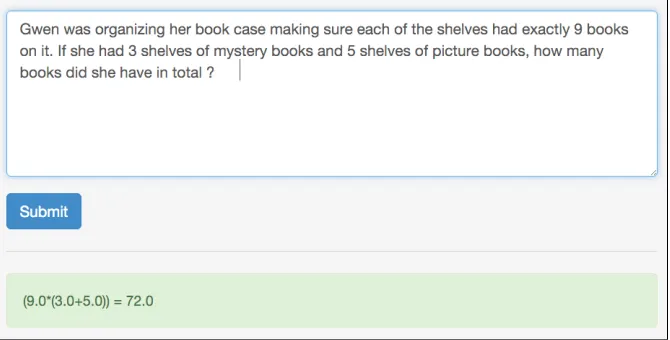
ad-dresses this issue by providing a web based plat-form, where users can type in their math word prob-lem and get the answer. It also outputs the mathe-matical expression generating the answer, allowing students to understand how to solve the problem. Fig 1 shows a screenshot of the web interface of the ILLINOISMATHSOLVER.
All systems for math word problem solving are trained and evaluated on datasets created from tu-toring websites and textbooks. However the prob-lems from the aforementioned sources tend to have limited variety in problem types and vocabulary. Of-ten these systems are brittle, and make mistakes with slight variation of text. As a result, there is a need for an easy way to analyze the robustness of these systems, as well as extract a wider variety of math word problems not available from textbooks and tu-toring websites. ILLINOIS MATH SOLVER solves
both these purposes, providing users an easy way to test the robustness of the system, and a tool for crowd based data acquisition. We expect people to query with small edits to math word problem text, to make our system get the wrong answer. This al-lows for adverserial data acquisition, which can help identify intricacies of mathematical reasoning.
Figure 1:Screen Shot of ILLINOISMATHSOLVER
2 System Description
The ILLINOISMATHSOLVERconsists of two main
modules - a context-free grammar (CFG) based se-mantic parser, and an arithmetic problem solver. We describe each component below.
2.1 CFG Parser
We use a CFG based semantic parser to handle queries asking for operations between numbers. Ex-amples of such queries include“What is the differ-ence of 22 and 5 ?” and“What is the result when 6 is divided by the sum of 7 and 5 ?”. We refer to such queries as “number queries”.
Our parser recognizes the mathematical terms in a number query like “added”, “difference”, “frac-tion”, etc. It then creates a list of the numbers and math terms mentioned in the query, maintaining the order in which they appear in the query. For the example “What is the result when 6 is divided by the sum of 7 and 5 ?”, the parser creates the list
{6,divided,sum,7,5}.
Next, it tries to parse the list of numbers and the math terms into a mathematical expression, using a list of derivation rules. An example of a derivation rule is as follows:
E→E1 divided E2
val(E)→val(E1)/val(E2)
whereE,E1 andE2 are non-terminals of our CFG
representing mathematical expressions. For each such non-terminal, we have an associated function
val(·), which computes the numeric value of the mathematical expression represented by that non-terminal. The above rule states that whenever we see the word “divided” between two expressions, we can parse them into a new expression. The value of the new expression will be obtained by dividing the first expression value with the second one. Overall, we have 26such derivation rules, and we will be aug-menting it as we come across more varied number queries. We use CKY algorithm for parsing. The derivation rules naturally capture composition. In the above example, it will first parse{“sum,7,5”}
into an expression E, and next parse {6, divided,
E}.
2.2 General Arithmetic Problem Solver
The second component of our system is the arith-metic word problem solver developed in our previ-ous work (Roy and Roth, 2015). The solver tackles a general class of arithemetic word problems, and achieves state of the art results on several benchmark datasets of arithmetic word problems.
2.2.1 Technical Details
Problem
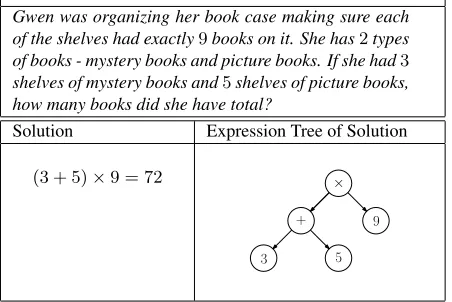
Gwen was organizing her book case making sure each of the shelves had exactly9books on it. She has2types of books - mystery books and picture books. If she had3 shelves of mystery books and5shelves of picture books, how many books did she have total?
Solution Expression Tree of Solution
(3 + 5)×9 = 72
3 +
5 ×
[image:3.612.74.300.69.220.2]9
Figure 2:An arithmetic word problem, solution expression and the corresponding expression tree
The arithmetic solver learns classifiers for the fol-lowing two prediction problems:
1. For every pair of quantitiesqi, qj in a problem
P, a classifier is learnt to predict a math oper-ation (one of addition, subtraction, multiplica-tion, division) along with the order of operation (applicable for subtraction and division). This operation is expected to denote the operation at the lowest common ancestor (LCA) node ofqi
andqj in the solution tree. For example, in fig
2, the operation between 3 and 5 is addition, and that between5 and9is multiplication. A multi-class classifier is trained for this predic-tion task.
Finally, we define PAIR(qi, qj, op)to denote the
likelihood score ofopto be the operation at the LCA node ofqi andqj in the solution
expres-sion tree ofP. The aforementioned classifier is used to obtain these scores.
2. We also train a classifier to predict whether a quantityq mentioned in a problemP is irrel-evant for the solution. For example, in fig 2, the number “2” is irrelevant, whereas all other numbers are relevant. A binary classifier is trained to predict this.
We define IRR(q)to denote the likelihood score
of quantityqbeing an irrelevant quantity inP, that is, q is not used in creating the solution. The aforementioned binary classifier is used to obtain these scores.
For an expression E, let I(E) be the set of all quantities in P which are not used in expression E. LetT be an expression tree for E. We define
Score(E) of an expressionE in terms of the above scoring functions and a scaling parameter wIRR as
follows:
Score(E) =wIRR
X
q∈I(E)
IRR(q)+
X
qi,qj∈I/ (E)
PAIR(qi, qj,LCA(qi, qj,T))
whereLCA(qi, qj,T)is the operation at the LCA
node ofqiandqj in the expression treeT.
Our search for solution expression tree is also constrained by legitimacy and background knowl-edge constraints, detailed below.
1. Positive Answer: Most arithmetic problems asking for amounts or number of objects usu-ally have a positive number as an answer. Therefore, while searching for the best scor-ing expression, we reject expressions generat-ing negative answer.
2. Integral Answer: Problems with questions such as ‘how many” usually expect integral so-lutions. We only consider integral solutions as legitimate outputs for such problems.
LetC be the set of valid expressions that can be formed using the quantities in a problem P, and which satisfy the above constraints. The inference algorithm now becomes the following:
arg max
E∈C Score(E)
2.2.2 Evaluation
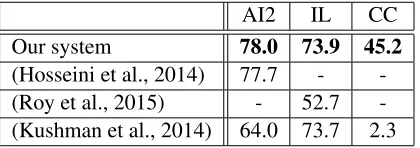
We evaluated our arithmetic word problem solver on three publicly available datasets – addition sub-traction problems from AI2 dataset (AI2) (Hosseini et al., 2014), single operation problems from Illi-nois dataset (IL)(Roy et al., 2015), and multi-step problems from commoncore dataset (CC)(Roy and Roth, 2015). We compare against systems which had achieved previously known best scores on these datasets, and show that our system achieves state of the art performance on all the above datasets. Table 1 shows the comparison. Finally, the models of the ILLINOIS MATH SOLVER are trained on the union
CFG Parser Parsed ?
Yes No
Arithmetic Word
Problem Solver
Answer
[image:4.612.100.517.59.158.2]Answer Input query
Figure 3:Pipeline of ILLINOISMATHSOLVER
AI2 IL CC
Our system 78.0 73.9 45.2
(Hosseini et al., 2014) 77.7 - -(Roy et al., 2015) - 52.7 -(Kushman et al., 2014) 64.0 73.7 2.3
Table 1: Accuracy in correctly solving arithmetic problems. We achieve state of the art results in all three datasets.
2.3 Illinois Math Solver pipeline
The pipeline of the ILLINOIS MATH SOLVER is
shown in Fig 3. Given input text, we first run the CFG parser, to check whether it is a number query. If our CFG parser can make sense of the query and can generate a mathematical expression from the query, we immediately output it as the answer. Oth-erwise, the query is fed to the arithmetic problem solver. The output of the solver is then displayed as the result.
3 Related Work
The interface of Wolfram Alpha is probably the clos-est to ours. However their system is limited to han-dling mostly number queries, and very simple arith-metic problems. In contrast, our system can solve complicated arithmetic problems described by mul-tiple sentences and requiring mulmul-tiple operations. There has also been a lot of work in quantitative rea-soning. Roy et al. (2015) looks at understanding en-tailment relations among expressions of quantities in text. There has also been efforts to automatically solve school level math word problems. Hosseini et al. (2014) looks at solving elementary addition sub-traction problems, Roy et al. (2015) aims to solve single operation problems and Koncel-Kedziorski et al. (2016) solves single equation problems. The system of Shi et al. (2015) tackles number word
problems by semi-automatically generated parsing rules, and is similar to our CFG parsing approach for tackling number queries. Kushman et al. (2014) proposes a template based approach for solving al-gebra word problems and finally, our system pro-posed in Roy and Roth (2015) solves a general class of arithmetic word problems, and achieves state of the art results on multiple arithmetic word problem datasets. This is the solver we use for handling arith-metic problems in ILLINOISMATHSOLVER.
4 Conclusion and Future Directions
We release ILLINOIS MATH SOLVER, an online
tool to automatically solve number queries and arithemtic word problems. It will help elementary school students to self-tutor. In addition, it will be a source of highly varied math queries, which might reveal difficulties of mathematical reasoning, and as-sist future advancement in the area.
[image:4.612.82.292.199.273.2]References
[Hosseini et al.2014] M. J. Hosseini, H. Hajishirzi, O. Et-zioni, and N. Kushman. 2014. Learning to solve arith-metic word problems with verb categorization. In Pro-ceedings of the 2014 Conference on Empirical Meth-ods in Natural Language Processing, EMNLP 2014. [Koncel-Kedziorski et al.2016] R. Koncel-Kedziorski,
H. Hajishirzi, A. Sabharwal, O. Etzioni, and S. Dumas Ang. 2016. Parsing algebraic word problems into equations. InTACL.
[Kushman et al.2014] N. Kushman, L. Zettlemoyer, R. Barzilay, and Y. Artzi. 2014. Learning to automatically solve algebra word problems. InACL. [Roy and Roth2015] S. Roy and D. Roth. 2015.
Solv-ing general arithmetic word problems. In Proc. of the Conference on Empirical Methods in Natural Lan-guage Processing (EMNLP).
[Roy et al.2015] S. Roy, T. Vieira, and D. Roth. 2015. Reasoning about quantities in natural language. Trans-actions of the Association for Computational Linguis-tics, 3.