Metaphor Identification as Interpretation
Ekaterina Shutova
International Computer Science Institute and Institute for Cognitive and Brain Sciences
University of California, Berkeley [email protected]
Abstract
Automatic metaphor identification and inter-pretation in text have been traditionally con-sidered as two separate tasks in natural lan-guage processing (NLP) and addressed in-dividually within computational frameworks. However, cognitive evidence suggests that hu-mans are likely to perform these two tasks si-multaneously, as part of a holistic metaphor comprehension process. We present a novel method that performs metaphor identification through its interpretation, being the first one in NLP to combine the two tasks in one step. It outperforms the previous approaches to metaphor identification both in terms of ac-curacy and coverage, as well as providing an interpretation for each identified expression.
1 Introduction
Metaphor undoubtedly gives our expression more vividness, distinction and artistry, however, it is also an important linguistic tool that has long become part of our every-day language. Metaphors arise when one concept or domain is viewed in terms of the properties of another (Lakoff and Johnson, 1980). Consider the examples in (1) and (2).
(1) My cardrinksgasoline. (Wilks, 1978)
(2) This policy isstranglingbusiness.
The car in (1) and business in (2) are viewed as
living beings and thus they can drink or be stran-gled respectively. The mapping between the car
(the target concept) and living being (the source concept) is systematic and results in a number of metaphorical expressions (e.g. “This oil gives your
car asecond life”, “this car has is very temperamen-tal” etc.) Lakoff and Johnson call such generalisa-tions a source–target domain mapping, or concep-tual metaphor.
The ubiquity of metaphor in language has been established in a number of corpus studies (Cameron, 2003; Martin, 2006; Steen et al., 2010; Shutova and Teufel, 2010) and the role it plays in human reasoning has been confirmed in psychological ex-periments (Thibodeau and Boroditsky, 2011). This makes its automatic processing an important prob-lem for NLP and its numerous applications (such as machine translation, information extraction, opin-ion mining and many others). For example, the use of the metaphorical verbstranglein (2) reflects the speaker’s negative opinion regarding the gov-ernment’s tight business regulations, which would be an important fact for an opinion mining system to discover (Narayanan, 1999). Other experiments (Agerri, 2008) have investigated and confirmed the role of metaphor interpretation for textual entailment resolution (RTE).
The problem of metaphor modeling is rapidly gaining interest within NLP, with a growing number of approaches exploiting statistical techniques (Ma-son, 2004; Gedigian et al., 2006; Shutova, 2010; Shutova et al., 2010; Turney et al., 2011; Shutova et al., 2012a). Compared to more traditional ap-proaches based on hand-coded knowledge (Fass, 1991; Martin, 1990; Narayanan, 1997; Narayanan, 1999; Feldman and Narayanan, 2004; Barnden and Lee, 2002; Agerri et al., 2007), these more recent methods tend to have a wider coverage, as well as be more efficient, accurate and robust. However, even the statistical metaphor processing approaches so far often focused on a limited domain or a subset of
phenomena (Gedigian et al., 2006; Krishnakumaran and Zhu, 2007), and required training data (Shutova et al., 2010; Turney et al., 2011), often resulting in a limited coverage. The metaphor processing task itself has been most commonly addressed in NLP as two individual subtasks: metaphor identification and metaphor interpretation, with the systems focus-ing only on one of them at a time, or at best comb-ing the two in a pipeline (Shutova et al., 2012a). Metaphor identification systems annotate metaphor-ical language in text, and metaphor interpretation systems discover literal meanings of the previously annotated expressions. However, cognitive evidence suggests that humans are likely to perform identifi-cation and interpretation simultaneously, as part of a holistic metaphor comprehension process (Coul-son, 2008; Utsumi, 2011; Gibbs and Colston, 2012). In this paper, we also take this stance and present the first computational method that identifies metaphori-cal expressions in unrestricted text by means of their interpretation. Following Shutova (2010), we define metaphor interpretation as a task of finding a literal paraphrase for a metaphorically used word and in-troduce the concept ofsymmetric reverse paraphras-ing as a criterion for metaphor identification. The main assumption behind our method is that the lit-eral paraphrases of litlit-erally-used words should yield the original phrase when paraphrased in reverse. For example, when the expression “clean the house” is paraphrased as “tidy the house”, the reverse para-phrasing of tidywould generateclean. Our expec-tation is that such a symmetry in paraphrasing is indicative of literal use. The metaphorically-used words are unlikely to exhibit this symmetry prop-erty when paraphrased in reverse. For example, the literal paraphrasing of the verb stir in “stir excite-ment” would yield “provoke exciteexcite-ment”, but the reverse paraphrasing ofprovokewould not retrieve
stir, indicating the non-literal use ofstir.
We experimentally verify this hypothesis in a set-ting involving single-word metaphors expressed by a verb in verb-subject and verb-direct object rela-tions. We apply the selectional preference-based metaphor paraphrasing method of Shutova (2010) to retrieve literal paraphrases of all input verbs and ex-tend the method to perform metaphor identification. In summary, our system (1) determines the likeli-hood of a verb being metaphorical based on its
selec-tional preference strength (Resnik, 1993); (2) identi-fies a set of literal paraphrases for verbs that may be used metaphorically using the algorithm of Shutova (2010); (3) performs reverse paraphrasing of each of the identified paraphrases, aiming to retrieve the original expression; and (4) if the original expres-sion is retrieved then the verb is tagged as literal, otherwise it is tagged as metaphorical.
We evaluated the performance of the system using the manually annotated metaphor corpus of Shutova and Teufel (2010) in precision- and recall-oriented settings. In addition, we compared its performance to that of a baseline using selectional preference vi-olation as an indicator of metaphor, as well as to two previous metaphor identification approaches of Shutova et al. (2010) and Turney et al. (2011).
2 Related Work
One of the first attempts to identify and interpret metaphorical expressions in text is the met* sys-tem of Fass (1991), that utilizes hand-coded knowl-edge and detects non-literalness via selectional pref-erence violation. In case of a violation, the re-spective phrase is first tested for being metonymic using hand-coded patterns (e.g. CONTAINER-FOR
-CONTENT). If this fails, the system searches the knowledge base for a relevant analogy in order to discriminate metaphorical relations from anomalous ones. The system of Krishnakumaran and Zhu (2007) uses WordNet (the hyponymy relation) and word bigram counts to predict verbal, nominal and adjectival metaphors at the sentence level. The au-thors discriminate between conventional metaphors (included in WordNet) and novel metaphors. Birke and Sarkar (2006) present a sentence clustering ap-proach that employs a set of seed sentences an-notated for literalness and computes similarity be-tween the new input sentence and all of the seed sen-tences. The system then tags the sentence as literal or metaphorical according to the annotation in the most similar seeds, attaining an f-score of 53.8%.
The first system to discover source–target domain mappings automatically is CorMet (Mason, 2004). It does this by searching for systematic variations in domain-specific verb selectional preferences. For example, pour is a characteristic verb in both LAB
a strong preference forliquidsand in theFINANCE
domain formoney. From this the system infers the domain mapping FINANCE – LAB and the concept mapping money – liquid. Gedigian et al. (2006) trained a maximum entropy classifier to discrimi-nate between literal and metaphorical use. They annotated the sentences from PropBank (Kingsbury and Palmer, 2002) containing the verbs ofMOTION
and CURE for metaphoricity. They used PropBank annotation (arguments and their semantic types) as features for classification and report an accuracy of 95.12% (however, against a majority baseline of 92.90%). The metaphor identification system of Shutova et al. (2010) starts from a small seed set of metaphorical expressions, learns the analogies in-volved in their production and extends the set of analogies by means of verb and noun clustering. As a result, the system can recognize new metaphorical expressions in unrestricted text (e.g. from the seed “stir excitement” it infers that “swallow anger” is also a metaphor), achieving a precision of 79%.
Turney et al. (2011) classify verbs and adjectives as literal or metaphorical based on their level of con-creteness or abstractness in relation to a noun they appear with. They learn concreteness rankings for words automatically (starting from a set of exam-ples) and then search for expressions where a con-crete adjective or verb is used with an abstract noun (e.g. “dark humour” is tagged as a metaphor and “dark hair” is not). They report an accuracy of 73%.
3 Method
3.1 Selectional Preference Strength Filtering
One of the early influential ideas in the field of com-putational metaphor processing is that metaphor rep-resents a violation of selectional preferences (SP) of a word in a given context (Wilks, 1975; Wilks, 1978). However, applied directly as an identifica-tion criterion, violaidentifica-tion of SPs is also indicative of many other linguistic phenomena (e.g. metonymy), and not only metaphor, which is problematic. We modify this view and apply it to measure the poten-tial of a word to be used metaphorically based on its selectional preference strength (SPS). The main in-tuition behind SPS filtering is that not all verbs have an equal potential of being a metaphor. For example, verbs such aschoose,remember,describeorlikedo
not have a strong preference for their direct objects and are equally likely to appear with many argument classes. If metaphor represents a violation of SPs, then the verbs with weak SPS are unlikely to be used metaphorically in any context. For every verb in the input text, the filter determines their likelihood of being a metaphor based on their SPS and discards the weak ones. The SPS filter is context-free, and the reverse paraphrasing method is then applied in the next steps to determine if the remaining verbs are indeed used metaphorically in the given context. We automatically acquired selectional preference distributions for verb-subject and verb-direct object relations from the British National Corpus (BNC) (Burnard, 2007) that was parsed using the RASP parser (Briscoe et al., 2006; Andersen et al., 2008). We applied the noun clustering method of Sun and Korhonen (2009) to 2000 most frequent nouns in the BNC to obtain 200 common selectional prefer-ence classes. To quantify selectional preferprefer-ences, we adopted the SPS measure of Resnik (1993). Resnik defines SPS of a verb as the difference between the posterior distribution of noun classes in a particular relation with the verb and their prior distribution in that syntactic position (regardless of the verb). He quantifies this difference using the Kullback-Leibler divergence:
SR(v) =D(P(c|v)||P(c)) =
X
c
P(c|v) logP(c|v) P(c) ,
(1)
whereP(c)is the prior probability of the noun class,
P(c|v)is the posterior probability of the noun class given the verb andRis the grammatical relation.
3.2 Literal Paraphrasing
The verbs that can be used metaphorically ac-cording to the SPS filter are then paraphrased us-ing the context-based literal paraphrasus-ing method of Shutova (2010). While Shutova only used the method to paraphrase manually annotated metaphors, we extend and apply the method to para-phrasing of literally used terms and metaphor identi-fication, eliminating the need for manual annotation of metaphorical expressions.
The system takes verbs and their context in the form of subject and direct-object relations as input. It generates a list of possible paraphrases of the verb that can occur in the same context and ranks them according to their likelihood, as derived from the corpus. It then identifies shared features of the para-phrases and the verb using the WordNet (Fellbaum, 1998) hierarchy and removes unrelated concepts. It then identifies literal paraphrases among the remaing candidates based on the verb’s automatically in-duced selectional preferences and the properties of the context.
3.2.1 Context-based Paraphrase Ranking
Following Shutova (2010), we compute the like-lihood L of a particular paraphrase of the verb
v as a joint probability of the paraphrase i co-occurring with the other lexical items from its con-textw1, ..., wN in syntactic relationsr1, ..., rN.
Li=P(i,(w1, r1),(w2, r2), ...,(wN, rN)). (2)
Assuming statistical independence between the rela-tions of the terms in a phrase, we obtain:
P(i,(w1, r1),(w2, r2), ...,(wN, rN)) = P(i)·P((w1, r1)|i)·...·P((wN, rN)|i).
(3)
The probabilities can be calculated using maxi-mum likelihood estimation as P(i) = Pf(i)
kf(ik)
and P(wn, rn|i) = f(wfn(,ri)n,i), where f(i) is the
frequency of the interpretation irrespective of its arguments, P
kf(ik) is the number of times its
part of speech class is attested in the corpus and
f(wn, rn, i) is the number of times the
interpreta-tion co-occurs with context wordwnin relationrn.
By performing appropriate substitutions into (3), we
obtain:
P(i,(w1, r1),(w2, r2), ...,(wN, rN)) = f(i)
P kf(ik)
·f(w1, r1, i)
f(i) ·...·
f(wN, rN, i) f(i) =
QN
n=1f(wn, rn, i)
(f(i))N−1·P kf(ik)
.
(4) This model is then used to rank the candidate sub-stitutes of the verbvin the fixed context according to the data. The parameters of the model were esti-mated from the RASP-parsed BNC using the gram-matical relations output created by Andersen et al. (2008). The goal of this model is to emphasize the paraphrases that match the context of the verb in the sentence best.
3.2.2 WordNet Filter
After obtaining the initial list of possible substi-tutes for the verbv, the system filters out the terms whose meanings do not share any common proper-ties with that of the verb. This overlap of properproper-ties is identified using the hyponymy relation in Word-Net. Within the initial list of paraphrases, the sys-tem selects the terms that are hypernyms of the verb
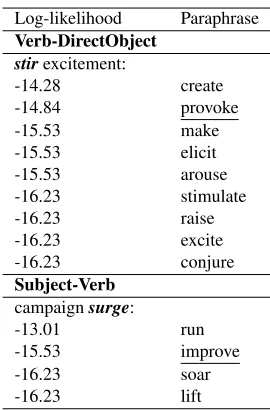
v, or share a common hypernym with it. Follow-ing Shutova, we restrict the hypernym search to a depth of three levels in the taxonomy. Table 1 shows the filtered lists of paraphrases for the expressions “stirexcitement” and “campaignsurged”. The goal of the filter is to discard unrelated paraphrases and thus ensure the meaning retention during paraphras-ing. Note, however, that we define meaning reten-tion broadly, as sharing a set of similar basic prop-erties. Such a broad definition distinguishes our sys-tem from other WordNet-based approaches to lexi-cal substitution (McCarthy and Navigli, 2007) and allows for a transition from metaphorical to literal language, while preserving the original meaning.
3.2.3 SP-based Re-ranking
candi-Log-likelihood Paraphrase Verb-DirectObject
stirexcitement:
-14.28 create
-14.84 provoke
-15.53 make
-15.53 elicit
-15.53 arouse
-16.23 stimulate
-16.23 raise
-16.23 excite
-16.23 conjure
Subject-Verb campaignsurge:
-13.01 run
-15.53 improve
-16.23 soar
[image:5.612.117.252.54.259.2]-16.23 lift
Table 1: The list of paraphrases with the initial ranking
dates for this purpose. Candidates used metaphor-ically are likely to demonstrate semantic preference for the source domain, e.g. soar would select for
birdsorflying devicesas its subject rather than cam-paigns (the target domain), whereas the ones used literally would have a higher preference for the tar-get domain. This is yet another modification of Wilks’ SP violation view of metaphor. Shutova (2010) has previously shown that selecting the para-phrases whose preferences the noun in the context matches best allows to filter out non-literalness, as well as unrelated terms.
As in case of the SPS filter, we automatically acquired selectional preference distributions of the verbs in the paraphrase lists (for verb-subject and verb-direct object relations) from the RASP-parsed BNC. In order to quantify how well a particular ar-gument class fits the verb, we adopted the selectional association measure proposed by Resnik (1993). Se-lectional association is defined as follows:
AR(v, c) =
1 SR(v)
P(c|v) logP(c|v)
P(c) , (5)
whereP(c)is the prior probability of the noun class,
P(c|v)is the posterior probability of the noun class given the verb andSRis the overall selectional
pref-erence strength of the verb in the grammatical rela-tionR.
We use selectional association as a measure of semantic fitness of the paraphrases into the
con-Association Paraphrase Verb-DirectObject
stirexcitement:
0.0696 provoke
0.0245 elicit
0.0194 arouse
0.0061 conjure
0.0028 create
0.0001 stimulate
≈0 raise
≈0 make
≈0 excite
Subject-Verb campaignsurge:
0.0086 improve
0.0009 run
≈0 soar
≈0 lift
Table 2: The list of paraphrases re-ranked using SPs
text, which stands for their literalness. The para-phrases are re-ranked based on their selectional as-sociation with the noun in the context. The incor-rect or metaphorical paraphrases are de-emphasized within this ranking. The new ranking is shown in Table 2. While the model in 3.2.1 selected the can-didate paraphrases that match the context better than all other candidates, the SP model emphasizes the paraphrases that match this particular context better than any other context they may appear in. Shutova’s experiments have shown that the paraphrase in rank 1 (i.e. the verb with which the noun in the context has the highest selectional association) represents a literal interpretation in 81% of all cases. Such a level of accuracy makes Shutova’s method state-of-the-art in metaphor paraphrasing. We now apply it to the task of metaphor identification.
3.3 Reverse Paraphrasing
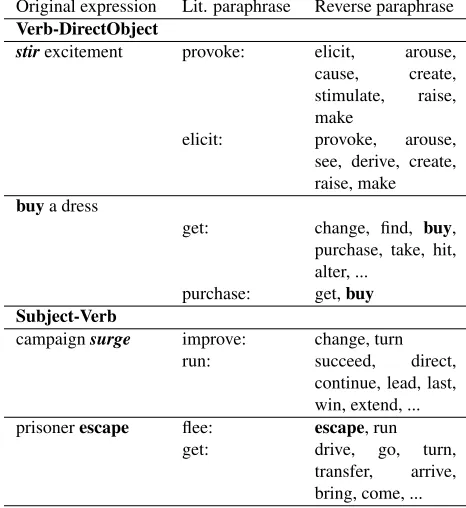
[image:5.612.358.495.55.260.2]Original expression Lit. paraphrase Reverse paraphrase Verb-DirectObject
stirexcitement provoke: elicit, arouse, cause, create, stimulate, raise, make
elicit: provoke, arouse, see, derive, create, raise, make buya dress
get: change, find, buy, purchase, take, hit, alter, ...
purchase: get,buy Subject-Verb
campaignsurge improve: change, turn run: succeed, direct,
continue, lead, last, win, extend, ... prisonerescape flee: escape, run
[image:6.612.70.303.60.314.2]get: drive, go, turn, transfer, arrive, bring, come, ... Table 3: The list of top two literal paraphrases and their reverse paraphrases, as identified by the system
two paraphrases it produces. If this process resulted in retrieving the original expression then the latter was tagged as literal, otherwise it was tagged as metaphorical. Some examples of reverse paraphras-ing results are given in Table 3. One can see from the table that when the metaphorical verbstirin “stir
excitement” is paraphrased as the literal “provoke”, the subsequent paraphrasing of “provoke” does not produce “stir”. In contrast, when the literal expres-sion “buy a dress” is paraphrased as “purchase”, the reverse paraphrasing generates “buy” as one of the candidates, indicating the literalness of the original expression. The same is true for the metaphorical
surgein “campaignsurged” and the literalescapein “the prisoner escaped”.
4 Evaluation and Discussion
4.1 Baseline
The baseline system is the implementation of the se-lectional preference violation view of Wilks (1978) using automatically induced SPs. Such a choice of a baseline allows us to compare our own modifications of the SP violation view to the original approach of Wilks in a computational setting, as well as evaluate the latter on real-world data. Another motivation
be-hind this choice is that the symmetry of reverse para-phrasing can be seen as a kind of “normality” test, in a similar way as the satisfied selectional preferences are in Wilk’s approach. However, we believe that the SP-based reverse paraphrasing method captures significantly more information than SP violations do and thus compare the performance of the two meth-ods in an experimental setting.
The baseline SP classes were created as described above and the preferences were quantified using se-lectional association as a measure. The baseline sys-tem then classified the instances where selectional association of the verb and the noun in the phrase were below a certain threshold, as metaphorical. We determined the optimal threshold by qualitative analysis of the selectional preference distributions of 50 verbs of different frequency and SPS (through the analysis of literally and metaphorically-used argu-ments). The threshold was averaged over individual verbs’ thresholds and equals 0.07 for direct object relations, and 0.09 for subject relations.
4.2 Evaluation Corpus
We evaluated the system and the baseline against the corpus of Shutova and Teufel (2010), that was man-ually annotated for metaphorical expressions. The corpus is a 14,000-word subset of the BNC, with the texts selected to retain the original balance of genre in the BNC itself. The corpus contains ex-tracts from fiction, newspaper text, radio broadcast (transcribed speech), essays and journal articles on politics, social science and literature. Shutova and Teufel (2010) identified 241 metaphorical expres-sions in the corpus, out of which 164 were verbal metaphors.
We parsed the corpus using the RASP parser and extracted subject and direct object relations from its output. Among the direct object relations there were 310 literal phrases and 79 metaphorical ones; and among the subject relations 206 were literal and 67 metaphorical. This constitutes a dataset of 662 rela-tions for the systems to classify.
4.3 Results and Discussion
Relation BslnP SystemP BslnR SystemR
Verb-DObj 0.20 0.69 0.52 0.63
Verb-Subj 0.13 0.66 0.59 0.70
Average 0.17 0.68 0.55 0.66
Table 4: Baseline and system performance by relation
the ones that were tagged by the system. Recall,
R, measures the proportion of metaphorical expres-sions that were identified out of all metaphorical ex-pressions in the gold standard corpus. The system
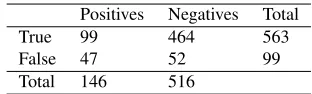
P = 0.68andR = 0.66, whereas the baseline only attains P = 0.17 andR = 0.55. System perfor-mance by relation is shown in Table 4. The hu-man ceiling for this task, according to the annotation experiments of Shutova and Teufel (2010) approxi-mates to P = 0.80. Figure 1 shows example sen-tences with metaphors identified and paraphrased by the system. Table 5 provides a breakdown of the an-notated instances into true / false positives and true / false negatives. As one can see from the table, the systems can accurately annotate both metaphorical and literal expressions, providing a balance between precision and recall.
The system outperforms the baseline for both verb-subject and verb-direct object constructions. Its performance is also close to the previous metaphor identification systems of Turney et al. (2011) (accuracy of 0.73) and Shutova et al. (2010) (precision of 0.79), however, the results are not di-rectly comparable due to different experimental set-tings. Our method has a strong advantage over the system of Shutova et al. (2010) in terms of cover-age: the latter system heavily relied on manually an-notated seed metaphors which limited its applicabil-ity in unrestricted text to the set of topics covered by the seeds. As opposed to this, our method is domain-independent and can be applied to any data. Shutova et al. (2010) have not measured the recall of their system, however indicated its possible coverage lim-itations.
In addition, our system produces paraphrases for the identified metaphorical expressions. Since the identification is directly dependent on the quality of literal paraphrasing, the majority of the inter-pretations the system provided for the identified metaphors appear to be correct. However, we found a few instances where, despite the correct initial paraphrasing, the system was not able to identify
FYT Gorbachevinheriteda Soviet state which was, in a celebrated Stalinist formulation, national in form but socialist in content.
Paraphrase: Gorbachev received a Soviet state which was, in a celebrated Stalinist formulation, national in form but socialist in content.
CEK The Clinton campaignsurgedagain and he easily won the Democratic nomination.
Paraphrase: The Clinton campaign improved again and he easily won the Democratic nomination.
CEK Their viewsreflecta lack of enthusiasm among the British people at large for John Major ’s idea of Eu-ropean unity.
Paraphrase: Their views show a lack of enthusiasm among the British people at large for John Major ’s idea of European unity.
J85 [..] the reasons for this superiority are neverspelled out.
Paraphrase [..] the reasons for this superiority are never specified.
J85 Anyone who has introduced speech act theory to students will know that these technical terms are not at all easy tograsp.
Paraphrase: Anyone who has introduced speech act the-ory to students will know that these technical terms are not at all easy to understand.
G0N The man’s voicecut in.
Paraphrase: The man’s voice interrupted.
Figure 1: Metaphors tagged by the system (in bold) and their paraphrases
the metaphor, usually in case of highly convention-alized metaphorical expressions. Overall, the most frequent system errors fall into the following cate-gories:
Errors due to incorrect parsing: The system failed to discover some of the metaphorical expressions in the corpus since their grammatical relations were missed by the parser. In addition, some of the in-stances were misclassified, e.g. “pounds paid to [...]” or “change was greatlyaccelerated” were la-beled as subject relations. Overall, the parser missed 9 metaphorical expressions.
Positives Negatives Total
True 99 464 563
False 47 52 99
[image:8.612.106.262.56.103.2]Total 146 516
Table 5: System tagging statistics
cases where the system could not generate any para-phrase (usually for literal expressions, e.g. “play an anthem”).
Errors due to metaphorical paraphrasing: Some of the system errors are due to metaphorical para-phrasing. For example, the metaphorical expression “mend marriage” was paraphrased as “repair mar-riage”, which is also used metaphorically. And re-pairin return generatedmend, when paraphrased in reverse. Errors of this type have been mainly trig-gered by the WordNet filter, and the fact that some metaphorical senses are included in WordNet.
Errors due to metaphor conventionality: a num-ber of conventional metaphors were missed by the system, since the original verb was retrieved due to its conventionality. Such examples include “impose
a decision”, “put the issue forward”, “lead a life”. Such cases suggest that the system is better suited to identify more creative, novel metaphors.
Cases of metonymy: a few cases of gen-eral metonymy were annotated by the system as metaphorical, e.g. “shout support”, which stands for “shout the words of support”, and “humiliate a mo-ment”, that is likely to mean “humiliate the event of the moment”. However, there were only 4 errors of this type in the data.
Baseline Errors: The output of the baseline exhib-ited two main types of error. The first stemmed from the conventionality of many metaphorical expres-sions, which resulted in their literal annotation. Con-ventionality leads to high selectional association for verbs with their metaphorical arguments, e.g. em-bracehas{view, ideology, conceptionetc.}class as its top ranked direct object argument with the selec-tional association of 0.18. The second type of error was the system selecting many language anomalies that violate selectional preferences and tagging these as metaphors. This resulted in a high number of false positives.
5 Conclusions and Future Directions
Previous research on metaphor addressed a num-ber of its aspects using both symbolic and statisti-cal techniques. While some of this work met with success with respect to precision in metaphor an-notation, the methods often focused on a limited domain and needed manually-labeled training data. Their dependence on manually annotated training data made the systems hard to scale. As a result, many of these systems are not directly applicable to aid real-world NLP due to their limited coverage. In contrast, our method does not require any manually-labeled data, which makes it more robust and appli-cable to a wide range of genres. It is also the first one to perform accurate metaphor identification and interpretation in one step, as opposed to the previ-ous systems focusing on one part of the task only. It identifies metaphor with a precision of 68% and a recall of 66%, which is a very encouraging result. We believe that this work has important implications for computational modeling of metaphor, and is rel-evant to a range of other semantic tasks within NLP. Although we have so far tested our system on verb-subject and verb-object metaphors only, we be-lieve that the described identification and paraphras-ing techniques can be similarly applied to a wider range of syntactic constructions. Extending the sys-tem to deal with more parts of speech and types of phrases (e.g. nominal and adjectival metaphors) is part of our future work.
Acknowledgments
This work was supported by the ICSI MetaNet project (grant number W911NF-12-C-0022). Many thanks to Srini Narayanan, Eve Sweetser and Jerry Feldman for their advice and feedback.
References
Rodrigo Agerri, John Barnden, Mark Lee, and Alan Wallington. 2007. Metaphor, inference and domain-independent mappings. In Proceedings of RANLP-2007, pages 17–23, Borovets, Bulgaria.
Rodrigo Agerri. 2008. Metaphor in textual entailment. InProceedings of COLING 2008, pages 3–6, Manch-ester, UK.
Oistein Andersen, Julien Nioche, Ted Briscoe, and John Carroll. 2008. The BNC parsed with RASP4UIMA. In Proceedings of LREC 2008, pages 865–869, Mar-rakech, Morocco.
John Barnden and Mark Lee. 2002. An artificial intel-ligence approach to metaphor understanding. Theoria et Historia Scientiarum, 6(1):399–412.
Julia Birke and Anoop Sarkar. 2006. A clustering ap-proach for the nearly unsupervised recognition of non-literal language. InIn Proceedings of EACL-06, pages 329–336.
Ted Briscoe, John Carroll, and Rebecca Watson. 2006. The second release of the rasp system. In Proceed-ings of the COLING/ACL on Interactive presentation sessions, pages 77–80.
Lou Burnard. 2007. Reference Guide for the British Na-tional Corpus (XML Edition).
Lynne Cameron. 2003. Metaphor in Educational Dis-course. Continuum, London.
Seana Coulson. 2008. Metaphor comprehension and the brain. In R.W. Gibbs, editor,Metaphor and Thought, Cambridge. Cambridge University Press.
Diego De Cao and Roberto Basili. 2009. Combining dis-tributional and paradigmatic information in a lexical substitution task. InProceedings of EVALITA work-shop, 11th Congress of Italian Association for Artifi-cial Intelligence.
Katrin Erk and Sebastian Pad´o. 2008. A structured vector space model for word meaning in context. In
Proceedings of the Conference on Empirical Meth-ods in Natural Language Processing, pages 897–906, Waikiki, Hawaii, USA.
Katrin Erk and Sebastian Pad´o. 2009. Paraphrase as-sessment in structured vector space: exploring param-eters and datasets. InProceedings of the Workshop on Geometrical Models of Natural Language Semantics,
pages 57–65. Association for Computational Linguis-tics.
Dan Fass. 1991. met*: A method for discriminating metonymy and metaphor by computer.Computational Linguistics, 17(1):49–90.
Jerome Feldman and Srini Narayanan. 2004. Embodied meaning in a neural theory of language. Brain and Language, 89(2):385–392.
Christiane Fellbaum, editor. 1998. WordNet: An Elec-tronic Lexical Database (ISBN: 0-262-06197-X). MIT Press, first edition.
Matt Gedigian, John Bryant, Srini Narayanan, and Bran-imir Ciric. 2006. Catching metaphors. InIn Proceed-ings of the 3rd Workshop on Scalable Natural Lan-guage Understanding, pages 41–48, New York. Raymond W. Gibbs and Herbert L. Colston. 2012.
In-terpreting Figurative Meaning. Cambridge University Press.
Paul Kingsbury and Martha Palmer. 2002. From TreeBank to PropBank. In Proceedings of LREC-2002, pages 1989–1993, Gran Canaria, Canary Is-lands, Spain.
Saisuresh Krishnakumaran and Xiaojin Zhu. 2007. Hunting elusive metaphors using lexical resources. In Proceedings of the Workshop on Computational Approaches to Figurative Language, pages 13–20, Rochester, NY.
George Lakoff and Mark Johnson. 1980. Metaphors We Live By. University of Chicago Press, Chicago. James Martin. 1990. A Computational Model of
Metaphor Interpretation. Academic Press Profes-sional, Inc., San Diego, CA, USA.
James Martin. 2006. A corpus-based analysis of con-text effects on metaphor comprehension. In A. Ste-fanowitsch and S. T. Gries, editors,Corpus-Based Ap-proaches to Metaphor and Metonymy, Berlin. Mouton de Gruyter.
Zachary Mason. 2004. Cormet: a computational, corpus-based conventional metaphor extraction sys-tem. Computational Linguistics, 30(1):23–44. Diana McCarthy and Roberto Navigli. 2007.
Semeval-2007 task 10: English lexical substitution task. In Pro-ceedings of the 4th workshop on Semantic Evaluations (SemEval-2007), pages 48–53.
Diana McCarthy, Bill Keller, and Roberto Navigli. 2010. Getting synonym candidates from raw data in the en-glish lexical substitution task. In Proceedings of the 14th EURALEX International Congress, Leeuwarden, The Netherlands.
Srini Narayanan. 1999. Moving right along: A compu-tational model of metaphoric reasoning about events. InProceedings of AAAI 99), pages 121–128, Orlando, Florida.
Dario Pucci, Marco Baroni, Franco Cutugno, and Alessandro Lenci. 2009. Unsupervised lexical sub-stitution with a word space model. InProceedings of EVALITA workshop, 11th Congress of Italian Associ-ation for Artificial Intelligence.
Philip Resnik. 1993. Selection and Information: A Class-based Approach to Lexical Relationships. Ph.D. thesis, Philadelphia, PA, USA.
Ekaterina Shutova and Simone Teufel. 2010. Metaphor corpus annotated for source - target domain map-pings. In Proceedings of LREC 2010, pages 3255– 3261, Malta.
Ekaterina Shutova, Lin Sun, and Anna Korhonen. 2010. Metaphor identification using verb and noun cluster-ing. InProceedings of Coling 2010, pages 1002–1010, Beijing, China.
Ekaterina Shutova, Simone Teufel, and Anna Korhonen. 2012a. Statistical Metaphor Processing. Computa-tional Linguistics, 39(2).
Ekaterina Shutova, Tim Van de Cruys, and Anna Korho-nen. 2012b. Unsupervised metaphor paraphrasing us-ing a vector space model. InProceedings of COLING 2012, Mumbai, India.
Ekaterina Shutova. 2010. Automatic metaphor inter-pretation as a paraphrasing task. In Proceedings of NAACL 2010, pages 1029–1037, Los Angeles, USA. Gerard J. Steen, Aletta G. Dorst, J. Berenike Herrmann,
Anna A. Kaal, Tina Krennmayr, and Trijntje Pasma. 2010. A method for linguistic metaphor identifica-tion: From MIP to MIPVU. John Benjamins, Ams-terdam/Philadelphia.
Lin Sun and Anna Korhonen. 2009. Improving verb clustering with automatically acquired selectional preferences. In Proceedings of EMNLP 2009, pages 638–647, Singapore, August.
Paul H. Thibodeau and Lera Boroditsky. 2011. Metaphors we think with: The role of metaphor in rea-soning.PLoS ONE, 6(2):e16782, 02.
Peter D. Turney, Yair Neuman, Dan Assaf, and Yohai Cohen. 2011. Literal and metaphorical sense iden-tification through concrete and abstract context. In
Proceedings of the Conference on Empirical Meth-ods in Natural Language Processing, EMNLP ’11, pages 680–690, Stroudsburg, PA, USA. Association for Computational Linguistics.
Akira Utsumi. 2011. Computational exploration of metaphor comprehension processes using a semantic space model. Cognitive Science, 35(2):251–296.
Yorick Wilks. 1975. A preferential pattern-seeking se-mantics for natural language inference. Artificial In-telligence, 6:53–74.
Yorick Wilks. 1978. Making preferences more active.