Original Article
The impact of recombinant human growth hormone on
growth and development of low weight
premature infants
Weibin Qi1, Qiong Shen2, Yanxia Qiao1, Zhisu Wei1, Yanmin Wei1, Tao Fan1
1Department of Neonatology, The Fourth Hospital of Shijiazhuang City, Shijiazhuang 050011, Heibei, China; 2Department of Obstetrics and Gynecology, Armed Police Corps Hospital in Hebei, Shijiazhuang 050000, Heibei,
China
Received September 21, 2015; Accepted January 15, 2016; Epub February 15, 2016; Published February 29, 2016
Abstract: Recombinant human growth hormone (rHGH) shows remarkable curative effect on premature infants’ growth and development. This study analyzed the effect of rHGH on low weight premature infants. Premature in-fants delivered in our hospital were selected. Enzyme-linked immunosorbent assay was used to test the growth and development related indicators, insulin-like growth factor 1 (IGF-1), insulin-like growth factor binding protein 3 (IGFBP-3), IGF-1/IGFBP-3, and fasting glucose. Adverse reactions were observed. After 6 months’ treatment, body weight (10.4 ± 0.5 kg), length (68.1 ± 2.4 cm), and head circumference (35.8 ± 2.2 cm) in experimental group were
significantly higher than that in control, at birth, and treatment for 3 months, respectively (P < 0.05). Experimental
group performed higher body mass increasing speed, head circumference increasing speed, and length
increas-ing speed, shorter reachincreas-ing adequate feedincreas-ing time through the mouth, and lower EUGR incidence (P < 0.05). After
the treatment for 6 months, experimental group presented higher serum IGF-1 (184.2 ± 152.3 ng/mL), IGFBP-3 (5.4 ± 1.7 ng/mL), and IGF-1/IGFBP-3 (36.4 ± 4.5 ng/ml) levels than the control group, at birth, and treatment for
3 months, respectively (P < 0.05). Fasting glucose (5.23 ± 2.3 mmol/L) was obviously higher in the experimental group (P < 0.05). Four cases appeared local skin reactions (13.3%) and self-relieved. Recombinant human growth
hormone could safely promote low weight premature infants growth.
Keywords: Recombinant human growth hormone, low weight premature infant, growth and development, IGF-1, IGFBP-3
Introduction
With the development of the gynecology and neonatal medical innovation and technology, which include maternal pregnant examination and treatment, neonatal intensive care,
treat-ment of related diseases has been significant
improved. Though the premature infant’s quali-ty of life has been elevated obviously, it remains a hotspot to better solve the problem of prema-ture infant’s growth and development [1]. Since premature infants abnormally leave the mother earlier, the organ function and metabolic sys-tem have not yet matured. Accordingly, prema-ture infant faces up with the challenge of great nutrition burden for the growth and develop-ment [2]. British nutritionist Lucas proposed
that infants and young children suffered from a critical period of growth and development, and
good nutrition status had a lifelong influence on
the organ system function [3]. Generally, short of hormones and nutrients exist in premature infants. Hypothalamus or pituitary dysfunction decreases growth hormone synthesis or
secre-tion significantly, and even changes growth hor
-mone structure, leading to the body growth and development retardation. It also results in short stature, metabolic disorder, important organ and system dysfunction that seriously affect quality of life [4]. Recombinant human growth hormone (rHGH) is produced by genetic
engi-neering technology, and its application signifi
matura-tion and protein synthesis of preterm infants. Its wide use in the treatment of premature
growth hormone deficiency proved no side
effect that causes puberty and bone mature ahead of time in the growth process [5, 6]. Our study aims to evaluate the role of rHGH on the growth and development of premature infants or low birth weight infants, which may provide a future basis for the rational preparation of hor-mone therapy.
Materials and methods
General information
Sixty cases of premature infants delivered in The Fourth Hospital of Shijiazhuang City from Jan 2014 to Jan 2015 were enrolled. The sub-jects were divided into two groups: 30 cases in experimental group with 18 males and 12 females, and 30 cases in control with 16 males and 14 females. No statistical difference was observed in gender, gestational age, and weight between the two groups (P > 0.05) (Table 1).
Inclusion criteria: gestational age ≤ 32 weeks, weight ≤ 1800 g, length of stays > 14 d, and
the infants reached adequate feeding through mouth at discharge.
Exclusion criteria: congenital digestive tract malformation; severe liver and kidney dysfunc-tion; hereditary metabolic disease.
Therapeutic method
The infants in two groups were given oxygen
inhalation, intravenous fluids, heat preserva
-tion, and diet guidance. Experimental group received recombinant human growth hormone (Shanghai Unilab biological engineering co., LTD., batch number: 20140748) at 0.1 U/kg once-daily via subcutaneous injection for 6 months, while the control group received no drug therapy.
Observation indicator
Growth and development related indicator detection: Infant’s weight at birth, treatment for 3 months, and treatment for 6 months were measured accurate to 10 g. Measurement bed was applied to test infant’s length accurate to 0.1 cm. Infant’s head circumference was mea-sured by tape accurate to 0.1 cm. Weight
descent range, weight increase speed, head circumference increase speed, length increase speed, time of restore weight at birth, time to adequate oral feeding, and extra uterine growth retardation (EUGR) incidence were observed and compared.
Insulin-like growth factor 1 (IGF-1), insulin-like growth factor binding protein 3 (IGFBP-3), and IGF-1/IGFBP-3 detection: Peripheral blood was extracted at birth, 3 months after treatment, and 6 months after treatment and centrifuged at 3000 r/min to separate serum. The superna-tant was isolated and stored at -85°C.
Enzyme-linked immunosorbent assay (ELISA) was applied to test serum IGF-1 and IGFBP-3 levels. The ELISA kit was bought from Shanghai west tang biological technology development Co., LTD. 0.75 mL ddH2O was added to the bot-tle containing different amount of samples. 40 mL dense washing liquid was added into 960 ml ddH2O to prepare the washing liquid. 600 μL
Tracer was added to 12 ml CRP biotin to pre-pare incubation buffer. The microplate coated by streptavidin was washed by washed by
washing buffer. 25 μL standard substance or
sample was added to each hole together with
100 μL incubation buffer per hole. After vibrat
-ed at room temperature for 1 h, the plate was washed by washing buffer for six times. The
plate was added with 100 μL substrate and
vibrated at room temperature for 30 min. And
then, the plate was added with 100 μL stop
buffer and vibrated at room temperature for 1 min. Absorbance of plate (OD) was read at microplate reader at 405 nm to calculate IGF-1 and IGFBP-3 concentration.
Fasting blood-glucose detection: Fasting blood was extracted at birth, 3 months after treat-ment, and 6 months after treatment. Glucose oxidase method was used to test blood glucose (Sangon, Shanghai).
Adverse reaction comparison: Adverse reaction in two groups were observed, including skin irri-tation, rashes, liver and kidney function dam-age, hypothyroidism, systemic hypersensitivity, and scoliosis.
Data analysis
data was presented as mean ± standard devia-tion (_x ± s). T test and chi-square test were
used for data comparison. P < 0.05 was consid
-ered as statistically significant.
3 months treatment (P < 0.05). Control group
show-ed no statistical difference between 3 months and 6 months (P > 0.05), while they were both
[image:3.612.89.388.86.323.2]higher than at birth (P < 0.05) (Table 3).
Table 1. General information comparison
Item Experimen-tal group Control group valueP
Cases 30 30
Gender (male/female) 18/12 16/14 > 0.05
Gestational age (weeks) 30.5 ± 1.3 30.4 ± 1.2 > 0.05 Weight at birth (kg) 1.5 ± 0.3 1.3 ± 0.2 > 0.05 Head circumference (cm) 26.1 ± 1.1 26.8 ± 1.1 > 0.05
Height (cm) 42.3 ± 2.3 41.8 ± 2.4 > 0.05
Singletons premature infant 22 (73.3) 21 (70) > 0.05 Twins premature infant 6 (20) 5 (16.7) > 0.05 Multiple gestation 2 (6.7) 4 (13.3) > 0.05
Intrauterine infection (n%) 13 (43.3) 14 (46.7) > 0.05 Simple premature infant 26 (86.7) 25 (83.3) > 0.05 Hypoxic ischemic encephalopathy 2 (6.7) 3 (10) > 0.05
Amniotic fluid inhalation syndrome 2 (6.7) 2 (6.7) > 0.05
Neonatal asphyxia (n%) 5 (16.7) 6 (20) > 0.05
Neonatal respiratory distress syndrome (n%) 18 (60) 19 (63.3) > 0.05
Neonatal necrotizing colitis (n%) 9 (30) 8 (23.3) > 0.05
Table 2. Growth related indicators comparison
Item Experimental group Control group
Cases 30 30
Body mass (kg)
At birth 1.5 ± 0.3 1.3 ± 0.2
3 months’ treatment 4.1 ± 0.4 3.3 ± 0.2
6 months’ treatment 10.4 ± 0.5* 6.2 ± 0.4
Length (cm)
At birth 42.30 ± 2.30 41.8 ± 2.4
3 months’ treatment 60.2 ± 2.3 53.2 ± 2.1 6 months’ treatment 68.1 ± 2.4* 62.2 ± 1.7
Head circumference (cm)
At birth 30.1 ± 1.6 29.8 ± 1.6
3 months’ treatment 33.4 ± 2.1 31.4 ± 1.8 6 months’ treatment 45.8 ± 2.2* 33.0 ± 2.0
Body mass increasing speed (g/kg/d) 2.3 ± 0.2* 1.4 ± 0.9
Head circumference increasing speed (cm/week) 0.7 ± 0.4* 0.4 ± 0.1
Length increasing speed (cm/week) 1.2 ± 0.2* 0.9 ± 0.1
Time of restore weight at birth (d) 5 (3)* 9 (1)
Reaching adequate feeding time (d) 20 (8)* 25 (9)
EUGR incidence (n%) 11 (36.7)* 18 (60) *P < 0.05, compared with control.
Results
Growth related indicators detection
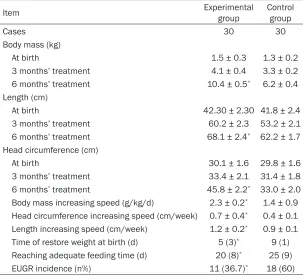
Growth related indicators between two groups were compared, including wei- ght, length, head circumfer-ence, body mass descend range, body mass increas-ing speed, head circumfer-ence increasing speed, length increasing speed, time of restore weight at birth, reaching adequate feeding time, and EUGR
incidence. No significant
difference in weight, length, and head circumference between two groups was observed (P > 0.05). After 6 months treatment, body weight, length, and head circumference in
experi-mental group were signifi
-cantly higher than that in control, at birth, and 3 months’ treatment,
respec-tively (P < 0.05).
Experime-ntal group presented high-er body mass increasing speed, head circumferen- ce increasing speed, and length increasing speed, shorter reaching adequate feeding time through the mouth, extended time of restore weight at birth, and
lower EUGR incidence (P <
0.05) (Table 2).
IGF-1, IGFBP-3, and IGF-1/ IGFBP-3 levels comparison
[image:3.612.87.390.358.636.2]Adverse reaction comparison
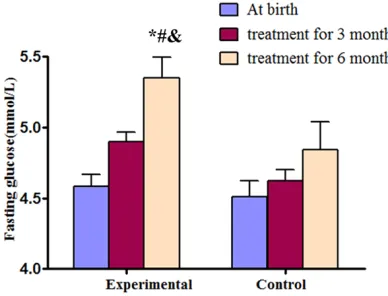
Fasting glucose monitor result showed that
there was no significant difference between
two groups at birth (P > 0.05). However, after 6 months’ treatment, the level in experimental group was obviously higher than that in control,
at birth, and 3 months’ treatment (P < 0.05)
(Figure 1). Four cases appeared local skin
irri-tation and rashes (13.3%), and they were
self-relieved without treatment. No severe hypothy-roidism, systemic anaphylaxis, or scoliosis hap-pened during the treatment process.
Discussion
Preterm is a major cause of neonatal cripple that seriously affects infant’s life and health, which easily inclines to cause physical and mental development disorder [7]. American
scholar RH Clark defined EUGR as growth
parameter including weight, length, and head
circumference lower more than 10% of the
same gestational age at birth, which was rela-tive to the intrauterine growth retardation [8]. It has been demonstrated that Preterm infant’s
growth is influenced by a variety of important
factors, which consist of economic level, living environment, parents’ educational level, family feeding way, health care, and heredity [9, 10]. In this study, we selected low weight premature infants in our hospital as the research object. After the continuous treatment of 0.1 U/kg recombinant human growth hormone for 6 months, the body mass, length, and head
cir-cumference levels were significantly higher
than the control group, at birth, and treatment for 3 months. Meanwhile, the increasing speed of body mass, head circumference, and length were also accelerated, while the time for ade-quate feeding was shortened, and EUGR inci-dence was reduced, suggesting that rHGH played a favorable role in maturation. Prema- ture infants may appear growth speed lower than the term infant after birth for a period of time. However, growth potential still anchored
for premature infants within their first six
months, which facilitates them to catch up with the body development of term infant [11]. Growth hormone is a type of single polypeptide containing 191 amino acids. It weighted in 22 kD, is synthesized, stored and secreted by growth hormone cells that locate in pituitary side ring [12]. Research indicated that serum growth hormone level in premature was lower than that in the term infants. It was reported that supplement of recombinant human grow- th hormone could promote premature to grow 10-12 cm in height per year [13]. Clinical trials received satisfactory effect of recombinant human growth hormone in treating premature infant’s growth retardation [14]. Exogenous recombinant human growth hormone can stim-ulate proliferation and differentiation of bone marrow cartilage cell, promote bone growth, and improve height growth speed [15].
[image:4.612.88.305.96.291.2]We detected serum IGF-1, IGBP-3, and IGF-1/ IGFBP-3 levels in premature at birth, treatment Table 3. Serum IGF-1, IGFBP-3, and IGF-1/IGFBP-3
comparison
Item Experimental group Control group
Cases 30 30
IGF-1 (ng/ml)
At birth 39.2 ± 33.4 38.7 ± 34.2 3 months’ treatment 124.8 ± 84.3*,# 47.2 ± 37.1#
6 months’ treatment 184.2 ± 152.3*,#,& 59.7 ± 55.3#
IGFBP-3 (ng/ml)
At birth 2.4 ± 0.5 2.3 ± 0.4 3 months’ treatment 4.6 ± 0.9*,# 2.7 ± 0.6#
6 months’ treatment 5.4 ± 1.7*,#,& 3.8 ± 0.9#
IGF-1/IGFBP-3
At birth 16.2 ± 2.1 16.9 ± 2.3 3 months’ treatment 21.3 ± 3.3*,# 17.2 ± 2.4#
6 months’ treatment 36.4 ± 4.5*,#,& 18.7 ± 2.7# *P < 0.05, compared with control; #P < 0.05, compared with at birth; &P < 0.05, compared with 3 months’ treatment.
Figure 1. Fasting glucose comparison. *P < 0.05, compared with control; #P < 0.05, compared with at birth; &P < 0.05, compared with treatment for 3
[image:4.612.90.284.342.490.2]for 3 months, and 6 months, and found that experimental group after 6 months’ treatment presented higher serum IGF-1, IGFBP-3, and IGF-1/IGFBP-3 levels, implying that rHGH pro-motes IGF-1 and IGBP-3 secretion. IGF-1 and IGBP-3 are the key regulatory factors for infa- nt’s growth and development. IGF-1, as a kind of biological active peptide, shares the similar-ity in structure and function to insulin, and is mainly involved in embryo differentiation and closely related to growth and development through regulating glucose, fat and protein
metabolism [16]. Research showed that defi
-ciency of IGF-1 may restrict the tissue growth
only up to 30% of normal levels [17]. IGF-1 bind
-ing with IGFBP-3 regulates growth and develop-ment through the involvedevelop-ment in GHRH-GH-IGF endocritic axis [18]. Besides, recent evidences unraveled that recombinant growth hormone stimulated the production of IGF-1 in liver, resulting in cell growth and differentiation. Recombinant growth hormone elevates fasting glucose, and participates in glycometabolism through activating gluconeogenesis enzyme to reduce glucose utilization rate. Additionally, recombinant human growth hormone shows low incidence of adverse reactions mainly in hypothyroidism, water retention, intracranial hypertension, scoliosis, decreased insulin sen-sitivity, and secondary tumors, etc. Findings also indicated that no risk of type I diabetes and malignant tumor had been increased dur-ing the rHGH therapy [19]. In this study, fastdur-ing glucose level after 6 months’ treatment was obviously higher than that in control, at birth, and treatment for 3 months. No severe hypo-thyroidism, systemic anaphylaxis, or scoliosis happened during the treatment process, in spit of 4 mild adverse cases. Similarly, previous studies also showed that rHGH promoted bone growth with no obvious adverse reaction after 4 years of follow-up [20]. Our data indicated that rHGH has therapeutic function on the pre-mature growth recovery with good tolerance and less adverse reaction.
To sum up, recombinant human growth hor-mone improves the development of low weight premature infants by increasing their weight, length, and head circumference within a short period of time. It induces the rise of IGF-1 and IGFBP-3 secretion to regulate the body’s endo-crine and metabolic state without severe
adverse reactions, which shows promising clini-cal popularization and application in the future. Disclosure of conflict of interest
None.
Address correspondence to: Dr. Qiong Shen, De- partment of Obstetrics and Gynecology, Armed Police Corps Hospital in Hebei, No. 130, West Road, Shijiazhuang 050000, Heibei, China. Tel: +86-0311-83626303; Fax: +86-0311-+86-0311-83626303; E-mail: [email protected]
References
[1] Field T, Diego M, Hernandez-Reif M. Potential underlying mechanisms for greater weight gain in massaged preterm infants. Infant Behav Dev 2011; 34: 383-389.
[2] Rosenbloom AL. Idiopathic short stature:
co-nundrums of definition and treatment. Int J
Pediatr Endocrinol 2009; 2009: 470378. [3] Lucas A, Fewtrell MS, Davies PS, Bishop NJ,
Clough H, Cole TJ. Breastfeeding and catch-up growth in infants born small for gestational age. Acta Paediatr 1997; 86: 564-569. [4] Wood CL, Tinnion RJ, Korada SM, Cheetham
TD, Relton CL, Cooke RJ, Pearce MS, Hollingsworth KG, Trenell MI, Embleton ND. Growth and metabolic outcome in adolescents born preterm (GROWMORE): follow-up protocol for the Newcastle Preterm Birth GRowth study (PTBGS). BMC Pediatr 2013; 13: 213.
[5] Goulet O, Dabbas-Tyan M, Talbotec C, Kapel N, Rosilio M, Souberbielle JC, Corriol O, Ricour C, Colomb V. Effect of recombinant human growth hormone on intestinal absorption and body composition in children with short bowel syn-drome. JPEN J Parenter Enteral Nutr 2010; 34: 513-520.
[6] Kristrom B, Dahlgren J, Niklasson A, Nierop AF,
Albertsson-Wikland K. The first-year growth re -sponse to growth hormone treatment predicts the long-term prepubertal growth response in children. BMC Med Inform Decis Mak 2009; 9: 1.
[7] De Curtis M, Rigo J. The nutrition of preterm infants. Early Hum Dev 2012; 88 Suppl 1: S5-7.
[8] Wasserstein MP, Larkin AE, Glass RB, Schuchman EH, Desnick RJ, McGovern MM. Growth restriction in children with type B Niemann-Pick disease. J Pediatr 2003; 142: 424-428.
Lapillonne A, Mihatsch W, Moreno L, Neu J, Poindexter B, Puntis J, Putet G, Rigo J, Riskin A, Salle B, Sauer P, Shamir R, Szajewska H, Thureen P, Turck D, van Goudoever JB, Ziegler EE; ESPGHAN Committee on Nutrition. Enteral nutrient supply for preterm infants: commen-tary from the European Society of Paediatric Gastroenterology, Hepatology and Nutrition Committee on Nutrition. J Pediatr Gastroenterol Nutr 2010; 50: 85-91.
[10] Maastrup R, Hansen BM, Kronborg H, Bojesen SN, Hallum K, Frandsen A, Kyhnaeb A, Svarer I, Hallstrom I. Factors associated with exclusive breastfeeding of preterm infants. Results from a prospective national cohort study. PLoS One 2014; 9: e89077.
[11] Senterre T, Rigo J. [Recent advances in nutri-tional support and postnatal growth in prema-ture infants]. Rev Med Liege 2013; 68: 79-85. [12] Ueland T, Olarescu NC, Jorgensen AP, Otterdal
K, Aukrust P, Godang K, Lekva T, Bollerslev J. Increased serum and bone matrix levels of the secreted Wnt antagonist DKK-1 in patients
with growth hormone deficiency in response to
growth hormone treatment. J Clin Endocrinol Metab 2015; 100: 736-743.
[13] Albertsson-Wikland K, Aronson AS, Gustafsson J, Hagenas L, Ivarsson SA, Jonsson B, Kristrom B, Marcus C, Nilsson KO, Ritzen EM, Tuvemo T, Westphal O, Aman J. Dose-dependent effect of
growth hormone on final height in children with short stature without growth hormone defi -ciency. J Clin Endocrinol Metab 2008; 93: 4342-4350.
[14] Ilias C, Evgenia B, Aikaterini P, Asimina GT, Constantina S, Maria L, George M, Paraskevi K, Christos T, Zissis M, Nikolaos N. Netherton Syndrome in a Neonate with Possible Growth
Hormone Deficiency and Transient
Hyperal-dosteronism. Case Rep Pediatr 2015; 2015: 818961.
[15] Ranke MB, Lindberg A. Predicting growth in re-sponse to growth hormone treatment. Growth Horm IGF Res 2009; 19: 1-11.
[16] Karamizadeh ZM, Ilkhanipoor HM, Bagheri FM. Effect of Growth Hormone treatment on Height Velocity of Children with Pycnodysotosis. Iran J Pediatr 2014; 24: 161-165.
[17] Albertsson-Wikland K. Growth hormone thera-py needs to be tailored based on individual re-sponsiveness in children with idiopathic short stature. J Pediatr 2011; 159: 516.
[18] Benito-Sanz S, Barroso E, Heine-Suner D, Hisado-Oliva A, Romanelli V, Rosell J, Aragones A, Caimari M, Argente J, Ross JL, Zinn AR, Gracia R, Lapunzina P, Campos-Barros A, Heath KE. Clinical and molecular evaluation of SHOX/PAR1 duplications in Leri-Weill dyschon-drosteosis (LWD) and idiopathic short stature (ISS). J Clin Endocrinol Metab 2011; 96: E404-412.
[19] Bakker B, Frane J, Anhalt H, Lippe B, Rosenfeld RG. Height velocity targets from the national
cooperative growth study for first-year growth
hormone responses in short children. J Clin Endocrinol Metab 2008; 93: 352-357.