Analyzing the Impact of Spelling Errors
on POS-Tagging and Chunking in Learner English
Tomoya Mizumoto1 and Ryo Nagata2 1 1RIKEN Center for Advanced Intelligence Project
2 Konan University
[email protected], nagata-ijcnlp @hyogo-u.ac.jp
Abstract
Part-of-speech (POS) tagging and chunk-ing have been used in tasks targetchunk-ing learner English; however, to the best our knowledge, few studies have eval-uated their performance and no stud-ies have revealed the causes of POS-tagging/chunking errors in detail. There-fore, we investigate performance and an-alyze the causes of failure. We focus on spelling errors that occur frequently in learner English. We demonstrate that spelling errors reduced POS-tagging pformance by 0.23% owing to spelling er-rors, and that a spell checker is not neces-sary for POS-tagging/chunking of learner English.
1 Introduction
Part-of-speech (POS) tagging and chunking have been essential components of Natural Language Processing (NLP) techniques that target learner English, such as grammatical error correction and automated essay scoring. In addition, they are fre-quently used to extract linguistic features relevant to the given task. For example, in the CoNLL-2014 Shared Task (Ng et al.,2014), 10 of the 12 teams used one or both POS-tagging and chunk-ing to extract features for grammatical error cor-rection.
They have also been used for linguistic analy-sis of learner English, particularly in corpus-based studies. Aarts and Granger(1998) explored char-acteristic POS patterns in learner English. Nagata and Whittaker (2013) demonstrated that POS se-quences obtained by POS-tagging can be used to distinguish between mother tongue interferences effectively.
The heavy dependence on POS-tagging and chunking suggests that failures could degrade the performance of NLP systems and linguistic analy-ses (Han et al., 2006;Sukkarieh and Blackmore,
2009). For example, failure to recognize noun phrases in a sentence could lead to failure in cor-recting related errors in article use and noun num-ber. More importantly, such failures make it more difficult to simply count the number of POSs and chunks, thereby causing inaccurate estimates of their distributions. Note that such estimates are of-ten employed in linguistic analysis, including the above-mentioned studies.
Despite its importance in related tasks, we also note that few studies have focused on performance evaluations of POS-tagging and chunking. Only a few studies, includingNagata et al.(2011),Berzak et al.(2016) andSakaguchi et al.(2012), have re-ported the performance of POS taggers in learner English and found a performance gap between na-tive and learner English. However, none of those studies described the root causes of POS-tagging and chunking errors in detail. Detailed investiga-tions would certainly improve performance, which in turn, would improve related tasks. Further-more, to the best of our knowledge, no study has reported chunking performance when applied to learner English.1
Unknown words are a major cause of POS-tagging and chunking failures (Manning,2011). In learner English, spelling errors, which occur fre-quently, are a major source of unknown words.
Spell checkers (e.g., Aspell) are used to correct spelling errors prior to POS-tagging and chunking. However, their effectiveness remains unclear.
Thus, we evaluate the extent to which spelling errors in learner English affect the POS
tag-1It appears that parsing doubles as chunking; however,
chunking only considers a minimal phrase (non-recursive structures).
ging and chunking performance. More precisely, we analyze the performance analysis of POS-tagging/chunking to determine (1) the extent to which performance is reduced due to spelling errors, (2) what types of spelling errors impact the performance, and (3) the effect of correcting spelling errors using a spell checker. Our analy-sis demonstrates that employing a spell checker is not required preliminary step of POS-tagging and chunking for NLP analysis of learner English.
2 Performance Analysis of Spelling Errors
Here, we explain how we analyzed POS tag-ging/chunking performance relative to spelling er-rors.
Extent of performance degradation due to spelling errors Spelling errors occur frequently in learner English. For example, the learner cor-pus used in (Flor et al., 2013) includes 3.4% spelling errors. Thus assuming that POS-tagging and chunking fails for all unknown words, perfor-mance would be reduced by 3.4% owing spelling errors. Realistically, performance does not drop a full 3.4% because POS-taggers and chunkers can infer POS/chunk from surrounding words. How-ever, it is not clear how POS-tagging/chunking can correctly predict them. In contrast, if it is possi-ble to estimate POSs/chunks of misspelled words from surrounding words, this has the potential to fail due to spelling errors. To investigate the extent to which performance is reduced due to spelling errors, we compared the results of POS-tagging and chunking on learner English without correct-ing spellcorrect-ing errors to results obtained by POS-tagging and chunking on learner English in which spelling errors were first corrected. In addition, we measured the effect of misspelled words had on them or their surrounding words by counting the number of correctly identified POSs/chunks. Types of spelling errors There are various types of spelling errors in learner English ( Sak-aguchi et al., 2012). The most common type of spelling error is a typographical er-ror (e.g., *studing/studying). In learner En-glish, other types of errors include homophones (e.g., *see/sea), confusion (e.g., *form/from), splits (e.g., *home town/hometown), merges (e.g., *airconditioner/air conditioner), inflections (e.g., *program/programming) and derivations (e.g.,
*smell/smelly).2 Some spelling errors, such as
ty-pographical and merge errors, result in unknown words, whereas others, such as homophones and split errors, are known words. For unknown words, it is possible to predict POSs/chunks from surrounding words, whereas for known words (e.g., homophone errors), POS-tagging/chunking fails. We use specific examples to investigate what types of spelling errors impact the performance of POS-tagging.
Some spelling errors have effective informa-tion that helps determine POSs. For exam-ple, for the above typographical error (i.e., *studing/studying), it may be possible to predict the corresponding POS as a “gerund or present participle verb” based on the suffix “ing.” We also consider the effectiveness of prefix and suffix (i.e., affix) information in determining the correspond-ing POS for misspelled words. For this investiga-tion, we compared POS-tagging systems both with and without affix information.
Effects of a spell checker Some previous stud-ies into grammatical error correction investigated using a spell checker in a preprocessing step to re-duce the negative impact of spelling errors. How-ever, as noted above, little is known about the per-formance of POS-tagging and chunking for mis-spelled words and their surrounding words. There-fore, the effectiveness of a spell checker in a pre-processing step on POS-tagging and chunking for learner English remains unclear. Spell check-ers can correct some errors, particularly unknown word errors; thus, POS-tagging and chunking have the potential to predict correct tags. We therefore examined the effect of a spell checker has on POS-tagging and chunking performance by comparing results obtained with and without the use of a spell checker.
3 Experimental Setup
To evaluate the performance of POS-tagging and chunking, we used the Konan-JIEM (KJ) corpus (Nagata et al.,2011) , which consists of 3,260 sen-tences and 30,517 tokens. Note that the essays in the KJ corpus were written by Japanese university students. The number of spelling errors targeted in this paper was 654 (i.e., 2.1% of all words).
We used a proprietary dataset comprising En-glish teaching materials for reading
#TP #FP #FN Precision Recall F-score 409 197 120 67.49 77.32 72.07
Table 1: Performance of spelling error correction
sion for Japanese students. We annotated this dataset with POS tags and chunks to train a model for POS-tagging and chunking. This corpus con-sists of 16,375 sentences and 213,017 tokens, and does not contain grammatical errors. We also used sections 0-18 of the Penn TreeBank only to train the model for POS-tagging.
We formulated the POS-tagging and chunking as a sequence labeling problem. We used a condi-tional random field (CRF) (Lafferty et al., 2001) for sequence labeling and CRF++3 with default
parameters as a CRF tool. The features used for POS-tagging were based on the widely used fea-tures employed inRatnaparkhi(1996). These fea-tures consist of surface, original form, presence of specific characters (e.g., numbers, uppercase, and symbols), and prefix and suffix (i.e., affix) information. In addition to (Ratnaparkhi, 1996), we used the original forms of words as features. For the chunking task, we also employed gener-ally used features in this case fromSha and Pereira
(2003). These features were based on surface, the original form of the words and POSs. These fea-tures are used in which tools are commonly used for grammatical error correction tasks.
We also developed a spell checker for our ex-periments. We constructed the spell checker based on a noisy channel model to capture the influ-ence of spelling errors originating via the mother tongue. Table 1 summarizes the spelling correc-tion performance of the spell checker on the KJ corpus. As can be seen, better performance re-sults is demonstrated compared toSakaguchi et al.
(2012). In most previous research into grammat-ical error correction, a spell checker is used in a pipeline. Therefore, we used this pipeline method and treated spelling correction and POS-tagging and chunking as cascading problems.
For our evaluation metrics, we used accuracy (number of correct tokens / number of tokens in the corpus). In addition, we counted the number of correct tokens identified despite spelling errors, as well as their preceding and succeeding tokens, to observe the effect of spelling errors had on their surrounding words.
3https://taku910.github.io/crfpp/
Method Accuracy
[image:3.595.317.517.191.250.2]Baseline 93.97 (92.71) Base+Aff 95.31 (93.93) Base+Checker 94.21 (93.13) Base+Aff+Checker 95.37 (94.05) Base+Aff+Gold 95.54(94.16)
Table 2: Results of POS-tagging. Accuracies of POS-tagging trained on Penn TreeBank are shown in parentheses.
Method # ofsi # ofsi−1 # ofsi+1
correct correct correct
Baseline 344 540 590
Base+Aff 465 542 598
Base+Aff+Gold 528 547 596
Table 3: Results of POS tagging for misspelled words and their surrounding words. siindicates a misspelled word.
4 POS-tagging Experiments
We conducted POS-tagging experiments to inves-tigate the question introduced in Section 2. We prepared the following five methods:
1. A POS-tagging system trained with surface, original form, and presence of particular character features (Baseline)
2. A system with prefix and suffix (affix) fea-tures added to theBaseline(Base+Aff) 3. The Baseline POS-tagging system with a
spell checker (Base+Checker)
4. The Base+Aff POS-tagging system with a spell checker (Base+Aff+Checker)
5. TheBase+AffPOS-tagging system without a spell checker, i.e., errors were corrected man-ually (Base+Aff+Gold)
This also indicates that an ideal spell checker does have a positive impact on POS-tagging.
We also observed that Base+Aff demonstrated 1.3% higher accuracy compared toBaseline. Sim-ilarly,Base+Aff showed higher accuracy than that ofBase+Checker. These results indicate that af-fix information is important to assigning corre-sponding POSs in learner English. Furthermore, there was only a difference of only 0.06% be-tweenBase+Aff andBase+Aff+Checker, thereby demonstrating that a spell checker is not necessary and that it is sufficient to assign POSs using affix information.
Table 3 shows the number of correct POSs identified for misspelled and surrounding words. As can be seen by comparing the Baseline to Base+Aff+Gold, the number of correct POSs for misspelled words increased. In contrast, for the number of correct POSs identified for surrounding words, there was nearly no difference, implying that spelling errors do not influence the accuracy of estimating the POSs of their surrounding words. Types of spelling errors that affect performance We first compared Baseline to Base+Aff to ob-serve spelling errors that can be corrected with af-fix information. The numbers of correct POSs for BaselineandBase+Aff were 344 and 465, respec-tively. Therefore, by using affix information, we could identify the correct POS for approximately 120 misspelled words. Two examples in which the Baselinefailed in POS-tagging butBase+Aff suc-ceeded are shown in the following.
(1) a. Winter is decolated/Verb, past... b. Accoding/Verb, gerundto ...
Here, the POS-tagger was able to assign correct POSs to misspelled words using affix informa-tion. Both decolated(*decorated)and Accoding
(*According) were inferred via theedanding
suf-fixes, respectively.
Next, we analyzed the output of Base+Aff and Base+Aff+Gold to identify spelling errors that make it difficult to predict POS-tags. The num-ber of POSs that Base+Aff failed to identify in POS-tagging but Base+Aff+Gold identified suc-cessfully was 105. We divided these 105 errors into five types according to the cause of the fail-ure. The most frequent cause (54 instances) was unknown words from spelling errors (e.g., evey). The remaining causes of failure were as follows: 20 errors in which a POS was predicted based on
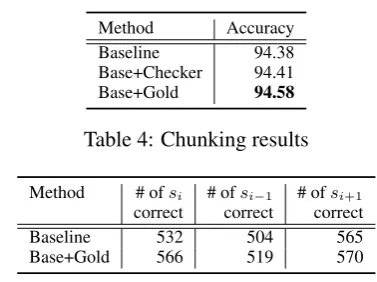
Method Accuracy
Baseline 94.38
[image:4.595.318.507.57.198.2]Base+Checker 94.41 Base+Gold 94.58
Table 4: Chunking results
Method # ofsi # ofsi−1 # ofsi+1
correct correct correct
Baseline 532 504 565
Base+Gold 566 519 570
Table 5: Results of chunking involving misspelled words, as well as corresponding preceding and succeeding words.
affix features (e.g., whiting), 17 errors due to dif-ferent words (e.g., thought→though), 10 errors in
which the POS was predicted based on the pres-ence of uppercase characters (e.g., Exsample), and three errors caused by romanized Japanese words. Effect of spelling correction by spell checker We analyzed spelling errors where POS-tagging failed in the system with affix information but the system with the spell checker succeeded. The number of spelling errors that were correctly as-signed to POSs with the spell checker was 74, whereas the number of spelling errors incorrectly assigned a POS was 49. The system with the spell checker correctly assigned a POS to the following:
(2) a. pepole/Noun, singular→people/Noun, plural
b. tow/Noun, singularapples→two/Numeralapples
These examples show cases in which spelling er-rors were corrected by the spell checker. As men-tioned priviously, these spelling errors are exam-ples of words in which POS-tagging failed due to unknown words. Examples in which POS-tagging with the spell checker failed involved the spell checker changing misspelled words to different but incorrect words (e.g.,tero→to(correct is
ter-rorist),tittle→little(correct istitle)).
5 Chunking Experiments
system with spell checking (Base+Checker), and (3) a baseline chunking system with no spelling errors, i.e., spelling errors were corrected manu-ally (Base+Gold). We used POSs that were auto-matically assigned by the POS-tagger4to train our
chunking model.
The experimental results on chunking are sum-marized in Table 4. As can be seen by compar-ing Baseline to Base+Checker, there was only a 0.03% difference, which has no statistical signifi-cance; thus, the spell checker had nearly no prac-tical effect. Comparing Baseline to Base+Gold, there was a difference of 0.2% which is statisti-cally significant even though it is only a small dif-ference. Thus, we conclude here that an ideal spell checker has a positive effect on chunking. How-ever, since chunking uses POSs identified by the POS-tagger as its features, it was assumed that POS-tagging errors would directly affect chunk-ing. Table5shows the number of correctly identi-fied chunks for misspelled and surrounding words. As with POS-tagging, the number of correctly identified chunks for misspelled words increased, whereas there was nearly no difference in the num-ber of correctly identified chunks for surrounding words.
6 Conclusions
In this paper, we have investigated the perfor-mance of POS-tagging and chunking in learner English. The primary cause of failures in POS-tagging and chunking is well known to be un-known words; thus, we focused our investigation on spelling errors, which are the primary sources of unknown words. Furthermore, we have demon-strated the performance of chunking in learner En-glish for, to the best of our knowledge, the first time. From our experiments, we conclude that POS-tagging performance dropped 0.23% due to spelling errors. Furthermore a spell checker is not necessary for POS-tagging, and it is sufficient to assign POS-tags using affix information.
References
Jan Aarts and Sylviane Granger. 1998. Tag sequences in learner corpora: a key to interlanguage gram-mar and discourse. In Sylviane Granger, editor,
Learner English on Computer, pages 132–141. Ad-dison Wesley Longman: London and New York.
4The POS-tagger was trained with all features.
Yevgeni Berzak, Jessica Kenney, Carolyn Spadine, Jing Xian Wang, Lucia Lam, Keiko Sophie Mori, Sebastian Garza, and Boris Katz. 2016. Universal Dependencies for Learner English. InProceedings of ACL, pages 737–746.
Michael Flor, Yoko Futagi, Melissa Lopez, and Matthew Mulholland. 2013. Patterns of mis-spellings in L2 and L1 English: a view from the ETS Spelling Corpus. Inthe Second Learner Corpus Re-search Conference.
Na-Rae Han, Martin Chodorow, and Claudia Leacock. 2006. Detecting Errors in English Article Usage by Non-Native Speakers. Natural Language Engineer-ing, 12(2):115–129.
John D. Lafferty, Andrew McCallum, and Fernando C. N. Pereira. 2001. Conditional Random Fields: Probabilistic Models for Segmenting and Labeling Sequence Data. In Proceedings of ICML, pages 282–289.
Christopher Manning. 2011. Part-of-Speech Tagging from 97% to 100%: Is It Time for Some Linguistics? InProceedings of CICLing, pages 171–189. Ryo Nagata and Edward Whittaker. 2013.
Reconstruct-ing an Indo-European Family Tree from Non-native English Texts. InProceedings of ACL, pages 1137– 1147.
Ryo Nagata, Edward Whittaker, and Vera Shein-man. 2011. Creating a Manually Error-tagged and shallow-parsed corpus. In Proceedings of ACL-HLT, pages 1210–1219.
Hwee Tou Ng, Siew Mei Wu, Ted Briscoe, Christian Hadiwinoto, Raymond Hendy Susanto, and Christo-pher Bryant. 2014. The CoNLL-2014 Shared Task on Grammatical Error Correction. InProceedings of CoNLL Shared Task, pages 1–14.
Adwait Ratnaparkhi. 1996. A Maximum Entropy Model for Part-Of-Speech Tagging. InProceedings of EMNLP, pages 133–142.
Keisuke Sakaguchi, Tomoya Mizumoto, Mamoru Ko-machi, and Yuji Matsumoto. 2012. Joint English Spelling Error Correction and POS Tagging for Lan-guage Learners Writing. In Proceedings of COL-ING, pages 2357–2374.
Fei Sha and Fernando Pereira. 2003. Shallow Parsing with Conditional Random Fields. InProceedings of HLT-NAACL, pages 134–141.