Original Article
Bauduanjin exercise restores T
cell function in man with heroin addicts
by decreasing CD4
+CD25
+Foxp3 regulatory T cells
Yan Wang1, Changle Chen2, Jie Li2
1School of Medical Instrument and Food Engineering, University of Shanghai for Science and Technology, Shanghai 200093, P. R. China; 2Shanghai Qigong Institute, Shanghai 200030, P. R. China
Received November 19, 2015; Accepted August 25, 2016; Epub October 15, 2016; Published October 30, 2016
Abstract: There is an increasing body of evidence that heroin addiction is associated with severe alterations in immune function, which might contribute to an increased risk to infectious diseases like hepatitis B and C or HIV. However, the impact of Baduanjin exercise on T cell function in heroin user is not well understood. Therefore, we analyzed the frequency of immune-suppressive CD4+CD25+FoxP3 regulatory T cells (Tregs) isolated from peripheral
blood of heroin users before (n=30) and after (n=30) practicing Baduanjin exercise. Interestingly, we detected a
significant decrease in the percentage of Tregs in PBMC of heroin addicted patients after practicing Baduanjin ex -ercise for 3 months. The proliferative response of PBMCs decreased in heroin users, but elevated after practicing
Baduanjin exercisers, whose mechanism might be related to the cytokine of TGF-β. These results suggest that the
impaired immune responses observed in heroin users can be restored by Baduanjin exercise through decreasing
Tregs or suppressing cytokine TGF-β.
Keywords: Qigong, baduanjin, immunity, addiction
Introduction
Heroin users have a high risk of developing infectious diseases such as HIV and hepatitis viruses [1] due to weak immunity function [2]. In the peripheral blood of heroin addicted patients the impaired lymphocyte proliferation and reduced natural killer (NK) cell activity were observed. The fragile immunity function will continue for a long time until drug addicts are under compulsory addiction treatment. The patients under compulsory addiction treatment are easily to resume heroines because of their weak will power and bad body conditions, which is also partly due to low immune function.
Therefore finding an easy method to enhance
the immune function is essential to reduce the high drug withdrawal rate for heroin users. Baduanjin is derived from traditional Qigong and is created by State Sports General Administration in China in 2003. It has been proved that Baduanjin can improve body health. An Bingchen found that practicing Baduanjin is a helpful exercise for knee osteoarthritis [3].
Wang searched 13 databases for the role of qigong exercise on immunity and infections and found favorable results [4]. Byeongsang [5] found qigong could improve quality of life, mood
and fatigue parameters, reducing inflamma -tion, and improving immunity in cancer patients. Moreover, Qigong may be an alternative treat-ment for heroin users without side effects. Li and colleagues have analyzed the
effective-ness of qigong therapy on detoxification of her -oin addicts [6]. They found reduction of with-drawal symptoms in the qigong group occurred more rapidly than in the other groups. All the data suggested that qigong can reduce with-drawal symptoms and enhance heroin users’ immunity. Baduanjin may enhance the immune function in heroin users, but further experi-ments should be conducted to prove the hypothesis.
Baduanjin can enhance immune response in heroin users
by limiting autoimmune processes and inflam
-matory responses [8], and also the criminal for
immune deficient disease such as cancer [9].
However, until now the mechanisms underlying the immune effect of qigong on heroin remains unclear. Therefore Tregs were examined before and after practicing Baduanjin in heroin users in our study.
Thus, the aim of the present study was to ana-lyze the effect of Baduanjinon heroin addiction. We determined the amount of Tregs in the peripheral blood of heroin users in comparison to healthy controls and patients before and after practicing Baduanjinqigong exercise for three months and investigated which effect these CD25high Tregs have on the functional phenotype of CD4+ T cells.
Materials and methods
Patients
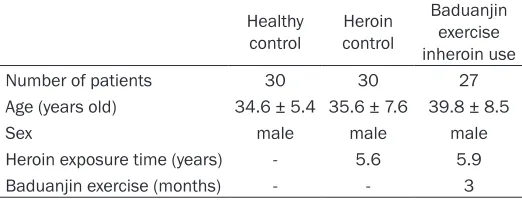
30 heroin users (all males) in control group, 30 heroin patients (all males) in Baduanjin exer-cise group, and 27 healthy donors(all males)
without active infections or inflammatory dis -eases participated in this study after giving
informed consent. There is no significant differ -ent between the age, sex, and heroin exposure time (as shown in Table 1). As for normal con-trol, 27 healthy men were recruited. Heroin users were recruited at The Coercive Reha-
bilitation Center for Addicts Affiliated to The
Public Security Bureau of Shanghai City for
detoxification treatment. All patients have been
routinely evaluated using a self-report ques-tionnaire concerning addiction history. The study was approved by the local institutional review board.
Baduanjin qigong training program
The Baduanjin exercise objects at first learned
Baduanjin for 2 weeks, and the performance
Cell extraction
Peripheral blood mononuclear cells (PBMCs) were isolated from 15 ml heparin-treated blood of heroin user, objects in heroin control, exercise group and healthy control by den- sity gradient centrifugation using Ficoll-Paque Plus (Pharmacia Biotech, Piscataway, NJ, USA). Isolated cells were counted and 3×10⁶ cells
were immediately analyzed by flow cytometry.
Residual cells were cryopreserved in medium containing 10% fetal calf serum (FCS; PAA Laboratories, Austria) and 10% dimethyl sulf- oxide (DMSO). CD4+ and CD4+CD25- T cells were isolated from thawed PBMCs using the CD4+ T cell isolation kit II (Miltenyi Biotech, Germany) followed by negative selection on an AutoMACS separation system (Miltenyi Biotech, Germany) according to the manufac-turer’s recommendation. For CD4+CD25- T cell preparation the same protocol was used exc- ept of adding 4 µl biotinylated CD25 anti-body (Miltenyi Biotech, Germany) per 1×10⁷ cells to the cell/antibody cocktail mixture.
Purity of cells was determined by flow cytome
-try. We observed no significant differences in
the purity of MACS separated cells used for analysis of proliferative activity.
Flow cytometry
PBMCs were stained with
fluorochrome-labe-led anti-CD4 and anti-CD25 (both from Mil-tenyiBiotec, Germany). Intracellular staining was performed with the Foxp3 staining kit from eBioscience (NatuTec, Frankfurt, Germ- any) according to the manufacturer’s recom-mendations. FACS analyses were performed with a FACSCalibur (BD Biosciences, Heidel-berg, Germany) and FlowJo software (Tree Star, OR).
Lymphoproliferation
[image:2.612.90.351.87.187.2]Microcultures of fresh PBMC were set up in triplicate for each sample (106 cells/ml) in
Table 1. Characteristics of the study participants
Healthy
control Heroin control
Baduanjin exercise inheroin use Number of patients 30 30 27 Age (years old) 34.6 ± 5.4 35.6 ± 7.6 39.8 ± 8.5
Sex male male male
Heroin exposure time (years) - 5.6 5.9 Baduanjin exercise (months) - - 3
of each object was corrected by the instructor. After that, the objects started to join a 12-week Baduanjin qigong training program, in which they practiced Baduanjin with the
instructor for five times per week
Amersham, UK) was added to all cultures. Eighteen hours later, cells were harvested by an automated cell harvester (Skatron) and RPMI 1640, 10% FCS with or without PHA (1
[image:3.612.92.517.71.602.2]µg/ml). After 48 h incubation at 37°C, 1.0 µCi of 3H thymidine (specific activity 2 Ci/mmol,
Figure 1. Decreased frequency of CD4+CD25+FoxP3+ regulatory T cells in peripheral blood of Baduanjin exercise in
heroin patients. PBMCs were isolated from heparinized blood samples and the absolute numbers of PBMCs isolated from 20 ml blood of healthy group (black circles, n=27), heroin group (white circles, n=30) and Baduanjin group (gray circles, n=30) was determined by cell counting (A). The percentages of CD4+CD25high Foxp3+ T cells (B) were
analyzed by flow cytometry (control, n=27; heroin user, n=30, Baduanjin exercisers, n=30). The gating strategy for
Baduanjin can enhance immune response in heroin users
radioactivity was measured in a liquid scint- illation counter (Packard, Downers Grove, IL, USA).
ELESA
PBMCs were treated as stated previously, and culture supernatants were collected from the top chamber of plates at 48 h after cultivation.
The levels of TGF-β1 in culture supernatants were then assessed by ELISA. The TGF-β1
OptEIA ELISA set (PharMingen) was used to
determine TGF-β1 concentrations after DAMGO
or LPS stimulation of PBMCs. The absorbance of each well was measured by using an ELISA microplate reader at 490 nm. All the proce-dures were performed according to manufac-turer’s instruction.
Statistical analysis
Two-way-ANOVA was used for determination
of statistical significance between
experi-mental groups. Results were expressed as mean ± SEM. P-values <0.05 were considered
statistically significant. *P<0.05, **P<0.01, ***P<0.001.
Results
Decrease of CD4+CD25+FoxP3+ regulatory T
cells in peripheral blood of heroin users in Baduanjin group
To analyze possible effects of practicing Bad- uanjin exercise on the Treg cells in heroin users,
It was described that heroin abuse influences T
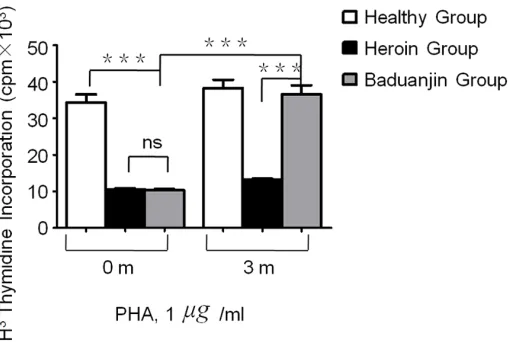
lymphocyte proliferation, we want to know whether qigong exercise can restore the T cell proliferation ability. Therefore, we isolated the T lymphocytes from the Baduanjin exercise group, control group, and normal healthy con-trol. The T cells were stimulated with PHA at 1
μg/ml for 2 days. As control, isolated T cells
from the same patient were left un-stimulated. As shown in Figure 2, T cells from Baduanjin
exercises group showed significantly higher
proliferative responses upon stimulation in vitro than T cells from heroin controls (P≤0.0001) and were comparable to T cells
from normal healthy control.
Depletion of CD4+CD25+ T cells from T cells of
heroin user restores their proliferative capabil-ity
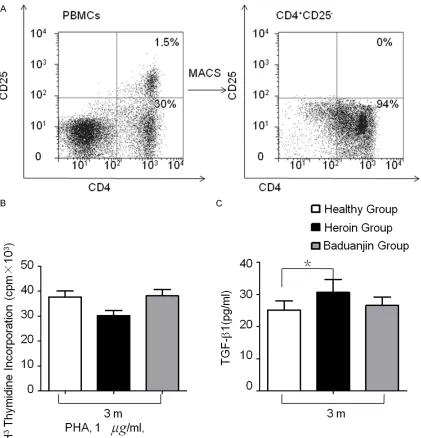
Next, we asked whether the reduced prolifera-tive activity of T cells was directly linked to the increased percentage of immune-suppressive Tregs. For this purpose, we depleted CD4+CD25+ T cells by using MACS technology with a mean purity of about 85% (Figure 3A), stimulated them in vitro or left them un-stimulated as con-trol and analyzed their proliferative activity and
TGF-β1 secretion. As shown in Figure 3,
[image:4.612.100.356.72.243.2]CD4+CD25- T cells from healthy controls and Baduanjin exercisers exhibited elevated pro- liferative activity upon stimulation in vitro (Figure 3B). Strikingly, depletion of CD25high cells from T cells of heroin controls resulted in Figure 2. Increased proliferative activity of T cells from Baduanjin
ex-ercise in heroin patients. Proliferation was measured in PHA (1 μg/ml)
stimulated PBMC cultures obtained from healthy control (black circles, n=27), heroin user (white circles, n=30) and Baduanjin exercisers (gray circles, n=30) treated subjects. Values are means ± SEM. *P<0.01.
we included 27 healthy control, 30 heroin patients in Baduanjin group, 30 patients in heroin control with similar age and gender (Table 1) in
our study. We observed no signifi -cant differences in the number of PBMCs isolated from peripheral blood between the three different groups analyzed (Figure 1A). Inte- restingly, the percentage of CD4+ CD25+FoxP3+ T cells was increased in heroin control. However in Bad- uanjin group CD4+CD25+FoxP3+ T
cells were significantly decreased
compared to heroin control (P≤
0.0001), but still higher than hea- lthy control (Figure 1B, P≤0.0001).
a significant increase in proliferative activity
compared to whole T cells from heroin controls (Figures 2 and 3B), and nearly equal to that of the proliferative activity of healthy control and Baduanjin exercisers (Figure 3B). These results
suggest that heroin abuse results in limited T cell function at least in part via expansion of Tregs. And Baduanjin exerciser can partly restore the T cell function. Moreover, we det-
ected a slightly but not significantly
increa-Figure 3. Similar proliferative activity of CD25high depleted CD4+ T cells from healthy controls, heroin control and
Baduanjin exerciser heroins. Five representative patients from each group were selected and their PBMCs were stained with anti-CD4 and anti-CD25 (A, left panel, representative for one experiment). CD4+CD25- T cells were
isolated from these PBMCs of healthy controls, heroin control and Baduanjin exerciser heroins by MACS technology. After separation cells were stained with anti-CD4 and anti-CD25 to verify depletion of CD25high cells (A, right panel,
representative for one experiment). Percentages refer to gated lymphocytes. 6×10⁵ isolated CD4+CD25- T cells from
healthy controls (black bars, n=5), heroin user (white bars, n=5) and Baduanjin exerciser heroins (gray bars, n=5)
were stimulated with 1 μg/ml PHA for 2 days to determine proliferative activity (B) and analysis of TGF-β secretion
[image:5.612.98.519.73.511.2]Baduanjin can enhance immune response in heroin users
sed TGF-β secretion of in vitro stimulated
CD4+CD25+ depleted T cells from heroin user than of healthy controls or Baduanjin exerciser patients (Figure 3C).
Discussion
Previous studies have suggested that heroin addiction has multiple immune-suppressive effects including reduced proliferative respons-es of lymphocytrespons-es from the peripheral blood (Govitrapong et al, 1998), which might con- tribute to the increased risk for developing infectious diseases among heroin user. Mor- eover, several researchers have found that qigong could enhance immune functions. Many researchers [11, 12] proved that qigong could improve immunity and body health. Several systemic studies were launched for the role of qigong in improving immunity. Byeongsang [5] found qigong could improve quality of life, mood and fatigue parameters,
and reduce inflammation and improve
imm-unity in cancer patients. As a complementary and alternative modality of traditional Chinese medicine, qigong is often used in cancer patients to manage their symptom [12]. Wang searched 13 databases for the role of qigong exercise on immunity and infections and fou- nd positive results [4]. To verify the mecha- nism of qigong enhancing immune functions, Li ZQ and his group found that qigong prac- tice may regulate immunity, metabolic rate, and cell death, possibly at the transcriptional level [13]. Interestingly, qigong may have thera-peutic effect on heroin addicts [6]. Li M found that qigong may be an effective alternative
for heroin detoxification without side effects,
but the mechanism remains unknown. The- refore we hypothesis that qigong may enhance immune functions in heroin users.
Baduanjin exercise is smooth and relaxing qigong which is adaptable for each age, and Baduanjin exercise could also improve body health and immunity in different patients. Baduanjin exercise program can improve sleep quality for older adults [14]. Chen found Baduanjin exercise can promote and maintain the health status of middle-aged women by preventing their bone loss [10]. Mei found
Baduanjin exercise could significantly decrease
the levels of TC, TG, LDL-C levels in plasma and elevate plasma HDL-C level for the healthy peo-ple. In addition, Baduanjin exercise modulated the blood lipid metabolism for patients [15]. To access the feasibility and safety of Baduanjin in
treating knee osteoarthritis, 28 patients were examined and the results showed Baduanjin exercise provided a safe and feasible treatment option for patients with knee OA, as well as offered reductions in pain, stiffness, and dis-ability, which improved the patients’ quadr- iceps strength and aerobic ability [16]. Hsu evaluated the effects of Baduanjin exercise on oxidative stress, antioxidant status and quality of life in middle-aged women, and
found Baduanjin exercise has beneficial
effe-cts on improving quality of life, increasing antioxidant enzymes and reducing oxidative stress in middle-aged women [17]. Baduanjin exercise can improve immunity, but the under-lining mechanisms remains unknown and until now there is no study was investigated on hero-in addicts. In this study, Baduanjhero-in exercise was used to analyze the immune effect on heroin users. As was reported, practicing qigong can improve the number and function of T cells, but the mechanism remains unk- nown. We therefore hypothesis qigong also restore heroin addicts’ immune response. Although CD4+CD25+ regulatory T cells only comprise 5%-15% of CD4+ T cells, they inhibit both Th1 and Th2 response. And studies have reported that regulatory T cells play roles in cancer [18], immune deficiency disease,
im-mune tolerance [19, 20], etc. Moreover, rese- archers also focus on the relationship bet- ween CD4+CD25+ regulatory T cell and heroin addicts. Liu WT [21] found impaired cellular immune function was found in heroin depen-dent with increased CD4+CD25+FoxP3+ T cells and decreased CD4+ T cells. The stress with the short-term withdrawal may be the cause of the autoimmune disease found in heroin users [22, 23]. Therefore, we suggested that qigong could also restore heroin addicts’ immune response by decrease CD4+CD25+ regulatory T cells. To verify the hypothesis, 60 heroin addicts were recruited to analyze the relationship of CD4+CD25+ regulatory T cells and practicing Baduanjin exercise in heroin addicts.
cells was increased in short-term withdrawal group compared to healthy control. Practicing Baduanjin could normalize CD4+CD25+FoxP3+ Tregs in heroin addicts. We also found heroin could not change the whole number of PBMC but increase the proportion of Tregs (Figure 1A
and 1B). As was reported that impaired imm- une responses observed in heroin users were related to the expansion of Tregs [21].
Since Tregs can inhibit T cell response, lympho-cyte proliferation was analyzed in three groups, and we found the lymphocyte proliferation was
significantly decreased in heroin addicts. But
practicing Baduanjin exercise can restore the lymphocyte proliferation response to normal range (Figure 2). Therefore, Baduanjin exercise could restore the immune function by decreas-ing the number of Tregs. Moreover, to further corroborate the suppressive effect of Tregs on T cell response in heroin users, lymphocyte proliferation was also analyzed after depleting CD4+CD25+ T cells. Interestingly, after deplet-ing CD4+CD25+ T cells, lymphocyte prolifera- tion in heroin group increased to the level similar to that in Baduanjin exercisers and healthy controls. The impaired immune func-tion in heroin addicts was highly related to Tregs and we also found both the number and function of Tregs can be inhibited by practic- ing Baduanjin exercise. Thus, as an important complementary exercise, Badujian qigong can be used in heroin users without causing adverse side effects.
Interestingly, heroin addiction seems not only to modulate the frequency of peripheral Tregs, which might contribute to the immune-suppres-sive effect of heroin, but we also observed an intrinsic defect in CD4+CD25+ T cells. Depletion of CD25high Tregs from CD4+ T cells of heroin user not fully restores the proliferative activity to values observed in Baduanjin exer-cisers and healthy controls. It was reported that heroin could inhibit immune response either directly or indirectly. A direct effect of heroin on immunity has been shown by Tho- mas [24], who reported that murine spleno-cytes treated with heroin in vitro, which exhib-ited decreased IL-2 production, B cell prolif- eration and NK-cell cytolytic activity upon stimulation.
Nevertheless, we demonstrated here for the
first time that the frequencies of immune-sup
-pressive Tregs significantly decreased after
practicing Baduanjin exercise for 3 months in heroin users. CD4+CD25+ Tregs are well known key players in the maintenance of peripheral tolerance by controlling auto-reactive immune responses. However, an increase in Tregs’ num-ber and/or activity not only has unfavorable effects on tumor progression [25, 26] and the course of chronic infectious diseases [27], but also has effects on heroin addicts. It is also
shown that TGF-β1 level increased slightly
with the lower lymphocyte proliferation (Figure 3B and 3C). It was reported that TGF-β1 was
one important cytokine secreted by Tregs and has inhibitory results on T cells, B cells [28]. Our data suggested that practicing Badu- anjin exercise can normalize the increase of CD4+CD25+ Tregs in heroin addicts, which in turn might contribute to the complementary treatment of invading pathogens in heroin addicted patients.
Acknowledgements
This work was supported by the State Sport General Administration Jianshen Qigong Project Management Center (08010) and Shanghai Sports Project (10TF001).
Disclosure of conflict of interest None.
Address correspondence to: Changle Chen, Shang- hai Qigong Institute, Mailbox 213, 516 Jun Gong Road, Shanghai 200030, P. R. China. Tel: +86 13916543672; E-mail: Chenchangle2014@163. com
References
[1] Kaushik KS, Kapila K, Praharaj AK. Shooting up: the interface of microbial infections and drug abuse. J Med Microbiol 2011; 60: 408-422.
[2] Gordon RJ, Lowy FD. Current concepts - Bacte-rial infections in drug users. New Engl J Med 2005; 353: 1945-1954.
[3] An BC, Wang Y, Jiang X, Lu HS, Fang ZY, Wang Y, Dai KR. Effects of Baduanjin Exercise on Knee Osteoarthritis: A One-Year Study. Chin J Integr Med 2013; 19: 143-8.
[4] Wang CW, Ng SM, Ho RT, Ziea ET, Wong VC, Chan CL. The Effect of Qigong Exercise on Im-munity and Infections: A Systematic Review of Controlled Trials. Am J Chin Med 2012; 40: 1143-1156.
Baduanjin can enhance immune response in heroin users
Function, and Survival in Cancer Patients. In-tegr Cancer Ther 2012; 11: 101-110.
[6] Li M, Chen K, Mo Z. Use of Qigong Therapy in
The Detoxification of Heroin Addicts. Altern
Ther Health Med 2002; 8: 50-4, 56-9.
[7] Fontenot JD, Rasmussen JP, Williams LM, Dooley JL, Farr AG and Rudensky AY.
Regulato-ry T cell lineage specification by the forkhead
transcription factor FoxP3. Immunity 2005; 22: 329-341.
[8] Westendorf AM, Fleissner D, Deppenmeier S, Gruber AD, Bruder D, Hansen W, Liblau R and Buer J. Autoimmune-mediated intestinal
in-flammation-impact and regulation of antigen-specific CD8(+) T cells. Gastroenterology
2006; 131: 510-524.
[9] Yan W, Le Z and Lusheng S. The activation of CD4+CD25+ regulatory T cells is induced by
poorly-immunogenic tumor in vivo induction. Edited by 2006; 3: 123-129.
[10] Chen HH, Yeh ML and Lee FY. The effects of Baduanjin qigong in the prevention of bone loss for middle-aged women. Am J Chin Med 2006; 34: 741-747.
[11] Jahnke R, Larkey L, Rogers C, Etnier J and Lin
F. A comprehensive review of health benefits of
qigong and tai chi. Am J Health Promot 2010; 24: e1-e25.
[12] Chan CL, Wang C, Ho RT, Ho AH, Ziea ET, Taam Wong VC and Ng S. A Systematic Review of the Effectiveness of Qigong Exercise in Cardiac Re-habilitation. Am J Chin Med 2012; 40: 255-267.
[13] Li QZ, Li P, Garcia GE, Johnson RJ, Feng L.
Ge-nomic profiling of neutrophil transcripts in
Asian Qigong practitioners: a pilot study in gene regulation by mind-body interaction. J Al-tern Complement Med 2005; 11: 29-39. [14] Chen M, Liu H, Huang H and Chiou A. The
ef-fect of a simple traditional exercise programme (Baduanjin exercise) on sleep quality of older adults: A randomized controlled trial. Int Jf Nurs Stu 2012; 49: 265-273.
[15] Mei L, Chen Q, Ge L, Zheng G and Chen J. Sys-tematic review of chinese traditional exercise baduanjin modulating the blood lipid metabo-lism. Evid Based Complement Alternat Med 2012; 2012: 282131.
[16] An B, Dai K, Zhu Z, Wang Y, Hao Y, Tang T and Yan H. Baduanjin Alleviates the Symptoms of Knee Osteoarthritis. J Altern Complement Med 2008; 14: 167-174.
[17] Hsu MC, Wang TS, Liu YP and Liu CF. Effects of Baduanjin exercise on oxidative stress and an-tioxidant status and improving quality of life among middle-aged women. Am J Chin Med 2008; 36: 815-826.
[18] Kobayashi M, Kubo T, Komatsu K, Fujisaki A, Terauchi F, Natsui S, Nukui A, Kurokawa S and
Morita T. Changes in peripheral blood immune
cells: their prognostic significance in metastat -ic renal cell carcinoma patients treated with molecular targeted therapy. Med Oncol 2013; 30.
[19] Ngalamika O, Zhang Y, Yin H, Zhao M, Gersh-win ME and Lu Q. Epigenetics, autoimmunity and hematologic malignancies: A comprehen-sive review. J Autoimmun 2012; 39: 451-465. [20] Berthelot JM, Jamin C, Amrouche K, Le Goff B,
Maugars Y and Youinou P. Regulatory B cells play a key role in immune system balance. Joint Bone Spine 2013; 80: 18-22.
[21] Hui-Ting L, Wang J, Zhou Y and Zhang W. Analy-sis of T cell subsets and NK cells in peripheral blood of heroin addicts. Chin J Cell Mol Immu-nol 2010; 188-189.
[22] Du W, Shen Y, Lee W, Wang D, Paz S, Kandeel F and Liu C. Foxp3+ Treg Expanded from Pa-tients with Established Diabetes Reduce He-lios Expression while Retaining Normal Func-tion Compared to Healthy Individuals. PLoS One 2013; 8: e56209.
[23] Zhang Q, Cui F, Fang L, Hong J, Zheng B and
Zhang JZ. TNF-β impairs differentiation and function of TGF-β-induced Treg cells in autoim -mune diseases through Akt and Smad3 signal-ing pathway. J Mol Cell Biol 2013; 5: 85-98. [24] Thomas PT, House RV and Bhargava HN. Direct
cellular immunomodulation produced by diacetylmorphine(heroin) or morphine. Gener-al Pharmacology 1995; 26: 123-130.
[25] Kim M, Grimmig T, Grimm M, Lazariotou M, Meier E, Rosenwald A, Tsaur I, Blaheta R, Hee-mann U, Germer C, Waaga-Gasser AM and Gasser M. Expression of Foxp3 in Colorectal Cancer but Not in Treg Cells correlates with Disease Progression in Patients with Colorec-tal Cancer. PLoS One 2013; 8: 1932-6203. [26] Conrad C, Gregorio J, Wang Y, Ito T, Meller S,
Hanabuchi S, Anderson S, Atkinson N, Ramirez PT, Liu Y, Freedman R and Gilliet M. Plasmacy-toid Dendritic Cells Promote Immunosuppres-sion in Ovarian Cancer via ICOS Costimulation of Foxp3(+) T-Regulatory Cells. Cancer Res 2012; 72: 5240-5249.
[27] Masood KI, Rottenberg ME, Salahuddin N, Ir-fan M, Rao N, Carow B, Islam M, Hussain R and Hasan Z. Expression of M. tuberculosis-in-duced suppressor of cytokine signaling (SOCS) 1, SOCS3, FoxP3 and secretion of IL-6 associ-ates with differing clinical severity of tuberculo-sis. BMC Infect Dis 2013; 13: 13.
[28] Han Y, Yang Y, Chen Z, Jiang Z, Gu Y, Liu Y, Xu S, Lin C, Pan Z, Zhou W and Cao X. Human
hepa-tocellular carcinoma-infiltrating CD4CD69