Building a Better Bitext for Structurally Different Languages
Through Self-training
Jungyeul Park∗ Lo¨ıc Dugast† Jeen-Pyo Hong‡ Chang-Uk Shin§ Jeong-Won Cha§ ∗Department of Linguistics. University of Arizona. Tucson, AZ 85721
†Academy of African Language and Science, University of South Africa, South Africa ‡NAVER Corporation, Republic of Korea
§Department of Computer Engineering, Changwon National University. Republic of Korea http://air.changwon.ac.kr
Abstract
We propose a novel method to bootstrap the construction of parallel corpora for new pairs of structurally different lan-guages. We do so by combining the use of a pivot language and self-training. A pivot language enables the use of existing trans-lation models to bootstrap the alignment and a self-training procedure enables to achieve better alignment, both at the docu-ment and sentence level. We also propose several evaluation methods for the result-ing alignment.
1 Introduction
A parallel corpus is a pair of texts written in different languages which are translation of each other. Since multilingual publication has become more widespread, there is an increasing amount of such parallel data available. Those are valuable resources for linguistic research and natural lan-guage processing applications, such as machine translation. It is also valuable when building cross-lingual information retrieval software. Finding the corresponding documents between two languages is a required step to build a parallel corpus, be-fore more fine-grained alignments (paragraphs and sentences) can be calculated. In some scenarios, multilingual data with identical or considerably similar texts can be found with more than two lan-guages involved. We ask whether a language can help as a pivot when aligning corpora and whether ∗ Most work has been done when J. Park was at the University of Arizona and L. Dugast was at the University of South Africa. Current J. Park’s affiliation is CONJECTO, Rennes, France and L. Dugast’s affiliation is TextMaster, Paris, France.
self-training may bring additional improvement of the alignment quality. We see further that both questions can be answered positively.
We propose a novel method to efficiently build better parallel corpora through the combination of pivot language and self-training. This method is especially targeted at aligning structurally differ-ent languages. We presdiffer-ent a topic-based documdiffer-ent alignment algorithm and a length and lexicon-based sentence alignment algorithm. Instead of directly aligning languages with widely different structures and even different writing systems, we make use of a pivot language and translate the other language into this pivot language before per-forming alignment. Translation can be done with a statistical translation model if previous exist-ing parallel data exist. In our case, we perform a joint alignment and training of a translation model for the Korean-English language pair. We use En-glish as a pivot language. Therefore, Korean sen-tences are translated into English before getting aligned. That is, we align English and English-translated Korean instead of directly aligning En-glish and Korean. In the end, alignments are re-stored in the original languages to build a parallel corpus. We also employ a self-trained translation model in which the statistical translation model is reinforced by the newly aligned data.
The contribution of this work is mainly as fol-lows: (1) We use a pivot language to align two languages with different writing systems. (2) We propose a self-training method to be able to pro-duce better parallel corpora. (3) We describe the basic preprocessing scheme for Korean to be able to improve the statistical machine translation re-sults. (4) We also propose several experiments for aligned parallel corpora by providing a standard
evaluation data set for Korean. We hope that the present work will pave the way for further devel-opment of machine translation for Korean.
2 Case Study for Crawling Parallel Documents from the Web
When we try to build a good parallel corpus by crawling bilingual (or multilingual) documents from the Web, we may encounter unexpected dif-ficulties. In this section, we show a case study to point out these difficulties in building a paral-lel corpus for Korean using bilingual documents crawled from the Web. We obtain the bilingual data from the KOREANAwebsite, a quarterly
jour-nal published on-line.1 It offers information on
Korean culture, originally written in Korean, along with their translations into several languages. For our small experiments in this case study, we work on web pages written in Korean and their transla-tions into English. We first align documents then sentences. We crawl and prepare 348 Korean and 381 English documents of the time-span (2005-2014). Sentences in (1-4) extracted from a docu-ment of the KOREANAsite, show the example
re-sults of alignment by our proposed method (align-ment through translation and self-training) as de-scribed in§3.
After aligning documents and sentences, results on Korean-English machine translation do not im-prove when using the newly produced aligned cor-pus. Actually, even though they present relatively
good quality of document and sentence align-ments, we notice that all English sentences do not exactly correspond to Korean sentences, but are rather loose translation of them or even involve substantial rewriting. Mismatches of the words in the aligned sentences are represented in gray. We also estimate their correctness of translation by a ratio which we simply calculate based on the num-ber of correctly translated words into English and the number of correctly translated words from Ko-rean as follows:
Correctness of translation
= # of correctly translated wordsTotal # of words (1)
where # are the number of words in Korean and English. Such mismatches in the aligned corpus will generate in bad quality of the translation model. We estimate that over half of English sen-tences are not exactly translated from Korean.
1http://www.koreana.or.kr
description notation
KOcorpus Ck
ENtranslated KOcorpus Cki0
ENcorpus Ce
Bilingual KO-EN BCiKOEN
KOENMT system MT(PiBCKiOEN)
Table 1: Notations for the Bilingual Setting
Therefore, even though we can align correctly such a corpus at the sentence level, we may not obtain good quality of the translation model. Ac-tually, many sites which provide bilingual (or mul-tilingual) language services, especially translated from Korean into other language, show similar characteristics. We consider that they are rather comparable corpora and it would be difficult to expect good quality of sentence-aligned data from these sites. Working on comparable corpora is be-yond the scope of this paper.
3 Proposed Method
Notations for this self-training setting are de-scribed in Table1.
3.1 Document alignment
For the document alignment task, we make the hy-pothesis that some topics are similar or even iden-tical between the original and its translations. We can therefore make use of a topic model to find the similarity between two documents. Probabilistic topic models enable to discover the thematic struc-ture of a large collection of documents. It provides a latent topic representation of the corpus. Latent Dirichlet Allocation (LDA) is one of the most used type of topic models (Blei et al.,2003). In LDA, a document may be viewed as a mixture of topics and represented as a vector. This enables the com-parison of document topics in a vector space.
The cosine similarity measure is applied to two latent vectors of documents in different languages. Letsimilarity(dL1, dL2)the cosine similarity
be-tween two documents in two different languages
L1 andL2. This cosine similarity is calculated as
follows:
similarity(dL1, dL2) =
VdL1 ·VdL2
kVdL1kkVdL2k (2)
(1) a. 그러나경복궁에는조선창업의뜻이담겨있으며, 500여년동안조선을상징하는장소로인식되었다. b. Still, Gyeongbokgung does embody the spirit of the Joseonfoundersand for some 500 years has stood as an
enduring symbol of the Joseon dynasty. (97.01%)
(2) a. 그러한경복궁에일본식민지통치를위한중추기관인조선총독부신청사를건설한것은지독히도폭력적인 방법이었다.
b. Since Korea’s liberation in 1945, there had been calls for the removal ofthe government general’s building, which served as a painful reminder of Japan’s colonial rule. (64.47%)
(3) a. 1990년대조선총독부건물을헐어내고 경복궁을복원하기시작한것은사실매우논란의여지가있는작업이다. b. Butupon the demolition of this building in the early 1990s, which enabled the Gyeongbokgung restoration project
to get underway,even this was not free of its own controversy.(63.51%)
(4) a. 그러나이러한기억투쟁이식민지시기를떨쳐내고자하는사회적요구에의한것이라는점도부인할수는
없다.
b. In any case,no one can dispute the value of restoring Gyeongbokgung to its former glory and magnificence. (18.75%)
byMT0
byMT1
[image:3.595.85.323.68.416.2](a) English (b) Translated Korean Figure 1: Examples of topic models in English and translated English from Korean
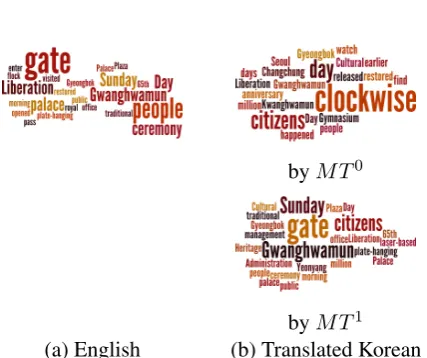
using all words in the document, we build these vectors from the topic models described above. Given a document in Korean and English, we translate them into English using the trained sta-tistical translation models. We know that origi-nal Korean and English topic models do not di-rectly share their elements in a vector space. How-ever, translated Korean and English data byMT0
show increasingly similar topic models and they become visibly related to each other. This situation improved further after self-training byMT1 (See
Figure1). Measuring such similarity is hardly pos-sible without using a pivot language or translated resources (Wu and Wang,2007,2009).2
3.2 Sentence alignment
Sentence alignment has been well-studied in the early 1990s (Brown et al.,1991;Chen,1993;Gale and Church, 1993; Kay and Roscheisen, 1993). However, development of machine translation
re-2SeeZhang et al.(2017), as an exception.
search demands increasing volumes of parallel data. This situation has led to the reinvestigation of sentence alignment such as in Moore (2002) and Varga et al. (2005) during the last decade. Actually, many sentence alignment methods were designed for related languages. The length-based alignment method inGale and Church(1993) was originally intended for the related languages of English, French and German. The method ofKay and Roscheisen(1993) which uses a partial align-ment of lexical items (cognates) to perform sen-tence alignment is also meant to be used for lan-guages close to each other in the phylogenetic sense.
But directly aligning fairly dissimilar languages with different writing systems still remains a chal-lenging task. For example, this could explain why the size of the Greek-English parallel corpus is one of the smallest corpora for the same time-span (1996-2011) in the Europarl Parallel Corpus, since the Greek language does not share the writ-ing system of the other languages in the European Union. To explore the alignment of languages us-ing different writus-ing systems, Wu (1994) applies the method of Gale and Church (1993) to a par-allel corpus between Cantonese and English from the Hong Kong Hansard using lexical cues, and Haruno and Yamazaki (1996) which is a variant ofKay and Roscheisen(1993) uses statistical and dictionary information for a parallel corpus be-tween Japanese and English.
[image:3.595.77.291.234.413.2]of the source text using an existing bilingual dic-tionary. It seems natural that a translation model should be of precious help to align languages with different writing systems.
In this paper, we extend the length-based Gale and Church sentence alignment algorithm. The proposed algorithm is detailed in Hong (2013). LetD(i, j)be the minimum distance. This is com-puted by minimizing operations as defined inGale and Church(1993). We use the distance function
dwith six argumentss1, t1,s2,t2, s3, t3 instead
of first four arguments. This is to extend to group-ing up to three sentences, instead of two. Seman-tics of calculating d(·) is described in Figure 2. For example,d(s1, t1;s2, t2;s3, t3)designates the
cost of mergings1,s2,s3and matching witht1,t2, t3.λ1 = 0.04, λ2 = 0.21, λ3 = 0.75are
empiri-cally estimated from the existing English-Korean parallel corpus, wherePiλi= 1.
3.3 Self-training method
We use a translation model learned from a previ-ous alignment to produce an improved alignment at both document and sentence levels. This kind of practice is often called self-training (McClosky et al., 2006), self-taught learning (Raina et al., 2007), and lightly-supervised training (Schwenk, 2008). We assume that the initial, baseline transla-tion models are trained with “out-domain” corpus, while the self-trained models are trained with “in-domain” corpus. Self-training therefore performs domain-adaptation that is beneficial to the quality of the final alignments.
At first, we translate Korean (Ck into English (C0
k0) using the machine translation (MT) system trained with the pre-existing Korean-English bilin-gual corpus, as noted byMT(BC0
KOEN). We then
align documents and sentences to produce the par-allel text for translated Korean and English. By restoring the original Korean sentences from trans-lated Korean (C0
k0) we build a new parallel corpus (BC1
KOEN). From here, we can train a new MT
sys-tem by adding the newly aligned bilingual corpus (MT(BC0
KOEN+BCK1OEN)) and re-translate
Ko-rean into English to build a self-trainedBC2
KOEN.
This procedure can be summarized as follows:
1. Build a translation model using the existing parallel corpusMT(BC0
KOEN).
2. Translate Korean Ck into EnglishCk00 using
MT(BC0
KOEN).
3. AlignC0
k0 andCe.
4. RestoreC0
k0 to Korean and create a new par-allel corpusBC1
KOEN.
5. Build a new translation model by adding the newly aligned parallel cor-pusMT(BC0
KOEN+BCK1OEN).
6. Repeat from (2) to (4) to create a self-trained parallel corpusBC2
KOEN.
Through self-training, we can improve the translation quality forCi
k0 and finally obtain bet-ter alignment results. Therefore, Ci
k0 (translation by MT(PiBCi
KOEN)) andBCiK+1OEN are the
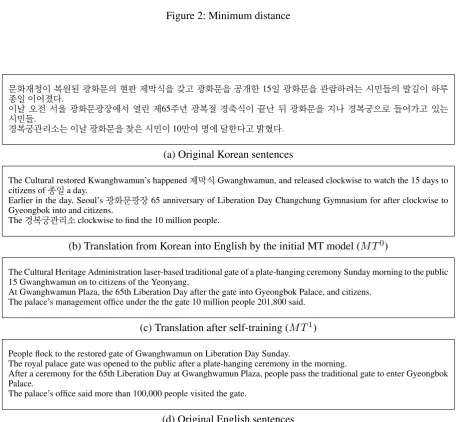
cor-pora produced during self-training wherei= 0,1. Figure 3 shows examples of English-Korean self-training. It shows their intermediate trans-lation for original Korean sentences by the ini-tial translation model and self-trained translation model. It is clear that the self-trained transla-tion model is reinforced by the previously aligned corpus in which it provides more context-proper translation.
4 Experiments and Results
In this section, we detail our experiments and present our alignment results obtained through machine translation and self-training3.
4.1 Data and systems
We experiment on a corpus extracted through web crawling. The corpus consists of news-wire arti-cles from theDong-a Ilbowebsite (literally ‘East Asia Daily’). We obtained articles published dur-ing 2010 and 2011. It amounts to 3,249 documents for both Korean and English, containing 47,069 and 46,998 sentences respectively.
D(i, j) = min
D(i, j−1) +d(0, tj; 0,0; 0,0)
D(i−1, j) +d(si,0; 0,0; 0,0)
D(i−1, j−1) +d(si, tj; 0,0; 0,0)
D(i−1, j−2) +d(si, tj; 0, tj−1; 0,0) D(i−2, j−1) +d(si, tj;sj−1,0; 0,0) D(i−2, j−2) +d(si, tj;sj−1, tj−1; 0,0) D(i−1, j−3) +d(si, tj; 0, tj−1; 0, tj−2) D(i−3, j−1) +d(si, tj;sj−1,0;sj−2,0) D(i−2, j−3) +d(si, tj;sj−1, tj−1; 0, tj−2) D(i−3, j−2) +d(si, tj;sj−1, tj−1;sj−2,0) D(i−3, j−3) +d(si, tj;sj−1, tj−1;sj−2, tj−2)
[image:5.595.94.389.82.263.2]d(s1, t1;s2, t2;s3, t3) =λ1log2P rob(δ|match) +λ2+λ3cosine(s1+s2+s3, t1+t2+t3)
Figure 2: Minimum distance
문화재청이복원된광화문의현판제막식을갖고광화문을공개한15일광화문을관람하려는시민들의발길이하루 종일 이어졌다.
이날오전서울광화문광장에서열린제65주년광복절경축식이끝난뒤광화문을지나경복궁으로들어가고있는 시민들.
경복궁관리소는이날광화문을찾은시민이10만여명에달한다고밝혔다.
(a) Original Korean sentences
The Cultural restored Kwanghwamun’s happened제막식Gwanghwamun, and released clockwise to watch the 15 days to citizens of종일a day.
Earlier in the day, Seoul’s광화문광장65 anniversary of Liberation Day Changchung Gymnasium for after clockwise to Gyeongbok into and citizens.
The경복궁관리소clockwise to find the 10 million people.
(b) Translation from Korean into English by the initial MT model (MT0)
The Cultural Heritage Administration laser-based traditional gate of a plate-hanging ceremony Sunday morning to the public 15 Gwanghwamun on to citizens of the Yeonyang.
At Gwanghwamun Plaza, the 65th Liberation Day after the gate into Gyeongbok Palace, and citizens. The palace’s management office under the the gate 10 million people 201,800 said.
(c) Translation after self-training (MT1)
People flock to the restored gate of Gwanghwamun on Liberation Day Sunday.
The royal palace gate was opened to the public after a plate-hanging ceremony in the morning.
After a ceremony for the 65th Liberation Day at Gwanghwamun Plaza, people pass the traditional gate to enter Gyeongbok Palace.
The palace’s office said more than 100,000 people visited the gate.
(d) Original English sentences
[image:5.595.70.533.288.710.2]the proposed regular expression followed by man-ual detection of text bodies performs better than that the use of specific web page cleaning tools. This is especially true for web pages of Dong-a Ilbo, which require only one iteration of man-ual tagging, we can easily detect body parts which have the same structures for all documents. How-ever, our method can be generalized by using such tools in future research.
After extracting text parts, sentence boundaries are detected using the ESPRESSO4POS tagger for
Korean andSPLITTAdescribed inGillick(2009)5
for English. We use these sentence segmented doc-uments for document and sentence alignments. Then, we tokenize sentences using different meth-ods depending on the language. As described be-fore, we use the POS tagging system to tokenize Korean sentences and during the sentence seg-mentation task, tokenization is also performed. We use MOSES’s tokenization script for English
sen-tences. We also change the case of letters based on true case models for English.
For document alignment, we use LDA imple-mented in MALLET6to extract topic models. We
convert the topics of each document into a sin-gle vector. We measure cosine similarity between two documents in different languages. Since we are working on English and English-translated Ko-rean, we don’t need polylingual topic models. For sentence alignment, we use a sentence alignment tool based on Hong (2013), which extends the algorithm of Gale and Church (1993). This sen-tence aligner enables the alignment of translated sentences and to restoration of original sentences based on sentence positions.
For Korean-English translation, we build the initial phrase-based statistical machine translation system using Korean parallel data that we pre-viously collected from several bilingual Korean newswire sites. We do so with the Moses (Koehn et al.,2007) toolkit.7For alignment, we limit
sen-tence length to 80 and use GIZA++ (Och and Ney, 2003). We use the SRILM (Stolcke,2002) toolkit with Chen and Goodman’s modified Kneser-Ney
4https://doi.org/10.5281/zenodo.884606 5https://code.google.com/p/splitta 6http://mallet.cs.umass.edu
7While we tested with a neural MT (NMT) system (Klein
et al.,2017), the proposed method by SMT outperformed re-sults from state-of-the-art NMT, most likely because of the small size of parallel data. We leave for future work the com-parison of performance/results between statistical and neural systems with a bigger English-Korean bitext.
Korean MT0 MT1
[image:6.595.326.506.62.130.2]precision - 0.9701 0.9987 recall - 0.9408 0.9981 F1 - 0.9552 0.9984
Table 2: Results on document alignment
discounting for 5-grams for language model esti-mation. We also use grow-diag-final-and
andmsd-bidirectional-fe heuristics.8
Fi-nally, we use minimum error rate training (MERT) (Och,2003) to tune the weights of the log-linear model.
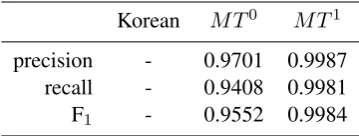
4.2 Results on document alignment
For the evaluation of document alignment, we use the name of documents as gold standard. Since the name of documents are identical for the Korean-English paired documents, for exam-ple 20101003K for Korean and 20101003E, we use this information as gold reference. Results on document alignment presented in this section are purely based on our proposed method that makes use of a topic model without referring to the name of documents. We evaluate our proposed methods using standard precision and recall as follows:
Precision
= # of produced alignment by threshold# of correctly paired documents
Recall
= # of correctly paired documents# of total paired documents
(3)
We report F1 score based on precision and
re-call (2P R
P+R). Table 2 shows results on document alignment. We denote MT0 for MT(BC0
KOEN)
andMT1 forMT(BC0
KOEN+BCK1OEN)for
con-venience’ sake. We introduce a thresholdθ≥0.5 of similarity for document alignment. Empirically we found that the recall drops if the threshold is set too high. For example, obtaining a precision of 1 comes with a drop in recall of 25% fromθ≥0.7 to≥0.8. By using the proposed method, we obtain up to 99.84% F1 score.
4.3 Results on sentence alignment
To evaluate sentence alignment, we manually align sentences to build a gold standard. We se-8http://www.statmt.org/moses/?n=Moses.
Korean MT0 MT1
[image:7.595.82.283.62.115.2]sent 37,333 39,209 38,802 tok 1,193,514 1,193,509 1,193,507
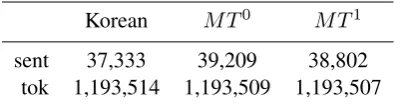
Table 3: Size of sentence alignment: (sent) for the number of sentences and (tok) for tokens in the English-side corpus.
Korean MT0 MT1
P 0.4943 0.5547 0.5575 R 0.5385 0.5874 0.5927 F1 0.5154 0.5705 0.5746
Table 4: Results on sentence alignment
lect documents over a period of two months (doc-uments from March and April 2010). It contains over 1,500 sentences for each language from 122 documents. We evaluate our proposed methods us-ing precision and recall as before:
P = # of produced bids# of correct bids ,R= # of correct bids# of total bids
(4) Table 3shows the size and results on sentence alignment. We report overall precision, recall and F1 scores. We provide results on sentence
ment without translation in which sentence align-ment is based on sentence length only (Korean).
MT0 is for alignment by translation and MT1
is for alignment by self-training. Table 5 present results for each bid by MT1 and their
occur-rences in the evaluation data. Bids represent Ko-rean:English. We found that many Korean sen-tences are not translated into English and the pro-posed sentence alignment method can correctly detect them. Some errors occur in 1:1 bids because the alignment method have a tendency to merge adjacent sentences, it can show better results in higher bids such asn:mwheren, m >1.
Finally, we perform an extrinsic evaluation of alignment quality by evaluating a machine transla-tion system. We train with the newly aligned cor-pus and evaluate the translation model using the JHE evaluation data (Junior High English evalua-tion data for Korean-English machine translaevalua-tion)9
and the Korean-English News parallel corpus10.
9https://doi.org/10.5281/zenodo.891295 10https://github.com/jungyeul/
korean-parallel-corpora
The direction of translation is Korean into English. Table6shows results using the translation quality metric BLEU (Papineni et al.,2002)11.
5 Discussion on the Proposed Method
In this section, we first discuss the generalization of our proposed method, so that it does not get lim-ited to the current bilingual setting. In the multilin-gual setting, we assume that we aim at aligning the source language and any other target language. We assume that there is a pivot language. Notations for this trilingual setting are described in Table7. We use some analogy that we described for the bilin-gual setting in Table1, such asCk for the source language corpus (e.gKorean),Cefor the pivot lan-guage (English), and in additionCf for the target language corpus (say, French).
Let k and f be Korean and French, respec-tively. English is a pivot language. We can use the result from the bilingual setting for the Ko-rean to English translation to translate KoKo-rean into English. Then, we translate French into English using a MT system trained with a pre-existing French-English bilingual corpus. Finally, we align documents and sentences using English translated Korean-French documents to produce the paral-lel corpus by restoring the original Korean and French sentences. In the trilingual setting, we can also align French and English to improve the trans-lation quality from French into English by provid-ing a self-trained aligned corpus as we perform for Korean-English alignment. This procedure can be summarized as follows:
1. Create a self-trained parallel corpus BCn
KE
using the bilingual setting and build a trans-lation modelMTn
KE.
2. Translate Korean Ck into English Ck0 using
MTn
KE.
3. Build a translation model using the existing parallel corpusMT(BC0
FE).
4. Translate French Cf into English Ck00 using
MT(BC0 FE).
5. AlignCk0 andCf00.
6. RestoreCk0and andCf00to Korean and create a new parallel corpusBC1
KF.
11ftp://jaguar.ncsl.nist.gov/mt/
[image:7.595.104.258.181.250.2]0:1 1:0 1:1 1:2 1:3 2:1 2:2 2:3 3:1 3:2 3:3 F1 1.0 1.0 0.3552 0.7350 0.625 0.4761 0.8333 0.5 0.6667 1.0 1.0
occurrences 2 36 822 117 8 42 18 2 3 2 2
Table 5: Final results on sentence alignment for each bid for MT1
Ko MT0 MT1
w/o (BC0
KOEN) 4.10 4.39 4.55 JHE
with (BC0
KOEN) 7.47 8.03 8.33 JHE
with (BC0
KOEN) 9.17 9.35 9.38 News
Table 6: Results on sentence alignment by BLEU scores. Ko is for results of the baseline system where the corpus is aligned with the pivot lan-guage. We also perform the translation with and without the initial bilingual corpus BC0.
7. AlignCf0 andCe.
8. RestoreC0
f0 to French and create a new par-allel corpusBC1
FE.
9. Build a new translation model by adding the newly aligned parallel corpusMT(BC0
FE + BC1
FE).
10. Repeat from (3) to (9) to create a self-trained parallel corpusBCi
KF.
Through self-training, we can improve the trans-lation quality for Cf0 by using the self-trained French-English parallel corpusBCFE. Finally, we
obtain better alignment results between Korean and French thanks to the better translation Cf0. Practically, it would be difficult to apply the pro-posed generalized method to real data because of the lack of proper multilingual data for Ko-rean. We are aware that there are some multilin-gual data for Korean such as technical documents and movie/tv-show subtitles (Some of them are al-ready available at OPUS).12According to our
pre-vious experience, these types of corpora are rela-tively easy to align because they may contain lex-ical cues (technlex-ical terms) or time stamps (subti-tles).
6 Conclusion and Future Perspectives
We explored the possibility of using a pivot lan-guage for the purpose of aligning two dissimilar
12http://opus.lingfil.uu.se
languages. Results show that alignment as eval-uated directly by document and sentence align-ments or indirectly by translation quality (BLEU), is improved as compared with directly aligning those two languages. Applying the generalized method for other language pairs such as Greek-English in the Europarl parallel corpus, in which multilingual parallel data are available and Greek does not share the same writing system with other European languages, can be considered as future work. In addition to using the pivot language, we also built a better parallel corpus using self-trained translation models. For immediate future work, we continue to identify suitable bilingual/multilingual web sites to collect more parallel data for Korean.
Acknowledgments
The authors would like to thank the anonymous reviewers for their valuable comments and ef-fort to improve the manuscript. J. Park and L. Dugast would like to thank Kyung Min Shin for the KOREANA bilingual data. This research was
supported by Basic Science Research Program through the National Research Foundation of Ko-rea (NRF) funded by the Ministry of Education (2017R1D1A1B03033534) for C.-U. Shin and J.-W. Cha.
References
David M. Blei, Andrew Y. Ng, and Michael I. Jordan. 2003. Latent Dirichlet Allocation. Journal of Ma-chine Learning Research3(4-5):993–1022.
Peter F. Brown, Jennifer C. Lai, and Robert L. Mer-cer. 1991. Aligning Sentences in Parallel Cor-pora. In Proceedings of the 29th Annual Meet-ing of the Association for Computational Lin-guistics. Association for Computational Linguis-tics, Berkeley, California, USA, pages 169–176. https://doi.org/10.3115/981344.981366.
Description Notation
Source language corpus Ck
Pivot language translated source language corpus Ci
k0, where0≤i < n
Target language corpus Cf
Pivot language translated target language corpus Ci
f0, where0≤i < n
Pivot language corpus Ce
Bilingual Source-Pivot corpus BCi
KE, where0≤i≤n
Bilingual Target-Pivot corpus BCi
FE, where0≤i≤n
Bilingual Source-Target corpus BCi
KF, where0< i≤n
Source-Pivot MT system MT(PiBCi
KE)
Target-Pivot MT system MT(PiBCi
FE)
Table 7: Notations for the Multilingual Setting
William A. Gale and Kenneth W. Church. 1993. A Pro-gram for Aligning Sentences in Bilingual Corpora. Computational Linguistics19(1):75–102.
Dan Gillick. 2009. Sentence Boundary Detection and the Problem with the U.S. In Proceedings of Hu-man Language Technologies: The 2009 Annual Con-ference of the North American Chapter of the As-sociation for Computational Linguistics, Compan-ion Volume: Short Papers. AssociatCompan-ion for Compu-tational Linguistics, Boulder, Colorado, pages 241– 244. http://www.aclweb.org/anthology/N/N09/N09-2061.
Masahiko Haruno and Takefumi Yamazaki. 1996. High-Performance Bilingual Text Alignment Using Statistical and Dictionary Information. In Proceedings of the 34th Annual Meeting of the Association for Computational Linguis-tics. Association for Computational Linguistics, Santa Cruz, California, USA, pages 131–138. https://doi.org/10.3115/981863.981881.
Jeen-Pyo Hong. 2013. Multilingual sentence align-ment using translation models. Ph.D. thesis, Chang-won National University.
Martin Kay and Martin Roscheisen. 1993. Text-Translation Alignment. Computational Linguistics 19(1):121–142.
Guillaume Klein, Yoon Kim, Yuntian Deng, Jean Senellart, and Alexander Rush. 2017. Open-NMT: Open-Source Toolkit for Neural Machine Translation. In Proceedings of ACL 2017, Sys-tem Demonstrations. Association for Computa-tional Linguistics, Vancouver, Canada, pages 67–72. http://aclweb.org/anthology/P17-4012.
Philipp Koehn, Hieu Hoang, Alexandra Birch, Chris Callison-Burch, Marcello Federico, Nicola Bertoldi, Brooke Cowan, Wade Shen, Christine Moran, Richard Zens, Chris Dyer, Ondrej Bojar, Alexan-dra Constantin, and Evan Herbst. 2007. Moses:
Open Source Toolkit for Statistical Machine Trans-lation. In Proceedings of the 45th Annual Meet-ing of the Association for Computational LMeet-inguistics Companion Volume Proceedings of the Demo and Poster Sessions. Association for Computational Lin-guistics, Prague, Czech Republic, pages 177–180. http://www.aclweb.org/anthology/P07-2045.
David McClosky, Eugene Charniak, and Mark John-son. 2006. Reranking and Self-Training for Parser Adaptation. In Proceedings of the 21st Interna-tional Conference on ComputaInterna-tional Linguistics and 44th Annual Meeting of the Association for Com-putational Linguistics. Association for Computa-tional Linguistics, Sydney, Australia, pages 337– 344. https://doi.org/10.3115/1220175.1220218.
Robert C. Moore. 2002. Fast and Accurate Sentence Alignment of Bilingual Corpora. In Stephen D. Richardson, editor, Proceedings of the 5th Confer-ence of the Association for Machine Translation in the Americas on Machine Translation: From Re-search to Real Users. Springer-Verlag, Tiburon, CA, USA, pages 135–244.
Franz Josef Och. 2003. Minimum Error Rate Training in Statistical Machine Translation. InProceedings of the 41st Annual Meeting of the Association for Computational Linguistics. Association for Compu-tational Linguistics, Sapporo, Japan, pages 160–167. https://doi.org/10.3115/1075096.1075117.
Franz Josef Och and Hermann Ney. 2003. A System-atic Comparison of Various Statistical Alignment Models.Computational Linguistics29(1):19–51.
Rajat Raina, Alexis Battle, Honglak Lee, Ben-jamin Packer, and Andrew Y Ng. 2007. Self-taught Learning: Transfer Learning from Unla-beled Data. In Proceedings of the 24th Inter-national Conference on Machine Learning. ACM, New York, NY, USA, ICML ’07, pages 759–766. https://doi.org/10.1145/1273496.1273592.
Holger Schwenk. 2008. Investigations on Large-Scale Lightly-Supervised Training for Statistical Machine Translation. In Proceedings of the International Workshop on Spoken Language Translation. Hawaii, USA, pages 182–189.
Andreas Stolcke. 2002. SRILM - An Extensible Lan-guage Modeling Toolkit. InProceedings of the 7th International Conference on Spoken Language Pro-cessing, ICSLP2002 - INTERSPEECH 2002. Den-ver, Colorado, pages 901–904.
D´aniel Varga, L´azl´o N´emeth, P´eter Hal´acsy, Andr´as Kornai, Viktor Tr´on, and Viktor Nagy. 2005. Par-allel corpora for medium density languages. In Pro-ceedings of the RANLP (Recent Advances in Natural Language Processing). Borovets, Bulgaria, pages 590–596.
Dekai Wu. 1994. Aligning a Parallel English-Chinese Corpus Statistically with Lexical Crite-ria. In Proceedings of the 32nd Annual Meet-ing of the Association for Computational Lin-guistics. Association for Computational Linguis-tics, Las Cruces, New Mexico, USA, pages 80–87. https://doi.org/10.3115/981732.981744.
Hua Wu and Haifeng Wang. 2007. Pivot Lan-guage Approach for Phrase-Based Statistical Ma-chine Translation. In Proceedings of the 45th Annual Meeting of the Association of Computa-tional Linguistics. Association for ComputaComputa-tional Linguistics, Prague, Czech Republic, pages 856– 863. http://www.aclweb.org/anthology/P07-1108. Hua Wu and Haifeng Wang. 2009. Revisiting Pivot
Language Approach for Machine Translation. In Proceedings of the Joint Conference of the 47th Annual Meeting of the ACL and the 4th Interna-tional Joint Conference on Natural Language Pro-cessing of the AFNLP. Association for Computa-tional Linguistics, Suntec, Singapore, pages 154– 162. http://www.aclweb.org/anthology/P/P09/P09-1018.