Case Report
CD20-negative diffuse large B-cell lymphoma
presenting with anuria: a case report
Lei Jiang1,2*, Qingsheng Li2*, Jing Bao2, Hailong Xia2, Xiaowen Chen2, Liyu Cao3, Zipeng Li4, Mingzhen Yang2,
Ruixiang Xia2
1Department of Hematology, The Fourth Affiliated Hospital of Anhui Medical University, Hefei, China; Departments
of 2Hematology, 3Pathology, 4Radiology, The First Affiliated Hospital of Anhui Medical University, Hefei, China. *Equal contributors.
Received November 23, 2015; Accepted February 10, 2016;Epub April 15, 2016; Published April 30, 2016
Abstract: CD20-negative diffuse large B-cell lymphoma (DLBCL) is a rare novel subtype of non-Hodgkin lymphoma. Herein, we report a case of CD20-negative DLBCL in a 54-year-old male who had suffered with anuria for 5 days. Positron emission tomography/computed tomography (PET/CT) revealed lymphadenopathy, and biopsy of the right inguinal lymph node was performed. Lymph node sections revealed a 2 × 2 × 2-cm solid mass histopathologically suggestive of DLBCL. Immunohistochemical (IHC) analysis revealed the patient’s lymphoid cells were CD10(+), CD21(+), CD79a(+), CD99(+), LCA(+), Myc(+), P53(+), PAX5(+), ALK(-), BCL-2(-), BCL-6(-), CD3(-), CD20(-), Mum-1(-), and TDT(-). Approximately 90% of his tested lymphoid cells reacted positively to Ki-67 antibody. A diagnosis of CD20-negative DLBCL (not otherwise specified) was made, and the patient was treated with seven courses of CHOP (cyclophosphamide, doxorubicin, vincristine, and dexamethasone) and one course of EPOCH (etoposide, cy-clophosphamide, doxorubicin, vincristine, and prednisolone) chemotherapy. However, the treatment outcome was unsuccessful. To the best of our knowledge, this is the first reported case of CD20-negative DLBCL-induced acute renal failure presenting as anuria. Formulation of an optimized therapeutic strategy for this rare and aggressive disorder is urgently required.
Keywords: CD20-negative diffuse large B-cell lymphoma, acute renal failure, anuria
Introduction
Diffuse large B-cell lymphomas (DLBCLs) are a heterogeneous group of malignant disorders that present as large transformed lymphoid B cells and account for approximately 30-35% of non-Hodgkin lymphoma cases. According to the World Health Organization (WHO) classifica-tion, DLBCLs include many distinct disease entities [1]. DLBCLs generally express B-cell lin-eage antigens, such as CD20, CD79a, and PAX5. Rituximab, a chimeric anti-CD20 mono-clonal antibody, has been used to treat DLBCLs with variable outcomes [2]. However, very few DLBCL patients do not express CD20 antigen, classified as CD20-negative DLBCL. This is a rare and heterogeneous group of lymphoprolif-erative disorders including plasmablastic lym-phoma (PBL), primary effusion lymlym-phoma (PEL), anaplastic lymphoma kinase (ALK)-positive DLBCL, and large B-cell lymphoma arising in
human herpesvirus-8 (HHV-8)-associated mul-ticentric Castleman disease (MCD) [3]. CD20-negative DLBCL has an aggressive clinical course with primary chemoresistance and poor prognosis. Due to lack of CD20 expression, rituximab therapy is not beneficial in these rare and aggressive disorders.
Patients with CD20-negative DLBCL typically present with rapidly enlarging nodal or extrano-dal masses with or without B symptoms (fever, night sweats, or weight loss). Enlarged lymph nodes may occur in any part of the body, caus-ing diverse clinical manifestations such as lac-tic acidosis [4], nasal obstruction [5], melena, loss of appetite [6], abdominal distension, and vomiting [7]. The multiple enlarged lymph nodes with strong 18F-fluoro-2-deoxy-D-glucose (FDG)
CD20-negative DLBCL presenting as anuria. To the best of our knowledge, this is the first reported case of CD20-negative DLBCL-induced acute renal failure presenting as anuria.
Case presentation
A 54-year-old male was referred to our hospital with a chief complaint of anuria, from which he had been suffering for 5 days. He was in other-wise good health with no antecedent trauma. The history of the present illness revealed he experienced nonspecific diffuse abdominal dis-comfort and reduced urine output, followed by anuria. On the fifth day, he was referred to the department of urology. He had no B symptoms (fever, night sweats, or weight loss). Physical examination revealed double kidney percus-sion pain, no ureteral tenderness, and no pros-tate gland enlargement. There were several palpable superficial lymph nodes, but no hepa-tosplenomegaly or any other mass. Laboratory tests revealed mild anemia. His serum bio-chemistry results were within normal ranges with the following exceptions: serum lactate dehydrogenase (LDH), 813 (109-245) U/L; serum creatinine (CRE), 1227.9 (53.0-106.0) mmol/L; and blood urea nitrogen (BUN), 28.2 (3.2-7.1) mmol/L. All other examinations were either within normal limits or no significant abnormality, including a negative result for human immunodeficiency virus (HIV) antibody detection. Ultrasound examination revealed bilateral hydronephrosis and diffused bladder-wall thickening. Computed tomography (CT) results were suggestive of colon cancer with metastatic carcinoma of multiple lymph nodes in peritoneum and pelvic cavity, and bilateral
hydronephrosis. The patient underwent hemo-dialysis treatment and ureteroscopy, which failed to locate the ureteral orifice. 18
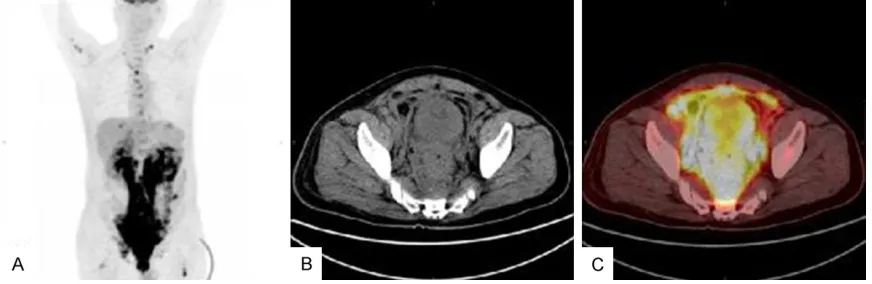
F-fluoro-2-deoxy-D-glucose-positron emission tomogra-phy/computed tomography (FDG-PET/CT) exami- nation was performed. As shown in Figure 1, PET/CT revealed multiple lymphoid swelling and strong FDG accumulation, which was con-sidered indicative of lymphoma. Biopsy of the right inguinal lymph node (2 × 2 × 2 cm) was performed, and the histopathology results indi-cated DLBCL. Subsequently, the patient was transferred to the hematology department for further treatment.
Bone marrow puncture and biopsy were per-formed; however, bone marrow cytology and pathology showed no evidence of lymphoma. Immunophenotype analysis was performed by multiparametric flow cytometry (FCM) on the patient’s biopsied bone marrow cells. As shown in Figure 2, his bone marrow cells were CD10(+), CD19(+), CD22(+), CD20(-), and immature B lymphocytes (3%) were obtained from the bone marrow aspirate.
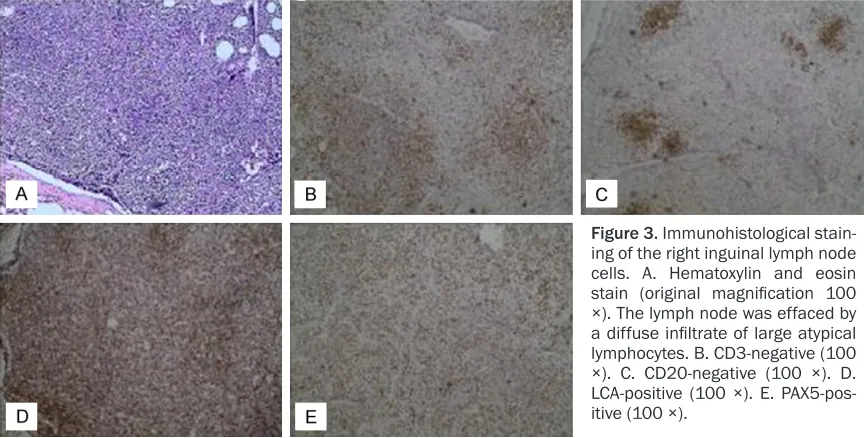
Immmunohistochemical (IHC) analysis revealed his lymphoid cells were CD10(+), CD21(+), CD79a(+), CD99(+), LCA(+), Myc(+), P53(+), PAX5(+), ALK(-), BCL-2(-), BCL-6(-), CD3(-), CD20(-), Mum-1(-CD20(-), TDT(-CD20(-), and approximately 90% of his tested lymphoid cells reacted positively to Ki-67 antibody (Figure 3).
The patient was diagnosed with CD20-negative DLBCL-NOS (not otherwise specified), Ann Arbor stage IV, group A, and international
[image:2.612.89.525.72.214.2]nostic index (IPI) intermediate-risk. He was treated with seven courses of CHOP (cyclo-phosphamide, doxorubicin, vincristine, and dexamethasone) and one course of EPOCH (etoposide, cyclophosphamide, doxorubicin, vincristine, and prednisolone) chemotherapy. His symptoms decreased after the first course, but relapsed after six cycles of chemotherapy.
Discussion
CD20-negative DLBCL is a novel rare subtype of non-Hodgkin B-cell lymphoma that exhibits a more aggressive clinical course with resistance to chemotherapy and worse prognosis com-pared with typical DLBCL. Due to lack of CD20 expression, rituximab is seldom used in the treatment of these cases, which are
character-ized by primary chemoresistance and early relapse [3]. Taken together, the outcomes of patients with CD20-negative DLBCL are poor, with the median survival time ranging between several months and a few years. In the present study, we report a case of CD20-negative DLBCL that was treated with seven cycles of CHOP and one cycle of ECHOP chemotherapy over 9 months. His symptoms decreased after the first course, but relapsed after six cycles of treatment. A new strategy is needed to cure these rare and aggressive disorders.
[image:3.612.94.524.73.215.2]Many factors and mechanisms contribute to the occurrence of CD20-negative DLBCL. These include environmental agents, genetic muta-tions, chromosomal translocamuta-tions, and patient immunological abnormalities. Deregulation of
Figure 2. Flow cytometry (immunophenotype) analysis of bone marrow cells. The cells were positive for CD10, CD19 and CD22 and negative for CD20 expression.
[image:3.612.90.522.265.484.2]BCL-6 gene expression may be specific to DLBCL [8]. An early study illustrated that plas-mablastic lymphomas of the oral cavity are associated with HIV infection [9]. However, recent cases have emerged in HIV-negative patients involving other sites, such as the nasal cavity [10], liver [11], small intestine [12], and central nervous system [13]. In this case, the patient had no HIV infection, tobacco or alcohol abuse, or toxic or other known exposure. In- creasing age and decreasing immunity may be considered risk factors in this case.
Patients with DLBCL typically present with rap-idly enlarging nodal or extranodal masses with unusual symptoms and presentations. A recent study reported a rare case of CD20-negative DLBCL presenting with lactic acidosis [4]. An early study reported a case of CD20-positive DLBCL presenting as acute renal failure, for which anti-CD20 targeted therapy could be beneficial [14]. In the present case, nodal and extranodal masses induced urinary tract obs- truction and acute renal failure. The patient’s prognosis was poor due to lack of CD20 expression.
PET/CT plays a vital role in the diagnosis of DLBCL [15]. In the present case, the CT results suggested colon cancer with metastatic carci-noma, and surgery was considered. PET/CT revealed multiple swollen lymph nodes with strong FDG accumulation, indicative of lympho-ma. Histopathology, the diagnostic golden stan-dard for neoplasms, confirmed the diagnosis. IHC examination revealed the subtype was CD20-negative DLBCL, thus providing evidence required for treatment.
CD20-negative DLBCL is a rare and aggressive lymphoproliferative disorder that represents a therapeutic challenge. As CD20 expression is negative, rituximab plus combination chemo-therapy is not efficacious. To date, many treat-ment strategies for CD20-negative DLBCL have been proposed in case reports and small retro-spective case series. However, no proretro-spective trials have been conducted to establish treat-ment standards for these patients. Standard treatment strategies for DLBCL, such as CHOP and EPOCH, have been used for the treatment of CD20-negative DLBCL. However, outcomes may vary depending on individual patient char-acteristics, cancer subtype, and Ann Arbor stage. A recent study reported a patient who
responded to EPOCH regimen therapy with par-tial regression of the disease [7]. The present case was Ann Arbor stage IV, which may have contributed to the poor outcome. Thus, it is cru-cial to diagnose DLBCL early and start treat-ment immediately.
In the present study, we report a very rare case of CD20-negative DLBCL-induced acute renal failure presenting as anuria. Given the poor prognosis of these lymphomas and the lack of therapeutic efficacy of anti-CD20 therapy, addi-tional cases should be collected, as formula-tion of an optimized therapeutic strategy is urgently required.
Acknowledgements
This work was supported by Natural Science Foundation of Anhui Province (1308085MH157 to R. Xia).
Disclosure of conflict of interest
None.
Address correspondence to: Dr. Ruixiang Xia, De- partment of Hematology, The First Affiliated Hospital of Anhui Medical University, No. 218, Jixi Road, Shushan District, Hefei 230022, Anhui, People’s Republic of China. Tel: +86-551-6292-2041; Fax +86-551-6292-3655; E-mail: [email protected]
References
[1] Xie Y, Pittaluga S and Jaffe ES. The histological classification of diffuse large B-cell lympho-mas. Semin Hematol 2015; 52: 57-66.
[2] Pfreundschuh M, Kuhnt E, Trumper L, Osterborg A, Trneny M, Shepherd L, Gill DS, Walewski J, Pettengell R, Jaeger U, Zinzani PL, Shpilberg O, Kvaloy S, de Nully Brown P, Stahel R, Milpied N, Lopez-Guillermo A, Poeschel V, Grass S, Loeffler M, Murawski N; MabThera International Trial (MinT) Group. CHOP-like chemotherapy with or without rituximab in young patients with good-prognosis diffuse large-B-cell lymphoma: 6-year results of an open-label randomised study of the MabThera International Trial (MInT) Group. Lancet Oncol 2011; 12: 1013-1022.
[4] Garg M, Lee BE, McGarry K, Mangray S and Castillo JJ. CD20-negative diffuse large B-cell lymphoma presenting with lactic acidosis. Am J Hematol 2015; 90: E49-50.
[5] Beltran B, Castillo J, Salas R, Quinones P, Morales D, Hurtado F, Riva L and Winer E. ALK-positive diffuse large B-cell lymphoma: report of four cases and review of the literature. J Hematol Oncol 2009; 2: 11.
[6] Hashimoto M, Inaguma S, Kasai K, Kuwabara K, Noda N, Hayakawa M, Fujino M, Ito M and Ikeda H. Plasmablastic lymphoma of the stom-ach in an HIV-negative patient. Pathol Int 2012; 62: 763-770.
[7] Xing X, Lin D, Ran W and Liu H. ALK-positive diffuse large B-cell lymphoma of the duode-num: A case report and review of the litera-ture. Exp Ther Med 2014; 8: 409-412. [8] Ye BH, Lista F, Lo Coco F, Knowles DM, Offit K,
Chaganti RS and Dalla-Favera R. Alterations of a zinc finger-encoding gene, BCL-6, in diffuse large-cell lymphoma. Science 1993; 262: 747-750.
[9] Delecluse HJ, Anagnostopoulos I, Dallenbach F, Hummel M, Marafioti T, Schneider U, Huhn D, Schmidt-Westhausen A, Reichart PA, Gross U and Stein H. Plasmablastic lymphomas of the oral cavity: a new entity associated with the human immunodeficiency virus infection. Blood 1997; 89: 1413-1420.
[10] Nguyen DD, Loo BW Jr, Tillman G, Natkunam Y, Cao TM, Vaughan W, Dorfman RF, Goffinet DR, Jacobs CD and Advani RH. Plasmablastic lym-phoma presenting in a human immunodefi-ciency virus-negative patient: a case report. Ann Hematol 2003; 82: 521-525.
[11] Tani J, Miyoshi H, Nomura T, Yoneyama H, Kobara H, Mori H, Morishita A, Himoto T and Masaki T. A case of plasmablastic lymphoma of the liver without human immunodeficiency virus infection. World J Gastroenterol 2013; 19: 6299-6303.
[12] Koike M, Masuda A, Ichikawa K, Shigemitu A and Komatus N. Plasmablastic lasmablastic lymphoma of the duodenal and jejunum. Int J Clin Exp Pathol 2014; 7: 4479-4483.
[13] Zhang LY, Lin HY, Gao LX, Li L, Tian YW, Liu ZQ, Shi XH and Liang ZY. Primary central nervous system plasmablastic lymphoma presenting in human immunodeficiency virus-negative but Epstein-Barr virus-positive patient: a case re-port. Diagn Pathol 2012; 7: 51.
[14] Monfared A, Orangpoor RO, Fakheri TF and Falahatkar S. Acute renal failure and bilateral kidney infiltration as the first presentation of non-Hodgkin lymphoma. Iran J Kidney Dis 2009; 3: 50-53.